June 28th, 2026
Ahrefs vs Moz vs Semrush: Which SEO Tool Suite Wins for AI Content Teams?
 WD
WDWarren Day
You know you need AI to scale your content operation, but which tool do you actually build your workflow around? The $30/month starter plan? The $200/month professional suite? The all-in-one that promises to do everything?
Be honest with yourself: you're not just picking a subscription. You're picking a second job.
If you're a founder or lean marketer trying to drive organic growth, you've hit a familiar wall. You can't afford a full-time SEO specialist, but your manual process of keyword research, brief writing, content generation, and publishing isn't going to scale either.
You've probably used Ahrefs, Moz, or Semrush before. You appreciate the data depth. But you're still left with a spreadsheet of keywords, a list of content gaps, and the same daunting question: who's going to write and publish all this?
That's why the classic ahrefs vs moz vs semrush debate has fundamentally changed. It's not about whose database is bigger or whose backlink index is fresher anymore. It's about which platform actually gets you from an idea to a published, ranking article with the least friction and the least manual glue work.
The winner isn't the tool with the most features. It's the one that removes the most steps.
As an engineer who's built content systems for large media companies and now runs an SEO automation platform, I've seen this from both sides. The big three suites are powerful, but they're built for analysis, not execution. They give you a diagnosis. They don't write the prescription, and they definitely don't fill it.
That gap between insight and action is the single biggest bottleneck for lean teams.
So in this comparison, I'm introducing a fourth contender: Spectre. It's the platform we built specifically for founders and small marketing teams who need to scale content production, not just analyze it. While Ahrefs, Moz, and Semrush have bolted on AI features, Spectre was designed from the ground up as an automated pipeline that takes a keyword and delivers a published, optimized article to your CMS.
The core question here: which tool actually delivers the fastest ROI when your goal is to grow organic traffic, not just study it?
The thesis is simple. For the job of scaling AI-powered content production, the "best" tool is the one that minimizes operational overhead. The one that eliminates manual handoffs between research, writing, optimization, and publishing. With the AI-based SEO Tools Market projected to grow to $12.5 billion by 2035 [Source: wiseguyreports.com], getting this architectural choice right matters more than ever.
Most comparisons miss four things. First, the true cost of ownership for an AI content team, which goes well beyond the monthly subscription and includes the hidden tax of manual integration work. Second, the operational burden of stitching multiple tools together, a cost that scales with your output and burns through your most valuable resource: time. Third, how depth vs. breadth of AI features actually plays out in practice, whether you need granular prompt tracking or just a reliable content engine. Fourth, how to measure real business impact, not just rankings, but traffic, conversions, and strategic leverage.
We'll start by examining each contender: Ahrefs as the data powerhouse, Moz as the SEO purist's dashboard, and Semrush as the broad marketing suite. Then Spectre goes on the same axes so you can see how a purpose-built automation platform changes the calculus.
You'll get a side-by-side comparison table, a deep dive into each tool's strengths for content scaling, and a situational guide that tells you exactly which option fits your team size, budget, and tolerance for manual work.
This isn't about declaring one universal winner. If your bottleneck is data analysis, a traditional suite might be exactly right. But if your bottleneck is production velocity, getting quality articles published at scale without hiring a team, then the entire equation shifts.
What is Ahrefs?: The Data Powerhouse Evolving Into AI
Ahrefs built its reputation on two things: a massive backlink index and a keyword database that stays fresh. SEO specialists have used it for years to do competitive analysis, link prospecting, and finding content gaps competitors missed.
That depth of data is still the core appeal. The kind that lets you reverse-engineer why a page ranks and figure out exactly which links are worth pursuing.
The AI stuff came later. The AI Content Helper grades your drafts against top-ranking pages and suggests structural changes. Brand Radar tracks your visibility across platforms like ChatGPT and Google's AI Overviews. Useful features, both of them, but they're add-ons. Bolted onto the research engine, not native to it.
Ahrefs pricing starts at $29/month for the Starter plan, which works fine for a solo founder or small team doing basic research. If you want meaningful AI functionality though, you're looking at the $99/month AI Content Helper add-on for 50 documents. Source: Ahrefs Pricing
The pitch is clear: if you're an SEO practitioner who needs to understand why a page ranks before you write a single word, Ahrefs gives you that. In the ahrefs vs semrush conversation, this is where Ahrefs consistently wins. Pure research depth. No other tool in the ahrefs vs moz vs semrush field matches it on that axis.
What is Moz?: The SEO Purist's Dashboard with Emerging AI
Moz is the veteran. Built around its proprietary Domain Authority metric, which has basically become the default standard for evaluating link quality across the industry.
It's the platform for teams who want clean rank tracking, solid site audits, and a clear priority list. Nothing overwhelming.
The AI push is happening through AI Content Briefs, which combine Moz's own data with Google SERP insights to generate structured outlines. On the Medium and Large plans, there's also an AI Visibility dashboard that tracks how often your brand shows up in AI Overviews and citations. Source: Moz Blog
But the scope is limited. Moz's AI features are built for content briefs, editorial checks, and visibility tracking. Not bulk article production.
If you're comparing ahrefs vs moz vs semrush and your team runs an audit-and-optimise workflow rather than churning out hundreds of AI articles, Moz fits. The Starter plan at $49/month gets you a solid all-in-one dashboard without a lot of noise. In the broader semrush vs moz vs ahrefs conversation, Moz is the pick for people who want discipline over volume.
What is Spectre?: The Automated Pipeline for Founders
Spectre is the automated pipeline built for founders and lean teams who need to scale content production, not just analyse it. Where Ahrefs and Moz treat AI as an add-on, Spectre's AI is the core engine running the entire workflow: keyword research, SERP analysis, writing optimised articles, publishing directly to your site.

The whole point is to cut out the operational glue work that eats hours in traditional SEO suites.
You define a content strategy and budget. Spectre handles the rest, continuously publishing articles designed to rank and pull backlinks. It's for teams where scaling output can't mean scaling headcount.
In the ahrefs vs semrush vs moz conversation, none of those tools are trying to do this. They hand you data and expect you to do something with it. Spectre just... executes.
If you're a founder comparing ahrefs vs ubersuggest, ubersuggest vs semrush, or weighing semrush pricing and ahrefs pricing against what you actually get done, the question worth asking is whether you need another dashboard or whether you need the work to happen automatically. For a lot of lean teams, the answer is obvious.
Side-by-Side Comparison: At-a-Glance Overview
| Feature/Capability | Ahrefs | Moz | Semrush | Spectre |
|---|---|---|---|---|
| Core focus | Backlink data & competitive analysis | SEO education & local SEO | Broad digital marketing suite | Automated SEO content production |
| Key AI features | AI Content Helper, Brand Radar | AI Content Brief, AI Visibility dashboards | AI Visibility Toolkit, Content Toolkit | Keyword-to-published article automation |
| Content generation | Grades & edits drafts | Creates briefs & checks tone | Generates 5 SEO articles/month | Writes & optimises full articles |
| AI visibility tracking | Add-on (Brand Radar) | Limited beta on higher plans | Dedicated toolkit ($99/month) | Integrated into content scoring |
| Workflow integration effort | Manual (export/import) | Manual (brief to writer) | Manual (tool-to-tool) | Zero-click publishing |
| Est. cost for 50 articles/month | ~$228/month (Lite + AI Helper) | ~$143/month (Medium plan) | ~$258/month (Toolkit + Visibility) | Predictable flat rate |
| Best for | SEO specialists needing deep data | Teams prioritising learning curve | Agencies needing broad features | Founders scaling content output |
For lean teams, the only column that really matters is "Workflow integration effort."
That's where the hidden cost lives. Exporting keyword data, pasting it into an AI writer, optimising, then manually publishing. Whether you're comparing ahrefs vs semrush, semrush vs moz vs ahrefs, or weighing up ubersuggest pricing against the rest, the traditional suites all have the same problem: they hand you data and leave you to stitch everything together yourself.
A Deep Dive into the Contenders
So the table tells you what each tool does. But which one is actually worth your time and money?
That's what the next sections get into. We'll look at the real decision points: cost (including semrush pricing, ahrefs pricing, moz pricing, and ubersuggest pricing), AI feature depth, workflow burden, and whether any of this moves the needle on ROI.
Not a feature list. What each platform actually demands from your team when you're comparing ahrefs vs moz vs semrush, weighing up semrush vs ahrefs head-to-head, or trying to figure out if ubersuggest vs semrush is even a fair comparison.
Because ahrefs vs semrush vs moz looks like a data problem. It's actually a time problem.
Decision Axis 1: The True Cost of Ownership for AI Content Teams
What does it actually cost to run 50 articles a month through one of these platforms?
Not the headline price. The real number, after you've stacked the add-ons and accounted for the hours your team spends doing the glue work.
Ahrefs starts at $129/month (Lite plan). Add the AI Content Helper at $99 to grade and optimise your content and you're already at $228/month before you've written a word. [Source: ahrefs.com/pricing] If AI visibility tracking matters, Brand Radar is another $50. And Ahrefs doesn't actually generate articles, so you still need a separate AI writer on top of that.
Semrush requires more stacking. Pro+ is $299. Content Toolkit adds $60. The AI Visibility Toolkit is another $99. That puts you at $458/month as a starting point for the full setup. The included AI Article Generator caps at 5 SEO-boosted articles per month, so scaling past that means more add-ons or per-piece overages. (Semrush pricing adds up faster than the comparison tables make it look.)
Moz looks cleaner on paper. The Large plan runs around $239/month and bundles AI Content Briefs (50/month) with AI Visibility dashboards. It's the most contained option of the three when comparing ahrefs vs moz vs semrush on pure cost, but the trade-off is real: its generative AI capabilities are the weakest.
Every platform assumes you'll absorb the friction of connecting tools yourself. That's the unlisted line item: exporting keyword lists, importing briefs, copying scores between tabs, managing separate publishing queues.
We built Spectre to cut that out entirely. One subscription covers the full pipeline: research, AI writing, optimisation, and publishing, automated end-to-end. The cost is tied to output, not scattered across add-ons that still leave your team doing the integration work manually.
The Hidden Cost of Manual Workflow Integration
What does the subscription price actually buy you?
The headline number is just the entry fee. The real cost is the operational tax you pay every time you move data between tools.
Think about what two hours per article actually looks like: researching keywords in Ahrefs, exporting SERP data, pasting into an AI writer, optimising the output, publishing to your CMS. Do that for 50 articles a month and you've spent 100 hours before a single word gets edited for quality. At a blended rate of £50/hour, that's £5,000 a month in labour costs. No software subscription in any ahrefs vs semrush vs moz comparison comes close to that number.
For founders and solo marketers, there's an extra layer on top of that: context switching. Jumping between a keyword dashboard, a writing interface, and a publishing platform fragments your focus in a way that's hard to quantify but easy to feel.
The "best" AI feature is worthless if it adds steps instead of removing them. You're paying for automation but still doing the integration yourself.
We built Spectre to eliminate that entirely. You input a keyword. The system researches competitors, generates a brief, writes a first draft optimised for search and AI visibility, and publishes it to your site. Your job is review and final edits, not managing a zigzag between disconnected tools.
That's the gap the traditional suites can't close. They're built for analysis, not execution. Bolting AI features onto that architecture doesn't change what they are, it just gives you more data to manually act on.
Decision Axis 2: Depth vs. Breadth of AI-Powered Features
The real question isn't "which tool has AI", it's whether the AI actually fits how you work.
The traditional big three all took different bets on this. And the split is pretty telling.
Ahrefs went deep and focused. Its AI Content Helper grades your content against top-ranking pages, and Brand Radar tracks your visibility across AI platforms. Ahrefs reported an average 72% traffic increase for a site using the Content Helper. The quality is genuinely good. But you're still the one connecting all the pieces into something resembling a publishing pipeline.
Moz went broad, staying inside its existing dashboard. The AI Content Brief pulls in Moz's own data alongside SERP insights, and AI Visibility dashboards show up on higher plans. It's tidy. But the AI doesn't go very deep, and it's not really built for anyone trying to set up an automated content engine. It's for the person already living in Moz who wants AI sprinkled on top.
Semrush tries to do both, just... separately. The $60/month Content Toolkit handles generation. The $99/month AI Visibility Toolkit does prompt-level tracking. That combination can work at scale, Roche hit a 67.3% share of voice across 1,500 tracked prompts using it. But for a lean team, you're now juggling multiple interfaces, separate quotas, and separate costs. The power is real. So is the fragmentation.
In any honest ahrefs vs semrush vs moz comparison, or semrush vs ahrefs vs moz breakdown, this is the pattern: depth or breadth, rarely both in the same workflow.
We built Spectre around a different idea. One workflow, extreme depth: keyword to published article. There's no separate "AI Visibility Toolkit" because the whole system is built to win visibility from the start. Every article gets researched and written with traditional SERP features and AI answer snippets in mind, not as an afterthought.
The AI isn't a reporting layer you check after the fact. It's how the content gets made.
If you need outcomes and not more dashboards, that kind of integrated depth beats a collection of disconnected features pretty much every time.
When You Actually Need Granular AI Visibility Tracking
AI visibility tracking is monitoring when your brand or content gets cited in AI-generated answers, Google's AI Overviews, chatbot responses, that kind of thing. It's a reporting layer on top of your SEO work.
For enterprise teams managing large brand portfolios, that granularity matters. The Roche case study makes this clear, they used Semrush to monitor 1,500 AI prompts across their pharmaceutical portfolio and hit a 67.3% share of voice in three months [Source: enterprise.semrush.com/customer-stories/roche].
For a B2B SaaS founder targeting 20-50 core topics, that's overkill.
You're paying for a dashboard to confirm what you already know: if your content isn't structured to win AI citations, you won't appear in them. The $99/month Semrush AI Visibility Toolkit or Ahrefs' Brand Radar add-on becomes an expensive report card.
The smarter move for lean teams is to put resources into content that's built for AI search from the start.
That's why Spectre doesn't have a separate "AI tracking" module. Every article gets researched against current AI answer patterns and SERP features. Competitive analysis of AI results feeds directly into content creation, turning insight into published output, not another chart.
Decision Axis 3: Workflow Integration & The Operational Burden
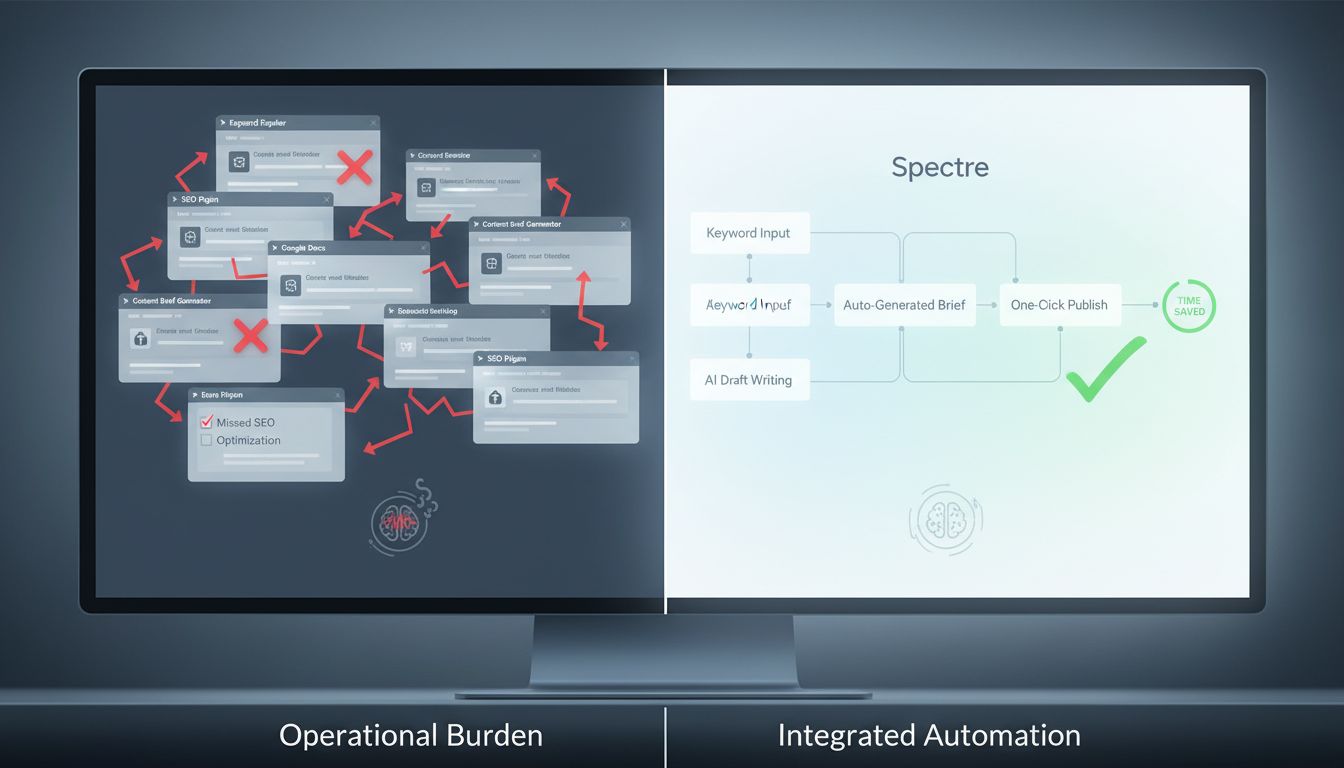
The real cost of traditional SEO tools isn't the subscription fee. It's the operational burden of stitching them into your workflow.
If you've used Ahrefs, Semrush, or Moz to produce content, you know the drill.
You start in the keyword explorer, export a CSV, then jump to the content brief generator. You copy that into Google Docs, write your draft, run it through an SEO plugin, publish to WordPress, set up rank tracking, and manually connect analytics.
That's at least five distinct tool interactions for a single article.
Each hand-off introduces friction. You forget to check a metric, miss a formatting requirement, lose the original research context. The fragmentation compounds daily, endless tabs, forgotten Zapier tasks, manual effort just to produce a basic performance report.
Ahrefs reported an average 72% traffic increase using their AI Content Helper. But that assumes you can consistently replicate a complex, multi-step process without error or fatigue.
Spectre eliminates the glue work entirely. You input a target keyword. The system researches it, generates a brief, and presents it inside our AI editor, where the draft gets written directly against that brief, optimised for both traditional SERPs and AI answer patterns.
One click publishes to WordPress, Webflow, or your custom CMS. Performance analytics are built in from day one.
The difference is systematic versus situational automation. Traditional tools like Semrush, Ahrefs, and Moz give you powerful levers but make you operate the machinery yourself.
For founders and lean teams, that's not a minor inconvenience. It's the difference between a content strategy that scales and one that collapses under its own operational weight.
The Integration Tax: Real-World Examples
"Operational burden" is one of those phrases that sounds abstract until you actually map out the steps.
Here's what a Semrush content workflow looks like in practice: Keyword Magic Tool, export the list, generate an AI brief in Content Toolkit, copy it to Google Docs, run the SEO Writing Assistant Chrome extension, make edits, copy the final text to WordPress, manually set meta tags, then configure tracking.
That's seven steps across three different interfaces. For one article.
Ahrefs isn't much cleaner. You have a draft in your CMS, copy the URL into Ahrefs, review the grade and suggestions, open your editor, apply changes, republish. You're still manually transferring recommendations between tools the whole time.
Spectre's flow: input a keyword, review the auto-generated brief (SERP data and competitor analysis pulled in automatically), the AI writes the article against that brief, you review and edit, then schedule publish.
Research, brief, writing, publishing, one pipeline.
The gap isn't really about fewer clicks. It's about cognitive load. Every tab switch, every copy-paste, every manual config step adds friction, and that compounds fast across dozens of articles.
For a founder publishing 20 pieces a month, Spectre saves roughly 140 manual steps versus a Semrush workflow. That time goes back into strategy, not glue work.
Decision Axis 4: Measuring ROI: Traffic, Conversions, and Strategic Impact
Rankings are becoming the wrong thing to measure. A page can show up in an AI Overview without ever touching the traditional top ten. What actually matters is whether your content drives qualified traffic, conversions, and revenue.
The numbers look good on paper. Semrush's blog reports nearly 70% of companies see better returns after integrating AI into their SEO workflows. Ahrefs reported an average 72% traffic increase for a site using its AI Content Helper. Real gains.
But there's a catch. That 72% doesn't come free. You're still manually exporting keyword data, writing drafts, grading content, publishing. Hours per article, every article.
Spectre's built-in analytics track traffic and goal completions directly. You see which articles drive conversions, not just which keywords moved. The focus shifts from "keywords tracked" to "qualified leads from blog."
That's the metric that actually matters.
For founders and lean teams, having 10,000 keyword opportunities doesn't help if you need to manually assemble each one. That's not a data advantage. That's analysis paralysis.
A system that identifies 20 high-converting opportunities and publishes them automatically creates momentum. The wider coverage doesn't.
The real ROI here isn't just traffic growth. It's the hours you stop spending managing tools and start spending building the actual business.
Common Pitfalls in Choosing and Using AI SEO Tools
The promise of automation leads teams into predictable traps. And the biggest one isn't picking the wrong tool between ahrefs vs semrush vs moz. It's misunderstanding what AI actually does for you.
The first pitfall: buying a feature-rich suite and using maybe 20% of it. Ahrefs Lite gives you 750 tracked keywords and 100,000 crawl credits. But if you're publishing ten articles a month, you're paying for a data warehouse you'll never fill. Founders and lean teams don't need enterprise-grade competitor tracking across 20 domains. They need a system that gets quality content published and ranked.
The second pitfall is underestimating setup time. AI doesn't mean "no work." Semrush's Content Toolkit requires you to configure brand voice, export briefs to your CMS, and manually verify AI-generated internal linking suggestions. If you don't account for the hours needed to stitch these tools into your workflow, the operational overhead becomes a sunk cost fast.
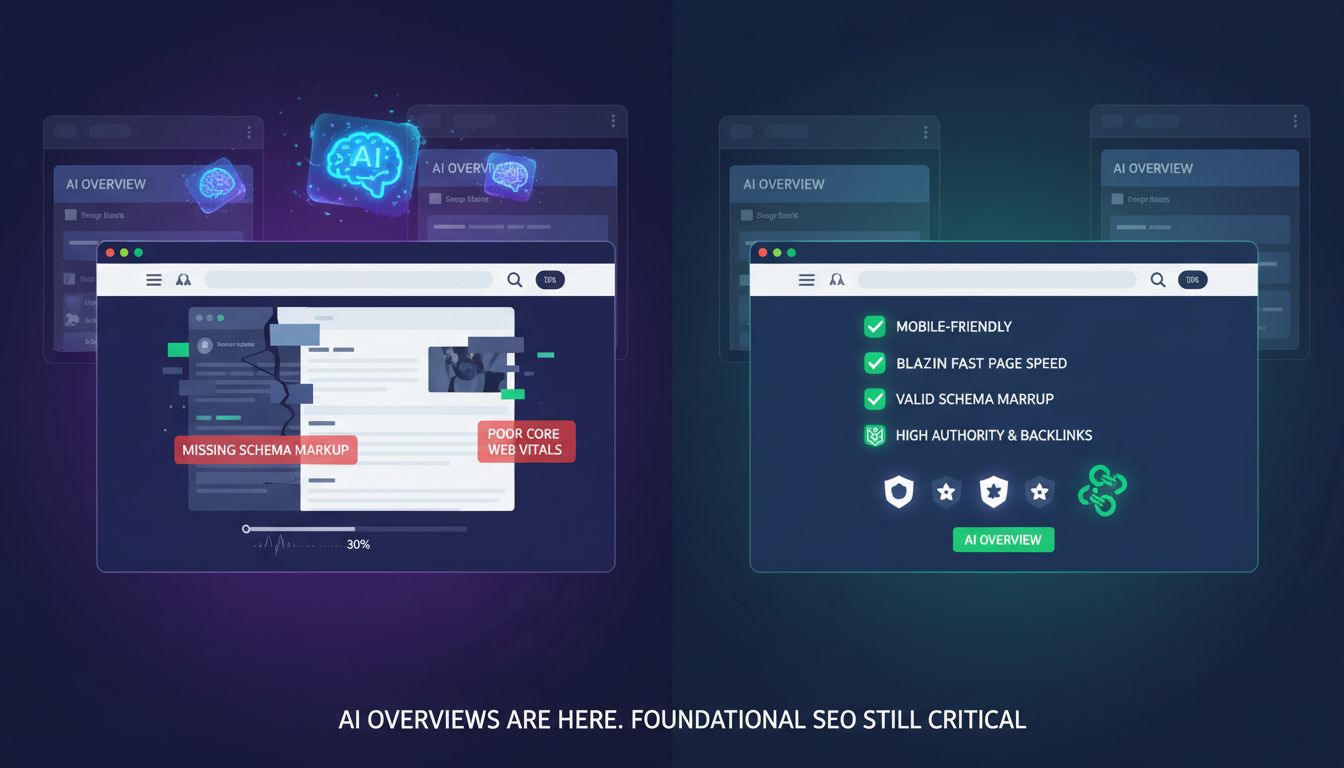
Third: chasing shiny AI metrics while ignoring fundamentals. AI Overviews appear in roughly 10.5% of searches, but weak authority signals and poor technical SEO will still kill your chances of being cited. AI can't fix page speed, mobile usability, or missing schema markup. You still have to build a solid site.
Fourth is assuming one tool fits every context. An agency needs Semrush's white-label reporting and multi-client dashboards. A solo founder needs Ahrefs' keyword research or Spectre's automated pipeline. Picking the agency tool when you're a solo operator means drowning in features you'll never touch.
The fix is simple: map your end-to-end workflow first. If it's "keyword → brief → draft → optimise → publish → track," find the tool that executes that chain or reduces the manual glue work between steps. Don't let a feature list distract you from the actual job you need done.
Which Tool Should You Choose? A Situational Guide
The choice isn't about which tool is "best." It's about which one fits how you actually work.
Pick Ahrefs if you're an SEO specialist or agency where deep backlink analysis and competitive intelligence are daily needs. The Lite plan starts at $129/month, but once you add AI Content Helper ($99-$250/month) and Brand Radar ($50-$250/month), it adds up fast. You'll get powerful data. You'll also spend time stitching things together.
Pick Moz if you run a local SEO-focused agency or small business that wants an affordable all-in-one dashboard. The Standard plan is $99/month ($79 on annual), includes core tracking, and now has some AI features like content briefs. It's simpler than the others, but it doesn't have the generative content capabilities or AI visibility depth you'd get from Semrush or Ahrefs.
Pick Semrush if you're an enterprise or large marketing team with budget and dedicated SEO resources. The bundled Semrush One plans start at $199/month, and the AI Visibility Toolkit adds another $99/month on top of that. Beyond included quotas, you're looking at per-domain, per-user, and per-prompt charges. That complexity makes sense if you have analysts to manage it.
Pick Spectre if you're a founder, solo marketer, or lean team of one to five people trying to grow organic traffic without adding headcount. This is the default recommendation for anyone whose primary goal is getting more content published and ranking faster. We built Spectre to remove the manual glue work between analysis and execution, one pipeline from keyword discovery to published article. If your team is measured on output rather than analysis depth, that matters more than feature count.
The question isn't which tool has the most features in the ahrefs vs moz vs semrush comparison. It's which one actually gets your content published and ranking while you focus on strategy, not administration.
Conclusion
So what's the actual problem with Ahrefs, Semrush, and Moz?
It's not the features. It's everything that happens after the analysis. You pull keywords, write a brief somewhere else, draft the content in another tool, and then manually push it to your CMS. That gap between "research done" and "article published" is where time dies.
For anyone running lean, that friction is the real cost. Not semrush pricing or ahrefs pricing. The hidden tax is context-switching and glue work.
That's why we built Spectre. One pipeline from keyword discovery to published article, with AI-optimized writing built in. No bouncing between tools. No manual handoffs.
If you're measuring your team on output, not analysis depth, that's the difference that matters.
Start your 7-day free trial at Spectre. Publish your first piece today and count the hours saved, not just the rankings.
Frequently Asked Questions
Is Semrush better than Ahrefs for comprehensive SEO?
Depends on what you're actually trying to do.
Semrush bundles its AI tools together, Content Toolkit, AI Visibility Toolkit, which works well for teams that need reporting across multiple channels in one place. Ahrefs keeps things more modular, with add-ons like AI Content Helper and Brand Radar sitting separately from the core product. SEO specialists who live and breathe backlink data tend to prefer it.
For content production workflows specifically, Semrush's bundled approach is more coherent. But both platforms still leave you with a gap between "insight" and "published article" that you have to close yourself.
Is Moz better than Semrush for AI content?
No. Not even close, if AI content at scale is the goal.
Moz pricing is friendlier, and the local SEO features are solid. But its AI capabilities are basically limited to briefs and light editorial checks. Semrush's Content Toolkit ($60/month) includes an AI Article Generator, Topic Finder, and SEO Writing Assistant. Moz's AI features are still "emerging", which is a polite way of saying they're not something you'd build a production workflow around.
Moz is a fine tool. Just not for this.
Is SEO dead or evolving in 2026?
Evolving. Genuinely.
AI Overviews and AI-driven search have changed the tactics, prompt tracking, citation optimization, things that didn't exist a few years ago. But authority, relevance, and user intent still matter. According to Semrush, nearly 70% of companies report better returns after integrating AI into their SEO and content workflows.
The shift is from purely manual optimization to hybrid human-AI pipelines. The core principles held. The execution layer changed.
What are the best AI SEO tools?
The ahrefs vs moz vs semrush debate usually comes down to analysis depth. Ahrefs' AI Content Helper, Semrush's Content Toolkit, both are good at research and optimization. That part's mostly solved.
The real question is what happens after the research. For founders and lean teams, the best tool isn't the one with the best data. It's the one that takes you from keyword to published article without manual handoffs in between.
That's what we built Spectre for. It researches keywords, writes EEAT-optimized content, and publishes directly to your CMS. The glue work is gone.
Is there anything better than Semrush?
If you're asking this, the problem probably isn't missing features.
Semrush is genuinely good at data breadth and reporting. But using it for content production still means you're doing the research in one place, writing somewhere else, and publishing manually. That's the friction.
In the ahrefs vs semrush vs moz conversation, and honestly, when you throw in ubersuggest vs semrush too, all of these tools share the same structural gap. They analyze. They don't execute. Spectre is built around execution: an automated pipeline that handles the whole process.
If your goal is more output without more overhead, that's a different tool category than what semrush pricing, ahrefs pricing, moz pricing, ubersuggest pricing, or even semrush api pricing gets you access to. Analysis suites and automation pipelines aren't really competing with each other. They're solving different problems.