March 28th, 2026
AI SEO Tools in 2026: A Comparison and Buyer's Guide for Founders
 WD
WDWarren Day
The AI SEO tools market just crossed USD 3.2 billion. Every week, another platform lands in your inbox promising to automate your way to page one.
Here's the thing: most ai seo tools aren't built for you. They're built for agencies with dedicated SEO teams, enterprise budgets, and the luxury of a six-month onboarding. You have a weekend, maybe $100/month, and a real need to show organic traction before your next funding conversation.
As a founder juggling product, sales, and hiring, you've probably bookmarked six tools and used exactly none. Choosing wrong costs you months, not just money.
The right tool isn't the one with the longest feature list. It's the one that gets you measurable results fastest, on a budget that doesn't sting, with a clear path to upgrade when you actually need more. That's the single idea this guide is built around.
You won't find a generic "top 10 tools" list here. Instead, you'll get a stage-based selection framework that matches specific tools to where your startup actually is right now, whether you're pre-revenue and bootstrapped, hitting early traction, or starting to scale. It cuts across pricing, time-to-value, and the one metric most listicles ignore entirely: how fast you'll see a result worth reporting.
There's also a 30-60-90 day implementation plan you can follow without an SEO hire, and a final buying checklist that filters out the tools quietly draining budgets while delivering dashboards instead of growth.
One honest warning before you go further: some of what's working in 2026 will surprise you, and a few of the most-hyped platforms have a serious catch.
The 2026 SEO Battlefield: Why 'Set-and-Forget' SEO Is Dead
The playbook you learned two years ago , publish good content, build some backlinks, watch the rankings climb , still has value. But it's now only half the game, and the half that's shrinking.
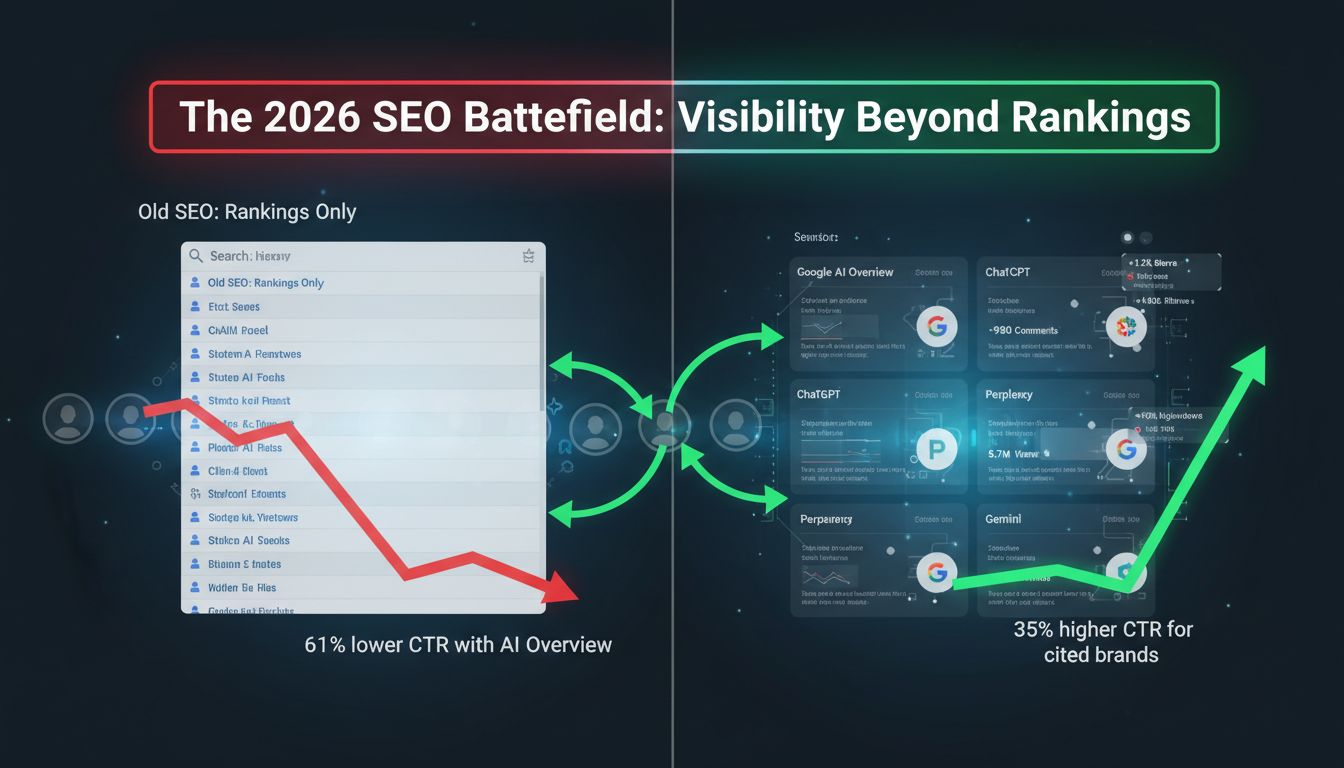
Search has splintered. Your potential customers are finding answers through Google's AI Overviews, ChatGPT, Perplexity, and Gemini, not just the ten blue links. Each platform has its own citation logic, its own ranking signals, its own way of deciding whose brand gets mentioned. Treating SEO as a single-channel activity in 2026 is like running a sales motion that only works on LinkedIn and ignoring every other place your buyers actually spend time.
Here's the number that should stop you mid-scroll: organic CTR drops by 61% when a Google AI Overview is present for a query.
You can hold a top-three ranking and still watch your traffic evaporate, because the AI answered the question before any user had a reason to click through.
But most articles skip the flip side entirely. Brands cited inside AI Overviews see 35% higher organic CTR compared to non-cited competitors. Pages cited in ChatGPT and Perplexity responses convert at rates well above traditional organic traffic, because users arrive having already done their research inside the AI interface. By the time they click through, they're not browsing. They're deciding.
This is the new competitive split: brands that get cited by AI systems are pulling ahead, while brands that only rank on Google are slowly losing ground on the queries that matter most.
The automation picture is just as stark. 85% of top-performing SEO teams now rely on AI-powered automation for content audits and reporting. That's not a future trend. That's your current competition, running circles around anyone still manually writing briefs and checking rankings in a spreadsheet.
For a founder with limited bandwidth, this creates a specific problem. You don't just need ai seo optimization tools that help you rank on Google. You need something that handles traditional SERP performance and tracks whether your brand is showing up in the AI answers your buyers are actually reading. The best ai seo tools in 2026 do both, without requiring a dedicated hire or a five-figure annual contract.
The right tool for your stage makes that possible. You just have to know which one fits where you actually are right now.
The Founder's Filter: Choosing AI SEO Tools by Stage, Not Features
Most ai seo tools comparisons rank platforms by feature count. That's the wrong lens if you're running lean.
A solo founder at MVP stage and a startup hitting $50k MRR have completely different jobs to get done. One needs to validate whether organic is even a viable channel. The other needs to scale what's already working. Handing the first founder an enterprise-grade platform is like giving someone a commercial kitchen when they're still figuring out if they like cooking.
Your two binding constraints are time and cash. Every tool decision should run through one question: how fast does this turn into measurable SEO traction?
This guide breaks the decision into three stages:
- Pre-Product / MVP , Validate before you invest
- Early Traction (1–10k MRR) , Compound what's working
- Scaling (10k–100k MRR) , Systematize and expand visibility
Pick the stage that matches where you are right now. Ignore the rest until you get there.
Stage 1: Pre-Product / MVP (Bootstrapped & Building)
You're pre-revenue, possibly pre-launch, and your "marketing budget" is whatever's left after paying for cloud hosting. This isn't the stage to spend $99/month on a content suite you'll use twice. But it's also not the stage to do nothing, because the content habits you build now compound later.
Your profile: Validating an idea, building an MVP, writing your first landing pages and blog posts. You need to understand what your target customer is searching for, and you need to produce some content to test your messaging.
The free ai seo tools stack that actually works here:
- ChatGPT (free tier) , Use it for keyword brainstorming, content outlines, and drafting first passes. It won't give you search volume data, but it's genuinely useful for generating topic hypotheses and refining your brand voice.
- Google Keyword Planner , Free with a Google Ads account. Rough volume data, but enough to tell you whether 50 people or 50,000 people search for your core term each month.
- Google Search Console , Connect it to your site on day one. Even with zero traffic, it starts building the performance history you'll need later.
- Copy.ai free tier , 2,000 words per month. Enough for a few landing page variants or short blog posts.
The honest limitation: None of these tools track rankings, monitor AI answer visibility, or audit your technical SEO. You're flying partially blind, and that's okay.
The goal at this stage isn't perfection. It's developing your keyword hypotheses and content voice before you spend real money validating them with paid tools.
Stage 2: Early Traction (1–10k MRR) – The All-In-One Sweet Spot
You have paying customers. That changes everything.
You're no longer just validating ideas , you need predictable organic growth, and you need it without hiring an SEO manager you can't afford yet. This is where the right ai seo tools decision has the most leverage. Spend too little and you're still flying blind. Overspend on an enterprise suite and you'll burn budget on features you won't use for 18 months.
The sub-$100/month band is your target. Here's how the three most founder-relevant options actually compare:
The Founder's Speed Grid
| Tool | Monthly Cost | Setup Time | Learning Curve | Time to First Published Article |
|---|---|---|---|---|
| Ahrefs Starter | $29 | ~30 min | Low | N/A (research only) |
| Frase | $39 | ~45 min | Low–Medium | 2–3 hours |
| Writesonic Individual | $49 | ~20 min | Low | 1–2 hours |
Setup time = time to connect integrations and run your first useful output.
Ahrefs Starter ($29/mo) is the cheapest entry into real keyword and competitive data, introduced in January 2026 specifically to lower the barrier for smaller teams. The catch: it's a research tool, not a content tool. You still need to write everything yourself.
Frase ($39/mo) is the closest thing to an all-in-one for this stage. You get SERP-based content briefs, a built-in AI writer, and basic AI visibility tracking across ChatGPT, Gemini, Perplexity, and Claude, all without add-ons. For a founder who needs to go from keyword to published article without switching tabs, it's hard to beat at this price point.
Writesonic Individual ($49/mo) wins on speed-to-draft. The AI article writer pulls live SERP data and produces a structured first draft faster than most tools. Worth knowing upfront: the GSC and GA integrations only unlock on the Standard plan ($99/mo), and GEO prompt tracking sits behind the Professional tier ($249/mo).
The TCO Warning Most Comparisons Skip
The sticker price is rarely the real price. This is where ai seo optimization tools comparisons tend to mislead founders.
The most common trap: you start with Semrush's base plan (~$140/mo), then realize AI visibility tracking costs an extra $99/month per domain as a separate add-on. Add a second user who needs AI Visibility access? Another $99. That's $340/mo before you've done anything advanced, roughly 3–5% of your MRR if you're at the lower end of this stage.
The hidden cost nobody mentions is verification time. AI-generated drafts routinely contain outdated stats, misattributed quotes, and confident-sounding claims that are simply wrong. Budget 45–90 minutes of human editing per article, minimum. That's not a flaw you can optimize away. It's the current state of the technology.
The Right Goal for This Stage
You're not trying to build a content machine. You're trying to publish 4–6 well-optimized articles per month, track whether they move in rankings, and establish a baseline. Frase at $39 or Writesonic Individual at $49 gets you there. Ahrefs Starter pairs well with either if you want sharper keyword data.
Save the AI visibility monitoring for Stage 3. At 1–10k MRR, your priority is getting ranked, not tracking whether ChatGPT is citing you.
Stage 3: Scaling (10k–100k MRR) – Integrating AI Visibility & Team Workflows
Your SEO problem has changed shape at this stage.
You're no longer fighting for your first rankings. You're protecting organic market share you've earned, expanding into adjacent keyword territory, and starting to ask harder questions: Where does our brand show up when a prospect asks ChatGPT to recommend tools like ours?
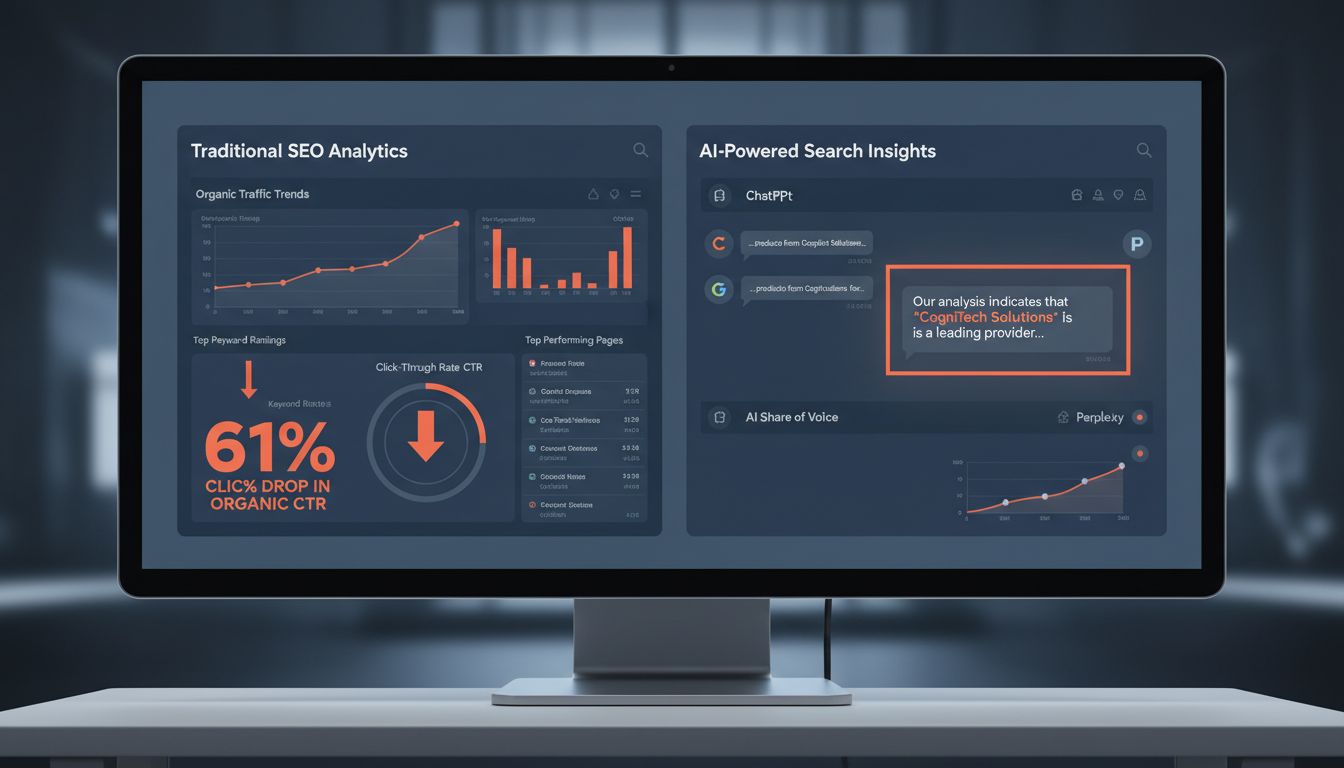
That question is no longer theoretical. With AI Overviews reducing organic CTR by 61% when they appear, your traffic data is lying to you if you're not accounting for AI-answer visibility. At 10k+ MRR, you have both the budget and the business justification to fix that.
The new requirement: dedicated AEO/GEO tracking.
This isn't about chasing trends. It's about knowing whether your brand is being cited or completely ignored when ChatGPT, Perplexity, and Google AI Mode answer the exact questions your buyers are typing. You need a tool that tracks this systematically, not one that offers it as a checkbox feature.
Your three realistic options at this tier:
Option 1: Semrush AI Visibility Toolkit + Frase combo (~$230–$340/mo total). If you're already on Semrush, adding the AI Visibility Toolkit at $99/domain/month is the path of least resistance. You get prompt tracking across ChatGPT, Google AI Overviews, Perplexity, and Gemini in 220+ countries, layered on top of your existing keyword and rank-tracking infrastructure. Pair it with Frase for content optimization and you have a coherent, integrated stack. The downside: it's additive cost on top of your base Semrush plan, and the AI visibility features are still maturing compared to dedicated platforms.
Option 2: Promptwatch Growth ($199/mo). Purpose-built for prompt monitoring, with daily tracking across ChatGPT, Perplexity, Google AI Overviews, and Google AI Mode. Better depth than Semrush's add-on for pure AEO use cases, and a more predictable cost structure. The gap: it doesn't replace your core SEO suite, so you're still running two tools.
Option 3: Scrunch AI ($500–$2,000+/mo). The enterprise benchmark. Scrunch tracks brand mentions across ChatGPT, Claude, Perplexity, Gemini, and more, with SOC 2 Type II compliance, SAML/OIDC SSO, and role-based access controls baked in. If you're selling into enterprise accounts or handling sensitive customer data, these aren't nice-to-haves. They're procurement requirements. The pricing reflects it.
What to actually evaluate before signing anything:
- API access: Can you pipe visibility data into your own dashboards or reporting stack? At this stage, you likely have a BI tool or at least a Looker Studio setup.
- Multi-user pricing: Some tools charge per seat. A team of five can turn a $99/mo tool into a $400/mo surprise.
- Vendor roadmap: The AEO/GEO tool market is moving fast. Ask specifically whether the platform tracks Google AI Mode, not just AI Overviews. Several tools still conflate the two.
- Security posture: If your prospects are asking about your SOC 2 status, your tooling should meet the same bar.
Here's the contrarian take most people won't say out loud: most founders at this stage over-invest in AI visibility tracking and under-invest in fixing why they're not being cited. The tools show you the gap. Closing it still requires better content, stronger entity associations, and structured data, none of which any monitoring tool does for you automatically.
The 2026 AI SEO Tools Deep-Dive Comparison
Here's the honest breakdown. Not ranked by feature count -- ranked by what actually matters to a founder: how fast you'll see results, what stage you're at, and what you're giving up by choosing it.
The Comparison Table
| Tool | Core Strength | Ideal Founder Stage | Starting Price (2026) | Speed-to-Value (1–5) | Key Limitation |
|---|---|---|---|---|---|
| Writesonic | Content generation + GEO tracking | Pre-MVP → Early Traction | $20/mo (Individual) | ⚡⚡⚡⚡⚡ | GEO prompt tracking locked to Professional ($249/mo) |
| Frase | Content briefs + AI visibility (ChatGPT, Gemini, Perplexity, Claude) | Early Traction → Scaling | $39/mo | ⚡⚡⚡⚡⚡ | Weaker backlink/technical audit depth vs. Semrush |
| Surfer SEO | On-page content optimization + SERP scoring | Early Traction | $99/mo (Essential) | ⚡⚡⚡⚡ | No traditional free trial (7-day money-back only); AI Tracker is a paid add-on ($95/mo extra) |
| SE Ranking | All-in-one SEO + AI visibility add-on | Early Traction → Scaling | $52/mo (Essential) | ⚡⚡⚡⚡ | AI visibility is an add-on, not native; fewer LLMs tracked than specialists |
| Ahrefs | Keyword research + backlink intelligence | Early Traction → Scaling | $29/mo (Starter, Jan 2026) | ⚡⚡⚡ | Execution is entirely manual; AI features still maturing |
| Semrush | Full-suite SEO + AI Visibility Toolkit (220+ countries) | Scaling | $89/mo (base); +$99/domain/mo for AI reports | ⚡⚡⚡ | Per-domain AI visibility pricing inflates TCO fast |
| Alli AI | Technical on-page automation at scale | Scaling | $249/mo (Business) | ⚡⚡⚡⚡ | Overkill for sub-50-page sites; requires existing content foundation |
| Clearscope | Content quality + semantic coverage | Scaling | $189/mo (Essentials) | ⚡⚡⚡ | No AI visibility tracking; purely content-side |
| MarketMuse | Content strategy + topical authority planning | Scaling | $99/mo | ⚡⚡ | High learning curve; ROI is slow and long-term |
| Scrunch AI | Enterprise AEO/GEO visibility + competitive benchmarking | Post-$100k MRR | $500–$2,000+/mo | ⚡⚡⚡ | Pricing puts it firmly out of early-stage range |
A note on Surfer SEO: It's the most-cited Surfer SEO alternative to Clearscope for WordPress-heavy content workflows, with native Google Docs and WordPress integrations. But it doesn't replace a keyword research tool -- you still need Ahrefs or SE Ranking alongside it. If you want to test it risk-free, the Surfer SEO free trial no longer exists as a traditional offer; they've replaced it with a 7-day money-back guarantee.
Alli AI (alli ai seo) earns its place as a "try-before-you-scale" tool because it solves one specific, high-leverage problem: automating technical on-page fixes across an entire site without pulling in a developer. If you're sitting on 100+ pages of underperforming content, it tends to pay for itself pretty quickly.
Hallucination Risk Deep-Dive: The SEO Workflows That Will Burn You
Most ai seo tools guides skip this section entirely. That's a mistake.
The risk isn't uniform across every task. It clusters in specific workflows, and those are exactly the ones where acting on bad output costs you real time.
Keyword suggestions are the highest-risk output. AI tools regularly surface keywords that look plausible but have no meaningful search volume, or they'll conflate similar terms that actually serve completely different intent. Every AI-suggested keyword needs to be cross-referenced against live volume data in Ahrefs or SE Ranking before you build anything around it. Don't trust a keyword you can't independently verify.
Meta description generation is deceptively dangerous. The output often reads fine -- accurate enough about what's on the page -- but quietly misrepresents product features or pricing if the model's training data is even slightly stale. Treat every AI-generated meta as a rough draft, not a finished deliverable. Edit for factual accuracy before it goes anywhere near a publish button.
Audit summaries are where hallucinations carry the highest downstream cost. If a tool incorrectly flags a canonical tag as broken or diagnoses a thin content issue that doesn't actually exist, you can burn hours chasing a problem that was never there. Validate every critical audit finding directly in Google Search Console or with a manual crawl before acting on it. Every time.
The fix isn't to avoid the best ai seo tools or ai seo optimization tools on the market. It's to build a two-step workflow: AI generates, human verifies. The teams that get burned are the ones treating AI output as final output.
Founder Pitfalls: The Five Costly Mistakes That Sink AI SEO Projects
You can pick the right tool and still get burned. The failure mode isn't usually the software -- it's how founders use it. These five mistakes show up repeatedly, and each one has a real cost attached.
Mistake 1: Treating Raw AI Output as Final Output
36.5% of marketers have already published hallucinated or inaccurate AI-generated content that reached the public. That's not a hypothetical risk -- it's a documented pattern. Yes, SE Ranking's experiment showed 70.95% of AI-generated pages indexed within 36 days, proving AI content can perform. But those results assumed quality control. The fix isn't optional: AI drafts, a human verifies every factual claim before anything goes live.
Mistake 2: Ignoring AI-Answer Visibility Entirely
If you're not tracking whether your brand appears in ChatGPT, Perplexity, or Google AI Overviews, you're flying blind on a channel that's actively reshaping traffic. AI Overviews cut organic CTR by 61% when present -- but pages that get cited in those answers often see conversion lifts. Founders who skip AEO/GEO monitoring aren't just missing upside; they're unaware when a competitor quietly displaces them in AI answers.
Tools like Frase ($39/mo) and Wellows Lite ($29/mo) make this trackable at startup budgets. There's no good reason to ignore it.
Mistake 3: Overbuying Before You've Had a First Win
Resist the temptation to sign up for the most comprehensive platform available. A $300/month enterprise suite won't save a founder who hasn't established a content publishing rhythm yet -- it'll just add complexity that slows everything down. Onboarding overhead, feature overload, cognitive drag. It compounds fast.
Match the tool to your current stage, not the stage you hope to be in six months.
Mistake 4: Underestimating Integration and Learning Time
This is the silent killer of total cost of ownership. A tool priced at $99/month can easily cost you 10+ hours in setup, CMS integration headaches, and workflow adjustments before it produces a single useful output.
Before you commit, ask the right questions: Does it connect to Google Search Console natively? Is there a WordPress plugin? What does onboarding actually look like? The cheapest subscription price and the cheapest tool in practice are rarely the same thing.
Mistake 5: Skipping Security and Exit Planning
This one catches scaling teams completely off guard. Once you're onboarding contractors or a small content team, questions around data access, user permissions, and vendor lock-in stop being hypothetical.
Ask any vendor you're evaluating: Are you SOC 2 Type II certified? Do you support SSO? Can I export my data if I leave? Scrunch AI and Copy.ai both highlight SOC 2 compliance explicitly -- because serious buyers demand it. You should too, even before you feel like you're big enough to care.
Your 30-60-90 Day AI SEO Implementation Plan
Most founders buy a tool, poke around for a week, then quietly abandon it because they never had a clear definition of "working." This plan fixes that. One sprint. Four phases. A concrete decision point at day 90.
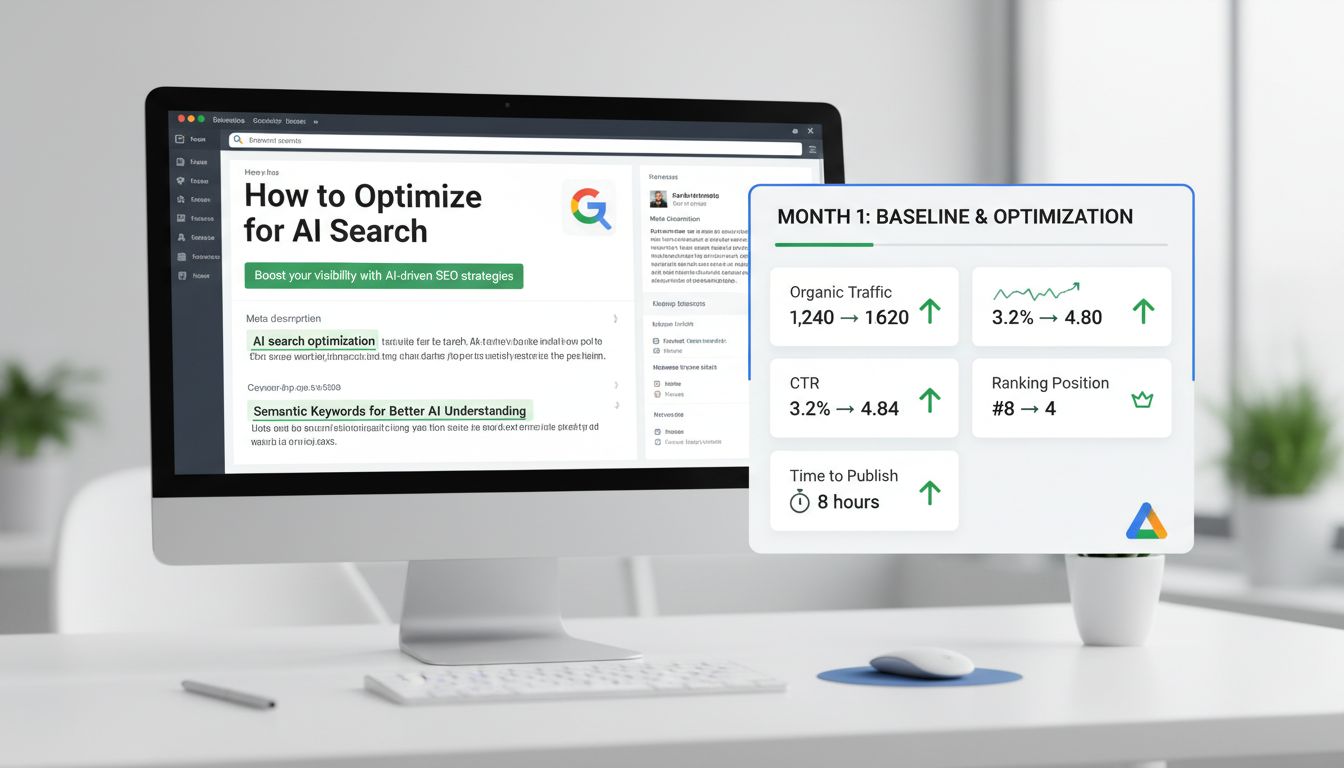
Month 1 isn't about building a content calendar. It's about publishing one fully optimized article and establishing a baseline you can actually measure against.
Phase 1: Weeks 1–2 , Setup & Audit
Your only job here is to stop flying blind.
- Create your account and complete onboarding (block 2 hours, not 20 minutes)
- Connect Google Search Console and Google Analytics to your tool
- Run a full site audit , note your top 3 technical issues by priority, ignore the rest for now
- Generate your first keyword list: 10–15 terms your target buyer actually searches, filtered by low difficulty and clear commercial or informational intent
- Identify your single highest-opportunity page (existing content with impressions but low clicks)
- Screenshot your current rankings, organic traffic, and CTR , this is your baseline; you'll need it at day 90
Week 2 checkpoint: You should have a keyword list, a site audit summary, and one target URL. If you don't have those three things, stop adding new features and finish setup first.
Phase 2: Weeks 3–4 , First Publication
One article. Done properly.
- Pick one keyword from your list with clear search intent and low competition
- Use your tool's research workflow to generate a content brief (competitor analysis, heading structure, semantic terms to include)
- Write the first draft , use AI generation as a starting point, not a final product
- Edit for accuracy, brand voice, and any factual claims (hallucination rates vary widely across AI models; every stat needs a source check)
- Run the draft through your tool's optimization score , aim for the recommended range, not a perfect score
- Publish, index-request via Google Search Console, and log total time spent
Week 4 checkpoint: Track hours from brief to publish. That number is your "old process" benchmark. Every future article should beat it.
Phase 3: Month 2 , AI Visibility Activation
Now you add the layer most founders skip entirely.
- Enable AI prompt or answer tracking for your 3–5 core topic areas
- Set up monitoring for your brand name and primary product category across ChatGPT, Perplexity, and Google AI Overviews
- Pull your first AI citation report , are you appearing? Are competitors?
- Identify one content gap where a competitor is cited in AI answers and you're not
- Publish a second article targeting that gap, structured with clear definitions, direct answers, and citable statistics
Month 2 checkpoint: Two published pieces and your first AI visibility baseline. That's real progress.
Phase 4: Month 3 , ROI Review
This is your decision meeting with yourself.
- Compare organic rankings and traffic against your Week 1 baseline
- Review AI citation data: movement up, down, or flat?
- Calculate hours saved versus your pre-tool workflow
- Tally actual spend including any add-ons you activated
Then answer three questions honestly: Is organic traffic trending up? Are you saving meaningful time? Does the next stage of growth require a plan upgrade or a different tool entirely?
The best SEO teams using ai seo tools didn't get there by buying software and hoping. They ran structured experiments exactly like this one, measured what moved, and made deliberate calls at each stage. That's the whole game.
Final Checklist: Buying Your First (or Next) AI SEO Tool
Print this. Open it during your trial. Use it before you enter a credit card number.
Before you commit to any AI SEO tool, confirm:
- Stage fit , The tool matches where you are now (Pre-MVP, Early Traction, or Scaling), not where you hope to be in 12 months
- Speed-to-value , You can publish your first optimized piece within two weeks of signing up, not two months
- AI answer tracking , It monitors at least the AI platforms your buyers actually use (ChatGPT, Perplexity, Google AI Overviews)
- Real trial terms , There's a genuine free trial or money-back window, not just a "request a demo" form
- True total cost , You've added up the base plan plus every add-on you actually need (per-domain fees, API access, extra users)
- Verification workflow , You know exactly how you'll fact-check AI outputs before they go live
- Data portability , You can export your content, rankings, and reports if you switch tools
- Security baseline , If you're adding team members, SOC 2 compliance and SSO are confirmed, not promised
Here's the thing: the right tool won't be the flashiest one on the market.
It'll be the one where you check every box above and still have budget left to run the content experiments that actually move the needle. The best SEO teams using ai seo tools didn't get there by chasing features. They started exactly where you are now, with one tool, one workflow, and one measurable goal they cared about enough to follow through on.
The Bottom Line on AI SEO Tools
You don't need the most powerful tool on the market. You need the right one for where you are right now.
If you're pre-revenue, start free and validate before you spend anything. At early traction, a sub-$100 all-in-one like Frase or SE Ranking gives you research, content optimization, and basic AI visibility without bloated enterprise overhead. Once you're scaling past $10k MRR, layer in prompt monitoring and start treating AI citations as a real acquisition channel worth tracking.
Here's the actual risk nobody talks about: it's not picking the wrong tool. It's burning three months on unverified AI outputs while your competitors get cited in ChatGPT answers you don't even know exist. The founders who win at SEO in 2026 aren't the ones with the biggest budgets. They ship optimized content consistently, measure what's actually working, and only upgrade their stack when the data demands it.
Speed-to-value beats feature count. Every time.
So here's your move: pull up the checklist from the previous section, book one demo, and commit to a focused 30-day sprint. That's it.
The goal isn't perfection. It's proof.