February 19th, 2026
Automated SEO Tools for SaaS: Scaling Content Production in 2026
 WD
WDWarren Day
You're under pressure to scale content for organic growth, but your team is small and your budget tighter. You've seen the hype around AI writing tools, but also the horror stories of generic, inaccurate content that tanks brand credibility.
In 2026, simply producing more isn't enough. You need a system that's both efficient and effective.
Here's what actually works: AI-generated content can cut production costs significantly and speed up your publishing schedule. But those gains only materialize when you move beyond scattered tool purchases and build an integrated workflow with human oversight baked in at every stage. The teams seeing real results aren't just buying automated seo tools and hoping for the best.
The problem isn't AI itself. It's that most SaaS teams are buying tools without a coherent plan for how they fit together, or how to catch the inevitable hallucinations before they go live. You're optimizing for yesterday's search landscape while ignoring the explosive growth of AI-driven answer engines that now influence how your buyers discover solutions. Google's AI Overviews, ChatGPT citations, Perplexity results... they're reshaping organic discovery whether you're ready or not.
This article gives you what the typical "best tools" listicle won't: a complete operational blueprint for a human-in-the-loop AI SEO workflow designed specifically for resource-constrained SaaS teams.
You'll see exactly which tools belong in your stack and why, how to wire them into a keyword-to-publish pipeline, and which new metrics actually matter when AI Overviews and chatbot citations are part of the game. Most importantly, you'll get a risk-mitigated 90-day pilot plan so you can prove ROI before committing budget at scale. No hype, no fluff.
The 2026 Reality: Why AI-Powered SEO Automation is Non-Negotiable
Your Series A board deck promised 3x growth in organic traffic this year. Your content team is you, a contractor who writes twice a week, and a product marketer who "helps when they can." Meanwhile, your competitors are publishing daily.
This isn't hypothetical. It's the reality for most B2B SaaS teams operating between $1M and $10M ARR.
The math is brutal: you need 20+ high-quality articles per month to build topical authority and capture long-tail search volume. At traditional production speeds, that requires a team of four writers, two editors, and a six-figure annual budget you don't have.

That's where automated seo tools powered by AI come in. 89% of marketers now use generative AI, and the results aren't marginal. 86% report saving more than an hour daily on creative tasks, while 68% see measurable increases in content marketing ROI. Early adopters have reduced production costs by 65% and improved content velocity by 84%.
Here's what most "AI SEO" articles won't tell you: speed without strategy is just expensive noise.
The real shift in 2026 isn't that AI can write faster. It's that search itself has fundamentally changed. AI Overviews now appear for your highest-value keywords. ChatGPT and Perplexity are answering questions that used to send traffic to your blog. AI search traffic surged 527% year-over-year in 2025, and if your content isn't structured for machine extraction and citation, you're invisible in this new discovery layer.
Strategic automation means building a human-supervised workflow that optimizes for both traditional rankings and visibility inside AI answer engines. Forward-looking teams now call this Generative Engine Optimization (GEO) and Answer Engine Optimization (AEO). That's the blueprint you're about to get.
The 2026 AI SEO Stack: Tools for Every Stage of the Funnel
Stop building your automated seo tools list like you're panic-buying at Costco.
Most SaaS teams screw up AI-powered SEO because they chase "best of" roundups instead of building a stack that actually covers the entire content lifecycle. You end up with five keyword tools that all do the same thing, zero integration between platforms, and workflow gaps you patch with spreadsheets and Slack reminders.
The difference between a tool collection and a functional stack? One maps specific capabilities to each stage of your operation, from the initial keyword decision through to tracking whether ChatGPT actually cites your article. Here's how to think about tool selection in 2026: by workflow stage, not feature list.
Stage 1: Discovery & Strategy (The 'What' and 'Why' to Write)
You need to know what will rank and why it matters to your pipeline before writing a single word. This stage is pure intelligence, keyword research, competitive gap analysis, topic clustering that aligns with your buyer journey.
Semrush remains the heavyweight. Its Keyword Magic Tool and Topic Research module now include AI-powered clustering that groups semantically related queries, so you're not accidentally optimizing 47 blog posts that all cannibalize the same search intent. The 2026 upgrade worth knowing about? SERP analysis now flags which queries trigger AI Overviews, letting you see where Google is summarizing answers instead of sending clicks. The Writing Assistant ($25/month) integrates directly into Google Docs with real-time SEO recommendations as you draft. They offer a seven-day free trial, making it one of the more accessible best free seo tools if you're testing before committing budget.
MarketMuse excels at topical authority planning. Instead of chasing individual keywords, it models your entire content inventory against competitors to identify coverage gaps. The free tier includes content planning and gap analysis, enough for a lean team to map a quarter's editorial calendar without spending a dollar. Paid plans start at $149/month.
Ahrefs delivers unmatched backlink intelligence and keyword difficulty scoring. If your growth strategy includes any link-building or competitive content analysis, Ahrefs shows you exactly which articles are earning authority and why. Plans start at $129/month, with a $7 seven-day trial.
The strategic play: Pick one all-in-one platform (Semrush or Ahrefs) as your foundation, then layer in MarketMuse only if topical authority is a board-level priority. Don't buy all three.
Stage 2: Creation & Drafting (The 'First Draft' Engine)
Once your brief is locked, you need velocity. This is where best ai seo tools earn their ROI, turning strategic direction into initial drafts your team can edit, not write from scratch.
Scalenut is purpose-built for high-volume blog production. With over 1,000,000 users and 5,000,000+ SEO blogs created, it's proven at scale. The Essential plan ($19/month) generates five SEO-optimized articles monthly, each structured with keyword density, headings, and meta recommendations baked in. For SaaS teams running content-led growth, that's your top-of-funnel engine at the cost of one freelance article.
Jasper ($69/month) offers more versatility. It's not just blogs, Jasper handles case studies, email sequences, landing page copy, and product updates. The 2026 version includes customizable brand voice profiles and tone controls, so your AI-generated drafts don't sound like every other startup's generic fluff. Teams with multiple content formats (not just SEO blog posts) get more mileage here.
Frase starts at $14.99/month and bridges research and drafting. Its AI Content Brief Generator analyzes the top 20 SERP results, extracts common entities and questions, then auto-generates an outline. The built-in Answer Engine surfaces "People Also Ask" queries and related questions, letting you structure content that answers what users, and AI summarizers, are actually seeking.
Reality check: Every one of these tools will produce drafts that need heavy human editing.
Budget 60–90 minutes of editor time per AI-generated article to fix tone, add proprietary insights, and verify factual accuracy. Knowledge workers now spend an average of 4.3 hours per week fact-checking AI outputs, according to research from Drainpipe.io. That's not wasted time. It's the quality gate that separates content that ranks from content that gets ignored.
Stage 3: Optimization & Enhancement (The 'Human-in-the-Loop' Hub)
This is where your editor turns an acceptable draft into a ranking asset. Optimization tools provide real-time SEO scoring, structural recommendations, and, critically in 2026, guidance for ai seo optimization that makes your content citation-worthy for AI answer engines.
Surfer SEO is the category leader here. Its Content Editor scores your draft against top-ranking pages in real time, flagging missing entities, weak keyword coverage, and structural gaps. The 2026 update includes GEO/AEO recommendations: answer-first paragraph structuring, entity highlighting for machine readability, FAQ schema suggestions. One SaaS team used Surfer to re-optimize product landing pages and saw an 18% lift in trial-to-paid conversions by improving keyword alignment and page structure. Essential plans start at $89/month; the AI Scale plan runs $219/month for teams producing dozens of articles monthly.
Alli AI ($299/month for the Business plan) tackles site-wide optimization tasks that would take weeks manually. It can adjust meta tags, optimize headers, and implement SEO rules across thousands of pages, critical for SaaS companies with large help centers, documentation sites, or programmatic landing pages. You're not paying for content creation here. You're paying for automated technical hygiene at scale.
The workflow integration matters as much as the features. Surfer and Alli both connect to WordPress, Webflow, Shopify, and Google Docs, so your team isn't copy-pasting between six browser tabs. That's the difference between a tool you use daily and one that gathers dust after the first month.
Stage 4: Measurement & AI Visibility (The 'New Frontier' Trackers)
Google Analytics and Search Console still matter, but they're completely blind to the fastest-growing discovery channel: AI-generated answers.
AI search traffic increased 527% year-over-year in 2025, yet most SaaS teams have no idea whether Perplexity, ChatGPT, or Google's AI Overviews are citing their content. You're optimizing for a game you can't see.
AthenaHQ fills that gap. It tracks your brand's presence across multiple AI platforms, measuring keyword-level citation frequency and "share-of-answer", the percentage of AI responses where your content is referenced versus competitors. For SaaS companies, this is your early-warning system: if your competitor is being cited 3x more often for "best [category] software," you know exactly where to focus your GEO efforts.
Perplexity Analytics and ChatGPT Insights (when available via API partnerships) let you track brand mentions and content citations inside conversational AI tools. These aren't vanity metrics. Being featured as an AI Overview source raises click-through rate from 0.6% to 1.08%, according to Seer Interactive research.
Look, if your growth model depends on organic discovery, your measurement stack must extend beyond traditional SERP rankings. AI Citation Count and Share-of-Answer are the new KPIs that predict which brands will dominate visibility in 2026 and beyond. Add them to your seo tools list now, or scramble to catch up in six months when your board asks why traffic is flat despite "good rankings."
Your 2026 AI SEO Content Workflow: A Blueprint for Scale
The gap between SaaS teams that scale content and those that drown in mediocrity isn't tool access. It's workflow design.
You can own every automated seo tool on the market and still publish generic, low-ranking content if your process treats AI as a magic button instead of a production partner. The uncomfortable truth? AI doesn't replace your editorial judgment. It multiplies it. The teams winning in 2026 run a disciplined, five-phase workflow where AI handles repetitive research and drafting while humans own strategy, accuracy, and brand voice. Skip any phase, and you're either too slow to compete or too sloppy to rank.
This blueprint assumes you're publishing 8-15 pieces monthly with a lean team, one strategist, one editor, and AI doing the grunt work. Scale the human checkpoints proportionally as volume grows, but never eliminate them.
Phase 1: From Keyword to AI-Optimized Brief
Start with your Discovery tools, Semrush for competitive keyword gaps, MarketMuse for topical authority clusters, or Ahrefs for content opportunities your competitors missed. Your strategist identifies a high-value topic cluster (e.g., "API security best practices" for a DevOps SaaS) and pulls the target keyword, search volume, and top-ranking URLs.
Now generate your AI brief. This is where most teams fail.
Human briefs assume context and strategic nuance. AI briefs require explicit structure. Feed your AI tool (ChatGPT, Jasper, or a platform like Scalenut) a detailed prompt: target audience persona, word count range, required H2/H3 structure, competitor URLs to analyze, tone guidelines, and 2-3 examples of your best-performing content. Don't just ask for "a blog post about API security."
The output is a structured brief with suggested outline, semantic keywords, questions to answer, and internal linking opportunities. AI brief generation can reduce research time by roughly 90%, collapsing what used to take 3 hours into 15 minutes.
Human Checkpoint: Your strategist reviews the AI brief for strategic alignment. Does it map to your ICP's actual pain points? Does it support a conversion path (trial signup, demo request)? Adjust the outline to include proprietary insights, customer quotes, or data only your team can provide. Approve and pass to the next phase.
Phase 2: AI-Assisted Draft Generation
Feed the approved brief into your Creation tool. Scalenut, Jasper, or Surfer AI will generate a first draft in 5-10 minutes based on the structured input. If your tool supports Retrieval-Augmented Generation (RAG), where the AI grounds outputs in your own knowledge base or verified sources, use it. RAG can reduce hallucination rates significantly, though it won't eliminate them.
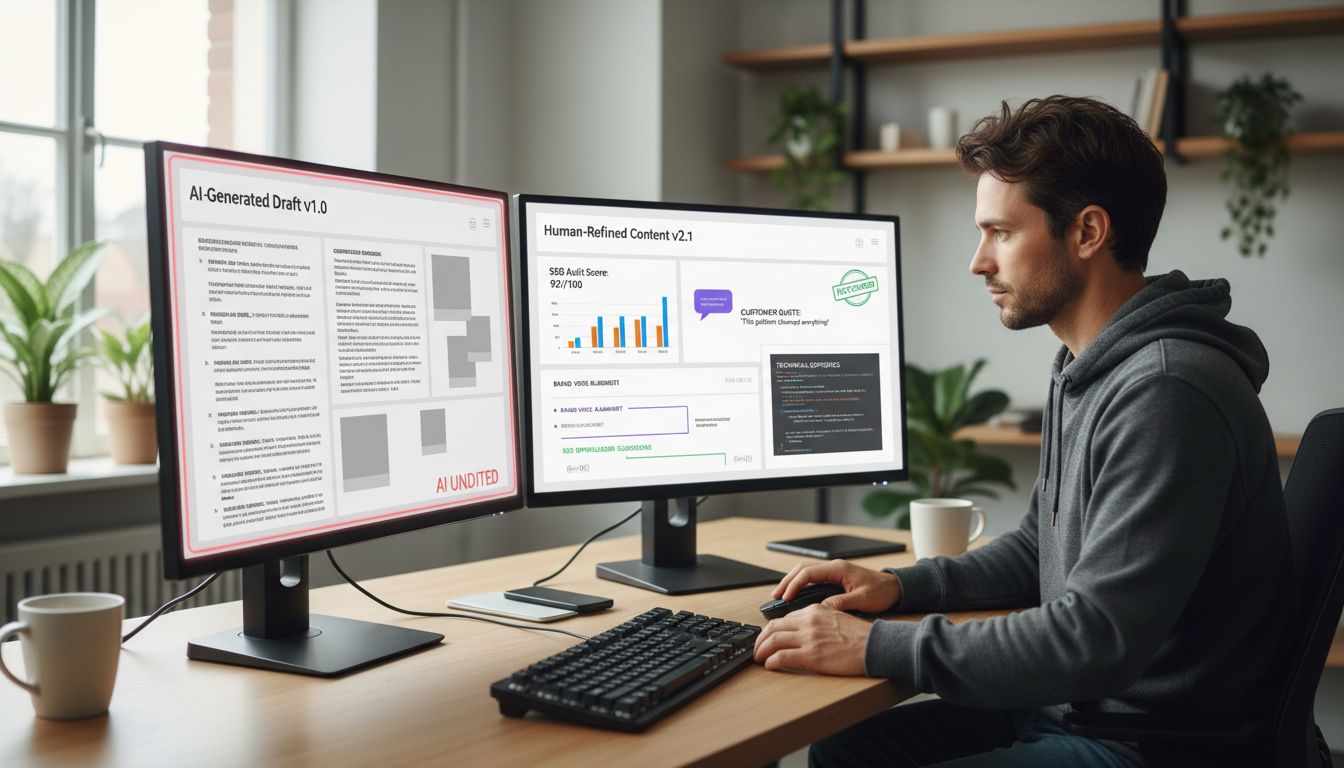
Set realistic expectations with your team: this draft is scaffolding, not a finished article. The AI will nail structure and keyword placement but will produce bland transitions, generic examples, and occasional factual errors. That's expected. You're trading 4 hours of blank-page drafting for 10 minutes of generation plus 90 minutes of intelligent editing.
Here's the thing: never publish an AI draft unedited. The ROI of AI content comes from velocity and quality, not velocity alone. Teams that skip human refinement see short-term traffic spikes followed by ranking drops as Google's quality signals catch up.
Phase 3: The Non-Negotiable Human Refinement Loop
This is where you separate signal from noise.
Your editor runs three sequential checkpoints, spending roughly 60-90 minutes per 1,500-word piece.
Checkpoint 1: Fact & Accuracy Review. The editor verifies every claim, statistic, and technical detail. Check that API security recommendations reflect current best practices, that linked sources are authoritative and recent, and that product comparisons are fair. Knowledge workers now spend an average of 4.3 hours per week fact-checking AI outputs, budget this time explicitly into your workflow, not as an afterthought.
Flag and rewrite any vague statements ("many experts believe") or unsourced claims. Add citations to primary sources: industry reports, your own product data, or customer case studies. This step typically takes 15-20 minutes per 500 words for technical SaaS content.
Checkpoint 2: Voice & Brand Alignment. AI writes in a flavorless corporate default. Your editor rewrites intros to hook your specific reader, swaps generic examples for customer stories, and injects contrarian or surprising angles that only come from domain expertise.
Ask: Would a prospect read this and think, "These people actually understand my problem"? If not, rewrite. Add specificity, replace "improve security" with "prevent token exfiltration in OAuth flows." This is where brand voice lives, and it's non-negotiable for SaaS companies where trust drives conversions.
Checkpoint 3: SEO & GEO Enhancement. Run the revised draft through Surfer SEO or Clearscope to validate on-page optimization, semantic keyword coverage, heading structure, content depth versus top-ranking competitors. Then optimize for Answer Engine visibility: break long paragraphs into 2-3 sentence blocks, place direct answers immediately after H2 headings, add FAQ schema for common questions, and structure lists for easy AI extraction.
This dual optimization, traditional SEO and GEO, is what separates content that ranks in Google from content that gets cited in ChatGPT, Perplexity, and AI Overviews.
Phase 4: Publishing, Promotion & Localization at Scale
Publish through your CMS (WordPress, Webflow, HubSpot) with proper schema markup and internal links to related product pages or high-authority pillar content.
Use your AI tools to generate promotional assets in 5 minutes: LinkedIn snippets, email newsletter summaries, and Twitter threads that drive initial traffic and social signals. For SaaS teams expanding internationally, AI localization is a serious advantage. Tools like DeepL or integrated translation features in platforms like Scalenut can translate your content at 30-50% lower cost than traditional agencies, with lead times cut by roughly 40%.
But here's the critical caveat: AI translation stumbles on domain-specific jargon. "OAuth token refresh flow" or "webhook payload validation" can get mangled without context. Always route translated drafts through a native-speaking domain expert for a final pass on technical terminology. The cost savings are real, but unedited machine translation will confuse your international prospects and damage credibility in new markets.
Track performance in both traditional analytics (Google Search Console for rankings and CTR, GA4 for engagement) and emerging AI visibility platforms (Perplexity Analytics, AthenaHQ) to measure whether your content is being cited as a source in AI-generated answers. Close the loop by feeding performance data back into Phase 1 for continuous improvement.
Measuring What Matters: From Traditional SEO to AI Visibility (GEO/AEO)
Your Google Analytics dashboard still shows organic traffic climbing. Your Search Console confirms you're ranking on page one. So why are your competitors suddenly appearing in ChatGPT answers while your brand gets ignored?
Welcome to the measurement gap that's catching SaaS teams off-guard in 2026.
Generative Engine Optimization (GEO) and Answer Engine Optimization (AEO) represent the evolution beyond traditional SEO. Where classic SEO aims to rank your page in position #3, GEO/AEO aims to get your content cited as the authoritative source inside the AI-generated answer itself. When someone asks Perplexity "What's the best project management tool for remote teams?" you want your brand mentioned in the synthesized response, not buried three clicks away.
The tactical shift is surprisingly straightforward. Place direct, concise answers immediately after your H2 and H3 headings. AI engines extract the first 1-2 sentences following a heading as candidate citations. Structure content with FAQ schema markup so answer engines can parse questions and responses cleanly. Keep paragraphs to 2-4 sentences, AI models favor scannable, modular content blocks over dense walls of text. Explicitly attribute data and claims with inline citations (e.g., "According to HubSpot's 2025 study…") because AI systems reward transparent sourcing.
Here's the thing: AI search traffic jumped 527% year-over-year in 2025, yet most SaaS teams still measure success exclusively through Google rankings. You're optimizing for yesterday's distribution channel while your audience migrates to AI-first discovery.
The KPI Comparison Table: Old vs. New
| Traditional SEO KPIs | 2026 AI Visibility KPIs |
|---|---|
| Organic Traffic (sessions from Google) | AI Citation Count (mentions in AI answers) |
| Keyword Rankings (position 1-100) | Share-of-Answer (% of AI responses citing you vs. competitors) |
| Domain Authority / Backlinks | AI-Generated Visibility Rate, AIGVR (% of target queries where you appear in AI output) |
| Conversion Rate from Organic | GEO vs SEO Delta Index (visibility gap between traditional SERP and AI answers) |
AI Citation Count measures how many times your domain is referenced as a source in AI-generated answers across platforms (ChatGPT, Perplexity, Google AI Overviews).
Share-of-Answer tracks your brand mentions as a percentage of total competitor mentions for a given topic or keyword cluster. Basically "share of voice" for AI responses.
AIGVR (AI-Generated Visibility Rate) calculates the proportion of your target queries where your content appears in AI answers, regardless of citation format.
GEO vs SEO Delta Index reveals the gap between your traditional search visibility and your AI answer presence. A negative delta means you're ranking well in Google but invisible to AI engines. That's a red flag for future traffic.
How to Track Your AI Visibility
Start with the tools from your Stage 4 stack. AthenaHQ tracks keyword-level visibility across ChatGPT, Perplexity, and Google AI Overviews, showing which competitors get cited for your target terms. Perplexity Analytics (if you're a verified domain) reports how often your content surfaces in Perplexity answers and which queries trigger those citations.
Set up monthly tracking for 10-20 high-intent queries relevant to your product. Query each major AI engine manually or via API, document which brands appear in answers, and calculate your share-of-answer percentage. It's tedious at first, but the pattern becomes clear fast.
The ROI case is simple: being cited in an AI answer delivers traffic quality comparable to owning the featured snippet. High intent, low friction, strong brand halo. Except AI answers don't require the click, so measure downstream brand search lift and direct conversions as leading indicators.
Common Pitfalls: How to Avoid Costly AI SEO Mistakes in 2026
You've built the stack. You've mapped the workflow. Now comes the part where most SaaS teams quietly sabotage themselves.
The gap between AI-assisted content success and expensive failure isn't technical. It's operational. The mistakes that kill ROI happen in the handoffs, the assumptions, and the corners you cut when you're racing to hit your Q2 publishing targets.
Here's what actually goes wrong, and how to stop it before it costs you ranking positions and brand trust.
Pitfall 1: Publishing Raw AI Output (The 'AI Mush' Problem)
Your competitors can smell AI-generated fluff from the first paragraph. So can Google's quality raters, and increasingly, so can the algorithm itself.
Publishing unedited AI content doesn't just fail to rank. It actively damages your domain authority. The telltale signs are everywhere: repetitive phrasing, hedged statements that say nothing, and that distinctive lack of specific examples that marks content written by something that has never actually used your product. You know the tone. That bland, technically-correct-but-utterly-forgettable voice that sounds like every other automated seo tools review on page three of Google.
The fix: Treat AI output as a research assistant's first pass, not a publishable draft. Mandate the two-step review process: one editor for factual accuracy and brand voice, one SME to inject actual expertise and contrarian insight. If an article doesn't include at least one data point, customer quote, or specific example from your domain, it's not ready to publish. Period.
Pitfall 2: Ignoring Hallucinations & Fact-Checking Time
AI models confidently invent statistics. They misattribute quotes and fabricate case studies. Knowledge workers now spend an average of 4.3 hours per week fact-checking AI outputs, and that number climbs when you're writing about technical topics or citing industry benchmarks.
The cost isn't just time. It's the reputational hit when a prospect catches a fabricated stat in your pillar content about the best seo tools for beginners.
The fix: Budget 15–20 minutes of fact-checking time per article in your production timeline. Require editors to verify every statistic, every product claim, and every competitor comparison against primary sources. Use tools with Retrieval-Augmented Generation (RAG) to ground AI outputs in your actual documentation, and flag any claim that lacks a verifiable citation for manual review. Honestly, if you're not doing this already, you're playing roulette with your brand credibility.
Pitfall 3: Mismatched Workflows & Briefs
Handing an AI the same two-paragraph brief you'd give a freelance writer produces generic garbage.
AI doesn't infer context or remember your last three conversations about brand voice. Human writers fill gaps with judgment. AI fills gaps with the statistically most common next token, which is why you get "in today's fast-paced SaaS landscape" in every introduction. Especially painful when you're trying to rank guides about free ai seo tools or best ai seo tools where differentiation matters.
The fix: Build standardized AI brief templates that include explicit constraints. Your brief should specify target keyword, target audience pain points, 2–3 competitor URLs to analyze for structure, brand voice examples (paste actual paragraphs from your best content), forbidden phrases, and required elements like customer quotes or data visualizations. Treat the brief as executable instructions, not creative guidance. The more specific you get, the less editing you'll need later.
Pitfall 4: Neglecting Localization & AI Visibility Tracking
Machine translation without domain review creates subtle disasters. "Customer success" becomes "client victory." Technical jargon gets mangled. Your EMEA content reads like it was written by someone who learned English from a phrasebook.
Meanwhile, you're optimizing for Google rankings while ChatGPT and Perplexity are citing your competitors in 40% of answers to your core queries. And you have no idea because you're not measuring it.
This hits particularly hard if you're publishing seo tools list content or comparison guides about top seo tools. Your carefully researched article ranks on page one in Google, but when someone asks an AI chatbot for recommendations? Crickets. Or worse, your competitor gets cited instead.
The fix: Require a native-speaking subject matter expert to review every localized piece before publication, with specific attention to industry terminology and product feature names. For AI visibility, integrate a tracker like Perplexity Analytics or AthenaHQ into your monthly reporting dashboard. Track citation count and share-of-answer for your top 20 money keywords the same way you track SERP position. If you're investing in best automated seo tools content but not monitoring whether AI engines actually cite you, you're flying blind.
Getting Started: Your 90-Day AI SEO Pilot Plan

You've absorbed the workflow, memorized the pitfalls, and bookmarked the tools. Now comes the part that actually separates strategic teams from those stuck in analysis paralysis: shipping something.
The biggest mistake SaaS teams make when adopting automated seo tools isn't picking the wrong platform. It's trying to scale before they've proven the system works. You need a controlled pilot that de-risks the investment and builds internal buy-in before you commit to a multi-tool stack and retrain your entire content operation.
Here's your 90-day roadmap to go from "AI-curious" to "AI-operational."
Pre-Flight: Weeks 0-2 (Setup & Baselines)
Start narrow. Pick one content pillar that matters to your pipeline. Ideally something like product how-to guides, feature comparison pages, or a high-volume FAQ cluster tied to your core value proposition.
Choose one or two tools maximum for this pilot. If you're testing the full workflow, pair a content optimization tool like Surfer SEO ($89/month Essential plan) with an AI drafting tool like Scalenut ($19/month for 5 articles). Both offer trials. Resist the urge to test six platforms at once. You'll spend more time managing logins than learning what works.
Define your success metrics before you write a single word.
Select three target keywords from your pillar. Record their current rankings in Google Search Console and their baseline monthly traffic in GA4. Set your AI citation count baseline at zero by using Perplexity or ChatGPT to manually check if your brand appears in answers for those queries today. Finally, establish your review protocol. Assign one person to edit every AI draft. Create a three-point checklist: factual accuracy, brand voice consistency, and citation-worthiness (does this piece answer a question better than competitors?). Document who approves what, and when content goes live.
Pilot Execution: Weeks 3-10 (Test & Learn)
Produce four to six pieces using the complete 2026 workflow: keyword research → AI brief generation → AI first draft → human editing → optimization check → publish.
Track everything. Log how many minutes each stage takes. Note every quality issue: hallucinations, off-brand phrasing, missing context. Collect feedback from your editor after every piece. What broke? What surprised you? What would make the next draft 20% better?
Do not scale yet.
Your only job during these eight weeks is to refine the process until it's repeatable. If your editor is rewriting 80% of every draft, your prompts or tool choice need adjustment. If fact-checking is taking longer than writing from scratch, you need tighter source constraints in your AI brief. This is where you figure out whether your chosen best free seo tools actually deliver on their promises or just create more work.
Review & Scale Decision: Weeks 11-13 (Analyze & Iterate)
Pull your metrics. Compare week-12 rankings and traffic to your week-0 baseline. Check manually for AI citations by searching your brand name in Perplexity, ChatGPT, and Google AI Overviews for your target queries.
Calculate your pilot ROI using this formula: ((Estimated Value of Leads Generated - Total Pilot Costs) / Total Pilot Costs) × 100. If you generated two demo requests worth $5K each and spent $2K on tools plus 40 hours of labor, your ROI calculation shows whether the unit economics work.
Make the go/no-go decision.
If content velocity increased by more than 50% and quality stayed consistent (measured by editor time and engagement metrics), expand to a second content pillar. If velocity improved but quality tanked, tighten your review checklist and add one more human touchpoint. If neither improved, diagnose the breakdown before you invest another dollar. Wrong tools? Unclear prompts? Mismatched content type?
This isn't a race to replace your writers. It's a test to see if AI can help your small team compete with competitors who have ten times your headcount. The top seo tools and best ai seo tools mean nothing if you can't build a repeatable process around them.
Conclusion
Automated SEO tools won't save your content program. A workflow will.
The SaaS teams winning organic growth in 2026 aren't the ones with the biggest tool budgets. They're the ones who built a repeatable system: AI for velocity, humans for judgment, and metrics that track both Google rankings and AI citations.
Your stack should cover discovery, creation, optimization, and AI visibility measurement. Your workflow must enforce human review at every quality gate. Your KPIs need to include AI Citation Count and Share-of-Answer alongside traditional organic traffic. And your rollout should start narrow. One content pillar, 90 days, clear thresholds before you scale.
Look, this isn't about replacing writers. It's about giving your small team the leverage to compete with companies that have ten times your headcount. That's the actual unlock here.
Pick one pillar. Map it to the workflow in section three. Track traditional and AI metrics from day one.
Run the pilot, measure what matters, and iterate. The goal isn't perfection. It's a scalable engine for predictable growth that doesn't fall apart the moment your AI draft hallucinates a feature your product doesn't have.
Frequently Asked Questions
Can AI SEO tools fully replace human writers?
No. And anyone selling you that vision is lying.
AI handles data processing, ideation, and first drafts better than humans ever will. But you still need people for strategy, brand voice, fact-checking, and any thought leadership that doesn't sound like it was written by a committee. The winning formula is AI for scale plus human for quality and trust. 76% of enterprises now include human-in-the-loop processes specifically to catch AI hallucinations before deployment [Source: Drainpipe.io].
What is the most cost-effective AI SEO tool for a bootstrapped SaaS?
Start with tools that offer robust free tiers or trials. MarketMuse's free plan works well for content gap analysis. Semrush gives you a seven-day trial before charging $25/month. Scalenut's Essential plan runs $19/month for five SEO articles [Source: Semrush, Scalenut].
Even $50-100/month can yield solid ROI if you validate the workflow first. Pair any paid tool with free Google Search Console and Analytics 4 to track impact without burning budget.
How do I measure the ROI of an AI SEO tool?
Use this formula: ((Value of Organic Leads - Tool & Labor Costs) / Tool & Labor Costs) × 100 [Source: Coalition Technologies].
Track cost per article including human review time, organic traffic lift, keyword rankings, and lead conversion changes. HubSpot's case study showed a 167% traffic increase after six months of using AI features, but your results will vary based on execution and market [Source: HubSpot]. The key is establishing baseline metrics before you introduce any new tools into your workflow.
What's the biggest risk of using AI for SEO?
Publishing unedited, inaccurate, or generic "AI mush" that damages brand credibility and fails to rank.
This stems from skipping human-in-the-loop checkpoints. 93% of marketers review AI content before publishing for good reason [Source: Semrush]. The fix is mandatory editorial review for facts, voice, and strategic alignment, plus an "AI smell test" to catch robotic tone and filler [Source: Brightspot]. Honestly, if you're not running human QA on every piece, you're gambling with your domain authority.
What is the best AI SEO tool for a SaaS company?
"Best" depends entirely on your stage and needs.
For beginner-focused teams, prioritize user-friendly tools with strong integrations like Surfer SEO ($89/month) or Semrush ($25/month for Writing Assistant) [Source: Surfer SEO, Semrush]. For advanced teams tackling GEO/AEO, look at AirOps (free starter plan), AthenaHQ for multi-platform AI search visibility tracking, or Perplexity Analytics to measure AI citation performance [Source: AthenaHQ]. Refer to the "Tools for Every Stage of the Funnel" section above for stage-specific recommendations.
How can I automate my SEO content process?
Build a five-step workflow.
First, use AI for keyword clustering and brief generation. This reduces research time around 90%. Second, feed the brief to an AI drafting tool with explicit constraints and examples. Third, implement a two-step human review: fact and accuracy first, then voice and brand. Fourth, run the draft through an on-page optimizer like Surfer or Clearscope before publishing. Fifth, track both traditional SEO metrics and AI visibility KPIs like citation count and share-of-answer [Source: Averi.ai, Semrush].
This human-supervised workflow is how you scale without sacrificing quality. The automation handles the grunt work. Your team handles the judgment calls that actually determine whether content performs.