July 6th, 2026
How to Use Free AI Writing Tools to Scale Your SEO Content Production
 WD
WDWarren Day
Most people grab a free AI writing tool, paste in a keyword, and wonder why the output reads like spam.
That's not a tool problem. It's a process problem.
If you're a solo founder or junior marketer trying to scale SEO content with no budget, you've probably already pasted a keyword into one of the many free AI writing tools and gotten back something generic and lifeless. The promise is real, AI can get you to a draft 430% faster [Source: Nightwatch.io]. But without a proper system, that speed just means you're producing bad content faster.
The average 500-word post takes about 4 hours to write manually [Source: Nightwatch.io]. You need that speed. You just can't afford the quality drop that usually comes with it.
The answer isn't finding the best free AI writing tools and hoping one of them magically solves it. It's building a smarter process around whatever tools you're already using.
AI isn't a writer. It's a specialist assistant. The difference between people who get good output from free AI writing tools like ChatGPT and people who don't is almost never the tool itself, it's whether they've built an actual production pipeline around it.
That means assigning specific, repeatable tasks to the right tool (research, drafting, optimization) and keeping all the strategic and editorial decisions in human hands. That's how you go from generating content to actually building something useful.
This guide covers how to put together a zero-cost stack, which AI to use for which job, and a five-step human-led workflow that gives your content the expertise and originality search engines actually reward. Whether you're looking for something better than ChatGPT for writing or trying to figure out the best AI for writing novels and long-form content, the process is the same.
Treat AI as a component in your system. Not the system itself.
Before You Start: Prerequisites for Your AI Pipeline
Get this wrong and you'll spend hours generating content that never ranks. Get it right and you'll have a system that scales.
You need three things ready before you generate a single word.
-
A Target Keyword List. Even a short one. "Best CRM for startups," "how to calculate CAC," "email marketing software comparison." You can't delegate research to an AI if you don't know what you're researching. If you don't have this, stop. Go use a free tool like Google Keyword Planner, AnswerThePublic, or Ahrefs' free keyword generator to get 5-10 starter phrases. This is non-negotiable.
-
Access to Your Free AI Assistants. You are the project manager; these are your junior writers. Create accounts for:
- ChatGPT (Free Tier): Your brainstorming and research partner. The free version has rate limits, but it's sufficient for outlines and ideation.
- Claude.ai (Free Tier): Your long-form drafter and editor. Claude's free plan is excellent for expanding outlines into coherent sections.
- A Google Account: For Docs and Sheets. This is your central hub for outlines, drafts, and edits. Never write your final draft directly inside an AI chat interface.
- A Clear Picture of Your Audience. Who are you writing for? A technical founder? A time-pressed marketing manager? Jot down one or two core pain points they have. This is the compass that guides every prompt you write and every edit you make.
Here's the mindset shift that actually matters: you are not replacing yourself with an AI. You're becoming an editor and a strategist. The AI handles the repetitive drafting. You provide the direction, the expertise, and the final quality control.

A lot of people assume this process eliminates work. It doesn't. It multiplies your output, but your effort just moves, upstream into strategy, downstream into editing.
According to HubSpot, 86% of marketers who use AI edit the output before publishing. Plan to spend at least 30% of your total time on the human editorial pass. That's where you inject the originality and authority that AI can't give you.
Whether you're using one of the many free ai writing tools, looking for free ai writing tools like chatgpt, or trying to figure out what's better ai than chat gpt for writing long-form content, the prerequisite list is the same. Keywords, tools, audience clarity. That's it.
If you have those three things, you're ready to build. If not, spend 20 minutes sorting them out now.
Adopt the Pipeline Mindset: System Over Tool
Why do most people get zero results from free AI writing tools?
Because they treat them like a magic button. Dump a keyword into ChatGPT, copy the output, hit publish. That's the "generate and pray" approach. And it's why 86% of marketers who use AI still edit the output before publishing (Source: HubSpot). The content feels generic, lacks any real expertise, and rarely ranks.
The fix is to build a production pipeline.
You're not using one tool to write an article. You're running a sequence of tasks, handing each one off to the best free AI for that specific job, while you stay in control of the strategy. This is how content professionals save around 12.3 hours a week Source: Nightwatch.io.
Think of it as an assembly line, not a single craftsman sitting down to write from scratch. Your job shifts from writer to editor-in-chief. The AI handles structure, verbosity, and initial formatting. You bring the direction, the domain knowledge, and the final polish that Google's E-E-A-T criteria actually reward.
The pipeline has five stages:
- Research & Outline: You define the topic, intent, and structure. AI helps cluster keywords and draft a content brief.
- Drafting: You delegate specific sections to different tools based on their strengths (ChatGPT for explanations, Claude for long-form narrative).
- SEO Optimization: You run the draft against top-ranking pages using free SEO tools, tightening keyword placement, readability, and structure.
- Human Editorial Pass: You inject your expertise, verify facts, add unique insights, and fix the voice. This is where trust gets built.
- Publish & Track: You ship the piece and watch performance to feed the next cycle.
That shift from "tool user" to "pipeline manager" is what separates people who scale effectively from people who just generate noise. Whether you're exploring the best free AI writing tools, looking at free AI writing tools like ChatGPT, figuring out what's better AI than ChatGPT for writing, or hunting for the best AI for writing novels, the pipeline is the same.
In the next section, we'll match specific free tools to each stage.
Assemble Your Free AI Content Production Stack
Stop looking for the single best free AI writing tool. That's not how this works. You're building a system, which means you need different tools for different jobs.
Quick reality check: "free" almost always means limited. Rate limits, word caps, no access to the latest models. That's fine. You're not running a content farm. The constraints actually force you to be strategic about where each tool fits.
Your Core Free/Freemium Stack
- ChatGPT (Free Tier): The Ideation & Research Specialist. Use it for brainstorming, question clustering, and initial outlining. Its strength is conversational exploration. Prompt it to "generate 10 subtopics for an article about [your keyword]" or "cluster these search queries by user intent." It gets weak at long-form coherence, so stop before the draft stage.
- Claude.ai (Free Tier): The Long-Form Drafting Specialist. When you need a coherent, structured section of text, Claude tends to produce better first drafts than ChatGPT. It follows instructions more carefully for narrative flow. Give it your outline from ChatGPT and a specific prompt like "write the 'installation' section for a technical audience."
- Writesonic (Free Credits): The SEO-Aware Drafter. Its free plan offers about 25 credits (~10,000 words). Use those credits for drafts where integrated SERP data actually matters. Its AI Article Writer can pull live search data to inform structure, which is a useful preview of what paid tools do.
This is your answer to the "what are the top free AI tools" question people keep searching. For a bootstrapped pipeline, it's ChatGPT, Claude, and Writesonic's free tier. If you need to scale slightly beyond free limits, Rytr at $9/month is often cited as the best-value option for pure output volume.
The Supporting Cast: Niche Free Tools
Your pipeline needs more than text generators. For the technical SEO pass, use dedicated free tools:
- SEO Meta Generators: Tools from sites like SEO Review Tools or SEOSpace can generate title tags and meta descriptions. Feed them your primary keyword, get 5-10 options, then review for relevance. It automates a tedious task, but you still have to check the output.
Is there a completely free AI writer? Technically yes. ChatGPT and Claude both have free tiers. But "completely free" for scaling content is a myth. The real cost is your time: prompt engineering, editing, assembling outputs from three different places. These tools are free in dollars, not in cognitive overhead. You trade money for manual orchestration.
The goal isn't finding one tool to rule them all. It's assigning the right task to whichever free tool does it best. ChatGPT for ideas, Claude for drafts, Writesonic for SEO-informed sections, niche tools for metadata. Whether you're working through the best free AI writing tools, exploring free AI writing tools like ChatGPT, trying to find something that's better AI than ChatGPT for writing, or hunting for the best AI for writing novels, the stack looks roughly the same.
Tool Specializations: Why One AI Doesn't Fit All
The question isn't "which free AI is better for writing?" It's "better for what?"
People ask "what AI is better than ChatGPT?" like there's a single answer. There isn't. It depends entirely on the task.
ChatGPT's free tier is fast and good at ideation. Need ten headline variations in thirty seconds? Nothing touches it. But ask it to draft a 1,500-word technical guide and you'll hit context limits quickly, the output gets repetitive or just drifts.
That's where Claude comes in. It's often cited as a better AI than ChatGPT for writing long-form content, and the reason is pretty concrete: its context window is larger, it handles complex reasoning better, and it produces more coherent drafts with fewer hallucinations. TheStacc's 2026 market segmentation explicitly calls out Claude's strength in long-form and thought-leadership content.
Here's the practical difference. Ask both tools to "explain technical SEO to a beginner."
ChatGPT probably gives you a bullet-point list. Claude is more likely to build a narrative, introducing crawl budget before indexation, using consistent analogies throughout. Use ChatGPT to brainstorm the outline, then hand the actual section writing to Claude.
The pipeline works because you're not asking one tool to do everything. You're giving each tool the job it's actually good at, within its free-tier constraints.
Step 1: Research and Outline with Strategic Prompts
The outline is where the article's quality actually gets decided. Not in the drafting, not in the editing. Here.
This isn't about generating a random list of headings. It's about turning your seed keyword into a structured, intent-matching blueprint that the AI can follow. Your role is strategic director, not copywriter.
Open ChatGPT (free tier). Your first prompt needs to frame the task and force strategic thinking. Don't just ask for an outline.
Use this exact prompt structure:
"Act as an SEO content strategist for the [your industry, e.g., SaaS marketing] industry. For the primary keyword '[your keyword, e.g., free AI writing tools]', analyze the user's search intent. Then, generate 5 distinct article angles that would satisfy that intent, ranked by commercial potential for a bootstrapped business."
ChatGPT will return something like:
- "A guide comparing the top free AI writing tools."
- "How to build a scalable content pipeline using only free AI tools."
- "The pros, cons, and hidden limitations of popular free AI writers."
- "A step-by-step tutorial for writing a blog post with ChatGPT's free tier."
- "free AI writing tools vs. paid: when is it worth upgrading?"
Your job is to pick the angle that actually fits your audience and commercial goals. For a bootstrapped founder, angle #2 wins. It's systematic, solves a real scaling problem, and aligns with the pipeline approach we're building here.
Now build the skeleton. Don't let the AI work in a vacuum.
Run a second, more specific prompt:
"For the angle 'How to build a scalable content pipeline using only free AI tools,' create a detailed article outline with H2 and H3 headings. Incorporate these related questions from 'People Also Ask': 'Is there a completely free AI writer?', 'What is the 30% rule for AI?', and 'Can I sell content written with ChatGPT?'. Ensure the outline flows from problem identification to implementation."
You'll get a structured outline back. Now do the human verification pass, this is the part most people skip.
- Check logical flow: Does it move from "Why this matters" to "How to do it" to "Pitfalls to avoid"? Re-order sections if needed. The AI often puts the conclusion too early.
- Inject keywords naturally: Weave your primary keyword ("free AI writing tools") and secondaries ("best free ai writing tools") into some H2s and H3s. Don't keyword-stuff, aim for clarity. For example, change "Selecting Your Tools" to "Assembling Your Free AI Writing Tools Stack."
- Assess depth: Does the outline fully address the core intent? If you're promising a "scalable pipeline," does it include steps for research, drafting, optimization, and editing? If not, add a missing H2: "Step 4: The Human Editorial Pass."
The common failure mode is accepting the first outline without any of this critique. AI can help with keyword clustering and drafting, but it won't give you topical authority on its own. Your input here, choosing the angle, refining the structure, checking commercial intent, is what separates a ranking article from generic AI spam.
Whether you're using the best free AI writing tools or looking at better AI than ChatGPT for writing long-form content (including anyone exploring the best AI for writing novels), the outline step doesn't change. Good structure is good structure. The tools just help you build it faster.
Your output should be a living document: a bullet-point outline with clear H2/H3 hierarchy, integrated keyword targets, and notes on which tool handles each section. That's what you're delegating from in the next step.
Step 2: Draft by Delegating Sections to the Right AI
You have a blueprint now. A structured outline with keyword targets and tool assignments. The job shifts: stop being the architect, start being the construction manager.
Delegate each section to the AI best suited for it.
Do not paste your entire outline into a single prompt and ask for a 2,000-word article. This is the most common mistake people make. You'll exceed context windows, get a disjointed mess, and waste an hour untangling it. Use the "chunking" method instead.
-
Open Claude.ai (free tier) in your browser. For long-form sections that need narrative flow and detailed explanation, Claude's larger context window makes it the best free AI writing tool for this kind of work. Coherence across long passages is where it consistently beats the alternatives.
-
Feed it one H2 section at a time. Copy your H2 heading and its H3 sub-points from your outline. Use this prompt template:
Write an informative, detailed section for a blog post titled "[Your H2 Heading Here]".

The audience is founders and solo marketers in bootstrapped startups. They are technical and time-poor.

Cover these sub-points in order:
- [H3 Sub-point 1]
- [H3 Sub-point 2]
- [H3 Sub-point 3]

Use a direct, practical, and slightly opinionated tone. Write in British English. Do not use marketing fluff or phrases like "in today's fast-paced world". Assume the reader is intelligent but needs clear, actionable steps.
-
Repeat for each major H2 section. Process them sequentially. Let Claude generate 300-800 words per section. Each one stays coherent internally and follows the structure you built.
-
Use ChatGPT for shorter, definitional tasks. While Claude handles the narrative heavy lifting, hand off glossary boxes, simple bulleted lists, or quick term definitions to ChatGPT. Its free tier is fine for contained, non-narrative jobs like these.
-
Combine everything into a single document. Paste each section's output in order. You now have a complete first draft.
Verification step: Skim the combined draft against your original outline. You're checking for completeness, not quality. Does every H2 and H3 have corresponding text? Flag gaps and any factual claims that need checking. Do not start line-editing or polishing sentences. That comes in Step 4.
This is also why people searching for the best ai for writing novels often land on Claude, that same ability to hold coherence across long narrative sections is exactly what you want here. The principle carries over: match the chunk to the AI that handles it best.
The real bottleneck in content creation isn't writing words.
It's structuring thought. You solved that in Step 1. Now you're using free ai writing tools like ChatGPT (and Claude) as a force multiplier to fill in that structure at speed, while saving your judgment for what actually needs it.
If you're evaluating better ai than chat gpt for writing long narrative sections, Claude is the honest answer. The best free ai writing tools aren't interchangeable, they have different strengths, and this step is where that distinction actually matters.
Step 3: Execute the Technical SEO Optimization Pass
You have a complete draft. Now you use free AI writing tools to generate the technical, on-page SEO elements that directly affect clicks and rankings.
AI handles this efficiently. But you're still the final judge.
Start with meta titles and descriptions. Paste your article's intro and conclusion into a free meta generator, or just use this prompt in ChatGPT: "Generate 3 SEO-optimized meta title and description pairs for this article summary: [your summary]. Target keyword: [primary keyword]."
The best free ai writing tools are built for exactly this kind of task, meta tag copy, H1s, SEO-friendly URLs. And it's not trivial: AI-generated meta descriptions improved click-through rate by 12% on average, according to pikaseo.com.
Then ask the same AI for a concise, keyword-rich URL slug. After that, run your H2 headings through it: "Review these H2s for clarity and keyword inclusion: [list headings]."
Here's the critical human verification step. Don't blindly accept the first output. Your job is to judge "clickability."
- For meta tags: Pick the pair that sounds most compelling to a human searching, not the one stuffed with the most keyword repetitions. AI's first suggestion is usually generic.
- For the slug: Make sure it's readable and not over-optimized.
yourdomain.com/free-ai-writing-tools-guideis good.yourdomain.com/best-free-ai-writing-tools-2026-seois spammy. - For headings: Check that they build a clear, logical hierarchy and actually reflect the content beneath them.
Common Failure: Publishing the AI's first meta suggestion without touching it.
Here's a real example from a test I ran:
- Bad AI-generated title: "Utilizing free AI writing tools: A Comprehensive Guide to SEO Content Production"
- Good human-edited title: "Scale Your SEO Content with Free AI Tools (A Founder's Pipeline)"
The first is technically correct. It's also lifeless. The second speaks directly to the reader's problem and hints at a real solution.
That's the difference between a box-ticker and an editor.
This step is about efficiency, not abdication. Let AI produce the options. You own the final click decision.
Step 4: The Human Editorial Pass, Injecting E-E-A-T
So what actually separates AI-generated content from something Google wants to rank? This step.
Think of it as the 30% rule: your human input should make up at least 30% of the article's final value. Not in word count. In insight, evidence, and perspective that no AI can fake.
Don't just fix grammar and typos. That's the bare minimum. Your job is to systematically inject Google's E-E-A-T criteria: Experience, Expertise, Authoritativeness, and Trustworthiness.
Here's your concrete editorial checklist.
Add Experience
Find the first generic statement in your draft. Replace it with a first-hand anecdote.
For an article on AI content pipelines, I'd swap "AI tools can speed up research" with: "When I built Spectre's integration with DataForSEO, the API latency meant our keyword clustering jobs would timeout if we didn't implement incremental caching. That's a real friction point most 'speed' metrics ignore."
That transforms an abstract claim into something only someone who's actually built the system could say.
Inject Expertise
AI drafts state trends without citing real, current data. Your job is to anchor every significant claim.
If the draft says "many marketers use AI," you change it to: "As of 2024, 71% of surveyed marketers use generative AI weekly or more." For technical SEO points, cite Ahrefs' Domain Rating studies or SEMrush's SERP feature analyses. Name the actual report. This shows you're not just repeating things you've heard.
Build Authoritativeness
AI text meanders. Read your draft and ask: "What's the actual point of this paragraph?" Then rewrite the topic sentence to be more forceful.
Add strategic internal links too. If you mention "keyword clustering," link to your own deep-dive guide. If you reference "E-E-A-T signals," link to Google's Search Quality Rater Guidelines. You're building a network of credibility, not just filling space.
Ensure Trustworthiness
Fact-check everything. AI hallucinates statistics, misattributes studies, and invents tool capabilities.
Then add nuance where the draft is overconfident. If the AI declares "AI content ranks just as well," you counterbalance: "While 72% of SEO professionals think AI-assisted content performs at least as well, Google's #1 position is still overwhelmingly held by human-written pages." That kind of honest calibration is what builds trust with readers.
Now, fix the prose.
AI writing is bland and passive. Search for "can be," "is able to," "utilize." Replace them with stronger verbs. Then read the article out loud. Where you stumble, that's where the transitions need work.
Here's why this step isn't optional: 86% of marketers who use AI edit the output before publishing. And human-edited AI content drives 32–45% higher organic traffic growth than purely manual workflows. The editorial pass isn't cleanup. It's where the value gets added.
The most common failure is treating this like proofreading. Fix only commas and spelling, and you'll publish something competent but forgettable. No unique insight. No reason for readers to bookmark it or for Google to elevate it.
Your experience is the moat. Your expertise is the ranking signal.
Common Mistakes and How to Troubleshoot Your Pipeline
Even with the best pipeline, you'll hit friction points. Here are the six most common mistakes I see teams make with free AI writing tools, and how to fix them.
Mistake 1: Publishing Unedited AI Content Consequence: High bounce rates, poor rankings, content that reads like generic marketing fluff. An AI-generated meta description might boost CTR by 12%, but unedited blog posts decrease time-on-page by 34% [Source: PikaSEO]. Fix: Never skip Step 4. Treat every AI draft as a rough scaffold. 86% of marketers edit AI output before publishing [Source: HubSpot]. If you're short on time, at minimum verify facts, inject one unique personal insight, and rewrite the introduction in your own voice.
Mistake 2: Scaling Low-Quality Content Consequence: Google flags your site for spam. Scaled content abuse created purely to game rankings violates their spam policies [Source: theStacc]. Fix: Focus on quality per piece, not quantity. Ask yourself: "Would I publish this if I had to write it manually?" If the answer is no, either improve the draft or scrap it. Volume without value is a fast track to penalties.
Mistake 3: Treating AI Output as Fact Consequence: Inaccurate content. Especially damaging for YMYL topics like finance or health, where a single wrong claim destroys reader trust. Fix: Implement a mandatory fact-checking step. Use AI for ideation and structure, but verify every statistic, claim, and technical detail against authoritative sources. Your expertise is the guardrail, not the AI's confidence.
Mistake 4: Over-Optimizing Meta Elements Consequence: Keyword-stuffed titles and descriptions that users ignore, which hurts CTR. Fix: When using free AI tools for meta tags, prioritize click appeal over keyword alignment. Edit the output to sound human, address intent, and include something that makes someone actually want to read it. Perfect keyword placement means nothing if no one clicks.
Mistake 5: Ignoring Long-Term Ranking Trajectory Consequence: Strong initial indexing followed by a steep drop-off. In one experiment, 71% of AI-generated pages indexed within 36 days, but only 3% remained in the top 100 results by months 3-6 [Source: SearchEngineLand]. Fix: Monitor rankings past the first month. If traffic drops, go back in. Add recent examples, update statistics, deepen the analysis. Treat the published article as a living document, not a one-time output.
Mistake 6: Assuming AI Automatically Improves Quality Consequence: Generic, surface-level content that doesn't stand out. Only 72% of SEO professionals think AI-assisted content performs as well as human-written work [Source: Semrush]. That means over a quarter see a quality gap. Fix: Whether you're using the best free ai writing tools, free ai writing tools like chatgpt, or something marketed as a better ai than chat gpt for writing, the pipeline mindset stays the same. AI handles speed and structure. You provide depth and originality. That's true even if you're using the best ai for writing novels or cranking out blog posts. The tool generates a draft. You provide the insight that makes it worth reading. That part isn't optional.
The Legal and SEO Reality Check
Two questions stop most founders cold: "Is this legal?" and "Will Google penalise me?"
On copyright: The U.S. Copyright Office has been consistent here. Raw, unmodified AI output probably isn't copyrightable because there's no human authorship. But the editorial pass changes that. Significant human modification, structuring, and added expertise transforms the work into your expression.
The pipeline I've outlined, where AI drafts and you provide the expertise, gives you a defensible position for commercial use.
Google's official stance is origin-agnostic. They evaluate quality, helpfulness, and originality, not how the content was created. But their March 2024 core update made one thing clear: scaled, low-value content created primarily to manipulate rankings is spam.
The algorithms detect patterns of thin, templated content. One well-edited, expert-led article assisted by AI won't trigger those patterns. A thousand unedited outputs from the same prompt absolutely will.
Here's the data that matters: a Convert analysis found the overlap between pages cited in Google's AI Overviews and those ranking in the top 10 organic results dropped from 76% in July 2025 to just 38% by March 2026.
Google is getting better at separating content good enough for a quick AI citation from content that holds long-term organic authority.
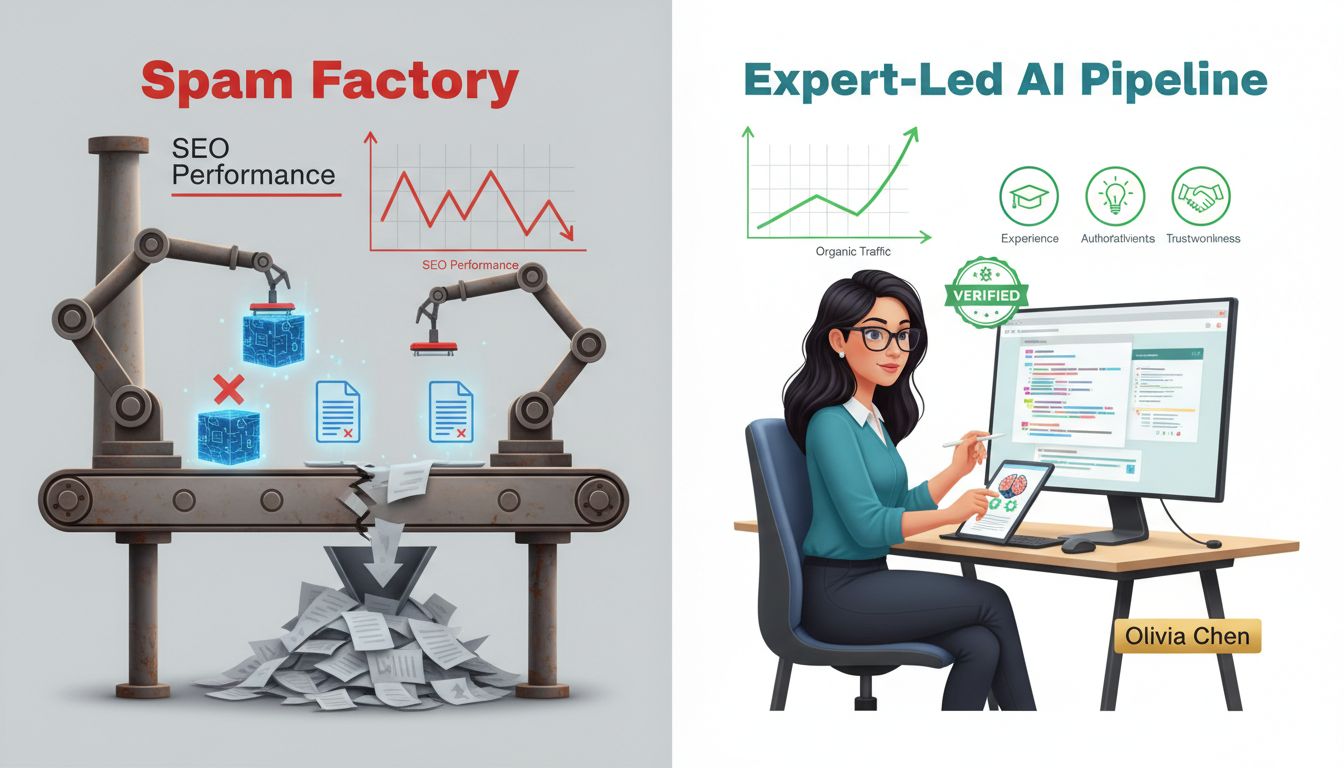
This pipeline works because it inverts the typical approach. Instead of generating at scale and hoping some of it sticks, you use free AI writing tools to accelerate the creation of individual, high-quality pieces where you remain the authoritative source.
Remove the human judgment, and you're not scaling content anymore. You're running a spam factory that will fail in search and leave you with assets you don't even own.
That's true whether you're using the best free AI writing tools, free AI writing tools like ChatGPT, something marketed as a better AI than ChatGPT for writing, or even the best AI for writing novels. The tool drafts. You provide the insight. That part doesn't change.
FAQ: Your Questions on Free AI Writing Tools, Answered
Is there a completely free AI writer?
Sort of. Most "free" tiers come with daily limits or credit caps. Writesonic's free plan gives you 25 credits, which works out to roughly 10,000 words (source: TheStacc). Truly unlimited free writing is rare outside of open-source models, and those require technical setup. Treat the free tiers as a starting point, not a complete solution.
Which AI is 100% free?
ChatGPT and Claude both offer free access tiers, but with rate limits. For 100% free, unlimited output, you'd need to run open-source models like Llama or Mistral locally, which takes real technical knowledge and computing resources. For most people, the freemium tiers of mainstream tools are the practical answer.
Which free AI is better for writing?
Depends on the task. For long-form structure and narrative coherence, Claude's free tier does well. For creative ideation and general speed, ChatGPT's free version has the edge. The honest answer is you should be delegating different writing tasks to different AIs anyway.
What is the 30% rule for AI?
It's a practical guideline: edit at least 30% of any AI-generated content before you publish it. That edit is where you inject domain expertise and strip out the generic patterns that unedited AI output is full of. That human pass is what turns an AI draft into something that actually ranks.
What is the smartest AI that I can use for free?
For complex reasoning and following detailed instructions, Claude's free tier is particularly strong. For general knowledge and conversational speed, ChatGPT's free version leads. "Smartest" depends entirely on what you're asking it to do.
Can I sell a book I wrote with ChatGPT?
Probably, if you've made substantial edits and added real creative input. Selling raw, unedited output is where you run into copyright risk, because AI can't hold copyright. Your ownership depends on the degree of human creative contribution. More on this in the Legal and SEO Reality Check section above.
Conclusion
Scaling SEO content with free AI writing tools isn't about finding a magic button. It's about building a pipeline where AI handles the predictable, repeatable tasks (research, drafting, technical optimisation) while you supply the strategy, domain expertise, and editorial judgment that Google's E-E-A-T criteria actually care about.
The numbers back this up. Content creation is 430% faster on average with AI [Source: nightwatch.io], and 72% of SEO professionals say AI-assisted content performs at least as well as human-written content [Source: semrush.com]. But that second stat only holds when a human is leading the process.
So here's the next step. Pick one keyword this week and run it through the full four-step pipeline outlined above. Time yourself. Compare it to your old manual process. You'll see it immediately.
If orchestrating all of this still sounds like a lot, that's exactly what Spectre is built for. It automates the whole system, from keyword research and SERP analysis through to drafting and publishing, so you can stay focused on the part only you can do.
Frequently Asked Questions
Is there a completely free AI writer?
Most "free" AI writing tools run on credits or daily limits, not unlimited output. Writesonic's free plan gives you 25 credits (around 10,000 words), and ChatGPT's free tier has usage caps. [Source: thestacc.com]
The practical way to think about it: treat free tiers as starting points in a production pipeline. Use them for specific tasks like research or drafting sections, then switch tools or upgrade when your scale demands it.
Which AI is 100% free?
Truly unlimited, 100% free text generation means running open-source models locally on your own hardware. That requires technical setup. The free tiers from ChatGPT, Claude, and Gemini all have usage limits. [Source: thestacc.com]
For foundational SEO work those limits are often fine. But if you're pushing out dozens of articles a week, you'll hit a ceiling eventually.
Which free AI is better for writing?
Depends on the task. For long-form content that needs structural coherence and can follow a complex outline, Claude's free tier is exceptionally strong. For creative ideation, brainstorming variations, and breadth of knowledge, ChatGPT is hard to beat. [Source: nightwatch.io]
My setup: Claude for drafting article bodies, ChatGPT for meta descriptions and H2/H3 subheadings. These are among the best free ai writing tools available right now, and using them together gets you further than picking one.
What is the 30% rule for AI?
It's a guideline that says you should add at least 30% original content to any AI-generated draft. Not about word count though. It's about value: your expertise, specific examples, contrarian takes, firsthand experience. Things the AI genuinely can't replicate. [Source: pikaseo.com]
That's what turns generic output into content that demonstrates E-E-A-T. Which is what actually ranks.
What is the smartest AI that I can use for free?
"Smartest" really does depend on what you're asking it to do. For analytical reasoning and multi-step instructions, Claude's free tier is currently the one to beat. For general knowledge and conversational speed, ChatGPT is still the benchmark. [Source: searchengineland.com]
In practice, I use Claude for structuring arguments and ChatGPT for quick fact-checks and tone adjustments. If you're looking for better ai than chat gpt for writing in specific contexts, Claude is worth trying. The combination ends up smarter than either alone.
Can I sell a book I wrote with ChatGPT?
Probably yes, if you've made substantial edits and original contributions that establish clear authorship. Selling raw, unedited AI output is a different story. Copyright doesn't apply to purely machine-generated text. [Source: slatehq.com]
The key is transformation. Use AI as a drafting tool, then rewrite, restructure, and inject your voice until it's genuinely yours. That applies whether you're writing a blog post or looking for the best ai for writing novels. The AI gets you a draft. What you do with it is what matters.