July 21st, 2026
Jasper AI vs Copy.AI: Which AI Writing Tool Wins for SEO Content?
 WD
WDWarren Day
Which tool actually gets articles ranking without turning you into a full-time editor?
That's the question. Not "Jasper AI vs Copy.ai, which writes better copy?" That framing is everywhere, and it's solving the wrong problem.
Here's what actually happens: you pick an AI writing tool, you generate drafts, and then you spend the next three hours researching keywords separately, editing for brand voice, optimizing for SEO, adding images, and manually publishing. The bottleneck was never text generation. It's the entire production pipeline around it.
I've watched this pattern repeat across startups and enterprises. Teams buy into AI writing tools expecting a content engine, and end up with a fancier manual process.
I'm a technical founder. I've spent 15 years building software, integrating directly with DataForSEO's API, building automated keyword clustering systems, and watching how large media companies actually orchestrate content at scale. The thing most jasper ai vs copy.ai comparisons miss is the axis that matters most: throughput. How many articles can you publish per week that actually rank, and what's the hidden operational drag eating your time?
This isn't a standard feature comparison.
Jasper positions itself as the SEO-focused platform, native integrations, long-form templates. Copy.ai markets itself as the speed and workflow tool for marketing teams. Both have real merits. But both keep you firmly in the driver's seat, manually steering every piece from concept to publication.
My take: choosing between Jasper and Copy.ai is like choosing between two manual transmission cars when what you actually need is something that drives itself. The whole debate assumes you want to drive. I assume you want to reach the destination.
We'll compare them across four axes that actually determine whether your content strategy scales or stalls.
On-page SEO & Ranking Potential: Which tool produces content that ranks? We'll look past the marketing claims, Jasper's Surfer SEO connection versus Copy.ai's conflicting feature claims, and get into what "SEO features" actually mean when Google increasingly penalizes generic AI output.
Workflow Efficiency & Operational Drag: Time from keyword idea to published article. Both Jasper's structured editor and Copy.ai's template-driven approach require significant human intervention. Those hidden minutes per article add up to days of lost productivity each month.
Governance, Accuracy & Search Risk: Jasper's reported 77.3% factual accuracy edges out Copy.ai's 73.7%, but both can produce content that scores 100% AI on detectors like Originality.ai. That's a real risk when Google explicitly penalizes low-quality automated content.
Total Cost of Ownership: The real price isn't just the subscription. It's your team's editing time, the additional SEO tool subscriptions you'll need, and the opportunity cost of content that doesn't rank. Jasper's $99+/seat pricing versus Copy.ai's $29 entry point is only part of the story.
Throughout this comparison I'll draw on my experience building Spectre, an AI-powered SEO content platform that automates the entire pipeline from research to publication. I'm not a marketer who learned to code, I'm an engineer who watched how editorial teams, SEO strategists, and developers collaborate (and clash) inside large media companies, then built systems to remove the friction.
The biggest cost in content production isn't the AI tool subscription. It's the human time required to make AI output actually valuable. Jasper might give you better SEO integrations, but you're still manually moving content between tools. Copy.ai might be faster for drafts, but you're still responsible for optimization and publishing.
There's also something most comparisons skip entirely: domain rating fundamentally constrains your keyword strategy, and no AI writer accounts for this. Jasper won't tell you which keywords are actually winnable for your site's authority. Copy.ai won't warn you that you're targeting keywords dominated by domains with 10x your backlink profile. That gap between what SEO tools suggest and what actually ranks is where most content strategies quietly fail.
The "pick Jasper for SEO, pick Copy.ai for speed" advice is oversimplified. Both tools trap you in an inefficient middle ground, not fully manual, but nowhere near automated.
If you're spending more than 30 minutes per article on editing, optimization, and publishing, you're experiencing exactly the operational drag that neither tool solves. The real question isn't which one generates better text. It's which system gets ranking articles onto your site with minimal ongoing effort.
What is Jasper AI?
Jasper is an AI writing platform built for content marketing teams and SEO-focused creators who need to scale long-form production. It's not a generic GPT wrapper. It positions itself as the SEO specialist, with native integrations to Surfer SEO and Semrush for real-time optimization scoring as you write.
The core differentiator is its long-form editor, basically Google Docs with AI built in, paired with Brand Voice training that learns your company's tone from existing content.
On top of that, you get SEO Mode for keyword optimization, plagiarism checking through Copyscape, and collaboration features for teams managing editorial calendars.
Jasper has over 50 templates, 17 of which are built specifically for long-form content like blog posts and product descriptions [Source: searchatlas.com/blog/jasper-ai-review]. It's used by over 100,000 businesses and rated 4.8/5 across reviews. Pricing runs Creator ($39-49/month), Pro ($99-125/seat/month), and custom Business plans for enterprises.
What is Copy.ai?
Copy.ai is built for speed, not depth.
Where Jasper leans into long-form SEO content, Copy.ai is aimed at marketing teams, sales ops, and founders who just need copy out the door fast. Ad variations, email sequences, social posts, product descriptions, that kind of thing.
It has over 90 templates and 100+ copywriting tools, and it scores 4.9/5 on G2 for ease of use [Source: searchatlas.com/blog/copy-ai-review]. The interface is chat-like, the template library is tuned for volume, and the whole thing is set up to help you crank out marketing and sales collateral quickly.
Integrations with Zapier, Mailchimp, and Salesforce mean it plugs straight into GTM workflows without much friction.
It's not really built for evergreen, ranking articles. If you're comparing jasper ai vs copy.ai and your main job is building out a content library for SEO, Copy.ai isn't the right fit. But if you're running campaigns and outbound sequences and need to move fast, it is.
Pricing starts around $29/month for the Chat plan, with team tiers (Growth, Expansion, Scale) that go up from there into enterprise territory for high-volume usage.
On-page SEO & Ranking Potential: Which Tool Actually Gets Results?
Features don't rank pages. Properly structured, optimized content does. This section looks at which tool actually moves search rankings, not just which one has more SEO checkboxes.
Jasper's approach is systematic. Its "SEO Mode" and native integrations with Surfer SEO and Semrush create a real optimization framework. You plug in a target keyword, get real-time scoring against ranking pages, and adjust headings, keyword density, and structure as you write.
The workflow is: research, brief, write, optimize, publish. There's documented evidence it delivers too, businesses using Jasper's SEO features see an average 40% improvement in organic performance, with one online retailer hitting a 45% traffic increase on product pages. Though to be fair, those numbers are tied to workflows using Jasper, not Jasper running by itself.
Copy.ai is a murkier picture. Some sources say it has no built-in SEO features, no keyword research, no content scoring, no internal linking guidance. Copy.ai's own marketing says otherwise, claiming automated brief generation and SEO-optimized drafts.
At best, that gap suggests its SEO capabilities are less structured than Jasper's. It's built to generate copy fast, not to methodically beat specific SERPs. For teams where SEO is the primary channel, that ambiguity is a real problem.
Here's the friction point both tools share: they output text. To rank, someone still has to manually handle H2/H3 structure, internal linking, meta descriptions, title tags, and schema markup.
Jasper might give you a better-optimized draft. But you're still copying it into your CMS, manually adding links, and hoping your WordPress plugin handles the rest. The Surfer SEO integration that powers most of Jasper's optimization costs $99/month on top of everything else. You're assembling the plane while flying it.

This is where Spectre was built differently. It doesn't just write text, it writes directly to SEO guidelines. The system automatically structures articles with proper heading hierarchies, suggests contextually relevant internal links based on your site map, and generates schema markup.
The output isn't a draft for manual assembly. It's publish-ready, with the on-page technicals already handled. That removes the hidden labor that makes "SEO-optimized" AI writing a misnomer in most tools.
There's also a subtler risk: detectability. In one comparative test, both Jasper and Copy.ai outputs scored 100% AI confidence on Originality.ai. Publishing raw, unedited AI content is a known ranking risk.
Jasper's framework encourages more human editing within the workflow, which helps. Copy.ai's speed-first model pushes users to publish faster with less refinement. Neither solves the real problem, adding unique expertise and editorial judgment is still a manual, human task.
Verdict on this axis: If you're comparing jasper ai vs copy.ai for serious SEO work and have the personnel to manage the full optimization and publishing process, Jasper's ecosystem is the stronger foundation. Copy.ai isn't built for this. But both require significant manual labor and extra tooling to translate features into actual rankings. The real differentiator isn't which AI writes better text, it's which system gets that text properly structured and published. That's the gap automated pipelines like Spectre are designed to close.
Workflow Efficiency & Operational Drag: From Prompt to Published
Features are one thing. Getting content from a draft to a ranked article is where the real work lives, and where the real costs hide.
This isn't about which AI writes faster. It's about which system creates less operational drag across an entire SEO content pipeline.
Copy.ai's velocity trap is real. It's great for a social media caption in 30 seconds. For a 1,500-word SEO article? You're on your own for the hard part: exporting the draft, pasting it into Surfer SEO ($99/month, separate), sourcing images, formatting headers and meta tags in your CMS, then publishing. Its 90+ templates are tuned for speed, but only for the first 10% of the job. The other 90%, the part that determines whether you rank, is all manual.
Jasper streamlines the drafting phase, but not the pipeline. Keyword research via integrations, writing, and Surfer SEO optimization all live in one dashboard. That reduces context switching while you're actually writing. But the workflow still hits a wall at publication. You manually export, format, add images, and push to WordPress or Webflow yourself.
Jasper has API access on Pro and Business plans, but you're responsible for building the integration to your CMS. That's either developer time or a Zapier setup that breaks when you need it most.
Putting numbers to this is uncomfortable. A 1,500-word article might take 1 hour in Jasper's editor, then 2+ hours of human editing, SEO tuning, image sourcing, CMS formatting, and scheduling. So 3+ hours total, most of it manual. Copy.ai's version of this workflow is arguably worse, more tool-hopping, more friction.
Both tools have the same blind spot: they're content generators, not content systems.
They solve the prompt-to-draft problem and leave the draft-to-published-to-ranked journey entirely to you. Every manual export, every copy-paste, every CMS login is a friction point that scales directly with your content volume. That's why teams hit a throughput ceiling.
We built Spectre to cut this operational drag out entirely. The workflow is the platform. You put in a target keyword. Spectre researches the SERP, clusters related terms, writes a fully optimized long-form article, generates images, and publishes directly to your CMS. No export, no secondary SEO tool, no manual formatting.
Keyword to published post. One automated event.
That 16-month AI content experiment showed what volume can look like, 71% of new AI pages indexed within 36 days. But getting there with jasper ai vs copy.ai means manually shepherding hundreds of articles through a fragmented process. The bottleneck was never AI writing speed. It's your team's capacity to manage everything that comes after.
Verdict on this axis: For short-form copy, Copy.ai's templated speed wins. For long-form drafting with fewer interruptions, Jasper reduces some of the drag. But neither tool touches the fundamental operational tax of running a content engine at scale. If you're trying to publish dozens of ranking articles per month without proportionally growing your team, you need an automated pipeline. A better AI writer isn't enough.
Governance, Accuracy & Search Risk: Protecting Your Brand and Rankings
AI-generated content carries business risk beyond poor rankings. Factual errors damage credibility. Hallucinated claims open you to legal liability. Google's evolving algorithms penalize low-quality automated content, especially after their 2026 updates pushing harder on expertise and experience.
The accuracy numbers are sobering. In one test, Jasper hit a 77.3% factual accuracy rate (17 accurate claims out of 22). Copy.ai scored 73.7% (14 out of 19). That 3.6% gap might feel small until you're publishing YMYL content, finance, health, anything where a single wrong figure destroys trust.
Then there's detectability. Both tools scored 100% AI confidence when tested with Originality.ai. Publishing raw output is asking for trouble. I've seen ranking drops happen within weeks when teams skip the human review step.
Jasper has stronger enterprise-grade governance. SOC 2 Type II, GDPR, and CCPA compliance matter when you're handling client data or working in regulated industries. Copy.ai has a subtler issue: its terms treat generated content as owned by OpenAI, with a license granted back to the user.
For most businesses that won't matter. For a legal team reviewing IP ownership, it's a red flag.
The editing requirement becomes a hidden cost center. Every article needs fact-checking against primary sources, brand voice alignment, and actual human insight added. That's not optional, it's what separates content that ranks from content that gets filtered out. Both Jasper and Copy.ai treat this as your problem, not theirs.
We built Spectre to bake governance into the pipeline from the start. E-E-A-T prompting frameworks, flagged fact sources that need verification, automatic schema markup generation. Not skipping the editing step, making it systematic instead of reactive.
Verdict on this axis: For enterprise teams handling sensitive data, Jasper's security posture wins. For anyone publishing public-facing SEO content, both jasper ai vs copy.ai leave you exposed without rigorous human oversight. Better accuracy percentages aren't the real answer. A workflow that makes quality control unavoidable is.
Total Cost of Ownership (TCO): The Real Price of Ranking Content
The subscription price you see on a pricing page isn't the real number. It's a tiny fraction of what ranking content actually costs.
Total cost of ownership for an SEO content operation includes software subscriptions, labor hours, and opportunity cost. The time your team spends managing tools instead of creating strategy.
Start with sticker prices. Jasper's Creator plan sits around $39-49/month, but for SEO workflows you're looking at the Pro tier at $99-125 per seat monthly [Source: vendr]. Copy.ai's entry-level Chat plan is $29/month, but their Growth/Expansion tiers jump to $1,000-3,000/month for team bundles [Source: eesel.ai].
On paper, Copy.ai wins for solo users. Jasper looks more expensive but includes more SEO scaffolding.
Now add the hidden stack. Jasper's SEO advantage comes from integrations, not built-in features. Surfer SEO starts at $99/month [Source: stackmatix]. Semrush, another common Jasper pairing, starts at $129/month. Throw in Grammarly ($30/month) and an AI detector like Originality.ai ($20/month) to manage search risk.
Copy.ai lacks these integrations entirely. You're exporting raw text and running it through the same external tools separately. That $29/month plan quietly needs $250+ in additional software before it produces anything ranking-worthy.
The biggest cost isn't software. It's time.
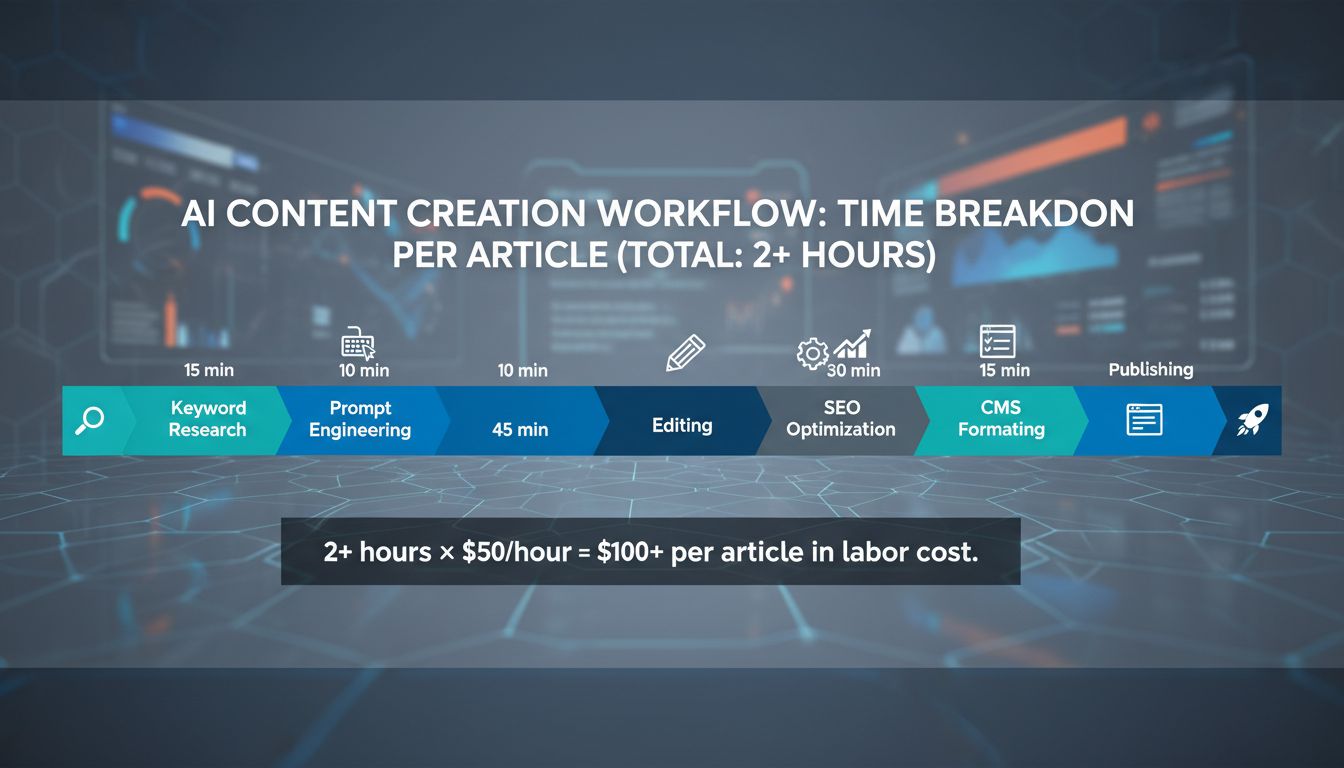
A typical SEO article requires keyword research (15 minutes), prompt engineering in Jasper/Copy.ai (10 minutes), editing for accuracy and brand voice (45 minutes), optimization against Surfer's checklist (30 minutes), formatting for your CMS (15 minutes), and publishing (10 minutes). That's over 2 hours at a conservative $50/hour rate. $100+ in labor per article before you've paid a single software subscription.
This is the fundamental economic problem with manual AI writing tools: high variable costs. Every article requires fresh human intervention. The more content you produce, the more your labor costs scale linearly.
Your team becomes expensive prompt engineers and editors rather than strategic content creators.
The only metric that matters is cost per ranking article. Calculate it as (Monthly Software Stack + Monthly Labor Cost) / Number of Articles That Actually Rank. With Jasper, you might spend $300/month on software and $2,000 on labor for 20 articles, that's $115 per article. With Copy.ai, you'd spend similar on software (you need the same external tools either way) but likely more on editing time due to weaker SEO guidance. Maybe $125 per article.
Here's where Spectre's economics diverge. Our platform internalizes the entire stack: keyword research via DataForSEO, SERP analysis, content generation optimized against ranking factors, automated publishing. The labor cost per article approaches zero because the system handles research, writing, optimization, and publishing in a single workflow.
You're paying for outcomes. Not for access to a tool that still requires hours of manual work.
Verdict on this axis: In the jasper ai vs copy.ai comparison, Copy.ai appears cheaper but leads to higher TCO for SEO content, no integrated optimization tools will do that. Jasper's higher price includes more SEO scaffolding but still carries labor costs that scale with your output. For founders and SEO leads who need predictable, scalable content economics, both tools trap you in a variable-cost model where growth means hiring more editors.
Conclusion
So which one wins, Jasper AI vs Copy.ai? Honestly, neither framing gets you to the answer that actually matters.
Jasper has better SEO scaffolding through integrations like Surfer. Copy.ai is faster for short-form copy but has zero built-in ranking tools. Both leave you manually managing keyword research, briefs, editing, and optimization.
That's the trap. More content means more manual labor. The variable costs scale with your output, and the real number to watch is cost per ranking article, subscriptions plus editor hours plus the risk of publishing content that never ranks.
I've built content systems for media companies and agencies. This operational drag is what kills growth. Not bad writing. The coordination overhead.
That's why we built Spectre, an automated pipeline that handles keyword research, AI writing optimized for your domain, and direct publishing. It's built around outcomes, not just text generation.
If you're scaling content for organic growth, stop choosing between manual AI writers. See how Spectre automates your entire SEO pipeline. Start your free trial at https://spectreseo.com.
Frequently Asked Questions
Which AI is best for writing SEO content?
Jasper has native integrations with Surfer SEO and Semrush, which makes it the more structured option for on-page SEO work [Source: searchatlas.com]. But it still requires you to handle keyword strategy, briefs, and optimization scoring manually.
Both tools produce raw text that needs human editing for E-E-A-T and factual accuracy. Publish either one as-is and you're taking on real search risk.
Is copy AI better than Jasper?
Rarely. In the jasper ai vs copy.ai comparison, Copy.ai only wins in a pretty narrow case: you need high-volume short-form copy (social posts, ads, email sequences), you're using its GTM integrations, and you have zero SEO goals [Source: slatehq.com].
For anything meant to rank, Jasper's workflow holds up better. That said, both are manual text generators, and that whole category is starting to look dated compared to automated end-to-end SEO systems.
Can ChatGPT write SEO content?
Yes, but you have to be careful. ChatGPT can write a draft that covers a topic. What it doesn't have is the structured workflows, SEO-specific templates, or editorial guardrails you get from something like Jasper.
To use it well, you need to bring a complete brief, target keyword, H2 structure, tone, and then manually handle every technical SEO element yourself (meta tags, schema, internal links). That's a lot of expertise and time. For non-experts, the risk of producing thin, generic content is high.
Is copy AI worth paying for?
The subscription price is only part of it. The real cost includes an SEO tool like Surfer ($99/month), a plagiarism checker, and somewhere between one and two hours of editing per article [Source: stackmatix.com].
Jasper Pro ($99/month) has the same problem. You still need Surfer, still need editing time.
The number that actually matters is cost per ranking article, total monthly spend divided by the articles you can realistically produce, optimize, and get to rank. That's the metric both tools struggle to justify.