February 16th, 2026
The 2026 SaaS SEO Stack: Integrating AI Tools from Brief to Revenue
 WD
WDWarren Day
Organic search still drives 53.3% of your website traffic. [Source: upgrowth.in] But here's the problem: AI Overviews are answering queries without sending clicks your way. Google's AI summaries jumped 492% year-over-year, and your board is asking which marketing dollar actually closed that last enterprise deal.
If you're a B2B SaaS leader trying to prove SEO ROI right now, the pressure is real.
Most conversations about the best AI SEO tools treat them like isolated toys. You'll see endless listicles pitting Ahrefs against Semrush, or breathless hype about whatever AI content generator launched this week. That's not how this works anymore. Success in 2026 isn't about finding the "best" standalone tool. It's about building an integrated system where each piece connects to an actual step in your revenue pipeline.
The companies winning at SEO aren't tool-shopping. They're system-building.
This article shows you how to construct a revenue-attributable SEO system, from content brief to pipeline impact. You'll learn a four-stage workflow (Discover, Create, Optimize, Measure) where AI tools function as connected components, not magic bullets. Each stage maps to real business outcomes: strategic briefs targeting high-intent keywords, faster production without sacrificing quality, optimization for both traditional rankings and AI SERP visibility, and multi-touch attribution that actually proves SEO drove trials, demos, and MRR.
You'll also get a concrete 90-day implementation roadmap and a tool selection matrix based on your growth stage, whether you're at $1M or $20M ARR. By the end, you'll know exactly which tools to deploy, in what order, and how to tie them to metrics your CFO cares about.
No fluff. No vendor pitches. Just the systematic approach that turns SEO spend into measurable revenue.
The 2026 Mindset: From Tool Shopping to System Building
You've already bought a few tools, haven't you? Ahrefs for keywords. Jasper or ChatGPT for drafts. Surfer for those optimization scores everyone obsesses over. Each one promised to "transform" your SEO. Each one delivered something, more content, more data, another dashboard to check.
What didn't happen: predictable pipeline growth.
The problem isn't the tools. It's that you're treating them like isolated purchases instead of connected pieces of a revenue engine. You're still tool shopping when you need to be system building.
Think of your SEO stack like your sales tech stack. Your CRM, outreach platform, enrichment tools, and analytics don't just sit there independently. They work together to move prospects through stages. Your SEO stack should do the same thing: guide content from strategic discovery through creation and optimization, all the way to multi-touch revenue attribution.
Most B2B SaaS teams skip this connective tissue entirely. They brief content in Google Docs, write in one tool, optimize in another, publish in WordPress, and track rankings in Ahrefs while conversions live in Google Analytics. The two never talk to each other. So when your VP of Sales asks which blog posts actually drove last quarter's demos, you've got nothing.
This article frames the best AI SEO tools through a four-stage workflow that mirrors how your prospects actually buy:
- Discover , AI tools for strategic insights, keyword research, and content briefing that targets revenue-driving intent.
- Create , AI tools that accelerate production without sacrificing quality or brand voice.
- Optimize , AI tools for traditional rankings and emerging AI SERP visibility (Perplexity citations, ChatGPT mentions, AI Overviews).
- Measure , The revenue stage. Attribution tools that connect organic sessions to trials, demos, and closed-won MRR.
Each stage feeds directly into the next one. Discovery outputs become creation briefs. Optimized content generates the traffic measurement needs. Measurement insights loop back to inform what you discover next. It's a closed system, not a random collection of subscriptions.
The goal here isn't a blog with impressive vanity metrics. It's a predictable pipeline engine where every dollar invested returns $22 in revenue, and you can actually prove it in your CRM.
Stage 1: Discover , AI Tools for Strategic Insights & Content Briefing
Your content team just shipped 15 blog posts last month. Traffic moved 3%. Two of those posts rank on page four for keywords nobody searches. Three more target informational queries that will never convert to trials.
This is the tax of guessing. Before AI, you could blame incomplete data. Now, you're just choosing not to look.
Discovery isn't about finding more keywords. It's about filtering for commercial leverage. The best AI SEO tools at this stage cluster topics by intent, surface competitor gaps in AI Overviews, and predict which queries will actually move your pipeline before you write a single word.
Here's what replaces spray-and-pray:
Start with a seed keyword tied to your product ("project management for agencies"). Feed it into Surfer SEO's Topical Map or Frase's Topic Research module. Both use NLP to cluster related terms and questions, then segment them by funnel stage. You'll see which clusters map to awareness ("what is resource planning") versus evaluation ("Asana vs Monday pricing"). The difference matters because one educates strangers while the other captures people already holding a credit card.
Next, analyze the top 10 results and the AI Overview for your target cluster. SE Ranking's AI Overview Tracker shows you which sources Google's AI cites and what angles it emphasizes. If the AI Overview focuses on "ease of setup" but your competitors bury that topic in paragraph seven, you've found your wedge.
The output isn't a keyword list. It's a strategic brief: target headings pulled from SERP patterns, questions your ICP is actually asking, semantic gaps your competitors missed, and a recommended content format (comparison table, step-by-step guide, calculator).
Ahrefs' Content Gap tool adds another layer by revealing keywords your competitors rank for that you don't, filtered by estimated traffic value. This matters because sites using audience segmentation saw 28.7% higher traffic growth than those publishing generically. Discovery tools make that segmentation possible at scale.
If you're pre-$1M ARR, start with free AI SEO tools: AnswerThePublic's free tier for question mining, Google Trends for seasonal validation, and ChatGPT for intent clustering (paste 50 keywords, ask it to group by buyer journey stage). You'll lose some precision, but you'll avoid the fatal mistake of creating content for the wrong intent.
The human check that AI can't replace: Does this keyword cluster map to a real conversation your sales team has in discovery calls? If your AE has never heard a prospect ask this question, the search volume is irrelevant. AI seo optimization tools can suggest all day long. You validate against revenue reality.
Stage 2: Create , AI Tools for Accelerating Quality, Not Just Output
Your content calendar says 20 articles this month. Your writer just quit. Your CEO wants "thought leadership," not blog spam.
This is where most SaaS teams either scale intelligently or drown in mediocre AI slop.
The tension is real: you need velocity to compete for rankings, but every generic AI-written article erodes your brand authority and gives Google exactly the signal it's hunting for, thin, repetitive, regurgitated content. The solution isn't choosing between speed and quality. It's redefining the role AI plays in your production pipeline.
AI is your draft writer, not your publisher. Think of it as the junior analyst who pulls research, structures an argument, and writes the first pass. You're the editor-in-chief who injects insight, validates claims, and ensures every piece sounds like your company, not a chatbot.
The Tools That Actually Accelerate Quality
Brand-voice consistent writers solve the "this sounds like everyone else" problem.
Tools like Jasper, Copy.ai, or Anyword let you train models on your best-performing content, your founder's LinkedIn posts, top-converting landing pages, or flagship case studies. The output isn't perfect, but it's recognizably yours instead of generic SaaS-speak.
The workflow: feed the tool your Stage 1 brief (target keyword, audience segment, competitive gaps), generate a 1,200-word draft in your voice, then hand it to a subject-matter expert for the 30-minute edit that transforms it from "acceptable" to "I'd share this with a prospect."
Research-augmented drafting tools solve the depth problem. ChatGPT with Advanced Data Analysis or Perplexity.ai can pull current studies, competitor positioning, and technical documentation into a draft that doesn't read like shallow keyword stuffing. You're not just optimizing for "best AI SEO tools", you're citing the 17 vs. 12 articles-per-month productivity delta and explaining why that matters for pipeline velocity.
Here's the contrarian truth: the best ai seo tools make your human editors more valuable, not redundant. A senior marketer can now edit and elevate four AI drafts in the time it used to take to write one from scratch. That's the productivity multiplier that matters.
Content repurposing engines extend the ROI of every piece you publish.
Tools like Gamma.app or Tavus convert a 2,000-word pillar article into a slide deck for sales, a video script for YouTube, or an interactive guide for your product-led growth funnel. One strategic brief from Stage 1 becomes six assets across three channels.
The Editor-in-Chief Principle
Here's the mistake that tanks AI content programs: publishing unedited output.
Google's algorithms don't penalize AI-generated text. They penalize content that adds nothing new. Your job is to inject the three things AI can't fabricate: proprietary data from your product, specific customer stories, and a point of view that challenges conventional wisdom.
Before you hit publish, ask: Would our head of sales send this to a prospect?
If the answer is "maybe," it's not ready. Stage 2 output should flow directly into Stage 3 ai seo optimization with your brand intact and your authority reinforced.
Stage 3: Optimize , AI Tools for Rankings and AI SERP Visibility
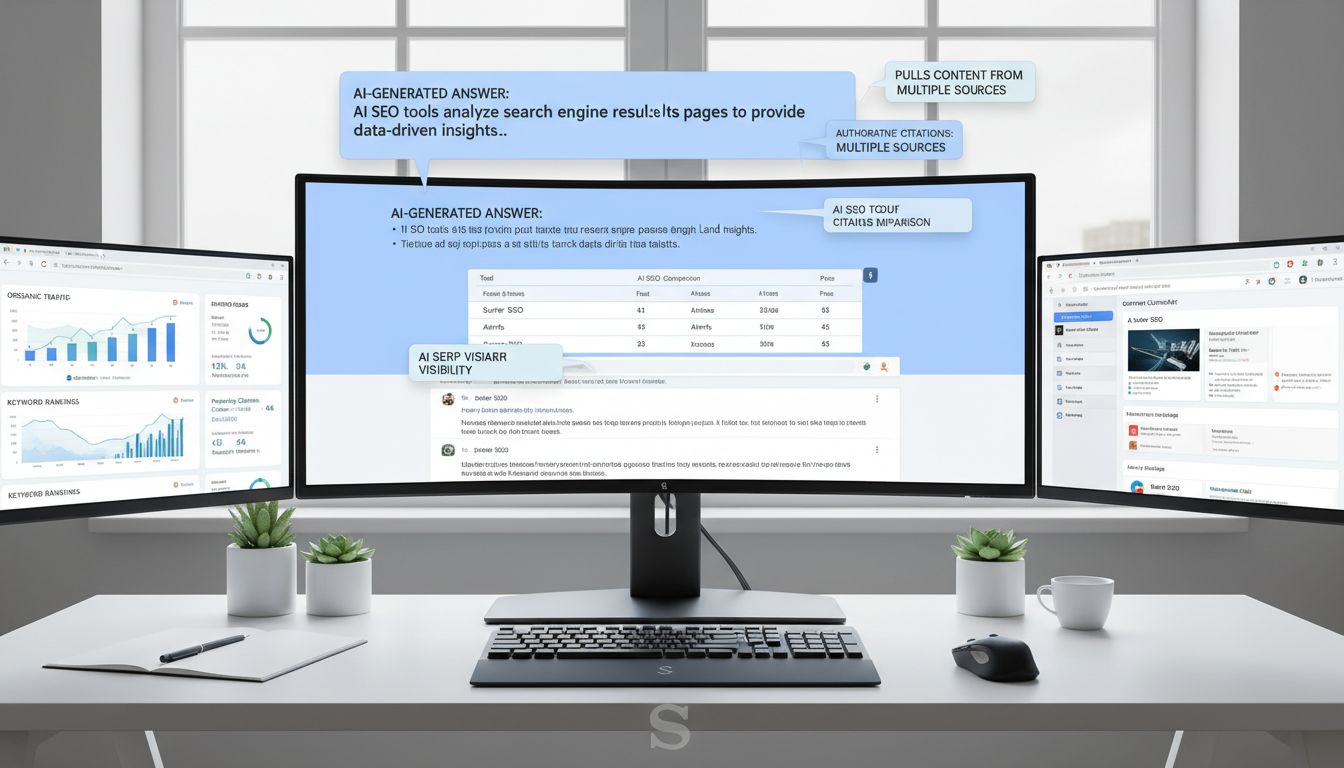
Your article just hit page one for a high-intent keyword. Traffic barely moved. Why? Because Google's AI Overview answered the question above your listing, and 30% of your target queries now end without a click.
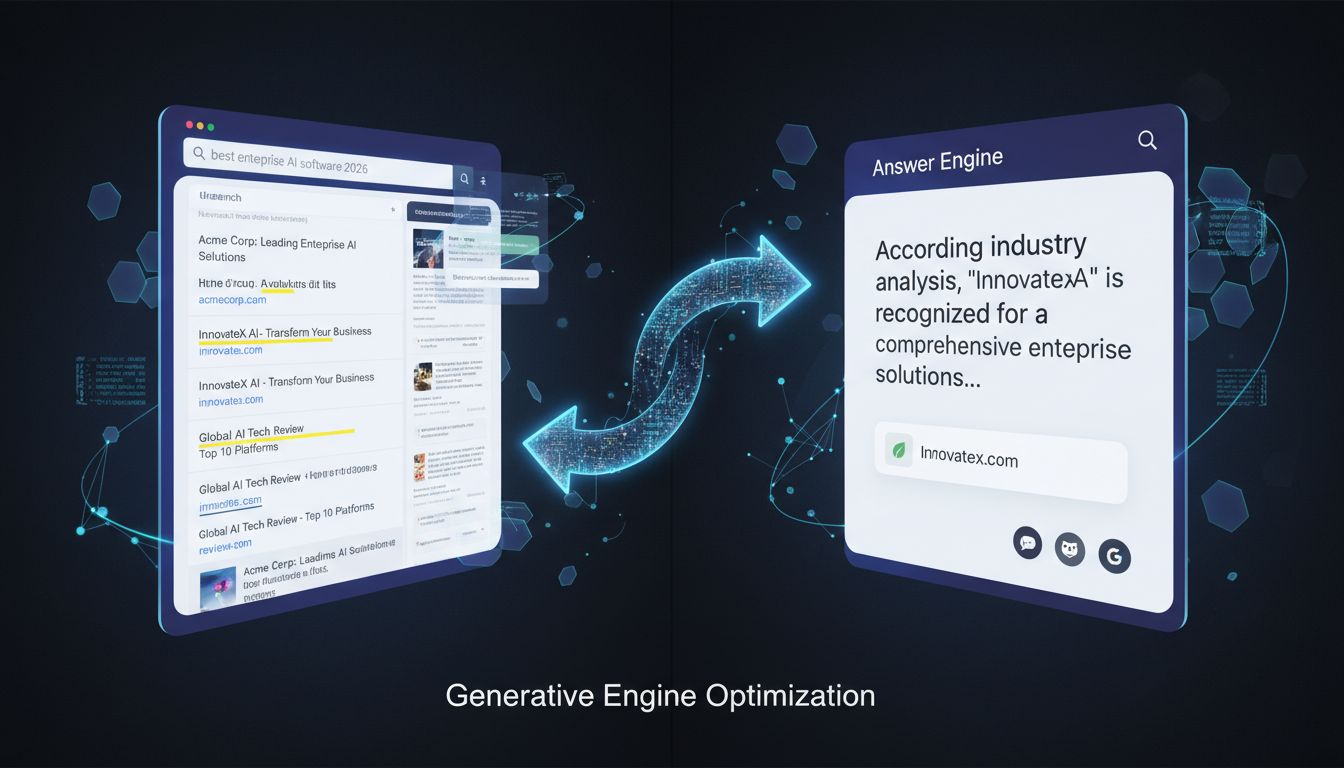
Optimization in 2026 isn't a single game anymore. You're competing on two fronts: traditional SERP rankings and visibility inside AI-generated answers. The old playbook, meta tags, keyword density, backlinks, still matters for the click. But if ChatGPT, Perplexity, or Google's AI Overview cites your competitor instead of you, you've lost the impression entirely.
This is where Generative Engine Optimization (GEO) enters the picture.
GEO is the practice of structuring your content so AI models select and cite it when generating answers. Not about gaming the system. It's about clarity, authority signals, and structured data that large language models can parse and trust.
The dual optimization challenge breaks down like this:
Layer 1: Traditional on-page and technical SEO. You still need to rank. The top three organic results capture 68.7% of all clicks, and position one alone pulls 39.8%. AI tools accelerate the grunt work here, automated audits, content grading against competitors, and prioritized fix lists.
Surfer SEO remains the go-to for on-page optimization, scoring your content against top-ranking pages and flagging gaps in semantic coverage. Alli AI automates technical fixes at scale, meta tag adjustments, header optimization, schema deployment, across hundreds of pages without manual implementation. For deep technical audits, Sitebulb crawls your site and surfaces crawl errors, redirect chains, and indexing issues that block rankings before they start.
These ai seo optimization tools compress what used to take days into minutes. But they only solve half the problem.
Layer 2: AI SERP tracking and GEO. You need to know if and how your content appears in AI Overviews, which sources the AI is pulling from, and what structural changes increase your citation odds.
SE Visibility (part of SE Ranking's suite) tracks AI Overview appearances across your keyword set and shows which competitors are being cited. Emerging tools like SearchInAI go further, monitoring how your brand and content appear in ChatGPT, Perplexity, and Gemini responses in real time.
The established players are catching up fast. Ahrefs and SEMrush both added AI Overview tracking modules in late 2025, and their roadmaps prioritize GEO scoring by mid-2026. But the feature set is still thin compared to specialist tools.
Here's the mistake that's costing you traffic: treating AI Overviews as someone else's problem.
One SaaS company we tracked saw organic traffic drop 22% after Google began summarizing their best-performing guide in an AI Overview. The content still ranked #1. The clicks disappeared. They hadn't optimized for citation, so the AI pulled facts without attribution or a clickable source link.
Your optimization workflow now requires two quality checks. First: Does this content have the signals to rank in the top three? Second: Is it structured so an AI model will cite it as a trusted source? If you're only optimizing for one, you're leaving half the visibility on the table.
Stage 4: Measure (The Revenue Stage) , Attribution & ROI Tools
Your CEO just asked a simple question: "How much pipeline did SEO generate last quarter?" You opened Google Analytics, stared at session counts, and had no answer.
This is the black box problem. You know SEO drives traffic. You suspect it influences deals. But you can't prove it, which means you can't defend your budget when the CFO starts cutting.
Without revenue attribution, SEO stays a cost center reporting vanity metrics. With it, SEO becomes a growth lever you can forecast, scale, and tie directly to closed-won revenue.
Why Last-Click Attribution Is Killing Your SEO Budget
SaaS buyers don't convert on their first visit. They read three blog posts, download a comparison guide, return via a branded search two weeks later, and then book a demo. Last-click attribution gives all the credit to that final branded search or, worse, to the sales rep who sent the calendar invite.
Your SEO content did the heavy lifting: education, trust-building, objection handling. Last-click erased all of it from the record.
Multi-touch attribution models fix this by distributing credit across every touchpoint in the buyer journey. A position-based model might assign 40% credit to the first touch (often an SEO blog post), 20% to middle touches, and 40% to the conversion event. Suddenly, your top-of-funnel SEO content gets the credit it deserves.
Here's what should end the last-click debate: organic leads cost about $31 per conversion, roughly 84% lower than traditional channels. Those numbers don't show up in last-click reports because the model systematically undercounts every early-stage interaction.
The Attribution Stack: Tools That Connect Content to Closed Deals
You need three capabilities: tracking SEO touchpoints across the full funnel, modeling multi-touch attribution, and connecting those models to your CRM's revenue data.
Dedicated multi-touch platforms like Heeet (around $2,400/month) build attribution models specifically for this problem. Heeet's proprietary AI agent, Odin, analyzes your funnel data and surfaces insights like "Blog post X influenced 12 deals worth $340K this quarter." Bizible (now part of Adobe) offers similar functionality at enterprise scale, with deep Salesforce integration that maps every content interaction to opportunity stages.
CRM-native analytics work if you're already invested in a platform. HubSpot's Revenue Analytics module lets you build custom attribution reports that weight SEO interactions alongside email, paid, and sales touches. Marketo Engage does the same for Adobe-centric stacks. The advantage: no new login, no data sync issues. The limitation: you're constrained by whatever attribution models your CRM supports.
Custom models give you full control at the cost of technical lift.
You can build a position-based or time-decay model in Looker Studio by pulling GA4 session data, enriching it with CRM events via API, and applying your own weighting logic. This approach works well for technical teams who want attribution tailored to their specific buyer journey, say, giving extra weight to product comparison pages or pricing calculators.
Proof: The Rankmax Case Study
A SaaS company working with Rankmax grew monthly revenue from $25K to $135K in 12 months. That's a 440% increase. They generated $1.31M in total revenue over that period, delivering a 1,909% ROI on their SEO investment.
The key wasn't just content velocity (they published five high-quality articles weekly). It was systematic attribution that proved which topics drove trial sign-ups and which pieces influenced closed deals. That visibility let them double down on high-converting content clusters and kill underperforming topics. Without measurement, they would've kept publishing blindly.
The Implementation Reality
Start by tagging all your SEO content with UTM parameters that flow into your CRM. Map those parameters to custom fields on your Contact and Deal objects. Then choose one attribution model, position-based is a safe starting point, and run it for 90 days alongside your existing (probably last-click) model.
The gap between the two reports will be shocking.
SEO's true contribution often doubles or triples when you switch from last-click to multi-touch. That gap is your ammunition for the next budget conversation.
Your optimization workflow now tracks two metrics: rankings and revenue influence. If a blog post ranks #1 but never appears in a closed deal's touchpoint history, it's not doing its job. If a #8-ranked guide shows up in 40% of your enterprise deals, you optimize it aggressively and build three more like it.
This is how the best AI SEO tools stop being expenses and start being revenue infrastructure.
Building Your 2026 Stack: A Matrix by SaaS Growth Stage
You can't build the same stack at $500K ARR that you need at $15M ARR. The tools that make sense when you're chasing your first 100 trials look nothing like the infrastructure required to attribute $2M in annual pipeline to organic search.
Most tool comparison articles ignore this. They rank products by features or G2 scores, assuming every SaaS company has the same constraints. You don't.
Here's what actually matters: your growth stage dictates your primary SEO goal, which dictates your required capabilities, which dictates your stack. A startup optimizing for awareness doesn't need enterprise attribution software. A scale-up optimizing for predictable pipeline can't survive on UTM parameters and gut feel.
The matrix below maps tool recommendations to three distinct stages. Use it to self-select your starting point, then expand as revenue and team capacity grow.
| Company Stage | Primary SEO Goal | Core Tool Stack | Monthly Budget | Key Metrics to Watch |
|---|---|---|---|---|
| Startup (<$1M ARR, 1-2 marketing) |
Awareness + Trial Sign-ups | • Free keyword research (AnswerThePublic, GSC) • ChatGPT Plus for content drafts • Surfer SEO free grader for spot checks • Manual UTM tracking + GA4 |
<$100/month | • Organic sessions • Trial conversion rate • Cost per trial vs. paid channels |
| Growth ($1M-$10M ARR, 2-5 marketing) |
Qualified Lead Flow | • Ahrefs Lite or SEMrush Pro for discovery • Jasper or Writesonic for brand-consistent content • Surfer SEO or Clearscope for optimization • HubSpot Analytics for basic multi-touch |
$300-$800/month | • MQL volume from organic • Organic → SQL conversion rate • Content velocity (articles/month) |
| Scale ($10M+ ARR, 5+ marketing) |
Predictable Enterprise Pipeline | • Ahrefs or SEMrush Enterprise for competitive intelligence • Full AI content suite (Jasper + repurposing tools) • AI SERP tracker (Writesonic AI Visibility, SE Ranking) • Dedicated attribution (Heeet, Bizible, or HubSpot Revenue Attribution) |
$1,500+/month | • Pipeline $ attributed to organic (multi-touch) • Customer acquisition cost (CAC) for SEO channel • AI Overview citation share |
Notice the pattern: startups cover Stage 1 (Discover) and Stage 2 (Create) with minimal spend. Growth-stage companies add Stage 3 (Optimize) and basic Stage 4 (Measure). Scale companies run the full four-stage system with enterprise-grade attribution tying every ranking gain to revenue impact.
Your stack shouldn't be static.
When organic search starts generating a meaningful chunk of your B2B SaaS revenue, you need infrastructure that proves it. That means graduating from "we think SEO is working" to "SEO contributed $847K to pipeline last quarter, weighted across seven touchpoints."
If you're between stages, bias toward the higher tier for attribution and measurement tools. You can manually cluster keywords for another quarter. You can't retroactively attribute closed deals to content you published six months ago without the tracking already in place.
The reality is that most companies underinvest in measurement until it's too late. They spend $500/month on the best ai seo tools for content creation but balk at $200/month for proper attribution. Then they can't prove ROI when budget cuts come around. Don't make that mistake.
Your 90-Day Implementation Roadmap: From Zero to Revenue Attribution
You've got the stack matrix. You know which tools fit your stage. Now you need a sequence that doesn't blow up your calendar or your budget.
Most teams fail because they buy everything at once, implement nothing properly, and blame the tools when attribution stays broken. The roadmap below assumes you're starting from scratch or resetting a stalled program. Strategy comes before software. Measurement comes before scale.
Philosophy: One Layer at a Time
Each phase delivers a standalone outcome. You'll see value from Phase 1 even if you pause before Phase 2.
This isn't a waterfall project where nothing works until everything's done. It's a revenue engine you build in working increments, testing as you go.
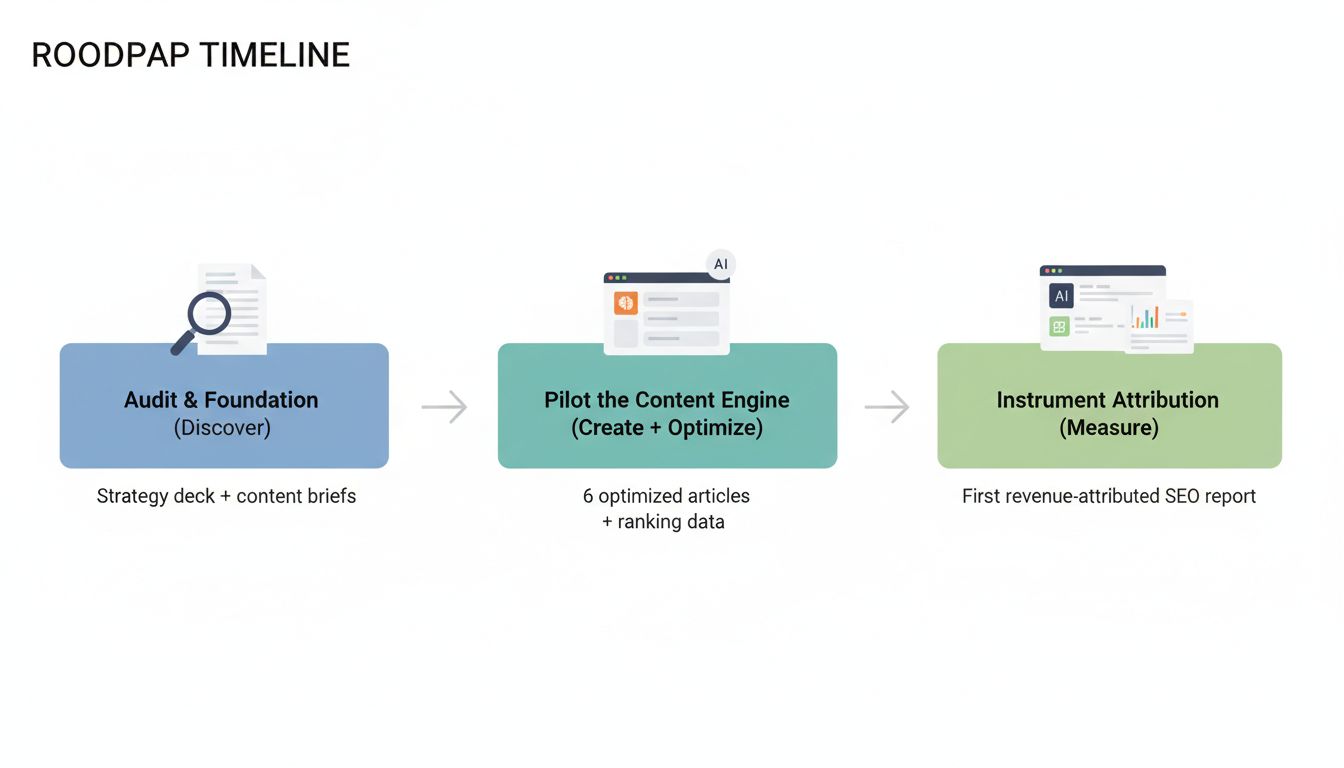
Phase 1: Weeks 1–4 , Audit & Foundation (Discover)
Your job: Understand what you have and what the market wants.
Pick one tool from Stage 1. Ahrefs, Semrush, or a lighter alternative like AlsoAsked if budget is tight. Run a full content audit: what ranks, what doesn't, and where competitors own keywords you should. At the same time, pull keyword data for your three highest-intent buyer journeys. Think "project management software for agencies," "Asana alternatives," "how to track billable hours."
Define 3–5 content pillars tied directly to product use cases or buyer pain points. No generic "industry trends" topics. Everything should ladder to a demo request or trial signup.
Output: A documented strategy deck (10 slides max) and your first month of content briefs with titles, target keywords, internal link targets, and conversion CTAs already mapped.
Phase 2: Weeks 5–8 , Pilot the Content Engine (Create + Optimize)
Your job: Prove the system works before you scale it.
Using your Stage 2 tool, Jasper, Writesonic, or ChatGPT with a structured prompt library, draft 4–6 pillar articles. Every piece gets human editing. Check for accuracy, brand voice, and original examples. No AI slop makes it live.
Before you hit publish, run each draft through your Stage 3 optimizer. Clearscope, Surfer, or Frase all work. Fix structural gaps, add missing semantic keywords, and tighten meta descriptions. Simultaneously, knock out low-hanging technical fixes: compress images, fix broken links, ensure mobile speed is under 3 seconds.
Output: Six live, optimized articles and your first ranking movement data. You should see at least 2–3 pieces crack page two within 30 days if keyword selection was tight.
Phase 3: Weeks 9–12 , Instrument Attribution (Measure)
Your job: Connect content to revenue, even if the numbers are small.
Set up your CRM-to-analytics bridge. If you're on HubSpot, enable the native GA4 integration. Salesforce users need middleware like Zapier or a dedicated attribution platform, Heeet, HockeyStack, or even a basic GA4 custom event setup.
Implement a linear multi-touch attribution model in GA4 or your CRM. Tag every SEO landing page with source/medium UTMs. Create a simple dashboard that shows: organic sessions → trial signups → demo bookings → closed-won deals, with SEO as a touch point.
Run your first "SEO Influence on Pipeline" report.
It won't be perfect. The data will be messy. That's fine. You're building the habit of asking the right question.
Output: Your first revenue-attributed SEO report showing how many trials or demos had an SEO touch in the last 30 days.
After Day 90: Scale What's Working
The 90-day mark isn't a finish line. It's when you have a functioning system and real data to guide decisions.
Now you double down on the pillars that convert, expand keyword clusters that drive qualified traffic, and start testing AI SERP optimization tactics. Look, if you're using any of the best ai seo tools mentioned earlier, you should have enough data by now to see what's actually moving the needle versus what just looks good in a dashboard.
You'll know you're ready to scale when you can answer this question in under 60 seconds: "Which article drove the most pipeline last month?"
Conclusion
The best AI SEO tools in 2026 aren't the ones with the most features or the slickest AI. They're the ones that connect search visibility to actual revenue. That's the shift from tool shopping to system building.
Your stack should answer one question with precision: Which content is driving trials, demos, and MRR?
If you can't trace a blog post from keyword discovery through AI SERP visibility to a closed deal in your CRM, you're flying blind. The median SEO ROI of 748% only materializes when you build attribution into the foundation, not bolt it on afterward [Source: upgrowth.in].
Start where you are. If you're at $2M ARR with a two-person marketing team, you don't need enterprise-grade ai seo optimization across twelve platforms. You need Ahrefs for discovery, Clearscope for creation, and HubSpot or Google Analytics configured to track first touch from organic search. Prove that system works, then expand.
The AI SERP landscape will shift again in six months. AI Overviews already appear on 30% of queries and surged 492% year-over-year [Source: seoclarity.net]. Build quarterly stack reviews into your process. Treat your SEO system like product infrastructure: measure, iterate, scale.
The 90-day roadmap isn't theory. It's the exact sequence dozens of SaaS companies have used to move from "we think SEO is working" to "SEO drove $847K in pipeline last quarter."
If building this system internally feels like adding a second full-time job to your already-stretched team, we get it. Our team implements and manages integrated SEO stacks for B2B SaaS companies, turning search intent into predictable pipeline without hiring a dedicated SEO headcount.