June 25th, 2026
How to Use AI Tools for SEO Optimization: A Practical Guide for SaaS Founders
 WD
WDWarren Day
Your organic traffic graph is flatlining. "Fix SEO" is on the board's priority list right next to "use AI." You're a SaaS founder, not an SEO specialist, and the 2022 playbook feels like it was written for a different internet.
The advice you're getting is either generic hype about ai tools for seo optimization or a rigid checklist that completely ignores the fundamental shift in how people find your product.
Here's what's actually happening: AI Overviews have cut click-through rates for the top organic result by nearly half. But the AI referral traffic that replaces those clicks converts at 4.4x the rate of traditional search visitors.
The mechanics changed. The opportunity didn't.
Winning in 2026 isn't about ranking for more keywords. It's about building a systematic, AI-optimized content engine that captures high-intent citations and referral traffic. That means different metrics, a different content architecture, and a different tool stack, including knowing which ai seo tools are worth paying for and which ones just look good in demos.
This guide covers the whole workflow: audit to iteration, built for technical founders and product leads from Seed to Series A. You'll get a pragmatic look at the best ai seo tools for your stage, how to stop chasing rankings and start earning citations, and the expensive mistakes that eat time and budget before you even notice.
By the end, you'll know how to build a content system that actually grows organic traffic, one that speaks to search engines and the AI models that now run discovery.
Before You Start: Your SaaS Founder's AI-SEO Prerequisites
Stop thinking about SEO as Google rankings.
Your new battlefield includes ChatGPT, Perplexity, Gemini, and Copilot. The goal is to become a cited source in AI-generated answers, not just a blue link on page one.
This shift changes everything. When AI Overviews appear, traditional click-through rates for top organic results can drop by 45% or more according to Ahrefs. But AI referral traffic converts at 4.4× the rate of traditional organic visitors [Source: Semrush 2025].
You're not losing clicks. You're gaining higher-quality visitors who never clicked through in the first place.
I'm assuming you understand basic SEO concepts: keywords, backlinks, Google Search Console. You're comfortable evaluating SaaS tools and can integrate via API if needed. That's your technical baseline.
Before you spend a penny on any ai seo tools, define what "winning" looks like.
For a Seed-stage SaaS, that might be: "10 AI citations for our top five product-use case queries within 90 days." For a Series A company: "Generate 50 qualified leads per month via AI referral traffic." Be specific. Measurable. Not just "improve SEO."
You'll need access to your CMS (WordPress, Webflow, whatever you're on) and a connected Google Search Console account. Budget for one core tool, we'll get into options in Step 1 based on your stage and goals.
Step 1: Audit & Goal-Setting – Building Your AI-SEO Dashboard
Stop downloading a generic SEO dashboard. Your metrics need to answer two questions: "Are we ranking?" and "Are we being cited by AI?" Track only the first one and you're flying half-blind.
Open Google Search Console. Go to the Performance report, filter for "Search Appearance" → "AI Overview." This shows every query where Google already considers your content relevant enough to potentially cite.
That's your baseline. Don't ignore it. These are your easiest wins for improving citation accuracy and share.
Now define your hybrid KPIs.
Traditional (Still Vital):
- Organic Traffic Volume
- Keyword Rankings (Top 3, Top 10)
- Click-Through Rate (CTR)
AI-Specific (Non-Negotiable Additions):
- AI Citation Share: The percentage of your target queries where your brand gets referenced in AI-generated answers (ChatGPT, Perplexity, Google AI Overviews).
- AI Referral Traffic: Visitors arriving directly from AI platforms. Track this separately in your analytics.
- AI Conversion Rate: How often those AI-referred visitors become leads or customers. Semrush data shows this traffic converts at 4.4× the rate of traditional organic visitors.
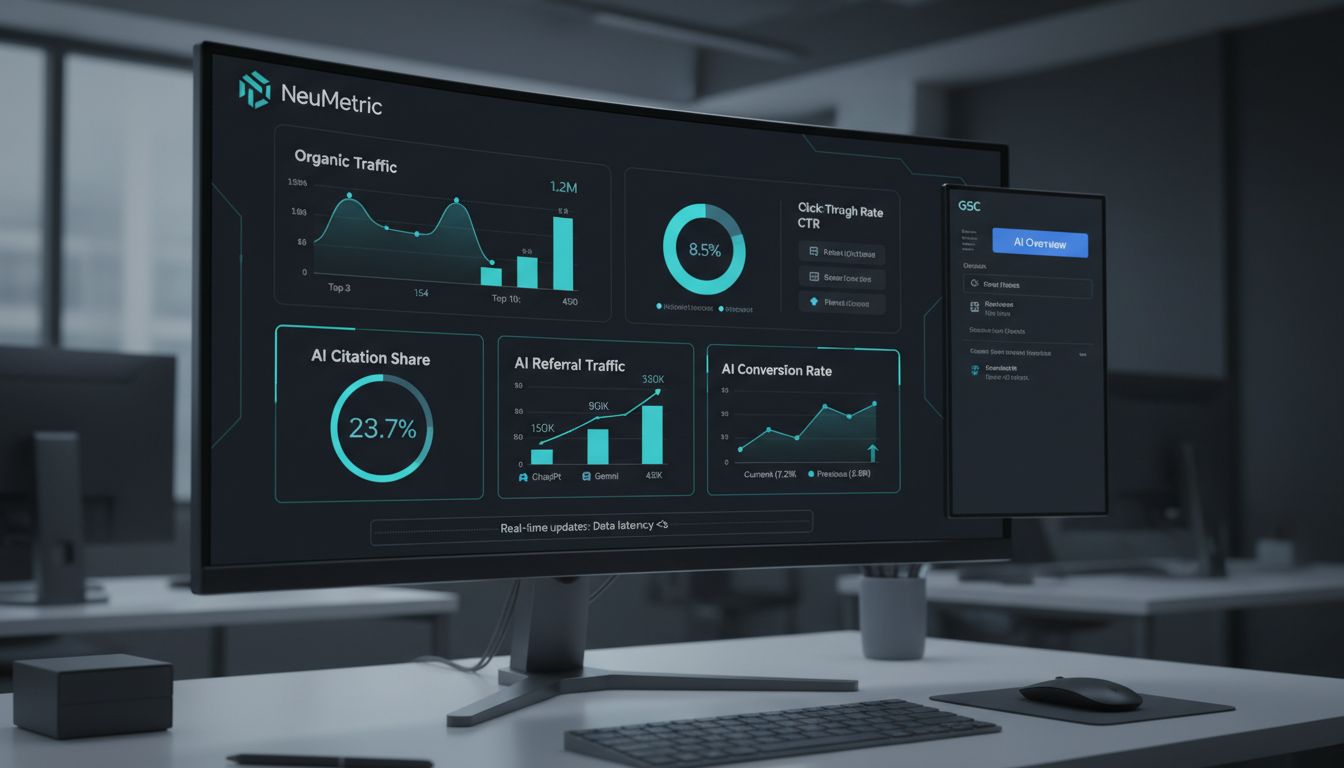
The goal isn't to maximize one metric at the expense of another. It's to understand the relationship between them.
If organic traffic plateaus but AI referrals climb, your strategy is working. If both drop, you have a real content or technical problem on your hands.
Choose Your Tool Stack by Stage, Not Hype
Your tool budget should match your company's maturity. A bootstrapped Seed-stage SaaS can't justify a $399/month enterprise platform. And a Series B company running on manual spreadsheets is leaving real money on the table.
Pick tools that solve your immediate next problem.
| SaaS Stage | Primary Use-Case | Recommended Tools | Realistic Pricing (June 2026) |
|---|---|---|---|
| Seed / Early-Stage | Foundational Audits & Basic Research | SE Ranking or Diib for daily rank tracking & keyword gaps. Google's free tools (Search Console, PageSpeed Insights). Screaming Frog (free tier for up to 500 URLs). | $0 - $50/month. Focus on free tools and one affordable all-in-one. |
| Growth (Series A) | Content Optimization & AI Visibility Tracking | Ahrefs or Semrush for deep keyword/intent research. Frase or Clearscope for content optimization. CapstonAI or Peec AI for multi-engine AI visibility monitoring. Spectre for AI-powered content creation & publishing. | $150 - $400/month. You're investing in specialization. |
| Scale (Series B+) | Enterprise Automation & Predictive Analytics | Profound or AthenaHQ for enterprise AI visibility. MarketMuse for deep content modeling. AirOps for large-scale workflow automation. Lumar (formerly DeepCrawl) for technical audits at scale. Spectre for scaling content production pipelines. | $400 - $2,000+/month. You're paying for automation, integration, and predictive insights. |
Tool pricing and features are dynamic. Always check current plans. The stack above reflects the multi-vendor reality top teams use.
One thing worth knowing from the inside: vendor dashboards are designed to show their own value. You'll see charts for "AI Visibility Score" or "Citation Opportunities." Useful directional signals, sure, but not your business KPIs.
Your north star metrics are Marketing Qualified Leads (MQLs), pipeline generated, and customer acquisition cost (CAC). Not a proprietary score invented by a software company.
Let your commercial goals dictate what you track in the tools, not the other way around.
Your action plan for this week:
- Export your baseline. From Google Search Console, export the list of queries triggering "AI Overview" impressions.
- Audit one key page. Pick your top commercial landing page. Run it through PageSpeed Insights and check its structured data with Google's Rich Results Test. Note any errors.
- Choose one new KPI. Commit to tracking either "AI Referral Traffic" or "AI Citation Share" for the next quarter. Set up the necessary UTM parameters or monitoring tool.
- Evaluate your stack. Look at the table above. Are you using a Seed-stage tool for a Growth-stage problem, or vice versa? Plan one upgrade or consolidation for the next billing cycle.
This diagnostic work is unglamorous. But it's what separates teams that actually know if their efforts are moving the needle from teams that are just staying busy.
Step 2: Shift from SEO to AIEO – The Foundational Work
Is SEO dead? No. But the goalposts have moved about 30 yards downfield.
You're no longer optimizing for a blue link on page one. You're optimizing to be the source an AI engine cites when it answers someone's question. That's AIEO, Answer Engine Optimization.
The core insight comes from Yext's analysis of 6.8 million AI citations: 86% come from brand-managed sources. Your product pages, documentation, pricing pages, core guides, that's your citadel. Your job is to make them authoritative, structured, and fast enough that AI systems can extract and trust them.
Stop chasing keywords. Start building citadel pages.
1. Implement Structured Data (Schema) – The Non-Negotiable
Schema markup is the language AI engines use to understand what your content is. Without it, you're speaking in riddles.
For SaaS, start with SoftwareApplication schema on every product page. This tells Google, ChatGPT, and Perplexity that your page describes a software product, not just a marketing brochure.
Here's the minimal JSON-LD snippet you need in your page's <head>:
<script type="application/ld+json">
{
"@context": "https://schema.org",
"@type": "SoftwareApplication",
"name": "Your Product Name",
"applicationCategory": "BusinessApplication",
"operatingSystem": "Web, iOS, Android",
"offers": {
  "@type": "Offer",
  "price": "0",
  "priceCurrency": "USD"
},
"aggregateRating": {
  "@type": "AggregateRating",
  "ratingValue": "4.8",
  "reviewCount": "125"
}
}
</script>
Why this matters: Sites with correct schema see 2–3× higher AI citation rates. It's the single most impactful technical signal you can send. After product pages, add FAQ schema to your help center and How-to schema to your tutorial content.
Common mistake: Adding schema but not validating it. Use Google's Rich Results Test after implementation. Errors mean your schema is broken, and broken schema is the same as no schema.
2. Optimize for Lighthouse Speed (<2.1s Target)
Page speed isn't just a user experience thing anymore. It's a direct crawlability and authority signal.
AI engines have limited computational budgets. They're far more likely to deeply parse and cite a page that loads in 1.5 seconds than one that staggers in at 4 seconds.
According to Arete.so's analysis, SaaS sites with sub-2.1 second load times are 46% more likely to be referenced in AI-generated answers.
Run a Lighthouse audit in Chrome DevTools. Focus on these metrics in order:
- Largest Contentful Paint (LCP): Should be under 2.5 seconds. This is usually your hero image or main heading. Optimize image formats (WebP), implement lazy loading, and consider a CDN.
- Cumulative Layout Shift (CLS): Should be under 0.1. Make sure images have defined dimensions and avoid injecting dynamic content above existing content.
- First Input Delay (FID): Should be under 100 milliseconds. Reduce JavaScript execution time and break up long tasks.
Verification step: After making changes, run the audit again. All three Core Web Vitals should be in the green "Good" range.
If technical optimization isn't your thing, tools like Alli AI can automate common fixes, image optimization, deferred JavaScript, cache policies. But understand the principles first. Automation without diagnosis just creates fragile solutions.
3. Architect 'Answer-Dense' Content
Forget keyword density. Think answer density.
An AI engine scanning your page needs to find a complete, self-contained answer to a specific query. That requires a real shift, from feature-list pages to intent-driven content that actually answers something.
Build pages around Jobs-to-Be-Done and integration queries:
- Bad: "Project Management Software Features"
- Good: "How to Automate Sprint Planning in Jira with [Your Tool]"
- Better: "The Complete Guide to Jira + Slack Integration for Remote Teams"
Structure each page with a clear information hierarchy:
- Answer first: Put the most important information in the first 100 words.
- Compact chunks: Write self-contained paragraphs that make sense in isolation. Each one addresses one sub-question.
- Simple sentences: Use subject-verb-object structure. AI models (and humans) process "The API returns JSON" faster than nested clauses.
- Structured formats: Use bulleted lists and tables for comparisons. They help language models extract facts and relationships cleanly.
This is what's replacing traditional SEO: being the definitive source for a specific use case.
The Peril of Over-Optimization
Here's the thing most guides using ai tools for seo optimization won't tell you. As Moz warns, crafting content solely to game AI summaries produces unnatural, low-value writing that neither users nor AI will trust long-term.
You'll see advice like "write in a Q&A format" or "include exact question phrases." Implement that clumsily and you get robotic content that reads like a FAQ written by a committee of lawyers. It might get an initial citation. It won't earn sustained trust or conversions.
The rule: Optimize for the user first. Make your content genuinely helpful and readable. The AI citation is a byproduct of that work, not the goal. If you wouldn't send this page to a potential customer during a sales call, don't publish it.
Your Foundational Checklist
- Audit schema: Use the Rich Results Test on your 5 most important pages. Fix any errors.
- Measure speed: Run Lighthouse on your homepage and a key product page. If LCP > 2.5s, start with image optimization and hosting.
- Rewrite one page: Take a feature-focused page and rebuild it around a single Job-to-Be-Done. Answer every related sub-question a user (or AI) might have.
- Set up monitoring: Use Google Search Console's Core Web Vitals report to track speed improvements week-over-week.
This foundational work turns your website from a brochure into a citable knowledge base. It's what separates brands that show up in AI Overviews from those watching their organic traffic quietly disappear.
Step 3: Build Your AI-Augmented Content Engine
You've got the technical foundation. Now comes the actual content machine. This isn't about hiring more writers, it's about building a repeatable workflow where AI handles the heavy lifting and your expertise provides the edge.
Stop writing one-off articles. Start building a system.
Cluster Keywords by Search Intent, Not Volume
Open your Semrush or Ahrefs dashboard. Run a keyword search for your core product category, say "project management software."
You'll see thousands of variations. The old approach: pick the highest volume terms, create separate pages. That's how you end up with 50 thin articles competing against each other.
Instead, use the AI-powered keyword clustering features both platforms now offer. Group by search intent, not search volume. One substantial piece of content per intent cluster.
Informational clusters answer "what is" and "how to" questions. These become your guides and tutorials. Commercial clusters compare solutions and evaluate options. These become your comparison pages and buyer's guides. Transactional clusters signal purchase intent. These become your pricing pages and feature breakdowns.
When building Spectre, we integrated DataForSEO's API specifically because it gives superior SERP feature analysis for intent classification. You can programmatically see which queries trigger product carousels, local packs, or featured snippets, critical signals for matching content format to user intent.
Here's what that looks like in practice:
# Example intent classification logic using SERP features
if "vs" in query or "comparison" in query:
  intent = "commercial"
elif "how to" in query or "tutorial" in query:
  intent = "informational"
elif "price" in query or "buy" in query:
  intent = "transactional"
This clustering approach reduces content duplication by 60-70% while increasing topical depth, exactly what AI models look for when selecting citation sources.
Create with Optimization in Mind, Not After the Fact
Open Surfer SEO, Frase, or Clearscope. Plug in your primary keyword from your intent cluster.
Don't just look at the word count target. Focus on the topical depth analysis, these tools show you which subtopics competing articles cover that yours doesn't. This creates what's called "answer density": your content addresses every facet of the query.
Generate a content brief with specific section headers, key points to cover, and semantic keyword suggestions. That brief becomes your AI writer's instruction manual.
One thing worth being clear about: Surfer SEO and Frase are optimizers, not writers. They analyze what already ranks and tell you how to structure your content. Original insight is still your job.
The common mistake is treating the optimization score as a checklist. A 90+ score doesn't guarantee quality, it just means you've matched the structural patterns of existing content. You still need to provide better information.
Where Spectre Fits: Automating the Engine
For founders who need to scale content without building an in-house team, this is where our product, Spectre, operates. It automates the entire research-to-publication workflow.
Here's how it works in practice:
- Research automation: Spectre connects to DataForSEO and Ahrefs APIs to cluster keywords, analyze SERP features, and generate intent-based content briefs automatically.
- Draft generation: Using those briefs, it creates first drafts optimized for both SEO and E-E-A-T signals, structuring content for search engines and AI models alike.
- Expert review pipeline: Drafts route to your subject-matter experts with specific gaps flagged ("add case study here," "include original data on this point").
- Programmatic publishing: Once approved, content publishes directly to your CMS via API with proper schema markup and internal linking.

The whole process from keyword research to published article takes hours, not weeks. But the human review step is non-negotiable. Spectre handles the 80% of grunt work; your experts provide the 20% of unique insight that makes content actually worth reading.
The Human-in-the-Loop is Non-Negotiable
This gets at the most common question: "Is ChatGPT good for SEO?"
Alone, no. Inside a supervised workflow, absolutely.
Every AI-generated draft needs review from someone who actually understands the topic. Not just proofreading, substantive editing that adds:
- Original case studies: "Here's how our customer reduced churn by 40% using this feature..."
- Unique data: Internal metrics, survey results, proprietary research
- Practical implementation details: The gotchas that only come from hands-on experience
- Contrarian perspectives: Where conventional wisdom is wrong in your specific context
This directly addresses Google's E-E-A-T guidelines. When Yext found that 86% of AI citations come from brand-managed sources, they were talking about precisely this type of authoritative, expert-driven content.
The review process should take 20-30 minutes per article. Use comments and suggestions in Google Docs or your CMS. The editor's job isn't to rewrite everything, it's to inject the expertise that AI cannot replicate.
Publish for Performance, Not Just Publication
Clean HTML matters more than ever. AI models extract content programmatically, and messy markup with inline styles or poorly structured headings makes that extraction less reliable.
Before publishing:
- Validate structured data: Use Google's Rich Results Test on every page. SaaS product pages should implement SoftwareApplication schema with price, feature list, and compatibility information.
- Optimize internal linking: Link from new content to 3-5 relevant existing pages, and update older pages to link back. This builds the topical clusters search engines recognize.
- Check Core Web Vitals: Ensure Largest Contentful Paint (LCP) is under 2.5 seconds. According to Arete.so's analysis, SaaS sites with sub-2.1s load times are 46% more likely to be referenced in AI-generated answers.
- Schedule regular updates: AI models favor fresh content. Revisit high-performing articles every 6 months.
Spectre's API integration handles this automatically. When content is approved, it publishes with clean semantic HTML, auto-generated internal links based on topical relevance, proper schema markup, optimized images with descriptive alt text, and instant sitemap updates.
The system runs on a continuous loop: research → create → optimize → publish → measure → iterate. Each cycle improves based on performance data from both traditional SEO metrics and AI citation tracking.
This is what separates using the best ai tools for seo optimization from just bolting a few ai seo tools onto an existing broken process. The tools available, whether you're looking at Surfer SEO, any Surfer SEO alternative, or broader seo software tools free tiers to test the waters, are only as good as the workflow around them.
The top seo tools and best ai seo tools on any seo tools list can't replace a clear system. That's true whether you're a solo founder acting as your own ai seo expert, evaluating ai seo companies to outsource to, or somewhere in between.
The AI handles scalability. Your expertise ensures quality. That combination is what actually captures both traditional rankings and AI citations.
Step 4: Monitor, Measure, and Iterate – The Feedback Loop
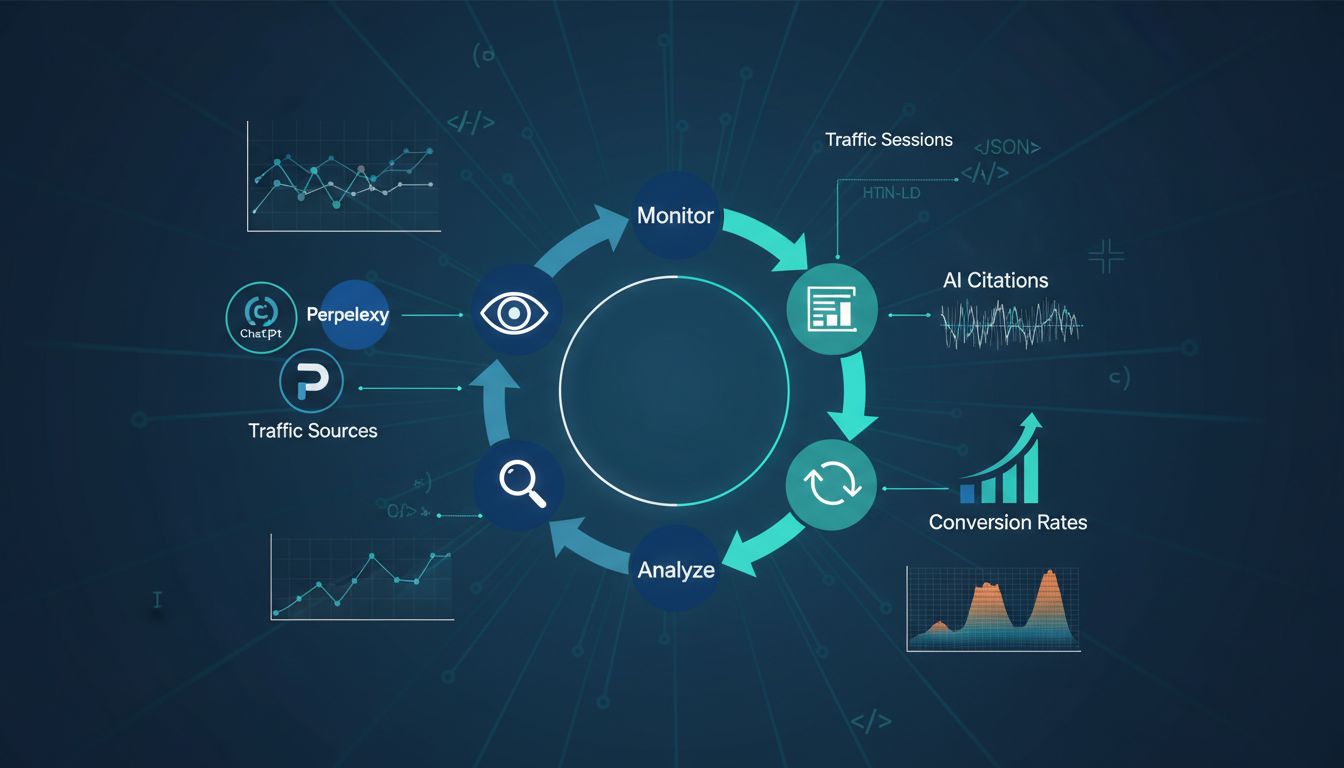
Your content engine is live. Now you need to know what's working.
This isn't about checking rankings once a month. It's about building a feedback loop that tells you where AI is finding your content and which visitors are actually converting.
Track AI Citations Proactively, Not Passively
Stop waiting to stumble on mentions. Set up systematic monitoring.
First, pick your tool. For continuous, multi-engine tracking, use something like CapstonAI or Peec AI. These simulate searches across ChatGPT, Perplexity, and Google AI Overviews to show you when and where your brand appears.
For a more manual, budget-friendly approach: build a spreadsheet of your top 20 target queries and check them weekly in incognito sessions across different AI platforms.
Here's the reality check: citation rates vary a lot by engine. Yext found that 86% of AI citations come from brand-managed sources, which suggests authority matters. Other analyses show citations appearing from outside the traditional top 10. The data is inconsistent depending on which engine you're looking at.
Our practical take: focus on being the best answer, and track citations wherever they appear.
Verification step: After one month of tracking, you should see your first citations appearing for your most authoritative, schema-rich pages, typically within 6-10 weeks of implementation.
Measure AI Referral Conversions Rigorously
Organic traffic means nothing if it doesn't convert. AI referral traffic is different, it often converts better. Semrush data shows AI referral traffic converts at 4.4x the rate of traditional organic visitors.
But you won't know your own number unless you track it properly.
- Tag your AI traffic. In Google Analytics 4 (or your platform), create a new traffic source for AI. Add UTM parameters (
utm_source=chatgpt,utm_medium=ai_referral) to any links you control within AI platforms or tools. - Create a conversion segment. Isolate sessions from known AI platforms (chat.openai.com, perplexity.ai, etc.) and build a segment to track their behavior.
- Compare key rates. Calculate the lead or trial conversion rate for this AI segment versus your overall organic segment. That's the actual quality signal.
Common mistake: Assuming all "Direct" or "Organic" traffic in GA4 is the same bucket. A significant portion of high-intent AI traffic gets misattributed there. Manual segmentation isn't optional.
Apply the 80/20 Rule to Your AI-SEO Efforts
You'll see a pattern pretty quickly. 80% of your AI visibility and conversion value will come from 20% of your content. For SaaS companies, it's almost always your core product documentation, top integration guides, and key comparison pages.
Run this analysis quarterly:
- Export your top 50 pages by AI referral traffic.
- Layer on conversion data, leads, sign-ups, demo requests.
- Identify the 10-15 pages driving the majority of value.
These are your "crown jewels." Your iteration budget goes here, disproportionately.
Iterate Based on Data, Not Guesswork
Monitoring tells you what's happening. Iteration is where you improve it. Use a simple refresh cycle for your top-performing pages.
For each winning page, every 90-120 days:
- Update with new data and FAQs. Review the actual user questions from AI platforms that led to the citation. Add those Q&As directly to the page. Refresh any stats with current-year data.
- Enhance answer density. Tools like Surfer SEO or Clearscope can rescan your page against current top results. Look for missing subtopics your competitors now answer and add concise, direct responses.
- Expand the content cluster. If a guide on "Stripe integration for SaaS" is winning, create complementary pieces: "Stripe vs. Braintree for SaaS," "Handling Stripe webhooks," etc. Link them properly.
Platforms like Semrush's ContentShake can automate the first step, surfacing refresh ideas based on SERP changes. For beginners or lean teams, start manually with your top 5 pages.
The goal isn't endless new content. It's making your best content better, systematically.
This feedback loop, track, measure, find winners, iterate, closes the system. Your dashboard stops showing just "traffic up/down" and starts showing which answers the market trusts and which ones are driving pipeline.
That's what separates actually using the best ai tools for seo optimization from just running ai seo tools on autopilot and hoping. Whether you're using Surfer SEO, a Surfer SEO alternative, or poking around seo software tools free tiers to test things first, the tools are only as useful as the feedback loop around them.
Every top seo tools list and best ai seo tools roundup will tell you what to use. Almost none of them tell you how to measure whether it's working. That's the part that matters, whether you're a solo founder acting as your own ai seo expert, working with ai seo companies, or figuring out which ai tools for seo optimization are actually worth Surfer SEO pricing versus free alternatives.
The best ai tools for seo optimization don't replace judgment. They just make it faster to act on.
Common Mistakes & How to Avoid Them
Even with the right tools and strategy, execution is where most AI-SEO efforts fall apart. Here are the five mistakes I see SaaS founders make most often.
Mistake 1: Publishing Raw AI Output You run a prompt, copy the result, hit publish. The content reads generically, misses real insight, and often has subtle factual errors that erode trust. Search engines and AI models both pick up on this and devalue it.
The Fix: Build a mandatory human-in-the-loop stage. For every piece, a subject-matter expert needs to:
- Verify every claim against primary sources.
- Inject a few paragraphs of original, first-hand insight, a customer case study, a nuance the tools missed, a counterargument.
- Adapt the tone to match your brand's voice. Tools like Surfer SEO or Clearscope can guide optimization, but they can't replace your expertise.
Mistake 2: Ignoring Technical SEO Fundamentals You focus on writing great answers, but your site is slow, lacks schema, or has crawl errors. AI models heavily weight technical signals. A slow site with poor structure is far less likely to get cited.
Sites implementing structured data see 2-3x higher AI citation rates.
The Fix: Treat technical SEO as infrastructure, not marketing. Run Screaming Frog quarterly. Prioritize:
- Schema markup: Implement
SoftwareApplicationandFAQPageschema on product and help pages. - Core Web Vitals: Get your largest contentful paint (LCP) under 2.5 seconds.
- Crawlability: Fix broken internal links and make sure your sitemap is clean.
Mistake 3: Chasing Volume Over Intent You target high-volume keywords like "project management software" instead of the specific queries your actual customer is typing: "how to integrate Jira with Notion for agile teams."
The Fix: Use your audit data to build content around jobs-to-be-done, not just keywords. Create fewer, deeper pieces. One definitive guide on "multi-channel attribution for B2B SaaS" will outperform ten shallow posts on generic "marketing analytics."
Mistake 4: Measuring Only Traditional Metrics You track organic traffic and rankings, see flat graphs, and assume nothing's working. But that's not the full picture. According to Ahrefs, AI Overviews reduced average position-1 CTR by nearly 45%. Meanwhile, Semrush data shows AI referral traffic converts at 4.4x the rate of traditional organic visitors.
The Fix: Expand your dashboard. Add these two metrics weekly:
- AI Citation Share: Use a platform like Profound or CapstonAI to track how often you're cited across ChatGPT, Perplexity, and Google AI Overviews.
- AI-Referral Conversion Rate: Tag traffic from AI tools in Google Analytics. Measure how it converts to trials or demos compared to standard organic.
Mistake 5: Assuming Uniformity Across AI Engines You optimize once for "AI" and expect consistent results. Citation patterns differ a lot between ChatGPT, Perplexity, Claude, and Google AI Overviews. What wins in one engine can get ignored in another.
The Fix: Monitor citations across platforms separately. Look for patterns, Perplexity might favor your integration guides while ChatGPT cites your pricing comparisons. Double down on whatever works for each specific engine.
A one-size-fits-all approach here is how you miss half the picture. Whether you're working with ai seo companies, running the best ai seo tools yourself, or still testing seo software tools free tiers to see what's worth paying for, the tools only matter if you're avoiding the mistakes that make them useless. That goes for Surfer SEO, any Surfer SEO alternative, or any other ai tools for seo optimization on your seo tools list.
Being your own ai seo expert means knowing where most people trip up. Now you do.
Conclusion
SEO in 2026 isn't really about chasing page-one rankings anymore. The target has moved to AI citations, and the work has shifted from SEO to AIEO, optimizing for how AI engines extract and cite your content, not just how search engines rank it.
Your tool stack needs to match where you actually are. Start lean with Surfer SEO or Frase for content optimization, then layer in AI visibility tracking as you grow. The human-in-the-loop part isn't optional. Your expertise is what keeps your content from blending into the sea of generic AI output everyone else is publishing.
Measure with hybrid KPIs. Track AI citation share alongside the traditional stuff like organic traffic. Semrush data shows AI referral traffic converts at 4.4x the rate of traditional organic visitors, that's the number that actually moves revenue.
Pick one tool from the table above that fits your stage. Run a free trial. Then do a simple intent-clustering exercise for your core product category and see what comes up.
That's your starting point. If scaling the content pipeline is the next problem, look into how Spectre handles the research, writing, and publishing loop.
Whether you're evaluating ai seo companies, hunting for the best ai seo tools, or still poking around seo software tools free tiers to figure out what's worth paying for, the tools on any seo tools list only matter if you're actually using them right. That goes for Surfer SEO, any Surfer SEO alternative, Surfer SEO pricing questions, and any other ai tools for seo optimization you're considering.
The best ai tools for seo optimization don't make you an ai seo expert. Avoiding the obvious mistakes does. Being your own top seo tool isn't about the software. It's about knowing what to do with it. The best seo tools for beginners mean nothing without that part.