June 24th, 2026
How to Build an SEO Internal Linking Strategy for AI-Powered Sites
 WD
WDWarren Day
You know internal linking matters for SEO. But staring at an AI-generated content library in 2026, the old playbook feels not just tedious but dangerously obsolete.
Manually dropping a few contextual links before hitting publish used to be enough. It isn't anymore.
AI search engines like Gemini, Claude, and ChatGPT's web search don't just crawl links. They ingest context. Your internal links are now hypertext for machines, signals that determine whether your content gets retrieved, understood, and cited.
A winning seo internal linking strategy in 2026 has to be rebuilt as a scalable technical system that feeds contextual signals to AI retrieval engines. Not a manual SEO tactic you do right before publishing.
If you're a technical founder or engineer managing a content-heavy site, you need something that integrates with your AI production pipeline. The hub-and-spoke model is a decent starting point, but it falls short for vector search and RAG (Retrieval-Augmented Generation). Your architecture needs to signal topic clusters, freshness, and semantic relationships to both Googlebot and AI retrieval models.
This guide is a five-step technical blueprint. You'll learn how to architect for flat crawl depth, optimize anchor text for AI comprehension, chunk content for vector search, signal structure programmatically, and automate discovery at scale.
No WordPress plugins. Actual system design.
The outcome is a linking infrastructure that works alongside tools like Spectre, turning your AI-generated content into a connected knowledge graph that ranks in both traditional and AI-powered search.
Why Your Old Internal Linking Strategy Is Obsolete in 2026
Dropping a few contextual links while writing used to be enough. That worked when search was purely algorithmic. In 2026, it's technical debt.
The game has shifted. It's no longer about distributing PageRank equity. It's about building context for AI retrieval systems.
Search engines now use Retrieval-Augmented Generation (RAG) to answer queries. These systems pull relevant content chunks from an index, and your internal linking architecture directly shapes that index's understanding of your content's relationships and freshness. Links aren't just equity pipes anymore. They're semantic signals that help AI models map your topical authority.
The stakes are real. Websites that strategically combine off-page and internal linking see a 60% increase in organic traffic. Structural optimization alone increased AI citation rates by 17.3% across generative engines [Source: Machine Relations Research]. And when your content gets cited in an AI Overview, it earns a 35% higher organic CTR.
Better linking equals more AI visibility. That's the whole thing.
Traditional SEO was about getting a page indexed and passing authority. AI-driven search is about whether your content is retrievable for specific questions. RAG systems favor structured, answer-like content [Source: Thatware], and they prioritize freshness. 76.4% of ChatGPT's most-cited pages were updated within the last 30 days [Source: Onely].
If you're generating content with AI tools without a systematic seo internal linking strategy, you're building a library with no catalogue. The pages exist. The retrieval engines just can't connect them.
Your old approach was designed for crawl-and-index. That's not the paradigm anymore.
Audit Your Current Internal Link Profile
Before you build anything new, figure out what's broken. The audit isn't about checking boxes. It's about getting the data that tells you where to start.
Start with orphan pages.
Run an Ahrefs Site Audit or use Screaming Frog. Filter for pages with zero inbound internal links. You'll probably find around 25% of your pages sitting there with no internal links pointing to them at all. Crawlers can't find them. Neither can AI retrieval systems. Export that list. Fixing those is your first sprint.
Next, measure crawl depth. Find any page that takes four or more clicks to reach from your homepage or a primary topic hub. Search engines crawl those less often and quietly treat them as unimportant. The goal is to flatten the structure. If your crawler doesn't visualize click-depth directly, a quick Python script using scrapy will map it for every URL.
Now look at your actual crawl budget consumption. This is where most technical founders get it wrong.
Ahrefs shows you link graphs. Your server logs show you what Googlebot actually visits. Pull your logs from Nginx or Cloudflare, filter for Googlebot user-agents, and compare how often it hits your high-priority pages versus throwaway pages like filtered views or tag archives. If crawl budget is getting eaten up by stuff that doesn't matter, that's a structural problem. Tools like JetOctopus or Botify are built specifically for this kind of log analysis.
Finally, take inventory of your content architecture. Use Spectre's content dashboard or export your sitemap to a spreadsheet. Categorize each page by:
- Primary topic cluster
- Commercial intent (informational, commercial, transactional)
- Last update date
- Current internal link count (inbound and outbound)
This inventory becomes the source of truth for your seo internal linking strategy rebuild. You're not just counting links. You're mapping the semantic and commercial relationships the new system will need to handle.
The golden rule: build for users first, but structure for both users and machines. The audit data tells you exactly where the machine's understanding of your site has broken down.
The Core 5-Step System for AI-Powered Internal Linking
Stop thinking about internal linking as a content task. It's a technical system that ingests your content pipeline and outputs a machine-readable site graph.
Your AI-generated content is raw material. This system is the assembly line. The output is a site that both humans and retrieval engines can actually navigate.
Here's the exact blueprint.
The 5-Step System:
- Architect for Topic Clusters and Flat Crawl Depth: Build a hub-and-spoke structure, ensuring no critical page is buried more than three clicks from a hub.
- Optimize Anchor Text and Placement for Humans & AI: Use descriptive, varied anchor text placed within relevant body copy, not just sidebars.
- Chunk Your Content and Link for Vector Search: Segment articles into 200-1000 token chunks and use internal links to signal relationships between those chunks to embedding models.
- Signal Freshness and Structure to AI Retrieval: Implement structured data and maintain update cadences. AI-cited URLs are on average 25.7% fresher than non-cited ones.
- Automate Discovery and Insertion at Scale: Use programmatic tools to maintain your seo internal linking strategy as content scales, fixing the ~25% of pages that typically have zero links pointing to them.
This isn't a checklist. It's an engineering workflow. The next sections break each step down into executable code and configuration.
Step 1: Architect for Topic Clusters and Flat Crawl Depth
Start with the structure before you write a single word.
Define your hub-and-spoke layout first. A pillar page (the hub) covers something broad like "React Performance Optimization." It links out to 5-10 detailed articles (spokes) on specific subtopics: "useMemo vs useCallback," "React.memo for Components," "Lazy Loading with Suspense." Every spoke links back to the hub. Then you add lateral links between related spokes, connect "useMemo vs useCallback" to "React.memo for Components" because they're both about memoization.
This conflicts with how most CMSs work by default. WordPress and Webflow nest pages in folders, which creates deep URLs like /blog/react/performance/optimization/use-memo. That's four clicks from your homepage. Instead, use custom taxonomies or post types to create logical groupings without the deep nesting. In WordPress, register a custom post type "Hub" and a custom taxonomy "Topic Cluster," then assign both to your articles. URLs stay flat: /react-performance-optimization for the hub, /use-memo-vs-use-callback for the spoke.
Enforce the three-click rule.
Pages buried four or more clicks from the homepage get crawled less and treated as low-importance (per digitalapplied.com). Design so no strategic page exceeds that depth. Map it manually first, spreadsheet, columns for Page, Hub, and Click Depth from Homepage. Anything showing "4" or higher needs a direct link from a higher-level page.
Here's what the technical implementation looks like in WordPress. Add a custom field hub_page to your post editor using Advanced Custom Fields or Meta Box. When editing a spoke, select its hub from a dropdown. Create a shortcode [related_spokes] that queries all posts where hub_page equals the current post's ID, then drop that shortcode into your hub page template. For static sites (Next.js, Gatsby), create a hubMap.json file that maps hub slugs to arrays of spoke slugs and generate the related links at build time.
Common mistake: Linking hub to spokes but forgetting lateral connections between spokes. Those "rim" links reinforce topical authority for both AI systems and search engines. If you're using Spectre, define your clusters during the content brief phase, it'll organize generated articles into these relationships automatically.
Verify everything by running a crawl in Screaming Frog. Set up a custom extraction to count clicks from the homepage, then filter for pages with "Depth" > 3. Any page on that list shouldn't matter. If it does, you've found a structural flaw.
Diagram: Flat Topic Cluster Architecture
Homepage
│
├─── Hub: React Performance Optimization
│       │
│       ├── Spoke: useMemo vs useCallback
│       │       └─── Lateral link → Spoke: React.memo for Components
│       │
│       └── Spoke: Lazy Loading with Suspense
│
└─── Hub: Next.js SEO
        │
        └── Spoke: Dynamic Metadata Best Practices
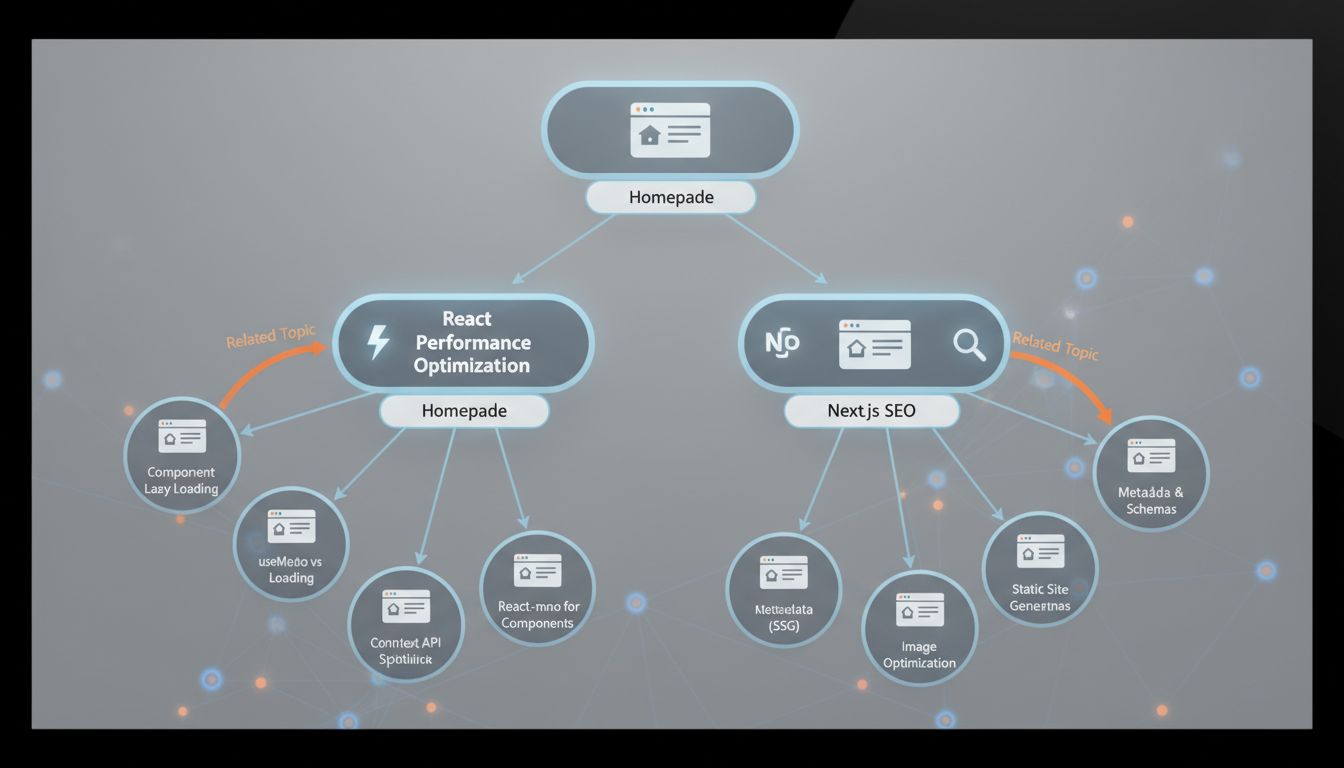
This flat structure is the foundation of any working seo internal linking strategy. Every piece of content sits inside a clear semantic neighborhood, which is exactly what Google's crawler and RAG systems use to figure out what your site is actually about.
Step 2: Optimize Anchor Text and Placement for Humans & AI
Most teams get the architecture right, then blow it on the links themselves.
They either stuff links everywhere or fall back on anchors like "click here" and "learn more." Neither tells Google or an AI retrieval system anything useful.
Treat anchor text as a semantic signal, not a keyword target. Use descriptive, accurate phrases that explain what the linked page is actually about. Instead of "internal linking," write "how to structure internal links for AI retrieval." That's not a small distinction.
Follow the sufficiency principle, not maximization. The Zyppy analysis found diminishing returns pretty fast: URLs with 40–44 internal links averaged around eight clicks from Google Search, while those with 0–4 averaged two https://nearmedia.co/internal-links-drive-clicks-google-support-decline-social-vs-search-growth. Adding more links past a point just dilutes equity. Aim for 3–5 well-placed, contextual links per 1,000 words.
Prioritize placement hierarchy. In-context body links carry the strongest semantic signal because they're surrounded by relevant text. After that, "Further Reading" sections at the end of articles. Breadcrumbs and primary navigation help with top-level discoverability, but they don't pass topical authority the same way.
Avoid exact-match over-optimization. Repeating the same anchor text across multiple pages looks artificial to crawlers and AI systems both. If your pillar page is about "RAG SEO," rotate in natural variations: "implementing retrieval-augmented generation," "RAG systems for search," "how RAG works in SEO." Variety actually improves click performance too.
This is the 80/20 rule applied to an seo internal linking strategy: 20% of your pages (hubs and key spokes) drive 80% of the value. Put your most descriptive, strategic links on those pages and pointing toward them.
For AI systems specifically, descriptive anchors help embedding models understand how nodes in your site's knowledge graph relate to each other. They're the contextual signal that tells a RAG system "this chunk about anchor text connects to that guide on semantic search", which is exactly the kind of relationship those systems are trying to map.
Step 3: Chunk Your Content and Link for Vector Search
AI retrieval engines don't read your pages the way humans do.
They convert text into mathematical vectors and search for semantic similarity. The part most SEOs miss: they often operate on segments of your content, not entire pages.
Think about it this way. When you ask ChatGPT a specific technical question, it doesn't ingest your entire 3,000-word guide. It pulls the most relevant 200–500 word chunk that contains the answer. If your content isn't pre-sliced into coherent, retrievable pieces, you're invisible to that layer of search.
Define your chunking strategy first. Research from Seattle Organic SEO recommends splitting content into segments of roughly 200–1,000 tokens (approximately 150–750 words) before embedding. Each chunk becomes a standalone node in a vector database.
Here's your technical playbook:
-
Chunk by semantic shift. This is the gold standard. Split content at natural topic boundaries, where the subject meaningfully changes. Your H2 and H3 headings are perfect built-in chunk delimiters. A chunk titled "Configuring Vector Indexes" should contain everything about configuration, then end before you transition to "Query Optimization Techniques."
-
Chunk by fixed length with overlap. For longer, flowing content like documentation, use a sliding window. Set a token limit (e.g., 500 tokens) and an overlap (e.g., 50 tokens). This ensures context isn't lost at arbitrary cut-off points. Tools like LangChain's text splitters automate this.
-
Never chunk by arbitrary HTML elements. Don't split after every
<p>tag. You'll create nonsensical fragments that destroy semantic meaning for the embedding model.
Now, connect your chunks with internal links. This is where your seo internal linking strategy meets AI infrastructure.
Internal links are cross-references between chunks, telling the vector search system which concepts are directly related. Within a chunk about "BERT embeddings," you should link to your detailed guide on "Transformer Models." That anchor text and surrounding context create a strong semantic signal that these two chunks belong together in the knowledge graph, which improves retrieval accuracy when a query bridges both topics.
Implement chunk metadata in your CMS. Each chunk needs a unique identifier (chunk_id) and a reference to its source URL. Store this in a structured field. When you generate embeddings (using OpenAI's text-embedding-3-small, Cohere, or open-source models like all-MiniLM-L6-v2), attach this metadata.
{
"chunk_id": "guide_python_decorators_sec3",
"source_url": "https://yoursite.com/guides/python-decorators",
"heading": "Advanced Use: Decorators with Arguments",
"token_count": 420
}
The latency caveat. Generating embeddings in real-time for every page view is expensive and slow. Pre-compute embeddings during your build process or via a scheduled cron job that updates when content changes. Services like Pinecone, Weaviate, or pgvector store these vectors for millisecond retrieval.
Common mistake: linking only at the page level. If your "Python Decorators" page links to your "Context Managers" page, that's good. But if the specific chunk about "@wraps" doesn't link to the chunk about "functools," you've missed a high-precision signal for AI retrieval. Use jump links (#) to connect specific subsections.
Your goal is a dual-layer structure: a page architecture for humans and crawl bots, and a chunk graph for vector search engines. The internal links are what stitch both layers together.
Step 4: Signal Freshness and Structure to AI Retrieval
Your seo internal linking strategy builds the pathways. Now you need the road signs that tell AI retrieval systems what they're looking at and how current it is.
Start with freshness. A March 2026 study found that 76.4% of ChatGPT's most-cited pages were updated within the last 30 days. URLs cited in AI results are, on average, 25.7% fresher than those in traditional search results.
Don't publish and disappear. Set a quarterly review cadence for your pillar content. Update statistics, swap in new examples, add links to your latest supporting articles. That's what signals active relevance.
Next, implement answer-friendly structured data. AI systems use schema markup as explicit cues about what your content does. FAQ schema on question-answer pages, How-To schema on tutorials, Article schema on blog posts.
A 2026 analysis found that products with schema markup appear in AI recommendations 3-5x more often than those without. Use Google's Rich Results Test to validate it. Tools like Spectre can generate this schema automatically during content creation, which keeps things consistent without the manual overhead.
Then check your canonical setup. Every page needs a self-referential canonical tag. Redirect chains are a quiet killer here, linking to a URL that 301s somewhere else leaks crawl budget and dilutes link equity.
Run a crawl with Screaming Frog or JetOctopus. Look for HTTP/HTTPS mismatches and broken internal links. These errors confuse indexing and waste crawl budget you've worked to optimise.
Verification step: Pull up your top-performing hub page. Check its last modified date in your CMS. Older than 90 days? Schedule an update. Run the URL through the Rich Results Test and confirm you're seeing valid Article or FAQ schema. That's your signal that both freshness and structure are coming through.
Step 5: Automate Discovery and Insertion at Scale
Manual linking works for a handful of pages. For a site with hundreds or thousands, it breaks down fast.
About 25% of web pages have zero internal links. [Source: digitalapplied.com/blog/internal-linking-strategy-2026-large-site-architecture-guide] That number doesn't improve by hand.
Start with the content pipeline. Use Spectre to generate on-topic, well-structured articles that slot into your pre-defined topic clusters. Without consistent content production, your seo internal linking strategy has nothing to work with.
Then bring in tools that handle discovery and insertion. Quattr or LinkWhisper (for WordPress) analyze your site semantically, they don't just match keywords, they understand context. They'll surface orphaned pages, suggest anchor text variations, and flag where new articles should connect to what already exists.
For engineering-led teams, build programmatic rules. Define logic that fires when content publishes. Something like: "All new product pages automatically get a link from their parent category and link back to the main comparison guide." Here's a simplified version you might run in a CI/CD pipeline or CMS webhook:
// Example rule for a headless CMS webhook
function autoLinkNewProduct(productPage) {
const parentCategory = findParentCategory(productPage);
const comparisonGuide = getPageBySlug('product-comparison-guide');

addInternalLink(parentCategory, productPage.title, productPage.url);
addInternalLink(productPage, 'compare all options', comparisonGuide.url);

logToAnalytics('auto_linked', productPage.url);
}
This turns internal linking from an editorial task into a repeatable process.
Verification step: In your analytics platform, create a segment for pages published in the last 30 days. Check how many have at least three internal links from existing pages. If that number is below 80%, your automation isn't keeping pace with publishing volume. That gap is where traffic leaks.
Common Technical Pitfalls and How to Avoid Them
Your system is built. Now you need to stop it from breaking. These technical mistakes leak crawl budget, confuse AI retrieval, and destroy your ROI. Treat this as your pre-flight checklist.
Crawlability Failures
JavaScript-Rendered Critical Links: If your primary navigation or key contextual links rely on client-side JavaScript, Googlebot may miss them on the initial crawl. That creates orphaned pages in the index.
- Fix: Use server-side rendering (SSR) or static generation for critical navigation. For React/Next.js sites, ensure
getServerSidePropsorgetStaticPropsincludes these links. Hybrid rendering works too, server-render the essential links, enhance with JS for UX. - Verification: Run a fetch and render in Google Search Console. If the rendered HTML is missing your main navigation links, you have a problem.
Linking to Redirects or Chains: Every internal link pointing to a 301/302 redirect wastes crawl budget. A chain of redirects is worse, equity leaks at each hop.
- Fix: Run a crawl with Screaming Frog. Filter for
Inlinksto pages with aStatus Codeof3xx. Update every source link to point directly to the final destination URL. - Verification: In your crawl report, the number of internal links to redirects should be zero.
Pagination Mismanagement: Using deprecated rel="next/prev" or blocking paginated views in robots.txt hides content.
- Fix: Treat every paginated URL as a crawlable page. Use self-canonical tags (
<link rel="canonical" href="[self]">) on each pagination page to avoid duplicate content flags. [Source: ContentGecko]
Architecture Blunders
Orphaned Pages: About 25% of web pages have zero internal links. These pages are invisible to crawlers and get nothing from your site's authority.
- Fix: Export a list of all URLs from your sitemap. Cross-reference with a crawl report of internal links. Any URL in the sitemap with zero
Inlinksis an orphan. Link to them from your most relevant hub pages first. - Verification: Your orphan page count should trend toward zero.
Excessive Crawl Depth: Pages buried four or more clicks from the homepage get crawled less and are treated as low-importance.
- Fix: In your site crawl, check
Link Depth. For any key commercial or pillar page sitting at depth 4+, add a direct editorial link from a higher-level page (depth 1 or 2).
Over-Linking and Equity Dilution: Adding 100+ outbound internal links from a single page dilutes PageRank to the point of negligibility.
- Fix: Cap contextual links to 3-5 per 1,000 words. For navigation-heavy pages, keep outbound links under 100. Use
rel="nofollow"sparingly, it's not an effective crawl-budget tool for modern sites.
AI-Specific Oversights
Failing to Chunk for Embeddings: If you don't segment long-form content into roughly 200-1000 token chunks before generating embeddings, RAG systems will retrieve entire, poorly-contextualized articles.
- Fix: Pre-process your content pipeline. Use something like LangChain's
RecursiveCharacterTextSplitterto create logical chunks by heading before storing vectors. Your seo internal linking strategy should ideally map to these chunk boundaries.
Exact-Match Anchor Text Over-Optimisation: Repeating the same keyword-rich anchor text across dozens of pages is a glaring artificial signal.
- Fix: Use semantic variation. Link to your "Python API tutorial" with anchors like "guide to Python APIs," "building an API in Python," and "our Python integration tutorial."
Trust Caveat: For sites under 50 pages, full automation is over-engineering. Editorial review is non-negotiable for E-E-A-T, especially with AI-generated content. A human must verify context and accuracy before any link goes live.
Measuring Impact: KPIs for the AI Search Era
What should you actually be tracking to know if your seo internal linking strategy is working?
Not organic traffic. Traffic is a lagging indicator. By the time you see movement, you've already wasted months on something that wasn't working.
You need leading indicators. Things that tell you the system is functioning before rankings show up.
Track crawl efficiency first. Use server log analysis or something like JetOctopus to measure crawl activity to your hubs and spokes. In one Botify case study, optimizing internal linking alongside sitemaps and robots.txt led to a 19× increase in crawl activity to target pages within six weeks. JetOctopus has documented crawl-coverage improvements of 40–70% after deliberate linking at scale. Check this weekly.
Then measure orphan page reduction. Your audit gave you a baseline. Roughly 25% of pages having zero inbound links is common. Set a quarterly goal to cut that in half. Track inbound link counts per page in Ahrefs or via a script against your CMS. Every important page should have at least one contextual link pointing to it.
For AI visibility, you're working with proxies. Directly tracking AI citations is hard. But you can monitor impressions for question-style long-tail keywords in Google Search Console. Pages cited in AI Overviews earn around 35% higher organic CTR, so watch for CTR spikes on pages you've optimized with structure and freshness signals.
Build a simple dashboard in Looker Studio or Google Sheets. Pull in Ahrefs internal link counts, GSC impression data for your topic clusters, and crawl stats from your log analyzer.
Then run a controlled test. Optimize links for one topic cluster, leave a similar cluster alone as a control, and measure the delta in crawl activity, indexation speed, and keyword impressions over 90 days. That isolates what your linking system is actually doing versus everything else.
Correlation isn't causation. But systematic measurement turns internal linking from a vague "best practice" into something you can actually point to.
Conclusion
Internal linking in 2026 isn't really about PageRank anymore. It's about feeding contextual signals to AI retrieval engines. And if you're still doing it manually, that's the bottleneck.
The seo internal linking strategy that actually works right now is engineered, not ad hoc. Audit your link profile, build topic clusters, optimize anchors for humans and machines both, chunk content for vector search, automate insertion at scale.
Your site's structure is infrastructure now. Treat it like that.
Measure success by crawl efficiency, orphan page reduction, and AI citation rates, not just traffic. [Source: machinerelations.ai/research/content-structure-ai-citation-rates-2026]
Start with the audit from Step 1. Use Ahrefs or your server logs. Then pick one high-priority topic cluster and build it out with the hub-and-spoke model. Use Spectre to generate the supporting content if you need to move fast.
That's it. Build the system, feed the machines.