June 1st, 2026
Best AI Tools for SEO: Top Picks for Scaling Content Production
 WD
WDWarren Day
Scaling SEO content isn't about writing faster. It's about fixing the workflow.
Most founders and marketers hit a wall because they're manually stitching together research, briefing, writing, and optimization across disconnected tools. Copying keywords between tabs. Reformatting data into briefs. Toggling between an editor and an SEO checker.
The bottleneck isn't creativity. It's the friction between steps.
There's another constraint people don't talk about enough: your domain rating (DR). A tool that keeps suggesting keywords your site can't realistically rank for isn't neutral... it's actively wasting your time. The best AI tools for SEO in 2026 are the ones that work within your DR reality while automating the pipeline from research to published post.
That's what this list is actually about. Not generic feature comparisons, but which tools solve specific scaling bottlenecks and connect your workflow end-to-end.
H2: What to Look For in an AI SEO Tool for Scaling (Our Selection Criteria)
Not all tools are worth your time. Here's how I actually judge them.
After building Spectre and working with dozens of agencies, I landed on five criteria. They're less about features and more about whether a tool solves a real bottleneck.
1. Full pipeline automation. Does it connect keyword research to a published post? Most tools handle one step, so you end up cobbling together a fragile system and spending half your time moving data between platforms.
2. DR-aware keyword strategy. A tool recommending you target "best credit card" with a DR 25 site is useless. Effective scaling means targeting keywords you can realistically rank for, not chasing volume metrics that waste your crawl budget.
3. Elimination of manual handoffs. Every copy-paste between your keyword tool, brief, AI writer, and CMS adds friction and error. The best tools handle this flow programmatically.
4. Transparent, scalable pricing. Can it handle 10 articles this month and 100 next? Watch for hidden limits on AI credits, keyword lookups, or publishing actions that create sudden cost cliffs. (Surfer SEO pricing is a good example of why you check this before committing.)
5. Built-in quality guardrails. Unchecked AI generation is a liability. You need mechanisms that reduce hallucination and anchor content to SERP data. Nearly 70% of companies report better returns after integrating AI, but that assumes the output is actually accurate.
The tools that pass these criteria treat content scaling as a systems problem. Not just a writing task.
H2: The Top 8 AI SEO Tools for Scaling Content Production in 2026
The global market for these tools is projected to hit around USD 2.43 billion this year. (Source: Business Research Insights) That number exists because teams need to scale content without scaling headcount.
Most founders and marketing leads I work with don't need another writing assistant. They need a system that connects keyword research to published content with minimal manual intervention.
Here's how the leading options break down.
| Tool | Best For | Core Strength | Starting Price |
|---|---|---|---|
| Spectre | Fully Automated SEO Content Pipelines | End-to-end automation from keyword research to publishing | $X/mo |
| Surfer SEO | Real-Time On-Page Optimization | Content scoring based on SERP analysis | $99/mo |
| AirOps | Customizable AI Workflow Orchestration | Flexible templates and bulk scheduling | Custom |
| Jasper | Brand-Consistent Content at Scale | Brand voice training and governance | $69/mo |
| Frase | Turning Research into Briefs (Fast) | SERP analysis and automated brief building | $14.99/mo |
| Scalenut | Cost-Effective Planning & Drafting | Cruise Mode for automated long-form drafts | $39/mo |
| Semrush ContentShake AI | Leveraging Semrush's Data Ecosystem | Topic suggestions tied to keyword data | Included with Semrush |
| Clearscope | Enterprise Content Grading & Workflow | Optimization scoring against ranking pages | $129/mo |
Each of these tools takes a different approach to the same problem: more ranking content, less manual effort.
Where they differ is where they save that effort. Some focus on the writing. Some on the optimization. Some try to handle the whole workflow. Which one fits depends entirely on where your actual bottleneck is.
H2: 1. Spectre, Best for Fully Automated SEO Content Pipelines
Best for founders and marketing leads who need to scale content production but lack a dedicated SEO team.
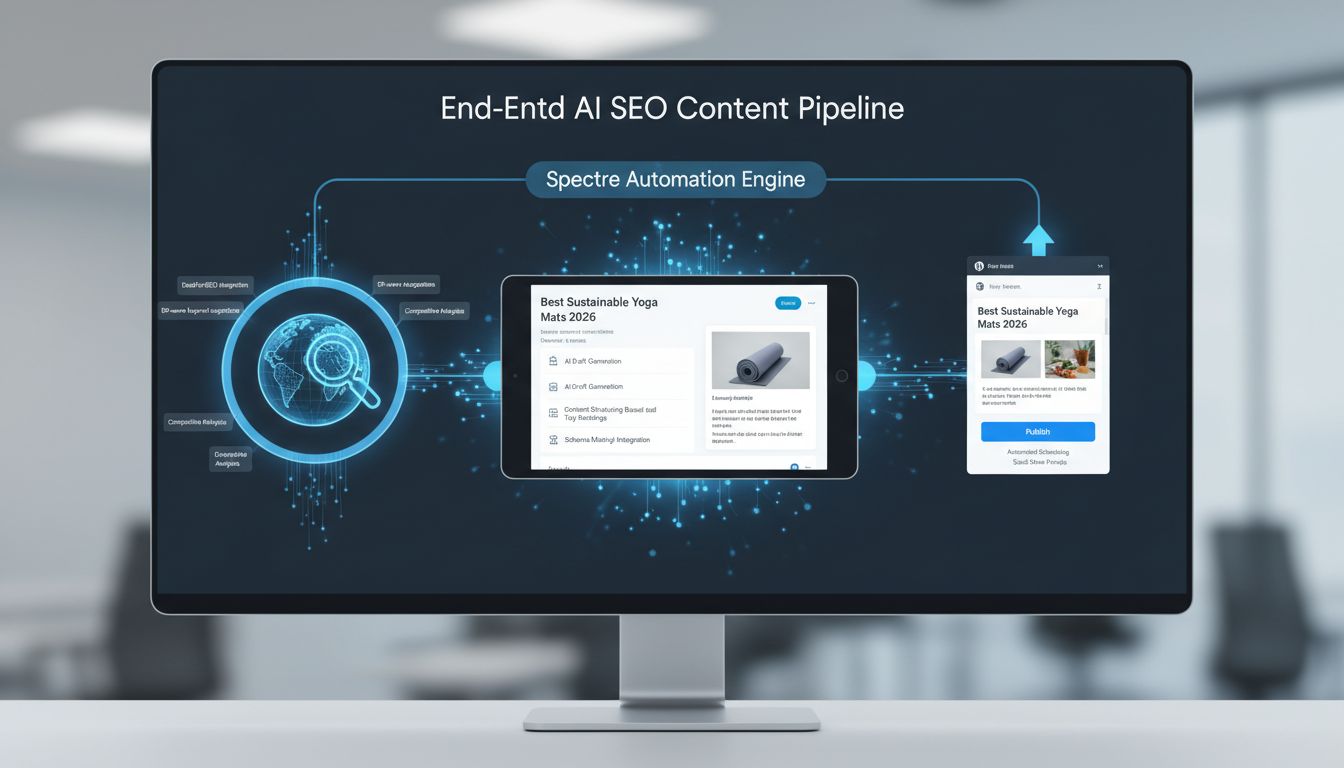
Most SEO tools solve one piece of the problem. Spectre tries to solve all of it.
It's an AI seo optimization tool that handles keyword research, drafts the article, and publishes it to your WordPress site in a single workflow. We built it for founders, marketing leads, and SMBs whose bottleneck isn't one part of the content pipeline, it's the whole thing.
If you're tired of bouncing between keyword tools, briefs, and your CMS, that's exactly what this fixes.
It connects directly to DataForSEO for keyword research and SERP analysis, then generates and publishes the draft without the manual handoffs that eat up most of a small team's time. It also uses your site's domain rating to surface keywords you can actually rank for, so you're not wasting cycles chasing terms that are out of reach.
The trade-off is real: Spectre prioritizes getting quality content published at scale over real-time optimization feedback. You won't get the live scoring you'd find in Surfer SEO. That's a deliberate call, it's built for teams that need output, not another editor to tweak things in indefinitely.
It works best when there's a human strategy layer guiding topics and reviewing drafts.
Pricing is tiered across Starter, Pro, and Enterprise plans, so it's accessible for bootstrapped startups and scales up for agencies. Nearly seven in ten companies report better returns after integrating AI into their SEO workflows (Source: Semrush), and Spectre is built to capture that by automating the entire pipeline.
For anyone searching for the best ai tools for seo, this is the top pick, not because it writes the best sentences, but because it solves the systems problem.
H2: 2. Surfer SEO, Best for Real-Time On-Page Optimization
Best for content teams who need rigorous, data-driven optimization of individual articles before hitting publish.
Surfer SEO's Content Editor is basically a real-time optimization coach. You write in it (or paste existing content), it analyzes the top-ranking pages for your target keyword, and then gives you a live score plus specific recommendations. Word count, heading structure, keyword density, related terms you're missing, it checks all of it.
The correlation between Surfer's scores and actual ranking outcomes is what makes it credible. Surfer's own case study data shows that articles scoring 83 or higher are 43% more likely to rank in the top three positions. Hostinger used it to scale tutorial content to over 1 million weekly organic clicks.
For teams serious about on-page SEO, the enterprise features hold up: GDPR compliance, SSO, dedicated advisory programs. Its AI Tracker also monitors your visibility in AI chat results, which matters more than most people realize right now if you're thinking about seo for ai search.
The trade-off is that Surfer is an optimization layer, not a complete pipeline.
You still need separate tools for keyword research, initial drafting, and publishing. That fragmented workflow can also push teams toward score-chasing at the expense of actual content strategy, which is the gap something like Spectre is built to fill.
surfer seo pricing is tiered across Basic, Pro, Business, and Enterprise plans. As a surfer seo alternative goes, it's hard to beat for pure on-page optimization, but if you need the whole system automated, it won't get you there on its own. It's the right call if you already have a content process and just want to squeeze more out of each article.
H2: 3. AirOps, Best for Customizable AI Workflow Orchestration
Best for agencies and technical marketing teams who need to build bespoke content assembly lines, not use pre-built ones.
So what happens when every tool on the best ai tools for seo list feels too rigid for what you're actually trying to do? You end up somewhere like AirOps.
AirOps gives you the components, access to multiple LLMs (GPT, Claude, Gemini), flexible templates, APIs, and then basically says "build the machine yourself." You can stitch together SERP analysis, internal data sources, and bulk content generation, then schedule runs and publish directly to WordPress, Webflow, or Shopify. For technical users with specific, repeatable processes, that's a genuinely useful thing.
The core appeal is that you're not locked into a single vendor's idea of what ai seo optimization should look like. You can pull keyword data from one source, enrich it with your own product documentation, and route it to a specific LLM for drafting.
The trade-off is real though. Steep learning curve, serious setup time, and you're essentially building your own content pipeline from scratch. That requires both technical skill and enough SEO knowledge to design the workflow correctly in the first place.
Pricing skews enterprise, often custom, which tells you everything about who this is actually for. If you're scanning a broader seo tools list hoping for something you can spin up this afternoon, this isn't it.
AirOps is what you reach for when other top seo tools, including the more flexible ones, still feel like someone else's workflow. You're trading implementation speed for total control. Whether that's worth it depends entirely on how specific your process is.
H2: 4. Jasper, Best for Brand-Consistent Content at Scale
Best for large marketing teams where maintaining a unified brand voice across hundreds of articles is more critical than SEO fundamentals.
Jasper is not an SEO tool. It's an AI writing platform built for scale, and that distinction matters more than people realize when they're searching for the best ai tools for seo.
The core thing it does well: you train it on your brand. Upload past content, style guides, approved messaging, and it generates drafts that actually sound like you. For enterprise teams managing dozens of writers, the governance controls are real, SSO, SCIM provisioning, audit logs, and claimed compliance with SOC2, PCI, DPA, CCPA, and GDPR [Source: research].
So it's beginner-friendly for writing. But it's dangerously weak for ai seo optimization.
There's minimal integrated keyword research. No meaningful SERP analysis. And user reviews consistently flag hallucinations, especially around statistics and factual claims. You get a consistent voice, but you can't trust what it says without someone checking every fact by hand.
Pricing starts at $69/month for the Pro plan, with custom Business tiers, so it's not exactly in the seo software tools free category either.
Think of it as one piece of a larger stack. Paired with something like Surfer SEO or Ahrefs, it handles the drafting bottleneck. On its own, it leaves the entire research and optimization workflow manual. For anyone looking for free ai seo tools or even just functional ai seo optimization tools, Jasper alone is a misstep.
It solves the wrong problem if SEO is your actual goal.
H2: 5. Frase, Best for Turning Research into Briefs (Fast)
Best for content strategists drowning in manual competitor analysis before they can even start writing.
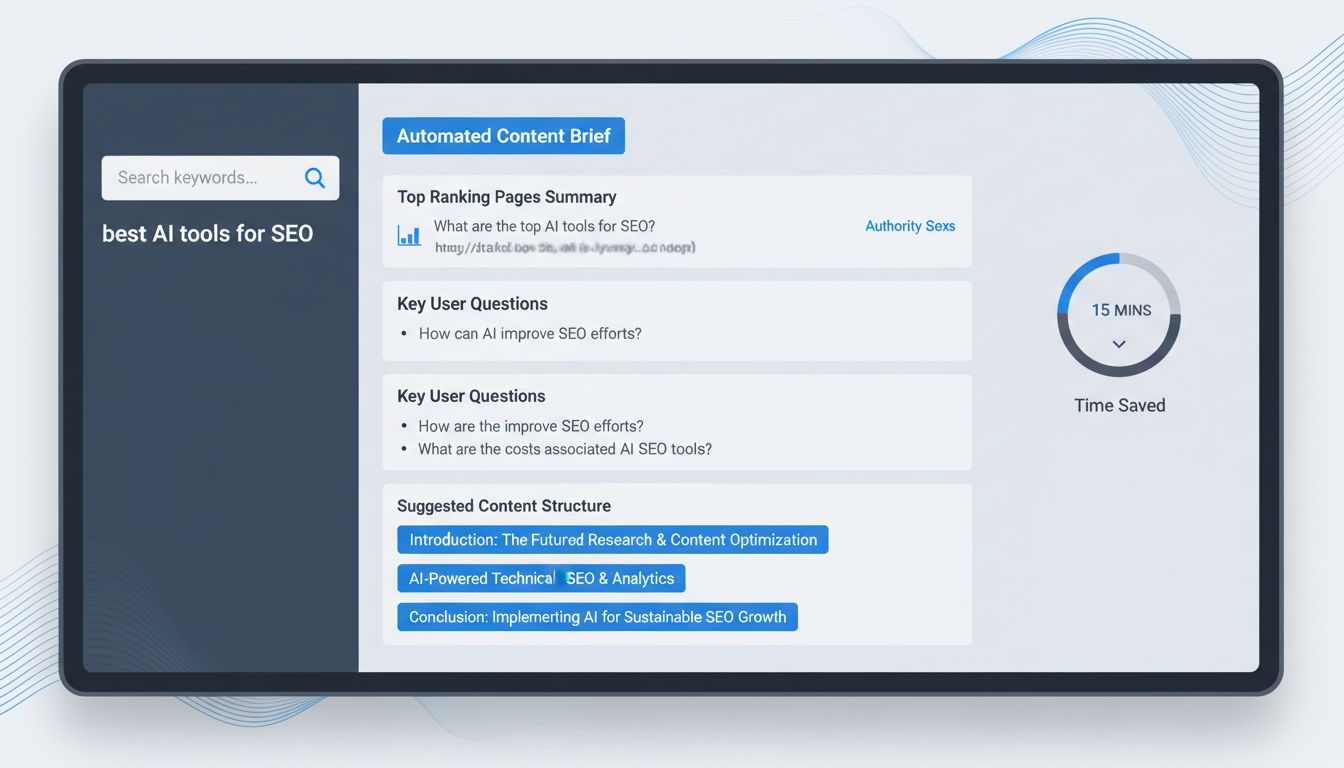
What's the most time-consuming part of content production? For most teams, it's not the writing. It's everything before the writing.
That's the specific bottleneck Frase goes after. While most ai seo optimization tools focus on the writing or the on-page tuning, Frase focuses on the research and briefing phase, analyzing SERPs, summarizing what top-ranking pages cover, identifying questions users are actually asking, and suggesting a content structure to match.
You feed it a keyword. It hands you a brief.
The Brief Builder can compress hours of manual research into about 15 minutes. For teams where strategists spend more time building briefs than producing content, that's a real shift [Source: aitoolsdevpro.com/frase-guide]. It also has CMS auto-publishing, so finished content can go straight to WordPress.
The catch is the writing itself. The AI generation is functional, but it's clearly a secondary feature, less capable than dedicated tools like Jasper, and nowhere near the integrated pipelines you'd find in something like Spectre. You're buying a research engine that happens to have a writing module attached.
Pricing runs from Starter up through Professional and Enterprise tiers, so it's not in the seo software tools free category. But as a top seo tool for the front end of your workflow, it's hard to argue with what it does.
The honest version: Frase handles the beginning of the pipeline well. But you'll still need other tools for generation, optimization, and publishing. If you're looking at the whole workflow, the way someone building a real seo tools list would, that gap is exactly what you'd need to account for.
H2: 6. Scalenut, Best for Cost-Effective Planning & Drafting
Best for freelancers and small teams who need an affordable, all-in-one platform to go from keyword planning to first draft.
Scalenut is the "I just want something that works without spending a lot" option in the ai seo optimization tools space.
It combines topic planning, SERP analysis, and its signature "Cruise Mode" for rapid drafting into one interface. If you're a solopreneur or small marketing team just starting to scale content, it removes a lot of the early friction.
The pricing tiers (Starter, Plus, Professional) are accessible, it has a 4.7 on G2, and it connects to WordPress and Semrush. Cruise Mode is genuinely good at generating a structured first draft from a single keyword, cuts out a chunk of the research and outlining you'd otherwise do manually.
The trade-off is depth.
Its content optimization and grading features are lighter than specialists like Surfer SEO or Clearscope. It handles the drafting step well but doesn't run the whole pipeline, keyword discovery, drafting, optimization, publishing, the way something like Spectre does.
You get a capable all-rounder. Not a deep specialist, not a fully automated engine.
For founders and marketers who've outgrown manual drafting but aren't ready to invest in full automation, Scalenut is a sensible, cost-effective stepping stone. It's a solid entry in any seo tools list, ahead of free ai seo tools in terms of structure, and a reasonable surfer seo alternative if surfer seo pricing feels like too much for where you're at right now.
But as your content volume grows, the gaps in automation and optimization become hard to ignore.
H2: 7. Semrush ContentShake AI, Best for Leveraging Semrush's Data Ecosystem
Best for dedicated Semrush power users who want AI content generation without leaving their familiar data ecosystem.
If your entire SEO strategy already lives inside Semrush, ContentShake AI is the obvious next step. It layers AI generation directly on top of Semrush's database, so topic suggestions, outlines, and drafts come pre-loaded with competitive intelligence you're already paying for. No CSV exports, no copying data between tabs.
That integration is the whole pitch. Your content briefs pull Semrush's keyword data and SERP insights from the start, which saves real time if you're already deep in that ecosystem. Some plans also include AI visibility and LLM ranking tracking, though those tend to be priced as separate add-ons [Source: https://semrush.com/blog/ai-seo-statistics].
The weakness is just as obvious: ecosystem lock-in.
If you're not already a Semrush subscriber, this tool doesn't make much sense. Starting with Semrush just to access its AI content features is an expensive, overcomplicated path, especially compared to a dedicated platform like Spectre. The AI generation is competent. It's not best-in-class as a standalone writer.
Pricing is tied to Semrush's Content Toolkit or specific AI add-ons. For an agency that lives in Semrush daily, it's the path of least resistance. For everyone else on a basic seo tools list, or anyone comparing top seo tools, ai seo optimization tools, or weighing surfer seo pricing against surfer seo alternative options, it's a solution to a problem you probably don't have.
If you're still figuring out best ai tools for seo, or looking at seo software tools free options and best seo tools for beginners, start somewhere simpler. ContentShake AI rewards existing Semrush users. It doesn't really serve anyone else.
H2: 8. Clearscope, Best for Enterprise Content Grading & Workflow
Best for large editorial teams that need a standardized, score-driven process for quality assurance before hitting publish.
Clearscope isn't an AI content generator. It's an optimization and editorial workflow platform, and that distinction matters.
You bring the draft, from your writers, from Jasper, from Spectre, wherever, and Clearscope grades it against the top-ranking pages for your target term. Clear score, specific recommendations, done. It's built for organizations that have content creation handled and just need to govern quality at scale.
The grading system is what teams actually trust here. Editors can assign reviews, track progress, and collaborate inside the platform without the whole thing falling apart. Business and Enterprise plans come with account management, which makes it a real fit for structured content operations.
The limitation is just as obvious as the strength: it's purely an optimization layer.
You still have to create the content somewhere else first. Clearscope doesn't help with that part at all. So if your bottleneck is drafting, or if you're still exploring the best ai tools for seo, comparing surfer seo alternatives, or trying to understand surfer seo pricing against other top seo tools, this isn't your starting point.
Pricing starts at $129/month on the Essentials tier. For teams doing ai seo optimization at scale with an established editorial process, it earns its place. For everyone else comparing seo tools lists, free ai seo tools, seo software tools free options, or looking for best seo tools for beginners, it's an expensive add-on to a problem a full-pipeline tool probably already solves. Same goes if you're thinking about seo for ai search more broadly and need something that handles the whole workflow, not just the final grading pass.
H2: Critical Mistakes to Avoid When Scaling with AI SEO Tools
Publishing AI drafts without human fact-checking. This is the fastest way to destroy your site's credibility.
Tools like Jasper hallucinate statistics and fabricate sources. I've seen entire case studies invented by AI, complete with fake company names and revenue figures. Google is getting better at detecting this stuff, and one factually wrong article can tank your E-E-A-T signals across the whole domain.
Ignoring your domain rating when choosing keywords. This is where most automated workflows fall apart.
Your ai seo optimization tool might flag "best project management software" as a great target because the search volume looks good. If you're running a DR 20 blog, you're not ranking for that. I've built content engines inside major media companies where domain rating was the primary constraint on keyword strategy, a tool that doesn't help you work within that reality is just setting you up to waste time.
Equating AI visibility with actual clicks. As AI Overviews get more prominent, CTR on traditional results drops. Getting cited in an AI answer doesn't mean anyone visits your site.
I track this through Surfer's AI Tracker. Sometimes you get visibility without the traffic. Optimizing purely for seo for ai search answer inclusion, without thinking about how to actually capture clicks, is a real strategic mistake.
Using one specialized tool for everything. Clearscope is great for optimization but won't generate drafts. Jasper builds consistent brand voice but doesn't do keyword research. Expecting any single entry on your seo tools list to handle the entire pipeline just leads to frustration and manual workarounds.
The best teams I've worked with run a connected stack. Not a magic bullet.
Overlooking data privacy and model training policies. Before you upload sensitive product roadmaps or proprietary research, check whether the vendor is using your content to train their models.
Compliance postures vary a lot. Jasper and Writesonic publish detailed claims about this; plenty of others say nothing. For B2B companies with confidential information, it's not just a compliance question, it's a competitive risk.
H2: Key Trends Shaping AI SEO Tools in 2026
What's actually changing in this market, and why does it matter?
The global AI SEO software tools market is projected to hit around USD 2.43 billion in 2026, growing to USD 5.97 billion by 2035 (Source: businessresearchinsights.com). That kind of growth pushes consolidation. The tools winning right now are the ones building integrated workflows, not isolated point solutions.
SEO is becoming AEO (Answer Engine Optimization). The best ai tools for seo now track visibility in AI Overviews and chat interfaces, not just traditional SERPs. Surfer SEO's AI Tracker and Semrush's AEO features exist specifically because of this shift. Showing up in an AI answer box can mean a 30% drop in traditional click-through rates.
Enterprise-grade compliance is now table stakes. GDPR, SOC2, SSO, audit logs, serious teams expect all of it. Jasper, Surfer Enterprise, and Writesonic all advertise these features prominently. It's not just security. It's governance at scale.
The adoption debate is over. Nearly 70% of companies report better returns after integrating AI into their SEO and content workflows (Source: semrush.com). The question stopped being if you should use ai seo optimization tools a while ago. It's now about how to implement them without creating more chaos than you had before.

The leading edge right now is full workflow automation. The next generation of top seo tools won't just generate or optimize content, they'll connect keyword research, SERP analysis, drafting, ai seo optimization, and publishing into a single automated pipeline.
That's exactly why we built Spectre. To orchestrate the whole process from discovery to publication, not hand you another item to add to your seo tools list.
Conclusion
Scaling SEO content isn't about writing faster. It's about systemizing the entire workflow, from keyword discovery to hitting publish.
The right best AI tools for SEO depends entirely on where your bottleneck actually is.
If you're drowning in manual competitor research before you even start drafting, Frase solves that. If brand voice is slipping across a large team, Jasper handles it. For data-driven optimization of individual articles, Surfer SEO or Clearscope do the job. Agencies that need custom workflows will get a lot out of AirOps.
But for founders and marketing leads growing organic traffic without a dedicated SEO team, the most effective solution automates the most steps.
The core friction isn't any single task. It's managing a fragmented process where every step lives in a different tool.
That's why Spectre is the top pick. It handles the entire pipeline: research, drafting, ai seo optimization, and publishing. If you want to move from manual, piecemeal production to a systematic content engine, that's where to start your evaluation.