May 26th, 2026
How to Do SEO for Small Business: A Step-by-Step Guide
 WD
WDWarren Day
You've probably heard that SEO is essential for your small business. And then you went looking for advice and found... a lot. Too much. Conflicting, jargon-heavy, written for someone with a marketing team and a six-figure budget.
You don't have that. So most of it isn't useful.
Forget exhaustive checklists. Effective how to do SEO for small business in 2026 comes down to a few things: stacking quick technical wins, building content around local and commercial intent, and tracking the handful of metrics that actually connect to revenue.
That's it. Everything else is noise.
I've built SEO systems for major media companies and now run Spectre, my own AI-powered platform that automates content production for businesses like yours. The thing most SEO guides won't tell you? Small business SEO depends less on chasing algorithm updates and more on ruthlessly prioritizing what moves the needle.
Here's what this guide covers: realistic timelines and ROI expectations for 2026, a core three-pillar strategy across technical, content, and local SEO, a 90-day action plan you can start immediately, and a clear-eyed look at when to DIY versus when to hire help, with actual numbers attached.
Whether you're researching affordable SEO services for small businesses, comparing SEO packages for small business, or just trying to figure out the best SEO for small business on a tight budget, this is where to start.
Prepare Your SEO Foundation: Tools and Mindset
What do you actually need before you start? Not much. These three free tools from Google are enough to get going.
- Google Search Console (GSC): This is your direct line to Google. It shows how your site appears in search results, flags technical errors stopping pages from being found, and lets you submit new content for crawling. Think of it as your website's health dashboard.
- Google Analytics 4 (GA4): This tracks who visits your site, where they come from, and what they do. You'll use it to measure organic traffic and conversions, proving your SEO is actually working. [Source: https://siteground.com/academy/seo-checklist]
- Google Business Profile (GBP): If you serve customers in a specific area, this one isn't optional. A fully optimised GBP listing is how you get into local "map pack" results, which drive 40% more clicks. [Source: https://pageoptimizer.pro/blog/small-business-seo-statistics-insights-to-grow-your-business-in-2025]
These are also some of the best affordable SEO tools out there, because free is about as affordable as it gets.
Plan to spend 5-10 hours a week actually implementing this stuff. SEO isn't a one-off project. It's a system where small, consistent actions add up over months.
Before you touch anything, take stock of where you're starting from. For something like Bristol Brick Oven Pizza, that means your GBP and local directory listings. For a CloudFlow SaaS startup, it means making sure your core product pages are technically sound and answering real commercial questions.
Know where you stand before you start building.
Set Realistic Expectations for Small Business SEO
SEO isn't a magic trick you pull off in a weekend. It's a compounding investment.
You'll typically see measurable organic traffic improvements within 3–6 months of consistent effort [Source: siteground.com/academy/seo-checklist]. Competitive keywords, where you're up against established players, can take 6–12 months to rank for.
And success isn't just more website visitors. For a small business, it's qualified leads, phone calls that convert, actual sales from your local area. That commercial focus is what makes the whole thing worth it, the average SEO ROI ratio is 22:1 [Source: rebootonline.com/seo-statistics]. For every pound you invest, you can expect twenty-two back.
Is SEO dead in 2026? No. But it's changing.
AI-generated overviews in search results are shifting click-through rates for some queries. They haven't, however, replaced the need for your business to be findable when someone searches "plumber near me" or "best accounting software for contractors." The fundamental job is still the same: build a visible, trustworthy presence that answers specific, commercial questions.
Forget the myths about instant #1 rankings. Whether you're figuring out how to do SEO for small business yourself, hiring an SEO company for small business, buying SEO packages for small business, or looking into affordable SEO services for small businesses, none of it works overnight.
The best SEO for small business is about stacking consistent, foundational wins over quarters, not days.
Adopt the Core 3-Pillar Strategy for 2026 SEO
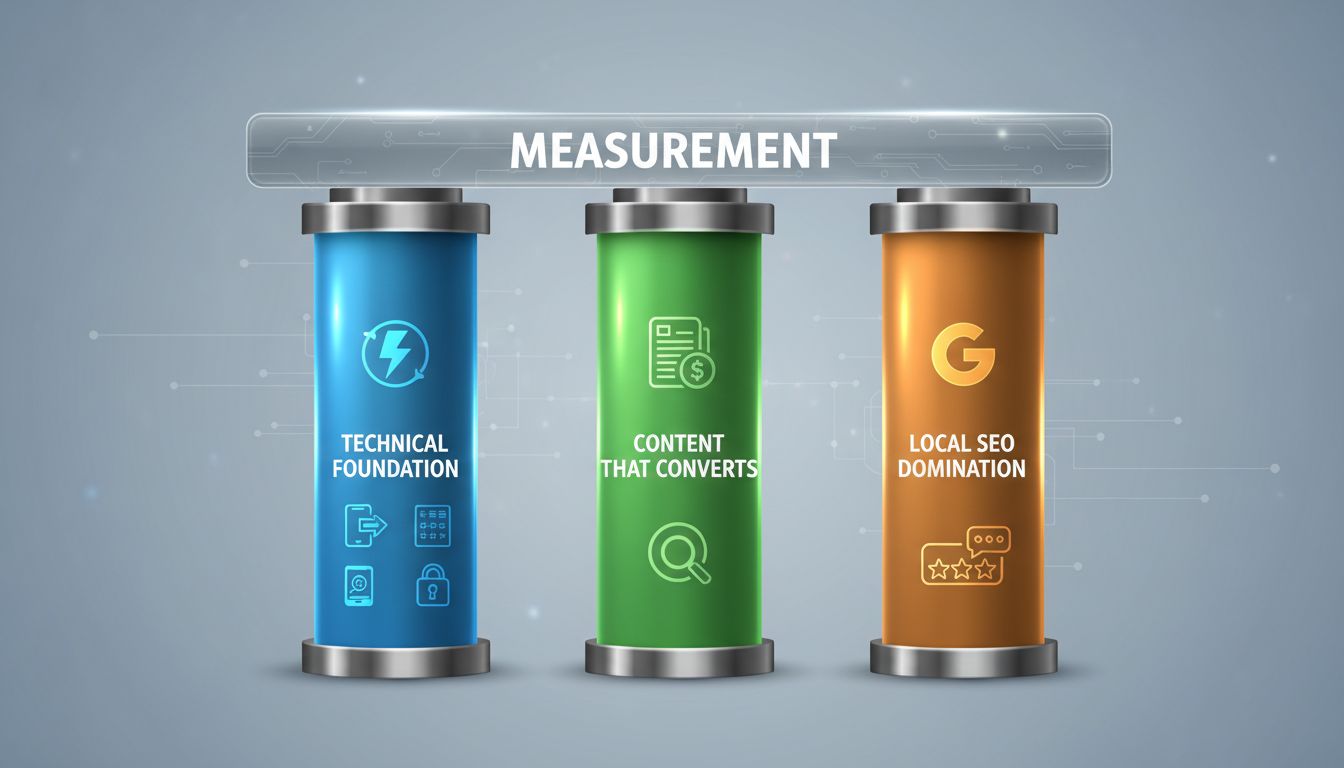
Here's the actual framework. Everything you do for best SEO for small business in 2026 fits into three pillars, with measurement running underneath all of it.
Pillar 1: Technical Foundation Your site needs to be discoverable, fast, and usable. That means Google can crawl and index your pages, you're on HTTPS, and you're built for mobile-first indexing.
A one-second delay in page load can reduce conversions by 7% [Source: https://fleexy.dev/blog/how-page-speed-affects-conversion-rates-study]. Technical SEO isn't optional, it's the floor everything else sits on.
Pillar 2: Content That Converts Create content that directly answers what your customers are actually searching for. For a SaaS business like CloudFlow, that means targeting "automate CRM data entry" with detailed, useful guides, not generic "business software" articles.
Google's recent core updates have been brutal to thin, AI-generated fluff. Real expertise shows.
Pillar 3: Local SEO Domination If you serve a specific area, this is your primary channel. Claim your Google Business Profile and actually optimize it properly.
Businesses appearing in the Local Pack see a 40% higher click-through rate [Source: https://pageoptimizer.pro/blog/small-business-seo-statistics-insights-to-grow-your-business-in-2025]. For a local business like Bristol Brick Oven Pizza, that means local citations, consistent NAP (Name, Address, Phone), and location-specific pages. This is where best local seo companies focus their energy first, and for good reason.
Cross-Cutting: Measurement Google Search Console tells you what's getting indexed and what people are searching. Google Analytics 4 tells you what that traffic actually does. Together, they turn your effort into something you can act on.
Whether you're figuring out how to do SEO for small business yourself, using affordable SEO tools, buying SEO packages for small business, or paying for affordable SEO services for small businesses through an SEO company for small business, this three-pillar model is the thing you keep coming back to.
Checklists are overwhelming. This isn't.
Build Your Technical Foundation (Weeks 1-2)
Your technical foundation is what Google sees before your content. Get it wrong and you're building on sand. These first two weeks are about fixing the showstoppers, the issues that prevent Google from seeing, understanding, or ranking your site at all.
Audit Your Site Health in 1 Hour
- Check your indexing status. Go to Google Search Console (GSC), navigate to "Coverage," and look for errors. A healthy site shows mostly "Valid" pages. For Bristol Brick Oven Pizza, a red flag would be seeing their main service pages marked as "Excluded."
- Run a speed test. Use Google PageSpeed Insights. Enter your URL and check the "Core Web Vitals" assessment. A one-second delay in page load time can reduce conversions by 7% Source: fleexy.dev. Aim for scores above 90 on mobile.
- Verify mobile-friendliness. Use Google's Mobile-Friendly Test. Google primarily uses the mobile version of your site for ranking. This one isn't optional.
Fix Critical Technical Showstoppers
Prioritise these fixes in order:
- Enable HTTPS. If your URL starts with
http://, you need an SSL certificate. Most hosting providers offer this for free. Basic security, basic ranking signal. - Audit your robots.txt file. Access
yoursite.com/robots.txt. A common mistake: usingDisallow:to block pages you don't want indexed. That's wrong. Use anoindexmeta tag or password protection instead.Disallow:is for crawl budget, not indexing. - Submit your XML sitemap. In GSC, go to "Sitemaps" and submit the URL (usually
/sitemap.xml). This tells Google about your important pages.
Leveraging AI for Technical Analysis
You can ask ChatGPT to generate a technical SEO checklist. It'll give you a decent list of items to check.
The limitation? It can't actually inspect your site. It doesn't know if your homepage has a 5-second LCP or if your product schema is broken.
That's where purpose-built AI tools come in. At Spectre, our AI audit doesn't just list checks, it crawls your site, identifies specific broken elements (like a missing LocalBusiness schema on your contact page), and prioritises fixes by potential impact. It automates the grunt work I used to do manually for agency clients.
Never fully automate trust, though.
Use AI to surface issues, but verify critical findings yourself in GSC, indexation blocks, HTTPS status, that kind of thing. The engineer's rule applies: trust, but verify.
Create Content That Converts (Weeks 3-8)
Technical foundation is done. Now you actually need to get leads from it. Forget posting daily, you want the 20% of pages that produce 80% of results.
Conduct Actionable Keyword Research
Start with Google Keyword Planner (free) or Ahrefs if you have the budget. Search for your core services plus location: "accountant London" or "roof repair Manchester." Then look for commercial intent, "buy" and "price" terms mean someone's ready to spend money, not just browse.
Build a simple spreadsheet with three columns: Keyword, Search Volume, and Intent (Informational, Commercial, Navigational). For the Bristol pizza shop example, that's "best pizza delivery Bristol" (informational) and "buy pizza oven Bristol" (commercial). That classification tells you what the page needs to do.
Apply the 80/20 Rule to Your SEO Efforts
Pick your five most important service or product pages. Optimise those first. For CloudFlow SaaS that's the pricing page, features page, and integration pages. Each one needs unique, detailed content that actually answers buyer questions.
Then plan one big cornerstone guide per quarter. Something like "The Complete Guide to SaaS Pricing Strategies." Long-form content earns significantly more links than short articles, which makes these your main authority builders. Prioritise by traffic potential and conversion value, not just keyword volume.
The Right (and Wrong) Way to Use AI for Content
Use AI like ChatGPT for ideation and first drafts. Hand it your keyword spreadsheet, ask for outline variations, see what comes back. But don't publish raw AI output. Google's Helpful Content System actively devalues thin, unoriginal material.
Here's the hybrid workflow that actually works: AI generates the draft structure, then you inject real expertise. Client case studies, technical gotchas from building something real, pricing breakdowns from actual implementations. That's what creates content with genuine Experience and Expertise (E-E-A-T).
Tools like Spectre handle the research and drafting while keeping a human in the loop for quality control. You get speed without losing the specific insights that make content rank.
One more thing: updating existing content can double traffic. Use AI to refresh older posts with new data and examples before you go building something new.
Content Brief Template:
- Primary Keyword: [e.g., "affordable seo services for small businesses"]
- Target Word Count: 1,200-1,800 words
- Competitor Analysis: Top 3 ranking URLs to analyse
- Unique Angle: Your specific experience or data point
- internal links: 3-5 relevant pages to link to
- Call-to-Action: Specific next step for the reader
Dominate Your Local Market (Ongoing)
Local SEO is the simplest high-ROI work you'll do. While everyone's obsessing over technical audits, you can be capturing real customers searching "near me" right now. Businesses in Google's Local Pack get a 40% higher click-through rate than competitors (Source: pageoptimizer.pro). That's free traffic you're just leaving there.
Here's your ongoing local dominance checklist:
- Claim and optimize your Google Business Profile completely
- Audit and standardise your NAP (Name, Address, Phone) across all directories
- Generate and respond to reviews weekly
- Create location-specific service pages on your website
Optimize Your Google Business Profile
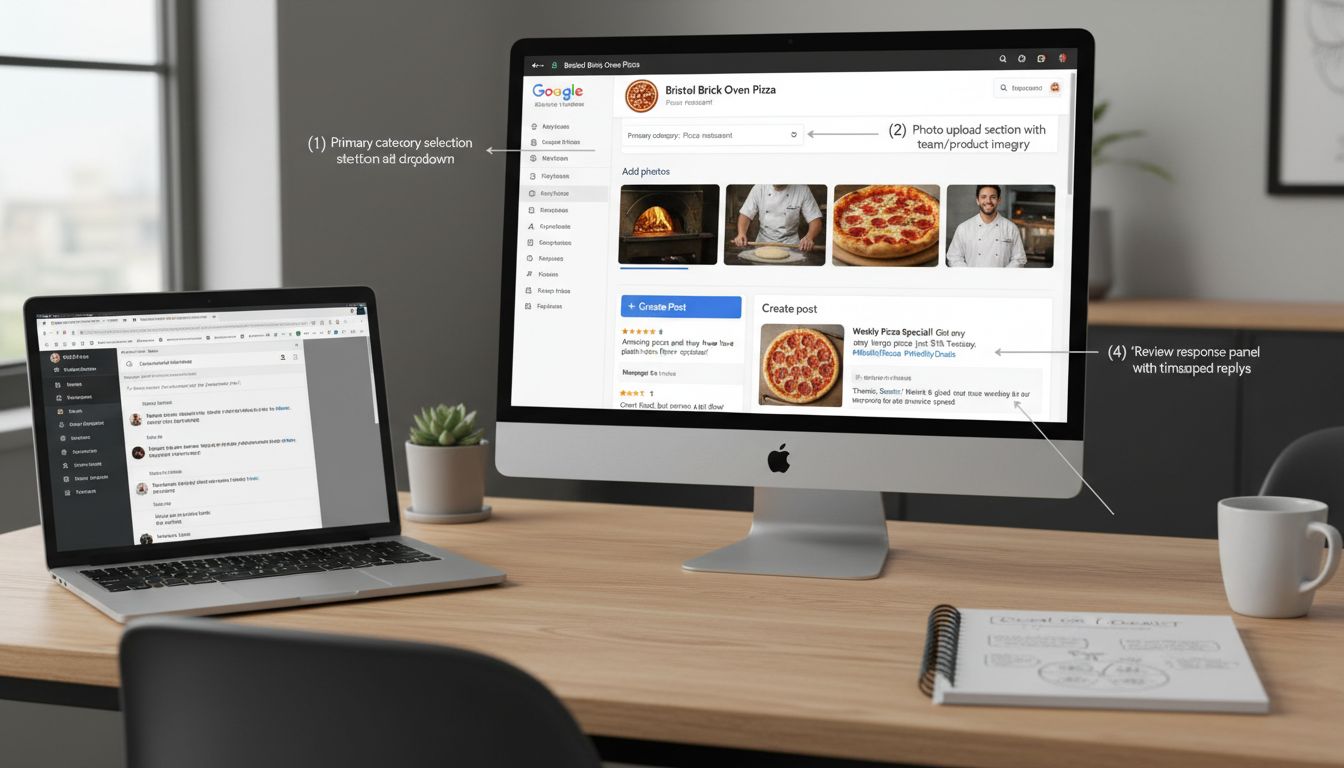
Open your Google Business Profile dashboard. Pick one accurate primary category. This matters more than most people realise.
Add secondary categories for everything else you do. Upload real photos monthly, not stock images, actual photos of your team, your space, your products. Weekly posts too: special offers, events, new services.
Respond to every review within 48 hours. Both positive and negative. Set a reminder. This part isn't optional.
For Bristol Brick Oven Pizza, that meant photos of their wood-fired oven, weekly pizza special posts, and responding to every review that mentioned "gluten-free options."
Ensure NAP Consistency and Citation Cleanup
Search your business name across Yelp, Apple Maps, Bing Places, and whatever industry directories apply to you. You'll find inconsistencies. Different phone numbers, old addresses, misspelled names.
Use BrightLocal's free audit or manually check the top 20 directories. Fix every inconsistency. Add your business to any relevant local directories you're missing.
It's not glamorous. But inconsistent NAP genuinely confuses Google's local algorithm, so it has to get done.
If that all sounds like a lot, that's exactly when you start thinking about outsourcing to best local seo companies. They'll handle your GBP, citations, and review generation for around £300-£800/month.
For most small businesses doing affordable seo for small business on their own, spending the first three months figuring this out yourself is worth it. You build the understanding. Then you hand it off knowing what you're paying for.
Assess the DIY vs. Hire Decision for Small Business SEO
This is your most critical financial decision. The wrong choice wastes money or stalls growth. Here's how to choose.
First, calculate your realistic hours. DIY requires 5-10 hours per week. You'll learn tools like Google Search Console and manage your Google Business Profile. If you can't commit that time, outsourcing is your only path.
Use this decision matrix:
| If your monthly budget is... | Recommended Approach | Where to Spend |
|---|---|---|
| Less than $300 | DIY with free tools | Your own time on GBP, basic content, technical fixes. |
| $300 – $1,500 | Hybrid (DIY + Freelancer) | Hire a freelancer for specific tasks like GBP optimisation or technical audits (~$30–$150/hr). Do content yourself. |
| More than $1,500 | Agency or Specialist | Outsource comprehensive strategy, link building, and scaling. Expect agency rates of $75–$250+/hr Source: RebootOnline. |
When to hire immediately:
- Technical debt: Your site has complex issues (redirect chains, JavaScript rendering problems).
- Link building: You need authoritative backlinks. A single DR 50+ link can generate thousands in annual traffic value, but costs $500–$1,000+ to acquire legitimately.
- Scaling content: You've validated a content strategy but lack bandwidth to produce volume. This is where a tool like Spectre automates research and writing, reducing the cost of scaling.
Example: Bristol Brick Oven Pizza with a $500/month budget might DIY their blog and hire a freelancer for 3 hours monthly to optimise their GBP and citations. CloudFlow SaaS with $2,000/month should outsource technical SEO and a targeted link-building campaign.
The hybrid model is how you figure out how to do seo for small business without handing over full control. You keep the parts you can handle, and buy expertise where it actually matters.
If you're searching for an seo company for small business or comparing seo packages for small business, that decision matrix above is your starting point. Know your budget before you talk to anyone.
And if budget is tight, there are genuinely good affordable seo services for small businesses and affordable seo tools out there. You don't need to spend $3,000/month to get the best seo for small business results at your scale. Plenty of providers offer affordable seo services in usa that fit a $500–$1,500/month range without cutting corners on the things that move the needle.
Measure and Track Your SEO Success
Measurement isn't optional. It's how you prove the investment is working.
You'll use two free Google tools for 90% of what matters.
Set up Google Analytics 4 for conversion tracking first. Create events for form submissions, phone calls, and online purchases. For Bristol Brick Oven Pizza, that means tracking "Order Completed" from checkout and "Call Button Clicked" from the website. That shows you which pages drive revenue, not just traffic.
Then check Google Search Console weekly. Look at the Performance report for impressions, clicks, and average position on your target keywords. Also check Coverage for crawl errors. Fix 404s and 5xx errors immediately, they waste Google's crawl budget.
Define these four KPIs:
- Keyword rankings for your 10-20 priority terms
- Organic sessions (total monthly traffic from search)
- Conversion rate from organic traffic
- Google Business Profile actions (calls, directions, website clicks)
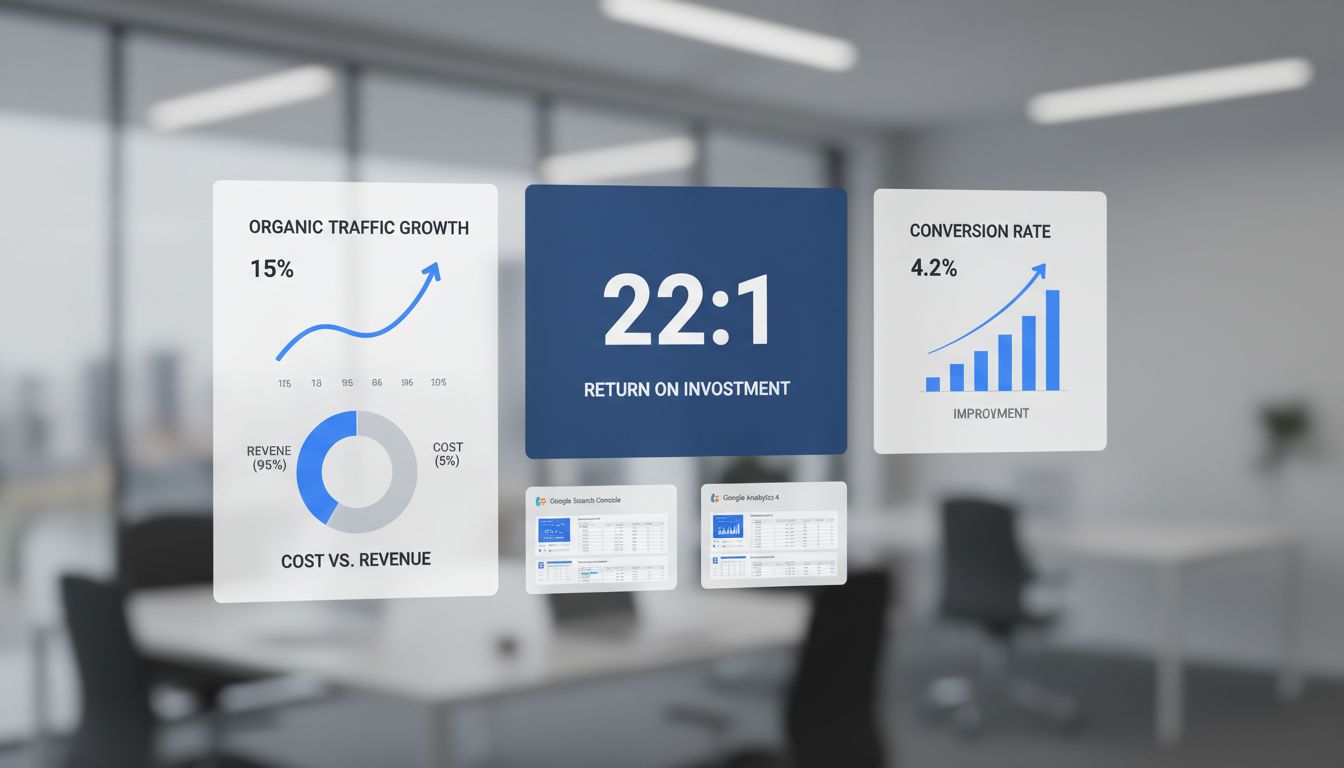
Calculate your SEO ROI quarterly.
The formula: (Revenue from organic – SEO cost) / SEO cost × 100. If you spend £1,000 on tools and content, and pull in £22,000 from organic search, that's a 2,100% ROI. That matches the 22:1 average ROI cited for SEO.
Track this number. It either justifies the continued spend or tells you to change something. Either way, you need the data to know.
Execute Your 90-Day Small Business SEO Action Plan
Stop planning and start executing.
This 90-day plan condenses everything we've covered into a week-by-week checklist. Follow it consistently and you'll see measurable improvements within 90 days.
| Week | Task | Tools Needed | Time Estimate |
|---|---|---|---|
| 1-2 | Technical Foundation | ||
| Week 1 | Set up Google Search Console & Google Analytics 4. Fix critical crawl errors (5xx, broken links). | GSC, GA4 | 3-4 hours |
| Week 2 | Ensure HTTPS is active. Submit XML sitemap. Run a Core Web Vitals check and fix major speed issues. | PageSpeed Insights | 2-3 hours |
| 3-8 | Content Creation | ||
| Week 3 | Complete keyword research: 20-30 buyer-intent terms. Create a content calendar. | Ahrefs, Semrush, or GSC | 2 hours |
| Week 4-5 | Optimise your top 3 service/product pages (title, meta, headings, schema). | CMS editor | 1 hour/page |
| Week 6-8 | Write and publish one detailed "cornerstone" guide (1,500+ words) targeting your primary keyword. | Spectre, Word processor | 4-6 hours |
| 9-12 | Local SEO Push | ||
| Week 9 | Fully optimise your Google Business Profile: categories, photos, description, posts. | GBP dashboard | 2 hours |
| Week 10 | Audit and clean up NAP citations across 5 major directories (Yell, Thomson Local). | BrightLocal, manual search | 3 hours |
| Week 11-12 | Systematically ask 5-10 happy customers for reviews. Respond to all new reviews within 48 hours. | Email, review link | 30 mins/day |
Monthly Tasks (Repeat every 30 days):
- Monitor: Check GSC for new crawl errors and index coverage (15 mins).
- Update: Refresh one piece of existing content with new data or examples (1 hour).
- Post: Add one new photo and post to your Google Business Profile (20 mins).
3-5 hours per week is all it takes. Month one is technical setup. Month two is content. Month three is local dominance.
By day 90 you'll have a technically sound site, content that converts, and a fortified local presence. That's the exact foundation behind the 22:1 average SEO ROI, and it's why figuring out how to do seo for small business correctly from the start matters more than most people think.
A lot of business owners assume they need to hire an seo company for small business or buy expensive seo packages for small business before any of this makes sense. Not always true. The best seo for small business usually starts with the basics done well, not a big budget.
There are affordable seo tools, Ahrefs Webmaster Tools, Google Search Console, PageSpeed Insights, that cover most of what you need in the early stages. Once you're ready to scale, affordable seo services for small businesses exist across the board, including plenty of affordable seo services in usa if you're stateside. The best local seo companies will tell you the same thing: the fundamentals have to be in place first. Affordable seo for small business isn't a shortcut. It's just not wasting money before you know what you're doing.
Avoid Common SEO Mistakes and Troubleshoot Issues
Even with a solid strategy, simple errors can stall your progress. These are the mistakes I see repeatedly across client audits.
Common technical mistakes:
- Using
robots.txtto block indexing (usenoindextags instead) - Ignoring mobile page speed, one-second delays can reduce conversions by 7% [Source: fleexy.dev]
- Not securing your site with HTTPS (critical for e-commerce)
Content mistakes:
- Publishing thin, AI-generated content without expert review
- Creating pages without internal links to your core service pages
- Updating content without refreshing publication dates
Local SEO mistakes:
- Inconsistent Name/Address/Phone across directories (Bristol Brick Oven Pizza fixed this on Yelp)
- Unclaimed Google Business Profile or hiding your address when it should be public
- Not uploading monthly photos to your GBP
Link building mistakes:
- Relying on guest posting for links (Google flagged this in 2014)
- Buying low-quality backlinks that trigger manual penalties
When traffic drops:
- Check Google Search Console for manual actions or indexing issues
- Audit recent site changes (plugins, redirects, content updates)
- Review Core Web Vitals for sudden performance regressions
- Check competitor movements in Ahrefs, sometimes they just improved
Most issues surface in Search Console. Check it weekly.
Conclusion
SEO for small businesses isn't about chasing every ranking signal or hiring expensive agencies. It's about picking a focused strategy and actually sticking to it.
The ROI is there, SEO delivers an average 22:1 return [Source: rebootonline.com], but only if you're patient and systematic. Forget the exhaustive checklists. The 20% that drives 80% of results is: fixing major technical issues, creating content around commercial intent, and owning your local market through Google Business Profile.
Start with the free tools. Search Console and Analytics 4 will tell you most of what you need to know. Then build out your content and local presence using the 90-day plan.
Track leads and revenue. Not vanity metrics.
When you're ready to scale, tools like Spectre can automate research and writing without tanking quality. And if you want hands-on help, there are plenty of affordable seo services for small businesses and seo packages for small business that won't drain your budget, a good seo company for small business can move things faster, especially on local optimization and technical fixes. If you're searching for the best seo for small business options or the best local seo companies in your area, look for ones that focus on results, not retainers.
There's also no shortage of affordable seo tools and affordable seo for small business options if you'd rather keep it in-house. Plenty of affordable seo services in usa cater specifically to smaller budgets. The question of how to do seo for small business always comes back to the same answer: start somewhere and actually do it.
The barrier isn't knowledge. It's execution. Start with your technical audit, measure what matters, and go from there.
Frequently Asked Questions
What is a good SEO strategy for a small business?
Three things, in order.
Fix your technical foundation first, make sure Google can crawl your site, that it works on mobile, and that it loads fast. Then create content that targets commercial and local search intent, backed by real case studies and actual customer examples. Then dominate local search through a fully optimised Google Business Profile and consistent citations across directories.
Is SEO dead or evolving in 2026?
Evolving. Not dead.
Google's 2024-2025 core updates devalued thin, AI-generated content and put more weight on E-E-A-T, Experience, Expertise, Authoritativeness, and Trustworthiness [Source: saffronedge.com]. For small businesses, that means authentic, helpful content matters more now than it did two years ago. AI-powered search features are also cutting click-through rates on some queries by up to 30% [Source: found.co.uk], so technical excellence isn't optional anymore.
Can I do SEO by myself?
Yes, if you can commit 5-10 hours a week.
Start with the free stuff: Google Search Console for technical audits, Analytics 4 for tracking, Google Business Profile for local visibility. The problem comes when you try to scale. Manual link building and content production get unsustainable fast. That's where tools like Spectre fill the gap, automating keyword research and content publishing without needing a full agency behind you.
Can ChatGPT write SEO articles?
It can write drafts. But purely AI-generated content gets explicitly devalued by Google's Helpful Content System.
The catch is that Google's algorithms now detect and demote content that lacks real expertise. So use AI for speed, but go back in and add your actual case studies, customer data, and hard-won insights. That hybrid approach is what satisfies E-E-A-T requirements while keeping production moving.
What is the 80 20 rule of SEO?
Find the 20% of pages driving 80% of your leads, usually your service pages or local landing pages, and put your effort there first.
Same logic applies to content: 20% of what you publish (typically your big cornerstone guides) will earn 80% of your backlinks. I've seen this play out enough times to stop questioning it. Optimize the high-impact assets before you touch anything else.
What are the 4 pillars of SEO?
For small businesses specifically: Technical (crawlability, Core Web Vitals, mobile-first indexing), Content (E-E-A-T aligned with commercial intent), Local (Google Business Profile and citation consistency), and Measurement (organic conversions, not just traffic).
This isn't enterprise SEO. It deliberately skips advanced schema and internationalisation, not because those things don't exist, but because they don't move the needle when you're working with real budget constraints.