May 18th, 2026
How to Implement Internal Linking Best Practices for SEO and AI Crawlers
 WD
WDWarren Day
Your site's internal linking isn't just a navigation feature or an SEO checkbox. It's the foundational data layer that teaches both Google's crawler and AI answer engines what your content means and why it matters.
If your linking is haphazard, you're leaving massive organic potential untapped. Like, 443% traffic growth untapped.
Most internal linking best practices guides give you disconnected tips. You know anchor text matters. You've heard about topic clusters. But you end up with a list of tactics, not a system.
Effective linking is no longer about mechanically distributing "link equity" through a rigid hierarchy. It's about building a navigable knowledge graph that signals entity relationships to both users and machines. The era of AI search means moving from keyword-matching links to entity-relationship signalling.
I'll give you a dual-audit framework I've built and deployed across media companies and SaaS products. A parallel technical audit for crawl and index health, plus a semantic audit for coherence.
Then you implement strategic, contextual links that both search engines and AI systems actually understand.
You'll walk away with a 4-step process: audit your current architecture, build your topic clusters, implement entity-aware links, automate measurement. This is the same framework behind Spectre's AI content system. Practical, scalable, built for how external linking SEO and internal linking actually work in 2026.
Before You Start: Prerequisites, Tools, and Mindset
What do you actually need before touching your site's architecture?
Three things.
A live website you control, admin access to Google Search Console, and a willingness to run a crawler. Basic SEO terminology and spreadsheets help. No coding required.
For tools: pick one site crawler. Screaming Frog (desktop), Ahrefs Site Audit, or Semrush Site Audit. Any of them gives you the raw structural data you need. Google Search Console is non-negotiable, that's your performance ground truth. Have a spreadsheet open and ready.
Then there's the mindset part.
This isn't about dropping random links into blog posts and calling it internal linking best practices. Think of it more like information architecture surgery. Done right, it's the kind of thing behind a 443% year-over-year organic traffic growth result documented in a Shopify case study.
You're building a navigable knowledge graph for users and AI crawlers alike, not just shuffling "link equity" around. External linking SEO fits into that same system.
Get that foundation right first. The tactical steps after this actually stick when you do.
Step 1: Run the Discovery & Health Check Audit
Stop guessing. Your first job is to crawl your entire site and extract every link relationship into a structured dataset. This isn't about opinions — it's about converting your chaotic link graph into a categorized list of technical problems you can fix systematically.
Open your terminal or your desktop crawler. You're going to run a full site audit and export five reports that become your master spreadsheet.
Configure and Run Your Site Crawler
Start with Screaming Frog or Ahrefs Site Audit. Configure the crawl to respect your robots.txt and handle JavaScript rendering if your site uses client-side frameworks.
If you're using Screaming Frog, set "Storage" to "Database" in Configuration > System. That lets you query the data properly later.
Run the crawl. Let it finish completely. This is your baseline.
Now export these five reports. Create a Google Sheet or Excel workbook with separate tabs for each:
- Orphan Pages: In Screaming Frog, go to Reports > Internal > Inlinks. Filter for pages with "Inlinks" equal to 0. These are pages your crawler found via your sitemap or external links, but with zero internal links pointing to them. Pages with only one incoming internal link are still considered weak and harder for crawlers to find. Export this list.
- Weak Pages: From the same Inlinks report, filter for pages with 1 or 2 inlinks. These are vulnerable. If you're using Ahrefs, also check the "Internal LinkRank" (ILR) score in Site Audit, pages below 10 need attention.
- Broken Internal Links & Redirect Chains: Go to Reports > Broken Links. Export all internal broken links (4xx errors). Then go to Reports > Redirect Chains. Any chain longer than one hop (e.g., Page A → 301 → Page B → 302 → Page C) is wasting crawl budget. Export these too.
- Pages with Excessive Outlinks: Navigate to Reports > Internal > Outlinks. Filter for pages with more than 100 outlinks. This is a flag for review, not an automatic penalty, you need to check whether those links are justified or just bloated navigation.
- Crawl Depth Report: In Screaming Frog, go to Reports > Structure > All Pages. The "Depth" column shows how many clicks from the start URL each page is. Flag everything deeper than 3 clicks, especially URLs with key commercial terms like "/pricing/" or "/enterprise/". Crawl depth greater than three clicks can cause pages to rank lower.
One caveat worth knowing: most crawlers parse static HTML. If your site relies heavily on JavaScript to render links (common in React or Vue SPAs), the crawler might miss them entirely, creating false "orphans." You'll catch those in the next step.
Cross-Reference with Google Search Console
Your crawler data is useful, but it's not the full picture. Open Google Search Console.
- Go to the Page Indexing report. Look for pages with the status "Discovered - currently not indexed." These are often your real orphan pages, Google found them but can't justify indexing them because nothing on your own site links to them. Add these URLs to your "Orphan Pages" tab.
- Go to the Links report (Internal Links). This shows Google's view of your top linked pages. Use it to check your crawler's "Top Linked Pages" export. If GSC shows a page with thousands of internal links and your crawler shows only a few, JavaScript rendering is probably the issue.
Your output is now a consolidated spreadsheet with five problem tabs: Orphan, Weak, Broken, Deep, and Bloated.
That's the difference between a vague feeling that "linking is messy" and a quantified list of architectural problems you can actually fix. Following internal linking best practices and keeping external linking SEO in mind, this spreadsheet is your work order for Step 2.
Step 2: Architect Your Topic Clusters and Prioritize
Your audit spreadsheet is overwhelming. A hundred problems, zero strategy. This step turns that flat list into an actual action plan.
First, find your hub and spoke pages. Hub pages are your site's pillars, broad-topic, high-authority pages that should rank for competitive commercial terms. Cross-reference these three sources to find them:
- Google Search Console: Pages with high impressions but low CTR (they're trying to rank but need help)
- Crawl data: Pages with the most internal links pointing to them
- Analytics: Pages that actually convert visitors
Spoke pages are the detailed subtopic content that supports each hub. Group them thematically.
Here's the friction point: your content team sees individual articles, not clusters. Map one high-value cluster visually, Miro, FigJam, even a whiteboard photo, to show how supporting content should orbit your commercial pillar.
Now apply the prioritization grid. Create a 2×2 matrix with Page Importance (Low to High) on the X-axis and Link Health (Weak to Strong) on the Y-axis.
Quadrant 1 (High Importance, Weak Links): These are your absolute priorities. High-value pages starved of authority. The Shopify dental products site that saw 443% YoY organic traffic growth started here.
Quadrant 2 (High Importance, Strong Links): Maintain and optimize. Consider adding more entity-aware links for AI search.
Quadrant 3 (Low Importance, Weak Links): Consolidate, delete, or deprioritize. Don't waste cycles here.
Quadrant 4 (Low Importance, Strong Links): Potential source pages. Could they link to your Quadrant 1 priorities?
Following internal linking best practices, your output here isn't another spreadsheet. It's a visual site map of one or two key topic clusters and a "Top 10 Pages to Fix" list pulled directly from Quadrant 1. Keep external linking SEO in mind as you build this out too, some of those Quadrant 1 pages may need stronger external signals, not just internal ones.
This is what you take to your next sprint planning.
Step 3: Implement Strategic, Contextual Links
Now you execute. You have your priority pages, your topic clusters, your authority sources. The audit told you what's broken. The architecture told you what's important. This step is about building the actual connections that make both systems, traditional search and AI retrieval, understand your site.
Core Internal Linking Best Practices (The Non-Negotiables)
These are the fundamentals. They work for Googlebot and they work for AI crawlers.
Anchor text must be descriptive and varied. Every link is a semantic label. "Click here" tells a crawler nothing. An exact-match keyword repeated fifty times looks manipulative. Cyrus Shepard's analysis of 23 million links found that greater anchor-text variation correlates with increased Google search traffic [Source: Moz anchor text guide]. Your goal is natural language: "our guide to technical SEO audits" or "compare our AI content platform." The anchor should describe the destination.
Place links contextually within body content. Navigation and footer links have their place, but the strongest signals come from links embedded naturally in your articles and product pages. A link within a paragraph explaining a concept is a vote of topical relevance. A link in a generic "related posts" widget is just a suggestion.
Follow the 3-5 links per 1,000 words heuristic, but use judgement. Research suggests most successful pages have 3-8 internal links, with longer content supporting more [Source: AnswerSocrates blog]. A 2,500-word pillar article might naturally support 7-12 contextual links. The rule is relevance. If you're forcing a link, it's wrong. If a paragraph clearly calls for a deeper explanation on another page, link it.
Link from high-authority pages to your priorities. This is PageRank distribution 101. Your homepage, key category pages, and top-performing blog posts pass more "link equity." Use your audit's authority score (like Semrush's Internal LinkRank) to identify these power pages and deliberately link from them to the Quadrant 1 pages you need to boost.
Semantic & Entity-Aware Linking for AI Crawlers
This is the 2026 differentiator. Old-school linking asked, "What keyword does this target page rank for?" Entity-aware linking asks, "What relationship does this link describe between two concepts?"
AI retrieval systems, Google's AI Overviews, ChatGPT's web search, Perplexity, parse your site to build a knowledge graph. They're not just counting keywords. They're inferring that "Product A" is a type of "cloud software," is compared to "Product B," and solves "workflow automation."
Your links become relationship statements.
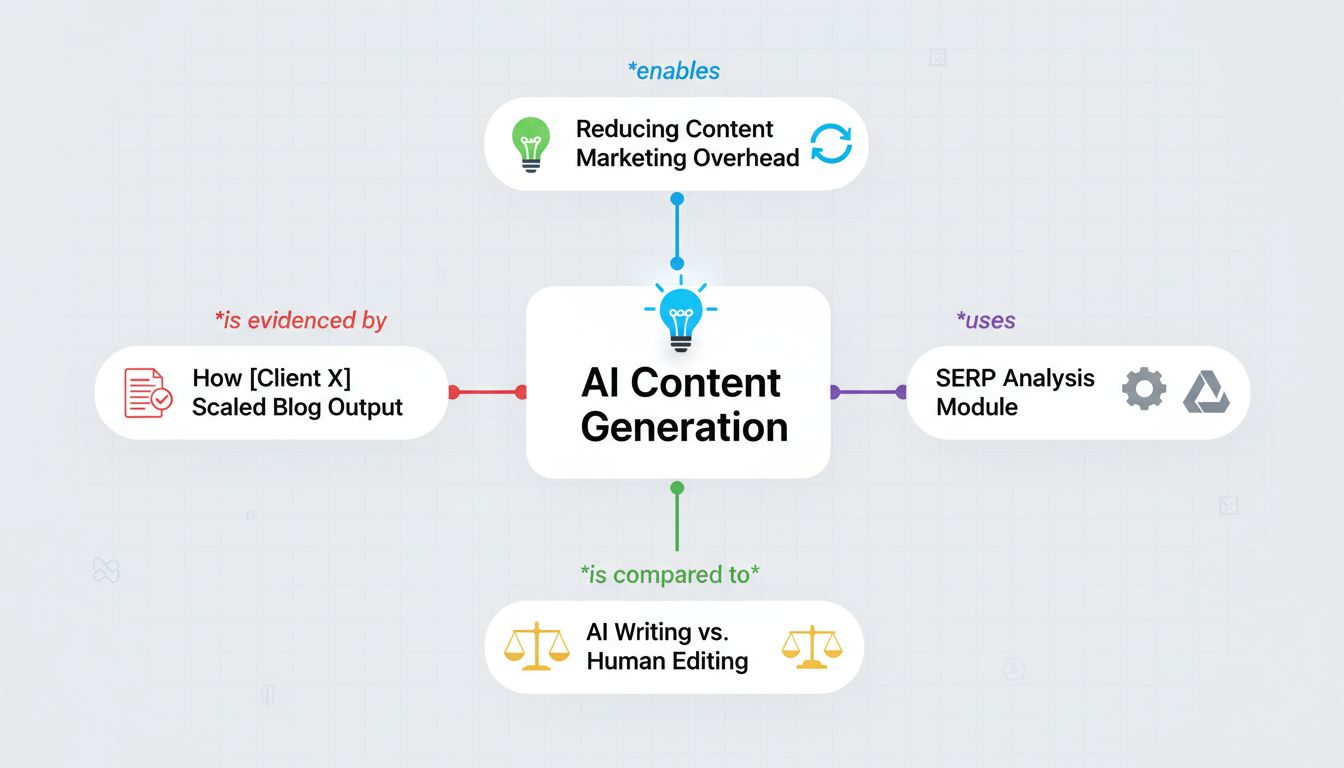
Say you run a platform like Spectre. You have a page about "AI content generation." The old keyword-matching approach would link that phrase to every other article that mentions "AI content." The entity-aware approach is different.
You might link "AI content generation" to:
- A benefit page: "reducing content marketing overhead" (relationship: enables)
- A feature page: "SERP analysis module" (relationship: uses)
- A comparison page: "AI writing vs. human editing" (relationship: is compared to)
- A case study: "How [Client X] scaled blog output" (relationship: is evidenced by)
You're not just repeating a keyword. You're building a network of meaning. This is why case studies show entity-linking drives AI visibility, Quattr reported a 75% growth in Google AI Mode visibility and 50% more top-3 ChatGPT citations for clients using this approach [Source: Quattr case studies].
How to implement it practically:
- Identify your core entities. These are your key products, services, core concepts, and named methodologies.
- Map their attributes. What are their features, benefits, comparisons, prerequisites, and outcomes?
- Link relationships, not just keywords. When you mention an entity, ask: "What related attribute or concept would a reader or an AI need to understand this fully?" Then link to it.
The geographic linking case study is a clean example of this. A site added links between "nearest geographic region" pages, creating a clear is located near relationship. The result was a 7% uplift in organic traffic for the linked pages [Source: SearchPilot case study]. AI crawlers understood the spatial relationship better, and so did users.
Following internal linking best practices here matters more than it used to. These aren't just navigation aids or PageRank conduits anymore. They're structured data for your site's private knowledge graph. And when you factor external linking SEO into this, the way outside sources reinforce your entity relationships, the whole system compounds.
Build them with intent.
Step 4: Automate, Measure, and Iterate
So the architecture is in place. How do you make sure it doesn't just... sit there?
Manual audits don't scale. One-off fixes don't scale. You need this baked into your workflow, and you need to track metrics that actually tell you something in 2026.
Tools to Scale Your Linking Workflow
Start with AI-powered suggestion tools like MarketMuse, InLinks, or Link Whisper. They crawl your content and surface relevant internal links based on semantic analysis. Their strength is speed, connections you'd miss manually, found in minutes.
Their weakness is that they have no idea what your commercial priorities are. They'll suggest linking from a high-value product page to a low-traffic blog post because the keywords match. You have to veto those. Use AI to generate possibilities, not make final calls.
Platforms like Spectre take the integration further. Internal linking gets built into the creation process itself, not retrofitted after the fact. The AI suggests entity-aware connections as it writes, so the link is a strategic input instead of an afterthought.
The numbers back this up. Quattr's AI-powered internal linking API boosted crawl discovery by 237% in controlled tests and delivered 15-19% organic traffic uplifts for clients. [Source: Quattr case studies]
One caveat on automation: tools get you 80% there. The last 20%, making sure commercial pages link appropriately, protecting your money pages from dilution, still needs a human. Schedule quarterly reviews.
What to Measure (The New KPIs)
Start with traditional SEO health. Monitor Google Search Console's Crawl Stats for discovery rate improvements. Watch index coverage for orphaned pages getting rescued. Track keyword rankings and organic traffic, remember the Shopify case that saw 443% year-over-year growth from strategic linking.
Then add user engagement. After you've implemented new links, check time on page and bounce rate for newly connected spokes. Did users actually follow the paths you built?
Now the frontier: AI visibility. In GSC's Performance report, filter by "Web Search" versus "Google AI Overview." Track impressions and clicks from AI surfaces. Watch whether your pages start showing up as cited sources in Perplexity or ChatGPT responses.
This is also where external linking SEO intersects with internal work. External links build domain authority. Internal linking best practices determine how that authority gets distributed across your site. Your KPIs should reflect both sides of that.
Set up a dashboard. Review it monthly. When traffic plateaus or AI visibility drops, go back to the audit spreadsheet. The process is circular: automate suggestions, implement strategically, measure what moves, then iterate.
Common Internal Linking Mistakes and How to Fix Them
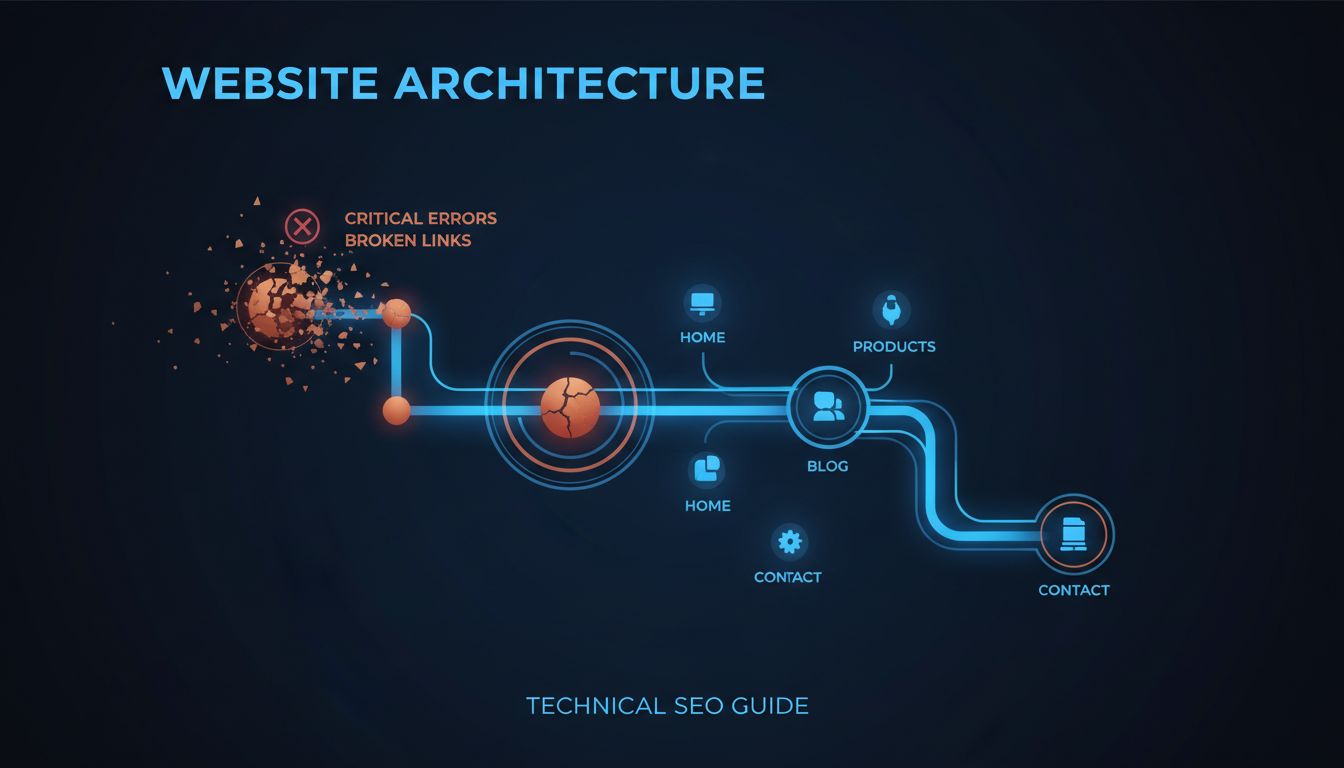
The architecture looks clean. The strategy is in place. Now here are six mistakes that quietly undo all of it.
1. Creating Orphan Pages
Pages with zero incoming internal links are functionally invisible to search engines. Even if they're in your sitemap, crawlers treat them as low priority.
Fix: Run the audit from Step 1. Any page with an Internal LinkRank (ILR) score below 10 or zero incoming links needs attention. Add at least two contextual links from semantically relevant, higher-authority pages. Pages with only one incoming internal link are harder for crawlers to find.
2. Overusing Identical Exact-Match Anchors
Repeating the same keyword-rich anchor text looks manipulative. It's a textbook spam signal.
Fix: Use descriptive, natural language. Cyrus Shepard's research on 23 million links found that more anchor-text variation correlates with more traffic. Link "comprehensive guide to Python decorators" instead of "Python decorators" every single time.
3. Letting Navigational Bloat Dilute Equity
Massive site-wide footers, sidebars with 50 links, mega-menus, they pass minimal PageRank to each target and waste crawl budget.
Fix: Streamline global navigation to essential sections. Save your strongest equity-passing links for contextual placements inside body content, where relevance is actually highest.
4. Using nofollow on Internal Links
This blocks Google from crawling the linked URL and stops authority transfer cold. Unless you're linking to a paid placement within your own site (rare), remove it.
Fix: Audit with Screaming Frog for rel="nofollow" attributes on internal links. Delete them.
5. Ignoring Redirect Chains
When Page A links to Page B (301) which redirects to Page C, you're wasting crawl cycles.
Fix: Update the link in Page A to point directly to Page C. Use your crawler to find internal links pointing to redirected URLs and fix them in bulk.
6. Neglecting Semantic Relationships
Linking only by keyword matching misses the entity-aware signals AI crawlers are looking for. It's one of the more overlooked gaps between internal linking best practices and how most people actually implement them.
Fix: Apply the principles from Step 3. Ask yourself: "What real-world concept does this page represent?" Link based on those relationships, not just matching words on a page. That's also where external linking SEO connects back to this work, external links build authority, but semantic internal linking is what gives that authority somewhere meaningful to go.
Conclusion
Stop treating internal linking as a technical chore. What we've covered is a systematic framework for building your site's knowledge graph, the data layer that Google's crawlers and AI retrieval systems parse to figure out what you're about and which pages actually matter.
Effective linking in 2026 means running parallel audits: one for technical crawl health, another for semantic coherence. The goal is a shallow, navigable architecture built on topic clusters, where every link does two things at once, distributes authority and clarifies entity relationships.
Descriptive anchor text, contextual placement, moving beyond simple keyword matching. That's what separates internal linking best practices from how most people actually do it.
Measure your progress by crawl discovery, internal PageRank flow, and AI visibility metrics, not just rankings. The 443% organic traffic growth in the 39 Celsius case study isn't magic. It's what happens when you follow this approach consistently.
This week: grab your site crawler and run the Discovery & Health Check audit from Step 1. Categorize five problem pages using the prioritization grid. That's it. That's where it starts.
And if you want to operationalize this at scale, look at how tools like Spectre can work entity-aware linking strategies directly into your content creation workflow. That's also where external linking SEO fits back in, external links build authority, but none of it lands anywhere meaningful without the internal structure to support it.
Frequently Asked Questions
What are the 3 C's of SEO?
Content, Code, and Credibility. Credibility is where internal linking actually matters. A well-architected link structure tells search engines your content forms a coherent knowledge graph, not just a pile of isolated pages. That's how you build the kind of trust modern SEO runs on.
What is the 80/20 rule for SEO?
80% of your results come from 20% of your efforts. For internal linking, that means focusing on the high-impact, low-authority pages your audit surfaces first. Link those strategically instead of linking everything haphazardly, and you'll get disproportionate gains from a pretty small amount of work.
What are the 4 pillars of SEO?
Technical, On-Page, Content, Off-Page. Internal linking touches three of them at once. It's a technical implementation (crawlable HTML), an on-page element (anchor text, placement), and it organizes content into a logical hierarchy. That's why it's foundational, not optional.
Is SEO dead or evolving in 2026?
Evolving. Internal linking is a good example of how. Its job has expanded from basic crawlability and PageRank flow to building a semantic, entity-aware knowledge graph for AI crawlers and answer engines. The fundamentals of relevance and authority haven't gone anywhere, but the signals keep getting more sophisticated.
What is an internal linking strategy?
A deliberate plan for using hyperlinks within your own site to define content hierarchy, guide users and crawlers, and distribute authority. Most sites just link for navigation and call it done. An actual strategy creates coherent architecture optimized for both search and AI discovery, not just for humans clicking around.
What is the difference between internal and external linking for SEO?
Internal links connect pages within your own site. External links point out to other domains. External linking SEO is about earning and using outbound links wisely to cite sources and build credibility with your niche. Internal linking is about architecting your own property so that authority actually has somewhere to go. Both matter, but they're doing different jobs.