May 12th, 2026
Best SEO Audit Tools for SaaS Founders: A Curated List
 WD
WDWarren Day
Most SEO audit tools won't fix your SEO problem.
You've probably tried a few of them already. The dashboard shows green checkmarks. Organic sign-ups stay flat. You're left wondering what you're missing.
After 15 years building software systems, I've found that no single seo audit tool does the job alone. The real leverage is a workflow that combines specialized tools in the right order, diagnosing the 20% of issues causing 80% of your traffic problems.
This guide walks through a 5-stage audit workflow built specifically for SaaS sites.
We'll cover technical foundation audits, visibility and authority analysis, content performance, and how AI-powered search changes the picture. You'll get a curated list of the best SEO audit tools mapped to each stage, with honest trade-offs on price, complexity, and SaaS-specific gotchas like JavaScript-heavy documentation portals.
We'll also cover the mistakes that waste founder time, things like over-relying on cloud connector data or underestimating how fast enterprise pricing adds up.
And we'll look at what's actually changing in SEO audits heading into 2026.
How We Chose: The 5-Stage Workflow for SaaS SEO Audits
Picking the right seo audit tool isn't about finding one perfect platform. It's about matching tools to specific stages of a workflow. Most SaaS founders jump straight to content or keyword analysis without fixing the technical foundation first, and that's why the efforts don't stick.
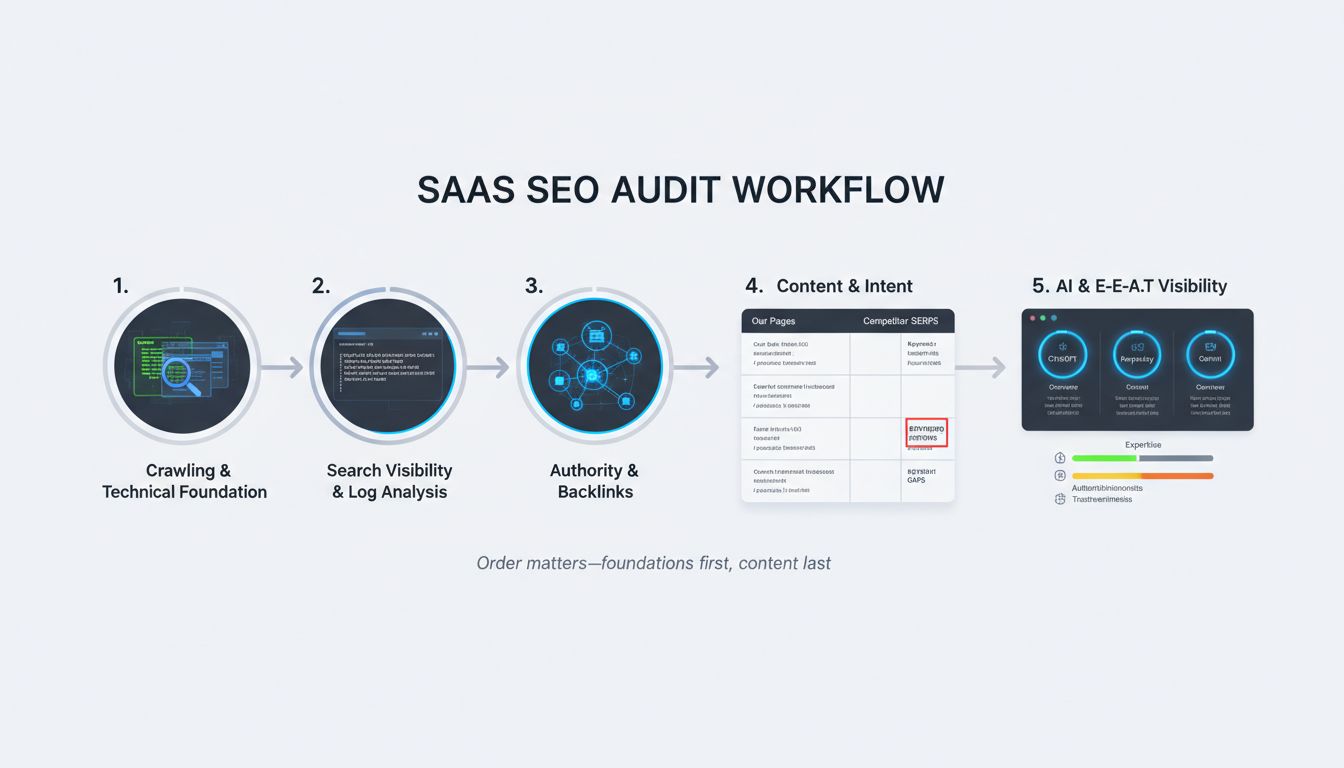
After running seo audits across dozens of SaaS companies, I've distilled the process into five sequential stages. Each one requires different capabilities. The order matters.
1. Crawling & Technical Foundation
You need to see what Google actually sees. That means JavaScript rendering for modern React/Vue apps, handling large documentation sites with millions of URLs, and catching crawl budget issues. Tools that can't render JavaScript miss critical issues on SPAs and headless sites.
2. Search Visibility & Log Analysis
Compare what you think Google crawls with what it actually crawls. Log-file analysis shows real Googlebot behavior, essential for diagnosing indexation problems that surface-level audits miss entirely.
3. Authority & Backlinks
Your domain rating determines which keywords you can realistically target. This stage looks at link equity distribution and flags orphaned pages that are sitting on ranking power they can't access.
4. Content & Intent
This is where most tools fall short. You need to audit existing content against competitor SERPs, spot intent mismatches, and prioritize updates that actually move rankings. It's also where Spectre earns its place, automating the gap analysis between what you have and what ranks.
5. AI & E-E-A-T Visibility
Optimizing for traditional search alone isn't enough anymore. You need to monitor AI overview visibility across ChatGPT, Perplexity, and Gemini, and assess E-E-A-T signals at scale.
When I evaluate the tools below against this seo audit checklist, I'm asking: does it handle JavaScript rendering? Can it scale to your documentation site? Does it connect technical fixes to content opportunities? And does it move you from diagnosis to action, or does it just give you more things to stare at?
That last one is what separates the best seo audit tools from the ones that produce a bloated seo audit report you'll never finish reading.
1. Spectre AI: Best for Automated Content Audits & AI-Powered Creation
Best for SaaS founders who need to scale content production without hiring a team of writers.
Most seo audit tools tell you what's broken. Spectre tells you what to write, and then writes it.
We built Spectre to solve the content gap that shows up after you've fixed your technical SEO. That part everyone ignores.
It automates keyword research, writes high-quality articles, and publishes them directly to your site. What used to be a multi-step slog, keyword clustering, SERP analysis, outlining, writing, optimization, becomes a single workflow.
It's built around Stage 4 (Content & Intent Audit) and Stage 5 (AI & E-E-A-T Visibility) of the audit model. You connect your site, define your topics, and it handles the research and publishing pipeline. Optimizes for traditional rankings and AI discovery surfaces like Google's AI Overviews.
The trade-off is deliberate: Spectre isn't a technical crawler. It won't find broken links or flag Core Web Vitals issues.
That's not what it's for. You use something like Screaming Frog to fix the foundation, then use Spectre to systematically build the content that actually drives traffic.
If you're using an seo audit checklist that stops at "publish more content" without telling you what content, that's the gap Spectre fills. It's why automating this part of your audit has gone from nice-to-have to the only realistic way to scale.
2. Screaming Frog SEO Spider: Best for Technical Foundation Audits
Best for founders conducting initial technical audits on mid-sized SaaS sites.
Screaming Frog is the desktop crawler most technical SEOs reach for first. It spiders your site the same way Googlebot would, surfacing broken links, redirect chains, duplicate content, and indexation issues.
The freemium model is its biggest draw: you can audit up to 500 URLs for free. For a lot of SaaS applications, that's enough to run a real seo audit without spending anything. A licence is required once you go past 500 URLs.
For sites built on React, Vue, or Angular, the JavaScript rendering mode matters a lot. You configure it to use headless Chrome, so it executes JavaScript and sees what your users see, not just the raw HTML. That catches things simpler crawlers miss entirely, like dynamically rendered meta tags or content that silently fails to load for search engines.
The trade-off is that it lives on your machine. Unlimited crawl depth on a paid licence, yes, but collaboration is manual. You can't hand a non-technical teammate a live seo audit report and have them poke around.
It's the right tool for a deep technical foundation audit. For ongoing monitoring or team visibility, you'll want something else alongside it.
3. Sitebulb: Best for Visual Reporting & International SEO
Best for SaaS companies with international audiences or teams that need to present audit findings to non-technical stakeholders.
Screaming Frog gives you a spreadsheet. Sitebulb gives you graphs, charts, and something closer to a narrative.
That distinction matters more than it sounds. When you're trying to explain crawl budget waste or schema errors to a founder or marketing lead, raw data doesn't help. Sitebulb turns that crawl data into visuals a non-technical person can actually read.
For SaaS specifically, the international SEO and structured data features are where it earns its place. It validates schema against Schema.org and flags mixed hreflang implementations, the kind of thing that quietly breaks sites targeting multiple regions.
It scales, too. The Cloud/Enterprise version handles audits up to 10 million URLs, which is how Zoopla used it to diagnose SEO issues at scale.
The real trade-off is between the Desktop and Cloud versions. Desktop gives you unlimited local crawling but needs a powerful machine to handle large sites. Cloud removes that constraint but comes with project limits and higher costs once you're at enterprise scale.
If visual clarity and international validation are your main goals for an seo audit, it's the right call.
4. Ahrefs: Best for All-in-One Audits with Backlink Analysis
Best for SaaS founders who want one platform to handle technical audits, backlink analysis, and competitor research without switching tools.
Most seo audit tools make you pick a lane. Ahrefs doesn't.
The Site Audit tool scans for over 170 technical and on-page issues and can run continuously 24/7, so when you're constantly shipping new features and documentation pages, it keeps up. Ahrefs Site Audit covers what most seo audit checklists treat as separate workstreams, technical health, Search Console integration, and authority analysis, all in one dashboard.
The backlink index is what actually separates it from other seo audit tools. Screaming Frog tells you about internal linking. Ahrefs tells you who's linking to your competitors and not to you. You can spot content gaps in your help centre or blog that could be pulling in referring domains but aren't.
That's three stages of a typical seo audit report handled without opening a second tool.
The trade-off is cost. Full access starts at $99/month, and if you're running a massive enterprise help centre with millions of URLs, you may eventually hit crawler limits where something like Botify or Lumar makes more sense. But as the best seo audit tool for connecting technical fixes directly to your authority profile, it's hard to beat.
If you want the best all-in-one option and don't need a dedicated enterprise crawler, this is it. There's also a free seo audit tool tier worth exploring if you're not ready to commit, though the best free seo audit tools and the paid version differ significantly in depth. The seo audit template and reporting features alone tend to justify the subscription once you're past early-stage.
5. Semrush: Best for Integrations & Task Automation
Best for SaaS teams that need to automate repetitive audit tasks and push SEO data into their existing workflows.
Semrush is the seo audit tool for founders who hate manual reporting.
The real strength isn't the site audit itself. It's that the whole process can run without you. The platform has a full Site Audit API for programmatic crawls, and its Zapier integration connects directly to Slack, Asana, or your CRM.
So you set up a workflow where a weekly audit runs automatically, and critical issues, a sudden drop in health score, new 404s in your docs, trigger a Slack alert or create a Jira ticket. That turns your seo audit checklist from a periodic thing you do into a continuous monitoring system. For content-heavy SaaS sites, the Content Audit tool also flags underperforming pages and suggests fixes based on what competitors are doing.
The catch: deeper automation is locked behind higher-tier plans.
It does execute JavaScript, but the rendering depth probably won't match a dedicated crawler like Screaming Frog on complex single-page applications. Worth knowing before you rely on it as your only seo audit tool for technical depth.
But if you want SEO insights embedded directly into your team's daily workflow, no manual intervention, no one remembering to run the audit, the integration stack here is hard to match. The seo audit report, the seo audit template, the alerting... it's all built around the idea that you shouldn't have to think about it. As far as the best seo audit tools go for automation specifically, Semrush is the one. And if you're comparing against the best free seo audit tools, just know this one earns its price tag through the hours it saves.
6. Botify: Best for Enterprise-Scale JavaScript Crawling
Best for large SaaS companies with JavaScript-heavy, single-page applications and dedicated SEO teams.

Botify is the enterprise answer to crawling modern web applications at scale.
If your SaaS product runs on React, Vue, or a headless CMS with millions of dynamic URLs, this is built for that. It renders JavaScript across your entire site, mirroring how Googlebot actually sees your content. And it uses Google's CrUX field data exclusively to surface Core Web Vitals issues [Source: https://support.botify.com/en/articles/9108535-understanding-core-web-vitals].
The workflow is designed for historical analysis at scale. Think crawl budget allocation across massive help centers or product documentation with thousands of pages.
The catch is the price. Public estimates put annual contracts starting around $75,000, with pricing that usually requires a direct conversation. This isn't an seo audit tool you trial on a credit card.
It's a strategic investment for companies where organic search is a primary, multi-million dollar acquisition channel.
For a startup or small team, this is overkill. No question. But for an established SaaS company with a complex technical stack and a dedicated SEO function, Botify gives you the data depth that the best seo audit tools for smaller teams simply can't match.
If you're comparing it against the best free seo audit tools or even mid-market options, the comparison doesn't really apply. Different category entirely.
7. Oncrawl: Best for Data-Driven SEO Platforms
Best for technical founders who treat SEO as a data science problem, not a checklist.
Oncrawl is a cloud technical SEO platform built around a high-performance crawler and a dedicated data visualization layer.
It's designed for teams who want to correlate crawl data with business metrics over time and automate analysis via API. The platform offers reusable crawl profiles, custom data extraction using Regex and XPath, and a historical data warehouse that lets you track trends rather than just snapshot issues [Source: https://oncrawl.com/products/seo-data-platform/].
Strengths:
- Data-first architecture: Historical reporting and trend analysis are core, not an afterthought.
- Automation-ready: Full API access and Python examples for building custom workflows.
- Custom extraction: Pull specific data points from pages using Regex or XPath.
Weaknesses:
- Steep learning curve: The interface and concepts are geared towards technical users.
- Overhead for small sites: The power is most justified for large, complex sites where data correlation matters.
If you're the type of founder who builds dashboards in Looker or runs SQL queries to understand funnel performance, Oncrawl fits that mindset.
It's less about finding a single broken link and more about understanding how crawl budget allocation to your help center impacts trial sign-ups quarter-over-quarter.
That's a different kind of seo audit report than what most tools produce. Most seo audit tools give you a list of issues to fix. Oncrawl gives you a data platform to analyze over time.
For simpler sites, that depth is unnecessary complexity. There's no seo audit checklist or seo audit template here to hand off to a junior hire.
But for data-driven teams, it's how you move SEO from a marketing task to something you can actually measure. If that's you, it belongs in your shortlist of the best seo audit tools for technical teams. If it's not, the best free seo audit tools will honestly serve you better.
8. Moz Pro: Best for Log-File Analysis Guidance
Best for SaaS founders who want to see what Googlebot actually crawls, not just what they think it crawls.
Most seo audit tools show you what could be crawled. Moz shows you what Googlebot actually crawled.
That distinction matters more than people realize. If you're running a SaaS product with a large documentation portal or help center, crawl budget waste is where real indexing problems hide. You won't see that in a standard seo audit checklist.
The platform includes link data, ranking tracking, and API access for automation. But the interesting part is connecting log data to your SEO metrics. You can spot situations where Googlebot spends 70% of its time recrawling old changelog pages while ignoring your new feature announcements. That's not something a basic seo audit report is going to surface.
Log-file analysis is available in Moz Pro without needing enterprise-level budgets, which is genuinely useful for mid-market teams who've outgrown surface-level audits.
The weaknesses are real though. JavaScript rendering is less developed than newer tools, and audit depth can struggle on sites past 500k URLs. There's no seo audit template here that a junior hire can just run with.
But if you need to understand real crawl behavior, not just a snapshot of issues, it earns a spot on your list of best seo audit tools. Alongside the best free seo audit tools, it's worth knowing what you're comparing against before you commit to anything. The seo audit tool you pick should match the actual problem you're trying to solve, and for log analysis specifically, Moz Pro is one of the few that takes it seriously.
Common SEO Audit Mistakes for SaaS Founders
Best for founders who want to avoid wasting time on audits that don't fix their real problems.
Even with the right seo audit tools, there are predictable mistakes that make the whole thing pointless. Here's what to avoid.
Relying solely on API data. Google Search Console shows indexed pages, but a full crawl with Screaming Frog or Sitebulb is the only way to find orphaned pages that aren't linked internally. API-only audits miss your biggest crawl budget issues.
Ignoring JavaScript rendering. If your SaaS uses React or Vue, you need a tool with Chrome headless rendering. Ahrefs and Screaming Frog both execute JavaScript now, but a lot of founders still audit the static HTML their server serves, not what users actually see.
Skipping log-file analysis. Logs show what Googlebot actually crawls versus what you think it crawls. It's the part of any seo audit checklist that people skip, and it's usually where the real problems are hiding.
Hitting unexpected limits. Cloud tools like Semrush have project and page quotas. PageSpeed Insights API has strict rate limits. Start with a desktop crawler for deep analysis, then use cloud tools for monitoring.
Using the wrong scale. Auditing a 10,000-page help center with a tool built for 500-page marketing sites is a waste of time. For large docs, you need enterprise-scale crawlers like Sitebulb Cloud or Botify from the start.
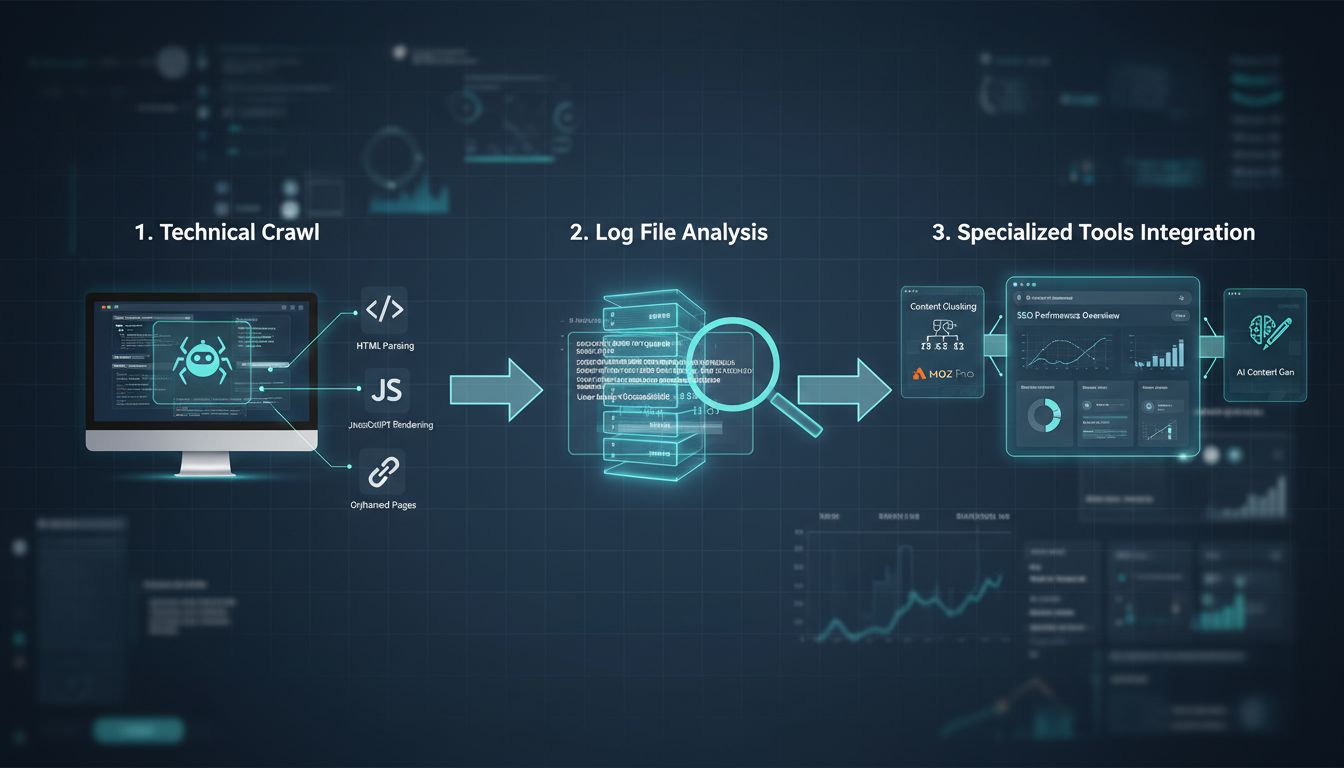
The fix isn't complicated. Start with a technical crawl, layer in log data, then use specialized tools for content and backlinks. Your seo audit report is only as good as the workflow behind it, don't let a single tool dictate your strategy.
The Future of SEO Audits: Trends to Watch
The tools we use today are already changing. For SaaS founders, there are a few shifts worth paying attention to.
JavaScript crawling is now standard. Most crawls are done with JS-capable tools at this point, and given how many SaaS products are built on headless architecture, that's not going away. But rendering client-side JavaScript isn't enough on its own, server-side rendering still matters for performance and indexation.
AI is also moving beyond content creation and into the audit workflow itself. Think anomaly detection, predictive analytics, automated issue prioritisation. This is exactly what we built Spectre to do, automate the entire content audit and creation pipeline so SEO insights turn into published articles without someone manually pushing things along.
The third shift is consolidation toward data platforms. Tools like Oncrawl and Lumar are already emphasising historical data storage and API access, and they're starting to correlate technical SEO issues with business metrics like trial sign-ups. The future seo audit report won't just list problems. It will estimate their revenue impact.
If you're building out your seo audit checklist or evaluating seo audit tools against an seo audit template, these are the capabilities worth filtering for now, not later.
Key trends to watch:
- AI-powered workflow automation and anomaly detection
- JavaScript rendering as a default, not a premium feature
- Data platforms that connect SEO health to business outcomes
- Increased focus on AI search visibility (GEO) alongside traditional SEO
Conclusion
The right SEO audit tools aren't about finding one perfect platform. They're about building a workflow that actually diagnoses what's blocking your growth.
Start with a technical foundation audit. Use a crawler like Screaming Frog or Sitebulb to make sure Google can access your content. Then layer in log analysis with something like Moz Pro to understand real Googlebot behaviour and stop wasting crawl budget.
Then audit your content. AI-powered tools like Spectre can cluster keywords and generate optimised articles, which turns your content pipeline from a bottleneck into something that actually ships. That matters more than most technical fixes.
Two mistakes worth avoiding: relying solely on Google Search Console data, and ignoring JavaScript rendering on your app. Both will quietly skew every audit you run.
Your seo audit checklist shouldn't be a static document you revisit once a quarter. It should be a live system. The goal isn't a clean seo audit report, it's a repeatable process that drives qualified traffic to your sign-up pages.
Ready to start? Run a free crawl with Screaming Frog on your first 500 URLs to check your technical health, or see how Spectre can automate your content audit and creation process with a free trial.
Frequently Asked Questions
Can ChatGPT do an SEO audit?
ChatGPT can generate an seo audit checklist and analyze content text. But it can't crawl your site, parse log files, or pull live data from anywhere.
A real seo audit needs tools that actually behave like Googlebot, check your backlink profile, and connect to Search Console. ChatGPT can help you think through a framework, but the technical foundation still requires dedicated seo audit tools.
What tools are best for an SEO audit?
Depends on the stage. For technical work, Screaming Frog or Sitebulb. For visibility and log analysis, Moz Pro or Ahrefs. For content auditing and AI-powered creation, Spectre AI handles the heavy lifting.
If you're running an enterprise-scale JavaScript site, Botify or Oncrawl are worth looking at. The best seo audit tools for your situation really just depends on your site size and where you are in the process.
What are the best AI-powered SEO tools specifically designed for SaaS companies to grow traffic?
For SaaS, Spectre AI is built to automate content creation and audits end-to-end, from keyword research to publishing, without the manual work. Semrush has AI content suggestions, and Botify includes anomaly detection, but neither covers the full pipeline the way Spectre does for SaaS content funnels and AI search visibility.
How do I do SEO for my SaaS website that has different products?
Treat each product as its own silo. Use Sitebulb to audit hreflang and internal linking across sections, and crawl each product area separately so you're not mixing up keyword strategies meant for different customer segments.
Tools like Spectre can keep optimization consistent across all of them while you scale content production. Otherwise you end up with three well-optimized product pages and six that are just sitting there.
What is the 80/20 rule for SEO?
80% of your results come from 20% of your efforts. In practice, that usually means fixing crawl errors, sorting out JavaScript rendering issues, and optimizing the pages with the most traffic potential.
When you're working through your seo audit report, don't treat every warning equally. Focus on the things actually causing traffic leaks or content gaps. The minor tweaks can wait, or honestly, just stay in the backlog forever.