April 30th, 2026
Best AI Writing Tools for SEO Content: A Curated List for Founders
 WD
WDWarren Day
You're a founder. Your to-do list never gets shorter. And somewhere on it, probably near the top, is "publish more content."
The problem isn't that you don't know content matters. You do. It's that you don't have the time, the budget, or a team to actually do it consistently.
Most roundups of the best AI writing tools aren't written for you. They're written for marketers who need Instagram captions and email sequences. You need something that fits into a technical workflow and actually moves the needle on rankings.
For a founder in 2026, the right tool isn't about word count. It's about stack integration, optimizing for both traditional search and AI engines (GEO), and real improvements to how fast a page ranks. And this isn't abstract, AI-written pages now make up 17.31% of top Google results, up from just 2.27% in 2019.
So this list is different. I evaluated every contender against a founder-specific 7-point checklist: limited time, technical debt, defensible SEO outcomes. You'll get a decision matrix, a curated shortlist, and the fixes for the most common AI-SEO mistakes that quietly drain budget and kill rankings.
How We Chose: The 7-Point Checklist for a Founder's AI SEO Tool

Most "best ai writing tools" lists evaluate features. I evaluate systems. As a founder, you're not buying features, you're buying a workflow that has to integrate with your existing stack, deliver measurable ranking outcomes, and scale without blowing your budget or your sanity.
Here's the seven-point checklist I applied to every tool in this review.
1. SEO-First, Not an Afterthought The tool has to bake SERP analysis, real-time content scoring, and keyword optimisation directly into the writing interface. If SEO is a separate tab or an export step, you've already lost.
2. Founder-Centric Workflow (The Integration Tax) The true cost isn't the monthly subscription. It's the "Integration Tax." Context-switching between your CMS, keyword tool, and writing app kills productivity. A founder's tool needs to plug directly into WordPress or Ghost via API and connect to Ahrefs or Semrush for live data.
3. GEO-Ready in 2026 (The Defensive Necessity) AI search is here. When an AI Overview is present, clicks on the #1 organic result drop by 58%. Your tool needs citation tracking, AI Overview optimisation, and multi-LLM monitoring built in. Not optional anymore.
4. Output Control & Factuality Hallucinations aren't quirks, they're reputation killers. I look for clear hallucination mitigation, brand voice capture that actually works, and plagiarism detection. If a tool can't cite sources properly, it's a liability.
5. Scalability Without Surprise Bills Transparent pricing with document limits that match startup growth. I've seen founders hit with 5x bills because their "unlimited" plan had hidden AI credit caps. No surprises.
6. Collaboration & System Governance Even solopreneurs need hand-off capabilities. The tool should enforce editorial review workflows and maintain version control. You'll eventually bring in a freelancer or a VA, plan for that now.
7. The 'Time-to-Rank' Focus Publishing faster is meaningless if content doesn't rank. I looked for features specifically designed to reduce time-to-rank: structured data automation, internal linking suggestions, and post-publish optimisation triggers.
This checklist filters out 90% of AI writing tools marketed to founders. What's left are actual SEO content engines, and incidentally, some of them (like novelcrafter ai for fiction-focused workflows) serve very different use cases, which is worth knowing if you're also looking for the best ai for writing fiction or the best free ai writing tools for things like free ai for research paper writing. Different jobs, different tools.
A Quick Note on ChatGPT, Claude, and the 'Raw Model' Illusion
You're probably thinking: "Why not just use ChatGPT? It's cheap and powerful." Fair. For brainstorming, breaking through writer's block, or getting a rough draft on the page, raw LLMs are hard to beat.
But here's the thing: ChatGPT and Claude are raw materials. Not finished content engines.
They give you words. They don't give you a system. Using them means you're manually stitching together your own SERP analysis, keyword integration, structure, on-page scoring, and GEO considerations for AI search. That's the entire job you were trying to automate.
The underlying model, GPT-4, Claude 3, Gemini, matters far less than the workflow built on top of it.
Take Novelcrafter AI. It's not just GPT with a nicer interface. It's a purpose-built engine for fiction writers, with story bibles, character tracking, and narrative structure baked in. That's why it shows up when people search for the best ai for writing fiction. Same idea applies to SEO, you need something that does that level of specialization for search intent and ranking signals, not a general-purpose chatbot.
Building that yourself from a raw LLM is a massive time sink. And for a founder, that's an efficiency calculation you really can't afford to get wrong.
The tools in this list, including some of the best ai writing tools and best free ai writing tools on the market, and yes, tools useful for things like free ai for research paper writing, are the assembly lines that take raw LLM output and turn it into a repeatable, ranking-focused process.
1. Surfer AI: The All-in-One Rank-First Engine
A unified workflow that turns a keyword into a fully analysed, scored, and optimised draft ready for publish.
Best for founders who want a single, opinionated dashboard to handle the entire process from SERP analysis to optimisation.
Surfer is the default sensible choice when you need everything in one place. Feed it a keyword, and it returns a complete content brief, draft outline, and live optimisation score, all pulled from analysing the top-ranking pages.
Its Content Score is calculated from over 500 on-page signals and gives you a clear numerical target to hit. Surfer reports this score has a vendor-reported correlation of 0.28 with Google rankings.
The real time-saver is the integration. You can publish directly to WordPress, or use the Chrome/Edge extension inside Google Docs, Gmail, or HubSpot.
That matters because the "integration tax", constantly copying and pasting between tools, is where momentum goes to die. Surfer mostly eliminates it.
For scaling, the one-click translation feature and $99/month plan (100 blogs) make it practical for a bootstrapped operation. It also has GEO features for AI visibility, though that's not really where it shines.
The risk is the obvious one: you start optimising for the Content Score instead of for the reader. Over-index on the metric and you get something that ranks but doesn't convert.
But for most founders, having a single system that handles research, drafting, and scoring is the fastest path from idea to a publish-ready article. Among the best ai writing tools for SEO-focused content, it's one of the few where you genuinely don't need to bolt on five other things to get a usable output.
2. Frase: The Research-First Powerhouse for Content Briefs
Best for founders who believe a bulletproof content brief is 80% of the battle, especially when managing freelancers or an internal writer.
Frase doesn't start with writing. It starts with research.
It takes the top 20 Google results for a keyword and turns them into an actionable brief in minutes, extracted headings, People Also Ask questions, semantic keywords, site analysis. The whole thing. For a founder, that's the difference between writing content and architecting it.
The core workflow is its Rank-Ready Documents. You write directly inside the brief, with real-time SEO and GEO scoring updating as you go.
The GEO Score Checker, which evaluates citability and structure for AI engines, is baked in from the start, not something you bolt on at the end. According to vendor materials, this cuts planning time significantly.
The weakness is scope. Frase owns the strategic middle ground: keyword to blueprint to draft. You'll still need something like Ahrefs for deep keyword discovery or backlink profiling.
But if you see content as a strategic investment that needs a solid foundation first, Frase turns hours of manual SERP analysis into a five-minute task. API access on higher plans lets you generate briefs programmatically too, which is useful if you're trying to scale content operations without scaling headcount.
3. Scalenut: The Scalable Content Operations Hub
Best for founders who need to systemise content production as they grow from solo creator to small team leader.
Scalenut isn't another AI writer. It's a content operations platform for founders who think in repeatable processes.
The core idea is an integrated workflow: keyword research flows into topic clustering, which flows into automated briefs and drafts, all in one place. That's for when you're past the "one-off blog post" phase and actually need to build a content engine.

The standout feature is Cruise Mode, which promises a 5-minute blog from a keyword. It's not magic, it's smart repackaging of your core research into multiple content formats, and a real time-saver for scaling pillar content.
The 2025 editor updates added real-time collaboration and version history [Source: Scalenut Bootcamp Documentation]. That's not an afterthought. That's product-market fit for founders hiring their first content lead.
Pricing is growth-aligned: $39/month for individuals, $79 for growing teams, $149 for advanced users [Source: Startupik].
The weakness is flexibility. It's a packaged platform, excellent for standardising a process, but not particularly hackable if you want custom, API-driven pipelines. You trade some control for operational efficiency.
If your bottleneck is moving from chaotic, ad-hoc creation to something a team can actually run, Scalenut provides the rails. It turns content from a creative task into a manageable operational function, which puts it among the best AI writing tools for founders who are scaling, not just experimenting. Unlike the best free ai writing tools or a free ai for research paper writing, or even something like novelcrafter ai (which skews toward best ai for writing fiction), Scalenut is built for operational output at volume.
4. Writesonic: The Integrated SEO & GEO Analytics Suite
Best for founders who want to consolidate their keyword research tool and AI writer into a single, data-rich platform.
Writesonic's real differentiator isn't the AI writing itself. It's the integrated SEO Suite.
This includes an AI Content Gap Analyzer and AI Keyword Clustering, features you'd normally pay for separately in something like Ahrefs or Semrush. If you're running SEO in-house, that consolidation actually saves money. You're not just getting a writer; you're getting something that spots where your content is missing the mark and clusters keywords by topic intent.
The second thing worth knowing about is its focus on Generative Engine Optimization (GEO). The platform tracks your brand's visibility across major LLMs like ChatGPT, Claude, and Gemini.
That matters more than it sounds. AI Overviews can reduce clicks on the #1 organic result by 58%, so knowing whether you're being cited or ignored in AI-generated answers is no longer optional.
The workflow runs through a live SEO Checker that scores your content and suggests one-click rewrites. Analysis and optimization in the same loop, no tab-switching.
The trade-off is that the feature density can feel like a lot at first. This isn't a "write and publish" button. It's built for the analytically-minded founder who's comfortable living in data.
If you're already weighing a dedicated SEO tool subscription against one of the best ai writing tools, Writesonic is a reasonable middle path. Less context-switching, one bill. Unlike something like novelcrafter ai (which is squarely aimed at the best ai for writing fiction crowd), or the best free ai writing tools and free ai for research paper writing options that trade depth for accessibility, Writesonic is built for founders who want real competitive intelligence baked into the writing process.
5. NeuronWriter: The Gamified, Affordable Optimiser
Best for bootstrapped founders who want laser-focused SEO optimisation without the enterprise price tag.
If you're running lean and every dollar needs to do real work, NeuronWriter is worth a look. It's $19 to $37 a month, there's even a free plan, and it punches well above its weight for SEO guidance.
Its core strength is singular: it analyses competitor SERPs and tells you exactly what to fix.
The thing that makes it genuinely fun to use is the real-time Content Score (1-100). As you write, it updates live, flagging your heading structure, keyword usage, NLP terms. You're not guessing. You have a number, and you know what moves it. That turns a pretty tedious optimisation job into something closer to a game. It also includes plagiarism detection, which is rare at this price.
The trade-off is scope. NeuronWriter is an editor and optimiser, not a full content engine. Deep GEO features aren't really here, and there's no complex API workflow to speak of.
For a lot of founders, that's fine. You don't always need the frills.
One user reported hitting Page 1 following its guidance, which says something about how actionable the advice actually is. If your priority is getting a draft SEO-tight before you publish, this delivers. Unlike the best free ai writing tools or something like free ai for research paper writing that trades depth for accessibility, or novelcrafter ai which is aimed squarely at the best ai for writing fiction crowd, NeuronWriter stays in its lane, and that's the point. Among the best ai writing tools at this price, it's exceptional value.
6. Outranking: The Data-Driven Strategist's Choice
Best for technically-minded founders who want to understand and control the 'why' behind every content suggestion, not just follow a score.
If Surfer gives you a traffic light and Frase builds the brief, Outranking hands you the engineering schematics.
This is for founders who don't want "optimise this paragraph", they want to know what semantic relationships and structural patterns the tool pulled from the SERP to make that call. Granular, strategic control is the whole point.
The standout feature is its 'Concept' system. Instead of generating content from a vague prompt, it first analyses top-ranking sources to extract core concepts, entities, and their relationships, then structures your draft around that verified semantic framework. That's a fundamentally different approach to AI-assisted writing than most of the best ai writing tools offer, and a more reliable one.
It also automates one of the more tedious scaling tasks: internal linking. Set your rules, and it suggests relevant anchor texts and links as you write, building site architecture without you thinking about it.
The trade-off is immediacy. There's more data, more required input, and some reviews flag that its approval workflows are limited. But for the engineer-founder who actually wants to understand the mechanism, that depth isn't a downside, it's the product.
A vendor case study with Clickworker reported a 1000% increase in blog clicks. That kind of result needs a solid foundational strategy behind it, but it shows what a systematic approach can do. Compare that to something like novelcrafter ai, which is squarely built for the best ai for writing fiction use case, or free ai for research paper writing tools that trade depth for accessibility, Outranking isn't trying to be any of those. It's for founders who treat content like a system of interconnected data points. Among the best free ai writing tools and paid options alike, nothing quite matches it for this specific type of strategic control.
7. Jasper: The Brand Voice & Campaign Orchestrator
Best for marketing-led founders who need to scale multi-channel campaigns without their brand voice sounding like a committee wrote it.
Does your content actually sound like you? Across every channel, every format, every writer on your team? That's the problem Jasper is built to solve.
Most SEO-focused tools completely ignore brand governance. Jasper doesn't. If you have a distinctive tone, quirky, authoritative, minimalist, and need to replicate it across blog posts, social copy, ad campaigns, and product descriptions, Jasper's brand voice engine is genuinely best-in-class.
The workflow is mature. You feed it a campaign brief and it produces a consistent suite of assets. Strong integrations with Webflow and Google Docs, built-in governance tools, the whole thing.
Here's the honest caveat though: native SEO is not Jasper's strength.
To get content that ranks, you're not buying Jasper alone. You're buying Jasper plus the Surfer SEO add-on, which changes the cost math entirely. The Creator plan starts at $39/month, but for serious SEO output, Surfer's fee gets stacked on top. You're paying for a premium brand layer sitting on a separate optimisation engine.
That's a real trade-off. If your main bottleneck is raw time-to-rank, this layered approach adds complexity and cost in ways that tools like novelcrafter ai (built squarely for the best ai for writing fiction crowd) or even the best free ai writing tools just don't.
But if your bottleneck is keeping a coherent voice across a growing content pipeline, especially with freelancers or a small marketing team, Jasper builds a real moat. Compare that to something like free ai for research paper writing tools, which trade brand control for accessibility entirely.
In the age of AI search, a distinctive recognisable voice might be your best GEO play. Even without technical optimisation baked in. Among the best ai writing tools, Jasper is the one that actually takes that seriously.
Head-to-Head: The Founder's Decision Matrix
Stop asking "which AI writing tool is the best?" The better question is "which tool fixes my bottleneck?"
Find the "Best For Founder Type" that fits, then read across that row.
| Tool | Core Strength | Best For Founder Type | SEO Depth (1-5) | GEO Features | Ease of Integration | Founder-Friendly Starting Price (Monthly) |
|---|---|---|---|---|---|---|
| Surfer AI | All-in-One Optimisation | Solo/Team seeking clarity | 5 | Strong | Very High | ~$99 |
| Frase | Research & Briefing | Strategist managing writers | 4 | Strong (Core) | High | $38 |
| Scalenut | Team Scalability | Team scaling content ops | 4 | Integrated | High | $39 |
| Writesonic | SEO Analytics Suite | Data-driven consolidator | 5 | Very Strong | Medium | $49 |
| NeuronWriter | Affordable Optimisation | Bootstrapped founder | 4 | Limited | Medium | $19 (Free plan) |
| Outranking | Strategic Control | Technical SEO founder | 5 | Strong | Medium | ~$25 |
| Jasper | Brand Voice & Campaigns | Brand-centric marketer | 3* | Limited | Very High | $39 (+ Surfer for SEO) |
Note: Jasper's native SEO depth is limited; it requires a Surfer add-on to reach a "5".
Common AI-SEO Mistakes Founders Make (And the System Fix)
Most AI-SEO failures aren't tool problems. They're system problems.
You're building a content engine, not just hitting publish on AI drafts. Fix these five process gaps and you'll be in the two-thirds of AI-generated content that ranks within two months of publication, according to Semrush.
Mistake 1: Publishing Raw AI Output.
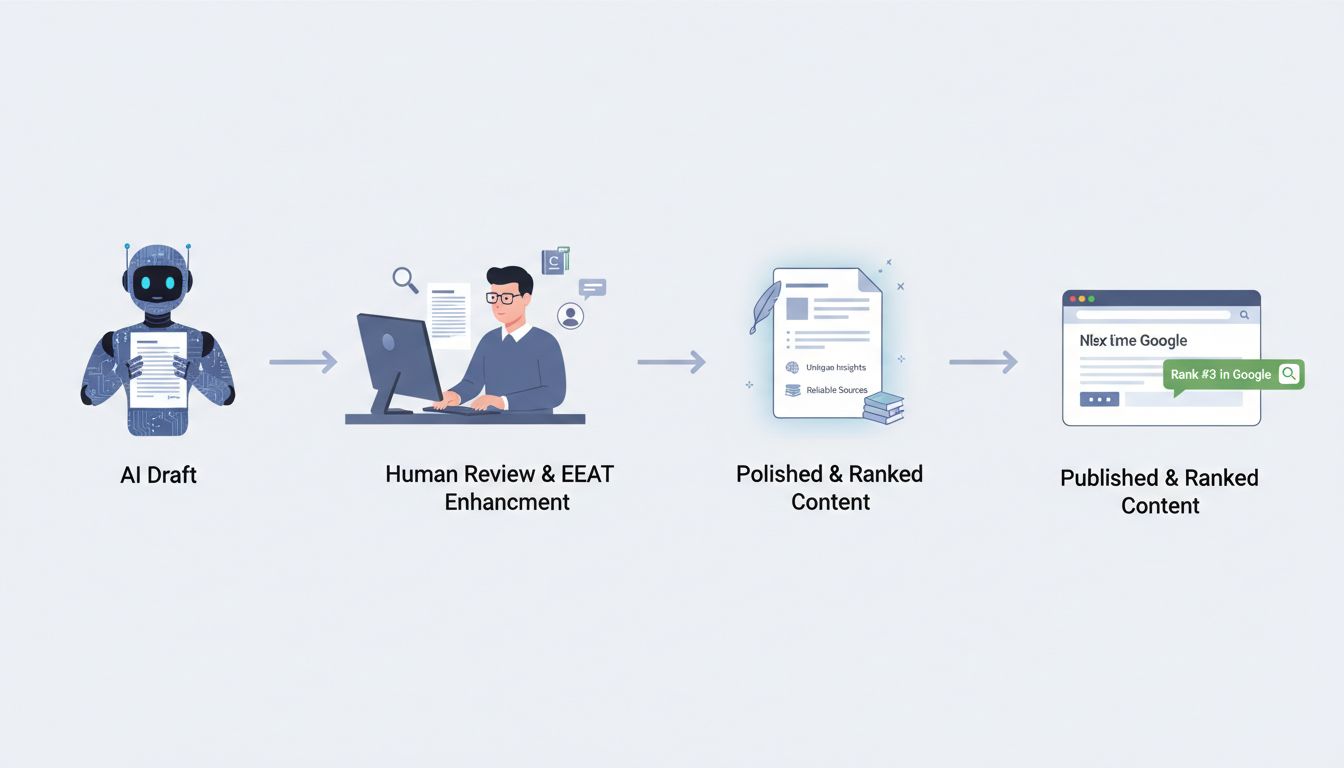
This is a quality control failure. You get generic, potentially inaccurate content that actively hurts your EEAT signals.
The fix is non-negotiable: add a human review step. Use tools with built-in plagiarism detection like NeuronWriter, or hallucination-reduction features like Outranking's Concept system. Then manually add author bios and cite your sources. AI drafts, human polish.
Mistake 2: Ignoring Search Intent.
This is a research failure. Ranking for a keyword that doesn't match what users actually want guarantees a high bounce rate.
Use your tool's SERP analysis, Frase or Surfer's content briefs, to understand the why before you write a word. Look at what's ranking in the top 10: is it a how-to guide, a product comparison, a definition? Match that format.
Mistake 3: Producing Thin or Duplicate Content.
This is a strategy failure, and it triggers Google's Helpful Content System.
Use Writesonic's Content Gap Analyzer or Scalenut's topic clustering to find angles competitors missed. Use AI for expansion and original synthesis, not just summarizing whatever's already on page one of Google.
Mistake 4: Over-Relying on AI for Keyword Research.
This is a validation failure. AI tools can suggest keywords, but they're bad at gauging real commercial search volume.
Use AI-generated lists as a starting point, then validate every target in Ahrefs or Semrush. Some tools, like Writesonic's SEO Suite, integrate that data directly. Use it.
Mistake 5: Forgetting SEO is a System, Not a Tool.
No AI writer, not the best ai writing tools, not the best free ai writing tools, not novelcrafter ai, not the best ai for writing fiction, not a free ai for research paper writing, will save you if your domain authority is weak and your backlink profile doesn't exist.
These tools are force multipliers. Their job is to maximize the ranking potential of content you already control. Build the system first, then accelerate it.
Conclusion
The search for the "best AI writing tools" ends when you stop evaluating features and start evaluating systems. The right tool is the one that fits your stack, works for both traditional search and AI engines (GEO), and actually cuts the time from idea to ranked content.
Your founder profile dictates the choice. Solo technical builder? Outranking or NeuronWriter. Scaling a content team? Scalenut or Frase. Multi-channel brand campaigns? Jasper. Need an all-in-one rank-first engine? Surfer AI.
It's not about ranking the tools. It's about fit.
These are force multipliers, not silver bullets. Mandate human editing, validate your SEO strategy with the tool's data, and remember that domain authority and backlinks are the moat these tools help you fill.
Build a sound system first. Then accelerate it.
Your move: Pick the tool that fits your immediate bottleneck and integrate it this week. Start measuring your content's time-to-rank. Then share which one you chose and why on LinkedIn, tag me, and let's compare notes.
Frequently Asked Questions
Is ChatGPT the best AI writer?
No. ChatGPT is great for brainstorming and first drafts, but it doesn't give you an SEO workflow. You need SERP analysis, competitive benchmarking, real-time optimization scoring, publishing integrations. That's a complete system, not just a language model.
What AI is better than ChatGPT?
Honestly, that's the wrong question. Raw model capability matters less than whether the tool embeds that intelligence into an actual SEO workflow.
Claude writes more nuanced prose. Gemini plays nicer with Google's ecosystem. But neither of those things tells you if the tool can analyze SERPs, generate optimized briefs, and track rankings after you hit publish. That's why we evaluate platforms, not just models.
Can I sell a book I wrote with ChatGPT?
Yes, but there are real caveats. Under current US and UK law, you likely can't copyright pure AI-generated text, which means you don't own the underlying content outright. Amazon KDP requires AI disclosure, and readers increasingly care about human curation.
The commercial value is in your editing, your assembly, your perspective. Check the latest terms of wherever you're publishing before you commit to anything.
What is the 30% rule in AI?
It's a heuristic. The idea is that roughly 30% of AI-generated content should be substantially edited by a human, adding unique value and the kind of E-E-A-T signals search engines reward.
In practice, the successful content I've seen goes way beyond simple tweaks. We're talking full structural rewrites, proprietary data, case studies, voice refinement. The 30% framing undersells how much human input actually matters.
Is SEO dead or evolving in 2026?
Evolving. The rise of AI Overviews and Generative Engine Optimization (GEO) means you're now optimizing for traditional search and AI engines like ChatGPT and Perplexity simultaneously.
AI Overviews reduce clicks on #1 organic results by 58% (according to goodfirms.co), but they also create new visibility opportunities inside AI-generated answers. Search intent and domain authority still matter. The channels have just multiplied.
Which AI is best for SEO writing?
It depends on your workflow, which is exactly why we built the Decision Matrix.
All-in-one with strong SERP analysis: Surfer AI or Scalenut. Data-driven SEO control: Outranking or Writesonic's SEO Suite. Brand-centric scaling with voice consistency: Jasper paired with Surfer SEO. If you're specifically looking for the best free ai writing tools or free ai for research paper writing, the Decision Matrix covers those filters too, including where novelcrafter ai fits for anyone building out fiction projects and wanting the best ai for writing fiction in their stack.
The best tool is the one that cuts your time from idea to ranked content.