April 26th, 2026
The Complete Guide to SEO Content Writing for AI-Driven Search
 WD
WDWarren Day
If your organic traffic has stalled or dropped since AI Overviews started showing up, you're not alone. Click-through rates have fallen by up to 61% where AI summaries appear. That's not a rounding error. That's a fundamental break in how SEO content writing has worked for the last decade.
18% of searches now generate an AI summary. Users click links inside those summaries only 1% of the time. Your content isn't just competing with other websites anymore, it's competing with Google's own answer engine.
And tweaking your headlines won't fix that.
The systems that powered SEO for years weren't built for retrieval-augmented generation pipelines or probabilistic citation models. Most content teams are still optimizing for metrics that don't reflect reality, while AI search engines pull answers from sources that aren't even on page one.
The shift is real, and it's structural.
Effective seo content writing now is essentially an engineering problem. You have to build content as a structured data source for AI retrieval, track performance with visibility metrics that actually mean something, and put together a production system that scales authority, not just volume.
This guide walks through all of that. You'll learn how to structure content for machine readability, why schema markup correlates with a 2.5× higher chance of AI citation, and how to use seo writing ai tools inside a hybrid workflow that keeps humans in the loop where it matters.
We'll also get into which seo content writing tools are worth your time, what it looks like to build this as a freelance seo content writer operating at scale, and how to measure citation share and discoverability rate instead of just traffic.
The last 90 days of your old strategy probably aren't coming back. Here's what to build instead.
The New SEO Reality: Lower Clicks, New Metrics
If your organic traffic has stagnated or declined as AI Overviews become prevalent, you're not alone. Click-through rates have dropped by up to 61% for queries where AI summaries appear. Source: dataslayer.ai
That's not a temporary glitch. That's the new baseline for seo content writing.
The numbers are pretty stark. Without an AI summary, the average CTR sits around 15%. When an AI Overview appears, that drops to 8%. Source: CampaignLive
And users click links inside the summary only 1% of the time. 26% of users just stop after seeing an AI answer, compared to 16% without one. The session ends. No click.
By March 2025, 18% of all Google searches generated an AI summary. Source: CampaignLive That figure has likely grown since.
Traditional SEO success metrics, built entirely around driving clicks to your site, are breaking. You can no longer measure content performance solely by traffic and keyword rankings.
This creates a real engineering problem. Your content now has to serve two audiences: the AI system that retrieves and synthesizes information, and the human who may never actually visit your page. Success shifts from capturing clicks to earning citations inside AI-generated answers.
The New Metrics That Actually Matter
To adapt, you need new KPIs. Three are becoming essential for measuring AI visibility:
- AI Share of Voice: How often your brand or content gets mentioned inside AI answers. Similar to traditional share of voice, but scoped to generative results. Platforms like Semrush's AI Visibility Toolkit measure this.
- Citation Share: For a given query cluster, what percentage of AI citations does your page receive? If an AI Overview cites six sources and you're one of them, your citation share is ~16.7%. This replaces "position #1" as the target.
- Discoverability Rate: The likelihood your content gets retrieved by an AI system for relevant queries. Influenced by structured data, entity clarity, and machine readability.
From my experience building Spectre and working with Ahrefs data, domain authority now acts as a hard constraint here. If your domain rating (DR) is below 30, chasing broad informational queries is often futile. AI systems heavily favor established, authoritative domains.
So the strategy has to shift. Prioritize definitive tools, deep comparative guides, or original research that even high-DR competitors haven't produced.
Here's the part most people miss: AI Overviews often cite sources outside the traditional organic top 10. BrightEdge found five out of six citations come from content not on page one. Source: BrightEdge
That's an opening, if you structure content correctly. If you don't, it's just irrelevance.
Whether you're a freelance seo content writer building client deliverables or an in-house team scaling production with seo writing ai tools, the core problem is the same. You're no longer just writing articles. You're building structured data sources for AI retrieval.
Content as Structured Data: Building for AI Retrieval
Your content isn't just prose anymore. It's a structured data source that AI systems query, chunk, and score for relevance. Think of it less like writing an article and more like building an API endpoint for machine consumption.
Under the Hood: How AI Search Retrieves Content

When you search using Google's AI Overviews, the system doesn't read your content like a human does. It breaks pages into chunks, converts those chunks into mathematical vectors called embeddings, and scores each piece against the search query's own embedding for semantic similarity. The chunks with the highest relevance scores get retrieved and potentially cited.
This explains why structure matters more than ever. If your key answer is buried in paragraph 8, it might not make it into the initial chunking window. If your headings don't clearly signal the entities and concepts within, the system might assign a lower relevance score.
I've seen this firsthand while building Spectre. Our platform uses DataForSEO's API to analyze SERPs and cluster keywords, then structures content briefs to ensure the most relevant answer clusters appear early and are clearly signposted. It's not about writing better. It's about engineering content for machine-first retrieval.
On-Page Structuring Best Practices
Start with answer-first introductions. Within the first 150 words, provide a concise, direct answer to the likely search query. This ensures that critical information gets captured in the first content chunk AI systems process.
Use question-style H2 and H3 headings. Instead of "Benefits of Cloud Migration," write "What are the benefits of cloud migration?" This directly mirrors how users phrase queries in AI search and increases the semantic match between your content and the search intent.
When implementing this at scale for media clients, we'd modify CMS templates to automatically format H2s as questions based on keyword research from Ahrefs.
Implement parsable content blocks. Tables, numbered lists, and bullet points are easier for AI to extract and attribute. For comparison content, use clear "Pros and Cons" tables with standardized column headers.
Avoid nesting critical information within complex JavaScript widgets or images without alt text. AI crawlers still struggle with these.
Get your structured data right. Content with proper schema markup has a 2.5× higher chance of appearing in AI-generated answers. I've implemented JSON-LD schema at scale across multiple CMS platforms and the pattern is consistent: start with Article, HowTo, FAQPage, and Product schema where applicable. Use Google's Structured Data Testing Tool religiously. Missing required fields or incorrect nesting will render your markup useless.
For teams with lower domain authority (DR 20-40), focus on tactical formats that punch above their weight. Comparison pages with clear verdicts, FAQ hubs that answer specific sub-questions, "versus" content, these often outperform broad authoritative guides in AI retrieval because they create clear, chunkable answer blocks that AI systems can confidently cite.
Also worth doing: control what gets extracted. Use data-nosnippet on sensitive pricing information or proprietary data you don't want surfaced in AI summaries. This is part of treating your content as an API, defining clear boundaries about what's publicly queryable versus what requires a direct visit.
Here's something that trips people up though. Over-optimizing schema can be as harmful as having none. I've seen sites implement every possible schema type, creating conflicting signals that confuse both traditional crawlers and AI systems.
Implement only what's necessary and accurate. Your HTML hierarchy should make the page's intent and key answers machine-obvious on its own. Structured data is the clarifying layer on top, not the foundation.
This is the real job of seo content writing now. Whether you're a freelance seo content writer working with clients, an in-house team using seo content writing tools, or someone leaning on seo writing ai to scale production, the underlying question is the same. Is your content structured so a machine can retrieve it confidently?
If it's not, it doesn't matter how well you wrote it.
The AI Visibility to Value Funnel: From Citations to Conversions
Getting cited in AI Overviews is just the starting point.
If you treat AI visibility as an end in itself, you'll optimise for metrics that don't move the needle. The goal isn't to be cited. It's to convert that visibility into trust, leads, and revenue.
This requires a fundamental shift in how you measure SEO success. Traditional metrics like keyword rankings and organic traffic become misleading. A Seer Interactive study found organic CTR fell 61% for queries with AI Overviews [Source: dataslayer.ai/blog/google-ai-overviews-the-end-of-traditional-ctr-and-how-to-adapt-in-2025]. Your page might vanish from the SERP while your content feeds the AI answer that's cannibalising your clicks.
Image prompt: An infographic showing a funnel with three stages: "AI Citation" at the top (widest), "Authority & Trust" in the middle, and "Lead/Conversion" at the bottom (narrowest). Arrows flow downward, with metrics like "Citation Share", "Discoverability Rate", and "Conversion Rate" labeled beside each stage. The graphic has a clean, technical aesthetic.
The Three-Stage Funnel: What You Actually Need to Track
Think of your AI visibility strategy as a conversion funnel with three distinct stages:
-
Citation Stage: Your content is sourced by an AI system. Key metrics here are Citation Share (what percentage of AI answers on a topic cite you) and Discoverability Rate (how often your content appears in AI responses for queries you target). These are vanity metrics if they don't lead to the next stage.
-
Trust Stage: The citation builds your brand's authority. This is measured indirectly through branded search lift, increased direct traffic, or higher engagement when users do click through. A citation answering a complex technical question is worth more than one in a simple definition.
-
Lead/Conversion Stage: Authority converts to action. This is where you track form fills, demo requests, or purchases from users who encountered your brand via an AI answer. It's the hardest to attribute, and it requires sophisticated session tracking.
Most teams get stuck at stage one, celebrating citations without asking "so what?"
Building the analytics to connect these dots is non-negotiable. For my platform Spectre, I built a dashboard that maps specific article citations in sampled AI Overviews to subsequent user sessions and lead sources. It's the only way to prove ROI.
The Tooling Reality: Build, Buy, or Sample
You have three options for tracking this funnel, each with trade-offs:
- Buy: Platforms like Semrush's AI Visibility Toolkit or Ahrefs are starting to offer citation tracking. Good for discovery, but they often lack the depth to connect to your CRM. They give you the "what," not the "why."
- Build: The most powerful route for technical teams. Use the Google Search Console API, sample AI Overviews for your target queries (tools like BrowserStack can automate this), and pipe the data into a custom dashboard alongside your analytics. This lets you build real attribution models.
- Sample: The pragmatic approach when you're resource-constrained. Manually check AI Overviews for your top 20 priority queries weekly. Track citation appearances in a spreadsheet and correlate with weekly fluctuations in branded traffic and conversions. Low-tech, but it reveals basic cause and effect.
The critical limitation to acknowledge is the probabilistic nature of AI visibility. An AI system might cite you in one response and not in the next for the exact same query. Your Discoverability Rate will never be 100%, and low-volume citations make statistical significance a real challenge. Don't chase perfect data. Look for directional trends.
Setting KPIs Based on Your Domain Authority
Your domain rating (DR) dictates realistic goals. A startup with DR<30 chasing broad AI Share of Voice is wasting effort.
- DR < 30: Focus on Citation Share in niche, long-tail topics. Goal: become the most-cited source for 3-5 hyper-specific question clusters relevant to your product. Track whether citations in these niches lead to a higher percentage of qualified leads.
- DR 30-50: Expand to AI Share of Voice for mid-funnel, comparative keywords. Goal: be consistently cited in "tool A vs tool B" or "how to solve [problem]" AI answers. Measure the impact on trial sign-ups.
- DR 50+: Compete for citation dominance in top-of-funnel, broad informational queries. Goal: own the narrative in AI answers for foundational industry questions. Correlate this with overall branded search volume and market perception surveys.
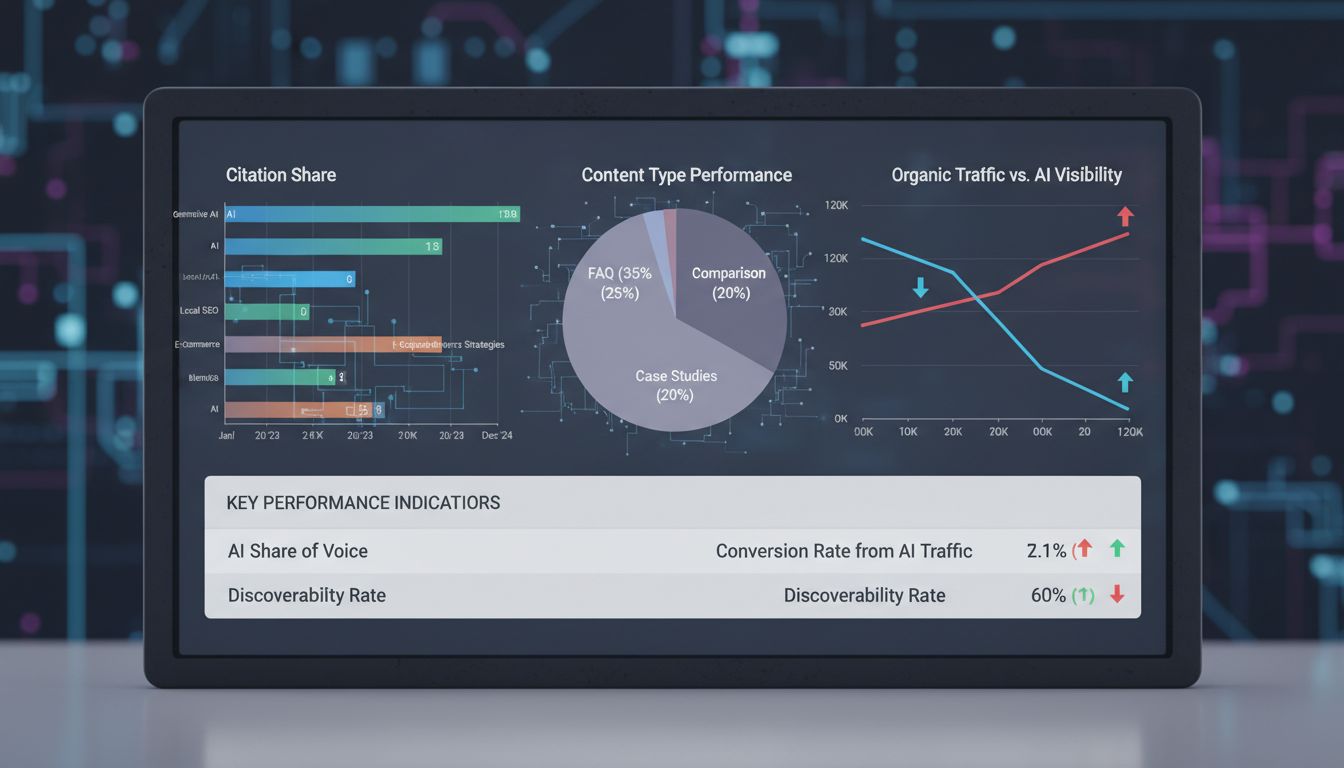
The core strategic tension remains: increased AI visibility often decreases direct clicks. Your KPI has to account for this. Something like: "Increase AI Citation Share for priority topic X by 15%, while maintaining or increasing the conversion rate of the reduced organic traffic it generates." That forces you to improve page quality and conversion paths, not just chase citations.
The funnel only works if you engineer the handoff from AI to your site. Your cited content needs a clear, compelling reason for users to click through, an exclusive tool, deeper data, a solution the AI summary only hints at.
Otherwise you're just building someone else's answer engine. And that's true whether you're doing seo content writing in-house, working as a freelance seo content writer, using seo content writing tools to scale production, or relying on seo writing ai to draft at volume. The question is always the same: does clicking through give the user something the AI answer didn't?
If not, they won't.
Architecting the Hybrid Human-AI Workflow
What happens when you treat AI as a replacement for human writers? You get content that's generic, untrustworthy, and ultimately useless.
The better approach treats AI as one component in a larger system, where human expertise provides the editorial judgment and original insight that machines can't replicate.
Think of it like building software: you wouldn't deploy code without tests or version control. Your content pipeline needs the same rigor. From my experience building Spectre, I've seen teams waste thousands on tool subscriptions only to end up with disconnected workflows where research lives in Ahrefs, drafts in Google Docs, and optimization scores in Surfer, with no single source of truth.
Tool Stack Recommendations by Team Size
Your tool decisions should scale with your team's capacity and budget, not your ambition.
For solo practitioners or founders wearing multiple hats, all-in-one platforms make sense. Semrush or Moz give you integrated briefs, keyword research, and basic optimization scoring in one place. The trade-off is depth, you get 80% of what you need, but you'll hit walls on advanced SERP analysis or custom automation.
Small teams (5-20 people) do better with a best-of-breed approach. Start with Ahrefs for deep keyword research and competitor analysis. Use Jasper or Frase for initial drafting, but treat those outputs as structured outlines, not finished articles. Then run drafts through Clearscope or Surfer to score against top-ranking pages.
The friction here is moving content between systems. Expect copy-pasting or basic Zapier connections.
For larger teams or agencies doing seo content writing at scale, API-driven automation becomes essential. At this point you're not just using tools, you're building workflows. My platform Spectre connects directly to DataForSEO for keyword clustering, pulls SERP features, and generates structured briefs that feed into your CMS. The goal is eliminating manual data entry and creating one pipeline from research to publication.
Without that integration, tool sprawl creates data silos that kill content velocity.
The hidden cost isn't the subscription fees. It's the context switching. Every time a writer toggles between five browser tabs, you lose focus and introduce errors.
Governance and Best Practices
Publishing AI-generated content without human editing is the fastest way to damage your E-E-A-T signals. Google's guidance is clear: they reward original, people-first content demonstrating experience and expertise. [Source: Google Search Central]
Your governance framework needs a few core pieces.
First, mandatory editorial review gates. Every piece should pass through a subject-matter expert who verifies accuracy, adds original insight, and checks tone. This matters especially for YMYL topics where misinformation carries real risk.
Second, audit trails. Document which tools were used, who edited what, and when updates were made. This isn't just for compliance, it helps you iterate. When a piece performs well in AI Overviews, you need to know exactly how it was produced so you can repeat it.
Third, label AI-assisted content internally. Not public disclaimers (those can backfire), but your CMS should track whether something was AI-assisted, human-written, or hybrid. That metadata helps you spot performance patterns as you scale.
Here's a practical example. A guide to "best project management software for agile teams" written the traditional way ranks tools with brief descriptions. An AI-optimized version leads with a comparison table, includes expandable sections for implementation details, and structures pros/cons with clear schema markup.
The second version wins because it's built for retrieval. AI systems can extract the comparison data directly, while still giving depth to human readers who click through.
The most common mistake I see, whether someone's a freelance seo content writer, an in-house team using seo content writing tools, or a founder relying on seo writing ai, is treating these tools like content factories instead of collaboration partners.
Jasper can generate a decent first draft. It cannot interview your customers, share case studies from your implementation team, or explain why your solution is different from competitors. Those things come from people.
Your hybrid workflow should map to the full content lifecycle: AI-assisted ideation and research, human SME drafting with original data, AI optimization scoring for structure and completeness, then final human editorial review for voice and accuracy.
Skip any step and you'll produce content that either doesn't rank or doesn't convert.
Tools don't create strategy. They execute it. Your competitive advantage comes from the unique insights and perspectives your team brings, not from which seo writing ai assistant you're subscribed to.
The 90-Day AI SEO Content Overhaul: A Practical Playbook
Tools don't create strategy. They execute it.
Your competitive advantage comes from the unique insights, data, and perspectives your team brings, not from which AI writing assistant you subscribe to.
A systematic 90-day overhaul works because it respects dependencies: you can't optimize content for AI retrieval if your technical foundation leaks, and you can't measure what you haven't built. This playbook is tiered by domain authority, your starting position dictates your tactical focus.
Here's the phased implementation:
| Phase | Timeline | Core Objective | Key Deliverables |
|---|---|---|---|
| Foundation | Days 1–30 | Fix technical readiness for AI retrieval | Technical audit, core schema implementation, question-based keyword clusters |
| Optimization | Days 31–60 | Refresh and restructure high-potential pages | 5–10 refreshed pages, topic hub pages, FAQ blocks, multimodal assets |
| Scale & Instrumentation | Days 61–90 | Systematize production and measure AI visibility | AI visibility dashboard, hybrid workflow pilot, iterative update cycle |
Phase 1: Foundation (Days 1-30)
Your first month isn't about writing. It's about making sure AI systems can find, understand, and trust your content.
Start with a technical audit using Screaming Frog or Sitebulb. Look for schema errors (Search Console will show these), 404s where AI crawlers might land, and pages blocked by robots.txt that you actually want indexed. Clean that up first.
Implement structured data on your 20 highest-traffic pages. Use CMS templates for JSON-LD Article schema (author, date published, headline) and Organization schema. Don't over-engineer it, focus on correct Tier 1 markup. Content with proper schema has a 2.5× higher chance of appearing in AI-generated answers [Source: Research], which makes this your highest-leverage technical task.
At the same time, reassess your keyword universe. Use Ahrefs' Content Gap tool and Semrush's Keyword Magic Tool to mine question clusters. Target queries with seven or more words, they trigger AI Overviews roughly 46.4% of the time [Source: Research]. Export People Also Ask data and use tools like AnswerThePublic to build semantic maps, not just keyword lists.
Tiered advice for low domain authority (<30 DR): Your moat is depth, not breadth. Skip broad informational queries. Identify 3-5 micro-niches where you can build definitive "answer hubs," make sure every page in those clusters has flawless schema and internal links pointing back to your hub. That concentrated authority signals to AI systems that you own a specific knowledge graph.
Phase 2: Optimization (Days 31-60)
With a clean technical base, now refresh your content.
Select 5-10 pages with high organic traffic but low conversion, or pages targeting question-based intents. Rewrite the first 150 words to lead with a direct, concise answer. Use H2s that mirror the exact question: "What is the best CRM for startups?" not "Introduction to CRM Solutions."
Build topic hub pages. These act as canonical maps for AI sub-queries. A hub page titled "Complete Guide to Marketing Automation" should internally link to child pages answering "how to set up lead scoring," "marketing automation tools comparison," and "email workflow examples." Descriptive internal linking helps AI systems understand how your content relates to itself.
Add FAQ blocks using schema.org/FAQPage markup to pages where you want to target featured snippets. Keep answers under 50 words. For multimodal optimization, embed a relevant YouTube video with a descriptive caption and transcript, AI increasingly ingests video content. No video? Create annotated screenshots or process diagrams with detailed alt text.
Tiered advice for mid-tier authority (30-50 DR): Here you can expand beyond answer hubs. Create comparison pages ("X vs Y") with clear verdicts in table format. Optimize for brand-mention opportunities: make sure your product names, founder bios, and case studies are marked up with Person and Product schema. When AI Overviews mention your brand, click-through rates tend to increase even on informational queries.
Phase 3: Scale & Instrumentation (Days 61-90)

The final phase is about systemizing what works and measuring it.
Implement basic AI visibility tracking. If you use Semrush, activate its AI Visibility Toolkit. For a custom approach, use the DataForSEO API (which I've integrated into Spectre) to track rankings for question-based keywords and monitor SERP features for AI Overview appearances. Track two new KPIs: Citation Share (what percentage of AI answers for your target queries cite you?) and Discoverability Rate (how often does your content appear in any AI-generated result?).
Pilot the hybrid human-AI workflow from Section 4 on all new content production. Assign one editor to audit the output against your E-E-A-T checklist. Document the time savings and quality benchmarks.
Then establish an iterative update cycle. AI visibility isn't static. Schedule quarterly reviews of your refreshed pages using your visibility dashboard, if citation share drops, update your statistics, add a new section answering emerging sub-questions, or enhance the schema. This turns content from a publication event into a living data asset.
The goal isn't to complete a project in 90 days. It's to install a new operating system for seo content writing, one where you're maintaining a structured knowledge base that both humans and AI systems query, using seo content writing tools and seo writing ai to execute, and measuring performance with metrics that actually matter. Whether you're a freelance seo content writer or running an in-house team, the shift is the same: from publishing articles to managing a knowledge system.
Risks, Limitations, and Future-Proofing Your Strategy
This approach has real trade-offs. Optimising for AI visibility can directly cut your click-through rates, Seer Interactive's analysis showed organic CTR falling 61% for queries with AI Overviews (Source: dataslayer.ai). You're trading direct traffic for citations, which means you need to map that visibility back to conversions through your funnel.
AI citation is also just... unreliable. A Tow Center study found AI systems misattribute or misrepresent citations in over 60% of test cases. Your content might be perfectly structured and still not show up consistently.
Mitigate this with relentless E-E-A-T signals: original research, author bios with verifiable credentials, regular content updates. Stale content loses AI visibility faster than it loses traditional rankings.
Future-proofing means thinking about multimodal search too. YouTube and video are already critical for AI answer engines. Optimise images with descriptive alt text, consider IPTC DigitalSourceType metadata for AI-generated visual assets, and start treating your entire content library as queryable data, not just articles.
There are also some common technical mistakes worth avoiding: over-optimising schema with irrelevant markup, neglecting crawler errors (34% of AI crawler requests return 404s on some sites), or assuming traditional backlinks translate directly to AI visibility. Earned media and third-party authority often matter more here.
Sustainable seo content writing now requires both engineering rigor and editorial judgment. Tools like my own Spectre platform can structure and scale production, but they can't generate original insight.
Your competitive moat is the unique perspective, proprietary data, and domain expertise that AI cannot replicate. Then you engineer systems to make that value retrievable at scale. That's true whether you're a freelance seo content writer or running a full in-house operation using seo writing ai and seo content writing tools.
The stats in this space move fast. Review your approach every six months.
Conclusion
SEO content writing has fundamentally changed. It's not about crafting perfect prose anymore, it's about building structured data sources that AI systems can actually query and cite. When I build content systems for clients now, I treat each piece like a structured API endpoint, not an article.
The shift is from chasing clicks to engineering visibility. Your new KPIs, Citation Share, Discoverability Rate, AI Share of Voice, measure how well your content works as retrieval fuel for AI models. That requires real instrumentation: tracking which pages get cited, which entities trigger citations, how those citations convert. Tools like Semrush's AI Visibility Toolkit give you a starting point, but the actual insight comes from mapping citation patterns to your commercial funnel.
A hybrid human-AI workflow isn't optional at this point. It's the only way to scale authority without the quality falling apart. The system I've described separates generation from validation: seo writing ai handles research and drafting at volume, human experts apply judgment, add original insight, enforce E-E-A-T. Smaller teams can compete with larger domains by being selective about where their editorial time actually goes.
The 90-day playbook gives you a path that doesn't require rebuilding everything at once. Fix schema errors on your top pages. Set up basic AI visibility tracking. Pilot the hybrid workflow on one high-potential topic cluster. Then measure what happens, both citation frequency and downstream conversions.
You don't need to do all of it today.
Start your AI SEO overhaul today: Audit your top pages for schema errors using Google Search Console. Set up basic AI visibility tracking with seo content writing tools like Semrush, or build a simple dashboard to monitor citation patterns. Then pilot the hybrid workflow on one high-potential topic, the impact shows up within weeks, whether you're a freelance seo content writer or running a full in-house team.
Your content infrastructure now determines your search visibility. Build it accordingly.
Frequently Asked Questions
What is SEO in content writing?
What even counts as "SEO content writing" in 2026? It's changed more in the last two years than in the previous ten.
The short version: it's the process of creating content optimized for both traditional search engines and AI retrieval systems. That means clear entity definitions, answer-first structure, and precise mapping to user intent, not just sprinkling in keywords and hoping for the best.
The goal has shifted from keyword targeting to engineering content for machine readability. New metrics like citation share and AI discoverability rate matter more than organic clicks now.
Is SEO dead or evolving in 2026?
It's evolving, fast. AI Overviews now appear for 15-20% of searches [Source: ahrefs.com], and organic click-through rates have dropped up to 61% where those summaries show up [Source: dataslayer.ai].
So traditional ranking matters less than being cited as a trusted source inside AI-generated answers. The game shifted from "rank #1" to "get quoted."
That's an engineering problem now, not just a writing one.
Is SEO content writing still relevant?
More than ever. But what "relevant" means has changed.
Content has to serve two audiences at once: human readers who want depth, and AI systems that need structured, extractable information. You can't optimize for one and ignore the other.
That's exactly what makes seo content writing commercially essential right now, the writers who figure out how to do both are the ones getting hired.
Will AI replace SEO?
It's already replacing the low-value stuff, basic keyword stuffing, generic content spinning. That work is gone.
But it's creating something more interesting in its place: demand for people who can do system design, strategic oversight, and editorial judgment at scale. E-E-A-T signals, experience, expertise, authoritativeness, trustworthiness, are fundamentally human qualities. AI can't fake those at scale, at least not yet.
The writers who understand that are building careers. The ones waiting to see what happens... aren't.
How much do SEO content writers make?
Depends heavily on specialization. In-house SEO content specialists at tech companies typically earn $50,000-$100,000 a year. Freelance rates run $0.10 to $0.50 per word for technical or AI-optimized content.
The premium goes to writers who understand both content strategy and the technical side, structured data, entity mapping, AI retrieval patterns. That combination is still rare enough to command real money.
As traditional SEO gets automated, those skills gap out further in your favor.
Can I make $1000 a month freelance writing?
Yes, if you specialize. A freelance seo content writer who focuses on AI-optimized SEO content for a specific niche is in a much better position than someone doing general blogging.
Target high-intent informational topics where AI Overviews frequently appear, question-based queries trigger them 57.9% of the time [Source: ahrefs.com]. Build a portfolio that shows measurable results: citation shares, traffic impact, actual numbers.
Platforms like Upwork work fine to start, but the real leverage comes from niching down to topics where you can demonstrate genuine expertise. That's what separates a $0.05/word writer from a $0.50/word one.