April 11th, 2026
The SEO Content Strategist's Playbook for AI and Automation
 WD
WDWarren Day
You're generating more content than ever, but organic growth has stalled. Your team is stretched thin, your AI tools churn out inconsistent drafts, and you're watching AI Overviews quietly siphon the clicks you spent months earning. The pressure to prove SEO's ROI has never been higher. Yet the playbook most people are still running, hire a good SEO content strategist, brief them on keywords, publish consistently, is increasingly obsolete.
Here's the uncomfortable truth: the role itself has fundamentally changed.
The SEO content strategist of 2026 isn't primarily a writer or even an editor. They're a systems architect. Their job is to design and govern the hybrid human-AI workflows that determine whether your content operation scales intelligently or just produces more noise. The ones who understand this are pulling ahead. The ones still treating it as a content production role are losing ground to competitors who've figured out the leverage.
I've built this from the engineering side, constructing the pipelines, integrating the APIs, and watching firsthand what separates content operations that compound over time from ones that plateau. That perspective shapes everything in this piece.
What follows isn't a survey of AI tools or a motivational argument for "embracing AI." It's a four-step operational playbook: how to audit your current content against real business outcomes, architect a workflow that combines AI efficiency with human judgement, build a tech stack around programmatic data rather than dashboard-clicking, and measure the metrics that actually connect to revenue.
Google AI Overviews now appear on 55% of searches. Zero-click rates are climbing. The rules have changed at the infrastructure level, and that demands a response at the same level.
This is that response.
The 2026 Reality: SEO Content Strategy in the Age of Generative Search
"SEO is dead" has been declared so many times it's become background noise. It wasn't true when social media was going to kill it, it wasn't true when voice search was going to kill it, and it's not true now. But something genuinely significant has shifted, and if you're running content strategy without acknowledging it, you're flying blind.
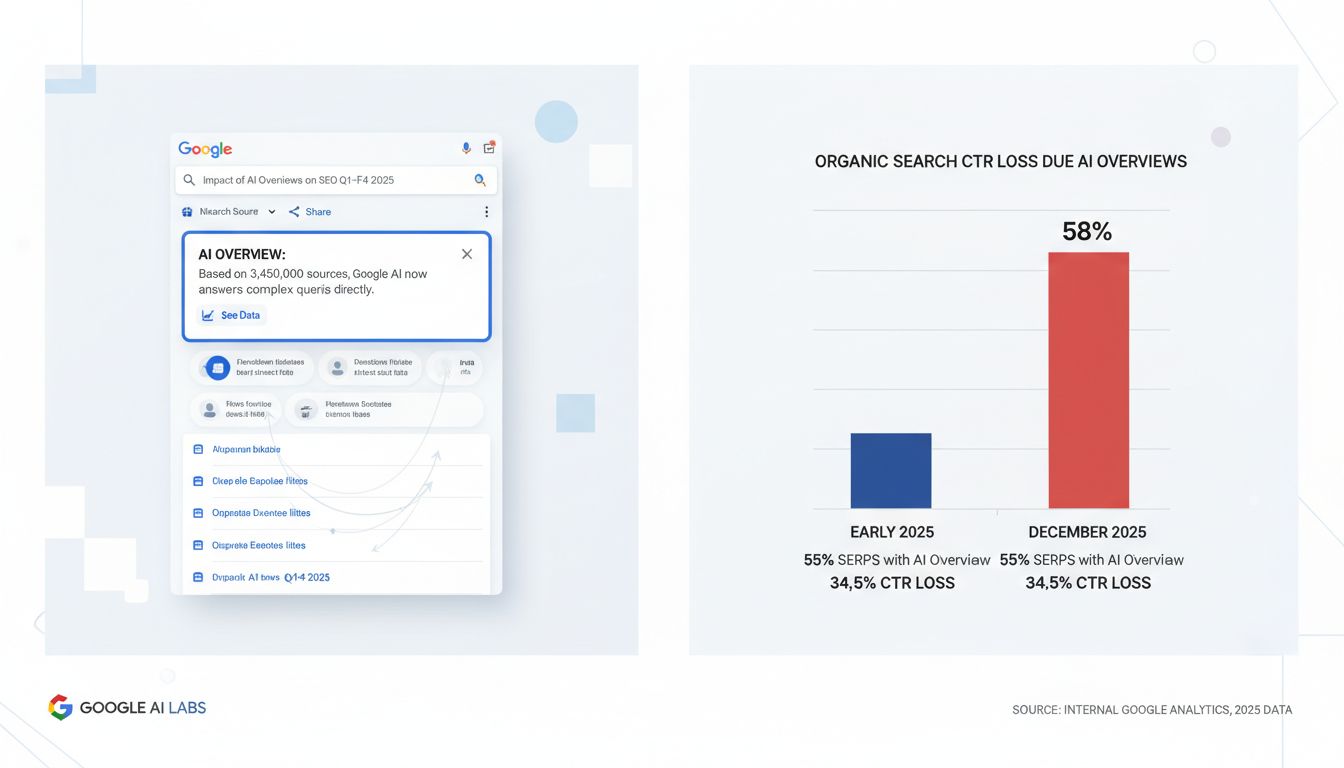
Here's the actual situation. Google AI Overviews now appear on 55% of searches, and when they do, the top organic result loses an average 34.5% of its clicks. Ahrefs re-ran their study in December 2025 and found that figure had worsened to 58%. That's not a blip. That's a structural change to the economics of organic search.
Zero-click search isn't new, featured snippets started this years ago. What's new is the scale and speed of the shift. Users are getting answers without ever visiting a website, and the search funnel now has a fork in it that didn't exist two years ago.
This is where the conversation about SEO in 2026 actually gets interesting. The strategist's job has split into two parallel tracks.
Track one is traditional SEO: ranking in the blue links for high-intent, commercial queries where AI Overviews are less prevalent and clicks still flow. Track two is GEO (Generative Engine Optimization): optimising to become a cited source inside AI-generated answers on Google, ChatGPT, Perplexity, and Gemini.
These aren't the same discipline. Traditional SEO optimises for rankings and clicks. GEO optimises for citation, authority signals, and structured content that language models can extract and quote. Both matter. Neither alone is sufficient.
The contrarian point worth making: zero-click isn't purely bad news. Visitors arriving via AI citation convert at significantly higher rates than average organic visitors, intent is sharper, trust is pre-loaded. Volume is lower; quality is higher. That trade-off changes how you think about content ROI entirely.
The SEO content strategist of 2026 isn't just a keyword researcher or a writer manager. They're the person who understands both tracks, decides where to play given the site's domain authority and commercial context, and builds the system to execute across both. That's the mandate this playbook addresses.
Redefining the role: what is an SEO content strategist today?
The title gets misused constantly. Most job postings describe a content writer who knows how to use Ahrefs, or a technical SEO who occasionally writes briefs. That's not this role.
A genuine SEO content strategist in 2026 operates across three distinct functions at once: roughly one-third data scientist (interpreting search intent, performance signals, and competitive gaps), one-third editor-in-chief (governing brand voice, quality standards, and editorial judgement), and one-third automation specialist (designing the workflows and systems that make content production repeatable and scalable). Remove any one of those thirds and you don't have a strategist, you have a specialist who'll create bottlenecks.
The core output isn't content. It's a reliable content system.
What the role actually owns in 2026:
- Content KPIs tied directly to revenue and pipeline, not sessions, not impressions
- The architecture and governance of hybrid human-AI workflows
- Tool selection, integration, and ongoing stack management
- Brand safety and quality control within an AI-augmented process
That last point matters more than most organisations realise. Only 43% have established business-wide AI governance councils, which means the strategist is often the only person actively thinking about what happens when the AI confidently publishes something wrong, off-brand, or legally problematic.
The domain rating moat, and why it changes everything
Here's the insight most AI-generated content strategies completely ignore: your domain authority dictates your entire keyword strategy, full stop.
I've worked across sites ranging from DR20 startups to DR80+ media properties, and the playbook is fundamentally different at each level. A DR33 SaaS site trying to rank for "project management software" isn't competing with Asana's blog, it's losing before the brief is written. The strategist's first job is realistic targeting: ultra-specific how-to guides, mid-funnel comparisons, and long-tail queries where authority isn't the deciding factor.
AI keyword tools will gleefully suggest high-volume terms your domain has no business targeting. A competent SEO content strategist filters that noise out immediately. That's not pessimism, it's the precision that separates a system that compounds over time from one that burns budget on content nobody will ever rank.
The high-stakes economics: ROI, salary, and career future
Let's address the questions people search for but rarely get straight answers on.
Is SEO a high-paying skill? Yes, when it's tied to measurable business outcomes. Semrush's analysis of 3,900 US job listings found a median salary of $130,000 for senior SEO roles, nearly double the $71,630 median for non-senior positions. Directors of SEO averaged $141,178. In the UK, senior SEO leads sit between £45,000–£65,000, with Head of SEO roles pushing £65,000–£100,000+. Compensation scales sharply with seniority and the ability to demonstrate strategic impact.
The keyword there is demonstrate. Tacticians who execute tasks get paid like tacticians. Strategists who own a system that produces measurable revenue get paid like strategists. Your salary is a direct function of how clearly you can connect your work to business outcomes.
Is SEO a stressful job? It can be, but the stress is largely self-inflicted by staying in reactive mode. If you're personally responding to every algorithm update, manually producing content, and scrambling to explain traffic drops to a sceptical CFO, yes, that's exhausting. Designing systems changes the equation. You're building a machine and monitoring its outputs, not firefighting every Google update with your bare hands.
Will AI replace SEO? It will replace tacticians who do work AI can do faster and cheaper. It won't replace strategists who design the systems AI operates within. 65% of businesses report SEO performance improvement through AI adoption, and teams save more than five hours per week once AI is embedded in their workflows. That's not a threat, that's leverage. The strategist who wields it compounds their output without proportionally increasing headcount.
The ROI case isn't hard to make when you have the right system producing the right evidence. The playbook that follows is the blueprint for building exactly that.
Playbook step 1: The strategic audit, aligning content to business outcomes
Before you open a single AI tool, answer one question: what does success actually look like for the business, not the blog?
This sounds obvious. Almost nobody does it properly.
Most teams operate with a loose brief, "we need more content around [topic]", and then wonder why their traffic graphs go up while their pipeline stays flat. AI makes this problem catastrophically worse. Without alignment, you're not producing better content at scale. You're producing irrelevant content at astonishing speed.
The fix is a simple mapping exercise. Force every content initiative through three columns:
| Business objective | Target content / KW theme | Success metric |
|---|---|---|
| Increase enterprise sign-ups | "Enterprise CRM software comparison" guides | Marketing Qualified Leads (MQLs) generated |
| Reduce support ticket volume | "How to set up [feature X]" tutorials | Ticket deflection rate |
| Expand into new vertical | "[Vertical] use case" landing pages | Organic visibility + demo requests |
| Improve trial-to-paid conversion | Onboarding and ROI-focused content | Free-to-paid conversion rate |
If you can't complete the second and third columns for a piece of content, it shouldn't be on your roadmap.
Here's your immediate task: pull your 3–5 highest-traffic pages and run them through this framework. I'd wager at least half have strong traffic numbers and almost zero connection to a revenue outcome. That gap, between content KPIs like pageviews and actual business goals, is where most content budgets quietly disappear.
Only 43% of organisations have established formal AI governance structures, which means most teams are scaling production without the strategic scaffolding to make it matter. This audit is that scaffolding. Do it before anything else.
Playbook step 2: Architecting the hybrid human-AI workflow
Most teams fail at AI-assisted content not because the tools are bad, but because they have no architecture. They open ChatGPT, type a vague request, get a mediocre draft, and wonder why it doesn't rank. That's not a workflow, that's improvisation.

A real hybrid workflow has defined stages, clear handoff points, and quality gates. Here's the model I use:
SERP & data input → human strategy → AI execution → human QA → publish & monitor
Each arrow is a deliberate handoff. Each stage has a different owner.
Phase A: Research and ideation (AI-powered, human-validated)
AI earns its keep here. Feed your target keyword into an LLM alongside live SERP data, pulled manually or via API, and ask it to identify intent patterns, topic clusters, and question gaps across the top-ranking results. Ahrefs' AI features or a custom GPT prompt against exported SERP data work well for this.
The human job at this stage is validation, not generation. You're checking whether the AI's identified gaps align with your commercial objectives. An AI will happily suggest a content angle that gets traffic but converts nobody. That's your call to make, not the model's.
Phase B: Brief creation and strategic prompting (human-led)
This is the highest-value task in the entire workflow, and it can't be handed off to AI.
Here's where the "prompt engineering" conversation gets muddled. People treat it as a technical skill, a set of clever syntactic tricks. It isn't. The brief is the strategic prompt. If you've done the thinking, the prompting is trivial. If you haven't, no amount of prompt technique saves you.
A brief for a hybrid workflow should specify: target audience and knowledge level, the core argument or unique angle, which competitor gaps to exploit, required data points or examples, tone and POV, and the intended conversion action. That's not a writing brief, it's a strategic document.
Here's what a strategically grounded prompt actually looks like:
"Using the SERP for [keyword], identify the top 3 user questions the current top 5 results fail to answer comprehensively. Draft an outline that addresses all three using either unique first-party data, a step-by-step procedural framework, or a direct contrarian position. Avoid generic definitions. Structure for featured snippet eligibility on at least one sub-section."
That prompt produces something useful because the strategy is already embedded in it.
Phase C: Content generation (AI drafting, human structuring)
The AI produces a first draft from the brief. Don't expect it to be publish-ready, expect a fast, structured starting point. A human editor then reviews the logical flow, cuts redundancy, and flags where the AI has generalised where it should have been specific. This pass takes 20–30 minutes on a 1,500-word piece, not two hours.
Phase D: Editorial QA and optimisation (human-led, AI-assisted)
The final gate is non-negotiable. 93% of marketers review AI-generated content before publishing, and the ones who don't are producing the forgettable, interchangeable content flooding the SERPs right now.
Human-in-the-loop review means checking factual accuracy, injecting genuine expertise or first-person experience, and ensuring the piece says something the competition doesn't. Use AI tools (grammar checkers, originality scanners) as assistive checks, not as the final word. The human editor is the quality gate. That doesn't change.
Playbook step 3: Building your 2026 tech stack, APIs over dashboards
Most SEO tech stack conversations devolve into tool lists. What matters is architecture, how the layers connect, where data flows, and which components you own versus rent.
The distinction that separates a scalable content operation from a collection of expensive subscriptions: dashboards are for analysis, APIs are for automation. If your workflow requires a human to log into a tool, copy data, and paste it somewhere else, you don't have a system, you have a manual process with a premium UI.
Layer 1: Intelligence and research
Your data foundation. Ahrefs and Semrush handle keyword research, backlink profiling, and competitor gap analysis at the dashboard level, but their APIs let you pull that data programmatically into your own pipelines. DataForSEO sits underneath both as a cost-efficient alternative for bulk SERP data and keyword metrics. SparkToro adds audience intelligence, understanding where your audience actually spends time, which shapes content distribution, not just creation.
A practical gotcha: API rate limits and data costs are real. DataForSEO's pay-as-you-go model is 90–97% cheaper than fixed subscriptions at low-to-mid volume, but accidentally hitting "Live" queue endpoints instead of batched ones can spike costs fast. Build rate-limit handling and cost monitoring into your pipeline from day one.
Layer 2: AI creation and ideation
ChatGPT, Claude, and their API equivalents are the generation layer. ChatGPT alone has over 1 billion active weekly users, it's table stakes now, not a differentiator. The differentiator is how you use it: structured prompts with brand voice guidelines, topic briefs pre-loaded from Layer 1 research, and output routed directly into your CMS or content queue rather than copy-pasted from a browser tab.
Layer 3: Optimisation and governance
Surfer SEO and Clearscope handle on-page optimisation scoring. Originality.ai and similar tools handle AI detection and plagiarism checks. This layer is your quality gate before publication, not a replacement for human editorial review, but a systematic check that catches what humans miss at volume.
Layer 4: Automation and orchestration
Make (formerly Integromat) and Zapier handle no-code workflow glue. For anything more complex, custom keyword clustering logic, programmatic publishing, multi-step SERP analysis pipelines, you need custom scripts. MCP (Model Context Protocol) is worth understanding here: it's an emerging standard that lets AI agents interact directly with your tools via a unified interface, rather than requiring bespoke API integrations for every connection. I built Spectre's pipeline using direct API integrations before MCP existed; if I were starting today, I'd evaluate MCP servers for the orchestration layer seriously.
The tool-agnostic principle
Avoid monolithic, locked-in platforms that bundle everything but expose nothing. Your stack should be modular, each layer replaceable without rebuilding the whole system. The test: does every tool in your stack offer API access? If not, it's a liability at scale.
Playbook step 4: The 2026 measurement dashboard, beyond vanity metrics
If your weekly SEO report still leads with "we moved from position 8 to position 6 for this keyword," you're reporting on a world that no longer exists. Rankings are a lagging indicator of a system that's changing underneath you. The 2026 measurement framework for an seo content strategist has to reflect what actually drives business outcomes, not what's easy to pull from a dashboard.
Here are the non-negotiable SEO KPIs for 2026:
1. AI Overview inclusion rate What percentage of your target keyword clusters trigger an AI Overview, and are you cited in them? This is the new "position 1." Being cited as an AI Overview source increases CTR from 0.6% to 1.08%, not transformative on its own, but a leading indicator of authority signals that compound across your whole domain. Track this per cluster, not just per page.
2. Zero-click search share and traffic composition You need to know what percentage of your impressions are evaporating before a click ever happens. Segment your Search Console data by query type and cross-reference with AI Overview presence. If informational queries are haemorrhaging impressions without clicks, that's not a content quality problem, it's a format problem. The fix is restructuring content for citation, not publishing more of the same.
3. Revenue per content asset / content-driven MQLs Every piece of content should be mappable to a pipeline contribution, whether direct conversions, assisted conversions, or MQL attribution. If you can't draw a line from a content asset to commercial impact, that asset is overhead, not investment.
4. Content production efficiency Cost per piece and hours saved per piece are the ROI of your workflow architecture. Teams using AI in their content workflows save more than 5 hours per week on average. If your hybrid workflow isn't beating that benchmark, something in the process needs reworking.
5. Quality score: engagement time and AI-referred conversion rate Here's where the data gets genuinely interesting, and contradictory. AI-referred visitors have been measured at 4.4x more valuable in conversion than average organic visitors. But Averi.ai's research shows human-generated content receives 5.44x more traffic than pure AI-generated content. These two stats aren't in conflict, they're telling you the same thing: quality is the variable, not the tool's origin. AI-referred users arrive pre-qualified; pure AI content fails to attract them in the first place. Measure both traffic volume and conversion quality, or you'll optimise for the wrong thing.
A practical dashboard structure:
| Layer | Metric | Cadence |
|---|---|---|
| AI visibility | AI Overview inclusion rate by cluster | Weekly |
| Traffic health | Zero-click share, organic clicks by intent type | Weekly |
| Pipeline impact | Content-driven MQLs, revenue per asset | Monthly |
| System efficiency | Cost per piece, hours saved, publish velocity | Monthly |
| Content quality | Avg. engagement time, AI-referred conversion rate | Monthly |
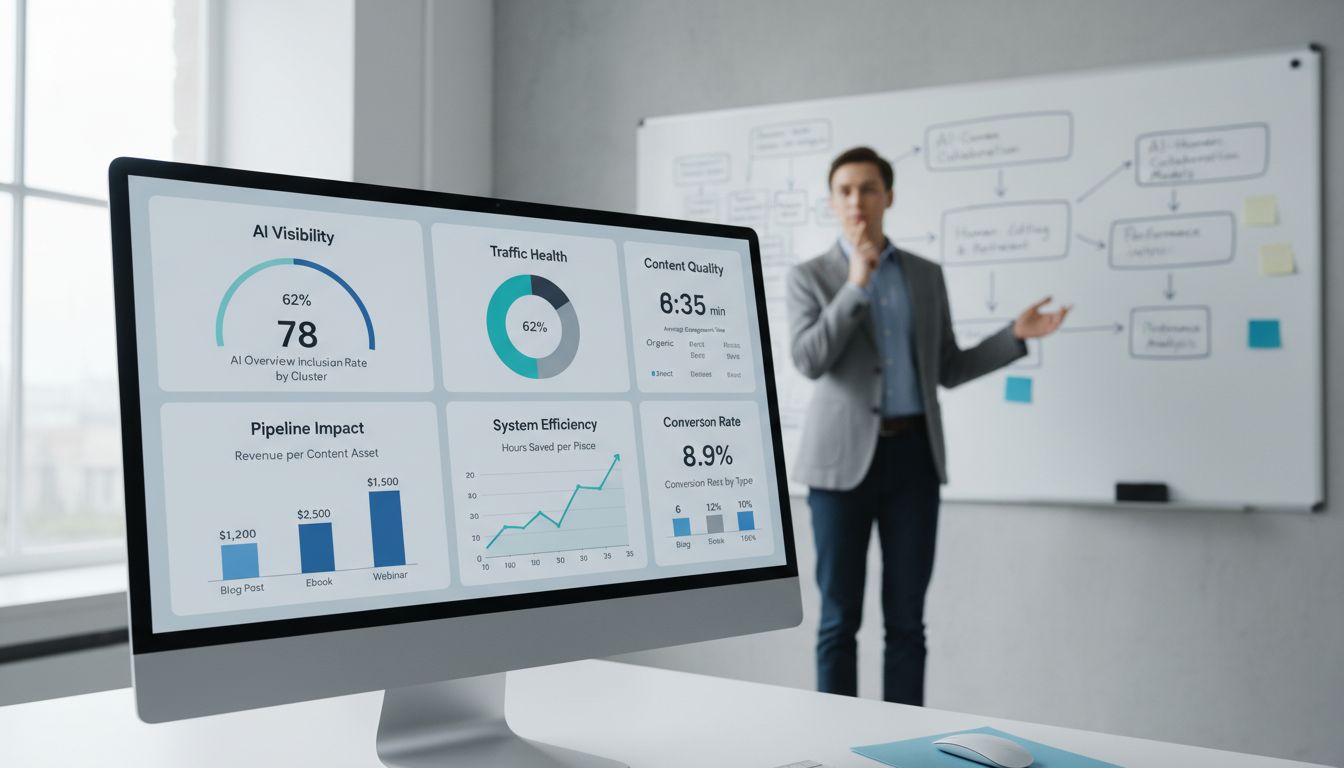
The point of this dashboard isn't to generate reports. It gives the seo content strategist a clear signal on which layer of the system needs attention, and the language to communicate that to a CFO without translating from SEO jargon first.
Navigating the minefield: common pitfalls & your mitigation checklist
Most AI-augmented content programmes don't fail because the strategy is wrong. They fail because the operational details are ignored until something breaks. Here's what will blow up your programme, and exactly how to stop it.
Pitfall 1: Publishing AI content without human review
The 93% of marketers who review AI output before publishing aren't being precious, they're catching factual errors, brand misalignment, and the kind of confident-sounding nonsense that tanks E-E-A-T signals.
Fix: Make an editorial QA gauntlet a non-negotiable workflow stage. No brief, no publish. No human sign-off, no publish. Full stop.
Pitfall 2: Tracking rankings while ignoring zero-click reality
If your dashboard still shows only organic sessions and keyword positions, you're flying blind. AI Overviews and AI Mode have fundamentally shifted what "visibility" means.
Fix: Add AI Overview inclusion rate, zero-click rate, and branded search volume to your weekly reporting. Set up Google Search Console filters segmented by query type today.
Pitfall 3: No AI governance policy
Only 43% of organisations have established business-wide AI governance councils, meaning the majority are one viral screenshot away from a brand or legal incident.
Fix: Create a one-page content governance policy covering fact-checking requirements, prohibited claim types, disclosure rules, and tone compliance. It doesn't need to be complex. It needs to exist.
Pitfall 4: Assuming AI content converts like human content
It might. It might not. Assuming parity without data is how you quietly erode pipeline quality.
Fix: Track revenue per asset. A/B test AI-assisted versus human-written content on your highest-traffic commercial pages before rolling out at scale.
Pitfall 5: One prompt template for everything
Using the same prompt for a top-of-funnel awareness guide and a bottom-of-funnel comparison page is like using the same brief for a billboard and a sales deck.
Fix: Build content-type-specific prompt templates, structured around the brief format from Step 2, that encode audience intent, tone, and conversion goal before a single word is generated.
The role has changed. The opportunity hasn't.
Everything covered here points to the same conclusion: the SEO content strategist in 2026 isn't a writer with keyword skills. They're a systems architect, someone who decides how human expertise and AI automation combine to produce content that drives measurable revenue, not just rankings.
The four-step playbook isn't theoretical. Audit your content against real business outcomes. Design hybrid workflows where AI handles the repeatable and humans own the irreplaceable. Build a tech stack around data pipelines, not dashboard subscriptions. Measure what actually moves the business, pipeline, revenue, AI Overview inclusion, not sessions and impressions.
Here's the contrarian truth most SEO content pieces won't say: AI hasn't made this job easier. It's made the bar higher. Anyone can now produce average content at volume. The strategist's edge is in producing the right content, structured for both human readers and AI retrieval systems, backed by a governance model that keeps quality consistent at scale.
The ROI is real. But it doesn't materialise from tools alone, it comes from the system around them.
Start this Monday with Step 1. Pull one existing piece of content and audit it against a specific business goal. Then design one repeatable workflow loop for your next piece. The seo content strategist's job isn't to do all the work. It's to build the machine that makes consistent, measurable results inevitable.
Start building yours.
Frequently Asked Questions
What is an SEO strategist? How is it different from an SEO content strategist?
An SEO strategist typically owns the technical side: crawl budget, indexation, site architecture, backlink acquisition, Core Web Vitals. An SEO content strategist works in a different lane entirely. They decide which topics to target, build content that matches search intent, and increasingly, design the human-AI workflows that produce and optimise that content at scale.
The two roles are complementary, not interchangeable. At a small company, one person wears both hats. At scale, they're genuinely separate disciplines that need to talk to each other constantly.
Will AI replace SEO jobs?
No, but it will replace the tasks that currently fill most SEO job descriptions. Basic keyword clustering, first-draft meta descriptions, initial content briefs: already being automated.
What that does is raise the floor. The SEO professionals who thrive are the ones moving up the value chain, designing the systems, reading data in the context of real business goals, making strategic calls no language model can make. If your value is in executing repeatable tasks, that's the part at risk. If your value is in judgement and system design, demand for your skills is going up.
What is a typical SEO content strategist salary?
It varies considerably by market and, more importantly, by whether you can show measurable ROI. In the US, senior seo content strategist roles are advertising in the $95,000–$140,000+ range, with hybrid roles blending AI workflow design and GEO (Generative Engine Optimisation) skewing higher [Source: interlinked.marketing]. In the UK, experienced practitioners typically land in the £55,000–£85,000 band, with London-based or high-impact roles pushing beyond that [Source: seojobs.com].
The biggest salary lever at this level isn't years of experience. It's the ability to tie your work directly to pipeline and revenue.
Is SEO a high-paying skill in 2026?
Yes, but only if you've moved beyond the tactical. What the market actually pays for right now is the ability to design a content system that measurably increases qualified leads, reduces cost per acquisition, and scales efficiently through automation. Not the ability to optimise a title tag.
Roles that blend traditional SEO with AI search visibility, AEO, GEO, structured data strategy, are already advertising at significantly higher rates than standard SEO positions [Source: interlinked.marketing]. The ceiling is high. The question is whether you're building toward it or staying comfortable with what you already know.