March 16th, 2026
How to Build a Fully Automated SEO Workflow with Content Creation Software (2026 Guide)
 WD
WDWarren Day
You're staring at your content calendar, and the gaps are glaring. Three articles behind schedule. A product launch needs support content. Your competitor just published their fifth piece this week.
Meanwhile, you're toggling between ChatGPT for drafts, a separate tool for keyword research, manual copy-paste into your CMS, and crossing your fingers that Google notices.
Here's what's changed: you're not just competing with other marketers for rankings anymore. You're up against AI answer engines that satisfy user intent without sending anyone to your site. At least 60% of searches now end in zero clicks because AI-generated summaries answer the question right there on the results page (Source: rebootonline.com). The old manual SEO content grind - research, write, optimize, publish, repeat - doesn't scale when you're a lean team of one to three people trying to actually move the needle.
Throwing money at the latest content creation software won't fix this, though. You've probably been down that road: signed up for an AI writer, generated some drafts, then hit the wall of "now what?" The real bottleneck isn't writing speed. It's the dozens of disconnected manual steps between keyword discovery and a live, ranking article.
What you actually need is orchestration, not just generation.
That means building an integrated SEO workflow - a system that runs while you sleep, connecting specialized tools into a single automated pipeline with built-in quality gates. This guide shows you how: a 6-stage blueprint for automating content from ideation through distribution, a realistic software stack matched to your budget, the non-negotiable human checkpoints that protect quality, and a 48-hour implementation plan to get your first automated workflow live this week.
Why 'Set and Forget' SEO Automation is a Myth in 2026
SEO workflow automation in 2026 means orchestrating specialized content creation software across your entire content lifecycle. Keyword discovery, drafting, optimization, publication, performance tracking. But if you're expecting to flip a switch and walk away, you're setting yourself up for a costly mess.
The search landscape shifted hard in 2025. AI-driven search traffic exploded by more than 500% year-over-year, and at least 60% of searches now end without a click because AI-generated summaries answer the query directly. This isn't a future trend. It's happening right now.
Welcome to Generative Engine Optimization (GEO). You're no longer just optimizing for Google's algorithm. You need to structure content so AI platforms like ChatGPT, Perplexity, Claude, and Gemini can cite you accurately in their responses. That means advanced schema markup, structured data, and content formatted for knowledge graph extraction. Keyword density and backlinks alone don't cut it anymore.
Here's the uncomfortable truth: automation's real value isn't eliminating humans from your workflow. It's handling the repetitive grunt work so your team can focus on strategy, brand voice, and editorial judgment. Crawling for broken links, tracking rank fluctuations, generating first drafts - that's what gets automated. The research is clear: enterprises adopting automated SEO cut labor costs by 35%, but the ones succeeding are doubling down on human quality gates, not removing them.
Every automated workflow needs a "human-in-the-loop" checkpoint. AI hallucinates facts. It drifts off-brand. It can't assess whether a piece actually serves your audience's intent or just checks SEO boxes.
The winners in 2026 aren't choosing between automation and human oversight. They're architecting systems where both are mandatory, integrated, and non-negotiable. Pure automation without governance is a liability, not a shortcut.
The 6-Stage Automated SEO Content Pipeline: Your 2026 Blueprint
Your SEO pipeline isn't magic. It's a manufacturing line where raw data becomes rankable content through specific stages, tools, and checkpoints.
Here's the architecture that enterprises use to cut labor costs by 35% while improving output quality:
Start → Ideation & Planning → AI-Assisted Creation → Human QA Gate → Automated Publishing → Programmatic Enhancement → Monitoring & Learning → Loop back to Ideation
You don't need all six stages at once. Most teams start with Stage 1 and Stage 5 - automating their editorial calendar and on-page optimization - then layer in the rest over 60-90 days.
The key difference between this blueprint and a simple tool stack? Each stage feeds data forward. Your monitoring insights shape next month's ideation. Your QA rejections train better creation prompts. The system learns.
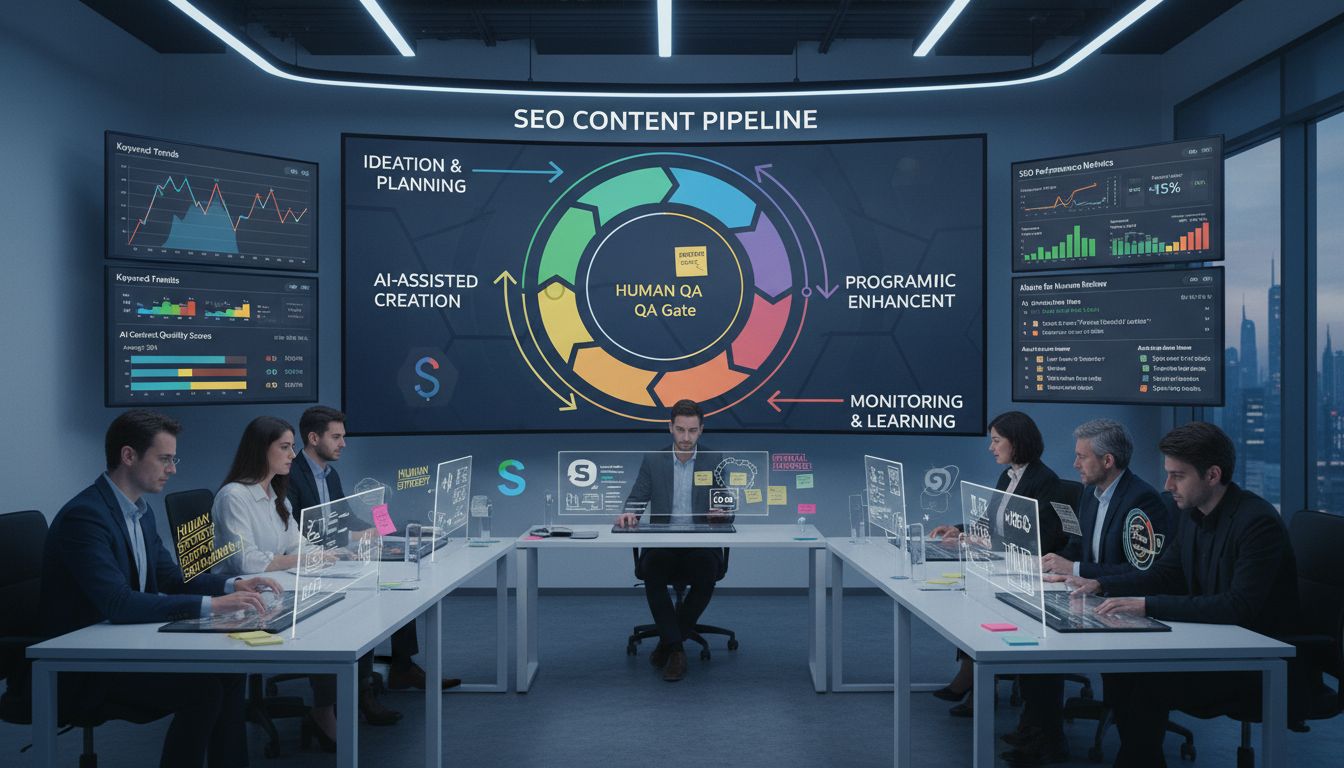
The following sections break down each stage with specific tools, integration points, and the exact human decisions you can't automate away.
Stage 1: Ideation & Planning – From Data to Editorial Calendar
Your content pipeline starts with a simple question: what should we write about?
The wrong answer is "whatever feels right." The right answer is automated keyword discovery that feeds directly into your calendar.
Topic clustering turns chaos into structure. Tools like MarketMuse and Semrush's Topic Research analyze your domain authority and competitor gaps to generate semantically related keyword groups. Instead of chasing individual keywords, you're building topical authority across entire content clusters. MarketMuse can save more than 15 hours per content plan by automating topic-cluster generation - time you'd otherwise spend in spreadsheets mapping parent topics to subtopics.
The automation magic happens when research flows into execution without manual handoffs. Use n8n or Zapier to push approved keyword clusters directly into your project management system. When MarketMuse identifies a content gap, a workflow creates a new Asana task with the target keyword, search volume, difficulty score, and a draft content brief. Your writers see actionable assignments, not raw data dumps.
Set up competitive intelligence on autopilot. Configure rank-tracking alerts in Semrush or Ahrefs to notify you when competitors publish new content or when your rankings shift. These signals inform both new content creation and update priorities for existing pages.
The output of Stage 1 isn't a list of keywords. It's a populated editorial calendar with prioritized, research-backed topics that your team can execute immediately. No more Monday morning meetings debating what to write.
Stage 2: AI-Assisted Creation & Optimization
Once your editorial calendar is locked, content creation software takes over the heavy lifting. These platforms - Surfer AI, Jasper, OpenAI's GPT-4o API, and similar tools - generate SEO-optimized drafts by analyzing top-ranking pages and encoding that intelligence into your content structure.
But here's what changed in 2026: you're no longer optimizing just for Google's crawler. Your drafts must satisfy two masters - traditional keyword algorithms and the AI answer engines that now handle 60% of searches without a click. That means comprehensive coverage, clean structural hierarchy, and content formatted to feed knowledge graphs.
How Surfer AI works in practice: You input your target keyword (say, "content creation software"). Surfer crawls the top 20 SERPs, extracts semantic patterns, identifies required subtopics, and generates a full draft with an optimization score - typically 70-85 out of 100 before human editing. The tool flags missing entities, suggests header improvements, and even recommends word count ranges based on what's currently ranking.
You're not writing from scratch anymore. You're steering an AI co-author that already knows what Google rewards.
For teams with technical resources, using the OpenAI GPT-4o API directly offers more control. At $2.50 per million input tokens and $10 per million output tokens, you can generate a 2,000-word article for roughly $0.15-0.25 and integrate that generation into your CMS, project management tool, or custom workflow. This approach trades ease-of-use for customization - you define the prompts, output format, and quality thresholds.
The critical discipline here: standardize your output format. Whether it's Google Docs with a template, Markdown files, or structured JSON, consistency enables the next stage. Your human reviewers shouldn't waste time reformatting. They should focus on accuracy, voice, and strategic alignment.
Stage 2 delivers draft content at scale. But drafts aren't publishable, and that's by design.
Stage 3: The Non-Negotiable Human QA & Governance Gate
This is where automation earns its credibility.
Your AI can draft 20 articles in an afternoon, but publishing them without review is how you end up with factual errors, off-brand messaging, and a Google penalty you didn't see coming. 93% of organizations review AI content before publication, and the 7% who don't are learning expensive lessons. Human QA isn't a bottleneck. It's the insurance policy that protects your domain authority and brand reputation.
Your Six-Point QA Checklist
Every piece of AI-generated content must pass through these gates before it touches your CMS:
-
Fact-Checking & Hallucination Audit - Verify every claim, statistic, and data point. AI models confidently invent numbers. Your job is to catch them before Google does.
-
Brand Voice & Tone Alignment - Score the draft against your style guide. Does it sound like your company, or like every other AI-generated blog on the internet?
-
Plagiarism & Originality Check - Run drafts through Copyscape or Grammarly Premium. Duplicate content kills rankings, and AI models occasionally regurgitate training data verbatim.
-
Readability & User Intent Flow - Does the article actually answer the search query? AI loves structure but often misses the why behind the question.
-
GEO & Schema Readiness - Confirm the content supports structured data markup (HowTo, FAQ, Organization schema). If AI answer engines can't parse it, you're invisible in 2026 SERPs.
-
Link & Authority Validation - Check that internal links map to relevant pages and external sources are authoritative. Bad links erode trust faster than good content builds it.
The Real Cost of Quality Control
Budget 15-30 minutes of human review time per article. For a lean team publishing 20 articles monthly, that's 5-10 hours of QA labor - roughly $250-$500 at freelance editing rates. This cost is non-negotiable. Skipping it to "save time" is how automation fails.
Governance & Traceability
Tag every AI-assisted article in your CMS with metadata like "AI-draft" or "human-reviewed." This creates an audit trail for compliance (GDPR, upcoming AI disclosure regulations) and lets you track performance by content origin. If AI drafts consistently underperform human-written pieces in engagement, your system needs recalibration, not more volume.
Quality gates slow you down just enough to keep you accurate. That's the entire point.
Stage 4: Automated Publishing & CMS Orchestration
Your approved content is sitting in a Google Doc. Now someone has to copy-paste it into WordPress, format the headings, upload the featured image, fill in meta descriptions, add tags, and set a publish date.
This is the last-mile problem - and it's killing your velocity.
The fix is integration middleware. Tools like Zapier, n8n, or direct CMS APIs act as the connective tissue between your approval system and your publishing platform. Once a document moves to "Approved" status in your project tracker, the automation takes over.
Here's a real workflow: when a Google Doc is tagged "Approved" in your shared Drive folder, a Zap or n8n workflow triggers. It extracts the title, body text, and metadata, creates a draft post in WordPress or Webflow, uploads the featured image from a designated folder, populates SEO fields, and sends a Slack notification to your editor with a direct link to review the staged post. Zero copy-paste. Zero formatting drift.
n8n is particularly powerful here because it's open-source and offers conditional logic - if the post is tagged "Pillar Content," route it differently than a quick update. You can also trigger updates to a central content inventory in Airtable or Notion, so your dashboard always reflects what's live without manual logging.
Automated publishing doesn't mean auto-posting to production. It means eliminating the tedious steps between "approved" and "ready to schedule." You still control the final go-live, but the grunt work is gone.
Stage 5: Programmatic On-Page Enhancement
Your article is live. Most teams stop here.
That's the mistake.

The best-performing content isn't static - it's continuously enhanced by automation that runs in the background. Programmatic on-page enhancements keep your published work competitive without adding manual tasks to your calendar.
Automated internal linking is the first layer. Tools like Link Whisper scan your content library and suggest contextually relevant internal links based on semantic analysis, not just keyword matching. This strengthens your site architecture and distributes link equity automatically. You can review suggestions in bulk or set rules to auto-insert links based on topical relevance. The result: a tighter content ecosystem that search engines can crawl and understand more easily.
Structured data generation is equally critical for 2026. Schema markup can increase click-through rates by 20-30%, and it's needed for feeding AI answer engines. Use WordPress plugins like Schema Pro or custom scripts that automatically apply the right schema - Article, HowTo, FAQPage, Organization - based on post category, tags, or content structure. This isn't a one-time setup; every new post gets the appropriate markup without manual intervention.
Content refresh triggers close the loop. Set up automated alerts in your rank-tracking tool to flag articles that drop five positions or haven't been updated in 18 months. These triggers kick off a refresh workflow: reassign the URL to a writer, pull updated keyword data, and schedule a revision. Automation doesn't write the update, but it makes sure nothing falls through the cracks.
Stage 6: Distribution, Monitoring & Iterative Learning
Publishing isn't the finish line. It's the starting gate.
Your content needs to reach people, and then you need to know what's working so you can do more of it.
Automated distribution turns your CMS publish event into a trigger. When a new article goes live, free social media management tools like Buffer's free plan or Metricool can automatically share it across your channels. Connect these tools to your CMS via Zapier or webhooks: publish in WordPress, and Buffer queues a LinkedIn post with your headline and featured image. No manual copy-paste, no forgotten promotions.
But here's where 2026 demands a different playbook. Traditional rank tracking still matters, but you need to monitor AI visibility too. Tools like Sight AI track whether ChatGPT, Perplexity, or Claude cite your content when users ask questions in your domain. Google Search Console impressions become your new north star metric - because automated SEO workflows can improve organic impressions by 23% within 90 days, even when clicks plateau due to AI Overviews.
Automated alerts keep you ahead of disasters. Set up a dashboard in Google Looker Studio (fed by Coupler.io) that pulls GSC data, rank positions, and AI visibility scores into one view. Configure Slack alerts for any article that drops five positions overnight or triggers a Core Web Vitals warning.
The real power? Closing the loop. Feed performance data back into Stage 1. Articles with high impressions but low clicks signal topics where AI Overviews dominate - pivot to more specific angles. High-engagement pieces reveal content formats to replicate. Your pipeline becomes self-improving, not static.
The 2026 Content Creation Software Stack: Matching Tools to Your Workflow
Here's the truth nobody wants to tell you: there is no "best" content creation software. There's only what works for your workflow stage, team size, and tolerance for integration headaches.
The philosophical divide is simple. Best-of-breed tools give you control - you pick the strongest specialist for each stage and wire them together. All-in-one platforms trade some power for convenience, handling multiple stages in a single interface. Neither approach is wrong. Your budget and technical capacity determine which is right.
Tool Comparison by Pipeline Stage
| Function | Best-of-Breed Specialist | All-in-One Platform | Best for Beginners |
|---|---|---|---|
| Ideation & Planning | MarketMuse, Ahrefs | SnowSEO, Conductor | Semrush |
| AI Creation & Optimization | Surfer AI, ChatGPT API | SnowSEO, Jasper | Surfer AI |
| Technical Audits | Screaming Frog, Deepcrawl | Siteimprove, Conductor | Semrush Site Audit |
| Rank Tracking | AccuRanker, Ahrefs | SnowSEO, Semrush | Semrush Position Tracking |
| Workflow Orchestration | n8n, Zapier | SnowSEO (native flows) | Zapier |
| Quality Control | Grammarly Premium, Copyscape | Built-in governance (Conductor) | Grammarly (free tier) |
| GEO & Schema | Custom scripts, Schema App | Conductor (structured data) | Manual JSON-LD |
Which software is best for content creation? If you're talking about the drafting stage specifically, Surfer AI leads the pack for balancing speed, SEO intelligence, and output quality. But creation is one piece of a seven-stage system.
The Lean Founder's Starter Stack (48-Hour Setup)
You don't need 12 tools on day one. This stack gets you operational fast:
Semrush ($129/month) handles keyword research, rank tracking, and basic site audits in one login. It's not the deepest tool in any category, but it covers enough ground to validate your pipeline before you specialize.
Surfer AI ($99/month Essential) generates optimized drafts based on real SERP analysis. Five articles per month is enough to test your workflow and prove ROI before scaling.
n8n (self-hosted, free) connects Surfer to your CMS and triggers notifications. Yes, it requires setup time. That friction forces you to document your process, which pays off when you hire.
Grammarly (free tier) catches the obvious errors your brain skips. Upgrade to Premium ($12/month) only after you're publishing weekly.
Total first-month cost: $228. No contracts. Cancel anything that doesn't earn its seat.
Enterprise-Grade Integrated Platforms
Once you're publishing 20+ pieces monthly, integration tax becomes real.
SnowSEO and Conductor consolidate ideation, creation, optimization, publishing, and tracking into governed workflows with audit trails. You sacrifice some best-of-breed power, but you gain standardized quality gates and unified reporting that scales across teams. Siteimprove adds real-time monitoring and compliance scanning for regulated industries.
These platforms make sense when coordination cost exceeds tool cost - usually around 5+ content contributors.
Budgeting Your Automated Workflow: A Realistic Cost Analysis
Let's talk numbers. Most guides skip this part because pricing gets messy fast. But you're making a budget case to yourself or a CFO, so here's what an automated SEO workflow actually costs.
DIY/Lean Stack (Under $200/month)
Publishing 4-8 articles monthly? You can start lean. OpenAI GPT-4o API runs about $10-30/month for drafting at $2.50 per million input tokens. Add Surfer SEO Essential ($79/month for 5 AI articles) and n8n self-hosted ($0-20). Tool cost lands around $120-150/month.
But here's the line item everyone forgets: human review time.
Budget half an hour per article at $50/hour. That's $25/article. Four articles means you're adding $100 in labor. Your real monthly spend? $220-250.
Mid-Market Stack ($500-800/month)
Scaling to 15-20 articles changes the math. You'll need Semrush Pro ($120), Surfer Scale ($175/month for 20 AI articles), and orchestration via Zapier or Make ($50-100). Tool cost hits $345-395. Human QA for 15 articles at $25 each adds another $375. Total comes to $720-770/month.
Enterprise Stack ($1,500-3,000+/month)
Platforms like SnowSEO or Conductor bundle ideation, optimization, and publishing into one license starting around $1,500/month. Add API costs for high-volume generation and dedicated QA workflows. At this tier, you're replacing half to one full-time employee.
The ROI math is actually straightforward. A mid-level content creator costs $4,000-6,000/month. Your $700 stack producing 15 optimized articles monthly pays for itself if it offsets even 15% of a hire. Enterprises adopting SEO automation typically cut labor costs by 35%, which means the tools fund themselves within a quarter if you're running any kind of volume operation.
Measuring Success: KPIs for an AI-First Search Landscape
Your rank tracker says you dropped from #3 to #7. Organic traffic is flat. Panic sets in, until you check the actual data.
Here's what changed: Google now shows an AI Overview for your target keyword, and at least 60% of searches result in no clicks because the answer appears right there. Your #7 ranking isn't the problem. Your measurement framework is.
Traditional SEO KPIs like rankings, sessions, and bounce rate were built for a world where every search ended in a click. That world is gone. You need metrics that reflect how AI answer engines, featured snippets, and knowledge panels reshape user behavior.
The 2026 KPI Stack You Should Track:
-
AI Overview & Knowledge Panel Visibility – Use Sight AI to monitor whether ChatGPT, Perplexity, Claude, and Gemini cite your content when users ask questions in your domain. If AI engines reference you, you're winning even without the click.
-
Featured Snippet Capture Rate – Track what percentage of your target keywords trigger a snippet you own. This is your real estate in the zero-click economy.
-
Impressions & Impression Share – Google Search Console shows how often you appear, even when users don't click. Rising impressions signal relevance, even if traffic stalls.
-
Click-Through Rate on Pages with Schema – Schema markup can increase CTRs significantly. Measure the lift on pages with HowTo, FAQ, or Product schema versus those without.
-
Non-Branded Conversion Rate – Traffic from branded terms inflates vanity metrics. Non-branded conversions prove you're capturing real intent.
Automate KPI reporting using dashboards like DashThis or Looker Studio. Pull data from Google Search Console, GA4, and rank trackers into a single view that updates daily.
The goal isn't more data. It's actionable insight.
If HowTo schema drives higher CTR, double down on it in Stage 5. If AI platforms cite your competitor more often, audit their content structure and adapt. Stop measuring the old game and start tracking the one you're actually playing.
Common Automation Pitfalls and Your Mitigation Plan
Every automation system eventually breaks. The question is whether you catch it in time.
Over-Reliance on AI Leading to Brand Drift & Hallucinations
Your AI starts inventing statistics. Your brand voice shifts from confident to generic. A competitor's talking points bleed into your content.
Mitigation: The Stage 3 QC gate isn't optional. Run every piece through your fact-checking protocol: verify all claims with primary sources, score brand voice alignment, flag any statement that sounds too good to be true. Don't publish anything until a human has reviewed it. Full stop.
Integration Friction & Data Silos
Your keyword tool doesn't talk to your content brief template. Your CMS won't accept automated schema injection. Data lives in five different spreadsheets.
Mitigation: Start with one core integration - brief creation to first draft. Use n8n or Zapier to connect your existing tools before buying new ones. Choose content creation software with documented APIs and active developer communities. Test the full loop with three articles before scaling.
'Set and Forget' Neglect
Your automation runs perfectly for six weeks. Then Google updates its algorithm. Your AI model starts hallucinating more frequently. Nobody notices for a month.
Mitigation: Schedule monthly workflow audits. Review a random sample of outputs. Check that your schema is still validating. Monitor API error logs. Automation reduces manual work - it doesn't eliminate oversight.
Misinterpreting AI Data
Your tool recommends targeting 47 keywords in one article. Your competitor analysis suggests copying their exact structure. Your content score says 89/100, so it must be good.
Wrong on all three counts.
Mitigation: AI provides signals, not decisions. Use recommendations as starting points for human judgment. Question any suggestion that feels off-brand or tactically questionable. If something sounds ridiculous, it probably is.
Ignoring GEO & Schema
You automate everything except the structured data that AI engines actually read.
Mitigation: Add schema validation to your QA checklist. Build HowTo, FAQPage, and Organization markup into your publishing templates. Make it impossible to publish without it.
Your 48-Hour Implementation Plan: Start Smart, Scale Fast
You've read the blueprint. Now actually do something with it.
Hour 1–4 (Day 1 Morning): Audit Your Current Bottleneck
Open a spreadsheet. Map every step in your content process from keyword research to publication. Time each stage honestly. Where do drafts sit for days? Where do you manually copy-paste metadata? That's your target.
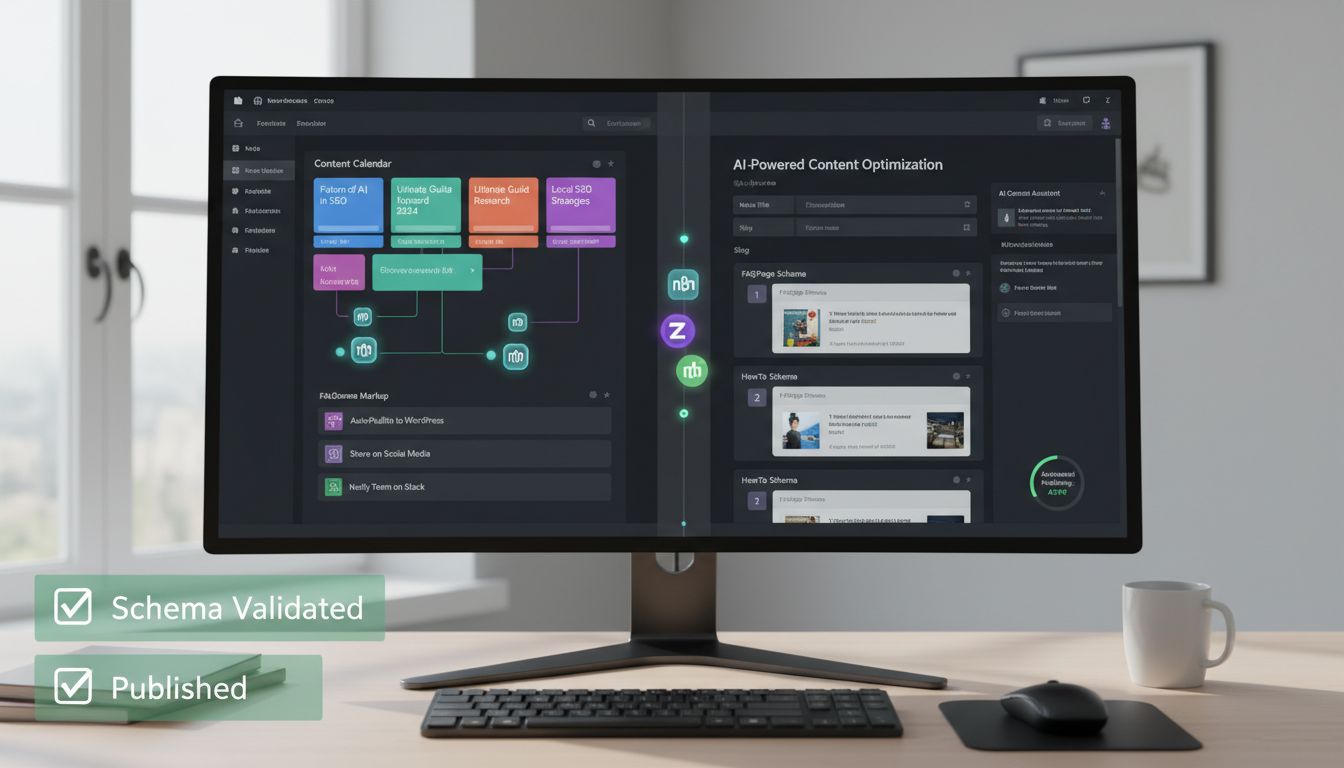
Pick one stage to automate first. Not three. One. Most teams should start with publishing or technical enhancement. They're high-impact, low-risk, and you'll see results immediately.
Hour 5–8 (Day 1 Afternoon): Choose Your Starter Stack
If you picked publishing automation, grab n8n (free tier) or Zapier and connect your CMS. If you chose technical enhancement, set up a schema generator template.
Don't buy five tools. Start with the minimum viable automation. You can expand later when you actually know what you need.
Hour 9–16 (Day 2): Build and Test
Configure your integration. Run two existing articles through your new workflow. Document every click in a shared doc - this becomes your team playbook. Fix what breaks.
Week 1: Measure One Thing
Push one new piece through your automated pipeline. Track time saved. If you shaved four hours off publishing, that's your proof of concept.
Now add the next stage.
Perfection kills momentum. Automated workflows improve organic impressions within 90 days, but only if you actually start. Your competitor probably already has.
Conclusion: Building Your SEO Autopilot
You don't need a bigger team. You need a better system.
The content creation software you choose matters less than how you connect it. That 6-stage pipeline we walked through turns scattered tools into something that actually works together. Content gets produced consistently, ranks reliably, and scales without burning out your team.
Here's what separates winners from wishful thinkers in 2026: winners automate the predictable stuff (keyword tracking, draft generation, schema injection, publishing) and save human brainpower for what actually needs it. Strategic positioning. Brand voice. Fact verification. The editorial instinct that separates decent content from stuff people actually want to read.
Start small. Pick one repetitive task this week. Maybe it's automating your content brief creation or connecting your CMS to a scheduling tool. Use that 48-hour checklist from earlier. Each automation compounds.
The future of SEO belongs to teams that blend machine efficiency with human creativity. Build your autopilot. Then use the time you've reclaimed to think bigger.
Conclusion: Building Your SEO Autopilot
You don't need a bigger team. You need a better system.
The content creation software you choose matters less than how you connect it. Your SEO workflow isn't a single platform. It's a pipeline where specialized tools hand off work cleanly, and humans step in only when their judgment actually matters.
That six-stage blueprint? Teams are using it right now to publish 10x more content without the quality dropping off, track visibility in AI answer engines, and get back dozens of hours every week. It works.
But here's what most guides won't tell you: you'll never finish building this. Search evolves. Tools change. Your workflow needs to flex with it.
Your next step? Don't boil the ocean. Block 90 minutes on your calendar and map out your current content process. Every painful handoff, every bottleneck, every place someone's waiting on someone else. Then pick just one stage (publishing automation or QA checks work great as starting points) and implement it this week. The time savings start compounding immediately.
The future of SEO belongs to teams that blend machine efficiency with human creativity. Build your autopilot. Then use those reclaimed hours to think bigger.
Frequently Asked Questions
Which software is best for content creation?
There's no single "best." It depends on where your workflow is actually breaking down.
For AI-assisted drafting with real-time SEO optimization, Surfer AI delivers strong results for mid-market teams [Source: siteimprove.com]. If you're just starting out, pair Semrush for keyword research with Surfer AI for content generation. Enterprises dealing with complex governance needs should look at integrated platforms like SnowSEO or Conductor.
How much does a content creator cost per month?
A lean automated stack using API access and focused tools can run under $200/month. A robust mid-market setup typically hits $300-$800 [Source: siteimprove.com].
Those numbers exclude human quality assurance, which isn't optional. Budget 15-30 minutes of expert review per article to catch AI hallucinations and keep brand alignment tight. Compare that to a full-time content creator's salary ($4,000-$8,000+ monthly) and the scalability advantage becomes obvious. Your costs don't double when your output does.
What is the best platform for beginner content creators?
Start with the "Lean Founder's Starter Stack": Semrush for keyword and topic research, Surfer AI for AI-driven writing and optimization (starting at $79/month annual), n8n for workflow automation, and Grammarly's free tier for basic grammar checks [Source: arvow.com].
This combination balances power, usability, and cost. You can automate a complete pipeline from keyword discovery to CMS publishing within 48 hours. More time on strategy, less on repetitive execution.
What is an example of a content creation software?
Surfer AI is dedicated content creation software that analyzes top-ranking pages for your target keyword, generates an SEO-optimized outline and full draft, then provides a real-time "Content Score" to guide improvements [Source: siteimprove.com]. It handles both traditional SEO factors like keyword density and header structure, plus emerging GEO requirements (structured data, AI-friendly formatting).
The platform generates complete articles in minutes. Human review still matters for fact-checking and brand voice alignment.
Is automated SEO content penalized by Google?
No. Google doesn't penalize content just because AI tools helped create it.
Their official policy focuses on quality and helpfulness, not authorship method [Source: searchengineland.com]. Content that serves user intent, demonstrates expertise, and provides genuine value will rank regardless of whether a human or AI drafted it. The risk comes from publishing low-quality, keyword-stuffed AI content without editorial oversight. That's why the QA gate in Stage 3 of your pipeline isn't negotiable.
Can I fully automate my SEO content workflow?
You can automate 70-85% of repetitive tasks. A 100% hands-off workflow is both a myth and a liability in 2026.
Strategic human oversight remains non-negotiable for quality control, fact-checking AI hallucinations (which happen constantly), maintaining brand voice, and adapting strategy based on performance data [Source: searchengineland.com]. The goal is "human-in-the-loop" automation. Machines handle efficiency through keyword research, draft generation, and technical optimization. Humans ensure excellence through editorial judgment and strategic decision-making.