March 10th, 2026
Content Creation Software for AI SEO: How to Automate Your 2026 Workflow
 WD
WDWarren Day
You've tested an AI writing tool, seen the potential, but now you're staring at a dashboard full of disconnected apps. Your content output has increased, but quality, consistency, and qualified leads haven't. In 2026, using content creation software is table stakes. The real competitive edge? Building a system that actually works together.
Here's what changed: AI-generated content now makes up 17.31% of Google Search results, up from just 2.27% in 2019. Your competitors aren't experimenting anymore. They're scaling.
But most founders fall into the same trap. They treat automation like a volume play, stack tools, chase output metrics, and then wonder why organic traffic flatlines and conversion rates tank.
The bottleneck isn't volume. It's quality at scale.
Winning in 2026 means moving beyond tool collection. You need an integrated, human-supervised workflow that handles the entire content lifecycle, from AI-powered ideation to automated publishing and performance analysis. And it needs rigorous quality, compliance, and strategic SEO checkpoints baked in. This isn't about finding the "best" AI writer or SEO optimizer. It's about building a system that turns AI's raw potential into something reliable, something that actually works in the age of AI search, zero-click SERPs, and content that hallucinates facts.
This guide gives you the framework to build that system. You'll get a four-pillar architecture for an AI-powered content engine, a step-by-step workflow you can implement this week, a quality and compliance checklist for 2026, and the KPIs that actually matter for measuring ROI. No fluff, no vendor pitches. Just the practitioner playbook for scaling content that drives revenue, not just traffic.
The 2026 Content Imperative: Why Your Workflow Can't Rely on Guesswork
AI-generated content went from 2.27% of Google Search results in 2019 to 17.31% in 2025. That's a sevenfold jump in six years. Your competitors are already publishing faster, and the SERPs are filling up whether you like it or not.
Most of that content? Completely forgettable.
Same tools, same prompts, same generic output. When everyone's got access to ChatGPT and Jasper, the AI itself isn't the competitive edge anymore. It's the system you build around it. That's what separates content that ranks from content that disappears.
You've probably felt this pressure. You need 10 blog posts a month to hit traffic goals, but your team can barely ship three. So you add another tool: an AI writer here, an SEO optimizer there, maybe a plagiarism checker just to be safe. Six months later you're juggling five subscriptions, manually copying content between platforms, and still second-guessing whether it's actually safe to hit publish. That's not a workflow. That's guesswork dressed up with expensive software.
The real risk isn't falling behind on AI adoption. It's adopting it badly. Publishing unverified AI content tanks your domain authority. Disconnected tools waste hours in context-switching. And when a single hallucinated statistic slips through? You just handed your competitors a credibility win.
The founders and marketers winning in 2026 aren't using more AI. They're using it better. Integrated systems that enforce quality gates, automate the tedious parts, and keep humans in control of the decisions that actually matter. HubSpot users who implemented AI features systematically saw 167% traffic growth after six months, not because the AI was magic, but because they built repeatable processes around it.
You don't need to guess. You need a system.
The 4-Pillar Framework for an AI-Powered Content Engine
Most founders approach content creation software like they're shopping for groceries. Grab Jasper for writing, Surfer for SEO, WordPress for publishing, and three different tools for social media. Each one works fine alone, but together? A mess of manual handoffs and duplicate data entry.
The alternative isn't finding one "perfect" tool. It's understanding the four distinct jobs your content system needs to perform, then selecting software that actually integrates across those functions.
Think of this framework as your blueprint. Every piece of content creation software you evaluate should fit clearly into one of these pillars. If it doesn't, or if it tries to do everything poorly, skip it.
The Four Pillars Explained
Pillar 1: Strategic Ideation & Planning is where you decide what to create. This isn't brainstorming in a vacuum. You're using data to identify topics your audience actually searches for, gaps your competitors missed, and clusters that build topical authority. Tools like AirOps automate topic generation using your brand knowledge and live search data. Scalenut's topic-cluster planning helps you map entire content campaigns before writing a single word.
Pillar 2: AI-Assisted Drafting & Creation handles the heavy lifting of turning outlines into first drafts. Content at Scale excels at high-volume production when you need dozens of articles fast. Copy.ai brings workflow automation and team collaboration for agencies managing multiple clients. Chatsonic stands out by pulling real-time web data and citing sources automatically, which matters when you're covering news or statistics that change weekly. Jasper's SEO mode weaves keywords into drafts during generation, though you'll still need human fact-checking.
Pillar 3: SEO optimization & Enhancement transforms decent drafts into search-competitive assets. Surfer SEO scores your content in real-time against top-ranking pages and suggests specific terms to add. Frase builds comprehensive briefs by analyzing SERPs. NeuronWriter layers in semantic analysis to ensure topical depth. This is where you enforce quality before anything goes live.
Pillar 4: automated publishing & Distribution gets finished content in front of readers without manual uploads. HubSpot's Content Hub API lets you programmatically publish and track performance. WordPress powers 64.2% of CMS websites and integrates with tools like Ranklytics for auto-publishing with proper meta tags. For social distribution, even free social media management tools can schedule posts across platforms, though premium options offer better analytics and AI-assisted caption writing.
The AI SEO tools market is projected to grow from $1.2 billion in 2024 to $4.5 billion by 2033, driven by businesses that treat content creation as a system, not a collection of random apps.
Framework Reference Table
| Pillar | Primary Function | Example Tools | Ideal For |
|---|---|---|---|
| Strategic Ideation & Planning | Data-driven topic discovery and content mapping | AirOps, BrightEdge Data Cube X, Scalenut (topic clusters) | Enterprise teams, agencies managing multiple clients |
| AI-Assisted Drafting & Creation | Generate high-quality first drafts at scale | Content at Scale, Copy.ai, Chatsonic, Jasper | Solo founders, lean marketing teams (10-50 employees) |
| SEO optimization & Enhancement | On-page optimization and technical polish | Surfer SEO, Frase, NeuronWriter | SMBs, B2B SaaS companies focused on organic growth |
| automated publishing & Distribution | Efficient deployment across channels | HubSpot Content Hub, WordPress + Ranklytics, Buffer | Any team publishing 10+ pieces/month |
Your stack doesn't need every tool listed here. But it does need at least one reliable solution for each pillar, with clear handoffs between them. That's what separates a functioning content engine from a pile of subscriptions you barely use.
Building Your System: A Step-by-Step Automated Workflow Blueprint

The difference between a content creation software stack and an actual content engine is workflow architecture. Most marketers bolt tools together and hope they'll cooperate. What you need instead: deliberate handoffs where each step triggers the next, and quality gates that prevent garbage from reaching your audience.
Here's the sequential blueprint that turns disconnected apps into a repeatable system.
Step 1: Opportunity Trigger
Your workflow starts when a signal fires, not when you "feel like" writing. BrightEdge Autopilot or Semrush can flag content gaps, keyword opportunities, or competitor movements automatically. Set threshold rules: if a keyword cluster crosses into "winnable" territory or a page drops five positions, the system creates a task. No manual hunting.
Step 2: AI Brief Generation
Feed that trigger into Frase, Surfer SEO, or NeuronWriter. These platforms analyze the SERP for your target keyword and generate a data-backed brief: recommended headings, semantic terms, competitor word counts, search intent signals. The brief becomes your blueprint, not a suggestion you ignore three paragraphs in.
Step 3: First Draft Generation
Pass the brief to your AI writing layer. Content at Scale, Copy.ai, or Chatsonic ingest the brief and produce a structured first draft. You're not looking for perfection here. You're looking for scaffolding. The AI handles the grunt work of translating brief to prose so your team doesn't start from a blank page.
Step 4: Human-in-the-Loop Review
This is where most automated workflows either succeed or produce mediocre spam.
A human editor (ideally someone who understands your market) reviews the draft for strategic positioning, brand voice, and factual accuracy. They're not rewriting every sentence. They're adjusting angle, injecting expertise, validating any claims the AI made. Human-supervised workflows deliver measurably better conversion outcomes precisely because this step exists.
Step 5: Integrated SEO optimization
Route the edited draft back through your SEO scoring tool: Surfer, Clearscope, or NeuronWriter. These platforms provide real-time feedback on missing semantic terms, thin sections, readability issues. Make targeted edits until the content hits your threshold score, typically 70-80+. This isn't keyword stuffing. It's ensuring the piece covers the topic comprehensively enough that Google takes it seriously.
Step 6: Multi-Layer Quality & Compliance Check
Before anything goes live, run automated scans for plagiarism (Originality.ai or Quetext), AI detection if your vertical demands it, and fact-check any statistics or citations. We'll cover this gate in detail in the next section. It's non-negotiable.
Step 7: automated publishing & Linking
Tools like Ranklytics or native CMS integrations (WordPress, HubSpot, Webflow) handle the final push: proper meta tags, featured images, schema markup. Internal linking plugins like Internal Link Juicer or Yoast SEO Premium suggest contextual links to maintain your topical architecture without manual cross-referencing.
Step 8: Performance Tracking & Loop Closure
Connect your CMS to HubSpot Content Hub, Google Search Console, or your analytics stack. Track organic traffic, keyword movement, engagement, and conversions per piece. Feed high performers back into Step 1 as expansion opportunities. Flag underperformers for refresh or retirement. The loop closes when performance data informs the next opportunity trigger.
Stitching It Together
If your tools lack native integrations, use Zapier or Gumloop to build the connectors.
A typical automation might look like: Semrush flags keyword → Zapier creates Frase brief → Frase triggers Copy.ai draft → Slack notification pings editor → approved draft auto-publishes via Ranklytics → HubSpot logs performance.
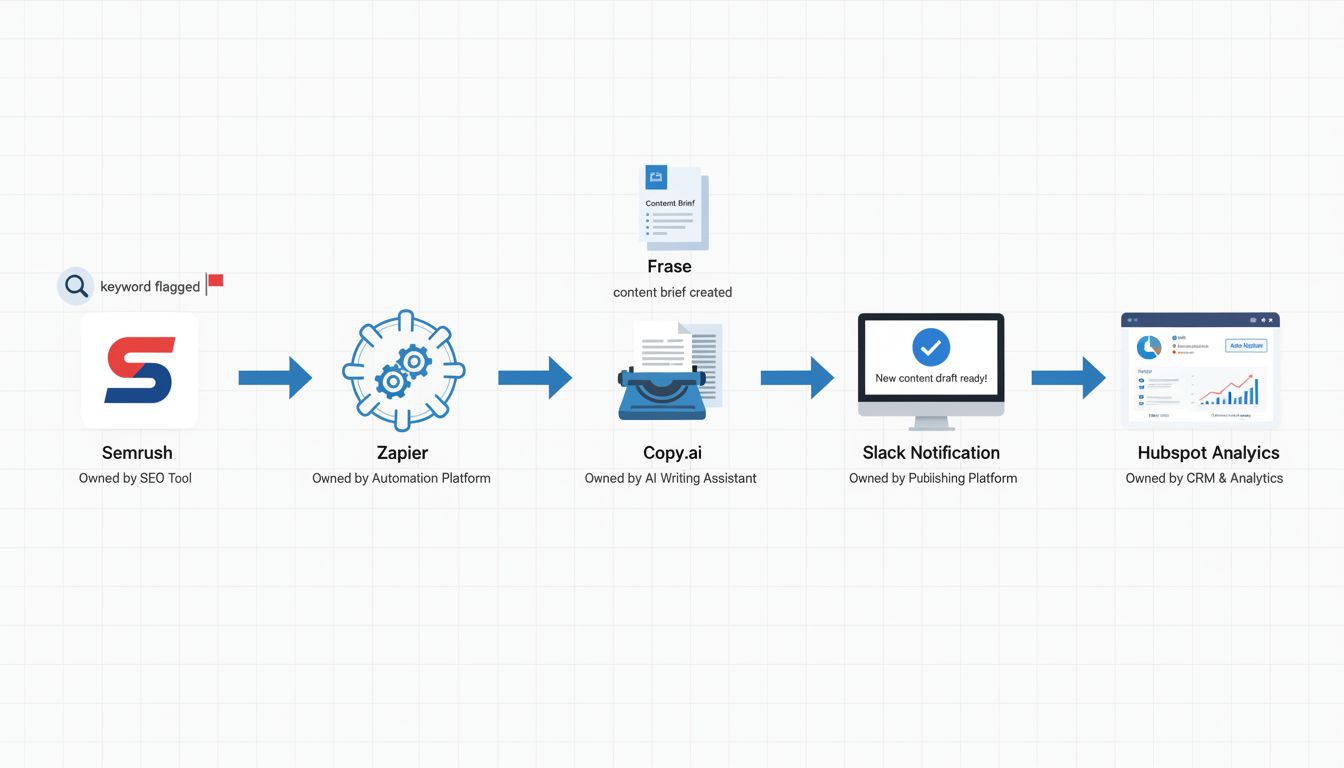
You don't need a developer. You need clarity on what happens at each step, and which tool owns it.
The 2026 Quality & Compliance Checklist: Your Non-Negotiable Gate
Speed without safety is just expensive liability.
Your automated workflow needs a mandatory quality gate between the SEO optimization step and the publish button. A checklist that catches what AI gets wrong before your audience does. Every piece of content creation software in your stack should feed into this validation process, not bypass it.
This isn't optional.
Check 1: Human Strategic Approval
Humans don't write every word anymore, but they must control every decision that matters. Your workflow requires human touchpoints at three specific moments: topic selection (does this align with business goals?), final edit (does this sound like us?), and fact-checking for any claim involving numbers, quotes, or sensitive subjects like compliance or security.
Publishing health, finance, or legal content? Expert review isn't a nice-to-have. It's mandatory.
Check 2: Hallucination Mitigation via RAG
Retrieval-Augmented Generation (RAG) means your AI doesn't just generate text from its training data. It retrieves and references real documents first. This grounding step reduces hallucinations by 71% compared to standard LLM outputs.
Tools like Chatsonic with real-time web access and AirOps with custom knowledge bases implement RAG workflows. If your content creation software doesn't offer this, layer it in manually: feed your AI verified source documents before asking it to write.
Check 3: Brand Voice Adherence
Generic AI writing screams "I didn't care enough to edit this."
Maintain a centralized brand-voice guide in Notion or Confluence, then feed 3-5 of your best existing articles into tools like Copy.ai or Chatsonic during setup. These platforms learn tone, terminology, and structure from examples, but only if you give them good ones.
Check 4: Plagiarism & AI Detection Scan
Run every draft through plagiarism and AI detection before it goes live. Quetext and Originality.ai consistently outperform competitors in evaluation tests for both plagiarism matching and AI fingerprinting. This isn't about fooling Google. It's about catching accidental duplication and ensuring your content has enough human refinement to stand out.
Check 5: Technical SEO & Mobile Health
Automate pre-publish technical audits using Ahrefs Site Audit or Semrush. These tools catch broken internal links, missing alt text, slow mobile load times, and canonical tag issues that tank rankings.
Run these checks weekly, not quarterly.
Check 6: Ethical Disclosure
Google's E-E-A-T guidelines don't penalize AI content. They penalize unhelpful content. Disclose AI assistance where transparency builds trust: health articles, financial advice, news reporting. Don't assign AI an author byline. Do credit human editors and subject-matter experts by name.
This checklist isn't bureaucracy. It's the difference between a content engine and a liability factory.
Measuring Success: KPIs and ROI for Your Content Engine
Your content creation software stack doesn't prove its value through word count. It proves value when organic traffic turns into pipeline.
Most teams track vanity metrics like articles published, keywords targeted, time saved. Those numbers feel productive, but they don't answer the question your CFO will ask: "Did this investment generate revenue?"
Primary Business KPIs: What Actually Matters
Start with the metrics that connect content to cash.
Organic traffic growth tells you if your content is visible. Keyword ranking improvements show whether you're winning the search positions that drive clicks. Conversion rate reveals if that traffic is qualified. You need all three, not just one.
Here's the surprise: automation doesn't just save time. It can improve conversion quality. Customers using HubSpot's AI-powered content tools see a 54% higher lead conversion rate compared to those not using AI features. That's not a productivity gain. That's a strategic advantage.
AI-Specific KPIs You Can't Ignore in 2026
Traditional SEO metrics miss half the picture now.
Track your Share of Voice in AI Overviews. That's the percentage of relevant queries where your brand appears in AI-generated answers. Count the number of times AI systems cite or reference your content when users ask questions in your domain. These metrics tell you whether your content architecture (entity-first structure, FAQ schema, citation-worthy depth) is actually working in the age of AI search.
The ROI Calculation That Matters
Compare what you spend (tool subscriptions + human editing hours) against what you gain (leads generated × average deal value). If your automated workflow produces 40 articles per month at $150 total cost per piece, and those articles generate 20 qualified leads at a $5,000 average contract value, your ROI is clear.
Don't forget time savings. If automation cuts content production from 8 hours to 2 hours per piece, that's 240 hours per month your team can redirect to strategy, product launches, or customer research. Real hours. Real opportunity cost.
Use Controlled Testing to Isolate Impact
Run SEO A/B tests to measure what's actually working.
Change one element at a time. Title tags, internal linking structure, content depth. Preserve canonical tags to avoid confusing search engines. This discipline separates signal from noise and proves which parts of your system deserve more investment.
| KPI | Tool to Measure |
|---|---|
| Keyword Rankings | BrightEdge, Semrush, Ahrefs |
| Organic Traffic | Google Analytics, HubSpot |
| Conversion Rate | HubSpot, Google Analytics |
| AI Citations & Share of Voice | AirOps, Writesonic, BrightEdge |
| Content Quality Score | Surfer SEO, Clearscope |
| Technical SEO Health | Screaming Frog, Semrush Site Audit |
Measurement isn't the last step in your content engine. It's the feedback loop that makes everything else smarter.
Common Pitfalls That Derail Automated Content (And How to Avoid Them)
Pitfall #1: Publishing unedited AI drafts
The most expensive mistake isn't the one that wastes money. It's the one that burns trust.
AI drafts sound plausible. They flow well. But look closer and you'll find subtle inaccuracies, generic phrasing that could've come from anywhere, and exactly zero brand personality. Readers can tell. They might not articulate why, but they click away.
Antidote: Enforce your human-in-the-loop gate. Every piece needs a strategic editor who validates facts, injects brand voice, and makes sure the content answers a real customer question. Not busy work. This is the difference between content that converts and content that quietly damages your credibility.
Pitfall #2: Skipping fact-checking in regulated or technical niches
AI hallucinates citations. It invents statistics. It confidently states complete falsehoods.
In healthcare, finance, or legal content, that's not just embarrassing. It's actionable. One invented stat in a financial planning article could trigger regulatory scrutiny or worse.
Antidote: Implement RAG (Retrieval-Augmented Generation) to ground AI outputs in verified sources, and require expert review for any claim involving numbers, regulations, or professional advice. If you're in a YMYL (Your Money Your Life) vertical, this gate is non-negotiable. Period.
Pitfall #3: Scaling before you've centralized brand voice
You can't train AI on "sound professional but approachable." Without a documented style guide, every AI-generated piece will sound like a different company wrote it. Your audience notices the inconsistency even if they can't name it.
Antidote: Build your brand voice guide before you scale. Include real examples of approved content, forbidden phrases, and tone guardrails. Feed these to your content creation software as training inputs. The upfront investment pays back fast.
Pitfall #4: Ignoring technical SEO while chasing content volume
Publishing 50 articles with broken canonical tags, slow load times, or mobile rendering issues means you've automated failure at scale.
Volume doesn't fix broken infrastructure. It exposes it.
Antidote: Integrate automated audit tools like Ahrefs Site Audit or Semrush into your workflow. Run scans before and after bulk publishing. Fix technical debt as aggressively as you create new content. Otherwise you're building a house on sand.
Pitfall #5: Running confounded SEO tests
Changing headlines, meta descriptions, and internal links simultaneously tells you nothing about what moved the needle. You've introduced three variables at once. Now you can't isolate cause and effect.
Antidote: Test one variable at a time, maintain canonical tags during experiments, and give each test at least two weeks to stabilize before drawing conclusions. Discipline here saves months of wasted effort chasing ghosts.
Future-Proofing Your Stack: Trends Shaping 2026 and Beyond

Your content creation software decisions today need to work for the next two years, not just the next quarter. The landscape is shifting fast enough that betting on the wrong architecture means rebuilding from scratch in 2027.
Zero-touch SEO operations are already here. Tools like BrightEdge Autopilot now handle duplicate resolution, broken link fixes, mobile optimization, and page performance issues without human intervention. The manual technical audit used to be a monthly ritual. Now it's a quarterly sanity check instead of a primary workflow. If your stack still requires weekly manual crawls and spreadsheet triage, you're already behind.
Generative Engine Optimization (GEO) is the new SEO baseline.
AI search traffic increased 527% year-over-year between January and May 2024 compared to the same period in 2025. That's not a trend. It's a tectonic shift in how people find information.
Your content needs to be structured for AI extraction or you'll be invisible to the fastest-growing search channel. FAQ schema, entity-first architecture, citation-worthy depth. The content creation software you choose must support structured data and semantic markup natively, not as an afterthought bolted on later.
Deep CMS integrations are separating leaders from laggards. AI writing directly into component-based systems like Contentstack or headless WordPress setups means your content can flow from brief to publish without manual copy-paste gymnastics. Look for platforms that treat your CMS as a first-class citizen, not just an export target.
The all-in-one versus best-in-class tension is intensifying. HubSpot and similar platforms are absorbing more AI features, tempting you with simplicity. But specialized tools still outperform on specific tasks. The smartest play? A hub-and-spoke model. One central platform for workflow orchestration, specialized tools for content quality, SEO optimization, and compliance checks.
The real question isn't which trend to bet on. It's whether your current stack can adapt when the next shift hits in six months.
Conclusion
Content creation software won't save you if you're just hoarding tools.
The real advantage in 2026? Building a system that connects ideation, creation, optimization, and distribution with humans making the calls that actually matter. Everything else can run on autopilot, but the strategic decisions still need your judgment.
You've got the framework now. The quality gates make sense. You know which metrics to ignore and which ones deserve your attention. So the question isn't what to do next. It's whether you'll keep duct-taping random apps together or finally commit to something that scales without constant firefighting.
The teams crushing it with automation aren't secretly using better tools than you. They're just using them as part of an actual system instead of a collection of shiny objects. Each piece reinforces the others. Quality checks flow into compliance workflows. SEO optimization feeds back into content planning. Distribution data shapes what gets created next. It's not magic. It's architecture.
Your next step: Pull up your current workflow and compare it against the 4-Pillar Framework this week. Find where you're weakest. Maybe ideation feels random. Maybe distribution is an afterthought. Pick one tool from this guide that fixes that specific gap. Then integrate it properly with actual checkpoints and measurement, not just another login to forget about.
Stop collecting software. Start building your system.
Frequently Asked Questions
Which software is best for content creation?
There isn't one. Depends entirely on where you're stuck.
If you can't come up with ideas, look at AirOps or BrightEdge. Need to draft faster? Content at Scale or Copy.ai. For SEO optimization, Surfer SEO makes sense. Publishing workflow a mess? HubSpot or Ranklytics. The point is building a system across the 4-Pillar Framework (ideation, drafting, optimization, publishing) instead of hoping one platform magically fixes everything.
What tools do I need as a content creator for my SaaS business?
Four core pieces: an AI drafting tool (Copy.ai or Jasper), an SEO optimizer (Surfer SEO or Frase), a CMS (WordPress or HubSpot Content Hub), and analytics (HubSpot or Google Analytics 4).
But here's what actually matters. Integration. Your drafting tool should feed into your SEO tool, which publishes directly to your CMS. Connected workflow, not five disconnected apps where you're copy-pasting between tabs all day.
What are the 5 C's of content in an AI-augmented workflow?
The 5 C's adapt when AI enters the picture: Context (RAG and accurate briefs to ground AI output), Clarity (human editing to ensure readability), Credibility (fact-checking, citations, and plagiarism scans), Consistency (centralized brand-voice guides fed to AI), and Conversion (SEO optimization and strategic CTAs). Each C needs a specific checkpoint in your human-in-the-loop system.
How do I start a content engine as a beginner SaaS founder?
Don't build all four pillars at once. You'll burn out.
Start with one pillar: grab an AI drafting tool and pair it with human editing (you or a contractor), then focus on creating one quality piece per week. Once that rhythm feels sustainable, layer in an SEO tool (Pillar 3), then automate publishing (Pillar 4). Grow your system organically as you learn what actually works for your audience.
Should I use free social media management tools for distribution?
Free tools like Buffer or Hootsuite work fine for testing. But B2B SaaS lead generation happens on LinkedIn and Twitter, not TikTok. For those platforms, paid tools that offer analytics, automation, and AI-assisted caption generation will save more time than they cost.
The principle here is using AI to enhance distribution strategy, not replace it with spray-and-pray posting across every platform.
How do I ensure my AI-generated content isn't flagged as plagiarism?
Run a mandatory plagiarism scan before every publish using Quetext or Originality.ai. Both outperformed competitors in recent evaluations [Source: quetext.com]. Implementing RAG (Retrieval-Augmented Generation) with your own proprietary data sources dramatically reduces the risk of AI replicating generic training data, and research shows RAG can cut hallucinations by 71% [Source: inra.ai].
Treat the scan as a quality gate, not an optional step. Plagiarism is a non-negotiable risk.