February 27th, 2026
AI-Powered Content Creation Software for SaaS: A 2026 Buyer's Guide
 WD
WDWarren Day
You're a marketing leader at a scaling SaaS company, staring down a Q2 content calendar that expects 50% more output with the same team. You've tried ChatGPT, but the drafts feel generic, lack your unique insights, and create more editing work than they save.
The promise of content creation software is real, but the path to measurable ROI feels cluttered with hype and hidden pitfalls.
Here's what changed: Generative AI adoption more than doubled from 33% in 2023 to 71% in 2024. What was experimental eighteen months ago is now strategic infrastructure. Your competitors aren't just using AI to write faster. They're embedding it into their entire content lifecycle, from research to compliance-ready publishing. The gap between teams that treat AI as a drafting assistant and those who've built it into their ContentOps workflow is widening fast.
The best content creation software for SaaS in 2026 isn't about who writes the fastest draft. It's about which platform can be most seamlessly embedded into your existing workflow to automate the entire content lifecycle, from intelligent research and personalized creation to optimization and compliance, delivering measurable ROI without sacrificing quality or SEO.
This isn't another listicle of "top 10 AI writing tools." You already know the names. What you need is a strategic framework to evaluate which platforms actually solve your workflow bottlenecks, not just your writing speed. You need to understand where RAG-powered research fits, how to measure real productivity gains beyond "3 hours saved per post," and why 80% of AI pilots never make it past proof-of-concept.
This guide gives you exactly that. A buyer's framework built around the seven stages of the SaaS content lifecycle, real-world implementation analysis of leading platforms, and a practical roadmap to avoid the failure modes that sink most AI content initiatives. You'll walk away with an evaluation scorecard, platform comparison data, and the strategic clarity to make this decision stick.
First, Define Your Need: The 4 Core Types of SaaS Content
Before you look at a single platform, figure out what you're actually trying to scale. Content creation software isn't one thing. The tools that crush it for Instagram carousels won't help you ship 20 SEO-optimized blog posts per month.
SaaS companies typically produce four distinct content types, each with different production workflows and tooling requirements:
1. Written Content , Blog posts, case studies, whitepapers, product documentation, email sequences, and landing page copy. This is the foundation of most B2B demand generation and product-led growth strategies.
2. Visual Content , Infographics, social media graphics, presentation decks, and branded templates. Tools like Canva handle this category well for teams without dedicated designers, offering thousands of templates and a collaborative workspace.
3. Video Content , Product demos, tutorial videos, customer testimonials, and webinar recordings. The landscape here is shifting rapidly. While CapCut dominated short-form editing for creators, newer AI video platforms like Descript and Synthesia are emerging with automated transcription, voice cloning, and screen recording built specifically for product marketing teams.
4. Audio & Social Snippets , Podcast production, social media clips, and repurposed audio content. Many free social media management tools now include basic video trimming and caption generation, though dedicated platforms offer deeper automation.

Look, visual content matters. Video matters. Audio matters. But for most scaling SaaS companies, they're not your bottleneck.
You can hire a designer when you need one. Video editing can be outsourced. What you can't easily solve is systematic, high-quality written content production at scale. Shipping consistent blog posts, updating product pages, personalizing email campaigns, maintaining documentation - that requires a repeatable process, not just a tool.
That's why this guide focuses on content creation software that can automate the entire written content lifecycle: research, drafting, optimization, compliance checking, and publishing. Many of these platforms now include or integrate with visual and video capabilities, but their core value is solving the written content bottleneck that prevents most SaaS companies from executing their growth strategy.
If you're primarily looking to scale video or graphic design, different tools apply. But if written content is your growth lever, keep reading.
The 7-Step SaaS Content Lifecycle & Where AI Software Automates Each Stage
Most content creation software only solves one problem: writing faster. But that's like buying a faster car when you need to redesign the entire highway system.
Speed isn't the real opportunity. It's eliminating friction between every stage of content production. What separates modern AI platforms from legacy tools is their ability to automate an entire ContentOps workflow, not just individual tasks.
Here's the full lifecycle and where automation actually matters:
Step 1: Strategy & Planning – From Guesswork to Data-Driven Roadmaps
Content planning traditionally meant quarterly brainstorms, spreadsheets, and educated guesses about what your audience wants. Someone manually audits competitors, flags keyword gaps, and builds a content calendar in Google Sheets.
AI flips this. Platforms like MarketMuse analyze your entire content library against competitors to surface exact topic gaps and opportunity scores. Instead of "we should write about pricing," you get "publish a 2,200-word comparison guide targeting 'usage-based pricing for SaaS' with a difficulty score of 34."
The calendar builds itself based on search demand and strategic priorities, not gut feeling.
Step 2: Research & Sourcing – Going Beyond Basic Web Search
Manual research means opening 15 browser tabs, skimming whitepapers, and hoping you remembered that one customer quote from three months ago. Slow, incomplete, and divorced from your proprietary knowledge.
RAG (Retrieval-Augmented Generation) changes the equation entirely. With RAG adoption surging 400% since 2024 and now powering 60% of production LLM applications, modern platforms pull directly from your CRM, support tickets, product docs, and past content. Your AI doesn't just know what's on the web. It knows what your customers actually asked your support team last week. That's the difference between generic and genuinely useful.
Step 3: Creation & Drafting – Personalized at Scale
This is where most people think AI stops: generating a first draft. Legacy tools give you a 1,000-word blog post that sounds like every other AI-generated article on the internet.
Advanced platforms use agentic AI to write drafts tailored to specific buyer personas, product tiers, or campaign goals. You're not getting one generic piece. You're getting personalized variations for enterprise vs. SMB audiences, all maintaining brand voice. The draft isn't the endpoint; it's the starting block for human refinement.
Step 4: Optimization & Enrichment – SEO Plus AI Search Visibility
SEO optimization used to mean manually checking keyword density and adding meta descriptions.
Now you're optimizing for two search ecosystems: traditional Google and AI-powered platforms like ChatGPT and Perplexity. Tools like Surfer SEO's Content Editor provide real-time scoring based on competitor analysis, but the next generation goes further. They're tracking whether your content gets cited in AI-generated answers. If ChatGPT never mentions your brand when someone asks about your category, you're invisible to a growing segment of search behavior.
Step 5: Assembly & Design – From Layout to Visual Assets
Manual assembly means copying text into WordPress, finding stock photos, formatting headers, and creating social graphics in Canva. Each piece takes 45 minutes of non-writing work.
AI-powered platforms auto-generate layouts, pull contextually relevant images, create social snippets, and format everything for your CMS. Some even generate custom graphics or video clips based on your content. What used to be a designer's afternoon is now three clicks.
Step 6: Publishing & Distribution – Multichannel Execution
Publishing isn't just hitting "post." It's scheduling across your blog, LinkedIn, email newsletter, and Slack community. Each requires different formats and timing.
Modern content creation software connects directly to your distribution stack, automatically reformatting and scheduling content across channels. One piece becomes a blog post, three LinkedIn carousels, an email sequence, and a Twitter thread without manual rewriting.
Step 7: Analysis & Iteration – Closing the Feedback Loop
Traditional analytics tell you pageviews and time-on-page two weeks after publishing. By then, you've already moved on to the next piece.
AI platforms surface real-time performance signals and suggest specific improvements: "This section has a 73% bounce rate - try adding a comparison table" or "Readers from paid ads convert 2.3x better when we mention ROI in paragraph two." The system learns what works and feeds it back into Step 1 for your next planning cycle.
The difference between legacy and modern tools? Legacy software helps with steps 3 and 5. Modern platforms automate the entire loop, and marketers save an average of 3 hours per piece of content as a result.
Understanding this lifecycle matters because your evaluation framework needs to assess automation across all seven steps, not just drafting speed. A tool that only writes faster still leaves you manually handling research, optimization, distribution, and analysis. That's not scaling. That's just moving the bottleneck.
Your 2026 Buyer's Framework: Evaluating AI Content Creation Software
Here's the truth most vendor comparison charts won't tell you: the difference between content creation software that scales your SaaS content operation and one that becomes expensive shelfware isn't features. It's fit.
You're not buying a word generator. You're selecting the automation layer for your entire ContentOps engine. That requires a framework that goes deeper than "Does it integrate with WordPress?" or "How many templates does it have?"
Use these five criteria to evaluate any platform. They're ordered by strategic impact, not vendor marketing priorities.
Criterion 1: Integration & Workflow Engine Depth
Your content creation software needs to live inside your existing stack, not alongside it.
The question isn't whether it has a Zapier connection. It's whether it can trigger actions, pull data, and push finished assets without your team becoming the middleware. Look for native integrations with your CMS, design tools, project management system, and distribution channels. Platforms like Contentful's AI Actions framework embed generative models directly into content pipelines, letting you automate at the workflow level rather than just the writing level.
The test: Can someone on your team create a brief in Notion, have the AI research and draft in the platform, route it for review in Slack, apply brand guidelines automatically, and publish to your CMS without manually copying and pasting between five tools?
If not, you're buying a feature, not a system.
Criterion 2: AI Architecture – The Core Differentiator
This is where most buyers glaze over. Also where the biggest performance gap exists between platforms.
Two terms matter: RAG (Retrieval-Augmented Generation) and Agentic AI.
RAG means the AI doesn't just generate text from its training data. It retrieves specific information from your knowledge base, documentation, or research sources before writing. Think of it as the difference between asking someone to write about your product from memory versus handing them your product docs first. RAG framework adoption surged 400% since 2024, and 60% of production LLM applications now use RAG. For SaaS content that needs to accurately explain technical features, pricing models, or use cases, RAG isn't optional anymore.
Agentic AI takes this further. Instead of responding to a single prompt, agentic systems can plan and execute multi-step tasks autonomously. Tell it "research our top three competitors' positioning on security features and draft a comparison blog outline," and it breaks that into subtasks: identify competitors, scrape their sites, extract security messaging, analyze gaps, structure an outline. Jasper's Agents feature and similar implementations let you delegate entire content workflows, not just individual writing tasks. This is the difference between saving 30 minutes per article and reclaiming entire days per week.
The architecture question separates tools that make you slightly faster from tools that fundamentally change what's possible with your team size.
Criterion 3: SEO & Discoverability Features (Including AI Search)
Traditional SEO optimization like keyword density, meta descriptions, and header structure? Table stakes. What separates 2026 platforms is optimization for how people actually find content now.

That means tracking brand mentions in ChatGPT, Perplexity, Claude, and Google's AI Overviews. Surfer SEO's AI Tracker monitors where your brand appears in AI-generated responses. Writesonic built an entire GEO (Generative Engine Optimization) tier specifically for this. If 80% of marketers are increasing AI SEO spend in 2026, your content creation software should help you compete in that channel, not just traditional search.
Criterion 4: Compliance, Governance & Transparency
The EU AI Act took effect in February 2025, introducing transparency and explainability requirements for high-risk AI systems.
Even if you're not EU-based, enterprise buyers increasingly demand content provenance, copyright protection, and audit trails. Ask vendors: Can you prove which sources the AI used? Do you offer copyright indemnification? Can you demonstrate compliance with transparency requirements? Can you track who edited what and when?
This isn't paranoia. It's due diligence. One copyright dispute or compliance failure costs more than five years of software subscriptions.
Criterion 5: Total Cost & Scalability Model
Pricing pages show the entry cost. Your CFO cares about the cost at 3x scale.
Analyze how pricing changes as you add users, increase volume, or access advanced features. Credit-based systems can become punitive fast. One platform's $49/month tier might give you 10 articles, while another's gives you 100. Calculate cost per published asset at your target volume, not your current volume. Factor in the cost of features you'll need later (API access, custom models, advanced analytics) even if you don't need them today.
The cheapest platform at 10 articles per month is rarely the cheapest at 100.
AI in Action: Real-World Examples of Automated SaaS Content Creation
Here's what automated content creation software actually looks like when you move past the demo.
Scenario 1: Automating Competitive Comparison Posts
The Challenge: A project management SaaS needs to publish comparison posts for every major competitor keyword ("Asana vs Monday," "Jira alternative," etc.). Each piece requires researching competitor features, pricing changes, and user reviews, then drafting 2,500+ words while maintaining brand voice.
That's 8 hours per article. Minimum.
The AI-Powered Solution: Using Jasper's Agent capabilities, the team builds a workflow that ingests competitor landing pages, G2 reviews, and internal product docs. The agent researches feature sets, identifies gaps, and generates structured comparison tables with narrative analysis. A human editor reviews for accuracy and adds proprietary insights, but the research and first draft happen automatically.
The Result: 90 minutes per article now, down from 8 hours. The team publishes 12 comparison posts monthly instead of 3, capturing long-tail competitor keywords that were previously ignored because nobody had the bandwidth.
Scenario 2: Repurposing Product Documentation into SEO Content
The Challenge: Engineering ships features faster than marketing can explain them. Product documentation exists but sits in a structured CMS, untouched by Google because it's written for existing users, not searchers.
Nobody's rewriting those technical specs into blog posts. There aren't enough hours in the week.
The AI-Powered Solution: Using Contentful's AI Actions framework, the team connects their documentation system to a content creation workflow. The AI analyzes technical docs, identifies feature updates, and automatically generates SEO-optimized blog posts explaining new capabilities in customer-friendly language. Because Contentful's structured content model provides clean context, the AI understands relationships between features without hallucinating capabilities.
The Result: Every product release now generates 2-3 derivative content pieces automatically. Time-to-publish drops from weeks to days. Feature adoption increases because customers actually discover new capabilities through search instead of stumbling across them in the app six months later.
Scenario 3: Optimizing for AI Search Visibility
The Challenge: A cybersecurity SaaS notices traffic declining despite ranking well in traditional Google results. Prospects are increasingly asking ChatGPT and Perplexity for vendor recommendations, and the company isn't being cited.
They're invisible in the channel where their buyers are actually researching.
The AI-Powered Solution: The team deploys Writesonic's GEO (Generative Engine Optimization) features to audit existing content and rewrite key pages specifically for AI search engines. They track AI citations using Writesonic's visibility dashboard and iteratively adjust content structure, adding more direct answers and authoritative sourcing that AI models prefer.
The Result: Within 60 days, the company appears in 3x more AI-generated vendor lists. Demo requests from "AI search" attribution increase 40% quarter-over-quarter. They're back in the consideration set, just in a different search environment than the one they'd optimized for five years ago.
Tool Spotlight: Analyzing Top Platforms Through a SaaS Lens
You've seen the examples. Now let's examine the actual platforms through the lens of what matters for SaaS content operations.
The table below scores six leading platforms against the five criteria that determine whether a tool becomes part of your workflow or another abandoned login. Scores are relative to SaaS-specific needs, not general content creation.
| Platform | Integration Depth | AI Architecture | SEO/GEO Capability | Compliance Ready | Cost Efficiency | Best SaaS Use Case |
|---|---|---|---|---|---|---|
| Jasper | ★★★★☆ | ★★★★★ | ★★★☆☆ | ★★★★☆ | ★★☆☆☆ | High-volume brand content across channels |
| Copy.ai | ★★★★★ | ★★★★☆ | ★★★☆☆ | ★★★☆☆ | ★★★★☆ | GTM workflow automation (marketing + sales) |
| Writesonic | ★★★☆☆ | ★★★★☆ | ★★★★★ | ★★★☆☆ | ★★★★★ | GEO-first content + AI search visibility |
| MarketMuse | ★★★★☆ | ★★★★☆ | ★★★★★ | ★★★☆☆ | ★★☆☆☆ | Data-driven content strategy + gap analysis |
| Surfer SEO | ★★★★☆ | ★★★☆☆ | ★★★★★ | ★★★☆☆ | ★★★★☆ | Real-time SEO optimization + AI tracker |
| Contentful AI Actions | ★★★★★ | ★★★★☆ | ★★★★☆ | ★★★★★ | ★★☆☆☆ | Structured content + headless CMS workflows |
Jasper positions itself as the enterprise-grade solution for teams that need consistent brand voice at scale. Its standout feature is Agents, which are autonomous workflows that handle research and personalization tasks without manual prompting. Pricing starts at $49/month for the Creator plan, with Pro plans scaling based on seats and usage.
Ideal for: Series B+ SaaS companies producing 50+ pieces monthly across blog, social, email, and landing pages. The platform excels when you need multiple team members creating content that sounds like it came from one voice. The drawback? Premium pricing that doesn't make sense until you're at meaningful scale.
Copy.ai has evolved beyond content generation into full go-to-market workflow automation. The Pro plan ($49/month for unlimited words) focuses on writing, while the Advanced plan ($249/month for 5 users) adds workflow credits that connect content creation directly to sales enablement and lead enrichment.
Ideal for: SaaS teams where marketing and sales operate as unified functions. If your content needs to trigger sequences, enrich CRM records, or personalize outreach at the point of creation, Copy.ai eliminates the handoff friction. Less compelling if you just need a better blog writer.
Writesonic has made a strategic bet on GEO (Generative Engine Optimization), which means optimizing content specifically for AI-generated search results in ChatGPT, Perplexity, and Google AI Overviews. Plans range from Lite ($49/month, annual $39) to Professional ($79/month) to Enterprise (starting at $1,499/month with annual commitment).
Ideal for: Early-stage SaaS companies that need cost-effective, high-volume content production with forward-looking AI search visibility. The AI Search Visibility tracker shows how AI engines cite your content, which is critical intelligence as traditional SEO evolves. Editing requirements are higher than premium tools, but the GEO focus addresses where search is heading, not where it's been.
MarketMuse takes a research-first approach, analyzing your entire content library to create data-driven plans and identify topic gaps.
Think of it as strategic intelligence rather than a writing assistant.
Ideal for: SaaS companies with existing content libraries that need to identify what's missing, what's underperforming, and where competitors have coverage you don't. Best paired with another tool for actual creation.
Surfer SEO provides real-time optimization through its Content Editor, scoring your draft against competitor analysis as you write. The newer AI Tracker monitors brand mentions across AI chat platforms, which answers the "are we showing up in AI search?" question most teams are now asking.
Ideal for: SEO-led SaaS content teams that optimize every piece for organic visibility. The real-time scoring prevents the "write first, optimize later" workflow that kills velocity.
Contentful AI Actions embeds generative models directly into your structured content pipeline. Because Contentful's content model is structured (not just markdown files), AI tools can understand and reuse components accurately across channels.
Ideal for: Enterprise SaaS with complex, multi-channel content needs and existing headless CMS infrastructure. The compliance and governance controls make it suitable for regulated industries. Overkill if you're just publishing blog posts.
Here's what this comparison doesn't tell you: Canva and CapCut are design and video tools, not content creation software for SaaS workflows. Canva's actual competitors in 2026 aren't other design tools. They're platforms like Jasper and Copy.ai that generate finished assets across formats without opening a separate editor.
Pricing and features are accurate as of February 2026. Always verify current details on each vendor's site before committing.
The right choice isn't the highest-scoring tool. It's the one that solves your specific bottleneck without creating new ones.
The Implementation Reality: Avoiding the 80% Failure Rate
Here's the number that should terrify you: more than 80% of AI and ML projects never surpass the proof-of-concept stage. Another study puts it even starker, 95% of AI pilot programs fail to achieve desired ROI.
You're not failing because the technology doesn't work. You're failing because you're treating content creation software like a plug-and-play solution when it's actually a workflow transformation that requires process redesign and cultural change.
The tool is only 30% of the solution. Process and people are the other 70%.
The Five-Step Implementation Framework That Actually Works
1. Start with a Defined Pilot Project
Don't try to automate your entire content operation on day one. Pick one repeatable workflow with clear inputs and outputs: monthly newsletter drafts, feature announcement posts, or weekly LinkedIn thought leadership. If you can't describe the workflow in three sentences, it's too complex for a pilot.
2. Secure Cross-Functional Buy-In Before You Sign the Contract
Your writers will resist if they think AI is replacing them. Your SEO lead will sabotage the pilot if they weren't consulted on quality standards. Your legal team will block publishing if compliance wasn't part of the conversation.
Get all three in the room during vendor evaluation, not after implementation starts.
3. Define Success Metrics Beyond Volume
"We published 40% more blog posts" is a vanity metric if traffic didn't increase and conversions stayed flat. Track time-to-publish, content quality scores (use your existing rubric), organic traffic to AI-assisted content, and lead attribution. Build an AI Content Scorecard that your CFO will actually care about.
4. Establish a 'Human-in-the-Loop' Process
Every piece of AI-generated content needs a defined review workflow. Who fact-checks claims? Who ensures brand voice alignment? Who approves final publishing? Document this before you create your first draft.
The 40% productivity boost employees report from AI tools only materializes when humans focus on high-value editing and strategy, not damage control.
5. Invest in Training & Change Management
Your content team needs to learn prompt engineering, output evaluation, and when to override the AI. Budget 20 hours per team member in the first quarter.
If your vendor doesn't offer structured onboarding and your internal champion can't dedicate time to training, delay your launch.
The companies that succeed with content creation software don't have better tools. They have better implementation discipline.
Common Pitfalls and How to Sidestep Them
The companies that succeed with content creation software don't have better tools. They have better implementation discipline.
Even disciplined teams fall into predictable traps. Here are the five mistakes that will quietly sabotage your AI content program, and how to avoid them before they cost you traffic, trust, or budget.
Pitfall 1: Publishing Thin, Generic Content That Tanks Your SEO
Your AI writes fast. Google notices. So do your readers.
Look, the problem isn't that AI-generated content gets penalized. It's that most AI content deserves to be penalized. Shallow, derivative, lacking the unique insight that earns rankings. You're publishing what every competitor with the same prompt could publish.
How to sidestep: Implement a RAG framework that grounds every piece in your proprietary data, customer research, product insights, internal case studies. Then enforce a review protocol where subject matter experts add perspective the AI can't manufacture. The AI drafts. Humans add the unfair advantage.
Pitfall 2: Ignoring Brand Voice Until Everything Sounds Like a Bot
You can spot AI-written SaaS content from orbit. The telltale signs: "leverage," "robust," "seamless," and that distinctive corporate-speak cadence that makes readers' eyes glaze over.
Worse, when people suspect content is AI-generated, they disengage. Your efficiency gains evaporate when no one reads past the first paragraph.
How to sidestep: Spend real time training your AI on your actual voice. Feed it your best-performing content, customer language from sales calls, founder interviews. Create explicit "never use" word lists. And always have a human editor who understands that "on-brand" means sounding like your company, not sounding professional.
Pitfall 3: Obsessing Over AI Detectors Instead of Reader Value
AI detection tools are unreliable theater.
They produce false positives on human writing and miss sophisticated AI content regularly. Yet teams waste hours trying to "beat" detectors that don't matter.
How to sidestep: Stop optimizing for detectors. Optimize for the signal that actually matters: does this answer the reader's question better than anything else in the SERP? If you're adding genuine insight and original data, detection becomes irrelevant. Google cares about helpfulness, not whether a human or machine typed the first draft.
Pitfall 4: Choosing Pricing Models That Punish Success
You pick a per-word pricing model because it feels predictable. Then your content program succeeds, volume scales, and suddenly your software costs are growing faster than your traffic.
The math stops working somewhere between months three and six. What looked like smart budgeting turns into a ceiling on your content velocity.
How to sidestep: Evaluate pricing based on output value, not input volume. Flat-rate or seat-based models often deliver better unit economics at scale. Run the math on your 12-month content plan, not just month one.
Applying the Strategic Framework: The 5 C's of Modern AI-Powered Content
You've seen the tools, the pitfalls, and the implementation roadmap. Now you need a decision framework that cuts through the noise.
The 5 C's model gives you a strategic checklist for evaluating any content creation software. This isn't about feature counts or marketing claims. It's about the structural capabilities that determine whether a platform will actually scale your SaaS content operation or become another abandoned pilot.
1. Connection (Integration Architecture)
Does the platform connect to your existing martech stack, CMS, and data sources?
Tools that operate in isolation force manual handoffs that kill velocity. Look for native integrations with your CRM, analytics platform, and publishing infrastructure. Not just Zapier workarounds.
2. Comprehension (RAG and Agentic Intelligence)
Can the system understand your product, market position, and existing content library? RAG-powered platforms that ingest your documentation, past content, and customer data produce contextually accurate output instead of generic templates. The difference shows up immediately in how well the AI grasps your specific positioning versus regurgitating industry boilerplate.
3. Compliance (Governance and Audit Trails)
Does it provide version control, approval workflows, and transparency into how content is generated?
With regulatory frameworks like the EU AI Act now in effect, you need platforms that document their decision-making process and maintain human oversight checkpoints. This isn't paranoia. It's basic risk management.
4. Calibration (SEO and Performance Optimization)
Can it optimize for both traditional search and AI-powered answer engines? The platform should provide real-time content scoring, competitive gap analysis, and tracking for how your content appears in ChatGPT, Perplexity, and Google AI Overviews. If it's still focused on keyword density metrics from 2019, you're buying yesterday's technology.
5. Cost Structure (Scalable Economics)
Does the pricing model align with your growth trajectory? Flat-rate or seat-based pricing typically delivers better unit economics than token-based consumption models that penalize scale. Run the math on your annual content volume, not just the first month's trial credits. What looks cheap at 10 articles per month might become unsustainable at 100.
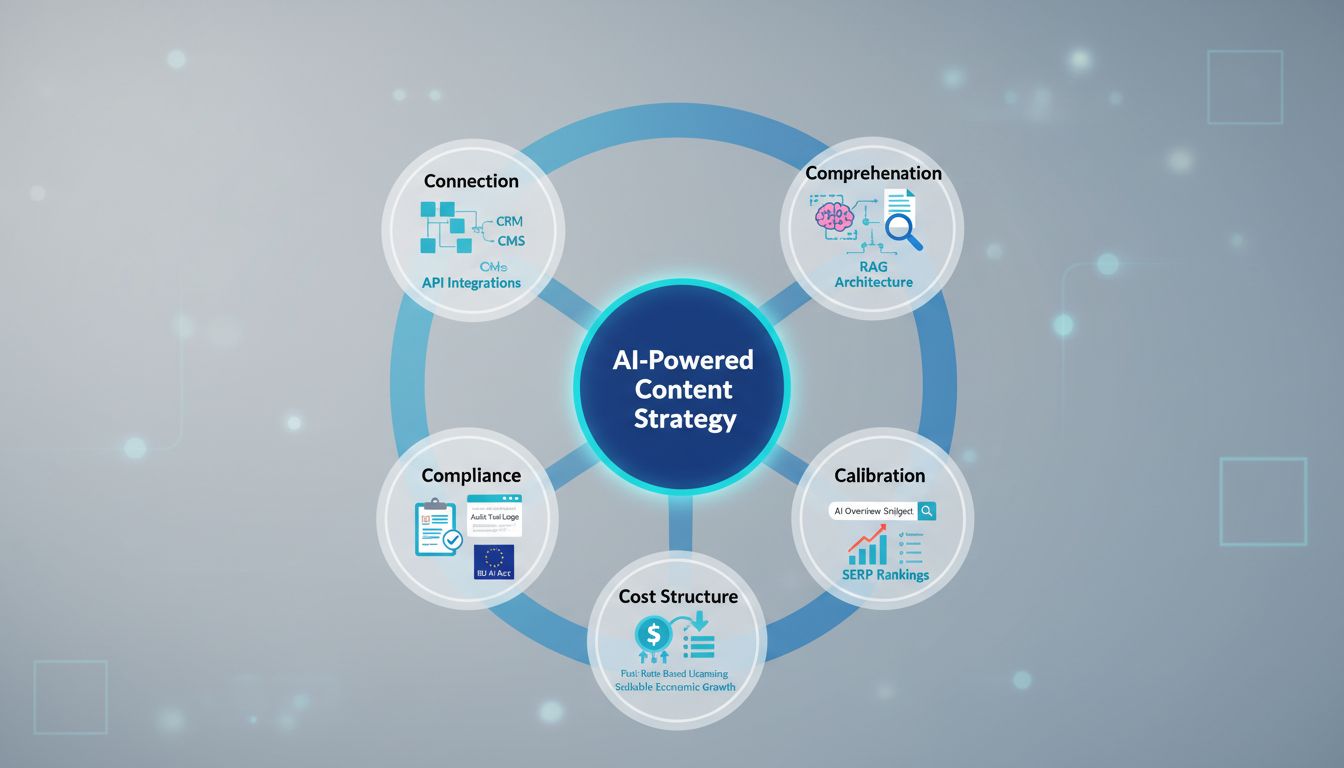
These five criteria form your evaluation lens. Any platform that scores well across all five deserves serious consideration. Anything missing two or more will eventually create friction in your content operation.
Conclusion
More content creation software options in 2026 doesn't mean better outcomes. It means higher stakes.
Generative AI adoption jumped from 33% in 2023 to 71% in 2024 [Source: autofaceless.ai], but here's the thing: most teams are still treating these platforms like faster typewriters instead of workflow engines. They're not thinking about systems. They're thinking about tasks.
Your choice matters because the wrong platform doesn't just waste budget. It creates technical debt, fragments your content operations, and trains your team on processes that won't scale. The right platform becomes the backbone of your entire ContentOps system. It automates research through RAG-powered intelligence, orchestrates multi-step workflows with agentic task automation, and maintains compliance guardrails that protect your brand.
The companies winning with AI content aren't using different tools. They're using the same tools differently.
They've moved beyond "can this write a blog post?" to "can this automate our entire content lifecycle while integrating with our existing martech stack?" They measure ROI in hours saved per content piece (averaging 3 hours according to autofaceless.ai), not just words generated. That shift in perspective changes everything.
Use the 5 C's framework and the evaluation criteria we've covered to score your shortlist objectively. Then run a tightly scoped pilot: one repeatable content type, clear success metrics, 30-day timeline. Prove the workflow integration before you scale the investment. No sprawling multi-quarter rollouts that stall in committee.
Look, the question isn't whether to adopt content creation software. It's whether you'll implement it strategically or join the 80% who never get past proof-of-concept. The difference comes down to treating this as a workflow transformation, not a tool purchase.
Frequently Asked Questions
Which software is best for content creation?
There isn't one. The right answer depends entirely on where your workflow actually breaks down.
Struggling with content that goes stale the minute you publish it? Look for platforms with RAG-powered auto-updates that pull from live data sources [Source: secondtalent.com]. Need to scale production without hiring three more writers? Use the 5 C's framework from this guide to compare options like Jasper (strongest on brand voice consistency), Writesonic (better for GEO optimization), or Contentful (built for structured content pipelines). Your biggest bottleneck determines your best tool.
What are the 5 C's of content creation?
The 5 C's is how you evaluate AI content platforms when you're serious about workflow transformation, not just faster writing. Connection means it integrates with your existing martech stack instead of creating another data silo. Comprehension covers RAG and agentic AI capabilities for intelligent research that goes beyond keyword stuffing. Compliance ensures governance features that meet regulations like the EU AI Act. Calibration handles SEO and optimization tools. Cost Structure gives you transparent, predictable pricing that scales with usage.
This framework separates workflow automation engines from glorified typewriters.
Does Canva create content?
Canva's excellent for visual design and templated graphics. That's not the same thing as handling a full SaaS content lifecycle.
While it offers AI-powered design features and basic text generation through Magic Media, it won't automate research, long-form writing, SEO optimization, or the compliance workflows that B2B content operations actually require [Source: happyscribe.com]. For blogs, whitepapers, or landing pages, you need dedicated content creation software that handles strategy through publishing. Canva creates beautiful graphics. It doesn't write your documentation or optimize your conversion funnels.
What are the 7 steps of content creation?
The SaaS content lifecycle breaks into seven stages: Strategy & Planning (topic research, keyword analysis), Research & Sourcing (gathering data, citations), Creation & Drafting (writing, scripting), Optimization & Enrichment (SEO, readability), Assembly & Design (formatting, visuals), Publishing & Distribution (CMS integration, multi-channel deployment), and Analysis & Iteration (performance tracking, continuous improvement).
Modern content creation software with RAG frameworks automates tasks across all seven stages, not just the drafting phase [Source: secondtalent.com]. That's the difference between a tool and a system.
Can I legally sell things I make on Canva?
Canva generally permits commercial use of designs you create on the platform, but specific restrictions apply to certain stock photos, premium elements, and templates. Always verify their current licensing terms before commercializing anything.
The bigger issue? AI-generated content assets exist in a rapidly evolving legal landscape. Regulations like the EU AI Act (effective February 2025) now require transparency disclosures for AI-created commercial materials [Source: autofaceless.ai]. Review both the platform's Terms of Service and applicable AI transparency regulations in your jurisdiction before selling AI-assisted content. The rules are changing faster than most legal teams can track.
Who is Canva's biggest competitor?
In pure design tools, Adobe Express competes directly with Canva.
But the competitive landscape is shifting. Canva now faces competition from comprehensive AI content platforms like Jasper, Copy.ai, and Writesonic that bundle design, writing, and workflow automation into unified systems [Source: averi.ai]. For B2B SaaS teams, the real comparison isn't Canva versus another design tool. It's whether a visual-first platform or full-lifecycle content creation software better fits your ContentOps strategy. Different problems require different solutions.