February 22nd, 2026
AI SEO Optimization in 2026: A Practical Guide for SaaS Businesses
 WD
WDWarren Day
You've seen the headlines: "AI is killing SEO." Your organic traffic reports might feel it, too, with clicks dipping as AI Overviews appear. But what if the real story is an 83% lift in conversion rates from AI-referred visitors?
For growth-focused SaaS leaders, 2026 isn't about AI destroying SEO. It's about AI creating your highest-quality lead channel.
Here's what most articles won't tell you: while traditional organic traffic still delivers volume, AI-driven traffic converts at 6× the rate for SaaS companies. The difference? When ChatGPT, Perplexity, or Google's AI Overview cites your product in response to a buyer's question, that visitor arrives with intent you can't buy. They've already filtered through generic advice. They're past the awareness stage. They're looking for a solution that fits their exact problem.
The catch is that ai seo optimization in 2026 isn't about ranking on page one anymore.
It's about becoming the cited source inside AI-generated answers. A fundamentally different game that requires schema markup most competitors ignore, content structured for machine extraction rather than human skimming, and KPIs that track citations instead of just clicks.
For SaaS businesses in 2026, ai seo optimization is a revenue-centric playbook focused on dominating AI assistant citations through strategic schema deployment, EEAT-aligned content hubs, and continuous tracking of AI-specific visibility KPIs. The result? Turning AI search traffic into your highest-quality lead source.
Look, you're under pressure to demonstrate ROI from organic channels without hiring an agency or risking algorithmic penalties. This guide delivers exactly that: a four-pillar technical and content framework, a tiered tool stack for every budget, and a 90-day implementation roadmap that connects AI visibility directly to pipeline. No speculation about the future of search. Just the specific moves that are already generating 287–415% first-quarter ROI for early adopters.
Why SEO is More Valuable (and Different) in the Age of AI
Is SEO still worth it with AI? Yes. But the game changed completely, and that shift actually makes organic search more valuable.
AI assistants don't just surface links. They pre-qualify your traffic. When someone clicks through from an AI Overview, ChatGPT citation, or Perplexity answer, they've already consumed a synthesized answer that positions your brand as the authority. They aren't browsing casually. They're ready to evaluate.
The conversion data is striking. AI-driven traffic converts at 6× the rate of traditional organic traffic for SaaS companies. One case study showed 27% of AI referrals became sales-qualified leads, compared to the 2–3% baseline most SaaS sites see from conventional search. 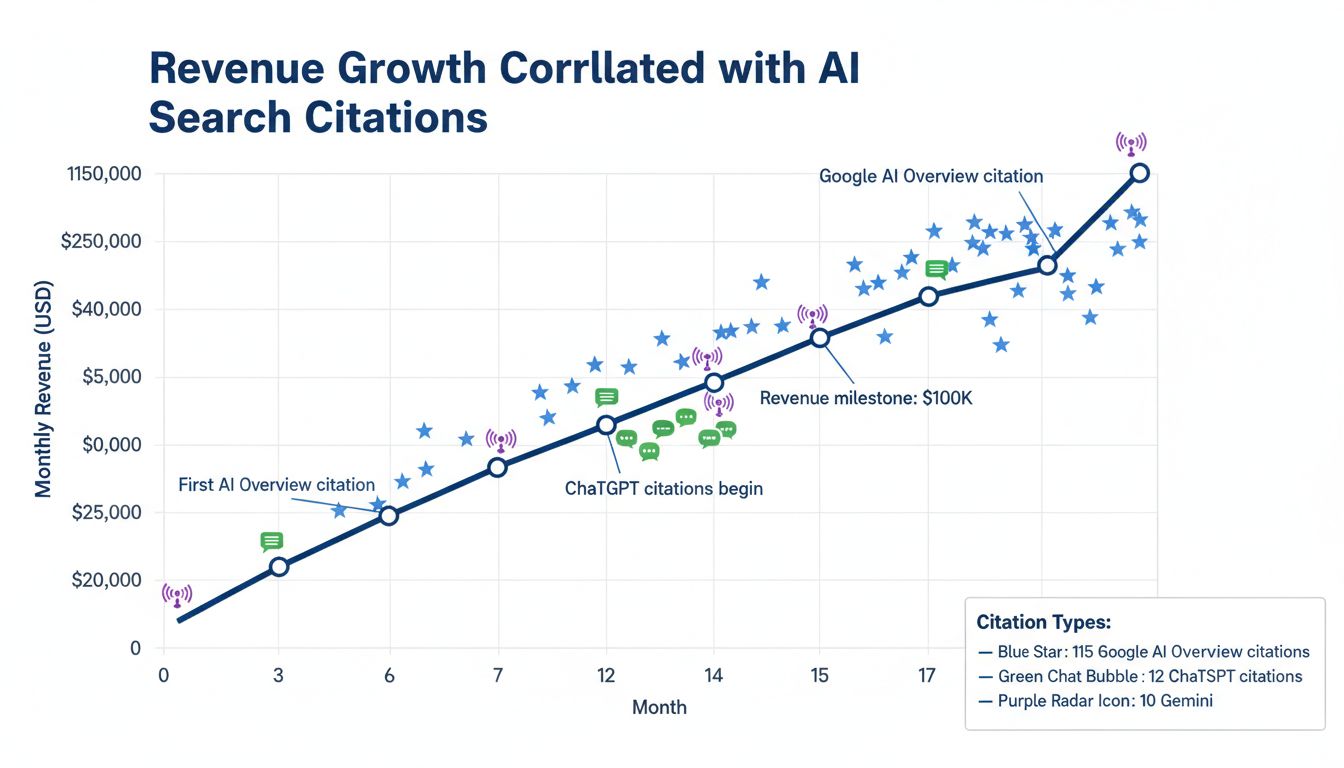
A B2B company tracked by Rankmax grew monthly revenue from $25,000 to $135,000 over 17 months. That's a 440% increase, directly tied to earning 115 Google AI Overview citations, 12 ChatGPT citations, and 10 Gemini citations.
The paradigm shift: from Click-Through Rate to Citation-Through Rate.
Traditional SEO chased position one and that 27.6% click share. ai seo optimization focuses on becoming the cited source inside the answer itself. Your new KPIs aren't just rankings and clicks. They're AI Overview impressions, citation frequency across ChatGPT and Perplexity, and conversion rate from AI-referred sessions.
This works as a filtering mechanism, not a threat. Sure, AI Overviews can suppress clicks for basic informational queries. But the users who do click have already been educated by the AI. They understand your value proposition. They're further down the funnel before they ever hit your site.
Has AI replaced SEO? No. It's made SEO harder to fake and more rewarding to do well.
You can't stuff keywords into thin content and rank anymore. AI assistants parse structured data, evaluate expertise signals, and prioritize sources that demonstrate clear authority. Schema markup, EEAT-aligned content hubs, and technical precision are now table stakes. Not because Google's algorithm demands them, but because AI engines require them to cite you.
Here's the opportunity: most of your competitors are still optimizing for 2019. Only 31.3% of websites deploy schema markup. Fewer than half pass Core Web Vitals.
If you systematically optimize to become the preferred cited source, you don't just win traffic. You win the highest-intent traffic your category has ever seen.
That's the thesis of this guide: ai seo optimization in 2026 is a revenue play, not a visibility play. The next four pillars show you exactly how to execute it.
Pillar 1: The Technical Foundation – Schema & Speed Are Non-Negotiable
Can AI do SEO optimization? Yes. But only if AI agents can actually read your site.
Most SaaS websites are invisible to AI assistants not because their content is weak, but because their technical foundation is broken. Load times drag, schema markup is missing, and the structured data that AI agents rely on simply doesn't exist.
Only 31.3% of websites implement any schema markup, and just 47% pass Core Web Vitals assessments. While your competitors fumble with slow load times and missing structured data, you can leapfrog them by fixing what they ignore.
Technical SEO isn't glamorous. But it's the difference between being cited by ChatGPT and being invisible.
Master Structured Data for AI Comprehension
Schema markup is the language AI assistants speak. Without it, even your best content is just unstructured text that LLMs struggle to parse and cite.
For SaaS companies, four schema types matter most: SoftwareApplication, FAQPage, HowTo, and Organization.
Here's a minimal JSON-LD example for a product page:
{
"@context": "https://schema.org",
"@type": "SoftwareApplication",
"name": "Your Product Name",
"applicationCategory": "BusinessApplication",
"offers": {
  "@type": "Offer",
  "price": "49.00",
  "priceCurrency": "USD"
},
"aggregateRating": {
  "@type": "AggregateRating",
  "ratingValue": "4.8",
  "reviewCount": "127"
}
}
For help articles or knowledge base pages, FAQPage schema tells AI exactly where your answers live:
{
"@context": "https://schema.org",
"@type": "FAQPage",
"mainEntity": [{
  "@type": "Question",
  "name": "How does your integration work?",
  "acceptedAnswer": {
    "@type": "Answer",
    "text": "Our integration connects via REST API in under 5 minutes..."
  }
}]
}
Deploy these on your top 20 pages first. Product pages, pricing, and your most-visited help articles. Use Google's Rich Results Test to validate before publishing.
Exceed Core Web Vitals for AI Crawlers
Speed isn't just a ranking factor anymore. It's a crawl budget issue. AI agents won't wait for your bloated JavaScript to render.
The 2026 targets are clear: Largest Contentful Paint (LCP) under 2.5 seconds, Interaction to Next Paint (INP) under 200 milliseconds, and Cumulative Layout Shift (CLS) below 0.1.
Most SaaS sites fail because of unoptimized images, render-blocking scripts, and third-party widgets. Run PageSpeed Insights on your homepage, pricing page, and top three blog posts. Fix the red flags first: compress images to WebP, defer non-critical JavaScript, and lazy-load anything below the fold.
Audit and Streamline Your Crawl Efficiency
Your XML sitemap and robots.txt file are the roadmap AI crawlers follow.
If they're misconfigured, you're wasting your crawl budget on irrelevant pages. Admin dashboards, duplicate blog tags, session parameters that create infinite URL variations. All of it eats into the time crawlers spend on pages that actually matter.
Your 48-hour technical audit checklist:
- Submit an updated XML sitemap to Google Search Console (exclude admin, duplicate, and noindex pages)
- Review your robots.txt file. Make sure you're not accidentally blocking critical product or content pages
- Fix all 404 errors and broken internal links (use Screaming Frog or Sitebulb for a full crawl)
- Identify and redirect or consolidate duplicate pages (common culprits: /blog vs /blog/, HTTP vs HTTPS)
These fixes won't make headlines, but they're the foundation everything else depends on. Skip them, and your content strategy is built on sand.
Pillar 2: Content Strategy Built for AI Citations (Not Just Clicks)
Here's the problem: you're still writing for Google circa 2019.
Keyword density, backlink profiles, domain authority. All the metrics you've obsessed over for years? AI assistants don't care. They're choosing what to cite based on signals you've probably never thought about.
Look at the data. When Perplexity answers a query, 46.7% of its top-ten citations come from Reddit. Not your polished blog posts. Not your carefully optimized landing pages. Reddit threads. And roughly 45% of pages cited by ChatGPT or Perplexity get almost no organic traffic. AI agents don't check your monthly uniques before deciding you're worth quoting.
They just want the best answer.
Target the AI 'Answer Layer'
AI assistants prefer content that sounds like a human explaining something, not a marketing team trying to hit a keyword quota.
This is exactly why Reddit outranks you. Those threads are specific, they cover edge cases nobody asked you to write about, and they sound real. Your advantage is you can deliver that same specificity with actual accuracy, at scale. Deep implementation guides, technical documentation that doesn't skimp on details, blog posts that answer a complete question instead of teasing a demo request.
Pull up your five highest-traffic pages right now. Read them as if you're an AI assistant. If you quoted this page verbatim to answer someone's question, would it actually be helpful? Would it be complete? Or would it feel like half an answer designed to capture an email address?
If it's the latter, rewrite it.
Architect EEAT-Aligned Content Hubs
The one-off blog post model is done. AI assistants favor sites that demonstrate comprehensive coverage through interconnected content.
Build a hub around each core topic your ideal customer actually searches for. Say you sell a customer data platform. Create a pillar page: "The Complete Guide to Customer Data Platforms." Then link out to tightly focused cluster content. A CDP glossary. Feature comparisons that aren't just your product vs. two strawmen. Implementation checklists. Compliance guides for GDPR, CCPA, and HIPAA. Integration tutorials for every major CRM.
Each cluster piece should be narrow and exhaustive, not surface-level. Link everything back to the pillar. This architecture signals topical authority to both Google and AI agents. Content hubs and programmatic SEO deliver compounding traffic gains, but only when the hub is genuinely comprehensive. Not just keyword variations with thin rewrites.
Optimize for Informational Intent
73% of LLM citations go to informational pages. How-to guides, definitions, explainers. Your product pages won't get cited. Your thought leadership might.
Audit your informational content every month. Update statistics (with real sources, not "studies show"). Clarify anything that reads ambiguous. Make sure every section has a clear semantic heading. AI agents parse structure aggressively. A well-organized page with descriptive H2s and H3s is exponentially more cite-able than a wall of text, even if the wall of text is beautifully written.
"Creating great content" used to mean hitting 1,500 words and sprinkling your target keyword eight times. Now it means becoming the single best-structured answer to a question an AI might be asked. If your page can't be quoted verbatim with confidence, you're invisible.
Pillar 3: AI-Aware Promotion & Authority Building
AI Overviews are cutting traditional click-through rates by around 15.5%. Fewer people click through to anyone's site now. But the sites that get cited inside those AI answers? They're winning disproportionately.
Off-page SEO isn't dead. It's just serving a different master now. Links still build domain authority, which search engines (and AI models) use as a proxy for trustworthiness. But you also need to think about brand mentions, citation patterns, and internal architecture that signals to AI crawlers which pages deserve to be quoted.
The playbook changed. Most people haven't noticed yet.
Digital PR for AI Trust Signals
Traditional link building chased PageRank. AI-aware PR chases credibility signals.
When TechCrunch or Forbes features your company in a piece about "CDP trends" or "AI-powered analytics," you're not just earning a backlink. You're creating a semantic association between your brand and authoritative discourse on that topic. AI models train on this content. A mention in a high-authority article can influence whether ChatGPT or Perplexity considers your site a credible source worth citing.

Focus your outreach on placements that mention your brand in context. Case studies, expert roundups, trend pieces. Not generic guest posts that read like advertorials. The goal is to become part of the narrative, not just collect a dofollow link.
Strategic Internal Linking for Citation Flow
Think of your site as a citation network.
High-authority hub pages (your pillar content) should funnel both users and AI crawlers to your commercial pages. Pricing, product demos, comparison tables. Use descriptive anchor text that mirrors the intent of the destination page. Don't just link "click here." Link "compare enterprise CDP pricing" or "request a personalized demo." This helps AI understand the relationship between pages and increases the likelihood that your commercial content gets surfaced when someone asks a buying-intent question.
Internal links distribute authority. Build them deliberately, not as an afterthought.
Monitor Your Competitors' AI Presence
You need to know which of your competitors' pages are being cited in AI Overviews, ChatGPT, or Perplexity.
Tools like Otterly AI, Surfer AI Tracker, and xFunnel now track AI citations by competitor and keyword. Run a monthly audit: What questions trigger AI citations in your category? Who's getting quoted? What content formats are they using? If a competitor's "ROI calculator guide" is being cited and yours isn't, you've found a gap. Close it with better structure, clearer answers, and stronger schema.
AI visibility is measurable. Treat it like rank tracking, because that's what it is now.
Pillar 4: Measurement – Connecting AI Visibility to Pipeline & Revenue
AI visibility is measurable. Treat it like rank tracking, because that's what it is now.
The difference? Your CFO doesn't care if you rank #1 in Perplexity. She cares whether those citations turn into trials, SQLs, and closed-won revenue. This section gives you the framework to prove it.
Track the New AI-Specific KPIs
Traditional rank tracking still matters, but it's incomplete.
You need three additional metrics to understand your AI search footprint:
1. AI Overview & Snippet Impressions
Google Search Console now surfaces queries where your site triggers AI Overviews or featured snippets. Filter your Performance report by "Search appearance" to isolate these. Track month-over-month growth in impressions for these query types. They're your earliest signal of AI visibility.
2. Citation Rate
Run your core product and category queries through ChatGPT, Perplexity, and Google AI Overviews weekly. Log which competitors get cited and how often you appear. One B2B SaaS case study tracked 115 Google AI Overview citations, 12 ChatGPT citations, and 10 Gemini citations over 17 months and tied each to pipeline growth. Build a simple spreadsheet: Query | Engine | Your Brand Cited? | Competitor Cited | Date.
3. AI-Referred Sessions
Most analytics platforms can't distinguish AI referrals from organic search yet. Use UTM parameters in any links you control (author bios, resource pages, whatever) or deploy a tool like Otterly AI or Surfer AI Tracker to tag and segment AI-driven traffic automatically.
Map AI Metrics to Your SaaS Funnel
Visibility is the top of the funnel. Revenue is the bottom.
Connect them.
Start by segmenting AI-referred visitors in your analytics. Then calculate:
- Trial Sign-Up Rate: What percentage of AI visitors convert to free trials or demos?
- Lead Quality Score: Use your CRM to tag AI-sourced leads and compare their engagement, time-to-meeting, and close rate versus other channels.
- Customer Acquisition Cost (CAC): Divide your AI SEO investment by the number of customers acquired from AI referrals.
Benchmark against this: in documented case studies, 27% of AI traffic converted into sales-qualified leads, far above typical organic rates. If your AI-referred conversion rate lags, revisit your schema deployment and content depth.
Conduct a Quarterly AI Visibility Audit
Set a recurring calendar reminder. Every 90 days, run this five-point checklist:
- Review Search Console 'Performance' for new question-based queries and zero-click patterns.
- Check for new featured snippets using a tool like Ahrefs or manually searching your top 20 target keywords.
- Run brand and product queries in ChatGPT, Perplexity, and Google AI Overviews. Screenshot results and compare to prior quarter.
- Analyze AI-referred traffic quality in GA4: bounce rate, session duration, goal completions.
- Update priority schema on your top-performing pages based on what's earning citations.
If you're not measuring it, you're not managing it. AI search is too valuable to leave to guesswork.
Your 2026 AI SEO Optimization Stack: Tools for Every Budget
What is the best AI for SEO? There isn't one.
The right answer is a stack. Three to seven tools working together, chosen for your stage and budget, not marketing hype.
Here's the problem: most SaaS teams waste money on overlapping features or underbuy on critical functions. The pattern that actually works? Cover five core jobs, crawl/audit, keyword intelligence, content optimization, AI-specific tracking, and outreach. Everything else is optional.
Here's how to build your stack without blowing your runway.
The Bootstrapped Stack (Free – $100/month)
Pre-Series A or running lean? You can still compete.
Google Search Console remains your technical foundation, free crawl data, Core Web Vitals reports, and impressions-without-clicks (your earliest AI visibility signal). Pair it with Google's Schema Markup Helper to deploy FAQPage and SoftwareApplication schema without a developer.
For content briefs and research, ChatGPT (free or $20/month) handles competitor analysis, outline generation, and FAQ expansion faster than any junior hire. Layer in Otterly AI at $29/month to track when you appear in AI Overviews, ChatGPT, and Perplexity. This is your only dedicated AI citation monitor at this tier.
Screaming Frog (free up to 500 URLs) covers your technical audits. Need more? The paid license is $259/year. Still cheaper than one month of enterprise SEO software.
This stack won't scale to 10,000 pages, but it'll get your first 50 high-intent pages optimized, cited, and converting.
The Growth Stack ($500–$2,000/month)
You're past product-market fit. Organic drives 20%+ of your pipeline. Now you need velocity and intelligence.
Pick Ahrefs or Semrush ($199–$499/month) for keyword research, backlink monitoring, and competitive gap analysis. Both now include AI Overview tracking in their SERP features. Don't pay for a separate rank tracker unless you need hyper-local or daily updates, in which case, add AccuRanker at $199/month.
Surfer with the AI Tracker add-on ($95–$495/month depending on volume) optimizes existing content and monitors whether your pages appear in AI-generated answers. Not perfect, but it closes the loop between on-page work and AI citation rates.
For content production, choose Writesonic ($49–$99/month) or Jasper if you need higher volume. Both integrate with your keyword data and can draft first passes of comparison pages, feature explainers, and FAQ sections in minutes.
Just remember: AI drafts, humans validate (more on that next section).
Round out the stack with Screaming Frog (paid) for large-scale audits and Respona ($199–$499/month) if outreach and digital PR are part of your authority-building plan.
Total monthly spend: $1,000–$2,000. This is the stack that takes you from 10,000 to 100,000 monthly visitors.
The Enterprise Stack ($2,500–$5,000+/month)
At scale, you're optimizing thousands of pages, managing multiple content teams, and need predictive intelligence, not just reporting.
Swap Surfer for MarketMuse ($600/month) for content planning that maps topic clusters to search demand. Add Sitebulb ($55/month) for visual technical audits that non-technical stakeholders actually understand.
For AI-specific visibility, upgrade to xFunnel (starts ~$197/month) or BrandLight (premium tiers vary) to track citations across ChatGPT, Perplexity, Gemini, and Google AI Overviews with competitive benchmarking and weekly alerts.
Running programmatic SEO or need to deploy schema changes across hundreds of pages simultaneously? Alli AI ($299+/month) automates rule-based optimizations without touching your codebase.
Keep Respona for scaled outreach and add a dedicated link intelligence tool like Ahrefs' advanced plans for deep backlink forensics.
This tier isn't about more tools. It's about automation, attribution, and the ability to prove that ai seo optimization tools are driving pipeline, not just traffic.
The Golden Rule: AI Assists, Humans Validate (The 10-20-70 Framework)
Can AI do SEO optimization? Yes. Is ChatGPT good for SEO? Also yes, but only if you treat it like a junior analyst who needs supervision.
Here's where teams screw up: they think AI replaces expertise. It doesn't. AI multiplies what you already know. It can't replace judgment, brand voice, or the ability to spot a hallucinated statistic before it goes live. The moment you auto-publish unedited AI content or deploy schema without a technical review, you're not scaling. You're building technical debt and inviting penalties.
The 10-20-70 Framework fixes this. Borrowed from data science, it maps perfectly to AI SEO workflows:
- 10% of your effort goes into picking the right tools (ChatGPT, Jasper, Surfer, schema generators).
- 20% goes into data prep, feeding AI accurate briefs, competitor analysis, keyword clusters, brand context.
- 70% goes into human-led validation. Editing. Fact-checking. Technical QA. Making sure every output aligns with your EEAT strategy.
Most teams flip this ratio. They spend 70% of their time shopping for tools and maybe 10% validating what comes out. That's how you end up with fake statistics, broken internal links, and content that tanks your rankings instead of improving them.
5 Common AI SEO Pitfalls (and How to Avoid Them)
Publishing Unedited AI Content , Google's getting better at spotting generic, unreviewed AI text. Treat AI drafts as first passes, not final copy.
Hallucinations & Inaccuracies , AI invents statistics, case studies, and product features with total confidence. Fact-check every claim. Every time.
Keyword Stuffing via Over-Optimization , AI tools love density metrics. Humans know when it sounds robotic. Optimize for readability first, keywords second.
Ignoring Technical Debt from Automation , Broken schema, missing alt tags, orphaned pages. Run technical audits after every AI-assisted publishing sprint, not six months later when you're trying to figure out why traffic dropped.
Chasing 'AI-Generated' Volume Over Quality , 100 mediocre pages won't outperform 10 authoritative ones. Prioritize depth and citation-worthiness over quantity.
A Safe AI-Content Workflow
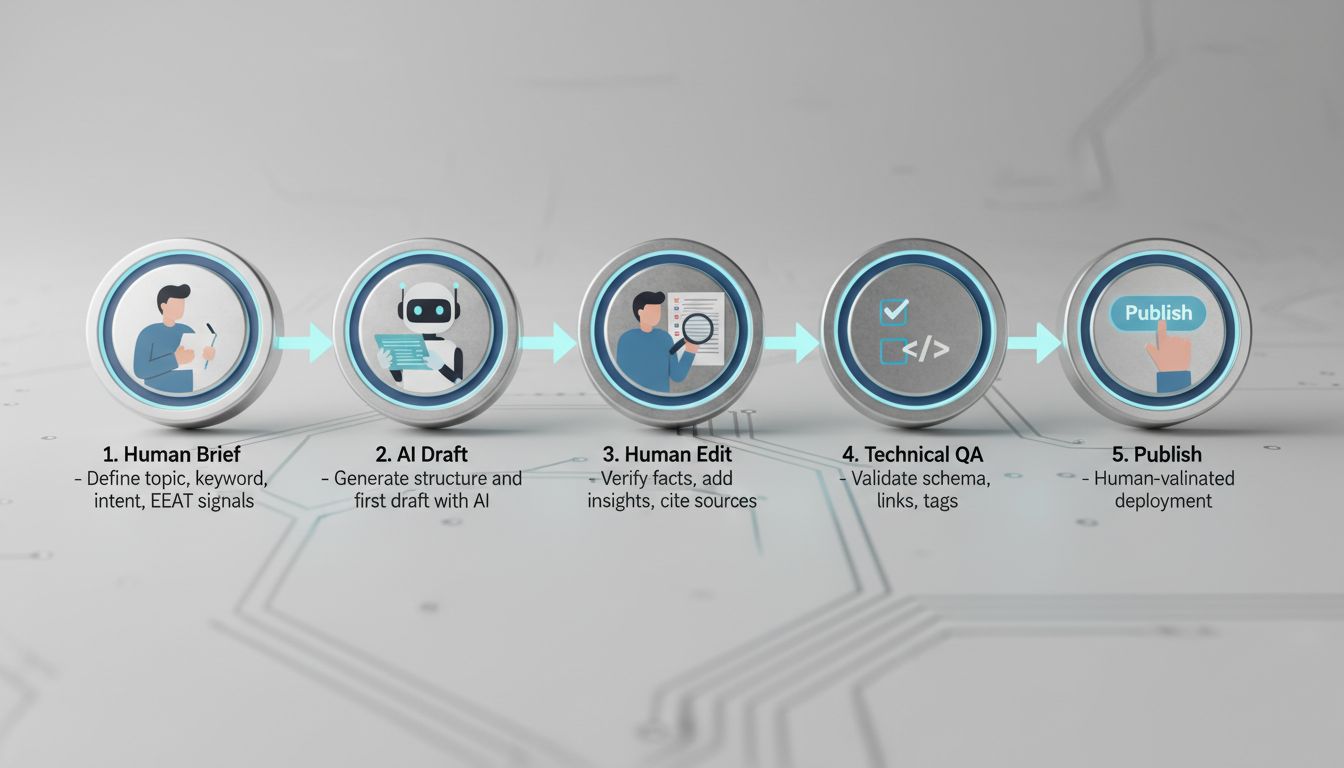
Here's the process that keeps quality high and risk low:
Human Brief , Define topic, target keyword, user intent, and required EEAT signals (author, sources, examples).
AI Draft , Use ChatGPT or Jasper to generate structure and first draft.
Human Edit for Accuracy/EEAT , Verify facts, add original insights, inject brand voice, cite real sources. This is where the actual value gets added.
Technical QA , Validate schema markup, check internal links, confirm meta tags and image alt text.
Publish , Deploy with confidence, knowing a human validated every layer.
Look, AI accelerates the work. Humans ensure it's worth publishing. Get that ratio backwards and you're just creating faster garbage.
Your 90-Day AI SEO Implementation Roadmap
You know what to do. Now here's when to do it.
This roadmap assumes you have a functioning SaaS website, basic analytics in place, and at least one person who can coordinate technical implementation (whether in-house or via contractor). If you're a solo founder, budget 6–8 hours per week. If you have a small team, assign clear ownership for each phase.
Phase 1: Days 1–30 – The Diagnostic & Technical Sprint
Week 1–2: Full technical audit
Run a crawl using Screaming Frog or Sitebulb. Export a list of every 404, redirect chain, and duplicate title tag. Pull your Core Web Vitals report from Google Search Console and flag any page with LCP above 2.5 seconds or CLS above 0.1.
Create a single spreadsheet with three tabs: Critical Fixes (anything blocking indexing or causing errors), Quick Wins (missing alt tags, thin meta descriptions), and Schema Opportunities (pages that should have markup but don't).
Week 3–4: Priority schema deployment
Implement structured data on your top 5 commercial pages (pricing, product, integrations) and top 5 informational pages (guides, comparison posts, how-tos). Use SoftwareApplication schema for product pages, FAQPage for content with Q&A sections, and HowTo for tutorials.
Validate every implementation with Google's Rich Results Test. Deploy to production. Submit updated sitemaps to Search Console.
Phase 2: Days 31–60 – Content Alignment & Tracking
Week 5–6: Audit for AI citation potential
Pull your top 20 organic landing pages by traffic. For each, ask: Does this page answer a specific question a prospect would ask ChatGPT or Perplexity? If yes, check whether it has schema, clear headings, and a concise answer in the first 150 words.
Refresh 2–3 key informational pieces. Add schema. Tighten intros.
Include a bulleted summary at the top. Update publish dates. The goal here is making it dead simple for AI engines to extract and cite your answer.
Week 7–8: Set up AI tracking and baseline KPIs
Subscribe to Otterly AI or a similar tracking tool. Configure it to monitor your brand, top competitors, and 10–15 high-priority keywords. Export your first baseline report: how many AI Overviews mention you, how many citations you have in ChatGPT or Perplexity, and which pages are being surfaced.
In your CRM or analytics platform, tag organic sessions by landing page and track demo requests, trial sign-ups, and SQLs. You need a clean attribution model before you can prove ROI.
Phase 3: Days 61–90 – Promotion & Iteration
Week 9–10: Execute one digital PR campaign
Pick one high-value topic where you have genuine expertise. Pitch a data-driven story or case study to 10–15 relevant publications (industry blogs, SaaS newsletters, niche media).
Secure 2–3 placements with backlinks to your best informational content. Internal linking matters, too. Update your navigation and footer to funnel authority from new backlinks into your product pages.
Week 11–12: Analyze and refine
Pull 60 days of AI tracking data. Which pages are getting impressions in AI Overviews but not citations? Which topics are your competitors dominating? Which schema types correlate with the most visibility?
Use this data to build your Q2 content calendar. Double down on what's working. Kill what isn't. Update your schema roadmap based on which formats AI engines are rewarding.
By day 90, you should have a technical foundation that doesn't leak traffic, a measurement system that connects AI visibility to pipeline, and enough data to make your next quarter's plan evidence-based instead of speculative.
Conclusion
Look, ai seo optimization isn't some 2027 planning exercise. It's what separates predictable pipeline growth from watching your CAC creep up while competitors snag the same buyers you're chasing.
The numbers don't lie. AI-referred traffic converts at 6× the rate of traditional organic for SaaS companies, and early adopters are seeing conversion rate lifts of 83% with SQL rates hitting 27% [Source: greenbananaseo.com]. This isn't a modest uptick. It's a complete reset in how qualified buyers find and vet solutions.
The playbook's actually pretty straightforward: deploy schema on your top 20 pages, fix Core Web Vitals gaps, build EEAT-aligned content hubs that answer real evaluation questions, and track AI citations the same way you track rank. The 10-20-70 framework keeps you using AI to move faster without ditching the human judgment that separates cited sources from ignored ones.
Your competitors are reading these same case studies right now.
The window to lock down authority in AI assistant citations is measured in quarters, not years. Start with a technical audit focused on schema coverage and Core Web Vitals performance, then map your existing top-funnel content to what people are actually asking AI tools.
If you're ready to turn AI search visibility into your most predictable revenue channel, SpectreSEO's AI-First SEO Audit provides the diagnostic blueprint and 90-day implementation plan tailored to your SaaS stack. Get your free assessment.
Frequently Asked Questions
Can ChatGPT do an SEO audit?
Sort of. ChatGPT can review a sitemap, spot obvious problems like missing meta descriptions or broken links, and spit out a checklist in under a minute. That's useful for getting started.
But it can't actually crawl your site, measure Core Web Vitals, render JavaScript, or figure out why Google's ignoring half your product pages. It's working off whatever you paste in, not live site data. Use AI to draft the framework, then validate everything with real crawlers like Screaming Frog and Google Search Console [Source: olivermunro.com].
What is the 10 20 70 rule for AI?
It's a resource-allocation framework that keeps AI projects from turning into science experiments. Spend 10% of your effort selecting the right ai seo optimization tools, 20% on building clean data inputs (verified schema, accurate keyword lists, performance benchmarks), and 70% on redesigning your workflows to integrate and validate AI outputs.
Most teams waste weeks tuning tools when they should be fixing their content QA and publishing pipeline. The rule reminds you that success comes from process redesign, not the algorithm itself.
Has AI replaced SEO?
No. It changed the win condition.
SEO isn't dead. The goal just shifted from "rank #1 and get the click" to "become the cited source inside the AI-generated answer." Google AI Overviews, ChatGPT, and Perplexity now sit between your content and the user, which means you need stronger EEAT signals, comprehensive topic coverage, and schema markup to earn citations. SEO professionals are now conversation architects for AI agents, not just keyword optimizers [Source: greenbananaseo.com, onely.com].
What are the 4 P's of AI?
Forget the academic version. For SaaS ai seo optimization in 2026, the four pillars that actually drive pipeline are: Precision (schema markup and Core Web Vitals), Pages (EEAT-aligned content hubs built for citations), Promotion (AI-aware link building and digital PR), and Pipeline (tracking AI visibility KPIs tied to revenue, not vanity metrics).
This framework gives you a concrete action plan instead of theory.