February 20th, 2026
Best AI SEO Tools for Founders in 2026: A Buyer's Guide
 WD
WDWarren Day
AI search traffic jumped 527% year over year, yet your organic growth flatlined three months ago. Meanwhile, your competitors appear in ChatGPT responses and Google AI Overviews while you're invisible. You've Googled "best ai seo tools" and found yourself staring at dozens of platforms, each promising to revolutionize your SEO, for anywhere from $49 to $4,500 per month.
Here's what nobody tells you: most of those tools were built for enterprise marketing teams with dedicated SEO specialists.
You're a founder wearing twelve hats, and SEO is maybe half of one of them.
The best AI SEO tool for you isn't the one with the longest feature list. It's the one that acts as a force multiplier for your limited team, automating the 80/20 of SEO operations while giving you strategic visibility in AI-powered answer engines like Google Overviews and ChatGPT.
Search behavior fundamentally shifted. Google AI Overviews now reach 2 billion monthly users. ChatGPT processes 2.5 billion prompts daily. Your potential customers are getting answers without clicking through to websites, and if you're not cited in those AI responses, you don't exist.
Look, the question isn't whether AI seo optimization works. The problem is choosing the right tool when you have zero margin for expensive mistakes.
This guide gives you a five-point evaluation framework designed specifically for resource-constrained founders, tool recommendations mapped to your actual needs (not feature bloat), and a 30-day launch plan that doesn't require hiring a specialist. We'll also answer the questions you're actually asking: Is ChatGPT enough? What's the real ROI? Will SEO even exist in five years?
If you're doing this solo, you need clarity and speed. Let's get both.
Why Your Old SEO Playbook Is Obsolete in 2026
Your content ranks on page one. You've built backlinks. You're tracking keywords in Search Console. And yet, your target customers are finding answers and choosing competitors without ever clicking your site.
The game changed while you were playing it.
Search engines stopped serving ten blue links and started serving answers. Google AI Overviews now reach 2 billion monthly users, and ChatGPT processes 2.5 billion prompts daily. Your prospects aren't scrolling anymore. They're reading a single AI-generated response that synthesizes multiple sources into one definitive answer.
If your brand isn't cited in that answer, you don't exist.
This is the shift from rankings to citations. Traditional SEO optimized for position #1 on a results page. AI seo optimization tools, what insiders call Generative Engine Optimization (GEO), optimize for being mentioned inside the answer itself. Completely different target.
Think about your own behavior. When you ask ChatGPT or Perplexity a question, do you click through to all the sources? Or do you trust the synthesized answer and move on? Your customers do the same.
The old playbook assumed visibility meant traffic. The new reality is that visibility often means no traffic because the AI gave your prospect everything they needed without a click. Yet conversion rates from AI referrals can be 9x higher than traditional organic search when users do click through. The quality is there. The volume isn't.
Here's the painful paradox: you need to dominate AI search to stay relevant, but the tools you're using were built for a world that no longer exists. Keyword rank trackers don't tell you if ChatGPT cited your competitor. Backlink dashboards don't measure your share of voice in Gemini.
You need new instrumentation for a new battlefield. And you need it to work without hiring a team.
Key Concept: Understanding GEO (SEO for AI Search Engines)
Generative Engine Optimization (GEO) is optimization for being cited, not ranked.
That's the whole shift. Traditional SEO puts you on a list where you fight for position #3 instead of #4. Users still need to click, scan, decide. GEO puts your brand inside the answer itself. When someone asks ChatGPT "What's the best project management tool for remote teams?" and your product appears in the response with attribution, you've already won.
The metrics flip completely. Rankings measure visibility on a page. Citations measure inclusion in the answer. One proves you're relevant. The other proves an AI model trusts you enough to reference you as a source.
PlushBeds saw a 753% surge in LLM traffic and 950% lift in AI Overview visibility within five months of implementing GEO tactics. Rocky Brands increased search revenue by 30% using similar approaches. These aren't marginal gains from climbing two positions. They're order-of-magnitude shifts from becoming a cited source.

Here's what makes this harder: you're no longer optimizing for one algorithm. ChatGPT, Perplexity, Claude, Gemini, and Google AI Overviews all pull from different source sets. They weight authority signals differently. You can't just check one dashboard and call it done.
This is why the best ai seo tools for founders aren't traditional rank trackers with an "AI" label slapped on. You need platforms that monitor citations across multiple AI engines, show you which sources are being referenced for specific queries, and help you become one of them. The best ai seo optimization tools give you that visibility across the whole landscape.
Without it, you're optimizing blind.
The Founder's ROI Framework: Are AI SEO Tools Worth It?
Here's the number that matters: the median SEO ROI in 2025 is 748%. That means for every dollar you invest in SEO, you're generating $7.48 back. Not theoretical value. Actual revenue.
But that statistic alone doesn't answer whether you should spend $99, $199, or $499 per month on an AI SEO tool. Let's do the founder math.
The Break-Even Calculation
If a tool costs $99/month, you need it to generate roughly $750 in monthly value to hit that median ROI benchmark. That value shows up in three forms:
- Traffic value: If your average customer acquisition cost is $200 and the tool helps you land one extra qualified lead per month, you're profitable.
- Time saved: If the tool saves you 10 hours monthly and your effective hourly rate is $100, that's $1,000 in reclaimed capacity.
- Competitive defense: If a competitor captures AI citations worth $5,000 in annual pipeline while you remain invisible, the opportunity cost compounds fast.
Most founders underestimate the time variable. They see a $200/month price tag and compare it to a VA's hourly rate, missing the context-switching tax entirely.
The Free Tool Trap
Look, there are legitimate free ai seo tools worth testing. ChatGPT's basic tier works fine for content ideation. Google Search Console gives you traditional ranking data. Ubersuggest and AnswerThePublic offer limited freemium plans that can get you started.
But here's what free tools won't give you: citation tracking across multiple AI engines, automated GEO scoring, or consolidated visibility dashboards. You'll spend hours manually checking whether ChatGPT mentions your brand, then more hours cross-referencing Perplexity and Claude. That's the hidden cost. Time you can't bill, can't reinvest, can't get back.
The Real Expense
For a solo founder, the actual cost isn't the monthly subscription. It's the cognitive overhead of juggling six different tools to accomplish what one integrated platform handles.
When you're wearing every hat in the company, consolidation isn't a luxury. It's survival math. The difference between ai seo optimization tools that fragment your workflow and ones that actually consolidate it determines whether you're spending your Tuesday mornings building features or manually compiling citation reports.
The right tool doesn't just deliver ROI. It returns your attention to building the business.
Beyond Writing: What 'Doing SEO with AI' Really Means in 2026
Most founders think AI SEO means "let ChatGPT write my blog posts." That's like thinking SEO means "put keywords in your title tag."
You're missing three-quarters of the game.
The Four Pillars of Modern SEO (& How AI Tools Actually Help)
| Pillar | What It Is | What AI Tools Do |
|---|---|---|
| Technical | Site structure, crawlability, performance | AI crawler audits, automated JS rendering checks, 404 monitoring for LLM bots |
| Content | Creation, optimization, topical authority | GEO-optimized briefs, citation-worthy formatting, answer-engine structuring |
| Off-Page | Backlinks, brand mentions, citations | Citation tracking across ChatGPT/Perplexity/Gemini, source discovery, sentiment monitoring |
| Analytics | Visibility, traffic, conversions | Multi-engine tracking, attribution by AI platform, prompt-level insights |
Traditional SEO tools cover the first two columns. The best ai seo tools for 2026 handle all four, especially the last two, which didn't even exist 18 months ago.
The 80/20 Rule for Your AI SEO Stack
You don't need every feature. You need the 20% of tasks that drive 80% of results.
Track where you appear in AI answers. If you're invisible in ChatGPT and Google AI Overviews, you're losing traffic right now. According to Semrush's 2025 data, AI-driven search is growing 527% year over year. Ignoring it isn't a viable strategy anymore.
Optimize your top 5-10 pages for citations. Not all content. Just the pages answering high-intent queries in your niche. Focus beats volume every time.
Audit for AI crawler errors. One study found 34% of AI crawler requests hit 404s or other errors. You can't get cited if bots can't read your site. Fixing this alone can unlock visibility you're already working for but not getting.
The right tool automates these three tasks. Everything else is nice to have.
The ChatGPT Gap: What It Can't Do
ChatGPT works brilliantly for brainstorming headlines, drafting outlines, and basic content audits. It's free (or $20/month for Plus), and you probably already use it.
Here's what it can't do: track your actual visibility in AI search results. It can't tell you which competitors are getting cited instead of you or monitor whether your content appears in Google AI Overviews or Perplexity answers. No real-time ranking data, no backlink analysis, no competitor intelligence.
Can ChatGPT do an SEO audit? It can check your meta tags and suggest keywords. It can't crawl your site, identify technical issues, or tell you why you're not ranking.
That's the difference between a writing assistant and an ai seo optimization tool.
The New Compliance Pillar
The EU AI Act goes into full enforcement on August 2, 2026. If you're publishing AI-generated content or operating in EU markets, labeling requirements and data residency rules now apply.
Tools that help you stay compliant aren't just nice to have anymore. They're a legal requirement and a trust signal. Ignore this and you're risking fines, not just rankings.
The best ai seo optimization tools don't just write. They see, track, fix, and protect.
How We Selected the Best AI SEO Tools for Founders
We didn't rely on vendor marketing pages or affiliate incentives. Every tool in this guide went through a five-point framework built specifically for founders operating with limited resources and zero patience for tools that waste time.
1. Core GEO & Visibility Tracking
Non-negotiable in 2026. Does the tool track your brand mentions and citations across ChatGPT, Perplexity, Google AI Overviews, Claude, and Gemini? If it only optimizes for traditional Google, it's already obsolete.
We prioritized platforms offering multi-engine visibility with query-level insights, not just vanity dashboards that look impressive in screenshots but tell you nothing actionable.
2. Workflow Integration & Automation
You don't have time to babysit another platform. We favored tools that connect directly to Google Search Console, GA4, and your CMS (WordPress, Shopify, headless, whatever you're running). Bonus points for API access and no-code automation support through Make, Zapier, or native workflows.
3. Accuracy & Data Reliability
Here's where it gets messy.
Our research uncovered conflicting pricing and user statistics across multiple sources, even for established vendors. We cross-referenced vendor sites, third-party reviews, and case studies, but you should verify current pricing and features directly before committing. Don't assume the first number you see is accurate.
4. Compliance & Future-Proofing
The EU AI Act enforcement begins August 2, 2026, bringing labeling requirements for AI-generated content and penalties up to €15 million. We evaluated whether tools address data residency, content attribution, and regulatory readiness. If you're B2B SaaS selling into European markets, this isn't optional anymore.
5. Founder-Centric TCO
Total cost of ownership isn't just the monthly fee.
It's setup time, learning curve, seat limits, and whether you'll need to stack three tools to get what one should provide. We mapped pricing from $20/month entry plans to $25,000+ enterprise contracts, focusing on clear ROI paths for early-stage budgets. If you can't see how a tool pays for itself within 90 days, it probably won't.
Do Your Own Due Diligence: We found pricing discrepancies for tools like Clearscope (reported at both $129/mo and $189/mo) and Surfer SEO ($49/mo vs. $79/mo). Always verify current pricing on the vendor's site and start with a free trial before annual commitments.
The Top 5 AI SEO Tools for Founders, Mapped to Your Needs
You don't need the same stack as an enterprise SEO team. You need the one tool that closes your biggest gap, whether that's visibility tracking, content velocity, or automation.
Here's how the top contenders map to real founder profiles:
| Tool | Best For (Founder Profile) | Key GEO/AI Feature | Pricing Tier |
|---|---|---|---|
| Writesonic | The All-in-One Strategist | Tracks visibility across ChatGPT, Gemini, Perplexity, Google AI Overviews. AI Article Writer 6.0 with real-time data from Ahrefs. | Growth (~$99/mo for 50 articles) |
| Surfer SEO | The Content Precision Expert | Content Editor with real-time SEO & GEO scores, Auto-Optimizer for NLP gaps, WordPress integration. | Bootstrap/Growth ($79–$89/mo) |
| Rankscale.ai | The GEO-Tracking Specialist | Affordable, clean interface for tracking citations across all major AI platforms. Editor-friendly workflow. | Bootstrap ($20/mo credit-based starter) |
| AirOps | The Automation-First Founder | No-code workflow builder to automate content pipelines, research, refreshes, and reporting. AI visibility insights. | Bootstrap (Free starter) / Growth (custom) |
| GrowthBar | The SEO Novice Founder | Simple all-in-one suite: keyword research, outlines, AI writing, competitive analysis. Strong Trustpilot reviews. | Bootstrap ($29/mo+) |
Our top pick: For most founders in 2026, we recommend Writesonic as the best balance of comprehensive GEO tracking, content creation, and founder-friendly pricing. It's the closest to a true force multiplier. You get visibility monitoring and production tools without stitching together three separate subscriptions.
If you're already producing content and just need optimization, Surfer SEO delivers the highest ROI per dollar. If GEO tracking is your only gap, Rankscale.ai gives you enterprise-grade visibility at bootstrap pricing.
Honorable Mentions:
Frase ($15/mo+) works best if your content strategy leans heavily on FAQ and answer-style optimization. It scores content for both Google and AI platforms, making it a strong AEO specialist.
MarketMuse ($399/mo) makes sense if you're playing the long game with topical authority. It inventories your entire site, models content gaps, and outputs prioritized topic clusters. Overkill for most early-stage founders, but powerful if content is your primary growth channel.
SE Ranking ($52/mo+) offers a full SEO suite with AI visibility tracking bolted on. Best for founders who need rank tracking, backlink analysis, and content optimization in one platform without Semrush's price tag.
Pricing caveat: We found discrepancies across sources for several tools. Always verify current pricing on the vendor's site and start with a free trial before committing to annual plans. Most tools adjust pricing based on usage limits (articles, queries, or credits), so your actual cost may vary.
The right tool isn't the one with the longest feature list. It's the one that eliminates your specific bottleneck without creating three new ones.
The Hidden Technical Gap: Getting Your Site Ready for AI Crawlers
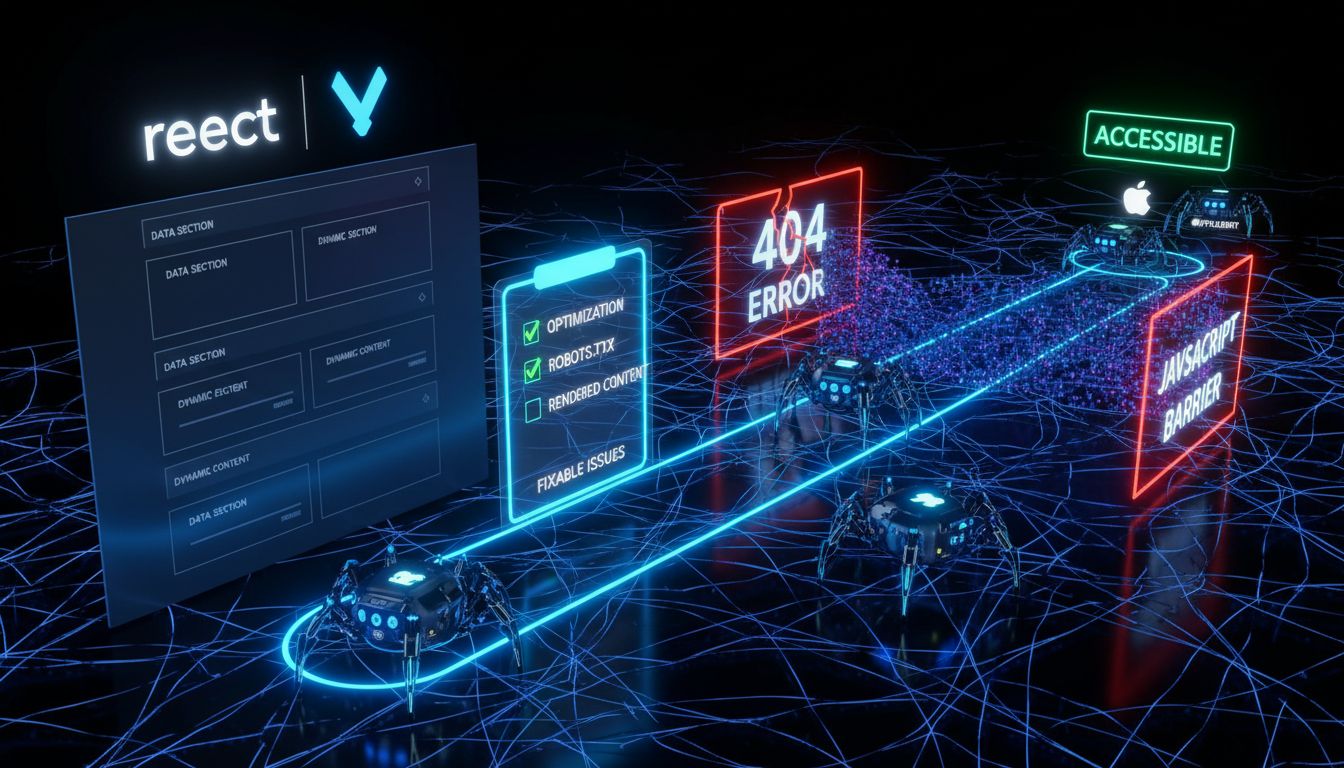
You can optimize content for ChatGPT all day, but if AI crawlers can't actually read your site, you're invisible.
Here's the problem most founders miss: roughly 34% of AI crawler requests result in 404 errors or other failures. Your beautifully optimized content might be completely inaccessible to the very engines you're trying to rank in. Even worse, most AI crawlers don't render JavaScript. Only Google's Gemini and AppleBot currently do. If your core content loads via React or Vue, you're essentially serving blank pages to ChatGPT and Perplexity.
This is fixable. You don't even need a developer to audit it.
Your AI Crawler Readiness Checklist
Run through these five checks before you invest another dollar in ai seo tools:
1. Verify your robots.txt file
Make sure you're not accidentally blocking AI crawler user-agents like ChatGPT-User, Google-Extended, PerplexityBot, ClaudeBot, or anthropic-ai. Most sites block nothing, but if you copied an aggressive robots.txt template, you might be locking out the engines you need most.
2. Check for AI crawler 404s
Pull your server logs or use a log file analyzer to see which AI crawlers are hitting dead ends. Look specifically for failed requests from the user-agents above. If you don't have log access, tools like Ahrefs Site Audit can flag broken internal links that affect all crawlers.
3. Test JavaScript rendering
View your most important pages with JavaScript disabled (Chrome DevTools > Settings > Debugger > Disable JavaScript). If your content disappears, AI crawlers can't see it either. You'll need server-side rendering or static HTML fallbacks.
4. Validate structured data
Run your key pages through Google's Rich Results Test. Confirm that FAQ, HowTo, and Article schema are present and error-free. AI engines use this markup to understand content structure and extract answers.
5. Audit internal linking
AI crawlers follow links just like Google does. Orphaned pages (content with no internal links pointing to it) won't get crawled or cited. Use Screaming Frog or your site audit tool to find and fix orphans.
This is foundational technical SEO for the AI era. The best ai seo optimization strategy in the world won't help if the crawlers never see your content in the first place.
Pitfalls to Avoid: Common AI SEO Mistakes for Startups

You've picked a tool, fixed your technical setup, and started optimizing for AI search. Here's where most founders stumble.
Publishing raw AI output without editing. ChatGPT can draft a 2,000-word article in 90 seconds. That doesn't mean you should publish it as-is. AI hallucinates facts, misses nuance, and produces generic phrasing that tanks engagement. Your job isn't to let AI write for you. It's to use AI to accelerate research and first drafts, then layer in your actual expertise, contrarian takes, and brand voice. Google and ChatGPT both reward specificity and authority. Generic AI slop delivers neither.
Treating AI referrals like traditional organic traffic. A visitor from ChatGPT behaves differently than someone who clicked a blue link in Google. They're often further along in their research, more skeptical, and less patient with fluff. Don't lump AI traffic into your standard organic segment in GA4. Tag it separately and analyze conversion patterns independently. You may find that AI-referred visitors convert at higher rates but in smaller volumes, which changes your content strategy entirely.
Chasing citation volume without context. Getting cited in ChatGPT for your brand name is table stakes. Getting cited for a high-intent commercial query your competitors own? That's revenue.
Not all citations carry equal weight. Your ai seo tools should help you distinguish between vanity wins and business-critical visibility. If they don't, you're flying blind.
Buying an enterprise contract before proving ROI. Start with a mid-tier plan, run a focused 30-day test, and measure actual impact on traffic and pipeline. Scale the budget only after you've validated the tool delivers for your specific use case. Vendors love locking startups into annual commitments. Resist until you have data.
Ignoring compliance deadlines. The EU AI Act's content labeling requirements take effect August 2, 2026. If you serve European users and publish AI-generated content, you need a plan. Factor compliance into your tool selection now, not when the fines arrive.
Your 30-Day AI SEO Launch Plan: From Zero to GEO Traction
You've read the strategy, compared the tools, spotted the traps. Now you need a plan before overthinking kills your momentum.
This isn't about perfection. It's about proving to yourself (and your board) that AI search optimization actually moves the needle. 30 days. Measurable results.
Week 1: Audit & Tool Selection
Days 1-3: Run that AI crawler audit. Check your robots.txt, verify JavaScript rendering for GoogleBot-Extended and GPTBot, scan for 404s that AI crawlers keep hitting. Write down what's broken. All of it.
Days 4-7: Pick one tool from our Top 5 based on your biggest gap. Need visibility tracking? Grab a GEO-focused platform. Starting from zero content? Get a content optimizer. Sign up for the trial and move on. You can switch later if it doesn't fit.
Week 2: Technical Setup & Baseline
Connect your tool to Search Console, GA4, and your CMS. Most platforms handle this with one-click integrations. Takes maybe 10 minutes.
Snapshot your baseline now: current organic rankings for your top 10 keywords AND your AI visibility score. How many citations are you getting in ChatGPT, Perplexity, or AI Overviews? Screenshot everything. You'll want proof of progress later.
Find 3-5 high-opportunity topics where you actually know your stuff but have weak search presence. Look for questions your sales team answers on every single call. Those convert.
Week 3: First Integrated Content Campaign
Use your tool to research and brief one solid cornerstone article. Optimize for traditional SEO signals and GEO citation triggers both: statistics, clear answers, structured data.
Publish it. Send it to your email list. Drop it in one relevant community. You're aiming for initial traction, not going viral.
Week 4: Measure, Iterate & Plan
Check your analytics. Did the new piece move rankings? Earn any AI citations?
Traffic from ChatGPT converts at 15.9%. Even one citation matters.
Document what actually worked. Turn it into a system: research template, optimization checklist, promotion sequence. Plan your next two pieces based on what the data just taught you.
You're not finished. But you've proven the approach works, and that's enough to justify continuing.
Conclusion
The best AI SEO tools for founders in 2026 aren't the ones with the longest feature lists. They're the ones that eliminate your specific bottleneck (whether that's AI visibility tracking, content production, or workflow automation) without demanding a full-time specialist to operate them.
You have a selection framework now. A technical checklist. A 30-day launch plan.
The gap between stagnant organic growth and meaningful AI search traction isn't about budget or team size. It's about choosing the tool that acts as a force multiplier for the constraints you actually face, then executing consistently.
Look, most founders overcomplicate this part. They audit 15 tools, compare pricing tables for weeks, and never actually start. Meanwhile, your competitors are already appearing in ChatGPT responses and Google AI Overviews while you're still researching.
Pick the tool that addresses your primary constraint. If you need comprehensive AI visibility and don't know where you stand, start with Writesonic or Rankscale.ai. Bottleneck is execution and you need workflow automation? Choose AirOps. Already deep in the Semrush ecosystem? Add their AI Visibility module.
Commit to a 14-day trial of your top choice. Run your first AI visibility audit this week. Launch one optimized piece of content by day 14. Measure what changes.
The window to dominate AI search is still open, but it's closing. Start now.
Frequently Asked Questions
Will SEO exist in 5 years?
SEO isn't going anywhere. It's just evolving into two distinct paths.
Traditional Google search will stick around, but the real action is happening in Generative Engine Optimization (GEO). We're already seeing 2 billion monthly users interacting with Google AI Overviews [Source: semrush.com]. The question isn't whether SEO survives, it's whether you'll adapt to citation-based visibility before your competitors figure it out.
Can Google detect and penalize AI SEO?
Yes, Google can detect AI content. But here's what actually matters: they don't penalize you for using AI. They penalize garbage content, regardless of how you created it.
Only 4% of organizations publish AI content without human editing. There's a reason for that single-digit number. Raw AI output lacks the expertise and nuance that actually ranks. Focus on quality, layer in your real experience, and disclose AI use when it makes sense. Trying to trick detection algorithms is a losing game.
Is ChatGPT good for SEO?
ChatGPT works great as an assistant. Terrible as a complete solution.
It's solid for brainstorming keywords, auditing content outlines, and drafting meta descriptions. What it can't do: track your rankings, analyze competitor backlinks, or pull real-time search data. Use it for the "Augment" tasks (research, ideation, first drafts), but pair it with dedicated ai seo tools for execution and measurement.
What is SEO but for AI called?
It's called Generative Engine Optimization (GEO) or Answer Engine Optimization (AEO). Both terms describe the same thing: optimizing your content to appear as citations and sources in AI-generated answers from ChatGPT, Google AI Overviews, Perplexity, and similar platforms.
Think of it as SEO for the 800 million weekly users who ask AI instead of typing into Google [Source: position.digital].
Are AI SEO tools worth it?
They're worth it if the math works and they solve your actual problem.
Median SEO ROI sits at 748% [Source: alloutseo.com]. A $200/month tool that generates even one qualified lead per month pays for itself. The real question is whether the tool saves you more time than it costs and whether it addresses your constraint (GEO visibility, content velocity, technical gaps). Skip tools that duplicate what you can already knock out manually in under an hour per week.
What AI tool is best for SEO?
For most founders in 2026, Writesonic offers the strongest force multiplier. It covers traditional SEO content optimization and GEO visibility tracking in one platform at a founder-friendly price point.
But "best" depends entirely on your bottleneck. Pure GEO tracking? Rankscale.ai starts at $20/month. Scaling content operations? AirOps offers no-code automation workflows. Use the comparison table in this article to match tools to your actual constraint, not whatever the vendor's marketing pitch claims you need.