February 17th, 2026
Real AI SEO ROI: Case Studies and Benchmarks for B2B SaaS (2026 Data)
 WD
WDWarren Day
You're a B2B SaaS marketing leader with flat budgets and rising pipeline targets. Your competitor just published a case study claiming a 6,864% ROI from 'AI SEO.' Meanwhile, your basic SEO tools feel outdated, and you're navigating a maze of AI hype. Where do you even start?
The noise is deafening. Every vendor promises transformation. Every case study shows hockey-stick growth. But when you dig into the numbers, the methodology is murky, the timelines shift, and the costs are conveniently omitted.
Look, 68% of organizations are already changing their SEO strategies in response to AI search. ChatGPT, Perplexity, and Google's AI Overviews are reshaping how your buyers discover solutions. The companies winning aren't just using AI to write faster. They're optimizing for an entirely new discovery layer where traditional SEO metrics don't tell the full story.
The astronomical ROI from AI SEO is real for B2B SaaS, but it's not a one-size-fits-all outcome. It's a function of selecting the best AI SEO tools for your specific growth stage and implementing a disciplined human-in-the-loop workflow that optimizes for both search engines and AI answer engines.
This isn't another listicle ranking tools by features.
You'll get stage-specific ROI benchmarks deconstructed from actual B2B SaaS case studies, a 2026 evaluation framework that maps tools to your ARR and team size, and a concrete workflow blueprint that connects AI capabilities to revenue metrics your board actually cares about. We'll also tackle the attribution challenges that make measuring AI SEO ROI harder than traditional organic and how to solve them without a six-figure analytics overhaul.
Just the framework you need to justify the investment and execute with confidence.
Why This is B2B SaaS's AI SEO Inflection Point (2026)
Your competitors aren't planning anymore. 68% of organizations have already shifted their SEO approach in response to AI search. Not testing it quietly in the background. Actually executing. This is the new table stakes.
AI Overviews now show up for product comparisons, implementation guides, vendor evaluations. The exact queries your buyers use. ChatGPT, Perplexity, and Claude answer "best project management software for remote teams" before prospects even see a traditional search result. These aren't beta features anymore. They're fundamentally changing how B2B buyers discover solutions, and the citation patterns reward a completely different playbook than whatever built your current organic traffic.

What makes 2026 different: The window for establishing authority in AI answer engines is still open. But it's closing faster than you think.
Traditional SEO took years to saturate. Every keyword cluster had entrenched competitors with domain authority you couldn't touch overnight. AI citations are still forming their patterns. A Series A company can appear right next to established players in ChatGPT responses if their content structure and entity relationships are optimized correctly. That wasn't possible in the old game.
The gap between early movers and laggards gets measured in pipeline now, not just rankings. Companies building AI-optimized content workflows today are capturing buyer intent at a stage where traditional organic search doesn't even exist yet. They show up in the research phase, the comparison phase, the validation phase. All before a prospect lands on a SERP.
Here's the trap, though: Most advice right now treats AI SEO as either magic or some distant thing to worry about later. Neither helps you build a budget case or actually execute. The real question isn't whether AI search matters. It's which specific investments generate measurable ROI at your revenue stage, and how you prove it without getting lost in vendor promises.
The Real AI SEO ROI Landscape: Benchmarks vs. Case Studies
You've seen the numbers. A 6,864% ROI case study makes the rounds on LinkedIn. Your board asks why you're not achieving the same.
Here's what they're not telling you: that figure represents $5.9M in revenue over 17 months for a company that implemented a full-stack AI SEO program. Technical optimization, AEO-specific content, schema markup, daily publishing cadence with human oversight. The works.
The aggregate benchmark tells a different story. B2B SaaS companies implementing traditional SEO achieve a 702% ROI with a 7-month break-even. That's still a 7x return, which beats most paid channels by a mile. But it's nowhere near the four-digit percentages vendors advertise.
Why the gap? Three factors create the variance: methodology, company stage, and scope.
Methodology matters because most vendor case studies don't disclose full cost attribution. That 6,864% figure? It measures revenue against tool subscriptions and content production costs. What it doesn't factor in: internal team hours, technical development resources, or the pre-existing domain authority the company built over years. When you run a complete cost analysis with opportunity cost and loaded headcount included, realistic first-year returns cluster between 300% and 900%.
Company stage determines your starting position. A Series A company with minimal domain authority and a 30-page website faces a fundamentally different ROI trajectory than a Series C company with 500 indexed pages and established backlink profiles. The latter compounds faster because AI answer engines cite authoritative domains more frequently.
Scope separates the winners from the disappointed.
Companies hitting 8-10x returns aren't just publishing AI-assisted blog posts. They're running integrated programs: technical SEO audits, structured data implementation, AEO-specific optimization, and systematic citation tracking across ChatGPT, Perplexity, and Google AI Overviews. The best ai seo tools help coordinate these efforts, but they're just one piece of the system.
Here's the framework that actually works:
Early-Stage (Seed to Series A, <$5M ARR): Your goal is establishing foundational visibility. Expect a realistic 3:1 ROI in year one with a $500-$2,500/month investment covering basic tools and freelance content. Look, you can find decent free ai seo tools to start with if budget's tight, but you'll need to supplement them. Focus on bottom-funnel keywords where buyer intent is clear, and start earning initial AI citations in your niche. Break-even typically hits around month 9-12.
Growth-Stage (Series B, $5M-$20M ARR): You're building a scalable pipeline engine. Budget $2,500-$7,500/month for a dedicated resource plus advanced tooling. Realistic ROI sits at 5-10x within 12-18 months. Your KPIs shift to organic pipeline velocity, share of voice in your category, and measurable AI citation volume. This is where human-in-the-loop workflows start generating compounding returns. Proper ai seo optimization requires this blend of automation and human judgment.
Scaling-Stage (Series C+, $20M+ ARR): You're competing for market category ownership. Invest $7,500+/month in an in-house team with enterprise ai seo optimization tools. Expect 8x+ returns with strong compounding effects in years 2-3. Track revenue attribution, AI overview dominance for commercial queries, and citation rates across all major AI platforms.
The outlier results are real. But they're the outcome of stage-appropriate investment and disciplined execution, not magic tools.
AI SEO in Action: 3 B2B SaaS Case Studies by Growth Stage
The outlier results are real. But they're the outcome of stage-appropriate investment and disciplined execution, not magic tools.
Here's what that execution actually looks like at three different company stages, each with completely different strategic priorities.
Early-Stage: FlareAI's 1,000% Traffic & Quality Play
FlareAI, a SaaS startup, ran a 12-month AI SEO program focused on bottom-funnel content. Organic traffic grew from 10,000 to over 100,000 monthly visitors. A 1,000% increase.
But the traffic number isn't the story.
Those organic leads converted at a 25% higher rate than leads from other channels. That's the ai seo optimization advantage early-stage companies actually need: not just more visitors, but better-qualified prospects who are further along in their research. People who land on your site already half-convinced.
The strategic focus here was surgical. Instead of chasing high-volume keywords, FlareAI used AI tools to identify and create content for high-intent, low-competition queries. Exactly where early-stage companies can win without outspending established competitors. The lesson? AI SEO at this stage is a quality play disguised as a traffic play.
Growth-Stage: Rankmax's $5.9M Attribution Engine
Rankmax took a different approach for a B2B SaaS client over 17 months: aggressive optimization for AI answer engines alongside traditional search. Organic users grew 429%, from 4,973 to 26,313. $5.9M in revenue attributed to organic search and AI LLMs.
The key tactic? Securing 138 AI citations across ChatGPT, Claude, and Perplexity.
These weren't accidental mentions. Rankmax structured content with conversational queries, FAQ schema, and authoritative data points that AI models prioritize when generating answers. They reverse-engineered what makes AI platforms cite a source, then systematically built content that triggers those citations.
This is where growth-stage companies should focus: building the infrastructure that makes your brand the default answer in AI-powered research. The traffic from AI citations is small in volume but converts at multiples of traditional organic because these users are asking specific, high-intent questions. They're not browsing. They're researching a purchase decision.
Scaling-Stage: Discovered Labs' Human-in-the-Loop Workflow
Discovered Labs faced a scaling challenge: how to increase content velocity from 8-10 posts per month to the volume needed to dominate their category.
Their solution wasn't just "use AI to write more." It was a disciplined human-in-the-loop workflow that published 66 optimized articles in the first month. A 4x increase in AI-referred trials followed. But honestly, the workflow is what matters for companies at scale:
Cluster-based briefs (human strategist identifies topic clusters) → AI draft generation (structured by intent and search behavior) → expert review (subject matter expert adds nuance and data) → technical optimization (schema, internal linking, conversational structure) → publish → track citations and conversions.
This isn't content creation. It's a production system.
At scale, your competitive advantage isn't the best ai seo tools you use. It's the repeatable process that ensures every piece of content serves both search algorithms and AI answer engines without sacrificing quality. Most companies using free ai seo tools or even premium ai seo optimization tools fail here because they automate the writing but not the strategy, review, or distribution layers. The workflow is the differentiator, not the software.
Evaluating the Best AI SEO Tools for Your Goals (2026)
These results were enabled by tools. But the "best ai seo tools" for your company depend entirely on your growth stage and primary bottleneck, not what's trending on Product Hunt.
Most marketing leaders start with tools instead of workflows. That's backwards. You need to identify where your process breaks down first: Is it content velocity? Technical debt? Attribution blind spots? The answer determines your stack.
Here's how the leading platforms map to real use cases.
AI SEO Tools by Function and Stage (2026)
| Tool | Primary Function | Price (2026) | Best For Stage | Key Limitation |
|---|---|---|---|---|
| Surfer SEO | SERP analysis + AI content workflow | ~$89-$219/mo | Series A-B (scaling content) | Requires strong editorial oversight |
| Jasper | AI content automation at scale | ~$49-$125/mo | Growth stage (high-volume needs) | Generic output without custom training |
| MarketMuse | Topic modeling & content strategy | ~$149-$599/mo | Series B+ (strategic planning) | Steep learning curve, high cost |
| Alli AI | Automated technical fixes (schema, linking) | ~$299-$599/mo | Any stage with tech debt | Limited control over changes |
| Screaming Frog | Technical SEO audits | Free-£259/yr | All stages (foundational) | Manual interpretation required |
| Conductor | Enterprise attribution & ROI tracking | Custom pricing | Series C+ (>$10M ARR) | Overkill for early-stage teams |
| Profound | Prompt tracking & AEO content generation | $99-$399/mo | Series A-B (AI search focus) | Newer platform, limited integrations |
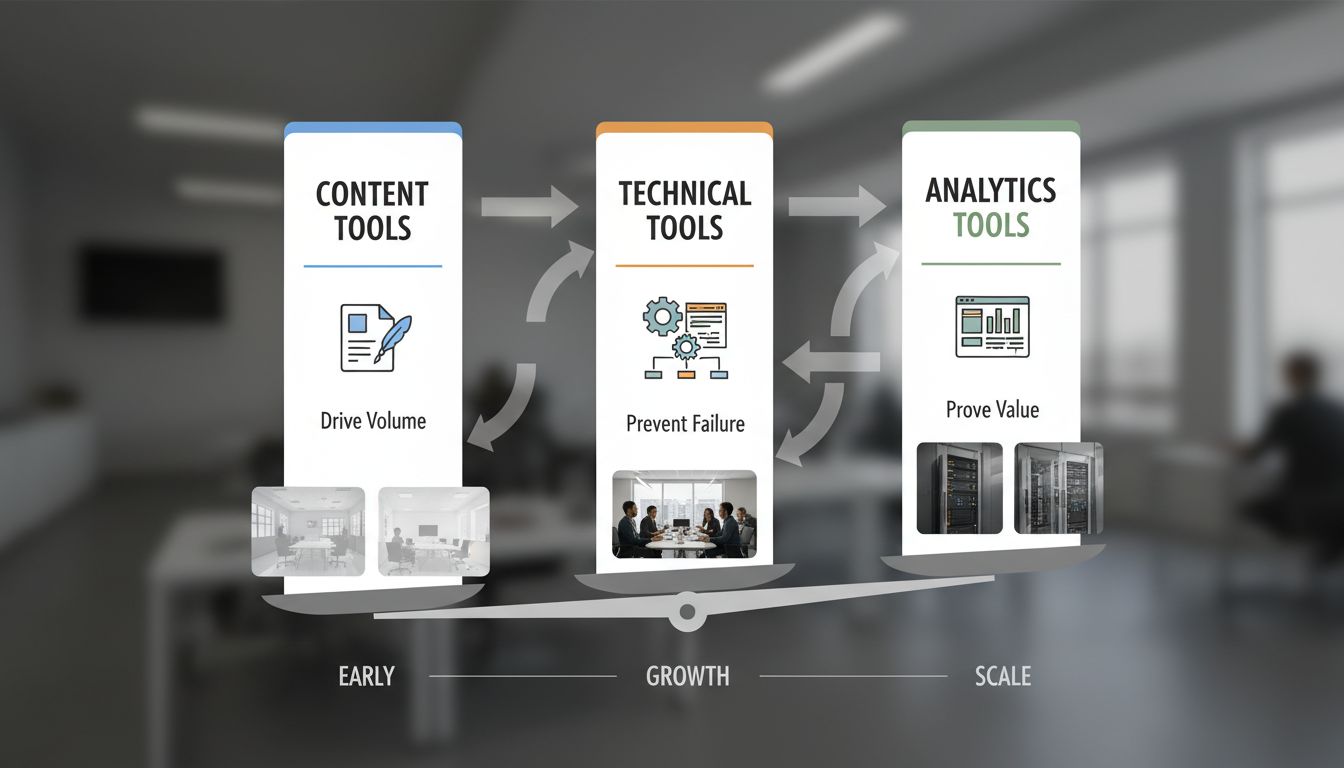
The pattern is clear: content tools drive volume, technical tools prevent failure, and analytics tools prove value. You need all three categories, but the weight shifts by stage.
Early-stage teams ($1M-$5M ARR) should prioritize Surfer SEO or similar platforms that combine research and optimization in one interface. Your bottleneck is producing enough quality content to compete. One B2B SaaS at this stage drove 150% traffic growth in three months by using Surfer to maintain quality while scaling from 8 to 66 articles monthly. They weren't doing anything fancy. Just using the tool to keep standards consistent at higher volume.
Growth-stage companies ($5M-$15M ARR) need MarketMuse for strategic topic planning and Alli AI to handle technical maintenance at scale. Your challenge isn't volume anymore. It's making sure every piece fits a cohesive strategy and your site architecture can actually support it. At this point, random content creation creates more problems than it solves.
Scale-stage organizations ($15M+ ARR) require enterprise attribution platforms like Conductor to connect SEO investment to pipeline. At this level, your CEO doesn't care about traffic. They want to see how $8,000/month in SEO spend translates to closed-won revenue. If you can't draw that line, you don't have budget approval for long.
The "Free AI SEO Tools" Reality Check
Search "free ai seo tools" and you'll find dozens of options. ChatGPT, Claude, and Perplexity can generate outlines and first drafts. Google Search Console and basic keyword planners cost nothing.
These are useful for experimentation. They are not sufficient for a commercial program.
Free tools lack the workflow integration, quality controls, and attribution capabilities that turn content into pipeline. If your board expects measurable ROI, free tools will create more problems than they solve. Specifically, content that ranks but doesn't convert, and no way to prove what's working. You'll spend three months publishing AI-generated articles, your traffic will tick up slightly, and you won't be able to tell your CFO which pieces drove actual revenue.
The right approach: Use free tools to validate concepts in month one, then graduate to paid platforms once you've proven initial traction. Trying to scale on free tools is like running a sales team on Gmail instead of a CRM. Technically possible. Practically insane.
Your tool selection should follow your workflow design, not replace it. The companies hitting 700%+ ROI aren't using different ai seo optimization tools than you. They're using them inside a disciplined process with clear human checkpoints. The software matters less than you think. The system matters more.
Building Your Human-in-the-Loop AI SEO Workflow: A Blueprint
AI scales execution. Human strategy drives relevance and quality. The companies achieving 702% ROI aren't choosing between the two, they're operating a system where both are mandatory.
Here's the exact workflow to implement this week.
Step 1: Strategic Keyword & Topic Clustering (Human-Led)
Start where AI can't: strategic prioritization aligned to your buyer journey and product positioning.
Use MarketMuse or Semrush to identify question clusters that map to awareness, consideration, and decision stages. Filter by search volume, difficulty, and commercial intent. Your human judgment determines which clusters align with your ICP's actual pain points and where you have genuine expertise to contribute.
AI can surface thousands of keywords. You decide which 20 matter for pipeline.
Step 2: AI-Assisted Content Drafting (Tool + Prompt)
Feed your chosen topic into Surfer SEO or Jasper with a detailed brief: target keyword, audience persona, competitive gaps, required structure, and tone guardrails.
The output is a first draft. Nothing more. Treat it like a research assistant's work: useful scaffolding that needs your expertise layered on top. This step should save you 60% of drafting time, not eliminate editing.
Step 3: Human Editing & Expertise Injection (Non-Negotiable)
This is where ROI separates from mediocrity.
Add proprietary data from your product analytics. Insert a customer quote or real use case. Rewrite the introduction to reflect a contrarian or nuanced take your competitors won't have. Make sure every claim is defensible and every example is concrete.
AI-generated content ranks. Human-edited content with unique insights converts and gets cited by other AI engines.
Step 4: Technical & AI Search Optimization (Tool-Assisted)
Run the edited draft through Surfer's Content Editor or use Alli AI to layer in technical ai seo optimization: FAQ schema, How-to structured data, conversational headings optimized for voice and AI queries.
Add a clear, quotable summary in the first 100 words. This is what Perplexity and ChatGPT will cite. Structure answers to anticipated follow-up questions using H3 subheadings.
Step 5: Publishing & Promotion
Publish to your CMS. Distribute through email, LinkedIn, and Slack communities where your ICP congregates.
Seed it on Reddit or relevant forums if the content genuinely answers a community question. No spam.
Step 6: Performance Tracking & Iteration
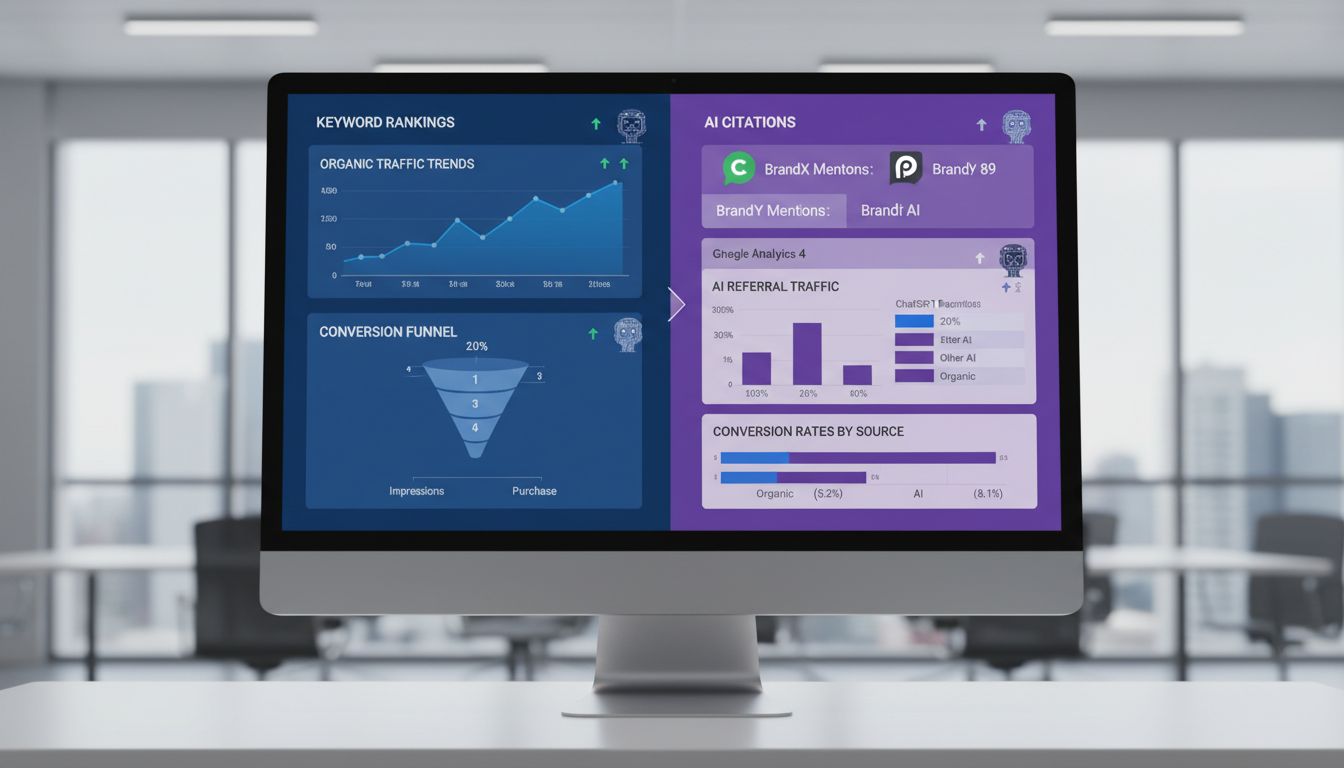
Track traditional metrics (rankings, organic traffic, conversions) plus AI-specific signals: citations in ChatGPT/Perplexity, AI referral traffic in GA4, and conversion rates segmented by source.
Feed high-performers back into Step 1. Double down on topics and formats generating pipeline. Kill or refresh underperformers after 90 days.
The loop matters more than any single piece. One company increased output from 8 posts per month to 66 in one month using this system. But the discipline of human checkpoints at Steps 1, 3, and 6 is what turned volume into revenue. You can't automate those without destroying the quality that makes ai seo optimization tools actually worth using.
Navigating Common AI SEO Pitfalls and Attribution Challenges
You've built the workflow. Now avoid the mistakes that waste your investment.
Pitfall 1: Publishing Unedited AI Content
The fastest way to tank your domain authority is shipping raw AI output. Google's E-E-A-T signals penalize generic, experience-free content, and AI models trained on your competitors' sites will produce exactly that without human intervention.
The fix is Step 3 in your workflow: subject-matter expert review. One B2B SaaS company we analyzed saw a 78% improvement in lead quality after implementing mandatory SME edits on every AI-drafted piece. The content took 40% less time than writing from scratch, but the expert layer made it defensible.
Pitfall 2: Ignoring Technical SEO Foundations
AI answer engines rely on structured data to understand your content. If your schema markup is broken or missing, ChatGPT and Perplexity can't cite you. Doesn't matter how good your content is.
Run a Screaming Frog audit quarterly. Fix broken schema, eliminate duplicate H1s, and make sure your site speed isn't killing crawl budget. Companies that fixed these basics before launching AI content campaigns saw citations appear within four weeks instead of three months.
Pitfall 3: Misattributing AI Search Impact
This is where most teams fail.
AI search traffic doesn't show up cleanly in Google Analytics, and your board wants proof. Here's how to track what's actually working.
Method 1: UTM tagging for AI tool referrals. When your content appears in ChatGPT or Perplexity, the referral traffic often shows as direct or unattributed. Create a tracking protocol: use utm_source=ai_search&utm_medium=chatgpt in any links you control in AI-optimized content to capture partial attribution.
Method 2: Track conversions from AI-cited pages. In GA4, isolate pages that earn AI Overview or Perplexity citations. Compare their conversion rates and assisted conversions before and after citation. AI-cited pages typically see conversion rates 25% higher than comparable organic pages.
Method 3: Estimate branded query lift. When you earn an AI citation, branded search volume typically increases within 2-4 weeks. Track this in Google Search Console as a proxy metric for AI influence, even when direct attribution is impossible.
Pitfall 4: Under-Investing Relative to Stage
A $500/month tool budget won't deliver Growth-Stage results.
Revisit the staged framework: Early-Stage companies need $500-$1,500/month in tools plus 20 hours of internal time. Growth-Stage needs $2,000-$5,000/month and dedicated headcount. Trying to shortcut this produces the 16% ROI outcomes, not the 702% benchmarks. You can't cheap out on the foundation and expect best ai seo tools to magically compensate. Even free ai seo tools require time investment to implement correctly.
Conclusion
The 702% ROI benchmark isn't hype. It's the documented outcome for B2B SaaS companies that treat AI SEO as a strategic investment, not a tool subscription [Source: onely.com].
Here's what separates the 16% outcomes from the 6,864% outliers: picking tools that match your growth stage, running a human-in-the-loop workflow that keeps expertise and strategic judgment in the driver's seat, and waiting 9-18 months for full pipeline attribution to materialize [Source: onely.com]. Patience matters more than most founders want to admit.
Your competitors already know this. 51% of organizations plan to increase AI search investment in 2026 [Source: brightedge.com]. The question isn't whether AI SEO delivers ROI anymore. The data already proved it does. The question is whether you'll implement it with the discipline required to actually capture it.
Start with an audit of your current AI search presence. Pull up ChatGPT, Perplexity, or Claude and search for your core buyer queries. If your brand doesn't show up, you're invisible. And you're leaving pipeline on the table.
Then allocate a stage-appropriate budget, pick one core tool from the framework in Section 4, and implement the workflow from Section 5. The astronomical ROI is real, but only for teams who move past experimentation into systematic execution. The best ai seo tools won't fix a half-committed strategy, and even free ai seo tools require serious implementation work to deliver results.
Frequently Asked Questions
What's a realistic AI SEO budget for a $2M ARR SaaS startup?
Plan for $500–$2,500 per month at your stage. That covers both software and the people who actually make it work.
You're looking at 2–3 core platforms: a content optimizer like Surfer SEO, an AI writing assistant, and keyword research software. But the bigger line item is freelance or part-time specialist hours to run the human-in-the-loop workflow. Software alone won't get you there. Growth-stage companies ($5M–$10M ARR) should budget $2,500–$7,500/month, while scaling orgs ($10M+ ARR) often allocate $7,500+ to support dedicated teams and enterprise platforms [Source: tryprofound.com]. The budget isn't just for subscriptions. You're paying for the strategic oversight that turns AI output into something that actually generates revenue.
How long until we see real AI SEO results (traffic or pipeline)?
Traffic from new AI-optimized content typically shows up within 3–6 months, same as traditional SEO [Source: onely.com]. AI citations in answer engines like ChatGPT or Perplexity can appear faster. Some teams report visibility within 4–8 weeks when they specifically target these platforms with structured data and conversational content.
Full pipeline attribution takes longer. Think 9–18 months, because B2B SaaS sales cycles are long and attribution models need time to mature [Source: onely.com]. Set expectations internally that you'll see leading indicators (rankings, citations, traffic) well before you can prove closed revenue. The revenue will come, but you can't wait for perfect attribution before you commit.
Do free AI SEO tools actually work for B2B SaaS?
For occasional research or testing a hypothesis? Sure. For systematic content production and competitive visibility in AI search? They're a false economy.
Free tiers exist for Surfer SEO, Jasper, and ChatGPT, but they're severely limited for commercial use. Restricted generation quotas, no team collaboration, zero support for answer engine optimization (AEO). You'll spend more time working around limitations than executing strategy. The best ai seo tools require paid subscriptions because they integrate proprietary data, SERP analysis, topic modeling, citation tracking, that free ai seo tools simply can't replicate.
How do you track ROI from AI Overviews and answer engines?
Use three complementary methods.
First, implement UTM parameters to tag traffic from AI platforms like ChatGPT and Perplexity. Many now pass referral data you can capture in GA4. Second, monitor conversions from pages that appear in Google AI Overviews by filtering GA4 landing page reports for your cited URLs and tracking their conversion rates. Third, measure branded query lift after you secure AI citations. If your brand appears in 20 ChatGPT answers this month, watch for corresponding increases in branded organic search and direct traffic as a proxy for awareness impact.
Attribution is still evolving here, so combine quantitative tracking with qualitative feedback from sales calls asking "How did you hear about us?"
Is it true that AI search visitors convert better than traditional organic visitors?
Yes, but the exact multiplier varies.
Research shows AI-referred traffic converts anywhere from 4.4× to 6× higher than traditional organic visitors, depending on industry vertical, product complexity, and how conversion is defined [Source: discoveredlabs.com]. The discrepancy likely comes from intent quality. Users asking AI tools for software recommendations are often further along in their buying journey than someone casually browsing a blog post.
Treat this as a potential upside rather than a guarantee. Benchmark your own organic conversion rate first, then measure AI referral performance against that baseline over 90 days. One case study reported AI traffic converting at 18.7% to qualified opportunities versus a 6.7% baseline, but your results will vary based on offer strength and sales follow-up speed.