February 11th, 2026
AI SEO Workflow Automation: A 5-Step System for Busy Founders
 WD
WDWarren Day
You're a founder, not an SEO expert. You know organic traffic matters, but between product, fundraising, and hiring, the idea of mastering keyword research and content calendars feels overwhelming. Sound familiar?
Here's the harder truth: even if you carve out time to learn SEO, the game just changed. AI Overviews now appear on search results pages, and they're crushing click-through rates. The top-ranking page sees 58% fewer clicks when an AI Overview shows up. Traditional SEO tactics alone won't cut it anymore.
But here's what most founders miss: the solution isn't hiring an expensive agency or becoming an SEO wizard overnight.
It's not even about finding the perfect free ai seo tools and hoping for the best. The winning move is implementing a lean, repeatable 5-step system that automates the grunt work with free tools first, enforced by non-negotiable human checkpoints. Think of it as your SEO assembly line. AI handles the heavy lifting (keyword expansion, content briefs, optimization suggestions), while you focus on the strategic decisions only a founder can make.
This article walks you through that exact blueprint.
You'll learn how to build a sustainable AI SEO workflow that fits your constraints: minimal budget, limited time, and zero room for fluff. No theory. No tool lists without context. Just a practical system you can start implementing today to drive organic growth while AI search reshapes the landscape.
The question isn't whether SEO still works. It's whether you're working it the right way.
Why Founders Need an AI SEO System, Not Just More Tools

Here's the trap most founders fall into: You bookmark a keyword research tool. Download a content optimizer. Sign up for an AI writing assistant. Then you wonder why organic traffic still isn't moving.
The problem isn't the tools. It's that you're treating SEO like a collection of disconnected tasks instead of a repeatable system. You research keywords on Monday, write content on Wednesday, and publish whenever you remember. No workflow. No automation. No compounding momentum.
67% of small businesses now use AI for content and SEO, but most are doing it wrong. They're stacking tools without connecting them. That's like buying ingredients without a recipe. You end up with waste, not results.
What actually works: the 80/20 rule for founder SEO. Eighty percent of your organic results come from systemizing the 20% of high-impact work like strategy, positioning, and quality control. The other 80% is grunt work. Pulling keyword data, formatting meta tags, scheduling posts. That's what AI should automate.
When you build a system instead of hoarding tools, you create leverage. One repeatable workflow replaces ten manual processes. You stop starting from scratch every time you need content.
And you need to move fast, because the game just changed.
AI Overviews are those AI-generated summaries at the top of Google, and they're killing traditional click-through rates. When an AI Overview appears, the top-ranking page sees 58% fewer clicks on average. Your old playbook of "rank #1, get traffic" doesn't cut it anymore.
This isn't about abandoning traditional SEO. You still need to rank. But now you also need to optimize for AI search visibility. Getting cited in those overviews, appearing in ChatGPT responses, showing up when someone asks Perplexity a question.
A system handles both. Tools just sit in your bookmarks folder. The next sections show you exactly how to build that system, starting with free ai seo tools you can deploy this week.
The Founder's 5-Step AI SEO Workflow: Your Blueprint for Automation
Think of this as a flywheel, not a checklist. Each step feeds the next. The output from monitoring becomes input for discovery. The content you publish becomes data for optimization. Nothing happens in isolation, and that's exactly the point.
Here's the complete cycle:
Step 1: Discover – AI finds keywords and topics your competitors are missing.
Step 2: Plan – Automated calendaring turns raw ideas into a publishing schedule.
Step 3: Create – AI drafts, humans refine. Never publish without this checkpoint.
Step 4: Optimize & Publish – One-click deployment with all the technical SEO boxes checked.
Step 5: Monitor & Iterate – Track both traditional rankings and AI Citation Counts, then loop back to Step 1.
The system runs on three non-negotiables. Start with free AI SEO tools before spending a dollar. Enforce human review at every quality gate (93% of marketers do this for good reason). Measure what actually moves the needle in AI search, not vanity metrics.
Most founders ask "Which AI is best for workflow automation?"
Wrong question. The architecture matters more than any single tool. A mediocre tool inside a solid system beats the fanciest AI with no process around it. Every time.
The next five sections break down each step with specific tools, prompts, and time estimates. You'll build this incrementally, not all at once. Trying to implement everything simultaneously is how systems die before they launch.
Step 1: Automated Keyword & Topic Discovery
Keyword research is reconnaissance. You're not mapping the entire battlefield. You're finding gaps where you can break through fast.
The old way? Hours in spreadsheets, manually typing seed keywords into tools, copying endless lists. AI flips this completely. Feed it a handful of ideas and get hundreds of clustered, prioritized targets back in minutes.
Start with three seed sources. Product features ("API monitoring for Node.js"), customer pain points from your support tickets ("why is my site so slow"), and competitor brand names. These aren't keywords yet. They're jumping-off points.
Next, let AI do the expansion. Free tools like Google Keyword Planner, AnswerThePublic, or Semrush's limited free tier can generate variations. But here's where an AI keyword generator actually changes things: Tools like Nightwatch's AI agent don't just dump a list on you. They automatically cluster keywords by search intent (informational, commercial, transactional) and group them into topic families.
Why does clustering matter?
Because "best API monitoring tool" and "API monitoring tutorial" attract completely different visitors at different funnel stages. Without intent grouping, you waste time writing content that ranks but doesn't convert.
Your prioritization filter as a founder: Ignore high-volume, high-competition terms. You'll burn months chasing "SEO tools" when you could own "SEO checklist for SaaS founders" in weeks. Focus on two beachheads instead.
First, People Also Ask questions. These index faster and often trigger featured snippets (free real estate at the top of SERPs). Second, long-tail, low-difficulty keywords with KD under 30. They're specific, easier to rank, and attract buyers instead of browsers.
One contrarian move: Don't obsess over exact search volume. A keyword with 50 monthly searches but crystal-clear commercial intent ("affordable project management tool for remote teams") beats a 500-volume generic term every single time.
Your output from this step: A simple spreadsheet or Notion database with columns for keyword cluster, search intent, difficulty score, and priority rank. This becomes your content roadmap for Step 2.
Paid tools like Semrush and Ahrefs offer deeper data and faster clustering, but they're not required to start. You can build your first 20-keyword hit list entirely with best ai seo tools that are free. Upgrade when you're ready to scale, not before.
Step 2: AI-Powered Content Planning & Calendaring
You've got keyword clusters. Now what?
Most founders stall here. They've got a list of 50 keywords sitting in a spreadsheet, but no clear path from "keyword" to "published post." The result? Analysis paralysis, or worse—random blog posts with no strategic thread connecting them.
This step fixes that. You're building a content calendar that turns clusters into a publishing roadmap you can actually execute.
From Clusters to Calendar
Each keyword cluster becomes a content theme or pillar. If your Step 1 output grouped keywords around "AI workflow automation," "SEO automation tools," and "keyword research," those are your three themes for the quarter.
Map one primary keyword per piece of content. Assign a publish date. Add a status column (Idea → Brief → Draft → Published).
That's your minimum viable calendar.
The 10-20-70 Rule for AI Projects
Here's a mental model that'll save you weeks: spend 10% of your time planning the system, 20% building your initial calendar and brief templates, and 70% on execution and iteration.
Translation? Don't spend three weeks perfecting your Notion database. Spend two hours setting up a simple table with columns for Theme, Target Keyword, Cluster, Due Date, and Status. Then start creating. The system improves as you use it, not before.
Calendar Automation Without the Overhead
You don't need enterprise software. A Notion database with calendar and board views works perfectly. Google Sheets with conditional formatting does too.
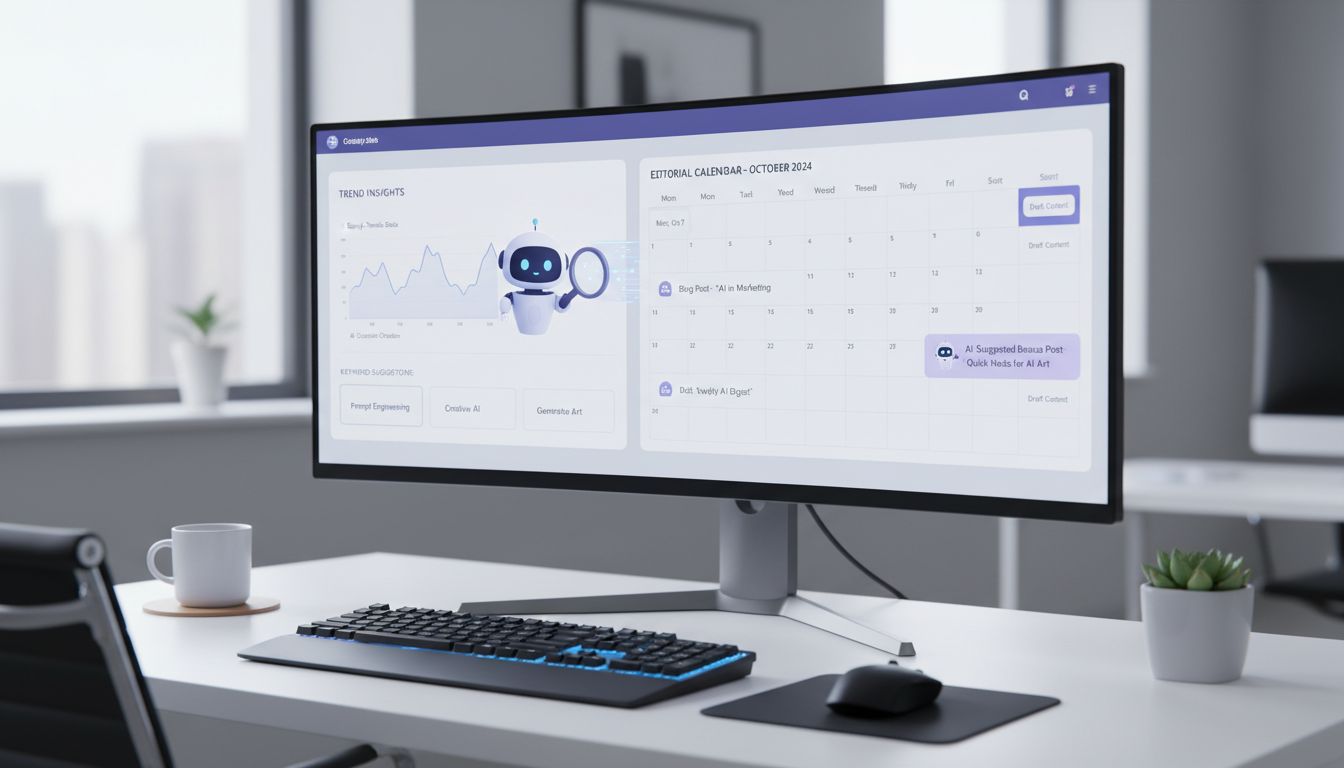
The real leverage comes from AI agents that can monitor trends and update your calendar autonomously. Set a weekly prompt: "Review Google Trends for [your niche]. Suggest three timely angles for our existing content themes." Drop the output into your calendar as bonus posts.
The Goal: Kill Decision Fatigue
When Monday morning arrives, you shouldn't be asking "What do I write about?"
You open your calendar, see "ai keyword generator comparison" scheduled for this week, and start writing. That's the difference between a system and a wishlist. One removes friction. The other creates it.
Step 3: Human-in-the-Loop Content Creation (The Golden Rule)
Here's the golden rule of AI for founders: AI drafts, humans decide.
You're not outsourcing judgment to a language model. You're outsourcing the blank page. The AI gets you 70% of the way there in 10% of the time. Your job is the final 30%. The part that actually matters.
Skip this step and you'll publish confident-sounding nonsense that tanks your credibility. Respect it and you'll cut content creation time by 70–95% while maintaining quality that ranks.
The Process: Brief → Draft → Edit → Publish
Three checkpoints. No magic.
Checkpoint 1: The AI Brief
Before you touch ChatGPT or Claude, build a brief. Think of it as instructions for a smart junior writer who's never heard of your company.
Your brief template:
- Target keyword (e.g., "free ai seo tools")
- Search intent (commercial, informational, navigational)
- Audience pain points ("I'm drowning in SEO tasks with no budget")
- Top 3 competitor URLs (paste the actual ranking pages)
- Required headings and structure (H2s, H3s, word count)
- Brand voice notes ("Practical, no-nonsense, like a founder advising a peer—never use 'dive into' or 'in today's world'")
This brief is your quality control lever. The clearer your input, the less editing you'll do later.
Checkpoint 2: AI-Assisted Drafting
Feed your brief to ChatGPT-4o or Claude with this prompt:
"Using this brief, write a comprehensive draft in a [your brand voice] tone. Include specific examples, avoid generic statements, and structure with short paragraphs."
Let it run. Don't overthink the first output. You're generating raw material, not a finished product.
Opinion Stage did exactly this with Frase for their content briefs. The result? They saved 500+ hours and produced 63 guest posts in a year, improving impressions and average SERP position across the board.
Checkpoint 3: The Non-Negotiable Human Edit
This is where founders separate themselves from content farms.
93% of marketers review AI-generated content before publishing. The 7% who don't? They're the ones getting penalized.
Your human editor (that's you, or someone you trust) must:
- Fact-check everything. AI hallucinates statistics, misattributes quotes, and invents case studies. Verify every claim with a source.
- Inject brand voice and unique insights. Delete the generic fluff. Add your contrarian take, a customer story, or a lesson from your own experience.
- Ensure E-E-A-T is evident. Google wants Experience, Expertise, Authoritativeness, and Trustworthiness. That means real names, real credentials, and real perspectives—not AI's impression of what an expert sounds like.
Can ChatGPT do SEO? Yes, as a co-pilot. No, as the pilot.
Your HITL (Human-in-the-Loop) Checklist
Before you hit publish, tick these off:
- All facts verified with credible sources
- Brand voice is consistent (no AI-isms like "delve" or "landscape")
- At least one unique insight or example added
- Readability score checked (aim for Grade 8–10)
- Meta description written and compelling
- Clear CTA included
This checklist is your insurance policy. Takes 10 minutes. Prevents weeks of reputation damage.
The workflow isn't sexy. But it's the difference between content that ranks and content that embarrasses you six months later.
Step 4: On-Page Optimization & One-Click Publishing
You've edited the draft. It's good. Now comes the tedious part: meta descriptions, alt text, internal links, slug formatting.
This is where most founders either rush through and publish garbage metadata, or procrastinate and never ship at all.
AI handles the grunt work here. Fast.
Generate meta titles and descriptions using your AI tool of choice. Feed it your article and ask for three options optimized for your primary keyword. Pick the one that doesn't sound like a robot wrote it. Same process for image alt text: describe the image context, let AI draft descriptive alt text that includes relevant keywords naturally.
Internal linking is harder to automate, but AI can suggest candidates. Ask: "What existing pages on [yourdomain.com] should I link to from this article about [topic]?" If you've been logging published URLs in your content tracker (Step 2), you can feed that list into the prompt for better suggestions.
For WordPress users, the Yoast SEO free plugin gives you real-time checks on readability and SEO basics. Think of it as a pre-flight checklist. Surfer SEO offers a free content grader that scores your on-page optimization in seconds.
The Automation Setup
Here's a simple Zapier workflow that demonstrates workflow automation in action:
- Trigger: New file moved to "Approved Drafts" folder in Google Drive
- Action: Create draft post in WordPress (auto-populate title, content, category)
- Human gate: Zapier "Request Approval" step—sends you a Slack message with a one-click approve/reject button
- Final action: If approved, publish post and log URL + date to your content tracker spreadsheet
The approval gate is non-negotiable.
Tools like Frizerly can automate scheduled publishing and pull Google Search Console data for monitoring, but you still need eyes on the final post before it goes live.
Why the gate matters: Automation can't catch a broken image, a formatting glitch, or a headline that suddenly feels off-brand. One bad publish damages trust more than a delayed publish damages momentum.
Once live, log the URL and publish date. That's your paper trail for Step 5.
Step 5: Monitoring with AI-Specific KPIs
Publishing isn't the finish line. It's the starting gun.
Most founders check rankings once, see nothing, and move on. That's leaving money on the table. The real wins come from watching what's working, doubling down, and cutting what's not.
Start with the free basics. Google Search Console is your command center. Set up weekly email reports for impressions, clicks, and average position. You're looking for two things: pages climbing (double down) and pages with high impressions but low clicks (optimize the title).
Here's where it gets interesting.
Traditional SEO metrics are becoming half the story. When ChatGPT, Perplexity, and Google's AI Overviews answer questions before anyone clicks, you need new scorecards. Welcome to AI Visibility SEO.
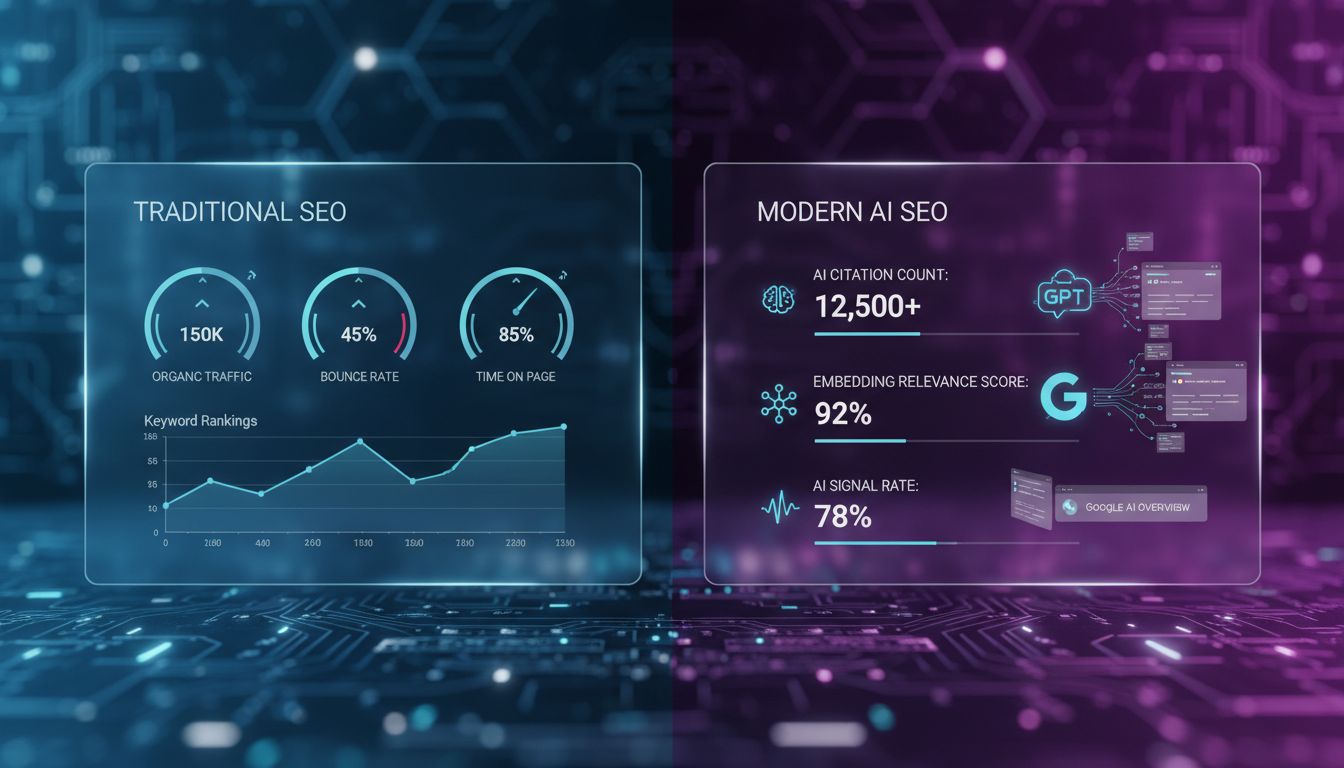
The metrics that matter now:
- AI Citation Count: Is your content being quoted in AI Overviews or chatbot responses? Manually test your target keywords in ChatGPT and Perplexity. If your brand or content shows up, you're winning. If competitors do and you don't, you've found a gap.
- Embedding Relevance: Harder to track without paid tools, but the concept is simple. Are AI models "learning" from your content? Pages with clear structure, authoritative sources, and FAQ sections perform better here.
- AI Signal Rate: Track what percentage of your target keywords now trigger an AI Overview in Google. These overviews correlate with a 58% lower click-through rate for the top organic result, so you need to optimize for the overview, not just around it.
The quarterly refresh rule is non-negotiable. Pages not updated at least once every three months are three times more likely to lose AI citations. That's not a suggestion. It's survival. Build quarterly content audits into your calendar (back in Step 2). Update stats, add new examples, refresh timestamps.
Look, this isn't set-and-forget. It's a flywheel.
Close the loop. Every month, export your top 20 pages by traffic from Search Console. Look for patterns: Which topics are climbing? Which keywords are you almost ranking for (positions 8–15)? Feed those insights back into Step 1. Your best keyword ideas come from what's already working.
The more you monitor, the smarter your next content gets. That's how you turn free ai seo tools into a system that compounds instead of one that collects dust.
Building Your Stack: Free AI SEO Tools vs. Scaling Up
Here's the philosophy that keeps founders sane: Start free, prove ROI, then scale.
You don't need a $500/month tool subscription when you're publishing three posts a month. You need to prove the system works first. Run the 5-step workflow with free ai seo tools for 90 days. Track your time saved and organic traffic gains. When you hit a ceiling (keyword data runs dry, content velocity slows, or monitoring becomes manual drudgery), that's when you upgrade the specific step that's bottlenecking you.
Not the whole stack. Just the friction point.
Here's your tiered roadmap:
| Step | Free Tools (Start Here) | Paid Upgrade (Scale Later) |
|---|---|---|
| 1. Discover | Google Keyword Planner, AnswerThePublic | Semrush, Ahrefs, Nightwatch AI Agent |
| 2. Plan | Notion, Google Sheets, Trello | Ayanza, Asana with AI |
| 3. Create | ChatGPT 3.5/4o, Claude Sonnet | Jasper, Frase, Surfer AI Agents |
| 4. Optimize | Yoast SEO Free, Surfer Free Grader | Surfer SEO, MarketMuse, Clearscope |
| 5. Monitor | Google Search Console | SE Ranking, Semrush Position Tracking, dedicated AI KPI dashboards |
Most founders ask, "What AI tool is best for SEO?" Wrong question.
The best tool is the one that solves your current bottleneck without breaking your budget. If keyword discovery feels like guesswork, upgrade Step 1. If you're spending six hours per post on optimization, upgrade Step 4. Publishing 20+ pieces monthly and losing track of what's working? That's when Step 5 needs an upgrade.
The free tier proves your system. Paid tools amplify results you've already validated.
That's the difference between founders who waste budget chasing shiny tools and those who build sustainable organic growth engines. Start lean. Scale smart. Let ROI dictate your stack, not FOMO.
Common AI SEO Pitfalls & How Founders Avoid Them
Every founder who's tried AI for SEO has hit at least one of these walls. The good news? They're all avoidable if you know where the tripwires are.
Pitfall 1: Publishing Without Human Review
This is the fastest way to torch your credibility.
AI hallucinates facts, invents statistics, and confidently states things that are flat wrong. One bad claim in a blog post can cost you a customer's trust forever. I've seen companies publish AI-generated "data" about their own industry that was completely fabricated. The founder didn't catch it until a prospect called them out on a sales call.
Your mitigation is already built in: the HITL checklist from Step 3. Brief approval, draft review, fact-check, brand-voice edit, final publish approval. Non-negotiable.
Pitfall 2: Generic, Bland Content
AI defaults to "corporate blog voice." Safe, boring, indistinguishable from every other SaaS company. Google calls this out explicitly: content without experience, expertise, or originality won't rank.
Your fix? The brand-voice section in your AI brief template and the human editing layer. AI drafts the structure; you inject the personality, the contrarian takes, the real examples. The stuff that actually makes someone want to read past the first paragraph.
Pitfall 3: Using the Wrong Tool for the Job
Founders waste weeks trying to force ChatGPT to do keyword clustering or using a $500/month tool for a task a free one handles better.
Tool mismatch kills momentum. I've watched teams spend three weeks configuring an enterprise SEO platform when they're publishing four posts a month. That's backwards. Stick to the tiered stack from the previous section. Free ai seo tools for proof-of-concept, paid tools only when ROI is proven.
Pitfall 4: Expecting Instant, Magic Results
AI accelerates execution, but SEO still obeys physics.
Positive ROI for AI SEO campaigns typically lands in the 6–12 month range. If you're checking rankings after two weeks and panicking, you're setting yourself up to quit early. The temptation is real. You publish ten optimized posts and refresh Google Analytics hourly. Nothing happens. So you assume it's broken.
It's not. Set realistic milestones. Track leading indicators like content published, keywords targeted, citations earned. Traffic spikes come later.
Pitfall 5: Not Refreshing Old Content
You publish 20 posts, celebrate, then wonder why traffic plateaus. Pages that sit untouched lose AI citations and rankings. The algorithm rewards freshness, and your competitors are updating their posts while yours age out.
Your quarterly refresh cadence from Step 5 solves this. Update stats, add new sections, refresh examples. Rinse, repeat. A 15-minute update to a post from six months ago often outperforms publishing something brand new.
These aren't hypothetical. They're the five biggest AI fails founders hit in SEO workflows, and every single one has a system-level fix already in your playbook.
Conclusion
The question isn't whether AI will change search. It already has. The question is whether you'll build a system that adapts or keep patching together random tools.
You've seen the blueprint: a 5-step flywheel that turns free ai seo tools into a sustainable growth engine. Discover keywords that matter. Plan content that scales. Create with AI, edit with judgment. Optimize without the grunt work. Monitor what AI search actually rewards. Then repeat.
This isn't about becoming an SEO wizard. You're a founder. Your job is to build systems that work while you're solving the next problem. The best AI SEO tools don't replace strategy, they execute it faster than any agency could, at a fraction of the cost.
Start small. Pick Step 1 or Step 3. Implement it this week using the free stack. Set one human checkpoint. Track one new KPI. Prove it works, then systematize the rest.
Organic growth compounds. So does the time you waste if you don't start.
Your move: Download the HITL Checklist. Block two hours. Build your first workflow. The founders already ranking in AI Overviews didn't wait. They shipped.