May 6th, 2026
How to Do Search Engine Optimization: A Step-by-Step Guide for Founders
 WD
WDWarren Day
What if you could skip most of the SEO advice out there and just do the parts that actually matter?
Your initial growth hack is running out of steam. Paid acquisition costs are climbing. And every time you go looking for answers, you end up buried in a mountain of checklists that seem to require a full-time expert just to start.
Most founders hit this wall.
Here's the thing though: 53% of all website traffic comes from organic search. That's your future customers, right now, searching for solutions you already provide. If your site isn't showing up, that's just revenue walking out the door.
So this guide cuts through the noise.
Effective how to do search engine optimization for founders isn't about knowing everything. It's about executing a focused 90-day priority stack that gets you measurable traction before you start scaling effort. No endless checklists. No vague advice.
What you actually need is a founder-first system: time-boxed sprints that fix critical technical blockers first, publish a tight set of high-intent content, and build just enough authority to start ranking.
I'm Warren, a senior software engineer and technical founder. I don't just write about SEO, I build the systems that automate it at scale through my platform, Spectre. I've also worked inside large media companies and watched firsthand how domain rating dictates what you can realistically rank for. I treat SEO as an engineering problem: testable, measurable, and ruthlessly prioritized.
This guide is that system.
You'll start with the foundational mindset shift every founder needs, then move through a 90-day playbook split into three phases: laying your technical foundation, building a content engine that compounds, and earning targeted authority. We'll cover what's actually changed in 2026 (AI Overviews, Core Web Vitals thresholds) and finish with a practical framework for figuring out what to do yourself, what to automate, and when to hire.
Before You Start: The Founder's SEO Mindset and Prerequisites
SEO isn't a quick fix. It's a system.
If you're expecting to write a blog post today and see revenue tomorrow, you'll be disappointed. The data is clear: it typically takes 6–12 months to see significant ROI from SEO Source: Searchlab. Your 90-day mission isn't to "win" SEO. It's to build a foundation that compounds over the next 6–12 months.
Forget everything you've heard about chasing random keywords. Founder-led SEO succeeds through ruthless prioritisation. The core philosophy: First, fix what's broken. Then, build what compounds.
That means solving critical technical blockers before you publish a single new article. It's the engineering mindset applied to marketing.
You absolutely can figure out how to do search engine optimization as a beginner. The question isn't about knowledge, it's about focus.
Most founders fail because they attempt random acts of blogging without fixing the pipes first. We'll use a time-boxed framework I call the Founder's SEO Time Stack to make this manageable:
- The 10-Minute Daily Check: Glance at critical signals.
- The 1-Day Foundation Sprint: Lock down technical essentials.
- The 1-Week Implementation Burst: Execute quick wins.
- The 90-Day Compounding Playbook: Build momentum.
Before we start, make sure you have these:
- A functional website you control.
- Access to your CMS or web host (to edit code/upload files).
- A Google account (for free, essential tools).
- A willingness to dedicate focused blocks of time, not just fragmented minutes.
Your toolkit starts with three free tools you'll use daily:
- Google Search Console: Your direct line to Google for errors and indexing.
- Google Analytics 4: To measure what actually converts.
- PageSpeed Insights: To benchmark and fix site speed.
Your 10-minute daily routine looks like this:
- Check Google Search Console for critical coverage errors.
- Glance at the Core Web Vitals field report for performance regressions.
- Note the top landing pages in GA4 for traffic spikes or drops.
- (If you're a local business) Check Google Business Profile insights.
The mindset shift, from chasing hype to systematic execution, is step one. Everything else builds from here.
Phase 1: Lay Your Foundation (Days 1-30)
The first month isn't about ranking. It's about making sure Google can find you at all.
Think of it like fixing the plumbing before you build the house. You're removing blockers, not chasing wins.
Day 1: Your 5-Point Foundational Sprint
Do these five things in one focused day. They're the minimum you need before anything else makes sense.
1. Set Up & Verify Google Search Console + Connect GA4
Register your site in Google Search Console using multiple verification methods (HTML file, DNS, or Google Analytics). The redundancy matters, if one method breaks, you don't lose access.
Once verified, submit your XML sitemap. Make sure it only contains canonical URLs, not duplicates or paginated pages. Then connect GA4 in the GSC settings so your search performance data links up with your conversion tracking.
2. Run a PageSpeed Insights Report
Go to PageSpeed Insights, enter your homepage URL, run the test. You want three numbers: Largest Contentful Paint (LCP), Interaction to Next Paint (INP), and Cumulative Layout Shift (CLS).
Compare them against the 2026 benchmarks: LCP under 2.5 seconds, INP under 200 milliseconds, CLS under 0.1 Source: whitelabelcoders.com. One thing people miss: "Lab Data" is simulated, "Field Data" is real users. Google uses field data.
3. Inventory Your Top 5 Revenue Pages
Open a spreadsheet. List your five most important commercial pages, homepage, core product or service page, pricing, a key feature page, your contact or sales page.
For each one, check manually:
- Does it have a unique
<title>tag under 60 characters? - Does it have a unique meta description under 160 characters?
- Is there one clear primary keyword it should rank for?
This step prevents keyword cannibalization early, where your own pages end up competing against each other.
4. Validate HTTPS and Mobile Responsiveness
Check that your site loads over https:// and not http://. Then run Google's Mobile-Friendly Test.
The real check isn't just whether it's "mobile-friendly." It's whether the mobile version has content parity with desktop. All the key text, images, CTAs, are they actually there? Google uses mobile-first indexing, so the mobile version is what gets crawled and indexed.
5. Perform a Basic Crawl Health Check
Download the free version of Screaming Frog SEO Spider. Set it to crawl up to 500 URLs, starting from your homepage.
You're not doing a full audit yet. Just scan the "Response Codes" tab for 4xx errors (404s) and 5xx server errors. Then glance at the "Redirect Chains" tab, if you see Page A → B → C chains, that's worth cleaning up.
Week 1: System Setup and Core Web Vitals Quick Wins
Conduct a Full Technical Crawl
Run Screaming Frog again, this time deeper. Free version covers up to 500 pages; larger sites need the paid license. Export the data and look for:
- Soft 404s: Pages returning "200 OK" but with basically no content, empty search results, zero-result filtered pages.
- Duplicate Content: Pages with identical or near-identical titles and meta descriptions.
- Faceted Navigation & URL Parameters: Filter systems like
?color=red&size=largecan silently create thousands of duplicate URLs and eat your crawl budget. - Missing Canonicals: Every page should have a self-referencing
rel="canonical"tag pointing to itself.
Implement Actionable CWV Fixes
Work through the highest-impact PageSpeed fixes first.
- Convert images to WebP/AVIF. Use a build plugin like
sharpfor Node.js sites, or a CDN like Cloudinary to serve modern formats automatically. Addwidthandheightattributes to your<img>tags, this alone prevents a lot of layout shifts. - Defer non-critical JavaScript. Chat widgets, heavy analytics, social embeds, load those after the main content.
- Remove unused third-party scripts. Go through your
<head>tag. That heatmap tool you stopped using two years ago is probably hurting your INP score.
From my engineering work, the most common INP culprits on startup sites are poorly implemented chat widgets (Intercom, Drift) and heavy analytics scripts that fire on every click. Lazy-load them or simplify them.
Finalize Initial Keyword Mapping
Don't chase volume yet. Use this filter: compare your site's Domain Rating (DR) against Keyword Difficulty (KD). If your DR is below 40 (check with Ahrefs' free backlink checker), stick to keywords with a KD below 40.
For discovery without a paid tool, WordStream's Free Keyword Tool works fine to start. Pick 3-5 keywords that map tightly to your top revenue pages and have clear commercial or informational intent.
Set Up Your Foundational Dashboard
In Google Looker Studio, create a new report using the Google Search Console and GA4 connectors. Build three cards: Organic Sessions, Organic Conversions, and a table of Top Landing Pages by organic traffic.
That's your baseline. You'll need it later.
The Realistic Keyword Filter: Understanding DR vs. KD
Here's what most beginner guides on how to do search engine optimization skip over: keyword difficulty scores are relative.
Tools like Ahrefs or Semrush estimate how hard it is for an average site to rank. If your Domain Rating is low, your backlink-powered "credit score" with Google, the actual difficulty is much higher than the number suggests.
A keyword with a reported KD of 50 isn't a 50/100 challenge. For a site with DR 30, it's closer to an 80. The tools don't account for the backlink gap. Pages ranking #1 have, on average, 3.8× more backlinks than pages in positions 2–20 Source: searchlab.nl.
Your rule for the first 90 days: target keywords where KD is equal to or less than your DR. DR 25? Look for KD 25 or lower.
This forces you into niche, intent-aligned phrases where you actually have a shot, instead of broad terms where you'll spend months producing content that never moves.
Intent alignment matters more than raw volume anyway. "How to integrate Stripe with React" (lower volume, high intent) is a better early target for a developer tools startup than "payment processing" (high volume, impossible competition).
Phase 2: Build Your Content Engine (Days 31-60)
Technical foundation is solid. Now comes the part most founders either skip or get completely wrong.
96.55% of content online gets zero organic traffic. That's not a small problem. Your job this month is to build the small set of high-intent assets that actually rank, not to publish constantly.
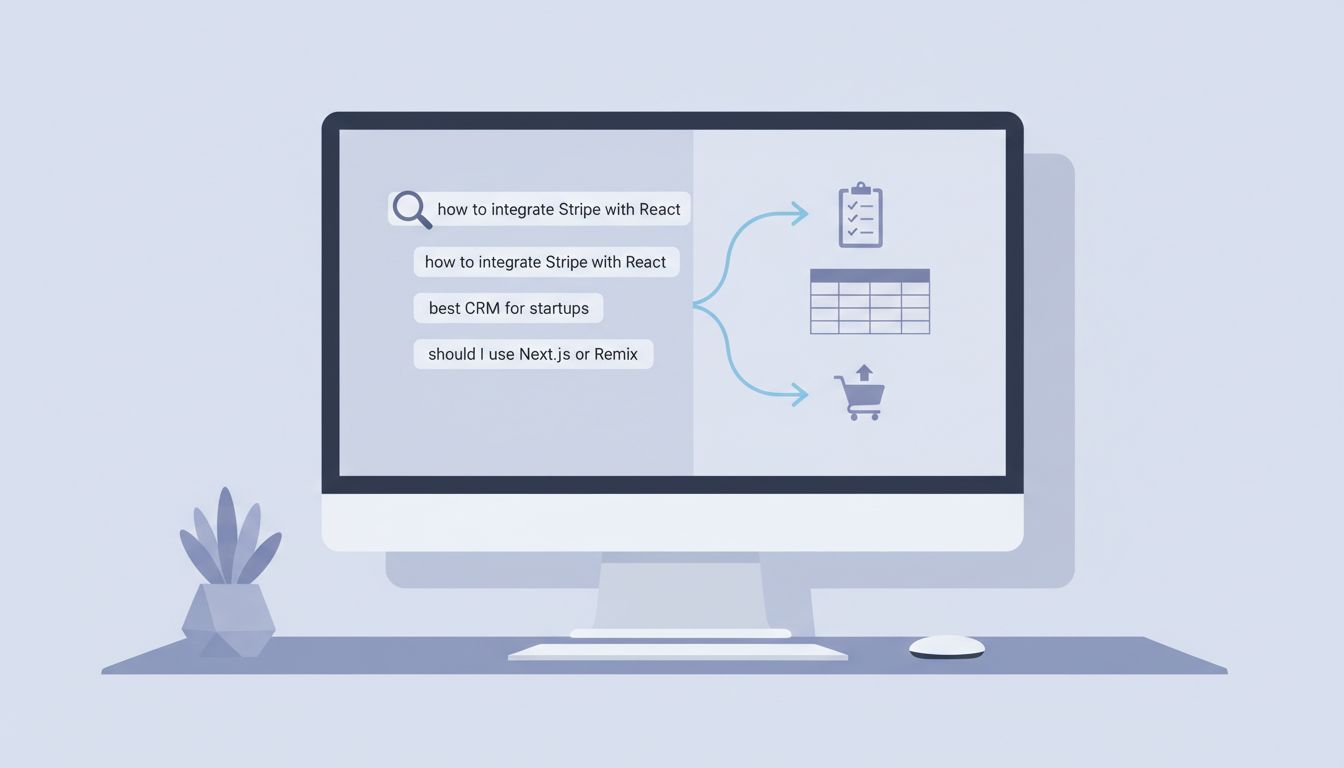
Go back to the keyword research from Phase 1. For each target, figure out the intent behind it. Is someone trying to learn something, compare options, or buy? That determines the format. A "how-to" query needs a step-by-step tutorial. A "best X for Y" comparison needs a features breakdown.
Build a simple spreadsheet that maps each keyword to:
- Target page URL
- Primary search intent
- Content format (guide, comparison, case study)
- Target publish date
Prioritize keywords where you can add something nobody else can. As a founder, you're solving customer problems every day. That's your content goldmine.
The AI-Assisted, Founder-Powered Content Workflow
Here's the real situation: 86.07% of SEO professionals now use AI in their workflows. SEO isn't being replaced by it, it's being changed by it. The question is whether you're using it in a way that actually works.
Use AI tools for research, ideation, and getting past the blank page. Run your keyword through ChatGPT or Claude to generate outline variations. Use Jasper or Copy.ai to draft initial sections. AI-generated articles with human editing run about $20-100 each, that's a useful benchmark if you're thinking about outsourcing.
Then comes the part you can't skip: your actual experience. This is where E-E-A-T (Experience, Expertise, Authoritativeness, Trustworthiness) matters. Add specific anecdotes from customer conversations. Include screenshots of your real product workflow. Reference the implementation problems you've actually solved.
The final edit isn't optional. Verify every technical claim. Swap out generic advice for the hard-won lessons. Add "why we built it this way" context that only you have. That founder perspective is what separates your content from the flood of AI-generated articles filling search results right now.
Forget publishing daily. Early-stage SaaS should aim for 4-8 high-quality pieces a month. Here's a realistic 90-day calendar:
Weeks 1-4: 2 product-led tutorials solving specific customer problems, 1 comparison guide ("Our Tool vs. Established Alternative") Month 2: 1 original industry report with proprietary data, 2 problem-awareness posts addressing pain points Month 3: 1 detailed customer case study (with permission), then go back and expand your Month 1 content based on how it performed
That pace is sustainable. It also gives each piece enough time to actually get promoted.
For every piece you publish, run this on-page SEO checklist:
- Title Tag: Include primary keyword naturally, keep under 60 characters
- Meta Description: Write a compelling 155-character summary with a clear value proposition
- Headers: Use H1 for main title, H2 for major sections, H3 for subsections, include keyword variations
- internal links: Link to 3-5 relevant existing pages using descriptive anchor text
- Images: Optimize filenames (keyword-descriptive.jpg), add alt text, compress to WebP format
- Structured Data: Implement JSON-LD schema, Article schema for blogs, HowTo for tutorials, Product for comparisons
The most common mistake at this stage is publishing thin content. If your article could've been written by someone who's never used your product, it's not good enough. Google's algorithms increasingly detect and demote content that lacks genuine expertise.
This applies to how to do search engine optimization in general, not just content. Most founders try to copy what big sites do, without the domain authority or content depth to back it up.
Your advantage isn't budget. It's authentic experience. A 1200-word guide written by someone who's actually solved the problem will outperform a 3000-word generic overview. Every time.
Phase 3: Earn Authority and Accelerate (Days 61-90)
Content is live, site is technically sound. Now the hard part.
Pages ranking #1 have 3.8× more backlinks than pages ranking 2–20. Without authority signals, good content just... sits there. For a startup, you're not trying to chase thousands of links. You're trying to earn 5-10 quality ones that signal you actually know what you're talking about.
Think of it like social proof for Google. A backlink from a respected site is a vote. That's your goal this month.
Build Link-Worthy Assets, Not Just Content
Don't ask for links to your product page. Nobody's citing that.
Create something worth referencing. As a founder, you have access to real customers, real data, and niche insight most writers don't. Use it.
A few ideas that actually work:
- A Simple ROI Calculator: Build a web tool where users input their metrics (team size, current tool cost) and see potential savings. We embedded one for our agency's content platform and it became our most-linked page.
- Customer Survey Results: Poll your users about a common pain point. Package the findings into a short report. "State of [Your Industry] 2026" has a natural hook for journalists and bloggers.
- Public Data Analysis: Find a relevant dataset (Google Trends, GitHub activity, public API usage stats) and make something visual out of it. Works especially well for technical audiences.
The asset should solve a micro-problem or give someone a data point they'd naturally want to cite. Utility is the whole game.
Execute Three Low-Budget Link Tactics
With your asset ready, here's where to put it to work.
- Convert Unlinked Brand Mentions: Set up Google Alerts for your company name, product name, and founder names. When someone mentions you without a link, send a short email. Thank them, and suggest linking to your relevant page for their readers' convenience. The success rate here is surprisingly high.
- Strategic Guest Posting: Target 2-4 publications where your ideal customers already are. Don't pitch generic content. Pitch something founder-specific: "How We Bootstrapped Our SaaS to 100 Customers Using Only Organic Search." The byline and link back to your site are the payoff.
- Resource Page Outreach: Use Ahrefs or a manual search (
"your industry" + "resources" + "links") to find curated lists and "best tools" pages. If your asset is genuinely helpful, propose adding it. Frame it as improving their resource, not promoting yours.
Avoid spray-and-pray outreach. Personalize every email. Mention something specific they wrote and explain why your asset fits.
Distribute Authority with Internal Links
When you earn a backlink to a page, that page gains link equity. Your job is to spread that credit around via internal links.
Review your top 5 commercial pages (pricing, main product page, demo signup). From any new authority-rich content, add 2-3 contextual links pointing to those key pages. Use descriptive anchor text like "learn more about our API pricing" instead of "click here."
That tells Google which pages matter most.
Conduct Your First Quarterly Review
End of 90 days. Open Google Search Console and Google Analytics 4 side-by-side and check three things:
- Keyword Movement: In GSC, filter the Performance report for the keywords you targeted in Phase 2. Have any entered the top 20? Note the current average position.
- Traffic Growth: In GA4, go to Acquisition > User Acquisition. Filter for "Organic Search." Is the trend line moving up, even slightly?
- Backlink Profile: In Ahrefs or Semrush, check your new referring domains. Are they from reputable sites in your space?
Don't expect massive jumps. Look for consistent, incremental movement.
This is how to do search engine optimization as a small team, not all at once, but compounding. Targeted content plus earned authority, adding up over time. By now you have a repeatable playbook. That's the whole point.
SEO in 2026: Navigating AI Overviews and Evolving Signals
SEO isn't dead. It's just harder to ignore the parts you used to skip.
Google's AI Overviews show up on a big chunk of search results now and they do cut into organic click-through rates. But traffic doesn't disappear, it just moves. The AI still cites sources, and those citations go to pages with clear authority signals, structured data, and actual credibility. If you built your foundation right in Phase 1, you're already better positioned than most.
This is why structured data (schema markup) isn't optional anymore. From building Spectre, our AI-powered SEO platform, I've watched firsthand how schema feeds these models the context they need to understand your content. JSON-LD markup on product pages, articles, and local business info directly influences whether you show up in AI Overviews and rich results. Not speculation, we see it in how we analyze SERP features for clients.
Discovery is also spreading out. People start searches on YouTube, Amazon, Perplexity. Your website has to be the authoritative home base across all of it. Fast, structured, easy for both crawlers and AI models to parse. The technical work from your foundation phase, Core Web Vitals, mobile parity, clean architecture, pays off here.
One thing hasn't changed: 72.9% of top-10 ranking pages are over three years old. Age and sustained authority still matter. AI Overviews shift how people find you, but they don't rewrite how trust and expertise actually work.
So don't panic about AI "killing" SEO. The fundamentals that matter to algorithms also happen to matter to humans: technical quality, clear entity signals through schema, genuinely helpful content. That's how to do search engine optimization in a world where the channels keep multiplying but a credible, findable presence matters just as much as it ever did.
The Founder's Decision Framework: DIY, Automate, or Hire?
You've learned the system. Now comes the question every founder actually gets stuck on: where do you put your limited time and money?
It's not a yes/no answer. It depends on three things: how much time you have, how technical you are, and what your budget looks like.
DIY for foundational control and strategy. Handle the initial setup, keyword mapping, and performance reviews yourself. You know your business, your customers, and your roadmap better than any outside hire ever will. Setting up Google Search Console, connecting GA4, checking weekly traffic, that's minimal time for serious strategic visibility. Don't hand this off.
Automate content production with AI tools and your oversight. This is the sweet spot for most early-stage teams. AI-generated articles with proper editing run $20–100 each, and automation platforms are $69–200/month. Use them to scale output, not to replace your thinking. You write the brief, pick the target keywords, and do the final edit for E-E-A-T. The tool handles the draft.
Hire for complex technical work. Large-scale migrations, deep technical debt, scaled link-building, that's when it makes sense to spend. Full-service agencies typically run $2,000–10,000+ per month. That's a real commitment, so save it for problems you genuinely can't solve internally, not for figuring out where to start.
From building Spectre (an AI SEO platform) and working as a contractor, here's the test I actually use: if a task is repeatable and rule-based, like meta description generation or basic content briefs, automate it. If it needs deep business context, keep it in-house. If it requires specialised technical skills you don't have, like fixing server-side rendering for Core Web Vitals, bring in a specialist for that one project.
When you do hire, find people who explain their reasoning clearly, show you their data, and talk about business outcomes. Not just ranking reports.
Anyone promising instant #1 rankings, or who can't connect their work to your revenue, that's a no. And knowing how to do search engine optimization yourself, even at a basic level, is what lets you spot the difference.
Common SEO Mistakes and Troubleshooting for Founders
Something's not working. Where do you even start?
Usually it's not one big catastrophic error. It's four small ones stacking on top of each other. Here are the most common failure points I see, and how to diagnose them.
Mistake 1: Targeting impossible keywords Symptom: Content publishes but never moves from page 20. Diagnosis: You're ignoring the Domain Rating (DR) vs. Keyword Difficulty (KD) reality. Pages ranking #1 have an average Domain Rating of 78 [Searchlab]. Your startup likely has a DR under 30. Fix: Return to Phase 2. Target keywords with KD30 until your DR grows.
Mistake 2: Publishing unedited AI content Symptom: Pages indexed but zero traffic, or high bounce rates. Diagnosis: Thin, generic content lacks E-E-A-T signals. Google's systems detect this. Fix: Every AI-generated piece needs human editing for expertise, experience, and unique perspective. Add specific examples, tool names, and real workflow friction points.
Mistake 3: Neglecting internal linking Symptom: Key commercial pages have no traffic despite being optimized. Diagnosis: Link equity isn't flowing to important pages. They're isolated in your site architecture. Fix: Create a simple spreadsheet mapping your 20 most important pages. Ensure each has at least 3-5 relevant internal links from other content.
Mistake 4: Technical bloat resurfacing
Symptom: Your crawl report shows thousands of duplicate URLs months after your initial audit.
Diagnosis: Faceted navigation, session IDs, or parameter-based filtering creates new duplicate content.
Fix: Implement rel="canonical" tags and use robots.txt to block parameter crawl paths. Monitor monthly with Screaming Frog.
Mistake 5: Ignoring Core Web Vitals field data Symptom: Lab tests show good scores, but rankings stagnate. Diagnosis: Field data (real user experience) differs from lab conditions. Google uses field data for rankings. Fix: Check Google Search Console's Core Web Vitals report monthly. Focus on improving INP (Interaction to Next Paint) 200ms and LCP (Largest Contentful Paint) 2.5s for your actual users.
Mistake 6: Invalid structured data Symptom: No rich results despite implementing schema. Diagnosis: JSON-LD errors or outdated markup. Fix: Test every schema template with Google's Rich Results Test before deployment. Audit quarterly, Google's requirements evolve.
Mistake 7: Inconsistent local NAP (for local businesses) Symptom: Local rankings fluctuate wildly. Diagnosis: Name, Address, Phone number mismatches across directories confuse Google's local algorithms. Fix: Use a tool like BrightLocal to audit and clean your citations. Update Google Business Profile weekly.
Knowing how to do search engine optimization is only half of it. The other half is diagnosing it when it breaks.
When it does, work in order: check indexation first, then technical health, then content quality, then authority signals. Fix in that order. Don't skip ahead.
Conclusion
SEO is an engineering system, not a grab-bag of random tactics.
The difference between wasting months and actually building growth comes down to sequence. Fix critical technical blockers first, build a focused content engine second, then accelerate with targeted authority signals.
The core idea is simple: knowing how to do search engine optimization isn't the hard part. The hard part is executing in the right order. Start with what prevents discovery, move to what creates value, then focus on what builds trust.
Your founder perspective is an actual advantage here. The hands-on experience, the direct customer insights, that's your E-E-A-T edge. Inject it into everything you publish.
SEO isn't dying. It's evolving. AI Overviews change where the clicks go, but they reward the same fundamentals: structured data, real page experience, credible expertise. Organic search still accounts for 53% of all website traffic [Source: searchlab.nl]. The system works, but only if you work it systematically.
Your next step isn't more planning.
Block Day 1 on your calendar for the Foundation Sprint. Open Google Search Console right now and start the verification process. Momentum in SEO comes from starting, not from planning to start.
Frequently Asked Questions
How to do SEO step by step?
Follow the 90-Day Playbook framework from this article: technical foundation first (Days 1-30), content engine second (Days 31-60), authority building last (Days 61-90).
The sequence matters. You fix the crawlability and speed issues before publishing content that might never get indexed. Then you build links to content that's already working.
The most common mistake is doing this backwards.
Can I do SEO on my own?
Yes, especially as a technical founder early on. Strategy and foundational technical work should stay with you, that stuff requires knowing your product and architecture.
For specific things like large-scale migrations or link campaigns, bring in freelance help or use AI tools to fill the gaps. The Founder's Decision Framework section covers when to make that call.
Is SEO dead or evolving in 2026?
Evolving. Decisively.
AI Overviews now show up on a significant share of SERPs and have cut organic click-through rates where they appear [Source: trydecoding.com]. That shifts focus toward structured data, entity signals, and content that actually satisfies E-E-A-T for answer engines.
But the channel isn't going anywhere. 53% of all website traffic still comes from organic search [Source: searchlab.nl].
Can a beginner do SEO?
Yes. A beginner with a focused, systematic plan can build real traction.
It's less about expertise and more about not trying to learn everything at once. Execute in sequence, each phase building on the last, starting with technical fixes you can verify for free in Google Search Console.
The 90-day playbook exists precisely for this.
Is SEO replaced by AI?
No. AI handles scale and initial research. You handle the rest.
86% of SEO professionals already use AI in their campaigns [Source: demandsage.com], but the parts that actually move the needle, strategic keyword selection tied to business goals, editorial judgment, knowing how to do search engine optimization in a way that reflects real commercial context, those still require a human.
Tools miss patterns. You don't have to.