May 4th, 2026
Artificial Intelligence SEO Tools: A Comprehensive Guide for Founders
 WD
WDWarren Day
What's the actual problem with artificial intelligence seo tools? It's not that there aren't enough of them.
It's that there are too many, and every vendor is promising the same thing. You spend hours comparing features and end up more stuck than when you started.
Here's the uncomfortable truth: the "best" platform doesn't matter as much as how the tools talk to each other. The wins come from building a workflow where clean data flows into a strategy that actually respects your domain authority and technical reality.
I've built these systems from both sides, as an engineer automating content pipelines and as a founder running a marketing agency. 51% of marketing teams now use AI for content, and pages optimized for intent with AI guidance are 50% more likely to crack the top three rankings.
Most teams waste that potential anyway. They treat every ai seo tool as its own isolated thing, never connecting the dots.
This guide isn't another ranked list of seo ai tools or a comparison table of surfer seo vs. everything else. It's a system blueprint, a framework for selecting, integrating, and actually piloting a stack that produces measurable results.
We'll map tools to specific workflow tasks, design the integration architecture that turns separate subscriptions into something coherent, and lay out a 90-day plan that proves ROI before your next budget review. Whether you're looking at free ai seo tools to start lean or a full ai seo service to hand off execution, the same logic applies.
The goal is a workflow built for seo for ai search, one that scales as your team does, not one that collapses the moment you add a new hire or a new channel.
AI SEO Tools: Beyond the Hype to System Architecture
Most people evaluate ai seo tools wrong.
They compare feature lists. They read review roundups. They sign up for trials and poke around dashboards. What they don't do is ask whether any of this fits together.
AI seo tools are software platforms that use machine learning and natural language processing to automate or generate insights for search engine optimization tasks. They go beyond traditional dashboards by understanding search intent, analysing competitor content at scale, and suggesting precise optimizations across keyword clustering, technical audits, and content generation.
The conversation has shifted a lot in the last decade. SEO used to be mostly manual: spreadsheets for keyword tracking, gut feel for content topics, monthly technical audits. Now, 51% of marketing teams use AI to optimize content, and the AI-powered SEO software market is projected to reach between $2.2 and $4.0 billion by 2025 [Source: businessresearchinsights.com].
Automated, data-driven systems are the baseline now. Not a competitive advantage.
As an engineer who's built these systems, I keep seeing the same mistake. Founders evaluate tools as isolated point solutions. They compare feature lists from Surfer SEO, Frase, and Semrush without asking how, or if, these platforms will actually connect.
The real value isn't in any single tool. It's in the system you build around them.
Every tool you consider needs to justify its place by doing at least one of these things:
- Replacing a manual task, Automating keyword grouping or generating meta descriptions at scale.
- Generating a novel insight, Using NLP to find content gaps your team would miss, or predicting which pages get hit by algorithm updates.
- Connecting data between other tools, Pulling keyword rankings from Ahrefs into your content briefs, or feeding performance data from Google Analytics into your optimization platform.
The market is flooded with seo ai tools that are basically glorified dashboards with a chatbot bolted on. They'll show you data but won't act on it. They'll suggest keywords but won't push those suggestions into your publishing pipeline.
That's where most implementations stall. You end up with subscriptions, not a system.
Your starting point shouldn't be "which tool is best?" It should be "what workflow do I need to automate, and what data needs to flow between which systems?" That's the mindset that separates useful ai seo service setups from expensive experiments, whether you're testing free ai seo tools to start lean or building a full stack optimized for seo for ai search.
The best artificial intelligence seo tools aren't the ones with the longest feature list. They're the ones that actually fit the gaps in your workflow.
The AI-Augmented SEO Workflow: Mapping Tools to Tasks
Most founders approach ai seo tools backwards. They start with a vendor's feature list and try to retrofit their process around it.
That's how you end up paying for Semrush's entire suite when you only needed the rank tracker, or buying Jasper when your real bottleneck is research, not writing.
Map tools to your actual workflow first. Here's the end-to-end SEO lifecycle every content-driven business follows:
Discover → Plan → Create → Optimize → Publish → Promote → Measure → Iterate
AI tools inject efficiency at specific pressure points. Discovery becomes keyword clustering and SERP intent analysis. Planning shifts from spreadsheets to AI-generated content calendars. Creation moves from blank pages to AI-assisted drafts.
The workflow accelerates, but only if you place the right tool at the right stage.
Here's where the major seo ai tools categories fit:
- Discover & Plan: Keyword research tools (Ahrefs, Semrush), topic modeling platforms (MarketMuse), competitive gap analysis
- Create & Optimize: Content generation (Jasper, Writesonic), on-page optimization (Surfer SEO, Frase), technical audit automation
- Publish & Promote: CMS integrations, outreach automation (Pitchbox, Backlinker.AI)
- Measure & Iterate: Rank tracking with AI visibility metrics (SERPs.io, Rankscale), attribution platforms (Windsor.ai, Ruler Analytics)
No single tool covers everything. An ai seo service that promises end-to-end coverage is almost always multiple point solutions stitched together with varying degrees of integration.
This is where the "crawl, walk, run" approach matters. Don't attempt a full-stack deployment. Start with one contained, high-impact use case, automating your competitive content gap analysis, or implementing AI-assisted meta description generation at scale. Prove ROI within 60-90 days, then expand. Research shows that long, multi-phase pilots are more likely to fail as the tool landscape evolves.
When you map tools to workflow stages, you stop buying features and start solving bottlenecks. You know exactly what data needs to flow between systems, which integrations matter, and where human oversight stays non-negotiable.
That's how you build a system. Not just collect subscriptions.
Your Foundational AI SEO Tool Stack (The 'Crawl' Phase)
What should your core tool stack actually look like when you're just starting out?
Simple answer: it depends on your Domain Rating (DR). If your DR is under 30, investing in advanced artificial intelligence seo tools for link-building is a waste of money. You need to crawl before you can walk.
Focus on two things at this stage: creating content a low-authority site can actually rank for, and making sure your technical foundation isn't quietly sabotaging you. Lay the track first. Build the bullet train later.
Keyword & Intent Research: Clustering Over Volume
Forget chasing high-volume head terms. At low DR, you win by targeting long-tail question clusters where competition is fragmented.
Tools like Ahrefs Keyword Explorer and Semrush Keyword Insights use machine learning to group semantically related queries. The most valuable feature isn't search volume, it's the "Parent Topic" or "Keyword Clusters" view. That's what tells you searches for "best project management software for startups" and "how to manage remote team tasks" belong to the same user intent cluster.
Mangools (starting at $29.90/month) is a solid, more affordable entry point for this research. The goal is to go from a list of isolated keywords to a map of user problems you can actually solve.
Content Optimization & Generation: Guardrails, Not Autopilot
This is the core of your initial AI investment. You've got two categories: optimization tools and generation tools. For low-DR sites, optimization platforms tend to deliver more immediate value.
Optimization tools like Surfer SEO (Essential plan: $69–$99/month) and Frase (Starter: $45/month) analyze top-ranking pages for your target query. They give you a "content score" based on NLP analysis of word count, heading structure, keyword density, and semantically related terms.
Here's the DR context that matters: if your DR is 25, Surfer's "Content Score" is a useful guide, but don't obsess over hitting 90+ for a competitive "best laptop" article. You'll lose that fight. Use it instead to make sure you've answered all the sub-questions for a long-tail cluster you found in Ahrefs.
A DR 25 startup I've seen used Surfer to comprehensively cover a "how-to" long-tail cluster and drove a 40% traffic lift within 90 days, just by being more thorough than the thin, higher-DR pages ranking above them.
Generation tools like Jasper (Creator: ~$49/month) and Writesonic (from ~$39/month) help you get past the blank page. They're good for first drafts and variations at scale. Treat their output as a starting block, not a finished product, edit heavily, and add your own experience and specific examples.
Technical SEO Auditing: The Non-Negotiable Base
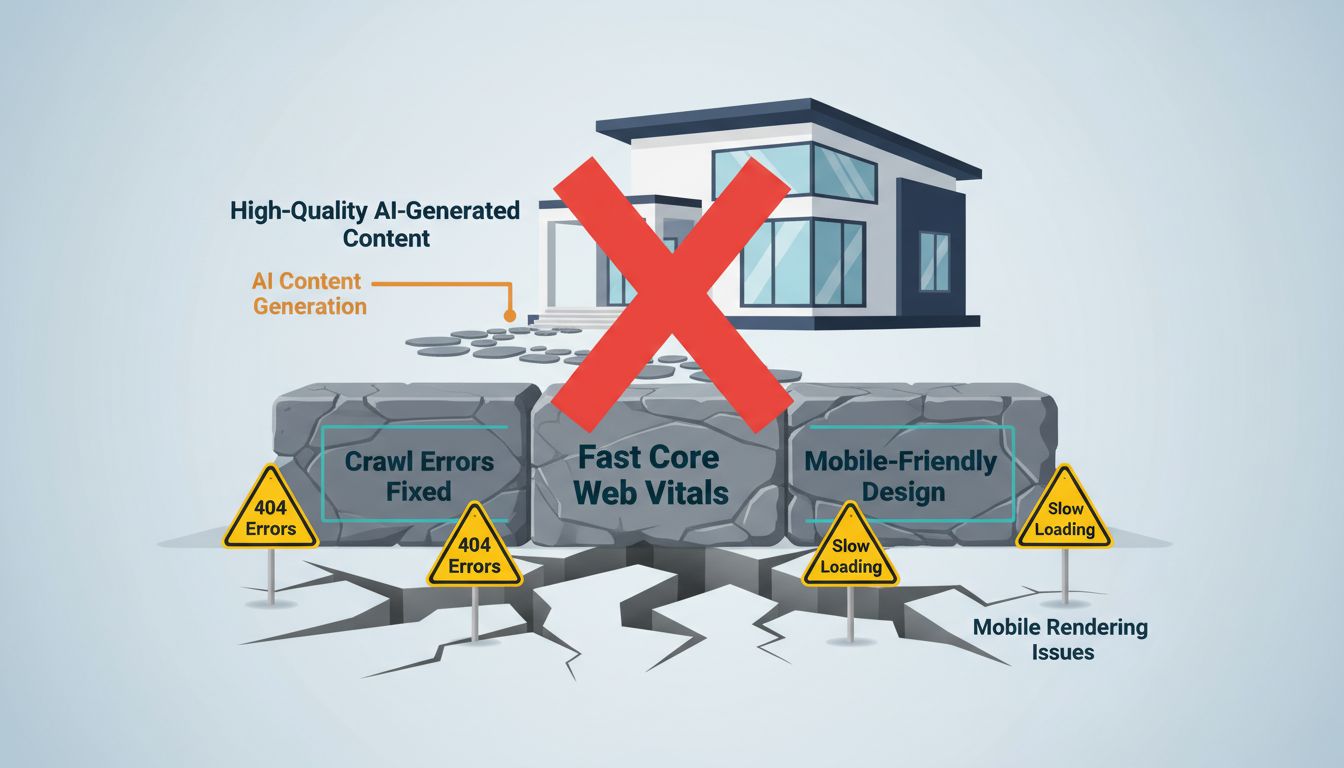
AI can't fix a broken technical foundation. Critical crawl errors, slow Core Web Vitals, poor mobile rendering, no amount of great AI-generated content will rank if those problems exist.
You need a technical audit tool. Look for ones with AI features for prioritization. Sitebulb, for example, uses heatmaps to visually flag the most critical issues across your site, so you know where to focus engineering time.
Not glamorous work. But skipping it to jump straight to content generation is like building a house on sand.
Rank Tracking & AI Visibility: The New Critical Layer
Traditional rank tracking tells you where you stand for keywords. AI visibility tracking tells you if you're being cited in AI Overviews, SGE, or other zero-click answer engines. This distinction matters now.
Ahrefs data shows AI Overviews reduce clicks to websites by 34.5%. If you're not tracking whether your brand appears in these AI-generated answers, you're missing a real shift in how search traffic moves. Tools like SERPs.io (Starter: $41/month) and Rankscale track not just position #1, but whether you're cited as a source in an AI answer, which is exactly what seo for ai search strategy needs to account for.
For a low-DR site, appearing in an AI Overview for a relevant query is a meaningful visibility win, even without a direct click. Brand recognition builds. Topical authority signals accumulate.
Your crawl-phase stack should include one tool from each of these four categories, chosen based on budget and integration needs. Pilot them on a single content cluster first. Prove the workflow and ROI there before scaling.
That's how you avoid buying enterprise-grade ai seo tools for a startup-grade domain. The best ai seo tools aren't the ones with the longest feature list, they're the ones that match where you actually are.
Advanced & Niche Tools for Scaling (The 'Walk' & 'Run' Phases)
Once your crawl-phase tools are working and you've proven ROI on a content cluster, you graduate to scaling. This phase is about efficiency in the specific tasks that become bottlenecks: link building, revenue attribution, custom data pipelines.
Link Building & Outreach Automation
When your Domain Rating crosses 40, or you have dedicated PR resources, manual outreach becomes your biggest constraint. Tools like Pitchbox ($165–$675/month), Respona, and Backlinker.AI (~$300/month) automate prospecting, email personalisation, and follow-ups. [Source: Backlinker.AI roundup, Respona pricing]
The caveat is stark: AI scales outreach, but it doesn't create relationships.
These tools are good at finding relevant journalists or bloggers and generating personalised first-contact emails. But they still need a human to vet the prospect list for quality and to actually nurture connections. I've watched startups burn through their domain reputation by blasting low-quality AI-generated pitches.
Use them to handle volume. Not to replace your editorial judgment on who's worth talking to.
Analytics & Attribution
This is where most SEO efforts fail to prove business value. You need to connect keyword rankings and content clusters to actual sign-ups, pipeline, or revenue. Generic analytics dashboards won't cut it.
Tools like Windsor.ai (starting at $19/month), Ruler Analytics ($299–$668/month), and Triple Whale bridge this gap. [Source: Windsor.ai docs, Ruler Analytics pricing]
They pipe data from GA4, your CRM (HubSpot, Salesforce), and e-commerce platforms into your data warehouse (BigQuery, Snowflake). A B2B SaaS I worked with used Windsor.ai to attribute 35% of their qualified sign-ups to a specific long-tail keyword cluster that traditional analytics had marked as "low volume." That one discovery justified tripling their content investment in that area.
The DIY Alternative: Open-Source & API Components
Some founders prioritise data control, privacy, or cost predictability over off-the-shelf convenience. This is the engineer's path.
For semantic search and content clustering, you can bypass hosted ai seo tools entirely and run open-source engines like Typesense or Meilisearch. Both offer hybrid vector and keyword search you can self-host. Or you can call the OpenAI Embeddings API directly (text-embedding-3-small costs $0.02 per 1M tokens) to generate vectors for your own classification models. [Source: Brightdata semantic search APIs, CostGoat OpenAI pricing]
I've implemented both Pinecone and a self-hosted Typesense cluster. For most startups, the engineering overhead of self-hosting isn't worth it until you have specific compliance needs or are processing over 1M documents monthly.
The decision isn't that complicated. If you have an engineer who can dedicate a week to setup and ongoing maintenance, and you need absolute data residency control, go open-source. If you need to move fast and your data volumes are under 500k documents, a hosted API is almost always cheaper once you factor in dev time.
These free ai seo tools (in the open-source sense) trade convenience for control. They're not for every team, but they matter the moment vendor lock-in or data governance becomes a real concern.
Integration Architecture: Making Your Stack a System

Most teams fail here. You can have the best individual artificial intelligence seo tools, but if they operate in isolation, you're just automating separate tasks. The real advantage comes from integration architecture, designing how data flows between tools to create closed-loop learning.
The critical failure point is data silos. Your keyword research lives in Ahrefs, content briefs in Frase, performance data in Google Analytics, attribution somewhere else entirely.
Without connections, you can't answer the most important question: which keyword clusters actually drive qualified leads, not just traffic?
Here are the core integration points you need to engineer:
- CMS to Content Tools: Your content platform (Frase, Surfer SEO) must push optimized drafts directly to WordPress, Webflow, or your headless CMS via their API. Frase's IndexNow integration, for example, can automatically ping search engines the moment you publish.
- SEO Data to Data Warehouse: Raw performance data from tools like Windsor.ai or Ruler Analytics should feed into your central data warehouse (BigQuery, Snowflake, Redshift). Windsor.ai is built for this, offering native connectors. This lets you join SEO metrics with CRM revenue data.
- Analytics to Attribution: Connect GA4 events to an attribution platform to see which content pieces influence pipeline. This moves you from tracking "clicks" to tracking "revenue influenced."
- APIs as Glue: The Ahrefs and DataForSEO APIs are powerful, but they have strict rate limits. When building Spectre, I hit these limits constantly when processing keyword data for large sites. The solution isn't just buying more credits, it's implementing intelligent batch processing, request queuing, and local caching of expensive SERP data.
A practical integrated workflow looks like this: Ahrefs API fetches a keyword list and competitor gaps. A script clusters these and pushes the topics to Frase via webhook to generate a brief. A writer creates the draft, runs it through Surfer SEO for optimization, then publishes via the WordPress REST API. Windsor.ai tracks performance, feeding data into BigQuery. A Looker Studio dashboard then blends that SEO data with HubSpot deal stages.
The "glue" for simple tasks can be Zapier or Make.com, but you'll quickly need custom scripts for complex logic and error handling. Define a central "content brief" JSON schema early, it will save you hours when you swap tools later.
One trust caveat worth taking seriously: review the Terms of Service for any ai seo tools or ai seo service you're running content through. When you send proprietary drafts to a third-party API for scoring, where is that data actually stored? For regulated industries, get explicit enterprise agreements that cover data residency and privacy.
Most founders discover this too late. It's a real compliance checkpoint, not a theoretical one.
If you're evaluating best ai seo tools or seo ai tools at scale, or even scoping out free ai seo tools for early-stage work, the integration question matters as much as any individual tool's feature set. Especially now, as seo for ai search changes what "ranking" even means, having a connected stack is what lets you adapt fast when the signals shift.
AI SEO Tool Pricing and True Cost in 2026
Vendor pricing pages show you the sticker price. Not the actual cost.
The range is real: entry-level tools like Mangools Premium at $44.90/month, mid-tier platforms like Surfer SEO's Scale plan around $200/month, enterprise packages past $1,000/month [Source: Hashmeta pricing guide]. But those numbers only tell part of the story.
The actual cost formula looks more like: Subscription + (Implementation Hours × Your Team's Hourly Rate) + Integration Maintenance + Opportunity Cost of Switching Tools.
That "free" open-source semantic search engine like Typesense? It costs 10-20 hours of developer setup plus ongoing maintenance. For a startup paying £75/hour for engineering time, that's £1,500 upfront, more expensive than a $50/month hosted API for your entire first year.
Justifying spend means mapping each tool to a specific business outcome, not a feature list. Don't buy Surfer SEO because it has "real-time content scoring." Buy it to increase content publish velocity by 30% or cut editorial revision cycles.
Don't invest in Windsor.ai's $19/month starter plan for "attribution data." Invest to reduce customer acquisition cost attribution uncertainty by 50%.
Start with a pilot budget for one or two tools, on monthly billing, even though the annual discount is real (usually 20-40%). Prove ROI within 90 days. Then commit.
The most expensive mistake isn't overspending on artificial intelligence seo tools, ai seo tools, or any ai seo service. It's underinvesting in the right ones and burning six months of growth finding that out.
Whether you're comparing best ai seo tools, scoping out free ai seo tools, or thinking about seo for ai search specifically, the math is the same. Run the real number, not the subscription line item.
The Human-in-the-Loop Imperative: Why AI Alone Fails
Anyone telling you to fully automate content creation with AI is selling you something.
These tools amplify expertise. They don't replace it. I've seen teams deploy AI-generated content at scale and watch it tank, not because Google "detected" it was AI, but because it was generic, unoriginal, and had zero real-world authority.
The question isn't "Can Google detect AI content?" It's "Does this content serve a user better than what already exists?"
Google's systems reward helpful content, regardless of origin. The failure mode isn't detection. It's mediocrity. AI can produce a thousand words on "best project management software," but it can't write from the visceral frustration of managing a remote team through a product launch, or explain why Asana's dependency feature falls apart at scale. That's where humans are non-negotiable.
Your human-in-the-loop system needs three clear roles.
First, editorial QA. AI hallucinates facts, dates, and statistics with alarming confidence. Research shows AI-generated drafts frequently contain factual errors and require human review. Someone needs to fact-check every claim, especially in technical or regulated spaces.
Second, injecting brand voice and unique insight. AI tools average out the top ten search results. Your brand's perspective, the contrarian take, the hard-won lesson, the specific customer story, is what makes content worth linking to. That's your differentiator.
Third, building E-E-A-T signals. Search engines look for Experience, Expertise, Authoritativeness, and Trustworthiness. AI provides none of these. You build E-E-A-T through author bios with real credentials, citations to primary sources, and case studies from your actual work.
Operationally, treat AI as your tireless junior analyst. It clusters keywords, analyzes SERPs, produces a first draft. The human is the strategic editor who turns that draft into something with a point of view, accurate data, and real utility.
That's where the 50% better ranking chance comes from, not from the ai seo tools or any ai seo service alone, but from a human using artificial intelligence seo tools like Surfer SEO as a lever. The best ai seo tools, including seo ai tools and even free ai seo tools, all follow the same logic. The tool does the grunt work. You bring the judgment.
And if you're thinking about seo for ai search specifically, this matters even more. AI-generated answers pull from content with demonstrated authority. Generic output doesn't make the cut.
Future-Proofing: SEO for AI Search Engines & Overviews
The biggest shift isn't the artificial intelligence seo tools you're buying. It's the AI getting baked directly into search itself.
Google's AI Overviews and Microsoft's Copilot are answering queries without making users click anywhere. Ahrefs data shows AI Overviews are already reducing clicks by 34.5% [Source: https://ahrefs.com/blog/ahrefs-top-blogs-2025/]. That number is only going up.
So your objective changes. You're no longer just chasing clicks. You're trying to become the source that AI answers pull from.
Optimizing for Citations, Not Just Clicks
Start with structured data. In my experience, FAQ schema gets extracted heavily for AI answers. How-To and Article schema matter too. But test everything with Google's Rich Results Test, invalid markup is worse than no markup at all.
I prefer JSON-LD. It's clean and easy to inject dynamically into a CMS or site template.
The deeper thing is content structure. You need to cover a topic from multiple angles, with enough depth that an AI engine can confidently cite you rather than the next result.
Tracking 'AI Visibility' as a Core KPI
You can't manage what you don't measure. Tools like SERPs.io and Rankscale now track how often your brand shows up in AI Overviews and similar answer snippets.
Set up tracking for your core commercial and informational queries. Here's the counterintuitive part: overall clicks may drop, but the traffic that comes through from citations tends to be way higher-intent. According to Ahrefs [Source: https://ahrefs.com/blog/ai-seo-statistics/], AI search visitors convert 23× better than traditional search visitors.
That's not a rounding error. That's a different kind of user entirely.

The future is entity-based. Search engines are moving past keyword matching toward understanding concepts, relationships, and content across formats, images, video, audio.
Your technical foundation matters more in this world, not less. Clean HTML, fast Core Web Vitals, semantic markup. That's what lets both traditional crawlers and AI agents understand your content well enough to trust it.
And if you're thinking seriously about seo for ai search, none of the best ai seo tools, not Surfer SEO, not any ai seo service, not even the free ai seo tools people lean on, get you cited by AI Overviews on their own. The seo ai tools handle the grunt work. The citation happens because your content actually had something worth citing.
Your 90-Day AI SEO Tool Implementation Plan
What's the single biggest mistake founders make when adopting artificial intelligence seo tools?
Pilot sprawl. Buying five platforms, trying to do everything at once, ending up with nothing measurable to show for it.
Your first 90 days should have one goal: prove that your chosen tools can deliver a positive ROI on a tightly scoped use case. That's it.
Think of it like a feature launch. You wouldn't ship ten features at once. You'd ship one, measure it, and iterate.
Step 1: Audit & Define Your Pilot Goal (Week 1)
Before you touch a single tool, do an honest audit. What's your current organic traffic? Which pages are underperforming? What's your domain rating? You need this baseline.
Then define one pilot goal. Not five. One.
Some examples from teams I've worked with:
- "Optimise our 10 highest-traffic but lowest-converting blog posts for clearer search intent using an AI content grader."
- "Generate and publish 5 new FAQ pages targeting 'answer' keywords our competitors rank for in AI Overviews."
- "Automate the technical audit and fix process for our 50 most important product pages."
The goal has to be specific, measurable, and tied directly to a business outcome, traffic, conversions, citations.
Step 2: Tool Selection & Pilot Design (Week 2)
Now, and only now, do you pick tools. Based on your domain rating and goal, choose 1-2 foundational ai seo tools. If your goal is content optimisation, look at Surfer SEO or Frase. If it's technical health, start with a crawler like Sitebulb or Screaming Frog's AI analysis.
Set strict success metrics upfront. For a content pilot: "Achieve a 15% traffic lift on the 10 optimised posts within 60 days." For an AI visibility pilot: "Secure at least 2 citations in Google's AI Overviews for our new FAQ pages."
Proving ROI within 60-90 days is what keeps pilots alive. Without it, they get abandoned and the budget disappears [Singlegrain, Web.Superagi].
Step 3: Integrate & Execute the Sprint (Weeks 3-10)
This is the doing phase. Set up the core integration, your chosen tool feeding into your CMS or project management system, then execute the pilot.
Resist the urge to expand scope. If you're optimising 10 posts, do just that.
Document every friction point as you go. Was the AI's content outline actually useful? How much human editing did it need? Did the CMS integration break? That operational data is just as valuable as the performance metrics.
Step 4: Analyze, Iterate & Plan Phase Two (Weeks 11-12)
Measure everything against your week-2 KPIs. Calculate the true ROI, tool cost and team time. Did the efficiency gain justify the investment?
You now have a clear, data-backed answer: double down on the workflow, adjust your tooling, or kill the pilot.
Use that answer to plan your next phase, maybe scaling content production, maybe adding a rank-tracking layer. You've moved from speculation to evidence. That's the only foundation worth building on.
Conclusion
The value of artificial intelligence seo tools isn't in any single platform's feature list. It's in how you build them into a system that actually compounds.
Three things matter: your Domain Rating constraining keyword ambitions, integration capability winning over shiny features, and every workflow keeping a human in the loop.
The tools will keep changing. The principles won't.
Start the 90-Day Plan today. Audit your site, find one real bottleneck, and run a focused pilot. The goal isn't to assemble the perfect ai seo tools stack by 2026.
It's to learn what actually moves the needle for your business. One proven workflow at a time.
Frequently Asked Questions
Can Google detect AI content and will it hurt my rankings?
Google's systems can identify AI-generated content, but they've been pretty clear they don't penalize content just because a machine wrote it. [Source: Google Search Central] The real risk is publishing low-quality, unoriginal stuff that AI happily produces when nobody's paying attention. Focus on expertise and actual value, regardless of how the first draft got made.
What's the most important AI SEO tool for a startup?
There isn't one. But for startups with limited domain authority, I'd start with a content optimization tool like Surfer SEO or Frase, plus a solid keyword research platform like Ahrefs or Mangools.
That combination helps you create content that actually matches search intent, which is the foundational problem when you're competing against established domains.
How much do AI SEO tools cost?
Costs vary a lot. Free tiers exist for basic use, but for anything serious, budget $50–$200 per month per tool for your core stack (research, content, tracking).
Enterprise-grade platforms can run $300 to over $1,000 monthly. [Source: hashmeta.ai] And don't forget implementation time. That's usually the cost nobody accounts for.
How do I measure if my ai seo tools are working?
Don't measure the tool. Measure the business outcome it was supposed to affect.
Set KPIs before you start: "20% more organic traffic to pilot content in 90 days" or "40% faster time-to-publish." Then use GA4 and a rank tracker like SERPs.io to see if it's actually happening. If you're measuring the tool instead of the outcome, you've already lost the plot.
Do I need technical SEO tools if I'm using AI for content?
Yes. Publishing AI-generated content on a technically broken site is like putting a great engine in a car with flat tires.
Site speed, crawlability, mobile-friendliness, structured data, that's the layer that lets your content get found at all. Sort the critical technical fixes first, then scale content. Not the other way around. This applies whether you're using the best ai seo tools or building a budget seo for ai search workflow from scratch.