May 25th, 2026
How to Automate Content Creation: A Practical Guide for SaaS Marketers
 WD
WDWarren Day
You've just been told to scale content production. The directive is simple: more high-quality content, more MQLs, more revenue. But your current process is a linear, manual grind, writer, editor, publish, repeat, and there's no version of that hitting 20+ pieces a month.
So you start looking at AI tools. And then you get skeptical. Can they hold quality? What's the actual ROI? You've seen the failed projects. You've read the generic outputs.
Here's what most people get wrong: figuring out how to automate content creation isn't about swapping your writers for robots. It's about building a scalable production pipeline that blends AI efficiency with human oversight. Done right, you're looking at measurable ROI within 90 days.
This guide walks through that process systematically. Not theory, a phased, tactical blueprint.
You'll get a 90-day playbook covering quick wins, core workflow pilots, and full-scale orchestration. We'll get into tool selection based on integration realities (not vendor promises), how to build a prompt library that actually keeps output consistent, and the ROI formula you need to justify this to leadership. Plus the five pitfalls that kill most automation efforts before they get anywhere.
Before You Start: Audit Your Current Workflow
Before you automate a single task, map your current workflow end-to-end. Blank sheet, whiteboard, whatever. Trace every step from ideation to publication, document who does what, how long it takes, and where things get stuck.
When I built Spectre, we wasted months automating the wrong parts because we skipped this. We assumed first drafts were the bottleneck. They weren't. The real constraint was keyword research and brief creation.
Your slowest step might be something completely different, image sourcing, CMS formatting, approval cycles. You won't know until you actually look.
Define your content strategy prerequisites before you touch any tooling. Automation amplifies strategy; it doesn't create it. Get crystal clear on your target audience segments, buyer journey stages, and core messaging pillars. If you're vague here, you'll just produce generic content faster.
Then assess your tech stack. Do you have a CMS with a decent API? A CRM for tracking MQLs? Basic analytics? This matters more than most people expect, 68% of users cite integration complexity as the biggest challenge. Your audit should flag which systems need API access or webhook support before you buy anything.
Last thing: secure team buy-in and define roles upfront. Who's the Content Ops Coordinator? Who's the Editor-in-the-Loop? Budget realistically, mid-market tools run $50 to $500 per user per month.
Get this foundation wrong and you won't figure out how to automate content creation so much as how to automate your existing chaos.
Phase 1: Identify Your Quick Wins (Weeks 1-4)
Don't try to boil the ocean.
Start with the repetitive, low-brainpower tasks eating your team's time. Quick wins here deliver immediate relief and build real confidence that the automation strategy is actually working.
First: automate your social media calendar generation. Take your published blog post URLs and feed them to ChatGPT or whatever AI tool you're using. Prompt: "Generate 5 LinkedIn post variations from this blog post summary: [paste summary]. Include 1 question format, 1 statistic highlight, and 1 quote-style post." Run this weekly and your social calendar goes from hours to minutes.
Second: build a library of email response templates. Document your 10 most common sales and support inquiries, then write a base template for each with variables for personalization. A pricing inquiry template should have placeholders for [COMPANY_NAME], [CONTACT_NAME], [RELEVANT_FEATURE]. Store them in a shared Google Doc or Notion database, your first primitive prompt bank.
Third: generate subject line and meta description variants for A/B testing. Before publishing anything, run your headline through an AI tool with this prompt: "Generate 8 subject line variations for a B2B SaaS blog post about [topic]. Include 2 curiosity-driven, 3 problem-solution formats, and 3 benefit-focused." Test them in your email campaigns and track what converts.
Set your first KPIs around operational efficiency, not revenue. "Hours saved per week" and "draft completion speed" are the right metrics at this stage.
If you're creating visual content, worth noting that ~75% of marketers now use AI for video and image creation. Turning blog content into simple graphics or short clips is another fast win when you're figuring out how to automate content creation.
The goal isn't perfection. It's proving this works and getting 5-10 hours a week back for work that actually requires a brain.
Phase 2: Build and Pilot Your Core Workflow (Weeks 5-8)
Quick wins are done. Now you build the actual pipeline.
Don't automate everything at once. Pick one repeatable format, your weekly how-to blog post, your monthly product update email, and build a hybrid workflow around it.
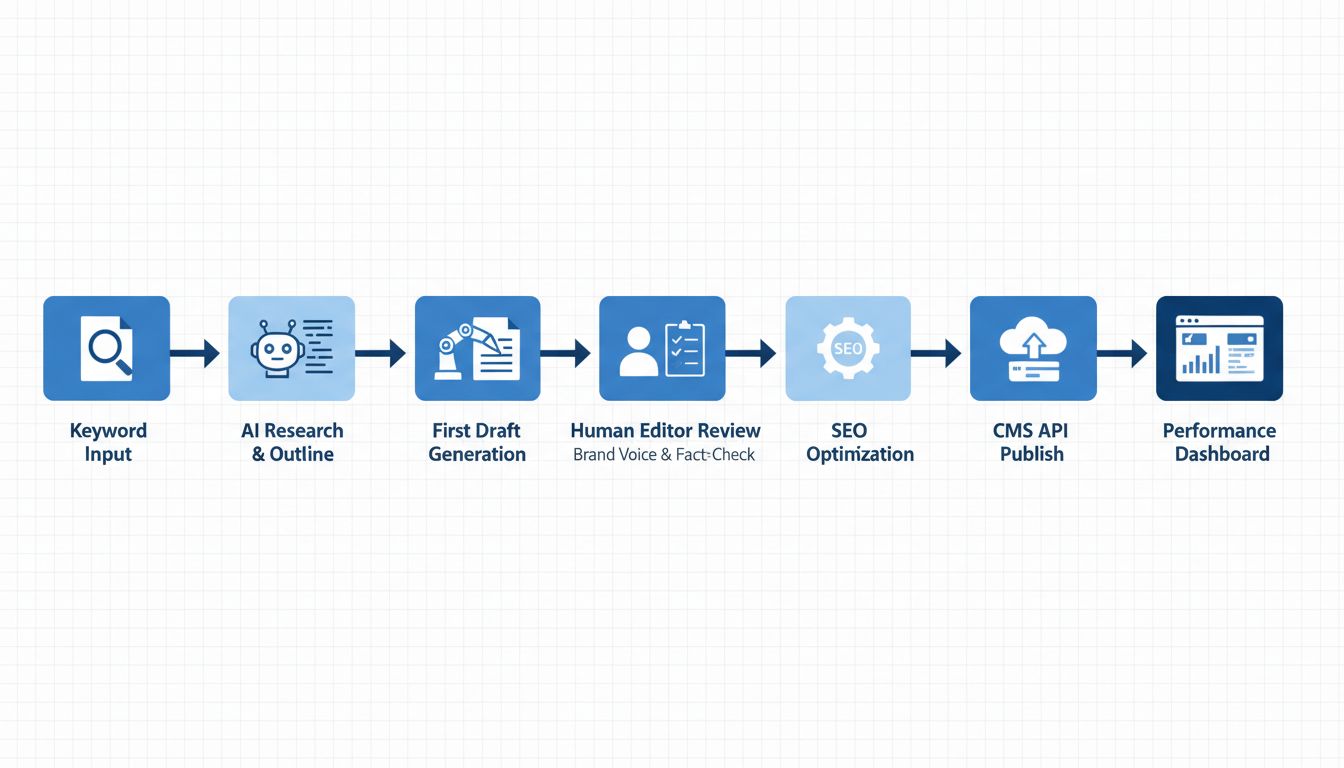
Start by mapping the flow. Visualize it as: Keyword Input → AI Research & Outline → First Draft Generation → Human Editor Review (Focus: Brand Voice, Fact-Check) → SEO Optimization → CMS API Publish → Performance Dashboard. The idea is to split the heavy lifting between AI and human judgment at the points where each actually matters.
For tooling, pair an AI writing assistant like ChatGPT Plus or Jasper with a workflow automator like Zapier or Make, and connect both to your CMS (WordPress, Contentful). The goal is one trigger, a new keyword brief in a Google Sheet, that kicks off draft generation and drops it into a staging area for review.
Keep it simple. 68% of users cite integration complexity as a challenge, so this isn't the time to get fancy. Source: https://cited.so/blog/ai-content-marketing-automation
Then run a parallel test. Produce your next piece the old manual way. Run the same brief through the new pipeline at the same time. Compare total time from idea to publish-ready draft, not just writing time. The drafting phase will probably shrink a lot. The editing phase won't, and that's fine.
Use the pilot to fix your prompts. Move past basic instructions and build structured prompt templates with labeled containers like TARGET AUDIENCE: and BRAND VOICE GUIDELINES:. Store these in a centralized Prompt Bank (Notion works well for this). Teams that figured out how to automate content creation this way, with real prompt systems behind it, now produce ~4.1x more content per marketer per month.
After four weeks you should have one documented, repeatable workflow for one content type, a library of tested prompts, and actual numbers on time saved versus quality. That's your blueprint for everything else.
Phase 3: Scale, Measure, and Refine (Weeks 9-12)
The pilot worked. Now you take what you validated and apply it to 2-3 more content types. Landing pages for product features are a good next move, then nurture email sequences. Same prompt library structure, same human-in-the-loop approval steps.
Connect your content platform to Google Analytics and your CRM now. Track organic traffic, MQLs generated from content, and conversion rates from MQL to SQL. Without this data, proving ROI to leadership is basically guesswork.
Calculate your returns using: ROI = ((Time Saved Value) - Platform Costs) / Platform Costs
Here's what that looks like with real numbers: a 5-person team saving 28 hours monthly at a $75 blended rate generates $2,100 in time value. Subtract $300 for platform costs, and you're at 600% monthly ROI. [Source: cited.so/blog/ai-content-marketing-automation]
ROI Calculation Example
| Metric | Value |
|---|---|
| Platform Monthly Cost | $300 |
| Hours Saved Monthly | 20 |
| Blended Hourly Rate | $75 |
| Time Saved Value | $1,500 |
| Monthly ROI | ($1,500 - $300)/$300 = 400% |
The median payback period on tooling investment is 4.2 months [Source: digitalapplied.com/blog/ai-marketing-statistics-2026-adoption-data-points]. That's your benchmark going in.
Then lock down your governance. Document who approves final drafts, what your fact-checking process actually looks like (a simple checklist is enough), and how you handle brand voice deviations.
This is how you automate content creation in a way that actually holds up, not just as an experiment, but as a production system you can hand off to someone else and not worry about it.
Select the Right Tools for Your Tech Stack
The tools you pick will either make this scale or turn into a mess of technical debt six months from now.
Don't collect tools. Build a stack. There's a real difference. Integration complexity is the number one problem people run into when adopting AI content platforms, which means picking one or two platforms that actually talk to each other beats having a dozen point solutions that don't.
Here's a functional breakdown of what you need:
| Category | Key Examples | Integration Capability | Cost Tier | Best For |
|---|---|---|---|---|
| LLM/Model Providers | GPT-4, Claude, Llama 3 | API/webhook | Usage-based | Core drafting, complex reasoning |
| AI Copy Assistants | Jasper, Copy.ai | Limited API | Mid-Market | First drafts, social posts, ad copy |
| Orchestration Platforms | Spectre, AirOps | Deep API & native CMS connects | Mid-Market/Enterprise | End-to-end workflow: research → write → publish |
| CMS & CRM | WordPress, Contentful, HubSpot | API, webhooks, Zapier/Make | All tiers | Content storage, distribution, lead tracking |
| Workflow Automators | Zapier, Make (Integromat) | Connects everything | SMB/Mid-Market | Gluing tools together without code |
Start with the LLM decision. ChatGPT is great for ad-hoc tasks and building out prompt libraries, roughly 70% of companies with prompt libraries are using ChatGPT Plus. But it's not a full-stack platform.
You'll end up building your own research integrations, SEO checks, and publishing pipelines. Dedicated platforms ship that stuff out of the box.
For orchestration, something like Spectre bundles keyword research (via DataForSEO), AI writing tuned against SERP data, and direct publishing. The alternative is stitching Jasper, Ahrefs, and Zapier together yourself. That works, but it's engineering-heavy.
The Advolve case study with Anthropic Claude is worth looking at: 90% reduction in operational work, 15% increase in ROAS. That kind of result comes from deep workflow integration, not just swapping in a better chat interface.
Quick litmus test for any tool you're considering: does it have solid API or webhook support? Can it push and pull data from your CMS and CRM without manual CSV exports?
If the answer is no, you're buying a short-term fix that becomes a bottleneck. And figuring out how to automate content creation properly means not building that problem into your stack from the start.
Engineer Your Prompt Library for Scale and Consistency
Your tool stack is the machinery. Your prompt library is the operating system.
This is where automation stops being random experimentation and becomes predictable production. A well-built prompt bank encodes your brand's institutional knowledge into repeatable templates, turning a junior writer into someone who produces like a senior one.
Stop treating prompts like disposable chat messages.
Build a central, searchable repository. Call it your Prompt Bank. Use Notion, Coda, or a dedicated platform. You need version control. Every prompt should have a title, owner, creation date, and a field for performance notes.
Structure is everything. Use labeled containers to give the AI clear, consistent guardrails. Here's a template for a SaaS product update post:
TARGET AUDIENCE: Technical decision-makers at mid-market SaaS companies who manage developer teams.
BRAND VOICE: Authoritative but approachable. Use concrete examples, not abstract theory. Avoid hype words like "revolutionary."
DESIRED FORMAT: 800-1000 word blog post. Start with the problem the update solves, then technical implementation, then business impact.
KEY POINTS TO COVER: [List 3-5 specific features or changes]
SEO KEYWORDS: [Primary and secondary keywords]
CALL TO ACTION: Link to documentation or schedule a technical demo.
Version and track everything. Tag prompts with the date created and the performance metrics of the published piece.
Did the "Q2 Feature Launch" prompt generate a 4% conversion rate? Note it. Did the "Competitor Comparison" prompt need heavy fact-checking? Flag it for revision.
The Content Operations Manager owns this library. Their job is to curate it based on editorial feedback and performance data, pruning what doesn't work, refining what does.
This is exactly how to automate content creation at scale without quality falling apart. And it's not just large teams doing it: 72 companies reported having prompt libraries, with roughly 70% of them having 50 or fewer employees.
Govern Your Output: The Human-in-the-Loop Imperative
Your prompt library automates drafts. Your governance layer ensures they're worth publishing.
41% of AI-generated content requires significant revision. That's not a failure, that's the system working. The AI writes the first draft; your team makes it good.
Assign every piece a clear editorial workflow. For a blog post: AI generation → First-Pass Edit → Fact-Check → Final Sign-Off.
The first edit runs through the "5 C's of Content" checklist. I use this on every piece before it leaves our platform:
- Context: Does it match the target audience's stage in the funnel?
- Consistency: Is the brand voice and terminology correct?
- Clarity: Is the argument easy to follow, or is it AI-sounding fluff?
- Creativity: Does it have a unique angle, or just rehash the SERP?
- Conversion: Is there a clear, relevant next step for the reader?
This is also where you fight generic phrasing. Search for terms like "best-in-class," "leverage," "revolutionize." Replace every one with something specific to your product or customer. That single step does more than most people expect.
Fact-checking is your second layer of defence. I've seen brands get burned by skipping this. Any statistical claim or technical assertion gets verified against a primary source, no exceptions. Advanced teams use confidence scoring or multi-agent consistency checks, which can significantly reduce hallucinations. For most SaaS teams, a simple "trust but verify" rule for any data point is enough.
Lock in roles. The Content Operations Coordinator handles the first-pass edit for the 5 C's. A subject matter expert or senior editor does the fact-check and final sign-off. Keep those duties separate.
Dedicate 25-45% of total production time to human editing. That's not overhead. That's what makes knowing how to automate content creation actually useful, instead of just fast.
Measure What Matters: KPIs and the ROI Formula
Your governance layer ensures quality. Now you have to prove it's working. Track two things: business outcomes and operational efficiency.
Start with the business KPIs your leadership actually cares about:
- Organic traffic growth (month-over-month)
- Marketing Qualified Leads (MQLs) generated from content
- SQL conversion rate = (SQLs ÷ MQLs) × 100
- Pipeline influence from content-touched deals
Calculate content marketing ROI with this formula: (Revenue from content − Investment) ÷ Investment × 100. Track it quarterly.
For operational efficiency, measure:
- Time saved per piece (baseline vs. automated)
- Cost per asset (platform costs + editing hours)
- Content velocity (pieces published per month)
- Editing time ratio (target 25-45% human editing time)
Then there's the 3-3-3 rule for content velocity: 3 foundational SEO articles, 3 expansion pieces (case studies, comparisons), and 3 experimental formats (video scripts, interactive tools) every month. Without automation, that mix isn't realistic for most teams.
Here's the ROI calculation your CFO will understand. Five-person marketing team:
- Monthly tooling cost: $499 (mid-tier platform)
- Time saved: 28 hours monthly at $75 blended rate = $2,100
- Monthly net savings: $2,100 − $499 = $1,601
- Payback period: Tool cost ÷ monthly savings = ~0.3 months
- Annualized value: $1,601 × 12 = $19,212
And that's before you count traffic or lead volume. Teams producing 20+ pieces monthly hit ROI breakeven in 2-4 months with AI automation. The median payback on AI tooling is 4.2 months.
Build your dashboard around four pillars: Strategy (are we targeting the right keywords?), Production (are we hitting velocity targets?), Distribution (is content reaching the right channels?), and Analysis (are the metrics moving?).
Measure each pillar weekly. When leadership asks why you're investing in how to automate content creation, you'll have the numbers ready.
Avoid These 5 Critical Automation Pitfalls
The final lesson from building these systems: avoiding failure matters more than flawless execution. Here's where SaaS marketing teams actually go wrong.
1. Underestimating Integration Complexity (The 68% Challenge) Don't assume tools will "just connect." 68% of users cite integration complexity as their primary hurdle. Start with platforms that have native integrations, or use Zapier/Make as your orchestration layer. Building custom APIs should be your last resort, not your opening move.
2. Assuming Zero Human Editing You'll hit a quality wall fast. 41% of AI-generated content requires significant human revision. That's why the governance layer from Section 7 isn't optional. Budget editorial time from day one, typically 20-40% of your original content creation time.
3. Having No AI Roadmap (The 75% Failure Correlation) Wandering leads to waste. 75% of organizations lack an AI roadmap, and that correlates with higher failure rates. This entire guide follows a phased 90-day playbook for a reason. Don't automate randomly. Follow the sequence: quick wins, pilot, scale.
4. Letting Generic Phrasing Slip Through AI defaults to bland corporate speak, and it erodes your brand fast. I've audited content where every third paragraph had "best-in-class" or "cutting-edge" in it. Use Section 7's editorial checklist to flag overused phrases and enforce your actual voice.
5. Ignoring Compliance & Cost Escalation Two quiet killers. Don't feed customer PII into public models, use local processing where you can. Copyright ambiguity is real, so document your data lineage.
And watch your costs. That $299/month platform becomes $1,200/month once you add seats and API calls. Build cost tracking into your ROI dashboard from the start, same one you're using to justify how to automate content creation to leadership in the first place.
Conclusion
Automating content creation isn't about buying a magic tool. It's about building a system. The real work is blending AI-powered workflows with human judgment so you have something that actually scales.
The 90-day phased approach exists for a reason: start with quick wins, pilot one core workflow, then scale what works. De-risk first, expand second.
The economics hold up. Teams can hit a 4-8x return on platform costs [Source: cited.so/blog/ai-content-marketing-automation], but only with the right tools, a solid prompt library, and real governance in place.
The goal isn't to replace writers. It's to stop wasting them on repetitive drafting so they can do the work that actually matters.
This is a systems engineering problem. Not a trend, not a shortcut.
So your next step is the audit. This week, map one content workflow end to end. Find the single biggest time sink. That's where you start learning how to automate content creation in a way that sticks.
Everything else follows from there.