February 28th, 2026
The Best Keyword Research Tools for SaaS Founders in 2026
 WD
WDWarren Day
Picture this: you're building your entire content strategy on search volume data that's off by 54%. Or going after "low-difficulty" keywords that your tool completely misread because it hasn't adapted to AI Overviews yet.
For a SaaS founder, the wrong keyword research tool doesn't just slow you down. It costs you real money.
Here's what actually matters when you're picking the best keyword research tool: forget the feature lists and flashy dashboards for a second. Sure, almost every tool will hand you search volume and difficulty scores. What you really need to know is whether it plugs into a content workflow that turns search data into something concrete. Trials. Sign-ups. Revenue.
The numbers tell a story. B2B SaaS companies pull a 702% ROI from SEO when they nail the fundamentals, typically breaking even around month seven. But that return lives or dies on your keyword decisions right at the start. Choose a tool feeding you wonky volume estimates or difficulty scores based on 2019 signals, and you'll watch your budget evaporate on content that either never ranks or brings in tire-kickers instead of buyers.
This isn't another comparison chart you'll skim and forget. You're getting a real breakdown of the 2026 keyword tool landscape: Ahrefs, Semrush, Moz, plus the newer AI-native platforms that are actually worth your attention. All of it filtered through one lens: does this fit into a working SaaS content engine? You'll walk away with a 5-step workflow you can start using this week, clarity on which metrics actually drive your business model, and a framework that maps tools to your specific stage, budget, and growth trajectory.
Stop guessing. Let's find the tool that actually moves the needle.
Why Keyword Research Is Your SaaS's #1 Growth Lever (The ROI Data)
Your keyword research tool isn't an expense. It's the highest-leverage investment in your growth stack.
B2B SaaS companies achieve a 702% ROI from SEO with a seven-month break-even. If you're spending $2,400 annually on an enterprise keyword tool, you need to acquire exactly one customer with a $5,000 lifetime value every two years to break even. Everything after that is pure margin.
The math gets better when you consider scale. Most SaaS keyword tools range from $99 to $399 per month. If your average contract value is $3,000 and your organic content converts at even 2%, you need roughly 17 qualified visitors per month to cover a $300 tool subscription. A single well-ranked article can deliver that in a week.
Here's the part most founders miss: keyword research isn't a standalone task you do once and forget. It's the foundational input layer for a scalable content engine. The tool you choose determines whether that engine runs on guesswork or precision. Whether you're writing content that ranks and converts, or content that sits at position 47 collecting dust.
UpGrowth documented similar patterns across their SaaS portfolio: 687% ROI from organic customers. These aren't outliers. They're the natural outcome of treating keyword research as a system, not a spreadsheet exercise.
The question isn't whether you can afford a keyword research tool. It's whether you can afford to build content without one.
Every article written without search intent data is a $500–$2,000 bet on intuition. Every keyword targeted without competitive analysis is a three-month gamble on rankings you'll never capture. Your competitors are using data. They're identifying gaps in your coverage, targeting keywords you've overlooked, and building topical authority while you're still debating tool features. The best keyword research tool for your SaaS is the one that turns search data into a repeatable acquisition system and turns that system into predictable revenue.
Beyond Search Volume: The 5 Pillars of Modern Keyword Analysis
Search volume is a vanity metric. There, I said it.
A keyword with 10,000 monthly searches means nothing if half that volume is overestimated, the SERP is locked down by an AI Overview, and the difficulty score you're trusting was calculated using a completely different methodology than you think. You're building your content strategy on quicksand.
The best keyword research tool for your SaaS isn't the one with the biggest database. It's the one that gives you accurate, actionable intelligence across five critical pillars, so you can make decisions that drive actual trials and revenue, not just traffic.
1. Data Accuracy & Granularity: Trust But Verify
Here's the uncomfortable truth: every tool is guessing.
Ahrefs' own study found their search volume estimates were roughly accurate for only 60% of keywords when compared to actual Google Search Console impressions. Google Keyword Planner, the so-called "source of truth", performed even worse at 45% accuracy and overestimated search volumes 54% of the time.
That means if GKP tells you a keyword gets 1,000 searches per month, there's a coin-flip chance it's actually getting 400. Or 2,000. You're making editorial calendar decisions based on data that's directionally useful at best.
The tools that perform better, Ahrefs, Semrush, do so by blending multiple data sources: Google Keyword Planner data, clickstream data from browser extensions, and proprietary models. Even then, you're looking at a 40% margin of error on individual keywords.
Never rely on a single source. Use search volume as a directional signal to prioritize topics, then validate with Google Trends for trajectory and your own Search Console data three months post-publication. If a keyword shows 500 monthly searches but Trends shows it's spiking, that's your signal. If your published content is getting 50 impressions instead of 500, you know the estimate was inflated, and you adjust your next batch accordingly.
Treat keyword data like a weather forecast: useful for planning, but you still check the sky before you leave the house.
2. Keyword Difficulty: A Methodology Deep Dive
Keyword Difficulty scores are not standardized. A "25" in one tool is a "45" in another, and treating them as gospel is how you waste three months writing content that never ranks.
Semrush calculates Keyword Difficulty on a 1–100 scale using over 100 parameters, including median referring domains, Authority Score of top-10 URLs, and SERP feature presence. Their lab test across 30,000 keywords showed strong correlation with backlink profile strength, and they claim better performance on long-tail and local keywords. Moz takes a different approach: their difficulty metric blends Page Authority, Domain Authority, and projected click-through rate. It's simpler, more transparent, but potentially less nuanced for competitive niches.
Mangools' KWFinder uses Link Profile Strength, essentially an aggregate of how strong the backlink profiles are for ranking pages. Fast, visual, beginner-friendly. But it doesn't account for content quality or user signals.
Here's the problem: if you're comparing a Semrush KD of 30 to a Moz KD of 30, you're comparing apples to motorcycles. Semrush might flag a keyword as "easy" because the top-10 pages have weak backlink profiles but strong brand authority. Moz might rate the same keyword "moderate" because those pages have high Domain Authority despite fewer links.
Cross-check difficulty across two tools before committing resources. If Semrush says 28 and Moz says 42, dig into the SERP manually. Look at the actual top-10 pages. Are they massive brands? Do they have 500+ referring domains? Are they publishing 3,000-word guides or thin listicles? The tools give you a starting hypothesis; the SERP gives you the truth.
And if you're targeting long-tail SaaS keywords, "best project management tool for remote teams", Semrush's methodology tends to be more reliable because it accounts for the nuance of low-volume, high-intent queries.
3. SERP & AI Feature Intelligence: The New Battlefield
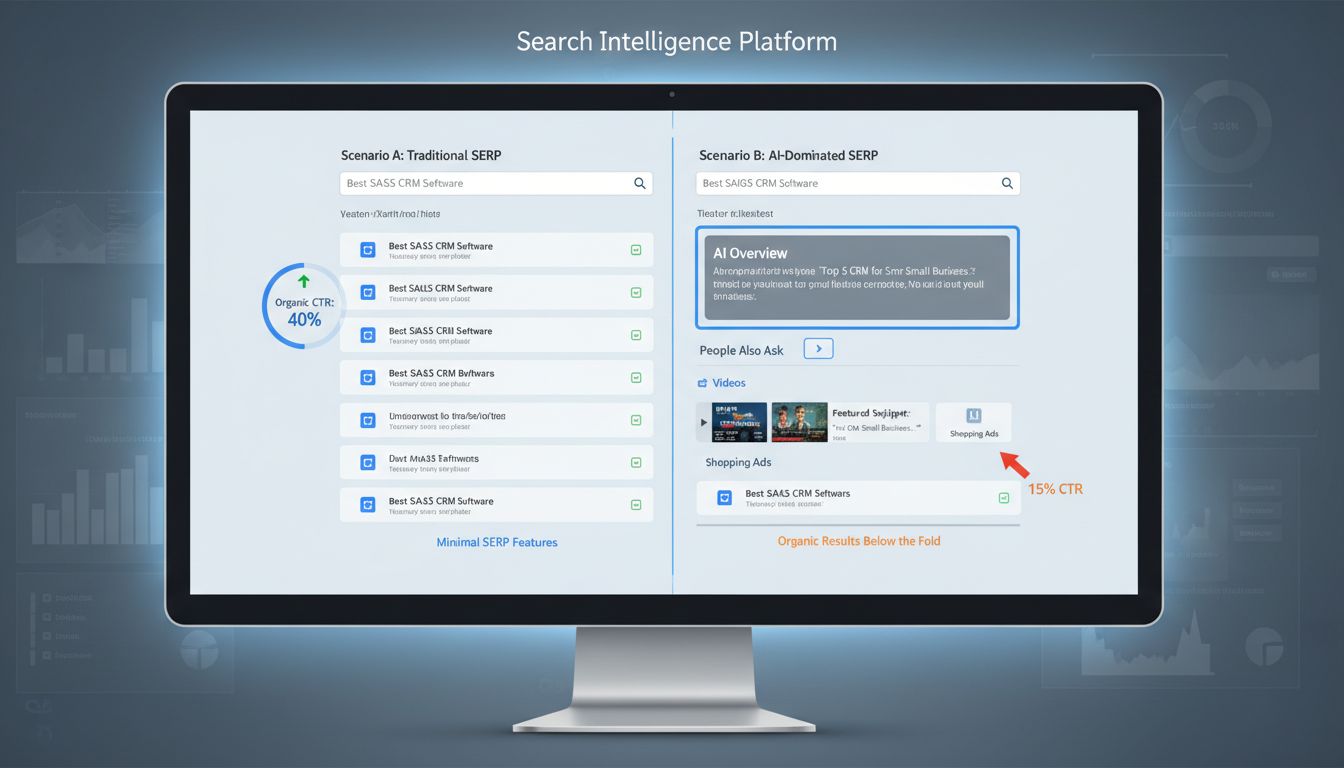
Ranking #1 doesn't mean what it used to.
If your target keyword triggers an AI Overview that answers the query directly, your organic click-through rate just dropped by 60%. If there's a People Also Ask box, a featured snippet, and a video carousel above the fold, that #1 ranking might be getting 15% CTR instead of the traditional 40%.
You need to know what the SERP looks like before you decide to target a keyword, and most founders skip this step entirely.
Moz now tracks AI Overviews as a SERP feature in their Keyword Explorer, so you can see which queries are being dominated by Google's generative results. Ahrefs' SERP Data API returns real-time top-100 results including all SERP features, PAA boxes, featured snippets, image packs, video carousels, and AI panels. This isn't academic. If you're targeting "best CRM for startups" and the SERP shows an AI Overview citing three tools, you have two options: optimize to be one of those three cited sources (Answer Engine Optimization), or pivot to a less AI-saturated keyword like "CRM for startup sales teams under 10 people."
Before greenlighting a keyword, pull the live SERP. Use Ahrefs or Moz to see feature prevalence. If AI Overviews appear on 80% of searches, you're fighting for scraps. If the SERP is clean organic results, you're in a fair fight. If there's a featured snippet, you know your content needs to be structured for snippet capture, short paragraphs, clear definitions, and schema markup.
SERP intelligence is the difference between writing content that ranks and writing content that converts.
4. API & Automation Capabilities: Scaling Your Content Engine
Do you want to do keyword research 100 times manually, or build a system that does it once and feeds your content workflow automatically?
APIs turn keyword tools from research platforms into data infrastructure. They let you pull keyword data into Google Sheets, feed it into your content calendar, trigger Slack alerts when competitors rank for new terms, and build custom dashboards that show keyword performance alongside trial signups.
Ahrefs offers three APIs: Keyword Research, Domain Analysis, and SERP Data. A B2B SaaS can use the Keyword API to dump 500 low-competition keywords into a Google Sheet every Monday, auto-tag them by intent (informational, commercial, transactional), and feed them directly into their content backlog. No manual exports. No copy-paste.
SpyFu provides API access and native integrations with Google Analytics, Google Search Console, and Zapier. You can set up a Zap that monitors your competitor's new ranking keywords and posts them to a Slack channel every week. Your content team sees the opportunity in real time, not three months later.
Moz consolidated their API in 2025, links, keyword metrics, and Brand Authority now accessible through a single token. If you're building a custom reporting dashboard that combines keyword rankings with customer acquisition cost, Moz's API makes that possible without duct-taping three different data sources together.
If you're planning to publish more than 10 pieces of content per month, API access isn't optional, it's the difference between a content team and a content engine. Start simple: use Ahrefs' API to auto-populate a keyword backlog in Airtable or Notion. Then layer in automation: Zapier triggers, weekly reports, competitor alerts. The ROI is in the time saved and the opportunities you don't miss because they were buried in a manual export.
5. Intent & Trend Discovery: Finding White Space
Traditional keyword tools show you what people searched for last month. Trend and question tools show you what they'll search for next month, and what questions they're asking right now that don't have good answers yet.
AnswerThePublic scrapes Google autocomplete to generate question-based keyword ideas. Instead of "project management software," you get "how to choose project management software for a small team" and "why is project management software so expensive." These are blog topics, FAQ content, and bottom-of-funnel assets that traditional volume-based research misses entirely.
Exploding Topics monitors millions of unstructured data points, Reddit threads, news mentions, search trends, and surfaces early signals before they hit mainstream keyword databases. Their database covers 1.1 million keywords, and they report that the top Google result captures nearly 40% of clicks. If you can identify a trend six months before your competitors, you can own that top spot before the keyword even shows up in Ahrefs.
Here's where secondary keywords fit naturally: a creator-focused SaaS might use a best keyword research tool for YouTube to discover video content opportunities that feed their top-of-funnel awareness strategy. An e-commerce platform could study best keywords for Etsy to understand how sellers search for tools and replicate those transactional patterns in their own keyword targeting.
Pair a traditional tool (Ahrefs or Semrush for volume and difficulty) with a question tool (AnswerThePublic) and a trend tool (Exploding Topics or Google Trends). Run your core keyword through AnswerThePublic to find 20 question-based variations. Check Exploding Topics for related rising terms. Now you have a content cluster: one pillar post and five supporting articles that target question intent and emerging search behavior.
White space isn't found in high-volume keywords. It's found in the questions no one's answering well and the trends your competitors haven't noticed yet.
The 2026 SaaS Keyword Tool Stack: Head-to-Head Comparison
You don't need every tool. You need the right tool for your workflow stage.
Most SaaS founders waste the first three months testing platforms that overlap 80% in functionality but differ wildly in the one feature that matters for their use case. The comparison below cuts through the noise by mapping each tool to a specific founder profile and workflow need.
Core Tool Comparison Table
| Tool | Best For | Key Strength (2026 Context) | Critical Consideration | Starting Price (approx.) |
|---|---|---|---|---|
| Ahrefs | Founders prioritizing backlink intelligence & API-driven workflows | Database size (7B+ keywords across 170 countries) + robust SERP Data API for real-time top-100 results | Search volume accuracy ~60% vs GSC; overkill if you're not using link analysis | $119/mo (Lite) |
| Semrush | Teams needing competitive intelligence + PPC integration | Keyword Difficulty uses 100+ parameters; strongest for long-tail & local KD accuracy | Keyword filterability can slow research; better for paid + organic hybrid strategies | $139/mo (Pro) |
| Moz Pro | First-time SEO hires wanting ease of use + education | Tracks AI Overviews in SERP features; consolidated API (2025 update); strong learning resources | Smaller keyword database than Ahrefs/Semrush; DA/PA metrics are proprietary | $99/mo |
| Surfer SEO | Content teams optimizing at scale with WordPress | real-time Content Score + native WordPress publishing; tight editor-first workflow | Supports only ~8 languages; less useful for standalone keyword discovery | $99/mo (Essential) |
| Clearscope | SaaS brands chasing featured snippets & AEO | AI-driven semantic optimization; 35% traffic lift reported in mid-market case study | Higher price point; ROI depends on content volume (best for 10+ posts/month) | Custom pricing |
| Frase | Global SaaS with multilingual content programs | Supports 100+ languages; AI research + optimization in one platform | Smaller keyword database; best paired with Ahrefs/Semrush for discovery | ~$45/mo |
| Exploding Topics | Founders hunting early-stage trend opportunities | AI + human verification of 1.1M+ emerging keywords; surfaces pre-competition topics | Not a replacement for volume/difficulty data; use for ideation layer only | $39/mo |
| SpyFu | Competitive SaaS verticals (e.g., fintech, martech) | Deep competitor PPC + organic history; Zapier/GA/GSC integrations | UI feels dated; better for competitive intel than net-new discovery | $39/mo |
| Mangools (KWFinder) | Bootstrap founders on tight budgets | Simple Link Profile Strength KD; clean UX for beginners | Limited technical SEO features; you'll outgrow it by Series A | $29/mo |
| Ubersuggest | Pre-revenue startups validating initial keyword hypotheses | Chrome extension shows metrics in live SERPs; lifetime payment option available | Data freshness lags Ahrefs/Semrush; treat as a validation layer, not primary source | $29/mo or one-time fee |
Table interpretation tip: If you're pre-product-market-fit, start with Ubersuggest or Mangools to validate demand without burning budget. Post-PMF SaaS companies driving predictable content velocity should default to Ahrefs (if backlinks matter) or Semrush (if competitive + paid context matters). Layer Clearscope or Frase on top once you're publishing 8+ optimized posts per month.
Rapid-Fire Niche & Supplemental Tools
These aren't your daily drivers. They're force multipliers you pull out when you need a specific angle alongside your core platform.
AnswerThePublic mines Google autocomplete for question-based queries. Use it to populate your "People Also Ask" content calendar and uncover the exact phrasing prospects type when they're problem-aware but haven't figured out solutions yet. The questions it surfaces don't always show volume in traditional tools, but they convert because they match how real people actually search.
Keyworddit scrapes Reddit threads by subreddit to surface community-driven long-tail keywords. Perfect for SaaS verticals with active Reddit communities (dev tools, productivity apps, design software). The keywords here often have zero reported volume in traditional tools but convert like crazy because they reflect real user language. I've seen bootstrap founders build entire content calendars from a single Keyworddit export in r/webdev.
SISTRIX offers Keyword Gap analysis with intent, competition, and CPC filters. European SaaS companies use it heavily; US founders typically skip it unless they're expanding into DACH or UK markets where SISTRIX has stronger local data.
Pair one niche tool with your core platform. Don't try to run all of them at once. You'll drown in data and ship nothing.
The 5-Step SaaS Founder Keyword Research Workflow (From Idea to Brief)
Tools without a workflow are just expensive dashboards. You need a repeatable process that transforms raw search data into content that converts.
Most founders treat keyword research like a one-time audit. They export a CSV, hand it to a writer, and wonder why the content doesn't move the needle. The real value comes from building a systematic workflow that connects trend discovery to brief creation. You're turning keyword research into a production line, not a brainstorming session.
Here's the exact five-step process that lets you move from "we should write about this" to "here's the brief, ship it by Friday."
Step 1: Trend & Question Mining (The Idea Funnel)

Start upstream. Before you touch Ahrefs or Semrush, you need raw topic ideas. Not keywords yet, just themes worth exploring.
Open Exploding Topics and filter by your category, SaaS, marketing tools, whatever fits your niche. Look for topics showing early growth signals, the ones trending upward but not yet saturated. These are your future content moats. A topic with 200% growth over six months beats a static 10K-volume keyword everyone's already targeting.
Next, fire up AnswerThePublic. Drop in your core product category ("project management software," "email marketing platform") and let it scrape Google autocomplete data. You'll get a visual map of questions real people type: "how does X work," "why is X better than Y," "can X integrate with Z."
Your goal here isn't validation. It's volume. Generate 50-100 raw topic ideas. Most will die in the next step, and that's fine, you're building a funnel, and the top needs to be wide.
Step 2: Search Data Validation & Triaging
Now you validate.
Take your topic list and run it through your core keyword tool, Ahrefs, Semrush, or Moz, depending on what you chose in the previous section. For each topic, pull three data points: search volume, keyword difficulty, and SERP features. Here's the critical part: don't trust a single difficulty score. Semrush KD uses over 100 parameters including backlink profiles and authority scores; Moz factors in Page Authority and projected CTR. Run the same keyword through two tools and compare.
If Semrush says 45 and Moz says 62, dig deeper. Check the actual SERP. Are the top results dominated by enterprise brands with massive domain authority, or are there gaps you can exploit? Look for AI Overviews (Moz now tracks these), video carousels, or People Also Ask boxes. These SERP features change your content strategy entirely.
Build a simple triage spreadsheet: Keyword | Volume | Semrush KD | Moz KD | SERP Features | Priority. Score each keyword on a 1-5 scale based on volume relative to your stage (500/month might be huge for a seed-stage startup), achievable difficulty, and strategic fit. Anything scoring 4+ moves forward.
This is where you kill 70% of your ideas. That's the point.
Step 3: Keyword Clustering & Topic Mapping
You now have 15-30 validated keywords. Don't write 30 separate blog posts. That's how you end up with keyword cannibalization and a content graveyard.
Group keywords into thematic clusters. "SaaS onboarding best practices," "SaaS onboarding checklist," and "how to onboard SaaS customers" all belong to the same cluster. They share search intent and should map to one comprehensive pillar page, not three thin posts competing with each other.
Semrush's Keyword Manager has built-in clustering, or you can do this manually in a spreadsheet. Sort by root keyword, then visually group variations. Each cluster becomes a content asset: one pillar page (2,000+ words) targeting the primary keyword, supported by 2-4 shorter posts targeting long-tail variations that link back to the pillar.
This creates topical authority. Google doesn't just rank individual pages anymore; it evaluates your site's depth on a subject. A well-structured cluster signals expertise in a way scattered posts never will.
Map each cluster to a content type: pillar page, how-to guide, comparison post, template/tool. This gives you a strategic content architecture, a roadmap that ties directly to business outcomes (awareness, consideration, conversion) instead of a random pile of "10 tips" listicles.
Step 4: AI-Optimized Content Briefing
You know what to write. Now you need to brief it properly.
This is where Clearscope or Frase earn their subscription cost. Drop your primary keyword into either tool and it will analyze the top 20 ranking pages, extract semantic keyword patterns, and generate a content brief with recommended headings, related terms, and readability targets.
Clearscope's 2025 update added Answer Engine Optimization features. It now surfaces questions and entities that trigger AI Overview citations. One mid-sized e-commerce brand using these AEO features saw a 35% increase in organic traffic within six months. That's not from keyword stuffing; it's from structuring content to match how modern search engines (and AI models) extract answers.
Your brief should include: target keyword, semantic keywords (not a laundry list, 10-15 core terms), recommended structure (H2/H3 outline), internal linking opportunities (which pillar or related posts to link to), and a one-sentence strategic angle that differentiates your take from the top 10 results.
Hand this brief to a writer or feed it into an AI content tool. Either way, you've front-loaded the optimization work. You're not hoping the content ranks, you've engineered it to rank before a single word gets written.
Step 5: Tracking, Iteration & Automation
Publishing isn't the finish line. It's the starting gun.

Set up rank tracking for every target keyword in your core tool. Ahrefs, Semrush, and Moz all offer this, track weekly or daily depending on your content velocity. But don't just track position; track SERP feature wins. Did you capture a featured snippet? Did your page appear in an AI Overview? These are the new ranking milestones.
Here's where APIs become critical. Use Ahrefs' or Moz's API to pull ranking data into a Google Sheet or dashboard automatically. Set up conditional formatting: green for top 3, yellow for 4-10, red for 11+. Add a trigger that alerts you when a tracked keyword drops five positions or more. That's your signal to refresh or reoptimize.
This closes the loop. Your workflow isn't linear; it's cyclical. Ranking data informs the next round of keyword research. A post ranking #8 tells you there's untapped opportunity, maybe you need to expand the content, add more internal links, or target a related cluster. A post stuck at #25 tells you to deprioritize that keyword and reallocate effort.
Automation turns this from a monthly chore into a continuous feedback system. You're not doing keyword research anymore. You're running a keyword-driven content engine that improves itself over time.
Keyword Research at Scale: APIs, Automations, and Zapier Flows
Manual keyword research doesn't scale past 10 articles a month. If you're serious about content velocity, you need to automate the data layer.
The gap between teams publishing 3 posts monthly and those shipping 20+ isn't effort. It's infrastructure. API-enabled tools turn keyword research from a recurring task into a background process that feeds your content engine automatically.
Three automations worth building this quarter:
1. Auto-populated keyword backlog
Use Ahrefs' API or Moz's consolidated 2025 API to pull search volume, difficulty, and SERP features for your target keyword list into Google Sheets every Monday. Connect that sheet to your Airtable content calendar via Zapier. Your writers see pre-scored opportunities without touching a keyword tool.
2. Competitor keyword alerts
Set up a weekly Make.com scenario that queries the Semrush API for new keywords your top three competitors rank for in positions 1-10. Push results to a dedicated Slack channel. You'll spot content gaps the day they appear, not three months later during your quarterly review.
3. Performance dashboard sync
Pull keyword ranking data from your SEO tool's API into Looker Studio or a Google Sheet dashboard alongside Google Analytics sign-up events. Now you're tracking which keywords drive trials, not just traffic. This is the view your CFO actually cares about.
SpyFu integrates natively with Zapier, Google Analytics, and Google Search Console, useful if you're running paid and organic in parallel. Ahrefs offers separate APIs for keyword research, domain analysis, and SERP data, giving you granular control over what you automate.
The payoff isn't just time saved. It's the shift from "we should probably update our keyword list" to a system that surfaces opportunities, prioritizes them by business impact, and queues them for execution without a standing meeting. You're building a machine, not running a process.
Tool Selection Flowchart: Which Keyword Research Tool Is Right For Your SaaS?
You've read the feature breakdowns. You understand the workflow. Now you need to pick.
Here's your decision path. Answer each question honestly, and you'll land on the right tool (or stack) for your situation.
Are you a solo founder or team under 5 with a budget under $200/month?
Yes: Start with Ubersuggest ($29/mo) or Mangools/KWFinder (affordable entry point). Both give you solid keyword research, basic difficulty scores, and SERP analysis without enterprise pricing. Add AnswerThePublic (free tier) for question mining.
No: Keep going.
Is your primary goal deep competitive backlink analysis and keyword discovery?
Yes: Choose Ahrefs or Semrush.
Ahrefs wins if you care most about backlink data quality and SERP API access. Semrush wins if you also run paid ads or need integrated social/PPC tools. Both deliver enterprise-grade keyword databases and accurate difficulty metrics.
No: Next question.
Is your primary goal producing high-ranking content at scale (10+ articles/month)?
Yes: Prioritize a content optimization tool. Clearscope if you want AI-driven semantic recommendations and AEO features. Surfer SEO if you prefer real-time Content Score and WordPress publishing. Frase if you're managing multilingual content, it supports 100+ languages versus Surfer's 8.
No: Continue.
Do you have developer resources or need deep automation via API?
Yes: Ahrefs (Keyword Research, Domain, and SERP Data APIs), Moz (consolidated 2025 API with keyword + Brand Authority endpoints), or SpyFu (API + Zapier integrations). Build your automated workflow using the methods from Section 5.
No: Stick with GUI-first tools like Mangools, Ubersuggest, or Surfer.
The Reality: Most Teams Use a Combo
Few SaaS companies run on a single tool.
The most common winning stack? Ahrefs or Semrush for research + Clearscope or Surfer for optimization. Start with one, add the second when you hit its limits. You'll know when that happens because you'll be manually copying data between platforms every week.
Conclusion
The best keyword research tool for your SaaS isn't the one with the flashiest dashboard or the longest feature list. It's whichever removes friction from your content engine and turns search data into predictable customer acquisition.
Look at the numbers: B2B SaaS achieves 702% ROI from SEO with a 7-month break-even [Source: breakingb2b.com]. That kind of return justifies tool investment, but only if you choose based on your actual workflow bottlenecks, not feature FOMO.
Most winning SaaS stacks combine a research powerhouse (Ahrefs or Semrush) with an optimization layer (Clearscope or Surfer). Add API access when you hit 20+ articles per month. Layer in trend tools (Exploding Topics, AnswerThePublic) when you need early-signal opportunities.
The mistake isn't picking the "wrong" tool.
It's buying tools without a repeatable workflow, trusting a single data source, or choosing features you'll never use. I've seen teams spend $500/month on Semrush while their content sits at keyword difficulty 15 because nobody validated search intent.
Here's your next step: audit your current process. Identify the single biggest friction point. Slow keyword validation? Weak competitor intel? No optimization feedback loop? Pick the tool that solves that problem first. Build your stack from there, not from a listicle.
Your content engine is only as good as the data feeding it. Choose accordingly.