May 28th, 2026
Best SEO Tools for Beginners: Top Picks to Start Growing Organic Traffic
 WD
WDWarren Day
What's the actual problem with most seo tools for beginners? It's not that they're hard to use. It's that nobody tells you which ones to even start with.
You've been told to "do SEO" to grow your business. So you Google it. Now you're staring at a list of 40 tools, three conflicting blog posts, and a vague sense that you're already behind.
Most founders and solo marketers start exactly here.
The good news: in 2026, the best seo tools for beginners aren't asking you to manually audit spreadsheets or reverse-engineer competitor backlinks by hand. The shift has been toward AI-driven content pipelines that can actually compete with established players, even if you have no dedicated SEO team.
The global SEO software market is projected to hit $84.94 billion in 2025. There's no shortage of options. That's kind of the problem.
So this list cuts through it. We evaluated tools across four things that actually matter for beginners: automation capabilities, ease of use, scalability, and real value when you're doing this alone. What you'll get is a curated top seo tools list with clear strengths and weaknesses, plus a 30/60/90-day workflow so you know what to do with them.
Whether you're looking for seo software tools free, the best ai seo tools, or the best paid seo tools, it's all here. This is your seo tools list for getting started without wasting six months on the wrong stack.
How We Chose: The 4 Criteria for Beginner SEO Tools in 2026
Most top 10 seo tools lists are just feature checkboxes. That's not useful when you're time-poor and need results, not a software manual.
After building SEO tools for startups and working inside large media companies, I've seen what actually moves the needle. In 2026, with most marketers now using AI for SEO, the right tool isn't about data volume. It's about closing the gap between insight and execution.
Our four selection criteria reflect that.
1. Automation & AI Integration Does it reduce manual work? We prioritized tools that automate content creation, keyword research, or technical analysis. A beginner shouldn't spend hours formatting spreadsheets when AI can structure the data and suggest next steps.
2. Ease of Onboarding Can you get value out of it in an afternoon? Complex dashboards with 50 metrics per page create paralysis. We looked for intuitive interfaces, guided workflows, and setups that take minutes. This is especially important for the best seo tools for beginners, if it takes a month to figure out, it's not a beginner tool.
3. Scalability & Value Does the pricing work for a startup budget while leaving room to grow? We skipped tools that lock you into enterprise contracts from day one. Whether you're after seo software tools free options or best paid seo tools, transparent pricing with clear upgrade paths is non-negotiable. This matters a lot for the best seo tools for small businesses that can't afford to overbuy.
4. Actionable Output Does it tell you what to do next?
Raw data is worthless without interpretation. The top seo tools and best ai seo tools on this list give you clear, prioritized recommendations. "Fix these three broken links" beats "here are 10,000 backlinks" every time.
That's the seo tools list standard we held everything to. If a tool didn't clear all four, it didn't make the cut.
1. Spectre: AI-Powered SEO Content Automation
Best for founders and solo marketers who need to scale content production without hiring writers or learning SEO intricacies.
What's the difference between most top seo tools and Spectre? Most tools give you data and leave you to figure out what to do with it. Spectre just does the work.
It's an AI-powered platform that automates the entire content pipeline, keyword research, SERP analysis, writing E-E-A-T-optimized articles, publishing directly to your CMS. We built it because founders don't need another dashboard. They need a system that outputs ranked pages.
The core strength is orchestration. From my experience building content engines for major media companies, success comes from connecting accurate data to automated production.
Spectre integrates directly with APIs like DataForSEO for keyword volume and difficulty scores, then uses that data to brief its AI on exactly what to write. You get a complete article, optimized for search intent and structured data, ready to publish. The typical content workflow goes from days to hours.
The trade-off is focus. Spectre is intentionally built to automate content creation and publishing, it's not a deep backlink analyser or PPC platform.
For a complete seo tools for beginners stack, pair it with Ahrefs Webmaster Tools (free) for backlink checks. That combination lets you build content at scale while keeping an eye on your off-site profile.
In your first 30 days, use Spectre to establish a foundational content library. Input your domain and broad topics; the system identifies 5-10 low-competition, high-opportunity keywords and generates the articles for you.
This directly fixes the most common beginner mistake: publishing thin or unoptimized content. Only 33% of sites pass Core Web Vitals, and Spectre makes sure on-page SEO and content quality aren't why you're in the other 67%.
2. Google Search Console & Bing Webmaster Tools: The Non-Negotiable Free Foundation
Best for every beginner without exception, your first 30 minutes of SEO work.
These are the only tools that give you data directly from the search engines themselves. Think of them as diagnostic dashboards, not strategy suites.
Google Search Console shows you exactly how Google sees your site: which pages are indexed, what queries bring clicks, and where you have critical errors like security issues or mobile usability problems. G2 rates it 4.7/5 for small-business SEO tools because it's authoritative and reliable.
Bing Webmaster Tools does the same for Microsoft's search network, which still drives real traffic, especially in B2B and technical niches. The interface is cleaner than Google's, and it has a decent free backlink checker.
Ignoring Bing because "everyone uses Google" is a classic beginner oversight.
Their weakness is intentional. They're data sources, not all-in-one platforms. You won't get keyword research, competitor analysis, or deep technical crawls here. That's why you layer other tools on top.
But starting anywhere else is like trying to fix a car without opening the bonnet.
On day one, connect both tools to your site. Use GSC's URL Inspection tool to force-index your homepage and key landing pages. Then keep an eye on the Page Experience report for Core Web Vitals alerts, only around 33% of sites pass these thresholds, so you'll likely have work to do.
This foundation is what makes every other tool's data actually usable. Whether you're working through a seo tools list, comparing the top seo tools free options, or starting to look at best paid seo tools and best ai seo tools down the line, none of it matters much until this is set up. It's where seo tools for beginners should always start, and honestly where the top 10 seo tools guides bury the most important step.
The best seo tools for beginners and the best seo tools for small businesses tend to be the ones that give you real signal without noise. These two do exactly that.
3. Screaming Frog SEO Spider & PageSpeed Insights: Your Technical SEO Audit Squad
Best for beginners ready to tackle the low-hanging fruit that blocks rankings, like slow pages or broken links.
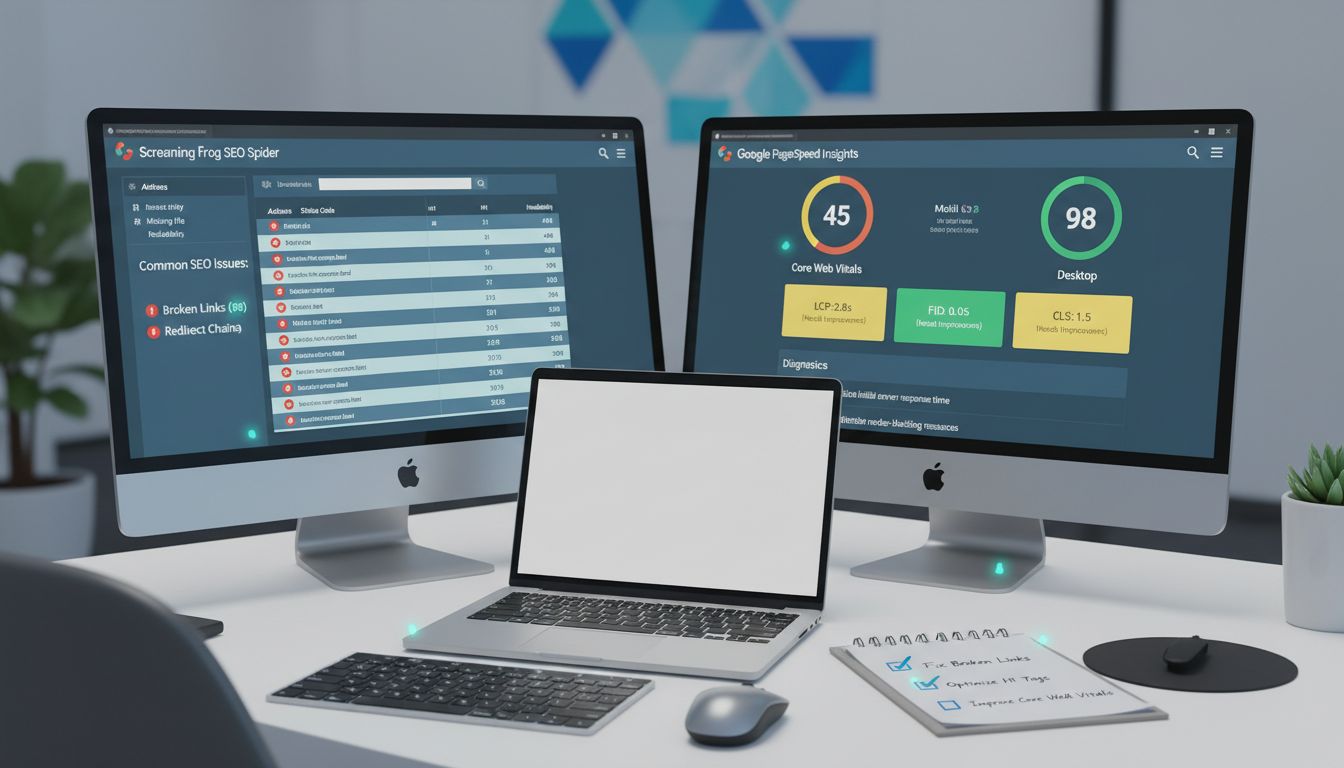
What's the point of great content if Google can't crawl it properly? That's where these two come in.
Screaming Frog is a free desktop crawler. Its free tier lets you crawl up to 500 URLs and immediately surfaces things like missing H1 tags (a problem for 59.5% of sites), broken internal links, and redirect chains that waste crawl budget. PageSpeed Insights gives you your Core Web Vitals score, only around 33% of sites actually pass those thresholds, so there's a good chance you'll find something to fix.
Together, they're the technical audit pairing you'll keep coming back to across any seo tools list.
What makes them useful is that the output is concrete. You get a CSV of every page missing a meta description or throwing a 4xx error. No guessing, no interpretation required.
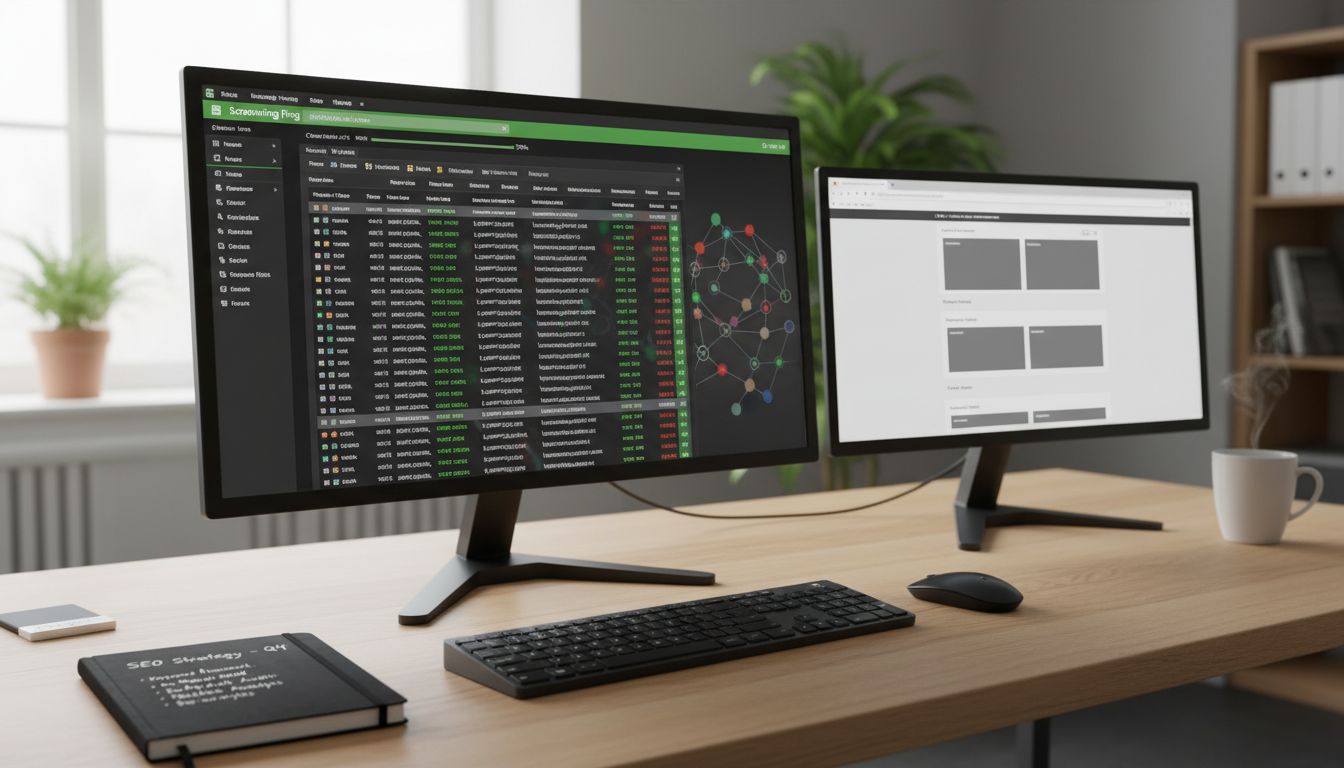
The interface looks dense at first. Ignore the advanced tabs. Stick to the pre-configured "Site Audit" and "Reports" sections and you'll get 90% of the value without the overwhelm.
Neither tool does keyword research, and the free crawl limit will cap you on larger sites. That's fine. Their job is making sure Google can actually crawl and render your site, a foundational step that most beginner guides to top seo tools either rush past or skip entirely.
As an engineer, I use Screaming Frog's API to automate crawl data into client dashboards. For most people reading this, the visual client is all you need. Run it monthly and after any major site update.
This is the kind of thing that belongs near the top of any seo tools for beginners checklist. It's not the most exciting work, but it's the work that makes everything else actually count, whether you're comparing seo software tools free options, looking at best seo tools for beginners, or eventually graduating to best paid seo tools and best ai seo tools. Fix the crawlability problems first. The top 10 seo tools guides don't say that loudly enough.
The best seo tools for small businesses aren't always the flashiest ones. Sometimes it's just a crawler and a speed test telling you what's broken.
4. Mangools (KWFinder Suite): The Affordable All-in-One Toolkit
Best for solo entrepreneurs or very small teams who need an integrated toolkit without enterprise pricing.
If Screaming Frog handles your technical foundation, Mangools gives you your first real marketing dashboard.
It's four tools in one subscription: KWFinder for keyword research, SERPWatcher for rank tracking, LinkMiner for backlinks, and SiteProfiler for domain overviews. For anyone working through seo tools for beginners guides, that matters, you're not bouncing between four different interfaces while you're still learning the basics.
The pricing is the main draw. It's consistently the most affordable all-in-one suite, with a permanent free plan and a 10-day full-featured trial so you can test the whole workflow before paying anything. The browser extension is genuinely useful too, you can pull up SERP analysis directly from your search results without opening another tab.
The trade-off is data depth.
The backlink index isn't as thorough as Ahrefs or SEMrush. Keyword difficulty scores are less granular than what you'd get from those platforms. If you're building a serious link-building strategy, you'll eventually hit a ceiling here.
But that's kind of the point. Think of it as a training ground, 80% of the functionality for a fraction of the cost. For your first six months, that's exactly what you need, whether you're looking at seo software tools free options or comparing best paid seo tools down the line.
It earns its spot on any top seo tools list for small teams. It shows up in top 10 seo tools roundups for good reason, and it's one of the best seo tools for small businesses if budget is the real constraint. When you need deeper competitive intelligence, real backlink gap analysis, advanced rank tracking, that's when you move to the heavier tools.
Until then, Mangools is enough.
5. SEMrush: The Scalable Enterprise-Grade Platform
Best for small businesses in competitive niches like B2B SaaS or e-commerce that have outgrown starter kits and need deep competitive intelligence to scale.
SEMrush is the industry's all-in-one heavyweight. $330 million in revenue in 2024, over 117,000 paying customers. That kind of market dominance tells you the database is reliable and constantly updated, keyword research, backlink analysis, site audits, PPC tracking, social media, all of it.
When you need to reverse-engineer a competitor's entire traffic strategy, this is the tool.
The breadth is what sets it apart. You can run a technical site audit that goes further than Screaming Frog's free tier, analyze keyword gaps against five competitors at once, and pull traffic estimates for any domain. For a founder in a crowded market, that's the difference between guessing and actually targeting weak spots in your rivals' content.
The trade-off is complexity and cost.
The interface is dense. Packed with modules that will overwhelm anyone still getting comfortable with seo tools for beginners. Pricing starts at $139.95/month for the Pro plan, a significant jump from Mangools.
My recommendation: use it in the 31-60 day phase of your SEO workflow, once you've handled the basic technical issues and need to find scalable content opportunities. Start with the Keyword Gap tool. It shows you terms your competitors rank for that you don't, those are your quick wins.
That's why it appears on every top seo tools list and top 10 seo tools roundup worth reading. It's one of the best paid seo tools out there, and if you're comparing best ai seo tools or the best seo tools for small businesses in a competitive niche, SEMrush is almost always in that conversation. It's not cheap, but for the right stage of growth, it earns it.
6. Ahrefs: The Authority & Backlink Data Powerhouse
Best for beginners who need to understand why they can't rank for certain keywords, and for those building a content-led or link-building strategy from day one.
Here's the thing most beginners miss: your Domain Rating creates a hard ceiling for your keyword targets.
If your DR is 15 and every page in the top 10 has a DR of 50+, you're not losing because your content is bad. You're just fighting the wrong battle. Ahrefs is the tool that shows you this before you waste three months writing content that was never going to rank.
The database backs this up. Ahrefs tracks 27.2 trillion internal backlinks, and backlinks are still Google's strongest ranking signal. So when you're staring at a keyword and wondering "why won't my page rank?", the answer is usually sitting right there in the DR column.
Its Keyword Difficulty score is more useful than raw search volume because it factors in the DR of pages actually ranking. Use it to find winnable targets instead of just chasing big numbers.
The Content Gap tool is worth calling out separately. It finds topics your competitors rank for that you haven't touched yet, those are your quickest wins. I've also used the API to build custom dashboards for programmatic reporting, which is handy once you're past the basics.
The trade-off is cost and scope. Ahrefs is a powerhouse for backlinks and keyword analysis, but it's not trying to be an all-in-one marketing suite the way SEMrush is. Pricing starts at £99/month for the Lite plan.
If you're comparing the best paid seo tools, best seo tools for beginners, or building out your seo tools list, Ahrefs consistently comes up in top seo tools and top 10 seo tools roundups for a reason. It's one of the best seo tools for small businesses running content-heavy or PR-driven strategies, and it belongs in any serious look at top seo tools free alternatives precisely because it clarifies what free seo software tools free options can't tell you.
Start here if understanding the authority landscape before you write a single word sounds like the right approach.
7. Surfer SEO: AI-Driven On-Page & Content Optimization
Best for content creators who need to reverse-engineer what's already ranking, a powerful optimizer, not a creator.
Surfer SEO solves a different problem than most tools on this list. It looks at the top-ranking pages for your target keyword and gives you a real-time checklist for your own draft: word count, keyword density, recommended headings, semantically related terms you should be including.
Think of it as a technical editor who's already studied the SERPs so you don't have to.
The Content Editor is where most of the value lives. You write directly in its interface (or use the browser extension), and it scores your content against the competition in real time, highlighting exactly what to add or cut. There's also a Content Planner that maps out topic clusters from a seed keyword, which is useful when you're trying to build out coverage on a subject rather than just targeting one-off queries.
It also integrates with AI writing tools like Jasper, so you can generate and optimize inside the same workflow.
The limitation is scope. Surfer is excellent at on-page optimization, but it doesn't touch research, drafting, or publishing. It runs on a credit system for deeper analyses, and you need an actual draft to optimize before any of it is useful. For most seo tools for beginners and best seo tools for beginners comparisons, that puts it in the "secondary tool" category, not where you start.
Here's how it fits into a broader setup. If you're using a platform like Spectre to research, generate, and publish a first draft automatically, you can then run that live URL through Surfer's audit feature. It'll give you a precise list of incremental improvements, specific terms to add, structural tweaks to make, for your next content update.
A published article becomes something you can systematically improve over time. That's a different way of thinking about content, and it's one of the more useful framings in any serious seo tools list.
It shows up consistently in top seo tools and top 10 seo tools roundups alongside the best paid seo tools and best ai seo tools, and for good reason. If you're weighing the best seo tools for small businesses or looking at seo software tools free alternatives first, Surfer is worth knowing about even if you don't use it immediately. The top seo tools free options won't give you this level of on-page analysis.
Synthesis: Building Your 30/60/90-Day Beginner SEO Workflow
Most beginners fail by trying to use every tool at once. Build a phased workflow instead, one that matches where you actually are, not where you want to be.
Phase 1: Foundation & Audit (Days 0-30)
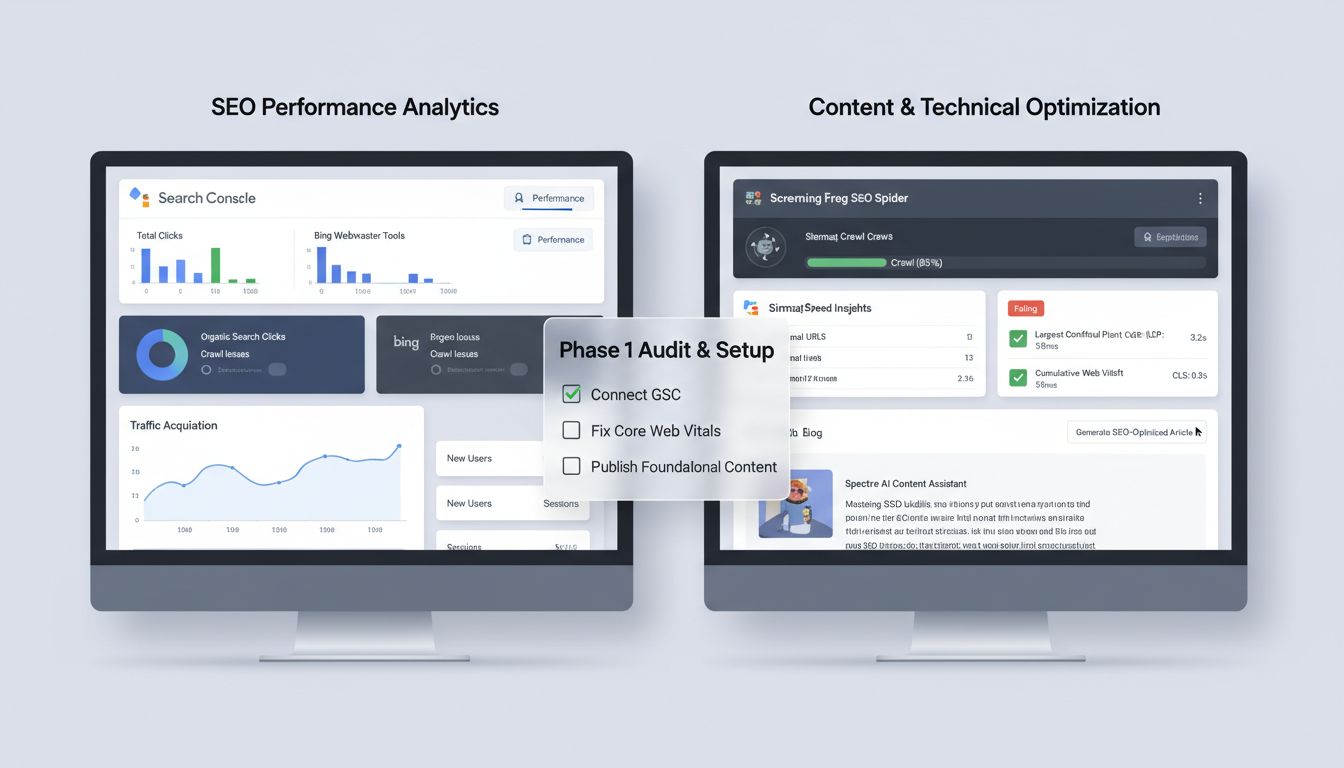
Set up Google Search Console and Bing Webmaster Tools immediately. Non-negotiable. Connect GA4, run Screaming Frog's free 500-URL crawl, and check PageSpeed Insights.
The data is sobering: only about 33% of sites pass Core Web Vitals. Fix what it finds.
At the same time, start your content engine. Use Spectre to research and publish 5-10 foundational articles on low-competition topics. Start a keyword list with Mangools' KWFinder free trial. The goal by day 30 is a technically sound site with actual content live, that's it.
Phase 2: Deep Dive & Optimization (Days 31-60)
Now act on your audit. Fix broken links, compress images, address slow pages. Use Ahrefs' free Webmaster Tools for a backlink snapshot.
Do a basic content gap analysis, what do your top competitors rank for that you don't? Start tracking 20-30 key phrases in Mangools' SERPWatcher.
This is the shift from fixing errors to actually being strategic about it.
Phase 3: Scale & Iterate (Days 61-90)
Double down on what works. Scale content production with Spectre, targeting medium-difficulty keywords you identified in Phase 2. Run Surfer SEO across your top 5 performing pages and optimize them.
If traffic is growing and budget allows, consider upgrading to SEMrush or Ahrefs for deeper competitor intelligence. The workflow by now is a flywheel: publish, measure, optimize, repeat.
Your Final Stack
Stop chasing every new tool. For most founders, the stack is: Spectre for content automation, Google/Bing tools as your free foundation, Screaming Frog and PageSpeed Insights for technical health, and Mangools for affordable analysis.
Upgrade individual pieces as specific bottlenecks show up, not because a competitor has more features.
The goal isn't tool mastery. It's systematic growth. Whether you're looking at seo tools for beginners, the best seo tools for beginners, or comparing best paid seo tools against seo software tools free options, the answer is the same: start small, stay consistent, and use what actually moves the needle.
Work through this workflow and in 90 days you'll have a functioning SEO engine. Not a seo tools list of unused subscriptions you keep meaning to learn. A real process, and that's what separates the top seo tools users from everyone else poking around the best ai seo tools, best seo tools for small businesses, and top seo tools free tiers without ever shipping anything.
Conclusion
What's the actual point of all these tools? Not to master dashboards. It's to stop doing manually what software can do for you.
Start with Google Search Console and Bing Webmaster Tools. Free, essential, no excuse not to have them set up. Then build from there with a core platform that handles the content creation side of things.
Spectre is worth calling out specifically because it solves the problem most founders actually have: producing optimized content at scale, consistently, without it eating your week. Keyword research, writing, publishing, automated. What used to take weeks takes minutes.
As your needs grow, layer in tools like Mangools for affordable research or Ahrefs for backlink intelligence. You don't need them on day one.
The 30/60/90-day framework exists for a reason. Fix technical issues first. Then optimize your content. Then scale production. In that order.
Whether you're comparing seo tools for beginners, weighing best paid seo tools against seo software tools free options, or just trying to build a basic seo tools list you'll actually use, the answer is the same. Start small. Stay consistent. Use what moves the needle.
The goal isn't to become an expert at the top 10 seo tools. It's traffic growth without the overwhelm. That's what separates people who actually get results with the best seo tools for beginners from everyone else who signs up for the top seo tools free tiers and never ships anything.
The best seo tools for small businesses aren't the ones with the most features. They're the ones you use.
Ready to start? Take the free AI content assessment at spectreseo.com to see how much time automated SEO can save you, and how fast you can grow organic traffic.
Frequently Asked Questions
Which SEO tool is best for beginners?
The best seo tools for beginners are the ones that cut out the most painful part of SEO: actually producing content.
Spectre handles keyword research, writing, and publishing in one place, so you're not context-switching between five different tabs. For foundational data, Google Search Console is the free starting point every site needs regardless of what else you're using.
Is SEO dead or evolving in 2026?
SEO isn't dead. It's just different.
AI-powered search experiences like SGE are changing how people find things, which means the tools that win are the ones optimized for both traditional ranking and AI discovery. The SEO software market is past $75B and still growing [Source: globenewswire.com], that's not a dying industry.
What are basic SEO tools?
Start here, all free: Google Search Console for indexing and performance data, Google PageSpeed Insights for Core Web Vitals, Screaming Frog SEO Spider (free tier) for technical crawls up to 500 URLs, and Bing Webmaster Tools.
These are your data bedrock. Any paid tool you add later is just building on top of what these tell you.
Can ChatGPT do an SEO audit?
Not really. It can generate a checklist, but that's not an audit.
ChatGPT has no access to your live site data, index status, backlink profile, or what your competitors are doing. Tools like Screaming Frog, SEMrush, or Ahrefs actually crawl your site, read server responses, and pull from real databases. An LLM is guessing. Those tools are measuring.
What is the 80/20 rule for SEO?
80% of your early results come from 20% of the work: fixing critical technical issues, cleaning up key pages, and publishing consistently.
That's it. The top seo tools, the ones worth your time across any seo tools list, whether you're looking at seo software tools free options or best paid seo tools, are the ones that automate or speed up those high-impact tasks. Spectre handles the content side. Screaming Frog handles the technical side.
Don't try to master every feature. Just do the things that move the needle, repeatedly, with the best ai seo tools and best seo tools for small businesses that fit where you actually are right now.