May 17th, 2026
How to Create SEO Content with AI: A Step-by-Step Framework
 WD
WDWarren Day
You've been told AI will fix your SEO scaling problems. Maybe you even tried it. The content came out generic, didn't rank, and definitely didn't convert.
The problem isn't AI. It's that most teams use AI writing tools like they're a finished product rather than one piece of a larger system.
AI Overviews now show up in roughly 48% of all search queries, which changes how content gets discovered and cited. That's a real shift. And yet most teams are still just... pasting into ChatGPT and hoping for the best.
I've built and operated Spectre, an AI-powered SEO content automation platform. I've also worked inside large media companies where editorial teams, SEO strategists, and engineers all had to actually collaborate to produce content that ranked at scale. What I learned: the secret isn't better prompts.
It's a production framework. AI handles research and drafting. Human strategy, expert editing, and measurement form the part you can't skip.
This guide walks through that framework. A 5-step system for producing high-quality, trustworthy, AI-optimized content that works within your domain rating constraints. We'll cover strategic research, grounded knowledge retrieval, human governance, technical optimization, and measurement loops that close the feedback cycle.
The goal is a process that treats AI as a collaborator, not a replacement, which is exactly how agencies and media companies actually operate when they're using the best seo tools for small businesses and scaling content without it falling apart.
Before You Start: Tools, Roles, and the Right Mindset
What happens if you skip this part and just start prompting?
You waste months producing generic content that doesn't rank. So before anything else, get the foundation right.
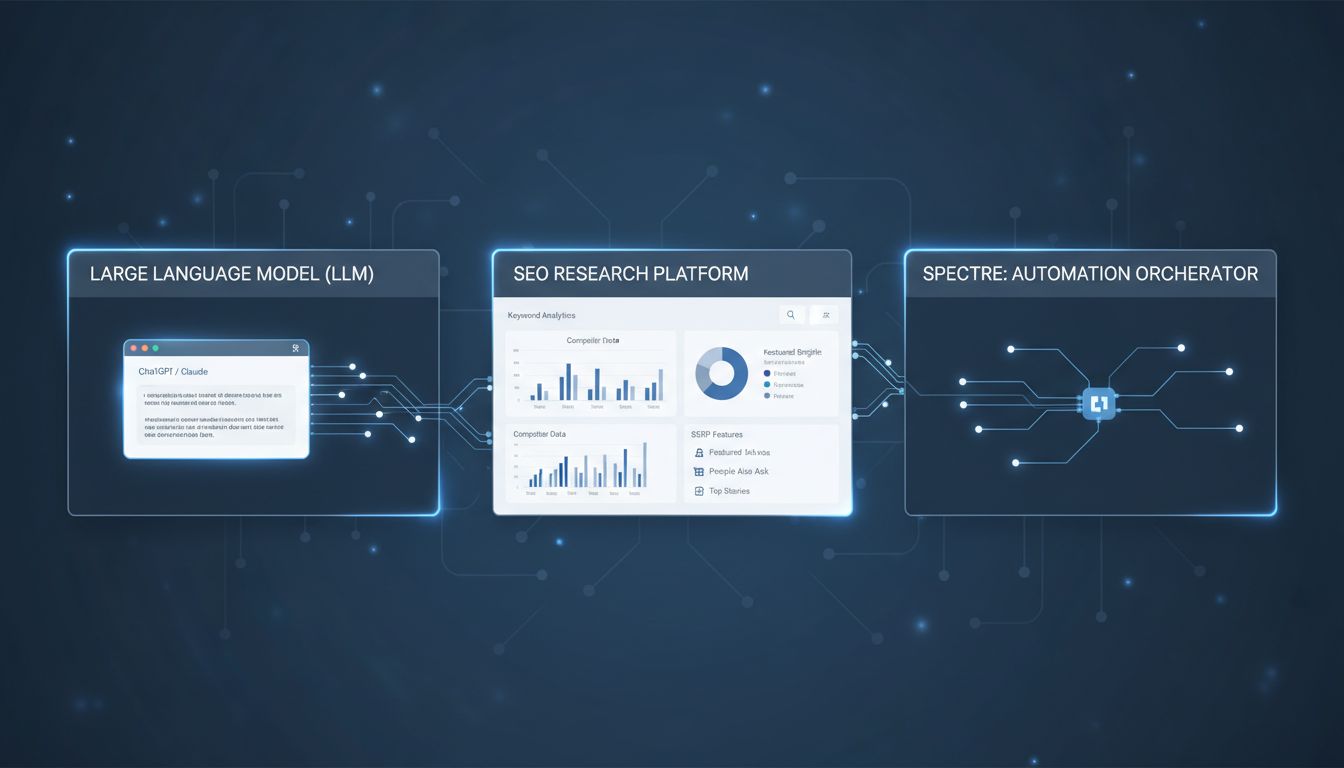
There are three categories of seo content creation tools you need working together. First, a capable LLM, ChatGPT (700 million weekly active users) or Claude, for drafting. Second, a dedicated SEO research platform like Ahrefs or SEMrush for keyword analysis, competitor research, and SERP feature tracking. Those two are non-negotiable if you want to understand search intent and find competitive gaps.
Third: an orchestrator. This is what tools like Spectre handle, automating the handoffs between research, briefing, drafting, and optimization. Without it, you're manually copying data between disconnected apps. That kills scalability and introduces errors in ways that are annoying to trace back.
The mindset shift matters too. AI is a high-speed collaborator, not a replacement. The bottleneck for quality content was never production speed, it's human expertise. Your strategy, editing rigor, and domain knowledge are what build trust and satisfy the E-E-A-T signals search engines now prioritize.
Define three roles upfront, even if one person plays all of them at first.
The Strategist sets direction: target keywords, audience intent, competitive analysis, and the content brief. The Writer/Prompt Engineer executes, using retrieval-augmented generation (RAG) to ground the AI in your specific knowledge base and produce a first draft. The Editor owns quality, fact-checking, brand voice, experiential depth, E-E-A-T.
This separation solves what I'd call "prompt dilution," where one person trying to do everything ends up with inconsistent, brand-drifting output. Media companies that successfully scale content have clear editorial workflows. Not just writers pasting into ChatGPT.
If you're already familiar with basic SEO concepts, keywords, search intent, backlinks, and you've played around with an AI writer, you're ready. This framework takes that experimentation and turns it into a repeatable production line. Whether you're looking at the top 10 seo tools, trying to find seo software tools free, or comparing best paid seo tools, none of it matters if the roles and workflow aren't in place first.
Fix the foundation before you touch the process.
Step 1: Strategize with AI-Powered Research & Briefing
Your first move isn't writing. It's building a technical specification.
Think of it like a PRD for an engineering team. The AI is your junior developer, the content brief is the spec. Without it, you get generic output that misses search intent entirely.
Start with keyword clusters, not isolated terms. Open Ahrefs and look for "parent" topics like "top seo tools," then map the "child" queries around it: "best seo tools for small businesses," "seo tools list," "best paid seo tools." Cluster by intent.
Then run a SERP analysis for each cluster. Are the top results listicles, comparisons, buyer's guides? Check for AI Overviews, featured snippets, video carousels. If 80% of the top 10 are comparison tables, your brief needs to mandate a comparison section.
Now build the spec. A proper brief has these fields:
- Primary & Secondary Keywords: The target cluster. Gives the AI the lexical field to work within.
- Search Intent: Classify it. Be specific: "User wants to compare 5-7 tools before shortlisting for a small business budget."
- Target Audience: "Marketing manager at a B2B SaaS, 10-50 employees, some SEO knowledge, constrained by budget and time."
- Competitor URLs: 3-5 top-ranking pages. The AI deconstructs their structure and finds gaps.
- Mandated E-E-A-T Opportunities: Concrete instructions like "Include a personal anecdote about implementing Ahrefs' API" or "Cite the Semrush stat on AI-generated content growth."
- H2/H3 Structure: The exact heading outline. Controls information hierarchy, ensures coverage of all sub-intents.
- Voice/Tone Guidelines: "Authoritative but approachable, like a senior engineer advising a peer. UK English. No hype words ('revolutionise', 'game-changing')."
Don't write this manually. Use a prompt template or a dedicated tool. Moonlit Platform can generate these briefs at scale via CSV upload, completing in under five minutes what used to take an hour of manual analysis.
Here's what the difference actually looks like:
Generic Prompt: "Write a 1500-word article about SEO tools." Output: A meandering, surface-level post that maybe mentions Ahrefs and SEMrush.
Structured Prompt (from a full brief): "Act as a senior SEO engineer. Write a commercial-intent listicle comparing the top 7 SEO tools for B2B SaaS marketing managers. The primary keyword is 'top seo tools.' The audience needs to understand trade-offs between cost, learning curve, and advanced features like API access. Include a comparison table. In the Ahrefs section, explain how Domain Rating constraints keyword strategy. Use the tone of a technical founder advising a peer..." Output: A targeted, actionable draft that's 70% ready for human editing.
The most common mistake is treating the brief like a keyword list. It's not. It's a blueprint of what to say and why, the argument, the evidence, the narrative structure.
Once it's done, the brief becomes the contract between strategist and writer. Every piece of seo content creation work that follows traces back to it. That's how you make sure the output aligns with both user intent and business goals before a single word gets generated.
Step 2: Prompt & Create with Grounded Knowledge (RAG)
What goes wrong when teams finally sit down to write?
They copy-paste the brief into ChatGPT and get generic, sometimes completely inaccurate content back. The problem isn't the AI. It's that you've asked a generalist model to be an expert without giving it the expert's notes.
Your job is to ground the AI in reality using Retrieval-Augmented Generation (RAG). Forget the jargon. RAG just means you give the AI a fact-checked source document to work from before it writes. Research from NAACL 2024 shows this simple technique can improve LLM accuracy from 10-31% to 94-99% when structured external knowledge is provided.
Here's the exact workflow.
1. Build Your Knowledge Base
Create a folder of source documents for each topic. This isn't academic research, it's your internal expertise. Gather:
- Product documentation and release notes
- Transcripts from customer interviews or sales calls
- Internal case studies or performance reports
- Links to 3-5 authoritative external articles you trust
For a piece on "best SEO tools for small businesses," I'd include our own Ahrefs keyword tracking data, anonymised client onboarding documents that show common pain points, and a few recent analyses from trusted industry blogs.
2. Construct the Grounded Prompt
Open your AI writing tool (ChatGPT, Claude, or an integrated platform like Spectre). Don't just paste the brief. Build a prompt that forces the AI to use your sources.
Use this template:
Role: You are an expert SEO consultant with 10 years of experience advising B2B SaaS founders.
Task: Write the first draft for the blog post described in the [content brief](/blog/seo-content-strategy-guide) below.
Knowledge Base: Below the brief, I have provided SOURCE DOCUMENTS. You MUST base all factual claims, statistics, and recommendations on these documents. Do not invent information.
Output: Follow the H2/H3 structure in the brief exactly. Write in a direct, analytical tone. Cite specific details from the source documents to support your points.
---
[PASTE YOUR FULL [content brief](/blog/seo-content-strategy-guide) HERE]
---
[PASTE YOUR CURATED SOURCE DOCUMENTS HERE]
The critical instruction is "You MUST base all factual claims... on these documents." That one line cuts hallucinations at the source.
3. Generate and Verify the Draft
Run the prompt. A good draft will:
- Adhere strictly to your H2/H3 outline.
- Integrate specifics from your sources (e.g., "As noted in our Q3 case study, Client X saw a 40% reduction in time spent on keyword research...").
- Read with confident, expert tonality, not the generic, passive voice of an untethered AI.
If the draft veers off into generic advice, your sources weren't specific enough. Go back and add more concrete, proprietary data.
The Common Mistake to Avoid
Letting the AI "think for itself" on niche topics is the primary cause of factual errors and thin content.
You hired an AI as a writer, not a subject matter expert. The expertise has to come from you.
Platforms like Spectre automate this grounding by pulling your keyword research, SERP analysis, and any uploaded background documents directly into the drafting environment. The AI writes with that context already in its working memory, which is far more reliable than hoping it recalls accurate information from general training.
The verification step is simple: scan the draft. Does it sound like someone who has actually read your source materials?
If yes, the grounding worked. If it reads like a generic web article, the kind that could've been written about any of the top seo tools, best paid seo tools, or items on a random seo tools list, the RAG process failed. Go back, strengthen your source documents, and run it again.
This applies whether you're using seo software tools free, pulling from the best seo tools for wordpress, or working with something from the top 10 seo tools lists. The model is only as good as what you feed it. That's true for beginners picking up the best seo tools for beginners and for teams running seo content creation at scale.
Step 3: Edit, Fact-Check & Govern, The Human Engine
Your AI has produced a draft. This is where the real work begins, and where most teams fail.
The editor's job is simple: add Experience and Expertise (the "E-E" in E-E-A-T). The AI gives you a base. Your human review makes it credible, unique, and trustworthy.
Google explicitly states that AI-generated content is acceptable only if it's people-first, high-quality, and subjected to rigorous human fact-checking to meet E-E-A-T signals. [Source: Moz]. Publishing without this step is the fastest route to "scaled content abuse" penalties, Google's term for bulk AI pages lacking demonstrated experience or credible authorship.
Here's your five-point editorial checklist. Print it.
1. Fact-Check Every Claim
Don't trust the AI's memory. Cross-reference every statistic, date, and technical claim with at least two trusted sources. Use a systematic method like SIFT:
- Stop before sharing or publishing.
- Investigate the source the AI might be vaguely referencing.
- Find better coverage from established authorities in the field.
- Trace claims back to the original context.
For niche topics, consult a subject-matter expert (SME). For scale, consider tools like WordLift that use AI agents to automate initial claim detection, but never skip the final human verification.
2. Inject Original Insights and Examples
The AI draft is generic. Your job is to make it unique.
- Replace generic advice with a specific, proprietary case study from your work.
- Swap hypothetical scenarios with real anecdotes from customer support tickets.
- Add a data point from your own analytics that no one else has.
If the article is about "improving SaaS onboarding," don't just list best practices. Describe the exact A/B test you ran, the surprising result (e.g., "moving one step cut drop-off by 22%"), and the lesson learned.
This is your competitive advantage over every other team using the same top seo tools, the same seo content creation tools, the same prompts.
3. Strengthen E-E-A-T Signals Architecturally
Make expertise visible to both readers and crawlers.
- Add a detailed author bio with relevant credentials and a link to their LinkedIn profile or portfolio. "John, a senior engineer with 10 years in DevOps" is good. "John led the platform team at [Well-Known Scale-Up] and now consults on Kubernetes security" is better.
- Ensure the publication date is clear and recent. Stale content screams neglect.
- Include clear 'About Us'/'Contact' links in the template, establishing your entity's legitimacy.
4. Ensure Readability and Human Flow
AI writes in blocks. Humans write in narratives.
- Break up monolithic paragraphs. Aim for 2-4 sentences max.
- Add transitional phrases to connect ideas logically. The AI often jumps.
- Read the piece aloud. If you stumble or get bored, so will your reader. Rewrite those sections.
5. Verify and Strategically Place Links
Links are credibility signals.
- Internal links: Add 3-5 relevant links to deeper content on your site. This aids crawl depth and demonstrates topical authority.
- External links: Link to high-authority sources you referenced during fact-checking (e.g., official documentation, research papers). Avoid linking to thin affiliate sites or direct competitors.
This matters whether you're writing for a large editorial team or you're one person using the best seo tools for small businesses and best seo tools for beginners to stretch a limited budget. The principles don't change.
Governance for Scale: Document this process and make it repeatable. Use collaboration tools like StoryChief or Google Docs with defined approval workflows to create an audit trail. Who reviewed it? When? What changed?
That governance is your operational defense against quality drift and algorithmic penalties. It's also what separates teams that scale content well from teams that end up on a best paid seo tools vs. best seo tools for wordpress debate thread, wondering why their traffic dropped.
The final check is the "So What?" Test.
After editing, ask: "Does this article provide unique value I couldn't get from the top five Google results?" If the answer isn't a definitive yes, you're not done.
That question applies to everything, whether you're working from a curated seo tools list, pulling data from seo software tools free options, or running a full content operation across the top 10 seo tools. Generic in, generic out.
The human engine is what changes that.
Step 4: Optimize for Technical & On-Page SEO Signals
Good content that nobody can find is just an expensive diary entry.
Start with content placement for AI citations. Research from Otterly shows that ~55% of AI Overview citations are drawn from the first 30% of a page's content. That's not a soft suggestion. Place your key evidence, definitive answers, and primary conclusions above the fold.
If your most quotable statistic is buried in paragraph 15, it's functionally invisible to AI.
Implement structured data. Schema markup (FAQ, Article, How-To) gives AI systems labeled signals to parse. When an AI crawler hits your page, it doesn't "read" like a human, it parses the Document Object Model (DOM).
Schema provides explicit property-value pairs ("question": "What is the best SEO tool?", "answer": "..."), making extraction accurate and fast. Pages with proper FAQ schema see a 28% increase in AI citations. That's not nothing.
Refine classic on-page SEO with precision. Your target keyword needs to appear in the H1, the first one or two H2s, and the meta description. Use a tool like Surfer SEO for real-time content grading against SERP winners.
Optimize every image too, descriptive file names (not IMG_0234.jpg) and accurate alt text that includes context, not just keywords. For best SEO tools for WordPress, make sure your CMS setup (Yoast SEO, Rank Math) is outputting clean, semantic HTML.
Don't skip the technical foundation. Page speed (Core Web Vitals) and clean HTML still matter. AI crawlers are built on traditional web crawlers, Google's AI Overview systems use a refined version of Googlebot.
A slow, JavaScript-heavy page that fails Core Web Vitals will struggle to be indexed fully, let alone cited. Run a Lighthouse audit and fix anything below a 90 performance score.
Automate what you can. This is where a platform like Spectre helps. It can automatically generate and insert the correct JSON-LD schema based on your content type, suggest contextually relevant internal links to strengthen site architecture, and handle technical publishing optimizations directly to your CMS.
That removes the manual, error-prone step of copying and pasting code blocks.
The common, costly mistake: publishing well-written, expertly edited content on a slow page with no schema and key answers buried at the bottom. You've built a library with no catalog.
Neither traditional search nor AI systems can efficiently parse and surface it, and it doesn't matter how many seo content creation tools, top seo tools, or seo software tools free options you used to produce it. Invisible is invisible.

Your verification step is the Technical Pre-Flight Check. Before hitting publish, validate your page with:
- Google's Rich Results Test (for schema)
- PageSpeed Insights (for performance)
- A quick visual check: Are the key answers within the first few scrolls?
If all three pass, you've wired your content into the grid.
Step 5: Measure, Analyze & Iterate to Close the Loop
So your content is live. Now what?
Now you find out if it actually works. Not "did we publish it", did it move the needle on something that matters to the business.
For most B2B SaaS companies, that means tracking five things:
- Organic traffic (Google Analytics 4)
- Keyword rankings for your target terms (Ahrefs or Semrush)
- Conversion rate from that traffic (GA4 goals)
- AI citation rate (Bing Webmaster Tools' AI Performance report)
- Dwell time and assisted revenue
The Bing AI Performance report is worth paying attention to. It shows how often your content gets cited in AI-generated answers across Bing, ChatGPT, and Copilot. According to SearchEngineLand, it tracks citation frequency but may not include click data, so pair it with your analytics.
Setting up GA4 conversion goals takes about 15 minutes. Go to Admin > Events > Create event. Name it "Content Lead," set the parameters for when someone submits a content offer form or requests a demo from a blog page. Done. No coding required.
Apply the 80/20 rule. Export your top 50 pages by traffic or conversions each quarter. Every time, you'll find that roughly 20% of your content is driving 80% of results. Those topics, formats, and angles go straight into your next briefing cycle.
Here's a practical monthly review for teams without dedicated analysts:
First Monday of each month:
- Export GA4 report: Landing Page > Sessions > Conversions
- Check Bing AI Performance report for new citations
- Review Ahrefs ranking changes for your top 20 target keywords
- Note which content formats perform best (guides vs. lists vs. case studies)
Buffer's analysis of 1.2 million posts found AI-assisted content had a 5.87% median engagement rate versus 4.82% for human-only posts. But that's platform-level data. Verify it holds for your actual audience before acting on it.
AI also speeds up A/B testing. Generate 10-15 variant titles and meta descriptions for your top-performing pages using a prompt like:
"Generate 10 compelling title tag variants under 60 characters for [Your Topic] that balance click-through rate with keyword relevance for [Your Primary Keyword]. Include emotional triggers and specificity."
Test one element at a time, title first, then meta description, then H1. Run each test for at least 2,000 impressions or 30 days, whichever comes first. Keep a shared spreadsheet of what wins.
The most common mistake here: measuring production speed instead of qualified outcomes. Publishing 20 mediocre articles that each get 50 visits is worse than publishing 5 pieces that convert at 3%. Doesn't matter how many seo content creation tools, top seo tools, or best paid seo tools you used to ship them fast.
Your measurement system should directly feed Step 1. If "SaaS pricing page optimization" guides convert 40% better than "general marketing tips," that's your next priority cluster. If certain H2 structures are getting more AI citations, those go into your brief templates.
Whether you're working through an seo tools list, trying to figure out the best seo tools for small businesses, or comparing the best seo tools for beginners against top 10 seo tools, none of it matters if you're not closing this loop.
Data from Step 5 becomes strategy for Step 1. That's a content engine. A publishing schedule is just... a calendar.
Common AI SEO Mistakes That Tank Your Rankings
You've built a system, followed the workflow, and invested in the right seo content creation tools. But one unforced error can still derail everything.
Here are the mistakes I've seen sink otherwise solid AI SEO strategies.
Publishing without human oversight is the cardinal sin. Google's guidance is clear: AI content is acceptable only if it's people-first, high-quality, and fact-checked by a real human. Publishing raw AI output erodes trust and invites quality penalties. Every piece needs a human editor who actually understands the subject and the audience.
Neglecting E-E-A-T and author bylines makes your content low-E-E-A-T by default. Content without clear authorship, credentials, and publication dates signals a lack of experience and expertise. Google's Search Quality Rater Guidelines explicitly reward demonstrable expertise. If you don't attribute work to a real, credible person, you're telling search engines your content lacks authority.
Creating thin, duplicate content at scale is the hallmark of failed AI SEO. Identical templates or prompts across hundreds of pages generate duplicate content that search engines struggle to index. No original value, no credible authorship, exactly what Google's "scaled content abuse" guidance targets.
Ignoring technical SEO renders great content invisible. Slow pages or heavy JavaScript that hinders crawling means neither traditional bots nor AI systems can access your content properly. Proper Article and FAQ schema increases AI citations by 28%, yet most AI-generated pages skip structured data entirely.
Grounded hallucinations happen when you skip RAG techniques. Without retrieval-augmented generation and curated knowledge grounding, LLM accuracy can drop to 10–31%. You get confident, well-written nonsense, and readers will eventually notice.
Measuring output, not outcome is the ultimate vanity metric trap.
Celebrating article count while traffic and conversions flatline means you've built a publishing machine, not a growth engine. Whether you're comparing seo software tools free against best paid seo tools, working through an seo tools list, or evaluating the best seo tools for wordpress, the top seo tools, best seo tools for small businesses, best seo tools for beginners, or top 10 seo tools, none of it matters if you're tracking production speed instead of qualified traffic and conversions.
Avoid these six mistakes, and your human-in-the-loop framework will actually deliver the rankings you're building it for.
Conclusion
AI-driven SEO isn't about replacing humans. It's about building a system where their highest-value work actually scales.
Strategy, expert editing, and continuous measurement are the engine. Not optional extras, the actual thing that ranks. The framework here treats AI as one component in a professional seo content creation tool stack, not a magic button you press and walk away from.
The shift is operational. You're not just generating content; you're building a closed-loop production system.
Success gets measured by qualified traffic, conversions, and visibility in AI-driven discovery. Not words produced. When roughly 55% of AI Overview citations come from the first 30% of a page, your human editors ensuring evidence is front-loaded become the real competitive advantage. [Source: otterly.ai]
Stop treating AI as a shortcut. Start treating it as the core of a disciplined content engine.
To implement this with the automation that ties research, drafting, and measurement together, explore how Spectre can be your central command for systematic, ranking content.
Frequently Asked Questions
Is SEO dead or evolving in 2026?
Evolving. Dramatically. The core goal hasn't changed, connecting what someone's searching for with content that actually answers it. What has changed is that you're now optimizing for both traditional search results and AI-driven discovery like AI Overviews, which show up in nearly half of all queries as of March 2026 [Source: evergreen.media].
That means more attention to schema, content placement, and E-E-A-T than ever before.
Which tool is best for SEO?
There's no single answer here. You need a stack. An LLM like ChatGPT for drafting and ideation, a research tool like Ahrefs or SEMrush for keyword and competitor strategy, and something like Spectre to orchestrate the whole thing from brief to publication.
The best seo tools list isn't one tool. It's an integrated system that executes your framework efficiently.
Can ChatGPT write SEO content?
Yes, but not by itself. ChatGPT is a genuinely capable drafter and research assistant, 700 million weekly active users says something [Source: semrush.com]. But content that actually ranks requires a human-defined brief, RAG-grounded sources, real editing for expertise and experience, and technical SEO optimization on top of all that.
Think of it as one component in the engine. Not the whole factory.
Can I do SEO by myself?
Yes, especially with AI in the mix. This kind of framework is built for small teams and solopreneurs. You'll be playing Strategist, Writer, and Editor, sometimes all in the same afternoon. But if you follow a disciplined process, each role gets its own space.
AI handles the heavy drafting and research. You handle the judgment calls. That split is where it actually works, and it's what makes this viable as one of the best seo tools for small businesses.
Can ChatGPT do an SEO audit?
Sort of. It can put together a high-level checklist and analyze on-page text. But it can't crawl your site, find broken links, read server logs, assess backlinks, or catch JavaScript rendering issues.
For that, you need dedicated tools, Ahrefs, Screaming Frog, something purpose-built. Use ChatGPT for brainstorming and initial analysis. Don't use it as your top seo tools replacement for actual technical work.
What is better than SEO now?
The question assumes SEO is losing to something. It's not. "AI Optimization" isn't a replacement, it's just what SEO looks like now. The goal is an SEO strategy adapted for an AI-augmented search environment, where AI-generated content represents over 17% of top results [Source: semrush.com].
You're not choosing between SEO and something else. You're choosing between keeping up or not.