May 24th, 2026
How to Use AI for SEO: A Step-by-Step Framework for Founders
 WD
WDWarren Day
You're a founder, not a marketer. And honestly, that changes everything about how you should approach this.
You've probably seen the "SEO is dead" headlines. Meanwhile your analytics are telling a different story. SEO isn't dying, it's shifting, and the shift is fast. AI search visitors are expected to surpass traditional search visitors by early 2028, and those visitors are worth 4.4x more. [Source: semrush.com/blog/ai-search-seo-traffic-study]
Your competitors aren't just asking ChatGPT for blog ideas. They're building automated systems. That's the gap.
Manual SEO is breaking under this. You can't write one blog post at a time and expect to keep up. You need a system, something that treats how to use AI for SEO as a real operational question, not a trick you read about on Twitter.
This isn't a "best ai seo tools" listicle. It's a framework.
I call it the AI SEO Flywheel: Research, Create, Optimize, Measure. Built for founders who think in workflows. We'll go from auditing your foundation with ai seo tools, to building a content system that doesn't require you to burn out running it. I'll show you what to hand off to automation, and where you actually need to stay in the loop.
You'll finish with a 90-day action plan. Fair warning: results don't come immediately. Technical fixes tend to show up in 2-4 weeks. Content results in 30-60 days. Full ROI on the strategy, including from whatever ai seo services or an ai seo agency you might bring in, typically takes 3-6 months. [Source: gomega.ai/blog/ai-seo-tools-for-small-business]
But the system compounds. Everything you build now gets more valuable over time, whether you're running it yourself or working with an ai seo company coalition of tools and vendors.
Before You Start: The Foundational Setup & Mindset (10 Minutes)
What do you actually need before running SEO with AI? Three tabs.
- Google Search Console – your direct line to Google's crawl data
- Google Analytics 4 – track the new AI Assistant channel introduced in 2025
- Screaming Frog – download the free version (500 URL crawl limit is enough for most startups)
These aren't fancy tools. They're your dashboard. You wouldn't build a product without observability, so don't do SEO without these. Everything else is optional.

Next, adopt the 10 20 70 rule for AI.
10% is your initial idea and strategic direction. 20% is AI execution, drafting content, analysing SERPs, auditing technical issues. The remaining 70% is human refinement: editing for expertise, injecting real-world case studies, aligning with your product voice, making the calls that actually matter.
AI handles scale and data. You provide the judgment that algorithms can't replicate.
This answers the question people keep asking: "Can SEO be done by AI?" Yes, but poorly if left alone. Effective SEO in 2026 is a human-AI collaboration, not a handoff.
Forget the tool hype. Map your stack to your business stage:
- Essential & Free: ChatGPT or Claude for brainstorming, GSC, GA4, Screaming Frog.
- Optional & Powerful: Surfer SEO for on-page optimisation, Semrush Copilot for research. These add precision.
- Aspirational (for later): Ahrefs Advanced for deep backlink analysis (costs $4,788 per year) or enterprise platforms like Conductor. If your domain rating is under 50, focus your budget and AI on long-tail question clusters, not premium tools.
There are plenty of ai seo tools and ai seo services out there promising to do it all. Most founders don't need them yet.
Your one rule to start: Do not try to automate everything on day one. Pick one process to master first.
For most founders, that's using AI to analyse a Screaming Frog crawl report and find technical debt, broken links, slow pages, missing meta tags. Get that workflow solid before you touch content generation.
That mindset shift, from looking for a magic AI button to building a deliberate human-in-the-loop system, is what separates founders who waste months on generic content from those who actually build traffic. Whether you eventually bring in an ai seo agency, work with an ai seo company coalition of vendors, or run it yourself using the best ai seo tools and seo software tools free options available, the foundation is the same. You still have to own the 70%.
Phase 1: Audit Your Foundation with AI Assistants (Weeks 0-2)
The first two weeks aren't about writing anything. They're about diagnosis.
You're using AI to do what would normally take a month of manual analysis. Site health, competitive gaps, keyword reality, all of it. Build the evidence first. Content comes later.
Conduct a Technical Health Check with AI
Open Screaming Frog (the free version crawls 500 URLs) and run a full crawl of your site. Export the data as a CSV.
Here's your prompt for ChatGPT or Gemini:
"Analyze this crawl data for a [insert your industry, e.g., B2B SaaS] website. Prioritize the top 5 technical issues affecting SEO, focusing on site speed, indexation, mobile usability, and crawl budget waste. Format the output as a numbered list with: 1) Issue, 2) Example URLs affected, 3) Business impact, 4) Recommended fix."
Why this works: You're giving the LLM a clear role (technical auditor), context (your industry), and a structured output. It scans thousands of rows in seconds and spots patterns you'd miss manually.
The critical filter step most founders skip: Before pasting, filter your CSV in Excel or Sheets. Show the AI only the signal, not the noise. Isolate:
- URLs with 4xx (client) or 5xx (server) status codes
- Pages with slow load times (look for high 'size' or 'time' columns)
- Pages blocked by
noindexorrobots.txt
The 'crawl budget' insight for technical founders: Search engines allocate a finite number of pages they'll crawl per site session.
If 30% of your crawl is wasted on duplicate tag pages, broken filters, or low-value admin paths, that's resource drain preventing Google from discovering your important commercial pages.
AI is genuinely good at identifying these patterns in crawl data. That's a real use of how to use ai for seo, not content generation, just pattern recognition at scale.
Verification: After implementing fixes (like redirecting 404s, compressing images, fixing noindex directives), re-crawl in 7 days. You should see the error count drop and average page speed improve. Technical fixes often show ranking impact within 2–4 weeks [Source: Gomega].
Reimagine Keyword & Competitor Research
Forget chasing individual keywords. Target question clusters instead.
This matters because 800 million weekly ChatGPT users don't type keyword strings, they ask questions. Your content needs to match how people actually search, not how SEOs used to think about it.
Action: Open Perplexity or Claude. Use this prompt:
"Identify 5 question clusters around '[core topic]' for a [target audience]. Format each cluster as: Main Question -> Bulleted list of 3-5 Related Sub-questions."
Example output for "project management software":
- Main Question: How do I choose project management software for a remote team?
- What features are essential for async collaboration?
- How important is native time tracking vs. integrations?
- What's the learning curve for non-technical team members?
- Main Question: What's the real cost of project management software?
- Are per-user fees or flat rates better for teams under 20?
- What hidden costs come with advanced reporting?
- How much does onboarding and training typically add?
Why question clusters win: They map to user intent and create natural content silos. One cluster becomes a pillar page. The sub-questions become supporting posts, all interlinked.
Introduce your strategic filter: Domain Rating (DR). Your Ahrefs Domain Rating is your SEO credit score. It constrains what you can actually rank for.
- DR 30: You're a startup. Target long-tail, specific question clusters (e.g., "how to evaluate a CRM for a 10-person sales team with budget under $50/user/month"). Compete on specificity, not volume.
- DR > 50: You have authority. You can credibly target broader, commercial-intent clusters (e.g., "best CRM software").
This is why Ahrefs Advanced at $4,788/year is aspirational for early-stage founders, you don't have the domain authority to act on most of its competitive intelligence yet.
Start with the question-cluster method. It's free, and it matches actual searcher behavior.
For deeper analysis: If you have the budget, best ai seo tools like Surfer SEO or Semrush can grade your existing content against these question clusters and show you exactly where subtopics are missing. They're among the more useful ai seo tools for automating the gap analysis between your content and top-ranking pages.
Some founders also bring in an ai seo agency or work with an ai seo company coalition to run this analysis. That's a reasonable call if you don't have the time. But you can start with the free prompt-based method and get 80% of the way there. There are even seo software tools free options that will get you moving without spending anything.
The point is: whether you're using ai seo services, running it yourself, or somewhere in between, the question-cluster framework is the same. The approach works for seo for ai search too, since AI-powered search engines respond well to content built around real questions.
Your deliverable after Week 2: A single document. Two sections: your top 5 technical action items, and your 5-7 priority question clusters, each mapped to a target page and filtered by your Domain Rating reality.
That's your blueprint. Everything after this builds on it.
Phase 2: Build Your Content Factory (Months 1-3)
Blueprint in hand. Now you build.
This isn't about cranking out 100 generic articles. It's about systematically creating the 20% of content that drives 80% of your traffic. This is the "Create" phase of the Flywheel.
Generate High-Impact Content Briefs
The 80/20 rule of SEO is real. A small number of deep, intent-rich pillar pieces will outperform dozens of shallow posts. Your brief is the spec that makes sure every piece targets that 20%.
Here's a complete, copy-pasteable prompt template for Claude or ChatGPT. I use variations of this daily:
You are an expert SEO strategist. Create a comprehensive content brief for a blog post.

**Context:**
- **Topic:** [Insert your core topic, e.g., "SaaS pricing models for B2B startups"]
- **Target Audience:** [Be specific: e.g., "Technical founders at Seed to Series A SaaS companies evaluating pricing page structure"]
- **Brand Voice:** [e.g., "Direct, pragmatic, engineer-to-engineer. Avoid marketing fluff."]

**Instructions:**
1.  **Primary Keyword:** Identify one primary keyword with commercial intent for this audience.
2.  **Secondary Keywords:** List 5-7 semantically related secondary keywords and question-based queries (include "how to," "best," "vs" variations).
3.  **Competitor Analysis:** Analyze the top 3 ranking URLs for the primary keyword (provide the URLs). Summarize their strengths and what they miss.
4.  **Outline:** Provide a detailed H2/H3 outline that covers:
- A direct answer to the core user question in the introduction.
- Comparison sections (e.g., tiered vs. usage-based pricing).
- A "how to implement" section with actionable steps.
- A "common mistakes" subsection.
5.  **Internal Linking:** Suggest 2-3 relevant internal links from our existing site content (mention specific page titles).
6.  **Content Gaps:** Based on competitor analysis, identify 2-3 unique angles or data points our article must include to surpass them.
The most common mistake is a broad prompt like "write a blog about pricing." That guarantees generic output. Specificity is what forces the AI, and eventually your writer, to address real user intent.
Real Brief Example (Redacted):
- Topic: SaaS Pricing Models.
- Primary KW: "value metric pricing."
- Competitor Gap Identified: All top articles define value metrics but none show how to calculate one from existing product usage data.
- Unique Angle Mandated: Include a formula and a real, anonymised example from a B2B analytics platform.
That brief took 90 seconds to generate. It'll save 4 hours of meandering research.
Execute the Human-in-the-Loop Writing Process
Your workflow is a three-step assembly line:
-
AI First Draft: Feed the brief to your LLM (Claude 3.5 Sonnet works well for long-form reasoning). The output is a 70% complete draft, structurally sound, but lacking your unique edge.
-
Human Editor Adds The 70%: This is where you inject what AI can't replicate. Add:
- Unique anecdotes: "When we implemented this at [Previous Company], the sales team pushed back because..."
- Proprietary data or frameworks: A simple chart from your own customer usage.
- Counterarguments: "Most guides will tell you to do X, but that ignores the technical debt it creates if..."
- Brand voice and E-E-A-T signals: Your specific experience as a founder building this.
- AI Second Pass: Take the human-edited draft and run a final optimisation prompt: "Review this draft for SEO and readability. Ensure sentences are concise and active, check keyword placement is natural, and suggest where to add bold for scannability."

The AI handles the scalable, repetitive structure. You reserve your time for the high-value expertise that builds trust and differentiation.
This is exactly why I built Spectre. It formalises this pipeline: automates the research, SERP analysis, and first-draft generation from a keyword, and delivers a structured brief and draft to your dashboard. Your job becomes focusing on that 70%, the experience and expertise, rather than the 30% of manual research and formatting.
Guard Against Hallucinations and Low Quality
AI-generated content accounted for 17.31% of top search results in 2025. The ones that rank have passed rigorous human QA.
Publishing unedited AI content is a major E-E-A-T risk. Google's policy allows AI content if it's helpful, but raw, unvetted output rarely is.
Run this pre-publish checklist on every piece:
- Fact-Check: Verify every statistic, claim, and "fact" the AI states. It will confidently invent studies.
- Citation Audit: If the draft says "according to HubSpot," find the original source link. Don't let it reference "studies show."
- Plagiarism Scan: Run a quick check (even a free tool will do). AI can regurgitate phrasing from its training data.
- Author Injection: Add a 2-3 line author bio at the bottom with relevant credentials. "Jane Doe has led product at three SaaS startups and now advises on monetisation strategy."
- Read Aloud: The final test. Does it flow like something a knowledgeable person would actually say? Edit anything awkward, overly formal, or repetitive.
Your goal for Months 1-3: Publish 5-10 of these "question-cluster" articles using the brief → draft → human-edit → QA process. That's a sustainable pace for a founder.
Content optimisation results typically start showing impact within 30-60 days. You're not looking for viral hits. You're building a foundation of depth.
This approach works whether you're figuring out how to use ai for seo yourself, using best ai seo tools like Surfer SEO, running with ai seo services, or working with an ai seo agency or ai seo company coalition. The process is the same. So are the free options, there are seo software tools free enough to get you moving without spending anything, and the question-cluster brief method works just as well for seo for ai search since AI-powered engines respond well to content built around real questions.
The factory isn't about speed for speed's sake. It's about a repeatable system that consistently produces content better than what your competitors are manually crafting, freeing you to do the work only you can do.
Phase 3: Optimize for Machines and Humans (Ongoing)
Your content factory is running. Now every piece needs to work for both traditional search crawlers and AI models.
This isn't about sprinkling keywords. It's about structuring information so machines can parse, understand, and cite you.
Think of it as the "3 C's" framework: Content, Code, and Credibility.
Structure Content for AI Understanding (The 3 C's)
Content means clear entity relationships. AI models map concepts, not just keywords. When you write about "React state management," explicitly connect it to "useState hook," "Redux," and "performance optimization." Use H2/H3 headings that mirror natural language questions.
Code is your technical foundation. A fast, clean site with proper schema markup tells AI you're a reliable source. Google's crawlers and AI models both penalize slow Core Web Vitals. Run a weekly Screaming Frog crawl, its AI integrations can now flag missing alt text and suggest fixes automatically.
Credibility is your E-E-A-T signal layer. AI models are trained to spot expertise. Add author bios with verifiable credentials, link to case studies, cite original data. This isn't marketing fluff. It's the trust signal that determines whether an AI cites you or a competitor.
The most actionable code-level task? Implement structured data. Google removed FAQ rich results in May 2026, so focus on Article, HowTo, and Product schemas. Don't use a generic generator, craft precise prompts for your AI assistant.
Run this exact prompt for any blog post:
Generate a production-ready JSON-LD Article schema for [Your Article Title Here].
Include required properties: headline, author (type Person with name), datePublished, dateModified, image, publisher (Organization with name and logo).
Use only Schema.org properties eligible for Google rich results. Output valid JSON-LD.
Validate the output with Google's Rich Results Test. This single step makes your content dramatically easier for AI systems to extract and attribute.
Automate On-Page Elements
You shouldn't write meta titles and descriptions manually. That's a perfect task for AI, but with guardrails.
Use this prompt template in Claude or ChatGPT:
Role: SEO specialist.
Context: Page about [topic], primary keyword [keyword], audience [audience], brand [name].
Generate 3 meta title variants (under 60 characters) and 3 meta description variants (under 160 characters) that include the keyword and a clear CTA.
Common mistake: Publishing AI-generated meta without review. I've seen tools produce titles with the wrong product name, or descriptions that sound robotic. Always spot-check for brand voice and accuracy.
Tools like Surfer SEO or Alli AI can automate this within your CMS, but schedule a weekly human review anyway.
For technical pages, use AI to audit headings. Prompt: "Analyze this page's HTML. List all H2 and H3 tags. Suggest improvements for semantic structure and keyword placement." This catches issues where visual design breaks logical document outline.
Build a Signal Network with Internal Linking
Internal links are your site's nervous system. They distribute authority and show AI the relationships between your concepts. Don't leave this to chance.
After publishing, run this analysis:
For the article "[Your New Article Title]",
analyze my site's content library [paste 10-15 relevant URLs/titles]
and suggest 3-5 relevant internal link opportunities.
Explain the semantic relevance for each suggested link.
Look for "silo" opportunities, clusters of content around a core topic. If you have five articles on "database optimization," they should all link to each other. This creates a topical authority signal that both Google and AI models recognize.
You can automate this. WordPress plugins like RankMath AI suggest links as you write. Headless CMS platforms like Storyblok have API integrations that automatically add alt text and internal link suggestions.
The goal is to make strong semantic connections a default part of your publishing workflow.
What is SEO being replaced by? It's not being replaced, it's expanding. Your optimization checklist now includes "LLM understanding" and "citation likelihood" alongside traditional ranking factors. The sites winning in ai seo and seo for ai search aren't just fast. They're built as machine-readable knowledge graphs.
This is true whether you're figuring out how to use ai for seo yourself, running with ai seo services, or working with an ai seo agency or ai seo company coalition. The underlying logic is the same. So are the free options, there's plenty of seo software tools free enough to get you started, and the best ai seo tools (Surfer SEO included) all reward the same thing: content structured for machines as much as humans. That's what ai seo companies and any serious ai seo company are selling you, at the end of the day. Whether you buy it or build it yourself, the structure is what matters.
This phase never ends. Each published piece should be re-audited quarterly. As AI models evolve, so do their parsing preferences. Your job is to make sure your code and content speak their language.
Phase 4: Measure What Actually Matters (Month 3+)
Is your system actually working? After three months, traditional rank tracking will actively mislead you. You need to measure what AI-era search rewards.
Define the New AI-Era KPIs
Forget chasing number one. Track these instead.
Tier 1: Business Outcomes. Non-negotiable.
- Conversions from organic/AI traffic: Form submissions, sign-ups, demo requests.
- Assisted revenue: Revenue where organic search was a touchpoint in the journey.
- Qualified leads: Leads that match your ideal customer profile, sourced via search.
Tier 2 & AI-Specific Signals. These are your early warning systems.
- AI Citation Count: How often Perplexity, ChatGPT, or Gemini cites your content verbatim. This is the new backlink.
- Share of Voice in AI Overviews: Your brand's visibility in Google's AI-generated answers. BrightEdge reported these Overviews increased AI-generated CTRs from 1.3% to 2.4% between December 2025 and February 2026.
- Embedding Relevance: How well your content's semantic meaning matches target queries (tools like Conductor measure this).
- Visibility in AI Tools: Track traffic from the "AI Assistant" channel Google added to GA4 in 2025.
The goal is attribution, not just ranking.
A page that ranks #5 but gets cited in three AI answers is more valuable than a #1 page that gets zero.
Build Your Founder's Dashboard
You need one scannable view. Don't get lost in ten tools. Build a simple table and update it weekly.
| Metric | Source (Tool) | Target | Current Status | Notes |
|---|---|---|---|---|
| GSC Clicks | Google Search Console | +15% MoM | ████▁ | Track trend, not absolute number. |
| GA4 Conv. (Organic) | Google Analytics 4 | 5/month | ██▁▁▁ | Primary business KPI. |
| AI Citation Count | LLM Refs (free) | 2 new/month | ███▁▁ | Manual check: ask AI your target questions. |
| Core Web Vitals | PageSpeed Insights | All "Good" | █████ | Critical for crawl budget. |
| Top 10 Rankings | Ahrefs/Semrush | 5 keywords | ███▁▁ | Secondary metric only. |
Set your tools. Connect Google Search Console to Google Analytics 4. Use LLM Refs for free AI visibility tracking. Use Screaming Frog ($279/year) for technical health. That's your core stack.
Set realistic timelines. This is where most founders get impatient.
- Technical fixes show impact in 2–4 weeks. [Source: Gomega.ai]
- Content optimization results appear within 30–60 days.
- Full AI-driven strategy ROI becomes measurable in 3–6 months.
- Revenue attribution often requires 6–12 months of consistent data. [Source: Getpassionfruit]
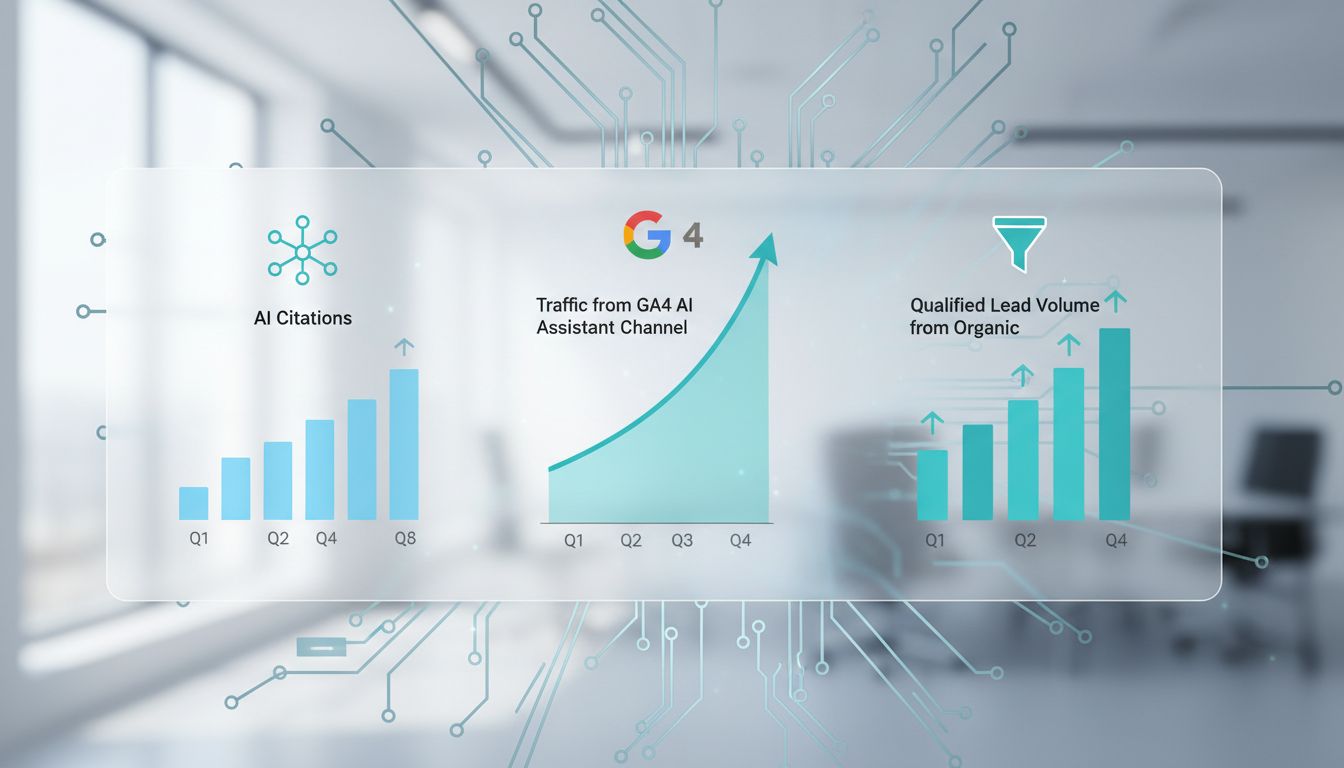
Don't panic if direct revenue lags. Watch for leading indicators instead: AI citations going up, GA4's "AI Assistant" channel showing traffic, qualified lead volume climbing from organic.
Those signals confirm the flywheel is spinning before the revenue catches up. Whether you're figuring out how to use ai for seo yourself, running with ai seo services, or working with an ai seo agency or ai seo company coalition, the measurement logic is the same. The best ai seo tools (surfer seo included) all surface the same signals. So do the free options, there's enough seo software tools free to build a real picture without spending much. Any serious ai seo company or ai seo companies worth working with will tell you the same thing: revenue attribution takes time. What you're watching for now is whether the right things are moving.
The 90-Day AI SEO Action Plan for Founders
This is your execution blueprint. Assume about 5 hours a week. Adjust the pace if you need to, but don't skip the sequence, foundation before scale.
Quarter 1: Audit & Foundation (Now – Month 3)
- Complete your Phase 1 audit. Run the technical, content, and competitor checks. You want one document listing your 10 highest-priority fixes.
- Set up your tool stack. Connect Google Search Console and Analytics. Pick one primary AI-assisted writing tool (like Spectre) and one research tool (Ahrefs, Semrush, or similar).
- Publish 5–10 foundational articles. Use the human-in-the-loop process from Phase 2. Target one core "question cluster" tied to your product. This builds your initial topical authority. Content optimization results typically appear within 30–60 days [Source: Gomega].
Quarter 2: Scale & Optimize (Months 4–6)
- Scale content production. Aim for 2–4 articles per week. Systematise your briefing and review process.
- Implement technical fixes. Address the top issues from your audit: broken schema, Core Web Vitals, crawl errors. Technical fixes can show ranking impact in 2–4 weeks.
- Start tracking AI-specific KPIs. Set up dashboards for AI citations, visibility in AI overviews, and traffic from the GA4 "AI Assistant" channel. This is when you start measuring what actually matters.
Quarter 3: Refine & Systemise (Months 7–9)
- Refine based on data. Look at your first 6 months of KPIs. Double down on the content clusters and formats driving qualified leads, not just traffic.
- Explore advanced tooling. Consider tools like Surfer SEO for deeper on-page optimisation or Semrush for broader market tracking. Whether you're figuring out how to use ai for seo yourself or leaning on ai seo services, invest where you see the highest return.
- Systemise outreach. Start a lightweight link-building and digital PR process focused on earning mentions for your best-performing content.
Full AI-driven strategies typically yield measurable traffic gains within 60–90 days [Source: Gomega], with ROI solidifying in the 3–6 month window.
The goal isn't perfection in Quarter 1. It's a repeatable system that compounds. Whether you're running this solo, working with an ai seo agency, or partnering with an ai seo company coalition, the sequence is the same. The best ai seo tools (surfer seo, the ai seo tools built into Semrush, seo software tools free options) all support this workflow. Any of the serious ai seo companies or ai seo company worth their rate will tell you the same thing: don't skip the foundation.
Common Mistakes & Troubleshooting Your AI SEO System
Your system is running. Now it will break. Every founder hits these friction points when scaling AI SEO. Here's what to watch for.
Mistake 1: Letting AI run without a human editor. You'll get generic, often incorrect content that tanks your E-E-A-T. The fix is the 70% human refinement rule from Phase 2. Every AI draft gets a human pass to inject proprietary data, founder anecdotes, and counterarguments. Non-negotiable.
Mistake 2: Skipping fact-checking. AI confidently hallucinates statistics. Always verify data against primary sources, and use RAG (Retrieval-Augmented Generation) where possible to ground responses in your own documentation. Never copy-paste a stat from ChatGPT without checking.
Mistake 3: Using vague prompts. "Write a blog about SEO" yields useless fluff. Use the prompt templates from earlier phases: include target audience, primary keyword, tone, and competitor analysis. A bad prompt wastes your most expensive resource, your editing time.
Mistake 4: Creating content purely for rankings. Google's guidance is clear: content created primarily to manipulate search rankings is against policy. Simple test, ask yourself "Would I share this with a potential customer even if Google didn't exist?" If no, rewrite it.
Mistake 5: Forgetting brand voice. AI has no personality. Create a one-page brand voice document. Include 4-5 adjectives, sample sentences you love (and hate), and a list of forbidden jargon. Paste it into every content brief.
Mistake 6: Not auditing AI's technical work. AI-generated meta descriptions can be repetitive. Schema markup can be invalid. Schedule a monthly QA review, open 10 random posts, check their meta tags in view-source, and validate structured data with Google's Rich Results Test.
Mistake 7: Expecting revenue in month one. This is the most common founder frustration. Technical fixes show in 2-4 weeks, content results in 30-60 days, and full AI-driven strategies yield measurable traffic gains within 60-90 days [Source: Gomega]. ROI solidifies at 3-6 months.
Mistake 8: Generating duplicate content at scale. When you produce 20 articles a week, accidental self-plagiarism happens. Run a plagiarism check before publishing, and monitor Google Search Console for "duplicate without user-selected canonical" alerts. Canonical tags are your friend.
When you hit a wall, traffic plateaus, rankings drop, don't panic. Return to your flywheel. Audit your inputs (keyword research), check your process (human-in-the-loop), measure your outputs (the right KPIs). The system is designed to be debugged.
Whether you're running this yourself, using ai seo tools like surfer seo, leaning on ai seo services, or working with an ai seo agency or ai seo company coalition, the same mistakes show up. The best ai seo tools and the serious ai seo companies will tell you the same thing. Any decent ai seo company knows that seo software tools free or paid doesn't matter much if you skip the basics. Knowing how to use ai for seo is only half of it. The other half is not screwing up the things on this list. Seo for ai search has the same failure modes. The tools are different, the mistakes aren't.
Conclusion
This isn't about using more AI tools.
It's about building a system that actually holds together over time. The AI SEO Flywheel uses AI for scale and human judgment for everything that actually matters: strategy, real experience, quality control.
The core loop is Research → Create → Optimize → Measure. AI handles keyword research, first drafts, technical audits, data analysis. You handle strategic direction, authentic experience, and the final quality gate that no AI can replicate. [Source: semrush.com/blog/ai-search-seo-traffic-study]
Stop chasing algorithm updates. The goal is a content engine that consistently produces genuinely helpful material. Technical fixes show impact in weeks, content rankings improve in 30-60 days, full strategy ROI becomes measurable in 3-6 months. [Source: gomega.ai/blog/ai-seo-tools-for-small-business]
Whether you're figuring out how to use ai for seo on your own, running surfer seo and other ai seo tools in-house, outsourcing to ai seo services, or partnering with an ai seo agency or an ai seo company coalition, the flywheel is the same. The best ai seo tools and the serious ai seo companies will tell you as much. Even seo software tools free options get you there if the system behind them is solid. The ai seo companies worth working with know this. And seo for ai search runs on the same logic.
AI is the lever. Your domain knowledge is what makes it move anything.
Start small, measure ruthlessly, scale what works. Spectre automates the research and first-draft generation so you can focus on authority and growth. Start building your AI SEO system today.
Frequently Asked Questions
Can SEO be done by AI?
Yes, but not well by AI alone. Effective SEO needs human-AI collaboration, AI handles data analysis, drafting, and automation at scale, while humans bring strategy, E-E-A-T signals, and creative judgment. Think of AI as a force multiplier for your existing skills, not a replacement.
The most successful implementations I've seen use AI for 70-80% of the volume work, reserving human judgment for the critical 20-30% that actually determines quality.
Is SEO dead or evolving in 2026?
Evolving faster than ever, not dying. AI search visitors are expected to surpass traditional search visitors by early 2028 [Source: semrush.com], and the average AI search visitor is worth 4.4x more than traditional organic traffic [Source: semrush.com].
SEO now includes optimizing for LLM understanding and citation likelihood alongside traditional ranking factors. It's not a replacement, it's an expansion.
Which AI is best for SEO?
There's no single best AI. Different tools do different things well.
Use general LLMs like ChatGPT or Claude for research and drafting, Surfer SEO for on-page optimization, Perplexity for question cluster research, and platforms like Semrush Copilot for keyword insights. What works for a content operation running at scale is different from what a founder needs for strategic planning.
What is SEO being replaced by?
Nothing. The scope is just expanding.
You still optimize for traditional search engines, but now you also have to think about AI models and how they cite sources. The core principles, helpful content, technical excellence, authority, haven't changed. The channels have multiplied to include AI Overviews, LLM citations, and AI-powered discovery surfaces that didn't exist a few years ago.
What are the 3 C's of SEO?
Content, Code, and Credibility. In the AI era, all three matter for both traditional search and AI discovery.
Content needs clear entity relationships and direct answers to user intent. Code needs clean schema, fast Core Web Vitals, and proper structured data. Credibility means demonstrating E-E-A-T through author bios, case studies, and authoritative backlinks. Weakness in any one area creates real vulnerability.
What is the 80 20 rule of SEO?
Twenty percent of your content, usually the comprehensive pillar pieces targeting core intent clusters, drives 80% of your meaningful organic traffic and conversions.
AI helps you find and build that high-impact 20% faster, by analyzing search patterns, clustering topics, and generating initial drafts. That frees up your time for the work that actually requires judgment: refining strategy, adding real expertise, and building authority signals no AI can replicate.