July 8th, 2026
How to Use Search Engine Optimization Keywords to Drive Organic Traffic
 WD
WDWarren Day
You've got a keyword list, a CMS, and a mandate to drive traffic. Your last 10 articles barely moved the needle.
The problem isn't your effort. It's your framework.
Keyword research without context is a waste of time. Specifically, if you're not accounting for your site's authority and how the modern SERP actually works right now, you're just guessing. You can't outrank established players for "best CRM software" with a DR 15 site, no matter how perfectly you place those search engine optimization keywords.
Here's the reality: organic search accounts for 64% of website traffic, with a median ROI of 748% [Source: 2PointAgency]. And yet chasing generic lists almost guarantees failure.
The game has changed. AI Overviews now appear on nearly half of tracked queries, slashing position-one organic click-through rates to 15-20% [Source: FirstPageSage].
Traditional keyword strategy is breaking.
This guide is a diagnostic workflow that starts where you actually are: your Domain Rating. I'll show you how to find keywords you can win, how to prioritize them, and how to use the right search engine optimization tools to drive measurable traffic, even with limited resources. There's also a search engine optimization course recommendation for anyone who wants to go deeper.
Before You Start: Understanding Your SEO Environment
You need two things going in: the right tools and the right mindset. The tools are the easy part.

Start with your toolkit. You need an SEO platform, Ahrefs or SEMrush, to pull Domain Rating (DR) and Keyword Difficulty (KD) scores. You also need Google Keyword Planner for search volume data. If you're bootstrapped, Ahrefs' free tools plus Google Search Console will get you started.
Don't skip this step. Guessing your authority or your competition is just wasting time you don't have.
There are two concepts that will shape everything else you do here.
Domain Rating (DR) is your site's authority score, a 0-100 metric based on your backlink profile. It's not something you "improve" for its own sake. It's a hard constraint. A DR of 25 means you're in the minor leagues. Targeting keywords like you have a DR of 70 gets you nowhere.
Keyword Difficulty (KD) measures how hard it is to rank for a term, mostly based on the DR of pages already sitting there. This is where most strategies fall apart. Someone sees a keyword with massive volume and a KD of 80 and thinks "challenge accepted." That's a fast track to zero traffic.
The number you actually want is the Authority Gap: your DR minus the keyword's KD. If your DR is 30 and a keyword's KD is 60, that's a 30-point gap. One great article won't close it. This gap is what builds your target list.
You also need to reset what you're measuring. The old game was chasing position one for a 39.8% click-through rate. Now AI Overviews show up on nearly half of tracked queries and that CTR drops to 15-20% [Source: First Page Sage]. Visibility, appearing in answers, snippets, overviews, matters as much as raw clicks now.
Organic search still drives 64% of website traffic and the median ROI sits at 748% [Source: 2PointAgency]. The opportunity is real. But only if you play within the limits your domain authority actually gives you.
Your first job is to diagnose where you are. Not where you wish you were.
Step 1: Diagnose Your Domain Rating and Authority Gap
Know your starting point before you touch a single keyword.
Open Ahrefs or SEMrush and run a site audit. Find your Domain Rating (DR) or Domain Authority (DA). That number is your single biggest constraint for keyword selection.
These platforms calculate DR by looking at your backlink profile, how many unique referring domains you have, and how authoritative those domains are. It's a logarithmic scale from 0-100. A DR of 40 doesn't mean you're 40% of the way to "good." It means you have exponentially more link equity than a DR 20 site. That's why you can't outrank established players without a comparable link profile.
Now compare your DR to the Keyword Difficulty (KD) score for any term you're considering. Ahrefs' KD (0-100) estimates how hard it is to crack the top 10, based on the backlink profiles of pages already ranking. The matrix is pretty blunt:
| Your DR vs. Keyword KD | Likelihood of Ranking | Action |
|---|---|---|
| Low DR / High KD (e.g., DR 25 vs. KD 65) | Impossible | Avoid. You're outgunned. |
| Low DR / Low KD (e.g., DR 25 vs. KD 20) | Easy Wins | Prioritise. Your sweet spot. |
| High DR / Low KD (e.g., DR 60 vs. KD 20) | Guaranteed | Quick traffic, but may lack volume. |
| High DR / High KD (e.g., DR 60 vs. KD 70) | Competitive Play | Requires sustained effort and resources. |
Here's the practical rule for bootstrapped teams: Avoid keywords where KD > (Your DR + 10). That's your "Authority Gap."
If your site sits at DR 32 and you're targeting terms with a KD of 45, you're probably burning months on nothing. You don't have the link-based trust to compete with the pages already sitting there.
This isn't a suggestion. It's a diagnostic filter.
I've built content pipelines for sites with DRs from 15 to 80. Ignoring this gap is the most common reason early-stage SaaS founders get zero results from their content. They pour budget into "money terms", the kind of search engine optimization keywords that look great in a deck, when they have no right to rank for them yet. Meanwhile the low-difficulty stuff sitting inside their actual authority bracket just... goes untouched.
When you're evaluating search engine optimization tools, this is the number one thing to check: can it surface KD scores fast and filter by your DR range? That workflow alone changes how you build a target list.
(If you're working through a search engine optimization course, this is usually the step that gets glossed over. It shouldn't be.)
Run every keyword list through this filter first. It cuts out 60-80% of "opportunities" that are dead ends, and points your limited resources at the stuff you can actually win.
Step 2: Find Keyword Opportunities (Beyond Basic Lists)
You know what you can realistically target. Now you need to build a keyword list that goes beyond the obvious stuff. Most people stop at "best [product]" or "[product] features" and call it done. You need to go deeper.
Here's the workflow I use for B2B SaaS and tech products.
1. Assemble Your Core Toolkit
You need three search engine optimization tools working together. Each fills a gap the others miss.
- Google Keyword Planner: Primary-source volume data pulled straight from Google's query logs. Essential for validation, but no difficulty scores. [Source: Google Keyword Planner docs]
- Ahrefs Keywords Explorer: Your workhorse. It gives you Keyword Difficulty (KD), Traffic Potential, SERP data, and built-in keyword clustering. The database of billions of terms is what you'll actually use to expand your seeds.
- SEMrush Keyword Magic Tool: Good for generating large lists of variations and related terms. Its Keyword Strategy Builder can analyze up to 10,000 keywords and cluster them by topic and intent.
2. Start with Your Seed Terms
Open a spreadsheet. First column, 10-20 seed terms. These should be:
- Your core product or service names.
- Your key features (e.g., "automated reporting," "team collaboration").
- Your top 3-5 competitor names.
- Your core value propositions framed as problems (e.g., "reduce SaaS churn," "scale content production").
3. Expand Using Tool Features
This is where you go from 20 terms to 200+.
In Ahrefs Keywords Explorer:
- Paste a seed term into the search bar.
- Go to the "Matching terms" report. This shows you variations.
- Critical step: Click the "Parent topic" link for high-volume terms. This shows the broader query Google considers the main topic, often a goldmine of related searches.
- Export the "Also rank for" data for the top 3 ranking pages. This tells you what else those pages rank for, which is a direct signal of topic association.
In SEMrush Keyword Magic Tool:
- Enter a seed term.
- Use "Advanced filters" to exclude branded terms if needed.
- Export the full list of "Broad Match" variations.
Run this process for every seed term. Merge the exports into one master list.
4. Incorporate Alternative Discovery Sources
Tools miss the conversational, long-tail queries your audience actually uses.
- Autocomplete: Start typing your seed term into Google and record every suggestion. Do it in an incognito window so you're not getting personalized results.
- Competitor Page Analysis: Use Ahrefs' Site Explorer on a competitor's blog or resource section. The "Top pages" report shows which search engine optimization keywords are driving traffic to their content, not just their homepage.
- Community Platforms: Search your product category on Reddit, Indie Hackers, or relevant forums. Look for phrases like "How do you handle…", "Alternatives to…", "I need a tool that…". Unfiltered intent, no algorithm in the way.
5. Clean and Group the Raw List
You'll have 500-2,000 terms now. Clean it first:
- Remove duplicates.
- Filter out irrelevant terms.
- Flag branded terms (yours and competitors') separately.
Then cluster them. This is the tedious part, but there's no skipping it. Group keywords that share the same core intent and topic. "Content calendar template," "social media calendar tool," and "editorial calendar software" all belong in one cluster about content planning tools.
You can do it manually by reviewing SERPs for each term, or lean on tool features:
- Ahrefs' built-in keyword clustering.
- SEMrush's Keyword Strategy Builder.
This is exactly the kind of systematic work we built Spectre to automate. It ingests your raw list, analyzes search intent and SERP data, and groups terms into actionable content clusters, saving you hours of manual sorting.
Your output: a cleaned, grouped list of 200-1,000 terms, organized by thematic cluster and intent. That's the raw material for step three, which is where you cut most of it.
(If you're working through a search engine optimization course, this is the step that gets underestimated. The list-building is the easy part. The clustering is where most people give up.)
Step 3: Prioritize Keywords Using the Intent vs. Difficulty Matrix
You've got your raw keyword list. Now you need to turn it into an actual execution plan, not just a spreadsheet you'll never look at again.
This is where most people fail. They either chase every keyword or pick the wrong ones.
First, label every keyword by intent. There are four types:
- Informational (Awareness): "What is," "how to," "why does." The searcher is learning. Traffic potential is high, commercial value is low.
- Commercial (Consideration): "Best," "vs," "review," "alternatives." The searcher is comparing options. This is your sweet spot for B2B SaaS.
- Transactional (Purchase): "Buy," "price," "deal," "coupon." Direct purchase intent. For e-commerce, this is gold.
- High-Conversion (Demo/Trial): "Pricing," "demo," "free trial," "[Your Tool] vs." The searcher is ready to act. Highest-value traffic you can get.
Now plot them on a simple 2x2 matrix. Y-axis is Intent/Value (High to Low). X-axis is Difficulty/Effort (Low to High). You can pull Difficulty scores (KD) straight from Ahrefs or SEMrush.
Your matrix will look like this:
High Intent/Value
↑
| High-Intent, Low-Difficulty  | High-Intent, High-Difficulty
| (Quick Wins)                  | (Major Projects)
|-------------------------------|-------------------------------
| Low-Intent, Low-Difficulty   | Low-Intent, High-Difficulty
| (Maybe Later)                | (Almost Always a Waste)
|
Low Intent/Value
←------------------------------→
Low Difficulty/Effort          High Difficulty/Effort
The 80/20 rule for SEO: focus relentlessly on the High-Intent, Low-Difficulty quadrant.
These are your quick wins. Most value, least effort. If you're a SaaS founder with limited resources, this quadrant pretty much is your entire initial content strategy.
The High-Intent, High-Difficulty quadrant is for later, once you've built authority. The Low-Intent, Low-Difficulty stuff is fine as filler when you have bandwidth. The Low-Intent, High-Difficulty quadrant? Ignore it entirely. Targeting "best CRM software" with a DR of 25 is a waste of months for zero return.
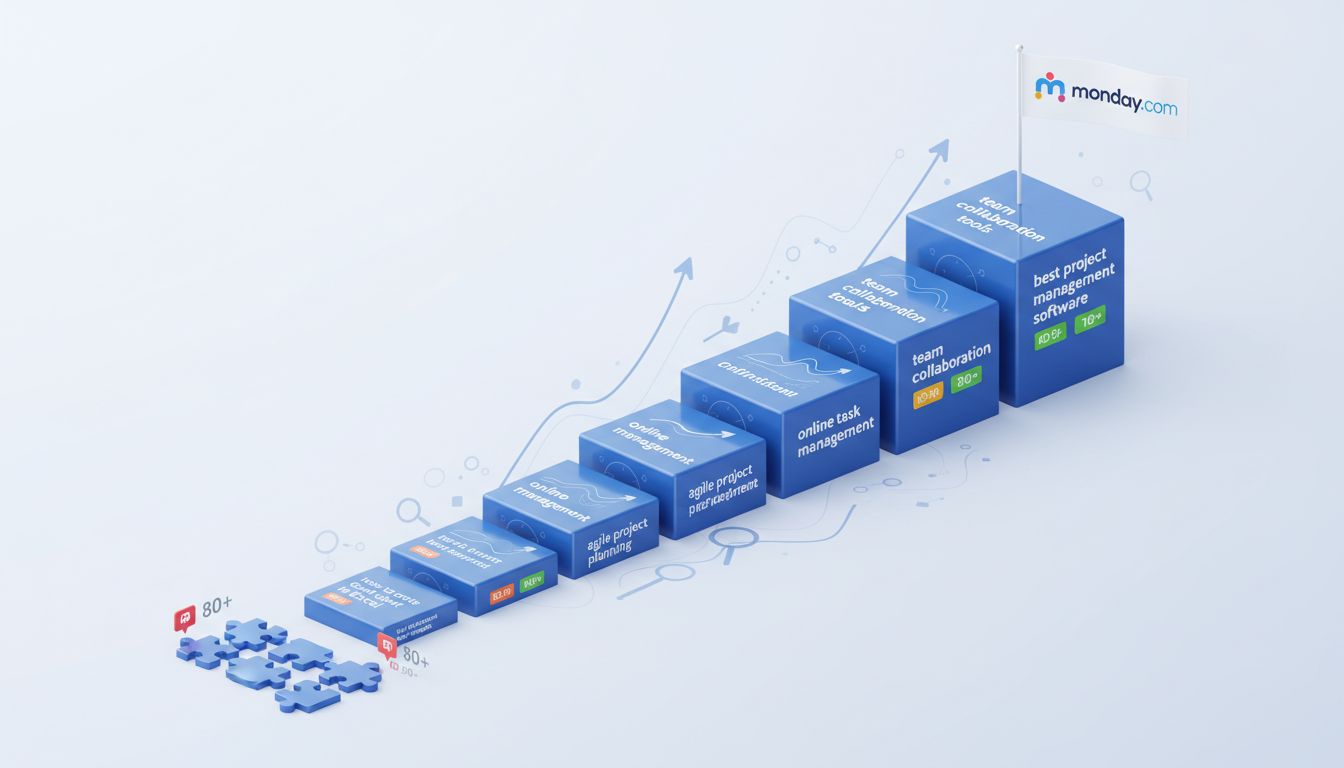
Look at Monday.com's strategy. They didn't start by attacking "project management software" (KD 80+). They targeted hundreds of specific, low-difficulty terms like "how to create a gantt chart in excel" (KD <25, volume 2-300/month). That compound approach built their organic foundation.
Run your list through this filter. Assign each keyword an Intent score (1-3, where 3 is high commercial value) and note its KD. Sort by the ratio of Intent to Difficulty.
Your goal is 20-50 priority targets from your original 200-1,000 term list.
This isn't about volume. It's about velocity. You're selecting the search engine optimization keywords that drive qualified traffic soonest, so you can prove the value and get more resources behind it.
The output is no longer a spreadsheet. It's a battle plan.
(Any good search engine optimization course will tell you that picking keywords is easy. Cutting them down to the ones that actually matter is the hard part. This matrix is how you do it without second-guessing yourself. And if you're looking for search engine optimization tools that handle this automatically, Ahrefs and SEMrush both have built-in filters that map pretty closely to this framework.)
SEO Keywords in Action: Real-World Examples
Theory is fine. Here's what it looks like when you actually apply it.
Informational keyword: "what is keyword clustering" Search intent: Learn a concept Content type: Definitive guide or blog post
The page needs to be educational, not a sales pitch. Step-by-step explanations, clear definitions, structured so someone can actually follow along. Search Engine Journal found that pages matching search intent rank 3-5 positions higher than mismatched pages with similar backlink profiles.
Commercial keyword: "best SEO tool for startups" Search intent: Compare solutions Content type: Comparison article or list
You're not describing features. You're helping someone make a decision. Pricing tables, feature comparisons, clear pros and cons. The goal is to be the trusted comparison point in your niche.
Transactional keyword: "buy Spectre SEO annual plan" Search intent: Purchase now Content type: Product page with clear CTA
Get out of the way and let them buy. Remove distractions, lead with benefits, make the path to checkout frictionless. Every element should point toward that "Buy Now" button.
High-conversion SaaS keyword: "Spectre SEO free trial" Search intent: Try before committing Content type: Landing page with demo signup
Minimal form fields. Clear value proposition. Immediate access. This is about lowering the barrier to entry, not walking them through every feature.
Here's what ties it all together: each keyword type demands a specific content format. Write a comparison article for a transactional keyword and you'll struggle to rank. Put a product page in front of an informational query and you'll just confuse people.
Match intent to format. That's what separates theoretical search engine optimization keywords from actual traffic growth. No search engine optimization course or search engine optimization tools can fix a mismatch between what someone is looking for and what you put in front of them.
Can ChatGPT Do SEO Keyword Research? (The Pragmatic Answer)
Yes, ChatGPT can help with keyword research. But only for ideation. It's a brainstorming tool, not a data source.
Use it to generate seed term lists and suggest content angles. Ask "What are common questions about SaaS pricing?" or "Give me subtopics for 'React performance optimization'." It'll produce a decent starting list.
Then stop.
ChatGPT has no real search volume, no Keyword Difficulty scores, no SERP data. Its suggestions are generic and disconnected from actual search demand. You cannot trust its volume estimates, they're based on pre-2021 training data, not live query logs.
The pragmatic workflow: brainstorm with AI, then validate everything with Ahrefs or SEMrush. Feed ChatGPT's list into Keywords Explorer, check Traffic Potential, analyze the top-ranking pages, and re-prioritize based on real metrics.
AI gives you ideas. Search engine optimization tools tell you which ideas are worth pursuing.
This is why we built Spectre differently. It connects directly to DataForSEO's live keyword database, volume, KD, clicks, SERP features, then uses that data to generate targeted content.
You get AI-powered ideation backed by actual search data, not guesses. The system researches, writes, and publishes in one workflow because a list of search engine optimization keywords with no execution behind them is just a list. No search engine optimization course teaches you to skip the validation step, and neither should your tools.
Step 4: Implement Keywords to Drive Organic Traffic
You've got your prioritized list of 20-50 keywords. Now you need to turn them into actual traffic.
This is where most people stumble. They treat implementation as a vague "write some content" step instead of a repeatable workflow.
First, map each keyword to a specific content type and page. Use a spreadsheet or Spectre's automated mapping feature. Ask yourself: does this keyword need a new article, a product page refresh, or a FAQ addition?
Match the format to the SERP intent you analyzed earlier. If the top results are all comparison tables, don't write a narrative blog post.
On-Page Optimization Checklist (New Page or Refresh)
Open your CMS and follow this sequence:
-
Title tag: Place your primary keyword within the first 60 characters. Don't stuff, make it readable. Example: "Best CRM for Small Teams (2026 Guide)" not "CRM Small Teams Best 2026 Guide CRM".
-
Meta description: Write 120-155 characters that include your primary keyword and a clear value proposition. This directly impacts click-through rates from SERPs.
-
H1 and H2 headers: Use keyword variations naturally in your headings. Your H1 should match the title tag. H2s should cover related subtopics, these become your article's skeleton.
-
Body content: Write for the user first, then work in keywords where they fit. Tools like Yoast will flag missing elements, but don't follow their suggestions blindly, sometimes they're pushing you toward keyword stuffing.
-
URL structure: Include your primary keyword in the slug. Keep it clean:
/best-crm-small-teams/not/blog/2026/04/15/post-1234/. -
Internal links: Link to 2-3 related articles from your site. This strengthens topical relevance and distributes authority.
Verification: After publishing, check Google Search Console for indexing status. You should see the page appear in your coverage report within 24-48 hours.
Technical SEO Prerequisites
Before you even write, make sure your page foundation is solid:
-
Page speed: Run a Lighthouse audit. Aim for Core Web Vitals scores above 90. Mobile performance matters, over 63% of US organic search traffic comes from mobile devices [Source: Intergrowth].
-
Structured data: Implement schema markup relevant to your content type. Google's case studies show real impact: MX Player saw organic engagement double or triple after adding video structured data, while ZipRecruiter improved job page conversions with JobPosting schema [Source: Google Developers].
-
Mobile optimization: Test on actual mobile devices, not just emulators. Check touch targets, font sizes, and layout shifts.
Content Strategy That Compounds
Don't publish articles in isolation. Build topic clusters around pillar pages:
- Create one comprehensive pillar page covering your core topic (e.g., "Complete Guide to CRM Software")
- Publish 4+ supporting articles per month that link back to the pillar
- Interlink all cluster content
This produces real results. Publishing four or more articles monthly within a cluster generates 2.1x more referring domains and 1.8x more organic sessions than publishing fewer than two [Source: ClickRank].
Common mistake: Optimizing each page for too many search engine optimization keywords. Focus on 3-5 primary keywords per page to avoid cannibalization. If you try to rank one article for "CRM software", "best CRM", "CRM pricing", and "CRM features", you'll likely rank for none of them.
Implementation Workflow Example
Let's say your prioritized keyword is "CRM for remote teams" (KD: 25, Volume: 320, High Intent):
- Content mapping: New blog post, format: comparison guide (SERP shows 4/5 top results are comparison tables)
- Technical check: Run page speed test on template, add SoftwareApplication schema
- Write: Title: "7 Best CRM Tools for Remote Teams (2026 Comparison)"
- Optimize: H2s include "features for distributed teams", "async collaboration tools", "pricing for remote companies"
- Internal linking: Link to existing pillar page "Complete Guide to CRM Software" and article "Async Communication Tools"
- Publish schedule: This becomes part of your "Remote Work Tools" cluster, with 3 more articles planned this month
Treat implementation like a production line, not a creative exercise. Every step should be repeatable, measurable, and connected back to your earlier research. No search engine optimization course or collection of search engine optimization tools will help you if the execution is inconsistent.
Step 5: Measure What Matters in 2026 (Beyond Rankings)

Stop tracking rankings. Seriously.
Rankings were a decent proxy for traffic ten years ago. Today, with AI Overviews appearing on up to 48% of tracked queries, they're practically meaningless. First Page Sage found that when an AI Overview is present, position-1 organic CTR drops to 15–20%. You can rank #1 and still get almost no clicks.
Your new KPI is visibility.
Open Google Search Console. Look at your Performance report. Ignore Clicks for a moment and sort by Impressions. This is how often you appear in search results, including AI Overviews, People Also Ask, and other zero-click features. That's your true reach.
Next, audit your SERP feature presence. In Ahrefs or SEMrush, filter your ranking keywords by SERP Features. How many featured snippets do you own? How many video carousels are you in? These placements drive impressions, even if they don't always drive clicks. Tools like the AI Visibility Index are emerging to quantify this, but Search Console's data is your foundation.
Now connect visibility to outcomes. Track organic sessions month-over-month. More importantly, track conversion rates tied to revenue.
A keyword that drives 100 visitors and 5 sign-ups is infinitely more valuable than one that drives 1,000 visitors and zero actions.
Here's your monthly iteration loop:
- Export your Search Console data for your target keyword clusters.
- Filter for high-impression, low-click keywords. These are your AI Overview casualties.
- Rewrite the content to directly answer the query in the first 60 words, structured for snippet inclusion.
- Monitor the change in impressions and featured snippet ownership over the next 30 days.
The old model was: pick keyword → write article → rank → get traffic. The 2026 model is: pick intent → create answer → gain visibility → capture traffic from multiple SERP features.
One thing no search engine optimization course really emphasizes enough: SEO still takes 6–12 months for ROI. That's just the reality. But visibility is your leading indicator.
If your impressions are growing month-over-month, you're on the right track, even if clicks lag. If they're flat, your content isn't connecting. No amount of search engine optimization tools or search engine optimization keywords will fix that if the underlying content isn't built for how search actually works now.
Common Mistakes and Troubleshooting
You can do everything right and still fail. Usually it comes down to one of these.
Mistake 1: Ignoring Your DR Constraint Targeting keywords with a KD of 70 when your DR is 15 means you'll spend months on content that won't rank. Go back to Step 1. If your DR is under 30, stick to KD < 40 and use the DR+10 rule to recalibrate your list.
Mistake 2: Chasing Search Volume Alone "Best laptop" gets 50,000 searches. "Best laptop for software developers 2026" gets 800. The first brings random traffic. The second brings buyers.
Re-prioritize using the Intent vs. Difficulty Matrix. If a keyword doesn't map to a stage in your funnel, drop it.
Mistake 3: Keyword Stuffing & Poor UX Forcing your primary keyword into every paragraph and header makes the content read like a robot wrote it. Users bounce.
Write for a human first. Put your primary term in the title, H1, URL, and first paragraph, then use variations throughout. Read it out loud. If it sounds forced, rewrite it.
Mistake 4: Not Tracking Conversions 10,000 new organic sessions with zero trials or sales is just a vanity metric. Set up revenue-linked goals in Google Analytics and track conversions from specific landing pages back to their source keywords. A high-traffic page with a 0% conversion rate either has the wrong intent or isn't built to convert.
Mistake 5: Duplicate Content & Cannibalization Five blog posts targeting minor variations of "SaaS pricing model" don't help each other. They compete against each other, splitting rankings and confusing search engines.
Run a content audit. Pick the strongest page as the canonical target, 301 redirect the weaker ones to it, or rewrite them to go after distinct long-tail queries. Consolidate.
Mistake 6: Neglecting Mobile & Core Web Vitals Mobile accounts for over 63% of US organic search traffic. If your page is unusable on a phone, Google notices.
Run a Core Web Vitals audit in Google Search Console. Compress images, cut render-blocking JavaScript, use a mobile-first responsive theme. Then test on an actual phone, not just a browser window resized.
The biggest mistake though? Treating SEO as a one-off project. No search engine optimization course teaches this loudly enough, but SEO is a continuous loop of diagnosis, execution, and measurement. When something isn't working, go back to where you made your original assumption and test a new one. That's the whole job.
Conclusion
Keyword research isn't about chasing high-volume terms. It's a diagnostic workflow that starts with your Domain Rating and matches opportunities to your actual authority.
You prioritize high-intent, low-difficulty keywords because they deliver real wins, not vanity metrics.
In 2026, you measure visibility in AI Overviews and SERP features, not just clicks. Organic search still drives 64% of website traffic [Source: Conductor], but the game has changed.
Your strategy has to be systematic, from DR-aware discovery all the way through to publication and measurement. Every search engine optimization course, every set of search engine optimization tools, every guide to search engine optimization keywords... they all point to the same thing. The process only works if you actually follow it.
If manually executing this 5-step workflow seems like too much, Spectre automates it: from DR-aware keyword discovery to AI-powered content creation and publishing. Try Spectre to scale your organic growth.
Frequently Asked Questions
What is the 80 20 rule of SEO?
Focus 80% of your resources on the 20% of keywords that combine high commercial intent with low competitive difficulty. That's the sweet spot where you can actually rank and convert visitors.
For bootstrapped teams, that quadrant gives you the highest ROI while you're building enough authority to go after the harder stuff later.
What are keywords in SEO example?
Think "how to do keyword research" (informational), "best SEO tools" (commercial), "buy SEO software" (transactional), or "SEO tool free trial" (high-conversion). Each one needs a different content format: tutorial, comparison guide, product page, landing page.
Matching format to intent isn't optional. Get it wrong and the page doesn't convert no matter how well it ranks.
What are the 4 types of keywords?
Informational, commercial, transactional, and high-conversion. The first three are standard. The fourth one matters especially for B2B SaaS.
"Free trial" or "demo" searches are the last step before someone becomes a customer. They need dedicated landing pages, not blog posts.
Can ChatGPT do SEO?
It can help with brainstorming and content structure. It cannot do keyword research.
No search volume, no keyword difficulty scores, no SERP analysis, no live competitor data. Use it for angles and outlines, then go to Ahrefs or SEMrush for the actual numbers.
How to use SEO to drive traffic?
Start by checking your Domain Rating. Then find keywords inside your "Authority Gap", terms you can realistically compete for given where your site is right now.
Prioritize based on intent versus difficulty. Optimize on-page and technically. Then measure visibility and conversions, not just rankings.
What are organic keywords for SEO?
Organic keywords are the search terms bringing unpaid traffic to your site. They're the base of your whole SEO strategy.
You pick them based on intent, search volume, and, this is the part most people skip, your site's actual ability to compete for them. Ignoring that last part is why most keyword lists go nowhere.