February 12th, 2026
Predictive SEO & SERP Volatility: How AI Tools Forecast Ranking Shifts
 WD
WDWarren Day
You check your rankings on Monday and you're on page one. By Friday, you've vanished. Traffic plummets, leads dry up, and you're left diagnosing a ghost.
This is the reality of modern SEO volatility, and more data isn't the cure. You need prediction.
The market for the best ai seo tools has exploded with promises of machine learning, forecasting, and proactive alerts. But most buyers treat these platforms like feature checklists: Does it have keyword tracking? Check. Backlink monitoring? Check. Some vague AI badge in the corner? Good enough. Then they wonder why a tool that costs thousands per year still leaves them reactive, scrambling to explain drops in Monday's standup.
Here's what nobody tells you: the value of a predictive SEO tool has almost nothing to do with its feature list. It hinges on whether the underlying forecasting model matches the time horizon you actually care about. An LSTM model excels at spotting volatility in the next 24 hours but fumbles quarterly traffic planning. ARIMA does the opposite. Prophet falls somewhere in between. If you don't know which model powers your tool or what horizon it's optimized for, you're flying blind with expensive instruments.
This article will show you how to move past the hype. You'll learn how different AI models forecast SEO shifts, how to evaluate tools based on your strategic horizon rather than a generic scorecard, and how to validate predictions against real data so you're not just trusting a black box. By the end, you'll have a framework for choosing tools that actually reduce uncertainty and a workflow that turns volatility signals into decisions before your competitors even notice the shift.
Why Your SEO Strategy Needs Predictive Intelligence (Not Just More Data)
Traditional SEO tools are built for autopsies. They'll tell you which keywords tanked, how many backlinks disappeared, what your competitor published last Thursday. But they won't tell you what's coming next week.
Predictive SEO flips the script. Instead of explaining traffic drops after they've already happened, you're working with probability models that flag where volatility is likely to hit and which pages are sitting ducks. It's the difference between a weather forecast and surveying the damage after the storm passes. Both rely on data, but only one gives you time to act.

The search landscape forces this shift whether you're ready or not. AI Overviews now show up in 28.11% of SERPs, completely rewiring click-through patterns and spawning new zero-click traps. Google's algorithm changes don't arrive in tidy monthly packages anymore. They roll out continuously. Your rankings don't just slide down the page, they bounce around daily based on signals you'll never see in a standard dashboard.
SERP volatility measures this chaos. MozCast tracks the daily "temperature" of Google's algorithm by watching 10,000 keywords across different industries and cities. A score of 90°F means calm waters. 110°F signals a major update tearing through the results. Advanced Web Ranking uses a 0–100 index where anything above 9 flags serious turbulence and below 6 suggests smooth sailing.
These aren't vanity metrics. They're early-warning systems.
Look, Ahrefs and SEMrush are diagnostic workhorses, not crystal balls. They surface historical trends and current positions beautifully. That's critical for understanding what changed. But they can't model what might change next week if a competitor drops ten pillar pages or Google adjusts how it interprets entity relationships.
Predictive tools stack forecasting models on top of that historical data. LSTM networks for short-term ranking wobbles, ARIMA for longer trend lines. They output probability ranges, not guarantees. SE Ranking's traffic forecast template projects monthly organic visitors with a stated 15% margin of error. That range matters more than the center point because it defines your actual risk exposure and tells you whether a planned content push has enough upside to bother.
You're not chasing omniscience. You're shrinking the gap between a ranking shift and your response from days to hours. Sometimes you eliminate the surprise entirely.
The Engine Room: How AI Models Forecast SEO Volatility
Before you trust any tool's predictions, you need to know what's actually running the calculations. Most AI SEO tools use one of three forecasting engines: LSTM, ARIMA, or Prophet. Each one's built for different timelines and data patterns. The model architecture matters way more than whatever's on the sales deck.
The Fuel: What These Models Consume
Every predictive model needs inputs. The best ai seo tools pull in historical ranking data (your position over weeks or months), backlink velocity and quality scores, real-time SERP features like featured snippets and People Also Ask boxes, user behavior signals including click-through rate and dwell time, content freshness scores, entity and semantic relevance data, plus competitor movements.
Think of it as a sensor array. Richer, more granular data means sharper forecasts. But only if the underlying model can actually process that type of signal.
LSTM: The Short-Term Detective
Long Short-Term Memory networks are neural models built to predict sequences.
LSTM shines when you need to know what happens next, in the next few hours or tomorrow.
Picture a detective piecing together the last 48 hours: a sudden backlink spike, a CTR drop, a SERP feature appearing overnight. LSTM demonstrated an 84–87% error reduction versus ARIMA in short-term forecasting contexts. That makes it the default choice for real-time volatility alerts and same-day ranking shift predictions.
If a tool promises to warn you before a ranking drop hits, it's probably running LSTM or a similar recurrent architecture. The catch? LSTM burns through computing power and needs continuous retraining as new data flows in.
ARIMA: The Economist's Chart
Auto-Regressive Integrated Moving Average is a statistical workhorse.
ARIMA takes the last two years of data, smooths out noise, and projects a trend line forward. It's the economist staring at quarterly charts, not the minute-by-minute ticker. ARIMA achieved MAPE values between 3.2% and 13.6% on simple linear patterns, and it beats neural models when you're forecasting anywhere from a few days to several months out. Building a quarterly traffic forecast or planning content six weeks ahead? ARIMA-based tools give you stable, interpretable predictions.
The weakness? ARIMA assumes your data follows a pattern it can decompose. Sudden algorithm updates or surprise competitor moves will catch it flat-footed.
Prophet: The Seasonal Specialist
Facebook's Prophet is an additive model designed for business time series with strong seasonality. Retail spikes in November, tax software in March, fitness queries in January.
Prophet achieved MAPE values between 2.2% and 24.2% depending on how pronounced the seasonal pattern was. If your business runs on predictable cycles and you need traffic forecasts around those peaks, Prophet handles holidays and recurring events elegantly. Outside those contexts, it's usually outperformed by LSTM or ARIMA.
Why This Matters to You
Vendor dashboards rarely advertise which model powers their forecasts.
But when you ask, "Is this tool built for daily alerts or quarterly planning?" you're really asking, "Is this LSTM or ARIMA?" Matching the engine to your strategic horizon is the difference between actionable intelligence and expensive noise. Get it wrong and you're either drowning in false alarms or missing the signals that actually matter.
Evaluating the Contenders: A Horizon-Based Framework for AI SEO Tools
The best ai seo tools aren't ranked by feature count or brand recognition. They're ranked by how well their forecasting architecture matches your decision timeline. A tool optimized for spotting algorithm updates within 24 hours will fail spectacularly at quarterly traffic planning. And vice versa.
The critical flaw? Most teams treat all predictions as equivalent, then wonder why a "top-rated" platform keeps missing the mark.
Here's the framework that cuts through the noise: categorize tools by their predictive horizon, then match that horizon to your strategic need. Three horizons matter.
Horizon 1: Short-Term Volatility Alerts (Next 24–72 Hours)
Your goal here is immediate reaction. Did Google just roll out an update? Are your rankings stable an hour after publishing that high-stakes landing page?
You need tools built on LSTM models or high-frequency statistical engines that ingest fresh SERP data and flag anomalies before your Monday morning standup. MozCast tracks daily Google algorithm "weather" using 10,000 keywords across 20 industries and 5 US cities, surfacing a temperature-like volatility score. Algoroo adds positive and negative term movements into a single 'roo' metric, with historical data stretching back two years. For live verification, DataForSEO's Live API returns SERP results in up to 6 seconds on average. Fast enough to check ranking stability within an hour of hitting publish.
Use case: You launch a product page targeting a competitive keyword at 9 AM. By 10 AM, you query DataForSEO's Live API to confirm it's indexing and check MozCast's temperature. If volatility is spiking (MozCast shows 90°+), you know any rank fluctuation is likely algorithmic noise, not a content problem. That context prevents panic-driven rewrites.
These ai seo optimization tools excel at "what just happened?" They're terrible at "what will happen next quarter?"
Horizon 2: Mid-Term Forecasts & Traffic Planning (1 Week – 3 Months)
Now you're planning content sprints, allocating budget, or forecasting pipeline contribution from organic. You need hybrid models like ARIMA, Prophet, or ensembles that balance historical trends with seasonal patterns and can project weeks or months ahead with quantified uncertainty.
SEMrush's Potential Traffic feature combines ranking data, backlink profiles, and SERP volatility signals to estimate domain-level traffic potential. SE Ranking's Organic Traffic Forecast template projects monthly traffic with a stated 15% margin of error, giving you a range rather than a false-precision single number.
That margin matters. It tells you whether a forecast of 12,000 visits means "somewhere between 10,200 and 13,800," which changes how you set executive expectations.
Use case: You're planning Q3 content. SE Ranking's forecast shows that ranking #5 for three target keywords would deliver 8,500–11,000 monthly visits. You allocate writer budget accordingly, and when actual traffic lands at 9,200 in September, you're inside the confidence interval. No surprises, no scrambling.
This is where ai seo optimization earns its subscription cost. These platforms turn "maybe we should write about X" into "if we rank for X by August, we'll see Y visits ± Z%."
Horizon 3: Long-Term Trend & Keyword Forecasting (3+ Months)
Annual strategy lives here.
You're identifying emerging topics, planning pillar content, and making bets on search demand six to twelve months out. ARIMA and Prophet shine at this horizon because they're built to model long-term trends and seasonality without overfitting to recent noise.
Ahrefs provides keyword search volume trend lines and forecasts, but only for keywords with at least 200 monthly searches and sufficient historical data. That threshold filters out volatile long-tail queries and focuses predictions on stable, forecastable terms. Exactly what you need for annual planning. Custom models built on Prophet (which achieved MAPE values between 2.2% and 24.2% on business time series with strong seasonality) can extend this further if you have the data pipeline.
Use case: In December, you pull Ahrefs' 12-month forecast for "AI contract review software." The trend line shows steady 8% monthly growth through next fall. You greenlight a pillar page and supporting cluster for Q2 launch, knowing demand will peak when your content matures.
Long-term forecasts tolerate wider error bands because you're optimizing for direction, not precision. A forecast that's off by 15% in month nine still tells you whether to double down or pivot.
The X-Factor: Explainability & Actionable Insights
A prediction without a reason is a guess with a dashboard.
The underrated dimension of any AI SEO tool is whether it surfaces why a forecast changed. SHAP values, permutation importance, and impurity-based feature rankings translate black-box outputs into strategic intelligence. Few vendors expose this natively, but the best tools highlight "top factors" behind predictions.
When a forecast drops 30%, does the tool tell you it's 70% driven by competitor backlink spikes and 20% by declining search volume? That breakdown tells you whether to launch an outreach campaign or shift topic focus.
Use case: Your forecast for a key landing page drops. The tool's feature importance report shows the decline is almost entirely explained by three competitors acquiring high-authority links in the past two weeks. You skip the content rewrite and route budget to digital PR instead.
Explainability turns predictions into decisions.
A Note on Free AI SEO Tools
Freemium models like MozCast (free daily volatility), DataForSEO's free SERP Volatility Index, and limited tiers of SEMrush or SE Ranking are excellent for Horizon 1 monitoring. They'll tell you when the algorithm moved. But free tiers rarely offer reliable traffic forecasting (Horizon 2) or long-term keyword trends (Horizon 3) because those features require expensive data pipelines and model retraining. Use free ai seo tools to spot fires; invest in paid platforms to plan quarters.
The Trust Factor: How to Validate AI-Powered SEO Forecasts
A forecast without validation is just expensive speculation.
Before you commit budget or strategy to any predictive tool, you need to know: how wrong is it, and how consistently? Start with a sobering baseline. SEMrush's traffic estimates carry an average error rate of 61.58% when compared against Google Analytics. That's from one of the industry's most established platforms. Small sites see errors exceeding 60%; even large domains average around 45%. SE Ranking openly states their Organic Traffic Forecast template operates within a 15% margin of error.
These aren't bugs. They're the inherent uncertainty of modeling complex, non-stationary systems like Google's algorithm.
The solution isn't to abandon predictive tools. It's to treat every forecast as a hypothesis you must test.
The 'Trust but Verify' Checklist
Step 1: Cross-Reference with Ground Truth
Pull a recent month where your chosen tool provided a traffic estimate or keyword position forecast. Compare it line-by-line with actual Google Analytics sessions and Search Console impressions. Calculate the percentage error for each major keyword cluster and for domain-level traffic.
This is your error baseline, not the vendor's marketing claim. If a tool is consistently off by 40% in your niche, you know to discount its next prediction by that margin.
Step 2: Contextualize with Independent Volatility Signals
When a tool alerts you to a ranking drop or traffic shift, immediately check MozCast, Algoroo, or DataForSEO's SERP Volatility Index. MozCast tracks 10,000 keywords across industries and cities; Algoroo maintains up to two years of historical 'roo' scores; DataForSEO publishes a daily 1–10 volatility index.
If all three show a spike on the same date your tool flagged, the issue is likely algorithmic, not your site. If they're quiet and only your tool is shouting, dig deeper into site-specific factors or question the signal's validity.
Step 3: Start Small & Scale
Don't roll out a predictive workflow across your entire keyword portfolio on day one.
Pick one high-value cluster. Say, your top 20 product-category terms. Run the tool's forecast for 30 or 60 days. Measure actual outcomes. Did the predicted "15% traffic increase from position improvements" materialize? Was the direction correct even if the magnitude was off?
Build institutional confidence through repeated small bets before you trust a tool to guide quarterly planning.
Step 4: Demand Explainability
A black-box prediction is worthless for decision-making. If a tool forecasts a 20% drop in October traffic, it must tell you why: competitor domain authority increased by X, your page speed fell below the 50th percentile, or a SERP feature now captures 30% of clicks.
Tools leveraging SHAP values, permutation importance, or impurity-based feature rankings can surface these drivers. If the vendor can't explain the 'why,' the forecast is entertainment, not intelligence.
Validation isn't a one-time audit. It's the operational backbone that turns probabilistic models into strategic assets you can actually bet on.
From Signal to Action: Your Volatility Response Matrix
You've validated your forecasts. You understand the model's horizon. Now the question every founder asks: what do I actually do when the tool fires an alert?
Most teams either freeze or overreact. A high volatility signal triggers a content rewrite sprint. A forecast dip spawns emergency link-building. Both waste resources because they ignore context.
The right response depends on two variables: what the volatility index shows (algorithm-level turbulence) and what your own rankings are doing. Here's your decision matrix:
| Volatility Signal | Your Rankings | Action |
|---|---|---|
| High (MozCast >80°, Algoroo 'roo' spike, AWR score >9) | Stable or improving | Monitor hourly but hold position. Competitors are likely churning; your stability is an asset. Document what you didn't change. |
| High volatility | Key rankings dropped 3+ positions | Pause new campaigns. Audit affected pages for freshness signals (publish date, content depth, broken elements). Do NOT rewrite content or change title tags yet, wait 48–72 hours for the algorithm to settle. |
| Low volatility (score <6) | Forecast predicts ranking drop in 7–14 days | Interrogate the tool's explainability output. Is it flagging a backlink issue? Content gap? Technical regression? Address the cited factor proactively before the drop materializes. |
| Mid-term forecast (30–90 days) | Traffic decline predicted for a topic cluster | Reallocate content budget to adjacent, growing keywords. Consolidate or update declining-topic content rather than producing new pieces. Treat this as portfolio rebalancing, not emergency response. |
A Series B SaaS founder I know had a major product-launch content push scheduled for mid-March. Two days before launch, Algoroo spiked to its highest 'roo' reading in six months. Instead of launching into chaos, she delayed the campaign by one week, let the SERPs stabilize, then published. The content ranked within 72 hours instead of getting buried in algorithmic churn.
Look, the goal isn't to eliminate risk. It's to avoid unforced errors, making structural changes during high turbulence or ignoring low-volatility warnings because "nothing's happening yet."

Your volatility response matrix is a checklist, not a playbook. It keeps decisions systematic when your traffic graph is doing things that make your stomach drop.
Architecting Your Stack: Data Pipelines and Explainability
Your volatility response matrix is a checklist, not a playbook. It keeps decisions systematic when your traffic graph is doing things that make your stomach drop.
But systematic responses require systematic infrastructure. The difference between reacting to a forecast and actually understanding it comes down to how your data flows and whether you can see inside the model's reasoning. Most teams have neither set up properly.
Live vs. Batch: Choosing Your Latency
Not every prediction needs real-time data.
DataForSEO's Live API returns SERP results in roughly six seconds, fast enough to power same-day volatility alerts or emergency competitor checks. You'll pay $0.002 per SERP for that speed. Their standard batch mode costs a third of that but queues requests for later processing.
The strategic question isn't "which is better?" It's "what decisions require sub-minute data?" If you're running daily forecast models or weekly content reviews, batch APIs feeding into scheduled scripts will do the job. Reserve live pulls for the moments that matter: algorithm update days, product launch monitoring, or when MozCast hits 100°F and you need to know if your vertical is burning.
Making the Black Box Transparent
A forecast that says "traffic will drop 18%" is useless unless you know why.
This is where explainability tools, SHAP values, permutation importance, impurity-based rankings, turn predictions into strategy. When a model flags risk, explainability shows you which features drove that conclusion. Maybe backlink diversity contributed +40% to a positive forecast, while title-tag keyword density barely moved the needle. That insight tells you where to invest effort. Without it, you're just chasing ghosts.
SE Ranking and similar platforms surface some of this natively. If you're building custom models or stitching together multiple data sources, you'll need to instrument explainability yourself, but the ROI is immediate. You stop optimizing everything and start optimizing what the model actually weights. Honestly, this is where most ai seo optimization efforts fall apart. Teams trust the forecast but never interrogate how it got there.
The Modular Dashboard
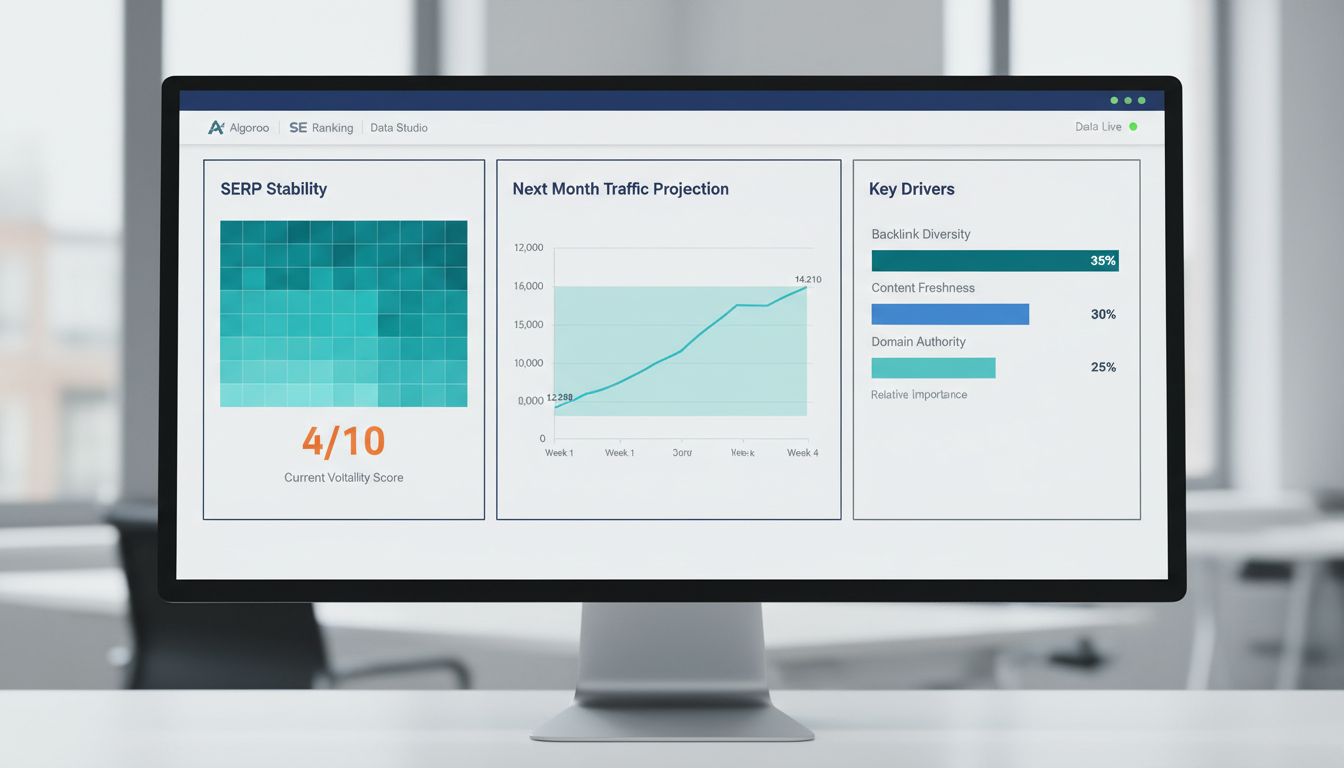
The most resilient ai seo optimization stack isn't a single vendor. It's a composable system: Algoroo for daily volatility context, SE Ranking's API for mid-term traffic forecasts, and Google Sheets or Data Studio as the integration layer. Each component does one thing well. The APIs let them talk.
Your dashboard should answer three questions at a glance: Is the SERP stable? What does the model expect next month? Which factors are driving that expectation? When those three signals align in one view, you've got infrastructure worth defending.
Common Pitfalls & How to Avoid Them
You've built the stack. You understand the models. Here's where most teams still stumble.
Pitfall 1: The Certainty Trap
Forecasts are probabilities, not promises.
When SE Ranking surfaces a traffic projection, it comes with a 15% margin of error. The moment you treat a prediction as ground truth, you've stopped thinking critically. Frame every forecast as a range: "We expect 12,000–15,000 visits next month if rankings hold." Build confidence intervals into your reporting. Your CFO will trust you more when you acknowledge uncertainty than when you pretend it doesn't exist.
Pitfall 2: Single-Source Syndrome
Relying on one vendor's forecast is like navigating with a single GPS. SEMrush traffic estimates carry an average error rate of 61.58% against Google Analytics. Higher for smaller sites.
Your defense? Triangulation. Cross-reference your vendor's prediction with your own GA4 trend data and a volatility tracker like MozCast. When all three signals agree, act. When they diverge, investigate. Most ai seo tools improve dramatically when you're validating them against each other instead of trusting any single output.
Pitfall 3: Context Blindness
You see a 15-position drop on Tuesday and immediately audit your site. Smart move, except you didn't check the algorithm weather first. MozCast might be showing a 95°F spike, meaning the entire SERP is in flux.
Always check the volatility context before diagnosing site-level problems. Half the time, the issue isn't you.
Pitfall 4: Model Misapplication
Using an LSTM-based real-time alert tool to forecast quarterly traffic is like using a thermometer to measure distance. Re-anchor to the horizon framework: LSTM for daily volatility, ARIMA for monthly trends, Prophet for seasonal planning. Match the model to the timeline or the output is fiction.
Pitfall 5: The Filter Fallacy
Filtering your SERP report to the top 10 results doesn't recalculate volatility scores.
Advanced Web Ranking computes those scores using the full SERP depth. Your filtered view is cosmetic. Don't mistake display preferences for data integrity. This trips up even experienced teams using free ai seo tools or paid platforms alike, because the interface makes it feel like you're looking at complete data when you're actually looking at a subset.
Conclusion
The best ai seo tools aren't the ones with the longest feature lists. They're the ones whose forecasting model actually matches how you need to use them.
Short-term volatility protection? You need LSTM-powered tools that catch SERP shifts before they torch your rankings. Planning quarterly content or building traffic projections for your board? ARIMA or Prophet models that understand seasonality and multi-week patterns. Trying to use the wrong model for your timeline just gives you expensive noise.
Validation isn't optional. SEMrush traffic estimates miss by 61.58% on average when you compare them to Google Analytics [Source: seo.promptperfect.xyz]. SE Ranking states their forecasts carry a 15% margin [Source: seranking.com]. Cross-check every prediction against MozCast, Algoroo, or DataForSEO volatility data and your own analytics. Without that ground truth, you're just trusting a black box.
Look at your current stack today. Figure out if you're covered for short-term alerts or long-term forecasting. Pick one tool from whichever horizon you're missing and run a 30-day test against your Google Analytics data. You're not aiming for perfection. You're building a reflex that turns ranking chaos into something you can actually work with.
Frequently Asked Questions
What is the most accurate AI SEO tool?
Wrong question, honestly.
Accuracy depends entirely on what you're trying to predict and when. LSTM-based platforms like SEMrush crush short-term volatility forecasts (think hours to days). ARIMA models handle multi-week trends better. Prophet excels when you've got clear seasonal patterns [Source: preprints.org]. The "most accurate" tool is whichever one you've actually validated against your Google Analytics data using the backtesting approach from section 4. Marketing claims don't count.
Are free AI SEO tools reliable for forecasting?
Free volatility trackers like MozCast and Algoroo? Extremely reliable for detecting ranking turbulence and figuring out if that sudden traffic drop is you or everyone. But they're signal tools, not crystal balls.
Free forecasting features in platforms like Ahrefs (keyword volume trends) give you directional guidance. Nothing more. They lack the probabilistic rigor you get from paid solutions like SE Ranking's traffic forecasts (15% margin of error) or SEMrush's domain-level predictions [Source: seranking.com]. Use free tools to monitor what's happening right now. Pay for platforms when you need quarterly traffic numbers for actual budget planning.
How do AI SEO tools predict algorithm updates?
They don't.
What they actually do is detect the effects in real time by measuring SERP volatility across thousands of keywords. MozCast tracks 10,000 keywords daily to generate a "temperature" reading. DataForSEO's index scores changes from 1 (minimal) to 10 (dramatic) [Source: moz.com, dataforseo.com]. When these indices spike, the tools infer an algorithm shift happened, but the update itself stays a black box until Google confirms it days or weeks later.
What's a good SERP volatility score?
Advanced Web Ranking defines 0–6 as low volatility, 6–9 as medium, and 9–10 as high on their 0–100 scale [Source: advancedwebranking.com].
"Good" depends on what you're doing. Scores below 6 mean stable SERPs, perfect for executing long-term content strategies without worrying about the ground shifting under you. Spikes above 9 demand immediate investigation to figure out if your rankings took a hit or if it's just industry-wide chaos. Context matters. A score of 8 during a known core update is whatever. The same score on a quiet Tuesday? That's weird.
What are the best AI SEO tools for predicting ranking changes?
Match the tool to your timeline. LSTM-powered platforms (SEMrush, Nightwatch) for real-time to 48-hour volatility alerts. ARIMA-based solutions (SE Ranking's traffic forecasts) for 1–3 month trend projections. Prophet models when you've got strong cyclical patterns and need seasonal planning [Source: preprints.org].
Pair any forecasting tool with free volatility trackers (MozCast, Algoroo) to separate algorithm noise from genuine ranking shifts. Validate every vendor's predictions against your Google Analytics baseline before you trust them for anything strategic.
How do AI SEO forecasting tools actually work?
They ingest historical time-series data: your rankings, traffic, backlinks, and SERP features over weeks or months. Then they apply statistical models (ARIMA for linear trends) or neural networks (LSTM for complex patterns) to project future states [Source: preprints.org].
The model identifies recurring patterns, seasonal cycles, and correlations between ranking factors. Output is probabilistic forecasts with confidence intervals. What separates credible tools from hype is whether they actually surface the model's assumptions, error margins (like SE Ranking's 15%), and feature importance scores so you can validate the forecast against reality [Source: seranking.com]. Without that transparency, you're just looking at numbers someone pulled from an algorithm you can't interrogate.