February 13th, 2026
Free vs. Paid AI SEO Tools: Where to Invest Your SaaS Content Budget
 WD
WDWarren Day
You're a SaaS founder or marketing lead staring at a line item for an AI SEO tool that costs more than your first hire's laptop. The promise is tantalizing: automate keyword research, optimize content, and track rankings. Yet, you've also seen claims that a $20/month DIY setup can deliver 80% of the results. So, when does paying hundreds per month actually make financial sense?
The market for free AI SEO tools and their premium counterparts has exploded. Pricing ranges from zero to $1,000+ monthly, and honestly, most teams waste money. 34% of AI tool budgets go to redundant subscriptions. 41% of licensed seats sit unused for months. The real question isn't whether AI can help your SEO. It's whether the specific tool you're considering will generate measurable pipeline impact that justifies its cost.
This isn't a simple feature comparison.
The decision to invest in paid platforms hinges on your SaaS's specific growth stage, content velocity, and which high-value SEO tasks you can automate for a quantifiable return. A pre-revenue startup burning through a seed round has radically different needs than a Series B company publishing 50+ pieces monthly. That seems obvious, but most buying guides ignore it entirely.
What follows is a stage-based framework that maps your current ARR, team size, and content output to the right tier of AI SEO investment. You'll get an actionable checklist that accounts for hidden costs, a breakdown of which specific tasks justify premium pricing, and the emerging reality of AI search visibility that's reshaping how B2B buyers discover vendors.
By the end, you'll know exactly where to allocate your next quarter's budget. Or why your current free stack might already be enough.
The ROI Reality: When Do AI SEO Tools Pay for Themselves?
The honest answer: probably not this quarter, and maybe not next.
Positive SEO ROI typically emerges over 6–12 months, with peak results landing in years two and three. That timeline doesn't magically compress because you slapped "AI-powered" onto your tool stack. If you're scrambling to justify a $200/month subscription in next week's board deck, you're solving the wrong problem.
But here's where it gets interesting.
When AI SEO is executed well, the upside can be absurd. Rankmax documented a B2B case study showing $5.9M in revenue from organic search and AI language models, with an ROI of 6,864%. That's $69 returned for every dollar invested. Another example from the same dataset: a B2B SaaS campaign hit 702% ROI with a break-even at seven months.
Those numbers aren't typical. They're the exception that proves execution matters more than the tool itself.
Here's a simpler lens: if a $200/month AI SEO tool generates just two qualified leads per month, what's your customer lifetime value? For most B2B SaaS companies with an LTV above $2,000, that's break-even in month one. The median payback period for AI tools sits at 72 days when they're applied to the right use case.
The brutal counterpoint: 95% of enterprise AI pilots deliver zero P&L impact.
The gap between the Rankmax case study and the silent majority of failed experiments isn't the tool. It's whether you have the process, team capacity, and strategic focus to turn software into pipeline. Buying premium ai seo optimization software doesn't fix a broken content strategy. It accelerates whatever you're already doing, good or bad.
So the real question isn't "Will this tool pay for itself?" It's "Do we have the conditions in place to make any tool pay for itself?" If the answer is no, a free stack won't save you. A premium one will just burn faster.
The Core SEO Tasks AI Can Automate (And Which Are Worth Paying For)
Look, 80% of your organic traffic comes from 20% of your efforts. Always has.
The real question is which tasks belong in that critical 20%, and whether AI automation justifies paying $200/month or if free tools get you 90% of the way there. Most SaaS teams get this backwards. They automate low-impact busywork while manually grinding through the stuff that actually moves rankings.
Here are five core SEO tasks where AI makes a measurable difference, and when you should consider paying for it:
1. Keyword Research & Clustering
ChatGPT works surprisingly well as an ai keyword generator. Feed it your product category and you'll get dozens of semantically related terms in seconds. Google Search Console gives you the actual queries driving clicks. Both free.
Paid tool justified when: You're managing 50+ pages and need automated clustering, search volume data, and competitive gap analysis at scale. That's where tools like Semrush or Ahrefs earn their keep.
2. Content Briefing & Outline Generation
ChatGPT Plus or Claude Pro can generate solid content outlines based on top-ranking competitors. You'll spend 10 minutes refining the structure, but the first draft is free.
Paid tool justified when: You need NLP-driven term suggestions, real-time content scoring, and integration with your CMS. If you're producing 10+ optimized articles per month, tools like Surfer SEO or Clearscope save hours per piece.
3. On-Page Optimization (ai seo optimization)
This is where free vs. paid diverges sharply.
Free tools can check title tags and meta descriptions. That's about it. Paid tools analyze semantic relevance, competitor content depth, readability scores, and suggest specific improvements with measurable impact on rankings. The synthesis of data into actionable content improvements, actual ai seo optimization, is what premium tools automate.
Paid tool justified when: Your team lacks SEO expertise or you're in a competitive vertical where ranking factors are nuanced. The gap between "here's what's missing" and "here's exactly how to fix it" is worth paying for.
4. Technical Audit Analysis
Google Search Console flags technical issues for free. ChatGPT can help interpret Core Web Vitals reports and suggest fixes.
Paid tool justified when: You have 100+ pages, complex site architecture, or need automated monitoring with alerts. Teams of three or more managing multiple sites benefit from tools that prioritize fixes by impact. Downloading a free seo audit report pdf manually every week gets old fast.
5. AI Search Visibility Tracking
This is the newest and arguably most critical task. Free solutions don't exist yet for tracking your brand's presence in ChatGPT, Perplexity, or Google AI Overviews.
Paid tool justified when: You're investing in content and need attribution data showing which pieces drive AI citations and conversions. Early adopters are seeing this become table stakes for 2026.
| SEO Task | Free Tool Enough? | Paid Tool Justified When... |
|---|---|---|
| Keyword Research | ChatGPT + GSC for <20 pages | Managing 50+ pages, need clustering & volume data |
| Content Briefs | ChatGPT/Claude for ideation | Producing 10+ optimized posts/month at scale |
| On-Page Optimization | Basic checks only | Competitive vertical, need NLP scoring |
| Technical Audits | GSC for small sites | 100+ pages, complex architecture |
| AI visibility tracking | No free option exists | Any content investment requiring attribution |
The pattern is clear: free ai seo tools handle ideation and spot-checks. Paid tools justify their cost when you need speed, scale, or specialized data that doesn't exist elsewhere. If you're a solo founder with 20 blog posts, stick with free. If you're managing multiple sites with distributed teams, the best ai seo tools will pay for themselves in saved hours alone.
The 2026 Contenders: A Tiered Guide to AI SEO Tools
The market has split into three tiers. Each solves a different problem, and your choice depends less on feature counts and more on which specific job you need done.
Tier 1: The All-in-One Optimizers
The job: Turn content briefs into ranking drafts at scale.
Surfer SEO, Clearscope, and Frase dominate here. They combine content grading, NLP term suggestions, and (increasingly) AI writing into a single workflow. Paste in a keyword, get a scored outline, write or generate a draft, then watch real-time feedback nudge your content score higher.
The value is speed and consistency. Publishing 10+ optimized articles per month? These tools compress what used to take six hours of research and outlining into 45 minutes. They're not magic. You still need editorial judgment. But they remove the guesswork from "did I cover this topic thoroughly enough?"
Pricing runs $89–$189/month for entry-level plans. Clearscope starts at $189/month for Essentials; Surfer hovers around $89–$119/month depending on billing; Frase sits in a similar range.
Tier 2: The Foundation LLMs
The job: Power sophisticated DIY workflows without subscription lock-in.
ChatGPT Plus ($20/month) and Claude Pro (similar pricing) are the engines behind many "free" AI SEO workflows. They handle ideation, first drafts, meta description batching, and FAQ expansion. The constraint? You. These tools require prompt engineering skill and manual orchestration.
A DIY workflow using ChatGPT Plus can deliver roughly 80% of a premium tool's output at 5% of the cost. But only if you're willing to build and maintain your own playbooks.
Tier 3: The Specialists
The job: Solve advanced, specific problems once basic optimization is handled.
MarketMuse offers topic authority modeling (free plan available; paid from $149/month). AirOps provides a free AI Answer Engine Visibility tracker. Promptwatch ($89–$199/month) monitors daily AI search rankings. Outranking ($79–$219/month) focuses on content operations and workflow automation.
These make sense when you've already nailed content production and need an edge in a narrow domain. Tracking AI Overviews, mapping content gaps at the cluster level, managing multi-author workflows.
| Tool | Tier | Starting Price | Best For |
|---|---|---|---|
| Surfer SEO | 1 | ~$89/mo | Content scoring & NLP optimization |
| Clearscope | 1 | $189/mo | Enterprise content grading |
| Frase | 1 | ~$15/mo | Budget-friendly optimization |
| ChatGPT Plus | 2 | $20/mo | DIY workflows & ideation |
| MarketMuse | 3 | Free–$149/mo | Topic authority modeling |
| Promptwatch | 3 | $89–$199/mo | AI visibility tracking |
Pricing updated January 2026; verify current rates before purchasing.
The best ai seo tools aren't the ones with the longest feature lists. They're the ones that directly automate the high-value tasks you identified in your workflow audit.
AI Search Is Changing the Game: Why Visibility Tracking Is Non-Negotiable
Your Google Analytics might show healthy organic traffic, but you're likely blind to a channel that's growing 40% month-over-month and converting at 4.4x the rate of traditional search.
25% of B2B buyers now use generative AI instead of traditional search for vendor research. They're asking ChatGPT, Perplexity, and Google's AI Overviews which project management tool to buy, not clicking through ten blue links. If your brand isn't cited in those AI-generated answers, you don't exist to a quarter of your potential pipeline.

The economics are stark. When AI Overviews appear in search results, traditional organic click-through rates drop roughly 70%. But here's the twist: the traffic you do get from AI search citations converts 4.4x better than standard organic visitors. These are high-intent buyers who've already been pre-qualified by an AI that deemed your content authoritative enough to cite.
MarketEngine achieved 10x growth in AI search visibility within seven months by systematically optimizing for citation in AI responses. They didn't just rank. They became the source AI models referenced when answering buyer questions.
You need new instrumentation. Google Search Console won't show you whether ChatGPT or Perplexity are citing your content. Specialized platforms have emerged to fill this gap: AirOps offers a free AI Answer Engine Visibility tool for basic tracking, while Promptwatch ($89-$199/month) provides daily AI visibility monitoring and attribution. All-in-one platforms like Writesonic and Scrunch AI ($249-$250/month) bundle visibility tracking with content strategy.
If you're creating content without tracking AI citations, you're optimizing for a channel that's shrinking while ignoring one that's exploding. The question isn't whether to track AI visibility. It's whether you can afford not to.
Your SaaS Growth Stage Tool Matrix
Your ARR dictates your stack more than any feature comparison chart ever will.
Pre-Seed to $1M ARR: The Free-First Foundation
Your goal here isn't sophistication. It's validation. Can you consistently create content that ranks and converts? Start with Google Search Console (free), Ubersuggest's free tier for basic keyword research, and ChatGPT Plus ($20/month) for content ideation and outline generation.
Monthly budget: Under $50. Track keyword rankings for your top 10 target terms, organic traffic growth month-over-month, and whether that traffic is booking demos. If you can't prove content ROI at this stage, throwing money at premium tools won't fix your thesis.
This is a one-person operation. You're the strategist, writer, and analyst. That's not a limitation. It's a forcing function for clarity.
Series A ($1M to $5M ARR): Hybrid Scaling
You've validated the model. Now you need to systematize it and increase velocity.
Add Semrush ($140/month) for comprehensive keyword research and competitive analysis, plus Surfer SEO ($89/month) for real-time content optimization. Monthly budget: $200-$500, roughly aligning with the 25-30% software allocation within your broader AI/SEO spend. Your team has likely grown to 2-3 people: a content lead, a writer, and possibly a part-time SEO specialist. This is the minimum viable team for effective tool collaboration.
Track content velocity (published pieces per month), keyword rankings across a broader set (50-100 terms), and most importantly, lead attribution from organic. If you can't connect content to pipeline, you're still guessing.
Series B+ ($5M+ ARR): Paid-First for Scale & Governance
At this stage, you need enterprise-grade insights and workflow integration. Your stack expands to Ahrefs for deep backlink analysis and competitive intelligence, Clearscope ($189-$399/month) for content optimization at scale, and a dedicated AI visibility tool like Promptwatch ($89-$199/month).
Monthly budget: $1,000-$2,000. Your team is now 3-5+ people: content strategists, SEO specialists, and possibly a dedicated analytics role. Without this team size, expensive tools become expensive shelf-ware.
Track organic traffic contribution to pipeline, AI citation frequency across ChatGPT and Perplexity, and content ROI by topic cluster. You're no longer proving content works. You're optimizing a proven growth engine.
The pattern is clear: your stage determines your stack, not the other way around. Buying Series B tools at pre-seed doesn't accelerate growth. It accelerates burn.
The Hidden Costs & How to Avoid Them
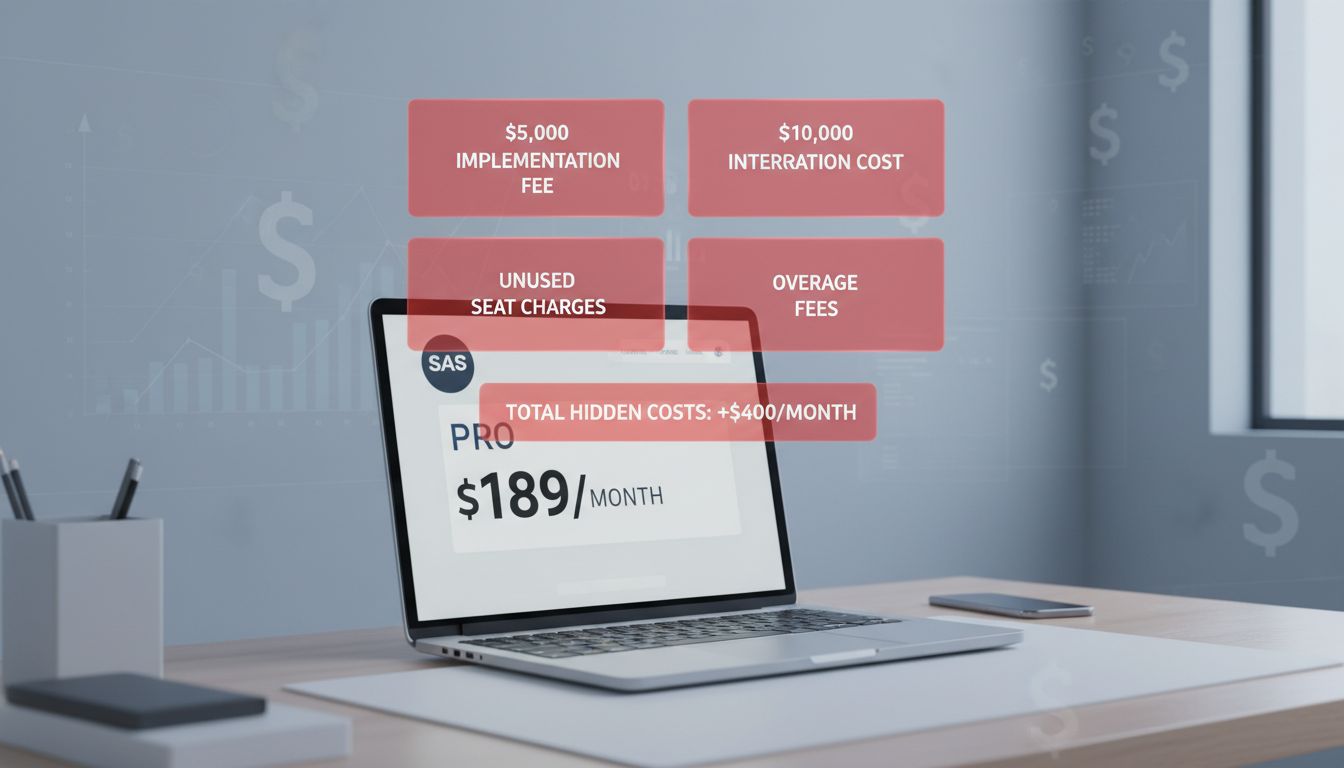
The sticker price is never the real price. That $189/month tool becomes $400 when you factor in what vendors don't advertise on their pricing pages.
Subscription overlap is bleeding you dry. About a third of AI tool budgets get wasted on overlapping subscriptions. The average company runs 3.2 tools with duplicate functionality. You're paying Surfer for content optimization while your team still has an active Clearscope license from last quarter's experiment. Run a quarterly SaaS stack audit. Literally open every tool you're paying for and ask: "Did anyone use this in the last 30 days?"
Implementation fees ambush you after the sale. Athena HQ's real cost isn't the monthly subscription. It's the $5,000–$15,000 in professional services and $10,000–$25,000 for custom integrations that suddenly appear in the onboarding call. Before signing anything, demand a detailed statement of work that includes all implementation, training, and integration costs. If a vendor won't provide one upfront, that's your signal to walk.
You're buying seats nobody uses.
41% of licensed AI tool seats sit dormant for 90+ days. Your VP bought five licenses "for the team," but only two people ever logged in. Start with a single team-wide license and add seats only after you hit utilization limits. Most tools let you upgrade mid-contract anyway.
Cheap tools create expensive problems. That $15/month "AI SEO service" might use tactics that trigger manual penalties. Recovery costs run $20,000+ when you factor in lost rankings, content rewrites, and the SEO consultant you'll hire to clean up the mess. If pricing seems impossibly low, it probably violates Google's guidelines.
Overage charges multiply fast. Premium AI model credits cost $0.10–$0.50 each, and advanced models run 2–5× baseline pricing. Generate 1,000 optimized meta descriptions and you've blown through your monthly allocation by Tuesday. Set hard usage caps in your account settings before your team can rack up surprise charges.
Your Action Plan: The AI SEO Tool Investment Checklist
Answer these seven questions before you swipe your card for any AI SEO tool.
1. What's your current ARR and content velocity target?
Pre-$1M ARR with fewer than 10 articles per month? Free tools plus ChatGPT will carry you. Between $1M and $5M with 20+ articles monthly? You need at least one paid content optimization platform. Above $5M? Budget for a full stack.
2. How many people will actually use this tool?
Solo founder or single marketer? Collaboration features are wasted spend. Three or more team members? Paid tools with workflow automation start paying for themselves through saved coordination time alone.
3. What's your realistic payback horizon?
If you need ROI this quarter, don't buy. SEO (AI-assisted or not) typically delivers positive returns in 6–12 months, with peak results in year two or three. Can your budget handle that timeline?
4. Have you reserved 20–30% for experimentation?
Lock in a chunk of your AI tool budget for testing new platforms and use cases. The fastest-moving teams treat a portion of their stack as disposable, rotating tools quarterly based on performance data. Somewhere between 20–30% is the sweet spot.
5. Do you have integration requirements that free tools can't meet?
Need automated publishing to your CMS? Real-time sync with Google Search Console or your CRM? Free tools tap out here.
List your must-have integrations before comparing vendors.
6. What does a free SEO audit report PDF from Google Search Console already tell you?
Pull your GSC performance report right now. If you're not already acting on that free data (fixing crawl errors, targeting high-impression/low-CTR pages), no paid tool will save you. Fix the fundamentals first.
7. When's your next quarterly tool audit?
Set a calendar reminder for 90 days out. Review usage logs, check for seat waste, and kill any subscription that hasn't directly contributed to published content or measurable ranking gains. Ruthless pruning prevents the 34% budget waste from overlapping tools.
Avoiding Costly Mistakes: 5 AI SEO Pitfalls That Wreck Budgets
Most AI SEO investments fail before they generate a single qualified lead. Here's how to avoid joining them.
Pitfall 1: Paying for Features You Don't Use
You signed up for the $399/month plan because it had "unlimited AI content briefs." You're publishing four articles a quarter. The math doesn't work.
Before you buy any tool, pull out your 80/20 task list from section two. If you're not doing keyword clustering at scale or running competitive SERP analysis weekly, you don't need enterprise features. Start one tier lower than you think you need. You can always upgrade when you actually hit the limits.
Pitfall 2: Ignoring AI Search Visibility
Traditional rank tracking tells you where you sit on page one. It doesn't tell you if ChatGPT or Perplexity are citing your competitors instead of you for the queries that drive pipeline.
Look, AI search visitors convert better than traditional organic search, but if you're not tracking AI visibility from day one, you're flying blind. Allocate $50–150/month for basic citation monitoring even if you're bootstrapped. This isn't optional anymore.
Pitfall 3: Skipping Investment in People & Process
Here's what should scare you: most enterprise AI pilots deliver zero P&L impact. The primary reason? People and process failures, not technology.
Software doesn't fix broken workflows. It just makes broken workflows faster. Reserve 15–20% of your AI budget for training, documentation, and potentially a fractional consultant who can architect the workflow before you buy the tools. The best free AI SEO tools in the world won't help if nobody knows how to use them properly.
Pitfall 4: Expecting Overnight Results
SEO ROI typically materializes over 6–12 months, with peak results in year two or three. If your CFO expects payback in 60 days, reset expectations now or you'll kill the program before it compounds. Track leading indicators in month one: content published, pages optimized, AI citations earned. Not revenue. That comes later.
Pitfall 5: Choosing a Tool That Doesn't Integrate
A content optimization tool that can't push directly to WordPress or pull data from Google Analytics creates manual work that kills velocity.
Before you demo, confirm native integrations with your CMS, GA4, and CRM. If the answer is "we have a Zapier connection," that's a red flag for a tool you'll use daily. You want direct API connections, not middleware that breaks every other month.
Conclusion
The best AI SEO tools aren't the ones with the longest feature lists or the flashiest AI models. They're the ones that solve your most expensive bottleneck right now.
If you're pre-revenue, that $189/month content optimizer won't save you. It'll drain runway you need for product development. Your constraint is execution, not tooling. Free AI SEO tools like Google Search Console and ChatGPT Plus give you 80% of the output at 5% of the cost.
If you're at $3M ARR publishing 20 articles monthly, the math flips. A paid tool that cuts content production time by 40% pays for itself in two weeks of recovered team capacity.
The goal isn't to build a tool collection. It's to generate measurable pipeline growth from organic and AI search traffic that converts 4.4× better than traditional visitors.
Your next step is clear: If you're pre-seed or Series A, run your workflow through the free stack (GSC + ChatGPT Plus) for the next 30 days. If you're scaling and feel the friction, use the Investment Checklist to evaluate one Tier 1 tool with a free trial.
Revisit your stack and this guide every quarter. The AI SEO landscape moves fast.