July 14th, 2026
Search Engine Optimization Copywriting vs AI Content Generation: Which Wins for SaaS?
 WD
WDWarren Day
Organic search drives 44.6% of all B2B SaaS revenue. That's not a small number to leave on the table.
Yet most founders and marketing leads are stuck arguing about the wrong thing: do you hire an seo copywriter and deal with the cost and slowness, or do you lean on AI and end up with generic content that doesn't convert? Neither option is obviously right, and the debate itself is what's costing you traffic.
Effective search engine optimization copywriting in 2026 isn't a choice between humans and AI. It's about building something that uses both, deliberately.
For B2B SaaS, the real edge comes from systemising how those two things work together. Not picking a side.
We'll break this down across four axes: Quality, Speed, Systemisation, and AI Discovery. You'll get a clear picture of where humans outperform, where AI scales, and how to actually run the workflow. If you're exploring seo copywriting jobs or shopping for an seo copywriting course, this framing matters here too.
The winner isn't a method. It's whoever builds the better system around it.
Conclusion
The debate isn't close anymore.
Organic search drives 44.6% of all SaaS revenue [Source: Oliver Munro SaaS Marketing Statistics 2026]. That's your single largest growth channel. And in 2026, the teams winning it aren't choosing between an seo copywriter and AI generation. They're building a system where both have a defined role.
Looking back across the four axes we've covered, the pattern is clear. Human expertise is non-negotiable for high-conversion "money pages" and strategic planning, where quality drives that 51% MQL-to-SQL conversion rate [Source: Oliver Munro SaaS Marketing Statistics 2026]. AI handles speed, volume, and long-tail scale. The edge comes from connecting the two into something repeatable.
The Hybrid Engine: Where Humans and AI Excel
Here's where each component actually belongs in your 2026 content strategy.
Human SEO Copywriting earns its place on:
- High-intent conversion pages: Pricing pages, product comparisons, case studies, solution pages. Every word on these is influencing a buying decision. This is where that 51% conversion premium matters.
- Strategic content planning: Keyword research interpretation, SERP intent analysis, mapping content to buyer journey stages. These require market intuition AI still doesn't have.
- Original research and expert insights: Proprietary data, customer interviews, deep technical expertise. The E-E-A-T signals here matter for both Google and AI answer engines.
AI Content Generation wins on:
- Volume at scale: Hundreds of drafts per month for long-tail informational queries, FAQ sections, programmatic content. Doing this manually isn't economically viable.
- Speed to publish: Weeks to minutes for time-sensitive content around product updates, feature releases, trending topics.
- Answer Engine Optimization (AEO): Structuring content for extraction by ChatGPT, Gemini, and Google AI Overviews. This matters more every month, given that ~80% of AI Overview queries now produce zero-click results [Source: SQ Magazine Content Marketing Statistics 2026].
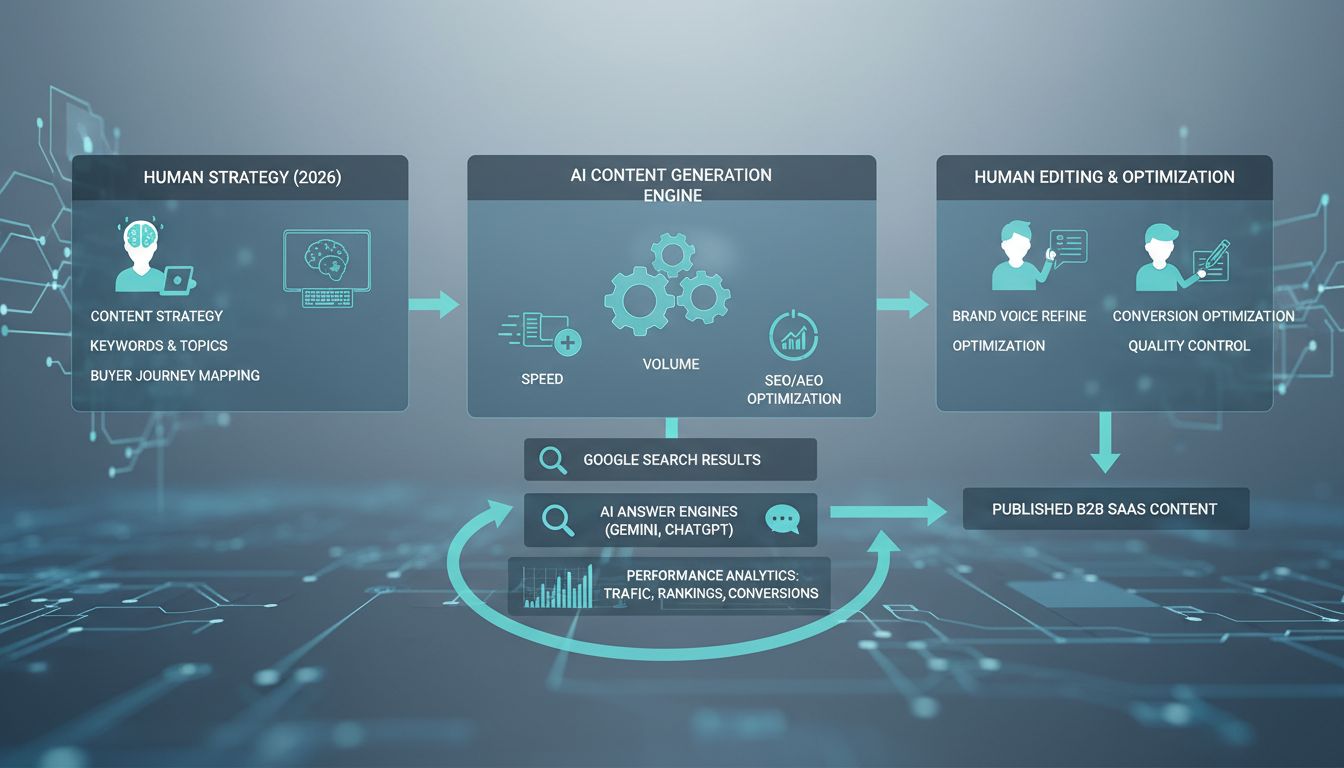
The best SaaS teams I've worked with don't force one approach to do everything. A human strategist identifies the keyword clusters and maps the content architecture. AI drafts at scale. Human editors polish for brand voice and conversion. Automated systems handle publishing and performance tracking.
Each component in its zone. That's the whole game.
The Systemisation Imperative
Here's the thing most teams miss: the bottleneck isn't which method you pick. It's systemising the workflow between them.
Without deliberate orchestration, you end up with disconnected processes. Writers working in isolation. AI tools producing content that doesn't align with strategy. No feedback loop between performance data and what gets created next.
The companies seeing 1300% traffic lifts (like the Surfer SEO HR SaaS client) [Source: Surfer SEO HR SaaS case study] or 786% increases in search clicks (like the Huckleberry Branding case) [Source: Huckleberry Branding SaaS SEO case study] aren't just using better tools. They've built better systems. Their content production pipeline is repeatable, measurable, and scalable.
That requires four components working together:
- Strategic planning layer: Humans define content strategy, target keywords, competitive positioning
- Automated production layer: AI handles initial drafting at scale based on those strategic inputs
- Quality control layer: Human editors ensure brand voice, accuracy, conversion optimization
- Performance feedback loop: Analytics inform future content decisions, continuously
Most teams stall at step two. They use AI tools in isolation, disconnected from strategic inputs or quality controls. The result is generic content that doesn't rank or convert.
The 2026 Reality: Dual Optimization
Something changed the calculus here: AI-driven discovery.
Optimizing for traditional Google rankings is necessary, but it's not enough anymore. You also have to optimize for AI answer engines (AEO/GEO): ChatGPT, Gemini, Claude, Perplexity, Google AI Overviews.
That creates a real dual optimization challenge:
- Traditional SEO: Still important for high-intent commercial queries where users click through to websites
- Answer Engine Optimization: Needed for informational queries where users get answers directly in AI interfaces
This isn't theoretical. AI Overviews are causing 20-40% traffic declines for many informational queries [Source: SQ Magazine Content Marketing Statistics 2026], while companies optimizing for both see compound growth. CHI Software achieved 55% visibility growth and tripled top-3 rankings by integrating AI-assisted SEO [Source: Growpad SaaS SEO & AEO case studies].
A hybrid approach handles this well. Human strategists understand which queries still drive clicks versus which should target AI answer extraction. AI can then structure content appropriately: concise, citation-rich formats for AEO, comprehensive conversion-optimized pages for traditional search.
The Economic Reality for Resource-Constrained Teams
Most SaaS founders and marketing leads aren't working with unlimited budgets or headcount. So let's talk about the actual math.
- Human-only approach: Skilled SEO writers run $0.20-$0.60 per word. At 9+ posts per month (the threshold that lifts organic traffic 35.8% YoY) [Source: Oliver Munro SaaS Marketing Statistics 2026], that's $3,000-$9,000 monthly just for writing, before strategy, editing, or publishing.
- AI-only approach: Commodity AI content costs $0.05-$0.15 per word but risks quality problems, brand voice dilution, and ranking issues without proper oversight.
- Hybrid system: Strategic human input combined with AI production at scale reduces costs by 60-80% while keeping quality and strategic alignment intact.
The hybrid model isn't just cheaper. It lets your limited human resources focus on high-value strategic work while automating the repetitive drafting. More output, without linear increases in input.
Why Most Teams Fail at Implementation
Having built Spectre and worked with dozens of SaaS teams on their content engines, the failure patterns are consistent:
-
Tool fragmentation: Separate tools for keyword research, AI writing, optimization, and publishing create workflow friction and data silos. Teams spend hours moving data between platforms instead of making content.
-
Lack of feedback loops: Creating content without systematically analyzing what performs and why. Without connecting performance data back to creation, you're optimizing blind.
-
Inconsistent quality thresholds: No clear guidelines for when content needs human review versus when AI output is sufficient. You end up either over-editing (wasting time) or under-editing (publishing weak content).
-
Ignoring technical SEO fundamentals: Focusing on content while neglecting site speed, internal linking, schema markup, and the other technical factors that determine whether good content actually ranks.

The teams that get past these treat their content operation as an integrated system, not a collection of disconnected tasks. They use platforms that connect research, creation, optimization, and publishing in one place.
Introducing Spectre: The Orchestration Layer for Your Hybrid Engine
This is exactly why we built Spectre. After 15 years as a software engineer working with media companies, agencies, and SaaS businesses, I kept seeing the same problem: teams struggling to scale content production because their tools didn't talk to each other and their workflows weren't systemised.
Spectre isn't just another AI writing tool. It's the orchestration layer for your hybrid content engine.
For Strategic Planning (Human Domain)
- Integrates directly with DataForSEO for keyword research and SERP analysis, giving you the data foundation for informed strategy
- Provides content gap analysis against competitors, identifying opportunities humans should prioritize
- Allows strategic keyword clustering and content mapping before any AI generation begins
For Automated Production (AI Domain)
- Generates initial drafts at scale based on your strategic inputs, maintaining consistency with your defined content architecture
- Optimizes for both traditional SEO and Answer Engine Optimization in a single workflow
- Handles the repetitive drafting work so your team can focus on high-value strategic and editorial tasks
For Quality Control (Human Domain)
- Built-in editorial workflow with approval gates, version control, and collaboration features
- Brand voice customization that persists across all AI-generated content
- Quality scoring against E-E-A-T signals with clear indicators of where human intervention is needed
For Systemisation (The Critical Bridge)
- End-to-end automation from keyword research to CMS publishing in a single platform
- Performance analytics integrated directly into the content planning interface
- Automated scheduling, internal linking suggestions, and metadata optimization
What makes Spectre different from tools like Jasper or Copy.ai is the focus on systemisation, not just generation. Those tools are good at producing marketing copy or individual articles. Spectre is designed for building and operating a complete content engine. The difference between a good word processor and an integrated publishing system.
Comparative Framework: Where Spectre Fits
Here's how Spectre positions against the alternatives across the axes that actually matter for SaaS teams:
Quality & Conversion Optimization
- Traditional SEO Agencies: Highest quality but expensive ($5,000-$20,000/month) and slow to scale
- General AI Tools (Jasper, Copy.ai): Variable quality, often generic without a strong strategic foundation
- Spectre: Strategic human direction combined with AI execution maintains quality while enabling scale
Speed & Volume
- Human Writers Only: 1-2 articles per week per writer, bottlenecked by availability and cost
- AI Tools with Manual Workflow: Faster drafting but still manual research, optimization, and publishing
- Spectre: Automated pipeline from research to publishing enables 9+ articles per month per strategist
Systemisation & Operational Leverage
- Disconnected Tool Stack: High friction, data silos, inconsistent processes
- All-in-One SEO Suites (Semrush, Ahrefs): Strong research but weak generation and publishing integration
- Spectre: Unified platform connecting strategy, generation, optimization, and publishing in one workflow
AI Discovery (AEO/GEO) Readiness
- Traditional SEO Focus: Optimizes only for Google rankings, misses AI answer engine opportunities
- AI Tools Without AEO Focus: Generate content but don't structure it for AI extraction
- Spectre: Dual optimization for traditional SEO and AI answer engines from a single workflow
| Approach | Quality/Conversion | Speed/Volume | Systemisation | AI Discovery | Cost Efficiency |
|---|---|---|---|---|---|
| Traditional SEO Agency | Excellent | Poor | Variable | Poor | Poor |
| In-House SEO Team | Good | Moderate | Good | Moderate | Moderate |
| General AI Tools | Variable | Good | Poor | Poor | Good |
| Specialised AI SEO Tools | Good | Excellent | Good | Good | Excellent |
| Spectre | Excellent | Excellent | Excellent | Excellent | Excellent |
Implementation Blueprint: Building Your Hybrid Engine
Ready to stop debating and start building? Here's the actual blueprint.
Phase 1: Audit & Strategy (Weeks 1-2)
- Content audit: Analyze your existing content's performance. Which pieces drive conversions versus which just generate traffic.
- Keyword mapping: Cluster your target keywords by intent (informational vs commercial) and buyer journey stage.
- Resource assessment: Honestly evaluate your team's capacity for strategic work versus execution work.
Phase 2: Workflow Design (Weeks 3-4)
- Define roles: Clearly separate strategic planning (human), content creation (AI + human editing), and publishing/optimization (automated).
- Establish quality thresholds: Create clear guidelines for when content needs extensive human review versus when AI output with light editing is enough.
- Design feedback loops: Build processes for feeding performance data back into content planning.
Phase 3: Tooling & Implementation (Weeks 5-8)
- Select your orchestration platform: Choose a tool that connects research, creation, optimization, and publishing rather than point solutions.
- Configure workflows: Set up automated pipelines for different content types (blog posts, landing pages, FAQ content).
- Train your team: Make sure everyone understands their role in the hybrid system and how to use the tools.
Phase 4: Optimization & Scaling (Ongoing)
- Measure systematically: Track not just traffic but conversion rates, time-to-rank, and AI answer citations.
- Iterate based on data: Use performance insights to refine your keyword strategy, content formats, and workflow efficiency.
- Scale strategically: Increase content volume in alignment with proven conversion pathways, not just traffic goals.
The Verdict: Which Approach Should You Choose?
After working through the data, case studies, and real implementation challenges, here's the honest answer:
Build a hybrid system orchestrated by a platform like Spectre.
Companies implementing hybrid systems see compound results: 1300% traffic growth, 51% MQL-to-SQL conversion rates, and dual visibility in both traditional search and AI answer engines. For resource-constrained SaaS teams, any other approach stops scaling at some point.
There are edge cases where traditional search engine optimization copywriting makes sense on its own:
- You're targeting exclusively high-intent commercial keywords with unlimited budget
- You're in a heavily regulated industry where every word requires legal review
- You're building brand authority in a new market and can afford to move slowly
AI-only generation makes sense if:
- You're targeting purely informational queries with no conversion expectations
- You're testing content formats before committing to a full strategy
- You have robust editorial processes to catch errors and maintain quality
For the other 95% of SaaS companies, the hybrid approach isn't just optimal. It's necessary.
Your Next Step: From Theory to Implementation
Reading about hybrid systems is one thing. Implementing them is another. That gap is where most growth initiatives actually die.
If you're a founder or marketing lead feeling the pressure to grow organic traffic on limited resources, start here:
Audit your current workflow against the four axes:
- Quality: Are your conversion rates where they need to be? (Benchmark: 51% MQL-to-SQL for SEO-sourced leads)
- Speed: Are you publishing 9+ articles per month? (The threshold for 35.8% YoY traffic growth)
- Systemisation: Is your content production a repeatable system or a series of one-off tasks?
- AI Discovery: Are you optimizing for AI answer engines, or only traditional search?
Identify the primary bottleneck. For most teams, it's systemisation: disconnected tools and manual processes that prevent scaling.
This is where Spectre provides immediate leverage. Rather than trying to wire together a dozen different tools yourself, you get an integrated system built specifically for SaaS hybrid content engines. Automation handles the repetitive work. Humans stay in the loop for strategy and quality control.
If you're evaluating seo copywriting jobs or looking for an seo copywriting course to build these skills yourself, this framing is worth internalizing first. The method matters less than the system around it.

The companies winning at SEO in 2026 aren't the ones with the biggest budgets or the most writers. They're the ones with the most efficient systems. They've moved past the debate and built something that works in both traditional search and AI-driven discovery.