July 7th, 2026
How to Apply Search Engine Optimization Best Practices to AI-Generated Content
 WD
WDWarren Day
AI lets you generate content fast. Really fast. And yet... your organic traffic might be going the wrong direction.
If you're seeing inconsistent results from your AI-generated content, the problem isn't the AI. It's the process. You're applying old workflows to something that has fundamentally changed.
When an AI Overview shows up at the top of Google results, average organic click-through rates drop by 34.5%. [Source: arcintermedia.com] That's not a temporary dip. It's a structural shift, and it requires new search engine optimization best practices.
The old approach, draft it in ChatGPT, sprinkle in keywords, hit publish, isn't working anymore. AI-generated pages land in the top spot only 9% of the time, while human-written content holds that position 80% of the time. [Source: semrush.com]
The search engine optimization tools have changed. The core challenge hasn't: create content that search engines trust and users actually find helpful.
Real search engine optimization best practices applied to AI-generated content flip the script. Treat the AI like a fast junior writer. Its output needs fact-checking, editing, and human oversight before it goes anywhere near a search result.
It's 20% generation and 80% human-led strategy, editing, and technical scaffolding. That's it. That's the whole model.
This guide walks through the exact five-step workflow we use at Spectre and in my agency work. You'll see how to build a search engine marketing strategy that goes beyond keywords, covering search engine marketing, prompt engineering, human expertise, technical seo fundamentals, and the KPIs that actually tell you if any of this is working.
The goal is closing the gap between AI's speed and the quality signals that move rankings. A good technical seo tool, a solid technical seo course worth its price, or even proper technical seo services all point to the same truth: the technical layer still matters, maybe more than ever.
Before You Start: Adopt the Right Mindset & Assemble Your Toolkit
Before you generate a single word, shift your perspective. You're not just prompting an AI writer. You're directing a fast junior writer who needs serious editorial oversight. Your goal is qualified, high-intent traffic, not content volume.
This matters because AI-generated content initially ranks about 35% higher due to keyword optimization, then drops 48% over time [Source: media.neliti.com]. The early boost fades without real human strategy behind it.
So here's what you actually need. Four tools, no shortcuts:
- Keyword & Entity Research Tool: Ahrefs or Semrush. These aren't optional. You need to understand search intent, competition, and semantic context before AI touches the topic. This is where your search engine optimization best practices start.
- AI Writing Assistant: This is where Spectre sits in our workflow. It's built for this integration layer specifically, handling keyword research, SERP analysis, and draft generation so you can stay focused on strategy and editing.
- Plagiarism & AI Detection Checker: Copyleaks or Originality.ai. Independent testing puts Copyleaks at around 96% accuracy [Source: hastewire.com]. Use these to verify originality, not as the final word on quality.
- CMS with Structured Data Control: Strapi, WordPress with Advanced Custom Fields, or any system where you can control schema markup programmatically. This is the technical seo layer that any decent technical seo course or technical seo services provider will tell you matters more now, not less. A good technical seo tool won't save you if your CMS can't support structured data.
I'm assuming you know basic on-page SEO: title tags, meta descriptions, heading structure. What's new is the systematic workflow connecting AI generation to those technical fundamentals.
That pipeline is what these search engine optimization tools are actually building toward. And it's what separates a real search engine marketing strategy from just... publishing fast.
Forget generating 100 articles this week. Build a system where AI handles the heavy lifting of research and drafting, while you apply the editorial judgment and technical optimization that sustains rankings.
That's the workshop. Everything else follows from it.
Step 1: Architect Your Strategy, Define Targets Beyond Keywords
Stop thinking in keywords. Start thinking in user intent and entity relationships.
When AI Overviews answer queries directly, chasing high-volume head terms is a losing strategy. Your content needs to target the deeper questions users ask after they've gotten the basic answer.
Map Intent, Not Just Keywords
Open your Ahrefs or Semrush dashboard. Look past search volume and difficulty. Check the "People Also Ask" and "Related Searches" sections for your target queries. Those are basically content briefs from Google itself.
Instead of targeting "project management software", you'd target "how to choose project management software for remote teams" or "Asana vs Monday.com for agile development". Long-tail, question-based pages gained visibility in AI-driven ranking while shallow content lost ground Source: Once Interactive.
Common mistake: Chasing keywords with 10,000+ monthly searches that AI Overviews will answer directly. You'll spend resources creating content that never gets clicked.
The 5 Pillars of SEO, Reforged for AI
You know the traditional pillars: Technical, Content, On-Page, Off-Page, User Experience. Each one needs recalibrating:
- Technical SEO now means crawlability for AI bots that may not execute JavaScript. Server-side rendering becomes non-negotiable.
- Content Strategy shifts from keyword density to comprehensive entity coverage within a topic cluster.
- On-Page Optimization focuses on structured data and semantic HTML that AI can easily parse.
- Off-Page SEO includes brand mentions across authoritative sites. AI systems use these as trust signals.
- User Experience extends to how well your content serves AI's need for clear, snippet-able answers.
The cost of targeting the wrong query is higher than it used to be. AI Overviews have reduced average organic click-through rates by 34.5% when present [Source: Ahrefs study via Arc Intermedia]. If you're targeting queries that AI answers directly, you're building on sinking ground.
Build Content Hubs Around Core Entities
Here's the actual workflow:
- Export keyword data from your search engine optimization tools for your target topic area.
- Cluster by search intent using tools like KeyClusters or Surfer SEO's Content Editor. Group "how to", "comparison", "review", and "definition" queries separately.
- Map to core entities, identify the main subjects, products, or concepts these queries reference.
- Create a hub page that covers the core entity thoroughly, then link out to detailed articles answering specific intent clusters.
For a B2B SaaS company targeting "CRM software", your entity map might look like: Core Entity (CRM Software) → Intent Clusters (Implementation guides, Comparison articles, Integration tutorials, Pricing breakdowns).
Verification step: Search your target query and check if an AI Overview appears. If it does, your content needs to go deeper than whatever that summary shows.
This is the architectural work that any real search engine marketing strategy depends on. It's also where search engine optimization best practices and technical seo overlap more than people expect, your search engine marketing only compounds when the structure underneath it is solid.
A technical seo course or technical seo services provider will tell you the same thing: get this layer right first. No technical seo tool rescues a content strategy that's targeting the wrong queries.
Step 2: Engineer Prompts for Structurally Sound AI Drafts
Stop treating your AI as a writer. Treat it as a structured outliner that needs explicit architectural instructions.
The difference between a fluff-filled draft and a publish-ready outline is entirely in how you prompt. Your prompt isn't a request. It's a creative brief.
Ask for "a blog post about technical SEO" and you'll get a surface-level listicle. Provide a detailed specification and you get a skeleton you can actually build on.
Build your SEO-optimized prompt with these exact components:
- Primary & Secondary Keywords: List them explicitly. Don't make the AI guess.
- Exact Content Structure: Provide the H2 and H3 headings you identified in your SERP analysis. This forces the draft to match search intent.
- Key Entities & Topics: List the specific concepts, tools, or methodologies the article must cover. This handles semantic relevance.
- Target Audience & Tone: Specify "for technical marketers at B2B SaaS companies" and something like "authoritative but approachable, avoid marketing fluff."
- Placeholder Instructions: Tell the AI to "leave clear placeholders for [statistics, expert quotes, proprietary data]." This creates a scaffold for human expertise.
Verification is immediate. Run the prompt. The output should mirror your specified H2/H3 hierarchy and contain your listed keywords and entities. If it doesn't, your prompt failed, not the AI.
The most common failure mode is vagueness. You get generic content because you asked for generic content.
Example: Weak Prompt vs. Structured Prompt
Weak Prompt (Guarantees Fluff):
"Write a 1500-word blog post about search engine optimization best practices."
Structured Prompt (Creates a Buildable Outline):
"Act as a senior SEO strategist. Draft a comprehensive article outline targeting the primary keyword 'search engine optimization best practices' and secondary keywords 'technical seo' and 'search engine marketing.'
Article Structure: Use these exact H2 sections: 1. Before You Start: Mindset & Toolkit, 2. Architect Your Strategy, 3. Engineer Prompts for AI Drafts, 4. Inject Human Expertise, 5. Apply Technical SEO Scaffolding, 6. Publish & Measure.
Under 'Engineer Prompts for AI Drafts,' include H3s for: The Prompt as a Creative Brief, Components of an SEO Prompt, Verification Step, Common Failure Mode.
Key Entities to Cover: E-E-A-T, SERP analysis, structured data (Schema), crawlability, AI Overviews.
Audience & Tone: For technical founders and SEO managers. Use a direct, practitioner-first tone. Avoid phrases like 'in today's fast-paced world.'
Critical Instruction: In the draft, leave clear, bracketed placeholders for [statistics from cited studies], [direct quotes from SEO experts], and [original data or examples]. Do not write these elements; just mark where they should go."
The second prompt produces a document that's 80% complete before you write a single original sentence. It aligns with search intent, covers the necessary entities, and creates gaps only human expertise can fill.
That last part matters. A technical seo tool or any search engine optimization tools you're running won't fix a draft that was thin to begin with. The prompt is where you set the ceiling.
This is how you invert the workflow: strategy first, AI execution second. It's also where your search engine marketing strategy starts pulling ahead of people who are still just typing into a chat box.
Step 3: Inject Human Expertise, The Non-Negotiable Editing Layer

Your AI draft is structurally sound. It's also generic.
This is where you turn "content" into something credible. Think of it like hiring a junior writer, you wouldn't publish their first draft without review. Same applies here, except the stakes are higher because search engines are actively looking for signals of human authorship.
Sites that combine AI with human editors see bounce-rate reductions up to 73%, according to Digital Applied. And after Google's March 2026 core update, articles with strong E-E-A-T signals saw an average ranking improvement of +11% in the same study.
Your editing layer is where you build those signals.
Fact-Check, Cite, and Add Originality
Open your AI draft in Google Docs or your preferred editor. Create a new version, never edit the original directly.
-
Verify every claim. AI models hallucinate statistics and sources. If the draft says "93% of marketers use AI," search for that specific statistic. Find the original study (like the CoSchedule 2026 report), then link directly to it. Replace generic references like "studies show" with "According to Semrush's 2026 data study, AI-generated pages appeared in the top spot only 9% of the time."
-
Inject first-hand experience. This is your competitive moat. Where the AI says "technical SEO is important," replace it with: "When I was building Spectre's content pipeline, I discovered Google's crawlers were ignoring our JavaScript-rendered tables. We switched to server-side rendering using Next.js, and our indexation rate jumped from 67% to 94% in three weeks." Specific tools, timelines, and outcomes signal real experience.
-
Rewrite introductions and conclusions completely. These are the most formulaic parts of AI writing. Start with a personal observation: "Last month, three clients asked me the same question: 'Why is our AI content ranking initially, then dropping?'" End with actionable advice only you can give: "Here's the exact prompt chain I use in Claude 3.5 Sonnet to analyze SERP features..."
Optimize for Readability and Scannability
AI tends toward dense paragraphs. Break them up.
-
Enforce the 3-sentence paragraph rule. Any paragraph longer than three sentences gets split. This isn't just for readers, AI crawlers parse shorter blocks more efficiently when extracting information for summaries.
-
Convert passive explanations into active lists. Instead of "There are several considerations for technical SEO," write:
- Implement server-side rendering for AI crawlers
- Add FAQPage schema markup using JSON-LD
- Ensure your H2s directly answer search questions
- Add visual anchors. Where appropriate, insert:
**Pro tip:** Use the `datePublished` and `dateModified` properties in your Article schema. Google's AI Overviews prioritize fresh content.
These break the visual monotony and highlight key insights.
Signal E-E-A-T Explicitly
Don't just hope Google detects your expertise, engineer the signals.
Expertise/Experience:
- Add a detailed author bio at the end. Mine reads: "Warren is a senior engineer who's built content systems for media companies processing 10M pages/month. He currently operates Spectre, an AI-powered SEO platform that integrates directly with DataForSEO's API for keyword clustering." Include credentials, years of experience, and specific technologies you've used.
- Implement
Personschema markup on your author page. IncludeknowsAboutproperties listing your technical domains: "SEO automation," "JavaScript frameworks," "API integration." - Mention specific tools with version numbers: "When using Ahrefs API v3.2, you'll need to handle pagination differently than in v2.8."
Authoritativeness:
- Cite authoritative sources, then add your commentary. "Google's AI optimization guide recommends semantic HTML. From an engineering perspective, this matters because..."
- Link to your own cornerstone content using exact-match anchor text when appropriate. This builds topical authority.
Trustworthiness:
- Add a "Methodology" section for data-driven articles. "We analyzed 200 keyword clusters using DataForSEO's API, filtered for KD < 40, then manually reviewed SERP features for each."
- Disclose AI use where relevant: "This article was drafted using Claude 3.5 Sonnet, then extensively fact-checked and edited with first-hand experience from building Spectre's content pipeline." The EU AI Act and proposed U.S. AI Labeling Act (S.2691) may require this.
The 3 C's for the AI Era: Crawlability, Clarity, Credibility
Every editing decision should serve one of these pillars:
-
Crawlability: Ensure your content's structure is machine-parseable. Use proper heading hierarchy (H2 → H3 → H4), semantic HTML tags, and avoid hiding key information in JavaScript-dependent elements.
-
Clarity: Write for both humans and AI. Define acronyms on first use, use consistent terminology, and structure sentences with clear subject-verb-object patterns. AI systems struggle with ambiguous pronouns.
-
Credibility: Build trust through transparency. Link to primary sources, disclose methodologies, and show your work. When you make a claim like "server-side rendering improves AI visibility," link to the iPullRank technical guide that demonstrates this.
Verification and the "Smell Test"
Before publishing, run your edited draft through an AI detection tool like Copyleaks. Use it as a self-check, not a definitive verdict.
These tools have real limitations, Copyleaks' own reporting shows detection accuracy drops sharply when AI text is paraphrased or human-edited. Aim for a low score, but trust the manual review more.
Read your article aloud. Does it sound like something you'd say to a colleague? Are there any "too perfect" phrases that lack personality? Replace them with slightly imperfect, human phrasing.
Common failure mode: Publishing the first AI draft because "it looks good." I've seen teams waste months creating content that ranks briefly, then disappears.
The editing layer isn't optional. It's what separates content that gets traffic from content that sustains it.
Your AI did the heavy lifting on research and structure. Now you're adding what it can't: judgment, nuance, and real-world experience.
That 80/20 split, 20% AI generation, 80% human editing, is what makes this work for search engine optimization best practices. No technical seo services shortcut replaces it. No technical seo tool automates it away. And no search engine marketing strategy built on unedited AI drafts survives long enough to matter.
This is true whether you're running a search engine marketing campaign, working through a technical seo course, or just trying to get your pages to actually rank. The search engine optimization tools you pick matter less than the human layer you put on top.
Step 4: Apply Foundational & Technical SEO Scaffolding
Your content is human-grade now. But if your website can't actually serve it to Google's crawlers and the AI systems powering generative search, none of that work matters.
This is where most technical marketers get it wrong. They assume a modern site built with React or Next.js automatically works for SEO. It doesn't.
Core Search Engine Optimization Best Practices Are Non-Negotiable
Lock down the fundamentals first. These haven't changed, but AI systems now use them as basic trust signals, so getting them wrong costs more than it used to.
- Craft your title tag and meta description. Your title should be under 60 characters with your primary keyword near the front. Your meta description should be a 155-character summary with a secondary keyword and a clear value proposition. AI Overviews frequently pull from these.
- Structure your URL. Use a clean, readable path (
/blog/technical-seo-for-ai), not a mess of IDs and parameters (/p?id=123&cat=4). Both users and machines need to understand the page's context from the URL alone. - Use a logical heading hierarchy. H1 is the page title. H2s for major sections, H3s for subsections. Never skip levels. AI parsers rely on this semantic outline.
- Optimize every image. Write descriptive, keyword-inclusive alt text for every image. It's not just an accessibility thing, it's a signal for image search and helps AI systems understand what's on the page visually.
Verification: Run your URL through Ahrefs' Site Audit or Screaming Frog. Check that every page has a unique title and meta description, and that your heading structure is in logical order.
Technical SEO for AI Crawlers
Most guides skip this part entirely. JavaScript-heavy sites often serve empty HTML shells and rely on client-side rendering. A lot of AI crawlers don't execute JavaScript fully, meaning they never actually see your content.
- Implement Server-Side Rendering (SSR) or Static Site Generation (SSG). If you're using Next.js, Nuxt.js, or Gatsby, make sure you're using their SSR or SSG features. The fully rendered HTML gets sent from the server, so crawlers get the complete page immediately. If you're on WordPress, you're probably fine.
- Use semantic HTML. Wrap your main content in
<main>, articles in<article>, navigation in<nav>. Avoid<div>soup. Google says you don't need perfect HTML, but semantic tags are clear signposts for AI systems trying to parse your page structure. - Build a flat, topical site architecture. Don't bury articles deep (
/blog/2024/03/15/post-title). Use a silo structure based on topics:/seo/(Pillar page)/seo/technical-seo/(Cluster page)/seo/technical-seo/ai-crawlers/(Supporting article)
This flat architecture builds topical authority, relevant for both traditional and AI-driven search.
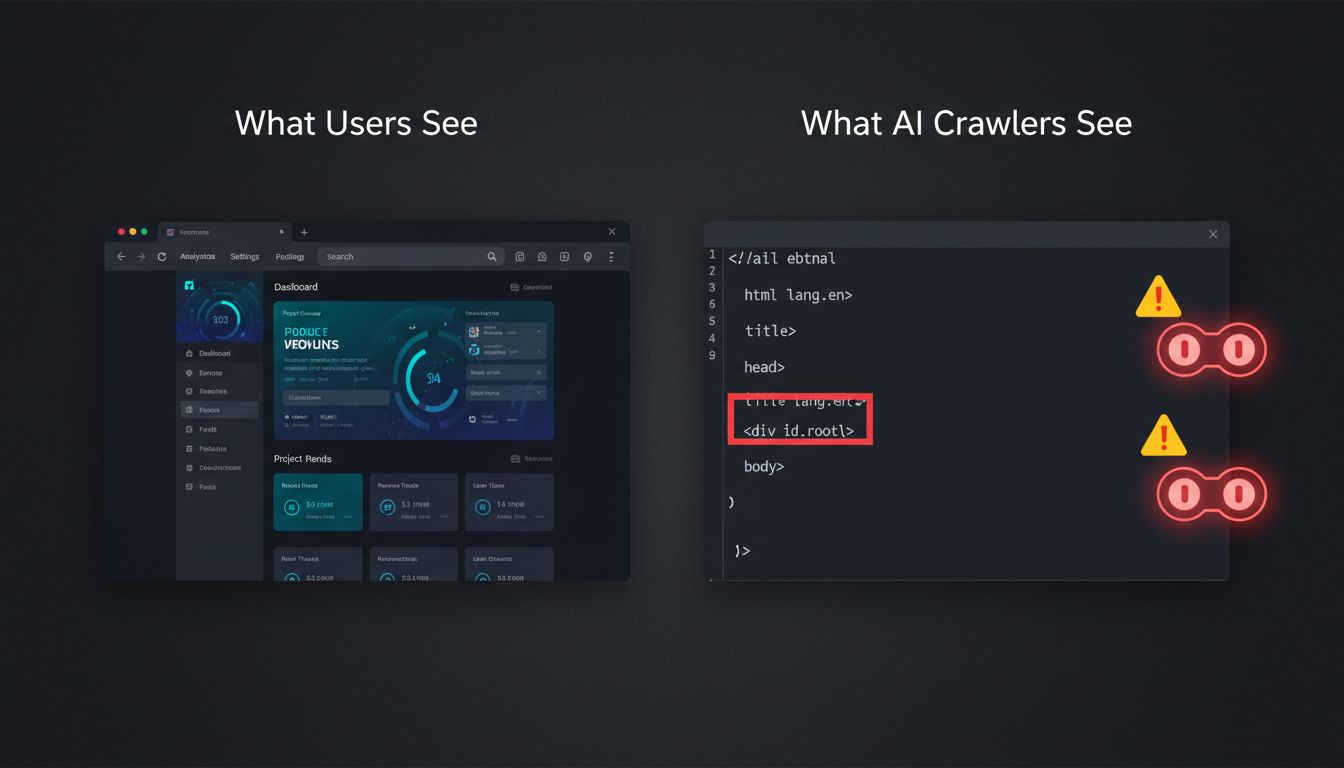
Common Failure Mode: Launching a single-page application built with React and no SSR. The page looks perfect in your browser. Googlebot sees a blank <div id="root"></div>. Tools like Lumar and Oncrawl specifically flag this crawlability issue when auditing for AI-era technical SEO.
Structured Data is Your Ticket to AI Overviews
This is your most powerful lever for AI visibility. Structured data (Schema.org markup) explicitly tells machines what your content is about. It directly increases the likelihood of your content showing up in AI-generated summaries.
Implement JSON-LD scripts in the <head> of your page. Focus on these schemas:
FAQPage: For any content answering questions. AI Overviews extract direct Q&A pairs from this.HowTo: For step-by-step guides. Gives AI a clear, ordered list to cite.Article: For blog posts. Include theauthorproperty linked to aPersonschema to boost E-E-A-T signals.Person: Create a page for each author with their bio, expertise, and social links. Link to it from every article they write.
Here's a minimal, actionable example:
<script type="application/ld+json">
{
"@context": "https://schema.org",
"@type": "Article",
"headline": "Your Article Title",
"description": "Your meta description.",
"author": {
  "@type": "Person",
  "name": "Author Name",
  "url": "https://yoursite.com/author/author-name/"
},
"datePublished": "2026-03-15",
"publisher": {
  "@type": "Organization",
  "name": "Your Company"
}
}
</script>
The CMS Headache: Manually adding JSON-LD to every post is unsustainable. This is where platforms like Strapi (with custom components) or Spectre become useful. In Spectre, the system automatically generates and injects Article, Person, and FAQPage schema from your content outline and author profiles. What's otherwise a manual chore becomes a background process.
Verification: Paste your live URL into Google's Rich Results Test. It'll show you exactly which schemas it detects and flag any errors. Do this before publishing, not after.
That's the full technical SEO scaffolding. Following search engine optimization best practices at this level, the kind you'd cover in a serious technical seo course, is what separates pages that get indexed from pages that get ignored. Whether you're running a search engine marketing strategy for clients or building your own site, a solid technical seo tool like Screaming Frog or Lumar will confirm whether any of this is actually working. No search engine marketing campaign survives bad technical SEO underneath it. And no amount of good content fixes a site that crawlers can't read.
Step 5: Publish and Measure with AI-Specific KPIs
Publish your optimized content, then immediately stop caring about traffic volume. In the AI-search era, volume tells you almost nothing. What matters is whether you're being cited, recommended, and actually converting the visitors who do show up.
Apply the 80/20 rule for quality, not speed. Spend 80% of your effort on strategy, editing, and technical optimization (Steps 1-4), and only 20% on AI generation. That flips the content factory model on its head. You're not scaling output. You're scaling impact per article.
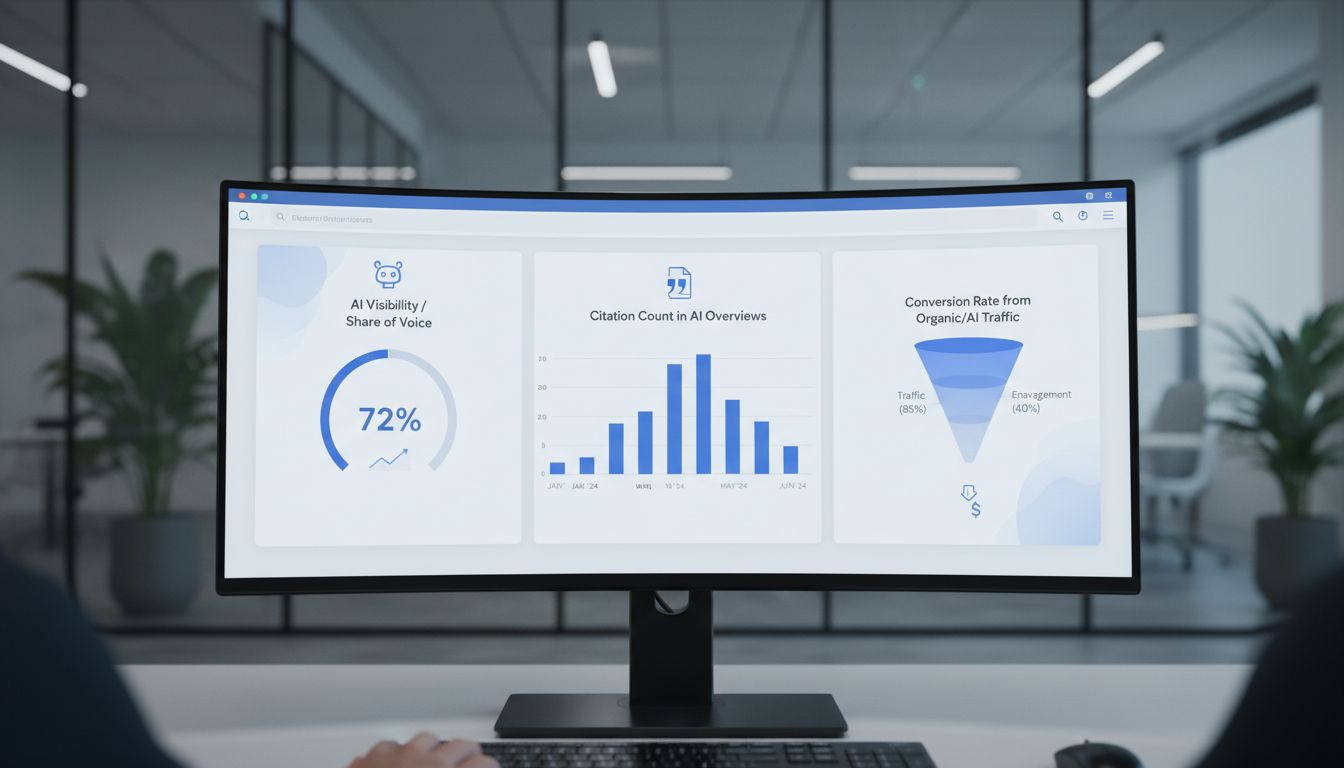
Track AI-specific visibility metrics alongside traditional KPIs. Set up a dashboard that includes:
-
AI Visibility/Share of Voice – Use search engine optimization tools like Semrush Copilot or Otterly.AI to track how often your content appears in AI-generated answers. When an AI Overview is present, organic click-through rates drop by 34.5% according to Ahrefs research. Measuring AI presence matters more now than tracking #1 rankings.
-
Citation Count in AI Overviews – How many times is your content directly quoted or referenced in AI-generated summaries? This is the new "backlink" for AI search.
-
Conversion Rate from Organic/AI Traffic – Overall organic traffic is down 18% in some studies. That makes conversion rate your north star metric. Are the visitors you do get actually valuable?
Double down on engagement signals that indicate quality. Dwell time, bounce rate, and pages per session are now real ranking factors. After Google's March 2026 core update, articles with strong E-E-A-T signals saw an average ranking improvement of +11%, while AI-assisted content saw only +4% according to Digital Applied research. Your editing and expertise injection directly move those numbers.
Verify with structured dashboards. In Google Analytics 4, create custom reports that segment AI-generated traffic through referral patterns or UTM parameters. Watch for pages where engagement improves while traffic stays flat. That means you're winning the quality battle even as overall search volume shifts.
Iterate based on what actually works. When a page gets cited in AI Overviews, dig into why. Was it the structured data? The Q&A format? The expert quotes? Feed those answers back into your prompt engineering and editing workflows. High traffic with low conversions means your call-to-action or content depth needs another look.
Chasing volume through AI generation alone is a race to the bottom. Your search engine optimization tools need to evolve past keyword tracking to cover AI visibility and citation impact. A search engine marketing strategy built on recommendation-worthiness, not just discoverability, is what actually wins here. That's true whether you're running search engine marketing for clients or just building out your own site.
Common Pitfalls, Legal Landmines, and Troubleshooting
After six steps, the workflow should be solid. But I've seen teams sabotage their own efforts anyway, usually by making the same predictable mistakes.
Here's what not to do.
Publishing unedited AI drafts. Still the single biggest failure point. Skip the human expertise layer and you're publishing generic content with no original insight in it. AI-generated pages appeared in the top spot only 9% of the time in Semrush's study, while human-written pages held it 80% of the time [Source: semrush.com/blog/does-ai-content-rank-in-search-data-study]. The AI gives you a first draft. Your job is to make it worth reading.
Producing scaled, low-value, or duplicate content. Google's scaled content abuse policy explicitly targets AI-generated content produced in volume whose primary purpose is ranking rather than helping users. Bing warns that duplicate pages reduce AI visibility because models cluster similar content and may pull outdated versions. If you're generating multiple articles on the same subtopic, canonicalize them or consolidate into a single guide.
Ignoring E-E-A-T signals. After Google's March 2026 core update, articles with strong E-E-A-T signals saw an average ranking improvement of +11%, while AI-assisted content saw only +4% [Source: digitalapplied.com/blog/ai-content-vs-human-content-6-month-serp-study]. If you're not demonstrating real expertise and authority, you're leaving ranking points on the table.
This isn't optional anymore.
Technical neglect that limits AI crawlability. If your site relies heavily on client-side JavaScript without server-side rendering, AI crawlers may not execute it properly. Missing structured data means AI systems can't easily extract key facts for citations. I've seen well-written content fail because the technical architecture made it invisible to generative search engines, and no amount of search engine optimization best practices fixes that if the foundation is broken.
This is where a solid technical SEO setup actually earns its keep. Whether you've taken a technical SEO course, hired technical SEO services, or use a technical SEO tool to audit your own site, you need to know what crawlers see when they land on your pages.
Legal and disclosure oversights. The regulatory landscape is moving fast. The EU AI Act requires clear, conspicuous disclosure and metadata identifying AI-generated content. In the U.S., the AI Labeling Act (S.2691) mandates similar permanent disclosure. From a copyright standpoint, U.S. guidance says purely AI-generated works are ineligible for protection, only human-authored elements qualify. When in doubt, disclose.
Misunderstanding detection tools. Vendor claims about AI detection accuracy sound impressive, Copyleaks reports 99.6/100 for scientific articles, but independent testing shows accuracy drops sharply when AI text is paraphrased or human-edited. These tools are a guide, not gospel. Don't waste time trying to beat detectors. Focus on creating genuinely valuable content.
Failing to measure AI-specific KPIs. If you're still only tracking traditional organic traffic, you're missing half the picture. When AI Overviews are present, average organic click-through rate drops by 34.5% [Source: arcintermedia.com/shoptalk/case-study-impact-of-ai-search-on-user-behavior-ctr-in-2026]. Your search engine optimization tools need to cover AI visibility and citation counts, not just rankings. Any real search engine marketing strategy accounts for this now.
Assuming AI is a set-and-forget solution. The teams doing this well treat their workflow as a living system. They audit regularly, update prompts based on performance data, refine editorial guidelines. Your search engine marketing strategy should do the same. If you're not iterating, you're falling behind.
Here's my troubleshooting checklist when something goes wrong:
- Traffic drops after publishing AI content? Check if it's thin or duplicate. Use Screaming Frog to find duplicate titles/meta descriptions.
- Content not appearing in AI Overviews? Verify structured data implementation with Google's Rich Results Test.
- High bounce rates on AI-generated pages? Review the human editing layer, did you add unique insights and practical examples?
- Legal concerns about disclosure? Add a simple "AI-assisted" note in your author byline or footer.
- Detection tools flagging edited content? Focus on quality metrics, not detection scores. If humans find it valuable, you're on the right track.
The biggest pitfall isn't using AI. It's using AI without the human strategy, editing, and technical foundation that makes content actually work.
Conclusion
The biggest pitfall isn't using AI. It's using AI without the human strategy, editing, and technical foundation that makes content actually work.
AI speeds up execution. It doesn't replace the strategy, editorial judgment, or technical SEO expertise that determines whether content actually ranks.
The process that works is sequential: Strategy → Engineered Prompts → Human Editing & E-E-A-T Injection → technical optimization → Measurement with New KPIs. When an AI Overview is sitting at the top of Google results, average organic click-through rate drops by 34.5% [Source: arcintermedia.com]. That's why the technical and editorial layer isn't optional.
SEO isn't dead, it's evolved.
The fundamentals of quality and user intent haven't gone anywhere. But the technical and editorial execution has to keep up with AI-powered search. Search engine optimization best practices still matter, they just look different now, and the bar for search engine optimization tools, search engine marketing strategy, and technical seo is higher than it was two years ago.
Audit your current AI-generated content against the checklist in this guide. Find your biggest gap, missing structured data, weak E-E-A-T signals, inadequate measurement, and fix it this week.
Use a tool like Spectre to handle the research and drafting. That frees you up for the human work that actually makes the difference.
Frequently Asked Questions
What is the 80/20 rule of SEO?
Spend 80% of your effort on human-led strategy, fact-checking, editing, and technical optimization. Only 20% goes to the actual AI generation.
Volume is cheap. I can produce 50 articles in a day with GPT-4. What's actually hard is the human layer that ensures accuracy, originality, and proper structure.
Invert that ratio and you'll produce content that ranks initially, then drops by 48% over time [Source: media.neliti.com].
Is SEO dead or evolving in 2026?
Evolving. Not dead.
The fundamentals, helpful content, authority, crawlability, are more important now, not less. What's changed is you're now optimizing for both traditional algorithms and the AI systems powering features like Google's AI Overviews, which need stronger E-E-A-T signals and structured data.
After Google's March 2026 core update, articles with strong E-E-A-T saw an average ranking improvement of +11% [Source: digitalapplied.com]. Quality-first SEO still works.
What are the 5 pillars of SEO?
Technical SEO, On-Page SEO, Content, Off-Page SEO (Links), and User Experience.
For AI-generated content, each one needs to be rethought. Technical SEO has to guarantee crawlability through server-side rendering. Content needs real citations and demonstrated expertise. On-Page needs structured data for answer extraction. Off-Page is still about earned authority. And UX now directly affects engagement signals that both humans and algorithms are watching.
Sites combining AI with human editors saw bounce-rate reductions up to 73% [Source: grafit.agency]. UX matters more with automated content, not less.
What are the 3 C's of SEO?
For the AI era: Crawlability, Clarity, and Credibility.
Crawlability means AI bots can actually access and render your JavaScript-heavy pages. No server-side rendering, no visibility. Clarity is semantic HTML, clear headings, plain language, so both users and AI systems understand what your content is actually about. Credibility comes from real E-E-A-T signals: author bylines with genuine expertise, citations to reputable sources, the stuff Google explicitly recommends [Source: developers.google.com].
What will replace SEO?
Nothing replaces it. It just gets bigger.
The shift is into Answer Engine Optimization (AEO). The goal moves from ranking on a page of links to becoming the cited source inside AI-generated answers. That means optimizing for direct answer extraction, entity authority, and being the source a search AI actually wants to quote.
When an AI Overview is present, organic click-through rates drop by 34.5% [Source: arcintermedia.com]. At that point, getting cited inside the answer is worth more than the #1 organic spot. That's where search engine optimization best practices, search engine optimization tools, your search engine marketing strategy, and your technical seo work all have to point, using a solid technical seo tool and, if needed, a technical seo course or technical seo services to close the gaps.