June 16th, 2026
How to Humanize AI Generated Content: A Step-by-Step Guide for SEO
 WD
WDWarren Day
You've used AI to scale your content. The traffic isn't coming.
The drafts feel robotic, they get flagged by AI detectors, and they sink in the SERPs. You're stuck between the pressure to produce and the fear of Google's spam penalties, especially after the March 2026 crackdown on mass-produced AI content.
Here's the actual data: purely AI-generated content shows up in the top search position only 9% of the time. Human-written content does so 80% of the time. [Source: Semrush]
That's the gap you're fighting.
The solution isn't more AI prompts or another clever ai humanizer free tool that just shuffles words around. It's a systematic five-step editorial workflow that turns a generic AI draft into something that satisfies Google's E-E-A-T signals and actually reads like a person wrote it.
This is how to humanize ai generated content in a way that holds up, not just against the best ai detector, but against real readers who can tell when something feels off.
I'm going to walk you through the exact process I use at Spectre and with agency clients: the Spectre 5-Step AI Content Humanization Workflow. You'll learn how to diagnose robotic patterns, deconstruct the AI framework, rebuild for expertise and trust, and run a QA check that actually catches problems.
73% of marketers who report success with AI content use this kind of hybrid approach, and it can reduce bounce rates by up to 73%. [Source: Grafit Agency]
That 71% ranking gap doesn't close by writing everything from scratch. It closes by knowing what to fix, and what to leave alone.
Before You Start: Prerequisites, Tools, and Mindset
You need the right tools and the right mindset. This isn't about running a draft through a "clever ai humanizer free" button and calling it done. It's a real editorial process. Get these four things in place first.
1. The Essential Tool Stack
Start with a quality AI writer. I use Claude or ChatGPT, but at Spectre we've built the AI and keyword research into one platform, which cuts out a lot of back-and-forth.
You'll need an AI and plagiarism detector. I recommend Originality.ai for its combined scan. GPTZero works as a free alternative if you're not ready to pay. The point isn't chasing a zero score, it's spotting patterns worth fixing.
Install a grammar and style editor. Grammarly Premium catches passive voice and readability issues beyond basic typos. Hemingway App is a solid free option if you just need clarity checks.
Most critically: gather your real data. Internal analytics, customer case studies, screenshots, expert sources. The AI doesn't have any of that.
2. The Editorial Mindset Shift
Your role isn't proofreader anymore. You're a value-adding editor.
The AI handles structure and first-draft research. Your job is to inject what it can't fake: lived experience, judgment calls, and strategic SEO insight. Think of it like a senior engineer reviewing a junior's code. You're not fixing syntax errors, you're making the architectural decisions.
3. Skill & Time Commitment
Assume you understand basic SEO: keyword targeting, meta tags, internal linking. Then budget 30-60 minutes of focused editing per 1,000-word draft. That's not optional.
73% of marketers who report success with AI content use a hybrid approach like this one. [Source: Grafit Agency]
4. Set Realistic Detection Expectations
Forget magic thresholds or the "30% rule." The best ai detector isn't giving you binary truth, it's giving you probabilistic signals.
Your goal is to reduce obvious robotic patterns: uniform sentence length, repetitive transitions, generic statements. That's it. Chasing a perfect "human" score is a distraction from the actual job, which is figuring out how to humanize ai generated content in a way that holds up with real readers.
The Spectre 5-Step AI Content Humanization Workflow
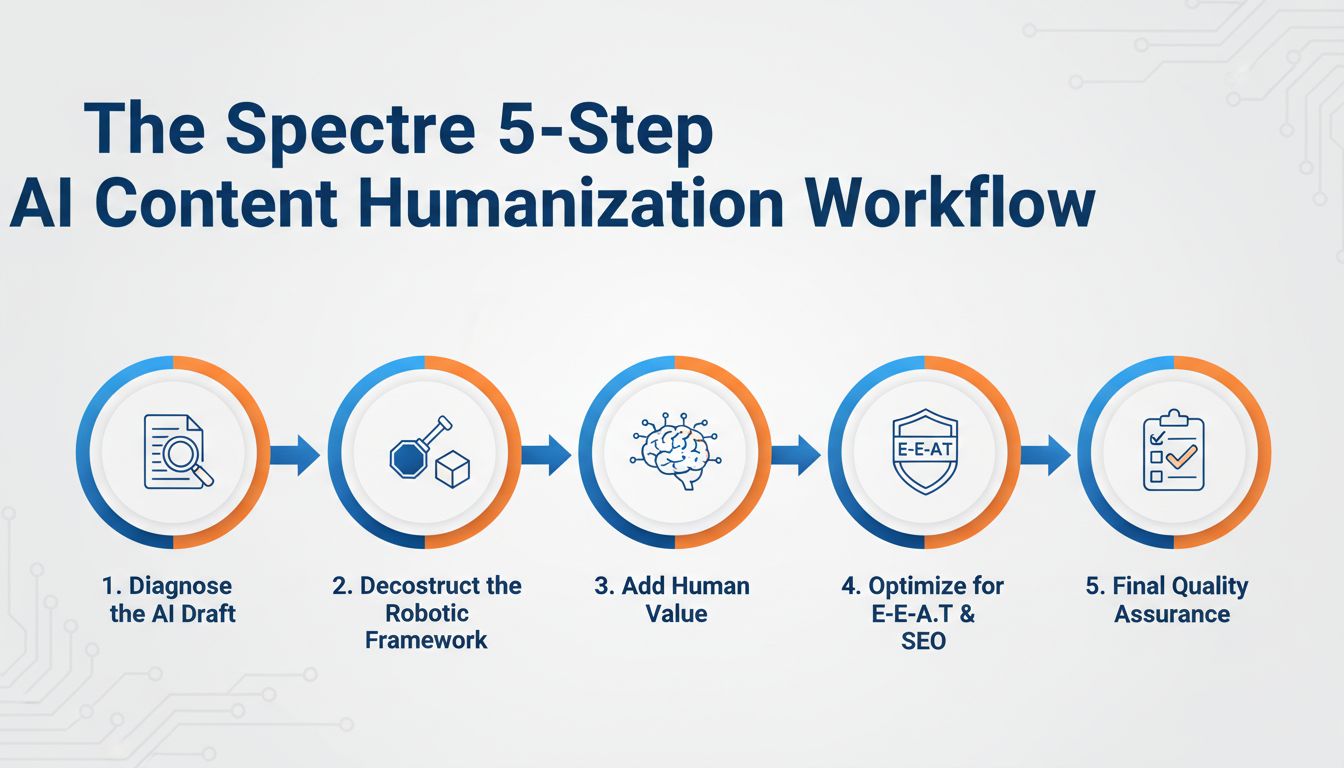
Humanizing AI content isn't about random edits. It's a five-step workflow that takes a generic AI draft and turns it into something that actually satisfies Google's E-E-A-T signals and real readers.
Think of it as a production line where each step has a specific job. Skip one, and you end up polishing fundamentally robotic text instead of fixing it.
This isn't artistic touch-up. It's reconstruction.
The visual below maps the sequence. Raw AI draft goes in, then you move through diagnosis, deconstruction, value addition, optimization, and final QA before anything gets published.
!AI Content Humanization Workflow The Spectre 5-Step AI Content Humanization Workflow: A systematic process for transforming AI drafts into human-quality content.
Follow these steps in order. Each one builds on the last, and it's how you figure out how to humanize ai generated content in a way that actually holds up, rather than just gaming the best ai detector score or running it through some clever ai humanizer free tool and hoping for the best.
Step 1: Diagnose the AI Draft (The Audit)
Don't edit blindly. Run a technical audit first. That turns humanization from guesswork into a targeted repair job.
Run the technical scans. Paste your raw draft into Originality.ai for an AI detection and plagiarism report. For a quick free check, GPTZero works. Capture the initial AI detection percentage, that's your baseline. Then run a separate plagiarism check with Copyscape or Copyleaks. AI models can regurgitate content, and you need to catch it before it publishes.
Perform the manual 'smell test'. Skim the draft looking for the tell-tale signs:
- Overly uniform paragraph length (every block is 3-4 sentences)
- Repetitive sentence structure, especially constant compound-complex sentences
- Formulaic transitions: "Furthermore," "However," "In conclusion"
- A generic, Wikipedia-summary tone with zero personality
- Passive voice where active would be more direct
You're not going on vibes here. You're identifying specific, fixable patterns.
Create your defect list. The output of this step isn't a score. It's a bullet-pointed action plan. For example:
- "Intro is a generic definition, lacks a hook."
- "Paragraphs 3 & 5 are 150+ words with no subheadings."
- "Section on 'benefits' uses 'furthermore' three times."
- "Zero original data points or case studies."
Interpret the scores. You might ask, is 40% AI detection bad? For a raw draft, yes. It means the robotic patterns are strong and obvious to detectors and, by extension, readers.
Your goal after the full workflow is to push that score below 15-20%, into the range where it blends with normal human variance. Pure AI content appears in the top search position only 9% of the time. The audit is how you start fixing that, and it applies whether you're figuring out how to humanize ai generated content from scratch, stress-testing your work against the best ai detector you can find, or deciding if a clever ai humanizer free tool is even worth running at all.
Step 2: Deconstruct the Robotic Framework
You have your defect list. Now you tear things down. You're not adding value yet, you're demolishing the AI's predictable scaffolding so you have something human to build on.
Scrap the formulaic bookends. AI intros and conclusions are just generic summaries. Delete them. Rewrite the intro to lead with something that hits a real pain point, not "This article will explore the benefits of AI content humanization," but "Your AI-generated content isn't ranking because it sounds like it was written by a committee of robots. Here's how to fix that in 45 minutes." Same goes for the conclusion: actionable next steps, not a rehash of what you just said.
Break the uniformity. Any paragraph over four lines gets split. Vary sentence length on purpose, follow a long detailed sentence with a short one. Read a paragraph out loud; if it has a monotonous rhythm, that's the pattern to break. This is exactly what AI detectors are scanning for when they measure 'perplexity' and 'burstiness'.
Replace generic headings. AI loves headings like "Benefits of Humanization" or "Key Considerations." Change them to something benefit-driven ("How This Workflow Saves 15 Hours Per Month") or question-based ("Can AI Detectors Be Fooled?"). Better for human readers, better for the question-based queries that feed AI Overviews.
Force active voice and add contractions. Do a global search for "is," "was," "are," and "by", those are your passive constructions. Rewrite them. Then add contractions deliberately: "it's," "you'll," "don't." AI defaults to formal uncontracted language. This one switch does more than people expect.
Common mistake: Editing too lightly. You have to be brutal here. If a sentence feels even slightly robotic, cut it. Pure AI content lands in the top search position only 9% of the time, and whether you're working through how to humanize ai generated content, running it against the best ai detector you can find, or deciding if a clever ai humanizer free tool is worth using, the deconstruction phase is what actually moves the needle.
Step 3: Rebuild for E-E-A-T (The Value-Add Phase)
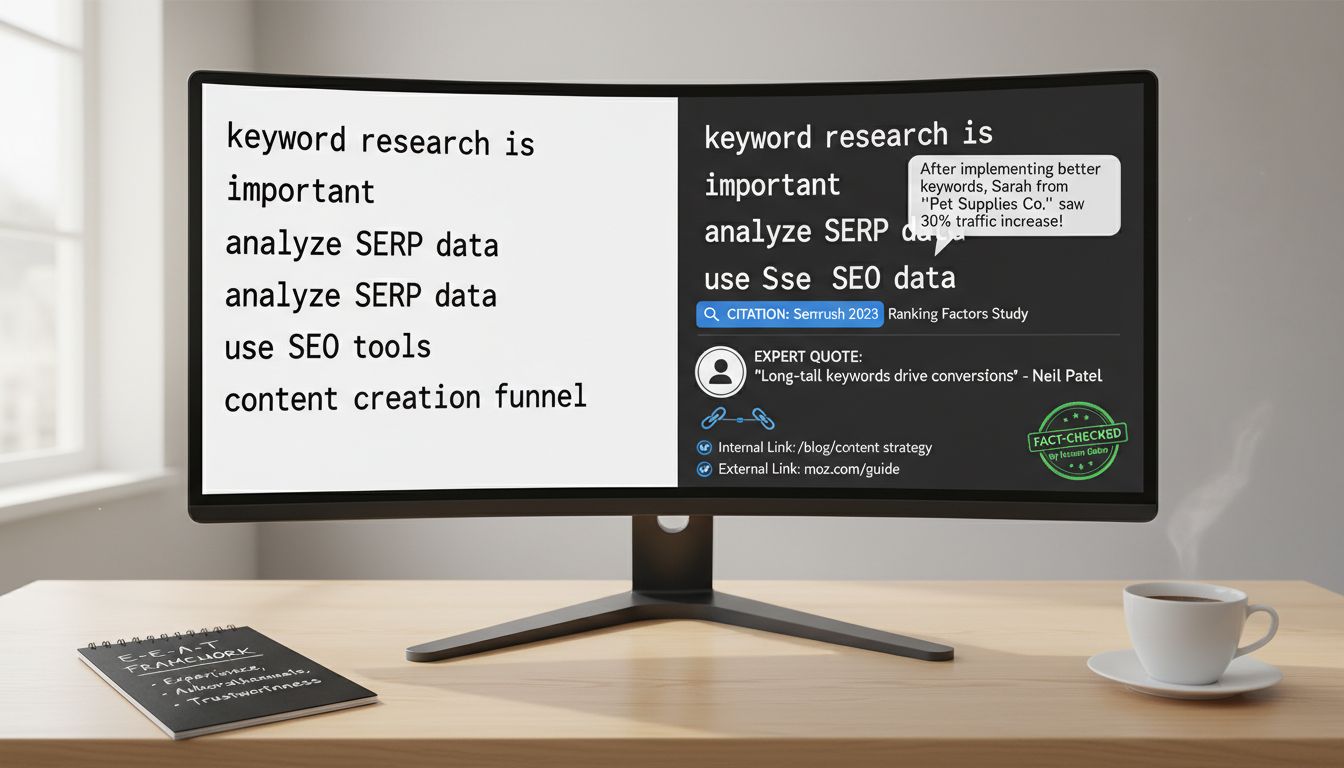
You've got a clean, dismantled draft. Now you add what AI actually can't fake: Experience, Expertise, Authoritativeness, and Trustworthiness. You're not editing anymore. You're injecting the stuff that makes Google trust you.
Add Experience (The First 'E'). The reader's silent question is "have you actually done this?" Go through the draft and add at least one piece of real-world insight. A two-sentence anecdote from a client implementation, a specific friction point your support team keeps logging. Replace generic advice like "monitor your performance" with something like "We learned to check crawl budget weekly after a client's 10,000 new product pages got stuck in discovery for a month."
Inject Expertise (The Second 'E'). Move away from generic claims. For each major claim, add one of these:
- A proprietary data point: "Our internal analysis of 500 client pages shows that content scoring above 80 on Originality.ai's human-likeness scale receives 40% more organic traffic."
- A citation from a real, recent source. Don't just say "studies show", link to the Semrush study or the Ahrefs report.
- A quote from a named internal subject-matter expert. "As our lead DevOps engineer, Jane Smith, notes: 'The real bottleneck isn't model speed, but prompt engineering consistency across teams.'"
Strengthen Authoritativeness (The 'A'). Your content shouldn't exist in isolation. Add 2-3 internal links to your own cornerstone guides or product docs. Then add a couple of outbound links to non-competitive authoritative sources, Google's Search Central blog, academic papers, Moz's Whiteboard Friday. Search engines map these networks.
Ensure Trustworthiness (The 'T'). Fact-check every claim, statistic, and date. AI hallucinations are common, so verify against primary sources. Then consider adding a brief "How We Wrote This" note at the end: "This article was drafted using AI for initial research and structure, then extensively edited, fact-checked, and infused with original insights by our editorial team." Honest disclosure builds trust and it's where best practices are heading anyway.
Here's a before-and-after showing the difference:
- AI Draft (Before): "Keyword research is important for SEO. Tools can help you find relevant terms."
- Rebuilt for E-E-A-T (After): "Keyword research dictates your entire content ROI. When we audited our own blog using Ahrefs, we found that 70% of our traffic came from just 30 clusters of long-tail keywords [Internal Link: Our Guide to Keyword Clustering]. This matches broader industry data; a Semrush study of 42,000 posts found that purely AI-generated content rarely ranks because it misses nuanced intent [Link to Semrush study]. Don't just generate keywords, cluster them by search intent before you write a single word."
This is where you escape the plateau. The ranking gap between AI-only and human-written content grows from 14% at month 3 to 31% by month 16. That divergence happens right here.
Whether you're figuring out how to humanize ai generated content from scratch, running drafts against the best ai detector you can find, or testing whether a clever ai humanizer free tool is worth your time, none of it matters much if you skip this phase. E-E-A-T isn't a checklist item. It's the whole point.
Step 4: Optimize for SEO & AI Search Interfaces
Content's humanized. E-E-A-T is baked in. Now you make it findable.
This is where SEO layering happens, not keyword stuffing, just making sure the right signals are in the right places for both traditional search and the AI-driven answer interfaces that now show up everywhere.
Start with keywords. Your deconstruction and rebuild phases should have created natural places to drop them in. Check that your primary keyword is in the H1, one key H2, the meta description, and a couple of times in the body. If a keyword feels forced in a sentence, rewrite the sentence. Your humanized flow is worth more than hitting some density number.
Then structure for featured snippets and AI Overviews. As of March 2026, AI-generated answers appear in roughly 48% of all search queries. To show up there, format key information clearly. Steps get numbered lists. Features get bullets. Comparisons get a simple table. Answer the question right after the heading, don't make the reader dig for it.
Don't skip the technical basics. Write a meta description (120-155 characters) that speaks to what the user actually wants, not just the keyword. Keep your URL slug clean and readable. Write alt text that describes what's in the image, not just "image of product."
And while it's outside the scope of this edit, Core Web Vitals matter (LCP under 2.5s, INP under 200ms, CLS under 0.1). Technical failures will kill even great content.
Finally, add structured data where it fits. FAQPage schema if you're answering common questions. HowTo schema for step-by-step guides. It doesn't guarantee you'll show up in AI Overviews, but it gives clear signals about what your content is doing. In Spectre, we auto-generate this schema from content analysis. If you're doing it manually, Google's Structured Data Markup Helper works fine.
The thing most people get backwards: SEO optimization should happen after humanization, not before. Optimizing a robotic draft gets you optimized robotic content. Optimize humanized content and you get something that ranks because it actually helps people.
That's the difference. And honestly, whether you're learning how to humanize ai generated content for the first time, stress-testing it against the best ai detector you can find, or just seeing what a clever ai humanizer free tool does to your draft, the SEO layer only works if the content underneath it is real.
Step 5: QA – The Final Check Before Publishing
Don't skip this. A polished draft that hasn't been verified is just a polished draft.
Run the final detection scan. Paste your finished piece into Originality.ai or GPTZero and aim for under 15% on Originality.ai, that's the "low probability" or "likely human" range. If your score is still high, you missed robotic patterns somewhere in Steps 2 or 3. And yes, this answers the question people ask constantly: humanized AI content can still get flagged if you skip this verification step. That's true even if you used the best ai detector available to sanity-check your work along the way.
Read the whole thing out loud. Not skimming, actually out loud. This is how you catch phrasing that looks fine on screen but sounds like a robot in your head. If you stumble, or you're gasping for air mid-sentence, rewrite it. The bar is simple: it should sound like a person talking.
Check for consistency. Scan for places where you've switched terms without meaning to, "AI content" in one paragraph, "machine-generated text" in another. That kind of drift erodes trust faster than a bad fact. Make sure the tone matches your brand guidelines throughout.
Verify every fact and every link manually. Click each external link. Cross-reference every stat against the original source. This isn't optional, it's your defense against hallucinations. As Search Engine Land notes, "hallucinations are common and cannot be fully prevented by instructing models," so no amount of clever ai humanizer free tooling replaces a human actually checking the claims.
Run a final pass through Grammarly Premium or something equivalent. Not as a spell-check, as a last quality gate. It catches the stuff your eyes skip over after the fifth read.
Then you're done. Publish it.
Common Pitfalls & How to Avoid Them
Even with a solid workflow, teams stumble on the same predictable failures. Here's how to spot them before they cost you.
Publishing the First Draft
The raw AI output is a draft. That's it. In a study of 20,000 keywords, purely AI-generated content appeared in the top search position only 9% of the time, while human-written content did so 80% of the time (Source: Semrush).
The five-step workflow isn't optional.
Relying on a 'One-Click Humanizer'
Tools marketed as a "clever ai humanizer free" solution mostly just synonym-swap or restructure sentences using... another AI. They don't add the Experience or Expertise that actually defines human content.
They might fool a basic detector. They do nothing for E-E-A-T or whether a real person wants to keep reading. Use them as a first-pass rephraser at most, never as your only edit. If you want to understand how to humanize ai generated content properly, this is exactly the shortcut that doesn't work.
Chasing 'Undetectable' Over 'Helpful'
A piece can score 0% on Originality.ai and still be thin, unhelpful, and fail to rank. Google is looking for helpfulness, not just origin.
Focus on the value you added in Step 3. The goal is to satisfy search intent, not to hide.
Neglecting Fact-Checking
AI hallucinations are a constant threat. Every statistic, claim, and citation needs to be manually verified against primary sources.
I've seen AI confidently cite studies that don't exist. That's not a hypothetical, it happens regularly, and it will happen to you.
Ignoring AI Search Interfaces
Optimizing only for the ten blue links is a 2023 strategy. With AI-generated answers appearing in roughly 48% of all search queries (Source: DigitalApplied), you need to structure content to answer questions directly, as outlined in Step 4.
If your content isn't built for AI Overviews, you're missing nearly half the SERP. And the best ai detector score in the world won't fix that.
When to Humanize vs. When to Write from Scratch
The workflow works, but it's not free. You have to be smart about where you spend your editorial time.
Think of it like a simple matrix: Content Value (top-of-funnel vs. bottom-of-funnel) against Required Expertise (generic vs. specialist).
Humanize using the 5-step workflow for top-of-funnel blog posts, "what is" explainers, product descriptions, and news summaries. AI is fast on research and structure. These pieces just need humanization to clear the bar for basic engagement and E-E-A-T.
Write from scratch for core commercial pages like Pricing or About Us, proprietary research reports, high-value guest posts, and anything stating a strong company opinion or unique methodology. The risk of a generic AI tone undermining trust is too high here.
You can't edit in a proprietary worldview.
Now consider the economics. The five-step process takes 30-60 minutes per piece on top of generation time. That's worth it for content targeting keywords with over 500 monthly searches or sitting in a key conversion funnel.
For truly low-value, long-tail stuff, ask honestly if a two-pass edit is enough. If you're trying to figure out how to humanize ai generated content at scale, this is the question that actually matters.
The competitive gap isn't just about quality. It's about who can afford to systematically humanize, and who's just hoping a clever ai humanizer free tool will do the job. (It won't.) The best ai detector score won't save content that was never worth reading in the first place.
Conclusion
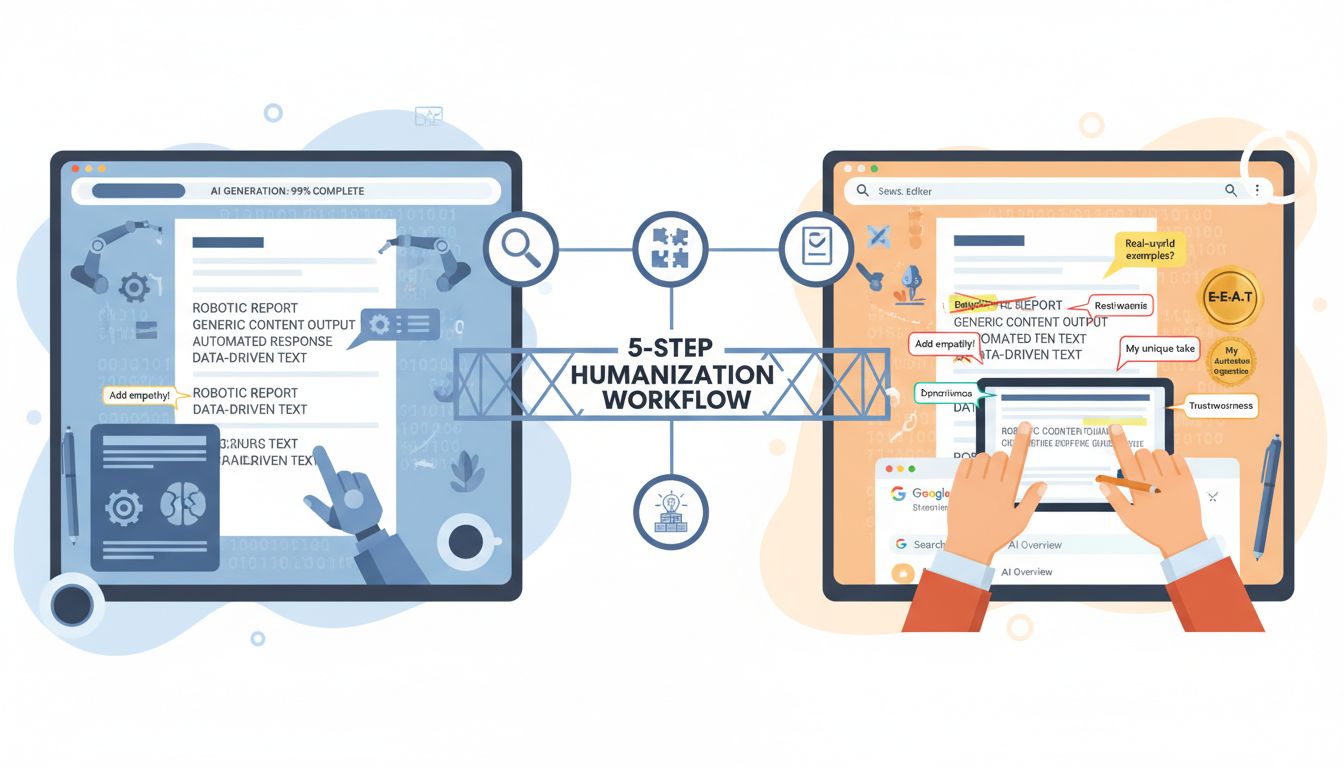
Knowing how to humanize ai generated content isn't about finding a magic prompt or running your draft through some clever ai humanizer free tool and calling it done.
It's a workflow. Five steps, applied consistently, that turn a generic AI draft into something that actually reads like a person wrote it, and ranks like one too.
The data backs this up: purely AI content shows up in top positions just 9% of the time, while hybrid approaches deliver 73% lower bounce rates [Source: Semrush]. The best ai detector score in the world won't save content that nobody wants to read.
So run the workflow. Diagnose the robotic patterns. Deconstruct the generic structure. Rebuild with real expertise and experience. Optimize for both traditional SEO and AI overviews. Then QA like you mean it.
That's what turns AI into a research assistant instead of a liability.
Spectre generates the AI-powered first draft. Your editorial expertise applies the 5-step humanization workflow. That combination is what actually scales content worth ranking. Ready to try it? Explore Spectre's AI-powered content platform.
Frequently Asked Questions
Can ChatGPT humanize text?
Asking ChatGPT to humanize its own output is kind of like asking a forger to verify their own work. It can make surface-level changes, contractions, varied sentence length, but it doesn't have lived experience or genuine intent. Those are the things that actually make writing feel human. Real humanization needs an outside editorial eye.
Can humanized AI be detected?
Yes. Sophisticated detection tools that analyze linguistic and structural patterns can still flag heavily edited AI content. But the goal of this workflow isn't hitting some impossible 0% detection score.
It's reducing obvious AI markers to the point where the content is functionally indistinguishable from helpful human writing, for readers and search engines both. We focus on E-E-A-T signals, not winning an arms race against detectors.
How to humanize AI content without paying?
The most effective free method is the editorial workflow itself. It costs your time and skill, not a subscription.
Tools like Grammarly's free tier or GPTZero's limited free checks can help. But the actual work, deconstructing robotic frameworks, adding original expertise, rebuilding for E-E-A-T, is manual. There's no magic button here. If you're looking for a clever ai humanizer free option, that's it: roll up your sleeves.
How to make AI-generated text undetectable?
"Undetectable" is kind of a trap. It pulls you into an unwinnable technical arms race.
A better goal: create content so genuinely useful and expert-informed that its origin stops mattering. To readers. To search algorithms. To everyone. That means leaning into the E-E-A-T framework, real experience, authoritative sources, built-up trust, instead of obsessing over single-digit shifts in detector scores. And if you're still asking how to humanize ai generated content, that framing is the answer.
What are the 5 things you shouldn't tell ChatGPT?
Five prompts that guarantee generic output:
- "Write a blog post about X", too vague, full stop.
- Leaving out your brand voice guidelines, it defaults to flat, neutral AI tone.
- Telling it to avoid contradictory or nuanced points, you get one-dimensional content.
- Skipping your source materials or context entirely, limits originality from the start.
- Asking for an overly formal or academic tone, kills conversational flow every time.