June 5th, 2026
SEO and Content Marketing: A Complete Guide for AI-Driven Growth
 WD
WDWarren Day
In 2024, HubSpot's organic traffic dropped by 75%. That same year, Shopify's AI-driven search traffic grew 7x. That's not a coincidence. If your SEO and content marketing strategy still looks like it did in 2023, you're actively managing decline.
You've seen the numbers. AI Overviews show up in nearly half of all queries, and 93% of those sessions end without a single click. But the visitors who do arrive from AI search convert at 4.4x the rate of traditional organic traffic. The old playbook, built on chasing keywords and backlinks, is bleeding out.
This guide is for founders and technical marketers who get that SEO and content strategy have to merge into one AI-augmented discipline. Not "use ChatGPT to write blog posts faster." Actually engineer a hybrid human-AI content engine that wins in both traditional search rankings and AI-driven discovery.
I've built this firsthand. As a senior software engineer and founder of Spectre, I work at the intersection of code and content, automating the research, creation, and optimization pipelines that drive real growth. I've seen what works inside large media companies and what falls apart at digital agencies. The gap is never the tools. It's that nobody built a coherent system.
The next sections go from strategy to execution: frameworks for AI-driven growth, technical foundations for AI discovery, the operational engine for your content lifecycle, and measurement systems that actually prove ROI. Whether you're evaluating an seo marketing agency, considering an seo marketing course, trying to benchmark an seo marketing salary, or just Googling "seo marketing near me" to find someone who knows what they're doing, the seo marketing examples ahead are worth your time.
This is a practitioner's blueprint. Not a list of tips.
The New Landscape: Understanding AI's Pervasive Impact on Search
Search results in 2026 aren't a list of blue links anymore.
AI-generated summaries answer questions directly on the page. AI Overviews now appear for roughly 48% of all queries, and when they do, click-through rates to traditional results drop by around 30%. [Source: DigitalApplied, BrightEdge]
This creates what I call the "citation economy."
Being cited inside an AI answer is becoming more valuable than getting the click. About 93% of AI search sessions end without any website visit at all. The game has shifted from driving traffic to building authority that AI models trust enough to reference.
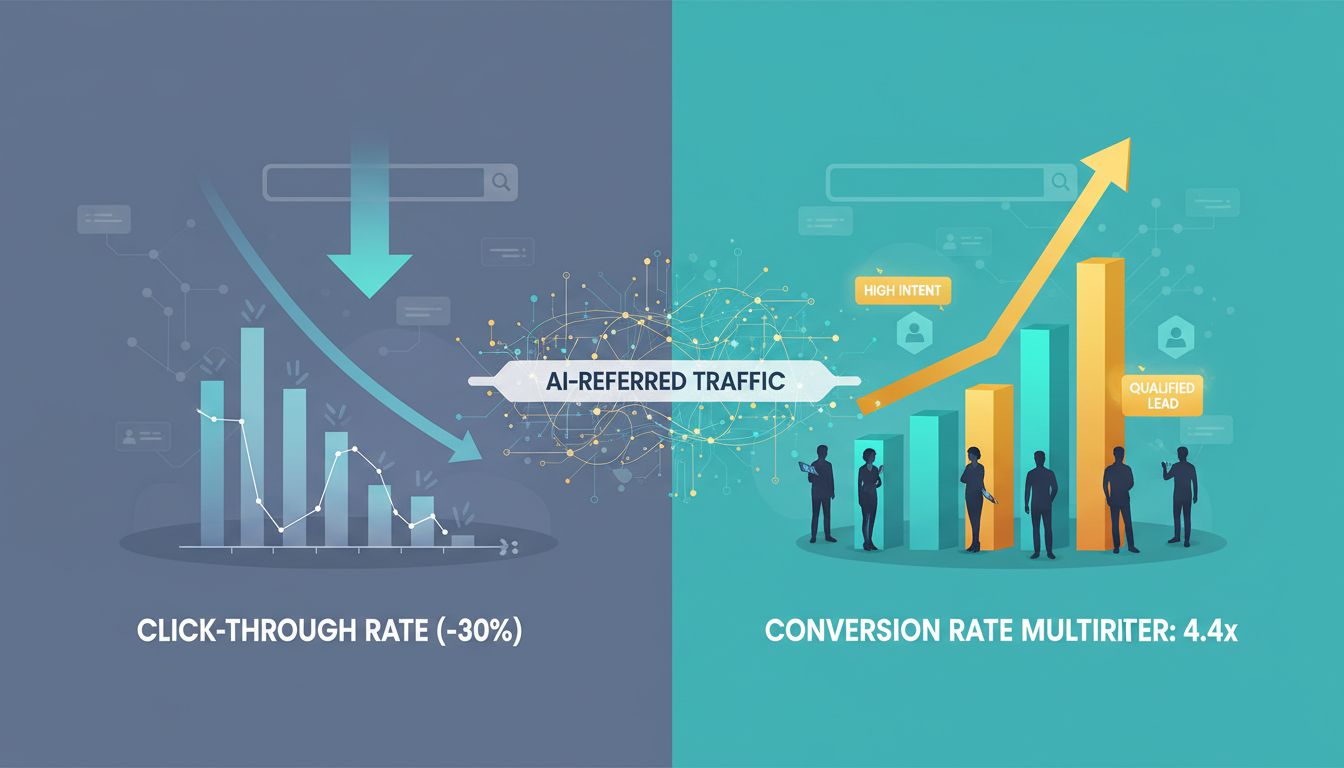
Here's the paradox: overall clicks decline, but the quality of the ones that remain goes up dramatically.
AI-referred visitors convert at 4.4x the rate of traditional organic visitors according to Semrush. The people who click through are the ones who wanted more than the surface answer, which makes them far more qualified.
This shift hits informational searches hardest. 88% of those queries now trigger AI Overviews.
For B2B SaaS companies, that means your how-to guides, technical docs, and comparison content need to be optimized differently. You're not just competing for position one. You're competing to become the source AI systems cite.
Google's March 2024 core update made this explicit, cutting unoriginal results by 40%. [Source: Brandlume] The penalty isn't for using AI, Google has said AI content is fine when it's useful and people-first. The penalty is for valueless content at scale.
I've seen this firsthand building Spectre and working with media companies. The teams that win aren't the ones avoiding AI. They're the ones using it to produce better content faster while keeping editorial standards intact. AI handles research and drafting. Human expertise provides the original insight that makes content worth referencing.
So is SEO dead in 2026? No. It's just harder.
It now requires optimizing for traditional ranking factors and AI discovery systems at the same time. Structured data that helps AI parse your content. Authoritative positioning that earns citations. Quality that clears Google's increasingly aggressive filters.
The old keyword density and backlink playbook is done. Every piece of content now has to serve two purposes: rank for human searchers and be reference-ready for AI systems. That's the new standard for anyone serious about seo and content marketing, whether you're at an seo marketing agency, taking an seo marketing course, benchmarking an seo marketing salary, or just building an seo and content strategy that actually holds up. The seo marketing examples that work in this environment all have one thing in common: they were built as systems, not one-off posts. And if you're still Googling "seo marketing near me" hoping someone local has figured this out, the answer is the same wherever you are.
Strategic Foundation: Frameworks for AI-Driven Growth
If the previous section described the battlefield, this is about choosing your weapons and your ground.
In 2026, SEO and content marketing aren't separate disciplines you coordinate, they're one system. The old siloed approach, where an SEO specialist hands a keyword list to a content team, creates friction and blind spots. Your strategy has to start from a unified model.
Bridging SEO and Content Marketing into One System
Think of it as Search-First Content Engineering.
Every piece of content needs to work for two audiences: the human searcher and the AI models that curate, summarize, and cite. That means your briefs evolve from "target keyword: X" to "target search intent: Y, with structured data for AI parsing, and authoritative citations for E-E-A-T signals."
The goal isn't just to rank on page one. It's to become a trusted source that both Google's algorithms and its AI Overviews pull from directly. Google's guidance is clear: AI-generated content is fine, but it has to be useful, people-first, and demonstrate real expertise.
The Cold Economics: Domain Rating Moats & Realistic Budgets
Here's the strategic filter most guides skip entirely: your domain rating (DR) dictates your viable keyword battlefield.
As an engineer who's built tools integrating with Ahrefs' API, I've seen the raw data. Targeting high-volume commercial head terms with a DR below 50 isn't ambitious, it's a fantasy that wastes months of budget.
The moat is real. Large media companies and established SaaS players have spent years building backlink profiles you can't brute-force. Your strategy has to work within that constraint.
This means letting go of the dream of ranking for "best CRM software" on day one. Focus instead on middle-funnel clusters, longer-tail, informational queries adjacent to your commercial offering. The "how to" and "why does" questions where you can establish topical authority with less direct competition.
Your content calendar should reflect this: 70% of effort on achievable mid-funnel clusters that build relevance, 20% on bottom-funnel support content, and maybe 10% on aspirational head terms as link-bait experiments.
A Modern Marketing Framework for AI
The classic 7 Ps need an update for the search-driven world. For a solid seo and content strategy, think in terms of:
- Content: The core asset, optimized for both readability and machine parsing.
- Context: The topical cluster and semantic relationships that signal authority.
- Crawlability: Technical foundations ensuring your content can be found and indexed.
- Citations: Both your inbound backlinks and the authoritative sources you cite to ground AI outputs.
- Conversion: Designing content journeys that capture value, not just clicks.
- Conversations: Engagement signals and community validation that boost credibility.
- Credibility: The overarching E-E-A-T demonstrated through author bios, case studies, and original data.
The number one rule is still knowing your customer. But now you also have to understand the AI models that serve them. Your seo marketing examples should show both sides of that equation.
Content Typology for 2026: Beyond Blog Posts
Forget the basic "4 types of content." Plan your production around these four engineered categories:
- Foundational/E-E-A-T Assets: Deep, research-backed guides, original studies, or definitive tutorials that serve as linkable cornerstones for your domain. Expensive to produce, but they build lasting authority.
- Answer-Optimised Content: Concise, structured pages directly targeting questions that trigger AI Overviews (which appear in ~88% of informational searches). FAQ pages, "how-to" steps with schema markup, definition posts.
- Scalable Support Content: AI-assisted content that fills out your topical clusters, addresses semantic variations, and supports the foundational assets. This is where automation actually earns its keep.
- Conversational Hooks: Content built for social and community engagement, LinkedIn posts, Reddit AMAs, webinar snippets, that drives direct traffic and brand signals, which increasingly feed into search relevance.
Tactical Integration: The 3-3-3 Rule
Within this framework, there's a practical tactic worth building around: the 3-3-3 Rule for content distribution.
- Produce 3 core pillar pieces (your Foundational Assets) per quarter.
- Repurpose each into 3 mid-funnel assets (turn a pillar guide into a webinar, a checklist, and a case study).
- Amplify each mid-funnel asset across 3 channels/platforms (LinkedIn, your email newsletter, an industry community).
It forces efficiency. It forces multi-channel thinking. And it extracts the most value from your highest-quality work, making sure your content actually reaches both search engines and the humans who engage on those platforms.
Technical Foundation: Building for AI Discovery and Scale
Strategy tells you what to build. Technical execution determines whether it actually works.
In the AI-driven search era, your website's infrastructure isn't just hosting content. It's a data structure that search engines and LLMs have to interpret programmatically. The gap between a good idea and a ranked page is now filled with structured data, crawlable architecture, and systems that keep factual integrity intact at scale.
The Lyzr.ai case study makes this concrete: a 150% increase in organic traffic within three months wasn't just about writing better content. It required technical and content synergy, where the underlying site structure supported both traditional crawlers and AI's new parsing methods.
Schema as an AI Translation Layer
Think of schema markup as a universal translator for your content. Without it, an AI Overview sees a webpage as raw HTML, a jumble of headings and paragraphs. With properly implemented structured data, you're handing the LLM a labelled, organised dossier.
It knows exactly which paragraph is the product price, which section lists the ingredients, which bullet points are the step-by-step instructions.
The types that matter most for AI discovery are Product, FAQ, How-To, Article, and LocalBusiness. These map directly to the informational queries AI Overviews favour.
I use Google's Structured Data Markup Helper for prototyping and Schema App for programmatic generation at scale in Spectre. The common pitfall isn't missing schema, it's implementing it wrong. Invalid JSON-LD that fails validation is actually worse than none at all, because it signals sloppy execution.
For scaling, you need automation: CMSs that generate Article schema on publication, or e-commerce platforms that dynamically output Product data.
RAG in Practice: From Concept to Content Pipeline
Retrieval-Augmented Generation (RAG) is the most important technical pattern for maintaining quality while scaling AI-assisted content. In simple terms, it stops AI from hallucinating by forcing it to look things up in your own verified data before responding.
Think of a researcher who, instead of writing from memory, constantly cross-references a filing cabinet of your company's past reports, case studies, and product docs.
Building a basic RAG pipeline involves four steps. First, you chunk your proprietary content, existing blog posts, whitepapers, support docs, into semantically meaningful blocks. Second, you convert those chunks into numerical representations (embeddings) using a model like OpenAI's text-embedding-3-small.
Third, you store these vectors in a dedicated database like Pinecone or Weaviate. Finally, when your AI writing tool drafts a new article on "enterprise SaaS pricing," the system queries that vector store for your most relevant content on that topic and instructs the LLM to ground its output in those sources.
The trade-off is cost and complexity. A modest pipeline processing 1,000 documents might run $50-100/month in embedding and vector database fees, plus engineering time to maintain.
The alternative, though, is ungrounded, generic content that fails E-E-A-T checks. For teams without in-house ML engineers, platforms like Spectre bake this RAG logic directly into the content workflow and abstract the infrastructure away entirely.
Site Architecture for Authority & Crawl Budget
When you scale content production with AI, you risk creating a sprawling, shallow site. Search engines allocate a finite "crawl budget" to each domain, the number of pages their bots will actually index in a given period.
If you generate hundreds of thin AI articles, Googlebot might burn its budget on those and never reach your cornerstone commercial pages.
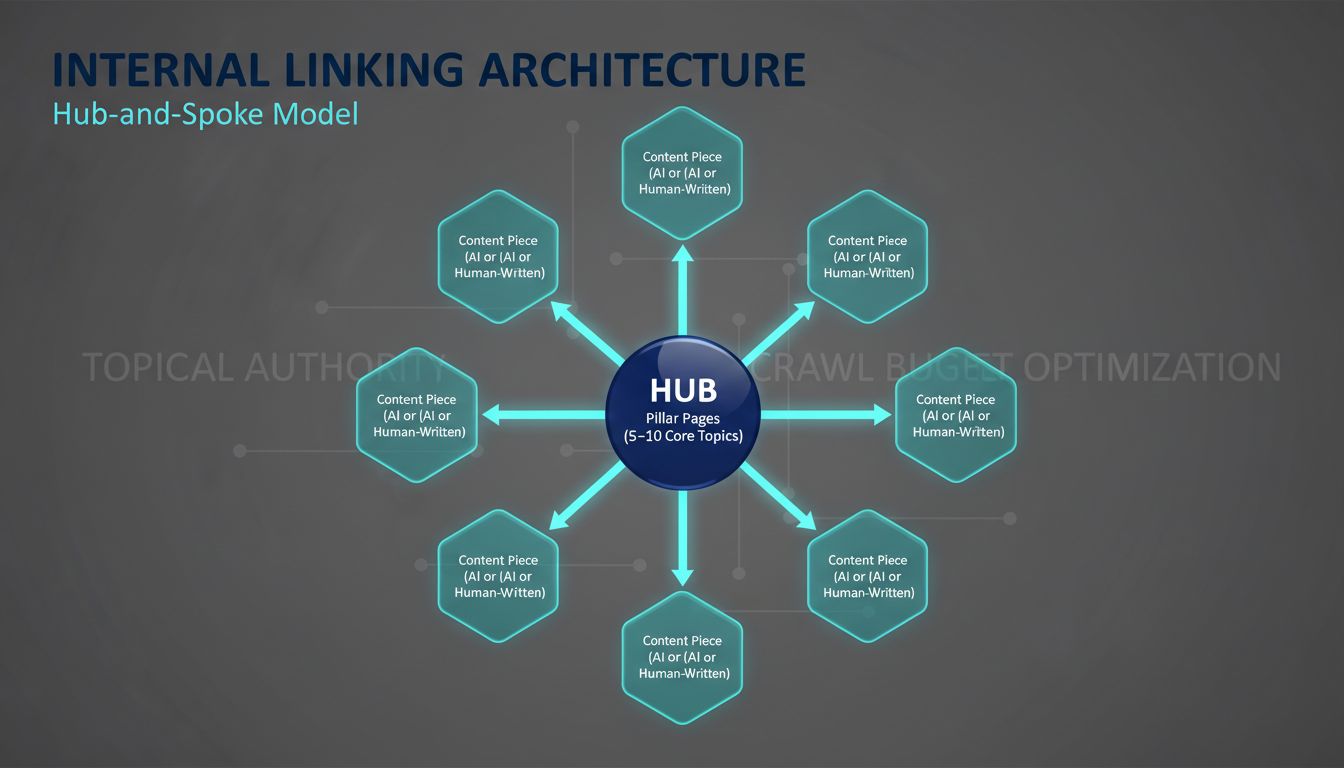
The fix is a hub-and-spoke internal linking architecture. You designate 5-10 "pillar" pages representing your core commercial topics. Every new piece of content, AI-assisted or human-written, links back to at least one relevant pillar.
This does two things: it signals topical authority by creating dense clusters of related content, and it guides crawl bots toward your most important URLs. Siloed content that doesn't integrate into this topical map is just dead weight.
Core Web Vitals & The Experience Signal
Site speed and responsiveness are the new plumbing. Nobody praises a building for having working toilets, it's just expected.
Core Web Vitals (Largest Contentful Paint, Interaction to Next Paint, Cumulative Layout Shift) work the same way. Technical readiness, including schema, increases your likelihood of featuring in generative answers. Their absence hurts rankings; their presence is merely assumed. This isn't a differentiation strategy, it's maintenance.
Use PageSpeed Insights and CrUX Dashboard not to chase perfect scores, but to find the catastrophic failures that block indexing altogether.
Answering the Viability Question
This brings us to a common question: can a beginner do SEO in 2026?
The honest answer is: it depends what you mean by "do SEO."
A beginner can execute tasks using guided tools, submitting a sitemap, adding basic meta tags, running a speed test. But architecting the systems described above, designing RAG pipelines, managing crawl budget at scale, programmatically generating schema, that requires engineering-minded thinking. The technical bar has gone up.
This is exactly why AI platforms exist. The goal isn't to turn every marketer into a machine learning engineer, but to provide abstractions that bake these technical necessities into the workflow.
A tool like Spectre handles the vector database, the chunking strategy, and the schema generation behind the scenes. The strategist focuses on topics and outcomes. In the context of SEO and content marketing, the beginner's role shifts from technician to system orchestrator, which is honestly a more sustainable place to be.
That framing matters whether you're hiring from an SEO marketing agency, working through an seo marketing course, or just trying to figure out seo marketing near me options for a local business. The tools have changed. The thinking required hasn't.
The seo marketing salary data reflects this shift too, practitioners who understand systems and seo and content strategy command more than those who just know the tactics.
The Operational Engine: The Hybrid Human-AI Content Lifecycle
Strategy without a process is just a document nobody follows.
The hybrid content lifecycle isn't about replacing people with AI. It's about designing a system where each part does what it's actually good at, with clear handoffs and quality gates. Most teams fail not because they lack AI tools, but because their workflow has no integrity. They automate the easy parts and skip the hard ones.
The Hybrid Workflow Blueprint
Think of this as a five-stage manufacturing line.
Stage one: AI-augmented ideation and clustering. Tools like DataForSEO or Ahrefs APIs can ingest thousands of keyword queries and cluster them by semantic intent far faster than any human could. That's how you identify content gaps and topic pillars without spending three weeks in a spreadsheet.
Stage two: structured briefing. This is where prompt libraries and standardized templates keep things consistent. A good brief has target keywords, SERP feature analysis, competitor angles, and, critically, the specific human expertise that needs to go in.
Stage three: creation via LLM drafting grounded by RAG. Retrieval-Augmented Generation pulls facts from your own knowledge base or trusted sources to cut down on hallucinations. The output is a solid first draft. Not a final piece.
Stage four: optimization. SEO-specific tools like Surfer and readability checkers run automated passes here, but a human makes the final call on keyword placement and flow.
Stage five: quality gates and publishing. Nothing goes live without a final human review checking for factual accuracy, brand voice, and strategic alignment.
Quality Gates & E-E-A-T Injection: The Non-Automatable Core
This is where most workflows fall apart.
You cannot automate E-E-A-T, Experience, Expertise, Authoritativeness, Trustworthiness. These get injected by humans at specific gates. For every piece of content, you need a protocol: who adds the first-hand experience? Which subject matter expert provides commentary? Where do you insert original data or case studies from your own work?
I run a "Human-in-the-Loop Protocol" based on content risk. For YMYL topics, financial advice, medical information, the gate is strict: multiple expert reviews, citation checks, sometimes a legal sign-off. For standard blog content, it might just be one editor adding narrative voice and real-world examples.
The rule is simple. If the content makes a claim that requires expertise, a human with that expertise has to touch it. Google's guidance is clear on this: content must be useful, people-first, and demonstrate E-E-A-T to rank well, regardless of how it was created.
Scaling & Localization Ethically
AI is good at scaling frameworks. Not final outputs.
The ethical approach to localization or adjacent topics is to use AI to adapt a proven, human-edited core asset. Take a deeply researched guide on "cloud migration for enterprises," have AI propose outlines for "cloud migration for healthcare" or "cloud migration for UK SMEs," then have a domain expert fill in the regulatory, technical, and cultural specifics.
You're scaling the structure. Not the nuanced expertise.
This avoids scaled content abuse, which violates Google's spam policies and leads to algorithmic penalties. It's also just... obviously the right way to work.
Tool Selection & Vendor Criteria
When evaluating platforms, skip the feature checklist. What actually matters is integration capabilities (is it API-first?), governance features (versioning, approval workflows, audit trails), and whether it directly moves metrics you care about, Surfer scores, conversion rates, something real.
Total cost of ownership has to include human time. Not just the license fee.
This is why platforms like Spectre exist. They codify this entire hybrid pipeline into an opinionated system. Spectre isn't just another AI writer, it's an operational engine that bakes in keyword clustering from DataForSEO, enforces briefing templates, integrates RAG grounding, and requires human review gates before anything publishes. The blueprint becomes a repeatable, measurable process.
Common Mistakes to Avoid
- Over-reliance on raw AI output. Publishing an LLM's first draft is a recipe for generic, factually shaky content. It's the most common mistake and the fastest way to get ignored by search engines and readers alike.
- Scaled content abuse. Generating hundreds of low-value pages targeting long-tail keywords might have worked in 2010. Today it leads to a 40% reduction in unoriginal search results post-update. Depth over breadth.
- Neglecting technical SEO in AI workflows. If your workflow publishes content without checking canonical tags, image alt text, or internal linking, you're creating future technical debt. SEO and content marketing don't work in isolation from the technical layer.
- Failing to plan for human review capacity. If AI can produce 50 articles a week but your team can only properly review 10, you have a bottleneck. Scale your human review process in tandem with your AI output. This is the friction point nobody talks about in any seo marketing course, and it's where most programs fall apart in practice.
Whether you're building this in-house, working with an seo marketing agency, or evaluating seo marketing near me options for a local business, the operational challenge is the same. The seo and content strategy has to include the process, not just the keywords and the calendar.
The seo marketing salary gap between practitioners who can design these systems and those who just know the tactics reflects this directly. And seo marketing examples worth studying, the ones showing real, compounding growth, almost always have a documented workflow behind them, not just good content.
Measurement, Attribution & Governance: Proving and Managing ROI
The operational engine matters. But if you can't measure what it's producing, you're just guessing.
This is where most AI-SEO initiatives fall apart. According to DigitalApplied research, only 19% of teams track AI-specific KPIs. They're measuring the old world with old tools, while their actual visibility flows through entirely new channels.
The New KPI Stack
Traffic volume is no longer the primary success metric. Focusing on it alone will mislead you.
AI Overviews have reduced average click-through rates by 30% [BrightEdge], yet AI-referred visitors convert at 4.4x higher rates [Semrush]. Those two facts together are the whole story.
You need to track four new core metrics alongside traditional ones:
- AI Overview/Knowledge Panel Appearance Rate – How often your content is cited or featured in AI-generated answers
- AI-Referred Session Conversion Rate – The value of traffic that comes via AI search interfaces
- Citation Velocity – The rate at which you earn both traditional backlinks and AI mentions across platforms
- Blended Content ROI – The combined return from traditional organic and AI-driven discovery
The problem is that traditional analytics tools don't surface this data. You're watching traffic decline on the dashboard while your actual business impact is growing through higher-value, lower-volume AI referrals.
A Sample KPI Dashboard for AI-SEO
Here's a practical dashboard I've implemented for clients that bridges the gap between traditional and AI measurement:
| KPI | Measurement Source | Target/Goal |
|---|---|---|
| Traditional Organic Sessions | Google Analytics 4 | Maintain or grow |
| AI-Referral Sessions | GA4 (segment by source = 'ai-search') |
Month-over-month growth |
| AI Citation Count | Brand monitoring tools (Mention, Brand24) | 10+ new citations/month |
| AI Overview Appearance Rate | Manual SERP checks + Search Console | Appear in 20% of target queries |
| Blended Conversion Rate | GA4 + CRM attribution | >4x traditional organic rate |
| Content Production Velocity | Internal tracking | 2-3x manual capacity |
| Editorial Review Cycle Time | Project management tool | 48 hours for standard content |
This isn't academic. It's what you need to see weekly to know if your hybrid engine is working. Notice how traditional traffic is just one row among many.
A Layperson's Guide to Multi-Touch Attribution for AI
Here's the attribution problem in plain terms. A user asks ChatGPT about "B2B SaaS pricing strategies." The AI cites your guide (touch 1). They later Google your brand name (touch 2). A week later they visit directly and request a demo (touch 3).
Who gets credit? Traditional last-click attribution gives everything to the direct visit and ignores the AI's role entirely.

Multi-touch models like Markov chains or Shapley value solve this by analyzing all touchpoints in a conversion path. They don't give you perfect mathematical truth, no model does, but they give you directional insight about which channels are actually working together.
A Markov model asks: "If we remove this touchpoint, how much less likely is conversion?" If removing the AI citation drops conversion probability by 40%, that touchpoint gets 40% of the credit. Shapley value uses game theory to calculate each touchpoint's marginal contribution to the outcome.
You don't need to implement these perfectly from day one. Start with a simple time-decay model that weights recent interactions more heavily, then evolve as the data builds up.
The key thing to understand is that AI discovery usually happens early in the journey. Conversion happens later, through traditional channels. Attribution has to account for both ends.
Governance & Risk Management
An AI-augmented content system needs clear operational controls. Without them you're exposed to everything from factual errors to Google penalties.
Your governance playbook should define:
- Roles and responsibilities – Who approves AI-generated briefs? Who performs final fact-checking? Who's responsible for updating content when underlying data changes?
- Editorial workflows – Mandatory human review gates for all AI-generated content, especially for YMYL (Your Money Your Life) topics
- Version control – Every AI-assisted document needs provenance tracking: which model version was used, what prompts generated it, what sources were referenced via RAG
- Compliance checks – Regular audits for copyright issues, privacy compliance regarding training data, and alignment with Google's E-E-A-T guidelines
I implement this as a simple checklist that runs before any AI-assisted content publishes. It takes 5-10 minutes per piece and catches 90% of potential issues before they become real ones.
Expected Timelines & Investment Realism
This isn't a quick fix. Averi.ai benchmarks show SEO delivers 748% ROI with a 7-9 month breakeven period.
Here's a realistic phased timeline:
- Weeks 1-4: Technical foundation, schema implementation, crawl optimization, site structure fixes
- Months 1-3: Initial ranking movement and AI citation appearances for newly optimized content
- Months 3-6: Meaningful traffic and conversion growth as authority builds and AI citations compound
- Months 6-12: Full ROI realization as the system scales and previous investments compound
The most common mistake I see is expecting month-one results from a quarter-one investment. AI-SEO compounds like traditional SEO, but with additional layers of AI-driven discovery that take time to build.
Budget for at least 6 months of consistent execution before expecting significant returns. That's true whether you're building in-house, working with an seo marketing agency, or evaluating seo marketing near me options for a local business.
Any serious seo marketing course will tell you this. The seo marketing examples worth studying, the ones showing real, compounding growth, all have patience baked in. And if you're looking at seo marketing salary data for practitioners who build and manage these systems, the gap between them and everyone else reflects exactly this: they know how to measure what matters.
Measurement isn't about finding perfect answers. It's about getting good enough data to make better decisions tomorrow than you made today.
In AI-driven search, that means tracking what actually matters across seo and content marketing and seo and content strategy, not just what's easy to pull from a dashboard.
Case Studies & Patterns of Success
What actually separates the winners from the losers in 2026? Look at HubSpot vs. Shopify.
HubSpot saw a 75% traffic decline. Shopify saw 7x AI traffic growth [Coalition Technologies]. That's not a dramatic hook, that's a roadmap.
HubSpot's problem wasn't volume, it was authority. They'd built a strategy around scaling mid-funnel informational content without enough first-hand expertise or depth behind it. When AI Overviews started surfacing answers directly, that thin content lost its reason to exist.
Shopify went the other direction. They optimized product search for conversational queries, structured data for AI interpretation, and built clear conversion paths from AI referrals. The result: AI-driven orders growing 11x.
In B2B, GreenBananaSEO's case studies show a 300% average increase in qualified leads across three companies. The pattern there is surgical focus. Not broad informational keywords, high-intent, bottom-of-funnel queries where AI was already serving commercial answers.
They used AI to build supporting content clusters around expert-led pillar assets. Topical authority that AI models could actually recognize and cite. And they tracked lead quality from AI referrals, not just volume. That distinction matters.
The Lyzr.ai and Surfer case study tells a similar story, 150% organic traffic growth in three months [Source: surferseo.com/blog/ai-platform-seo-case-study]. Foundation first. AI-powered tools for rapid technical audits and site optimization, then strategic content layered on top to hit keyword gaps. You can't skip the crawlable, well-structured foundation and expect the content to do all the work.
Across all of these, a few patterns show up every time. Every winner used a hybrid workflow: AI for scale, humans for depth and fact-checking. They built topical authority around commercial intent instead of chasing isolated keywords. And they measured what actually mattered, conversions, citations, lead quality, not just traffic.
These aren't theoretical principles. This is what delivered measurable ROI when the old approaches stopped working. Whether you're working through an seo marketing agency, taking an seo marketing course, or studying seo marketing examples on your own, the operational logic is the same. And it connects back to everything we covered around seo and content marketing and seo and content strategy, the underlying approach doesn't change, just the execution.
Conclusion
So what does all of this actually mean for how you operate going forward?
SEO and content marketing aren't two separate things anymore. They're one discipline. And the teams treating them as separate are already falling behind.
The case studies make this hard to argue with. Shopify's 7x AI traffic growth, GreenBananaSEO's 300% lead increases [GreenBananaSEO], these aren't flukes. Systematic execution beats isolated tactics, every time.
The technical foundation has to come first. Then the phased workflow. Then the governance model that keeps quality and E-E-A-T intact. You can't just scale content and hope for the best.
Execution is the differentiator. Not the strategy doc, not the seo and content strategy deck you send to stakeholders. The actual work.
That means building a hybrid engine, AI for scale and reach, humans for authority and trust. That's the only version of this that holds up. Whether you're inside an seo marketing agency, working through an seo marketing course, or just reverse-engineering seo marketing examples on your own, the underlying logic doesn't change.
Run the audit. Build the first pillar. Start measuring what actually matters, citations, lead quality, conversions, not just traffic.
If you've been searching for an seo marketing near me solution or thinking through seo marketing salary benchmarks for the team you need to hire to do this, those are downstream decisions. The first decision is whether you're actually building a system or just producing content.
Start there.
Frequently Asked Questions
Is SEO dead or evolving in 2026?
Not dead. It's merging with AI-driven content strategy, technical engineering, and data science in ways that make it harder, not easier, to ignore.
It's no longer just about ranking pages. It's about building content ecosystems that serve users, search algorithms, and AI models at the same time.
The discipline has gotten more complex, with priorities shifting toward AI citations alongside traditional clicks, and that requires expanded skill sets in technical implementation and workflow automation.
What is SEO and content marketing?
It's the integrated discipline of attracting an audience through valuable, relevant content, then technically optimizing that content for discovery by both search engines and AI models.
Content strategy drives creation. SEO ensures visibility and measurability. They've converged into a single system where you're serving two audiences simultaneously: human users and the AI models that surface content to them.
That's what seo and content marketing actually means in practice now.
What are the 4 types of content?
Modern strategies use four interconnected types: Foundational/E-E-A-T Assets (original research, expert-authored guides), Answer-Optimized Content (targeted at AI Overviews and featured snippets), Scalable Support Content (product documentation, localized FAQs), and Conversational Hooks (Q&A formats, interactive tools built for voice and AI chat).
This isn't just a typology exercise. Each type addresses a different part of how content gets discovered and cited now.
What is the #1 rule of marketing?
"Know Your Customer", but in 2026 that expands to "Know Your Customer and the Models That Serve Them."
Your content has to satisfy the end-user's intent and give the AI model something clear and authoritative enough to cite. You're designing for two audiences at once. Human psychology and machine interpretation patterns. Both matter.
Can a beginner do SEO?
Technically yes. AI assistants and user-friendly tools have made basic SEO tasks accessible to almost anyone.
But competing at a professional level is a different story. That requires blending content strategy, data analysis, technical understanding (schema, structured data), and AI workflow management.
Beginners can start with the fundamentals, just expect to build out the broader skill set if you want results in competitive markets.
What is SEO job salary?
As of mid-2026, there are real premiums for people who combine traditional SEO with AI implementation skills. According to industry salary surveys, Senior SEO Managers with AI/ML proficiency are pulling $120,000 - $180,000+, while SEO Specialists range from $65,000 - $95,000.
The seo marketing salary picture is shifting fast as the role moves from purely marketing-centric to something more technical and data-driven. It's not just writing briefs anymore.