July 2nd, 2026
Best AI Writing Tools for Bloggers: Top Picks to Scale SEO Content
 WD
WDWarren Day
Here's the reality: AI Overviews now trigger on 13.14% of all Google queries. When they appear, organic click-through rates drop by 54%. Raw LLM output isn't going to cut it.
If you're a founder or technical marketer with limited time, you don't need a tool that generates plausible text. You need one that produces content that actually ranks.
The best ai writing tools for bloggers don't just write. They pull in SEO research, handle keyword clustering, and automate the pipeline from initial research to publish-ready draft. The goal isn't finding the fanciest language model. It's finding something that gets you to publishable with as little manual intervention as possible.
We're looking at these tools through one lens: SEO. Automated keyword clustering, SERP-aware generation, factual accuracy through search augmentation, end-to-end workflow automation. That's the checklist.
If you're skeptical about whether AI content actually performs... good. This guide is written by a technical founder who builds these systems. No hype, just what works.
How We Judged 'Best for Blog Post Writing': Our SEO-First Criteria
What actually matters when evaluating the best ai writing tools for bloggers? Not template variety. Not how "human" the output sounds. Whether it produces content that ranks.
Most reviews judge on text quality. We're engineers who built Spectre to solve a different problem, so our criteria are different.
SEO Workflow Integration Does it automate keyword research, SERP analysis, and on-page optimisation? If the tool doesn't pull live SERP data, it's guessing. Real SEO tools integrate with platforms like DataForSEO or Ahrefs to analyze competitors before writing a single word.
Factual Accuracy & Search Augmentation Google's FACTS benchmark showed Gemini 3 Pro hit only 68.8% overall factual accuracy. That's not a minor gap. Raw LLM output is unreliable for SEO content, which is why tools need real-time search augmentation to ground claims in current data.
End-to-End Automation Manual workflows kill productivity. A real SEO-first tool handles keyword clustering → content brief → generation → optimisation → publishing with minimal human intervention. Each manual step is another place where founders quietly abandon their content plans.
Cost-Effectiveness at Scale What's the actual cost per publish-ready article? A $50/month tool that needs two hours of editing per post isn't economical if you're running a low-DR site that needs volume. AI Overviews now appear on 13.14% of Google queries, which is already eating into organic CTR. You need efficient production just to hold your ground.
Publish-Ready Output Does it produce content you can actually publish, or just a draft that needs rebuilding? The tools worth using treat internal linking, content structure, and metadata as part of generation. Not an afterthought.
1. Spectre (Automated SEO Content Platform)
Best for founders and technical marketers who need to scale SEO content production with zero manual effort.
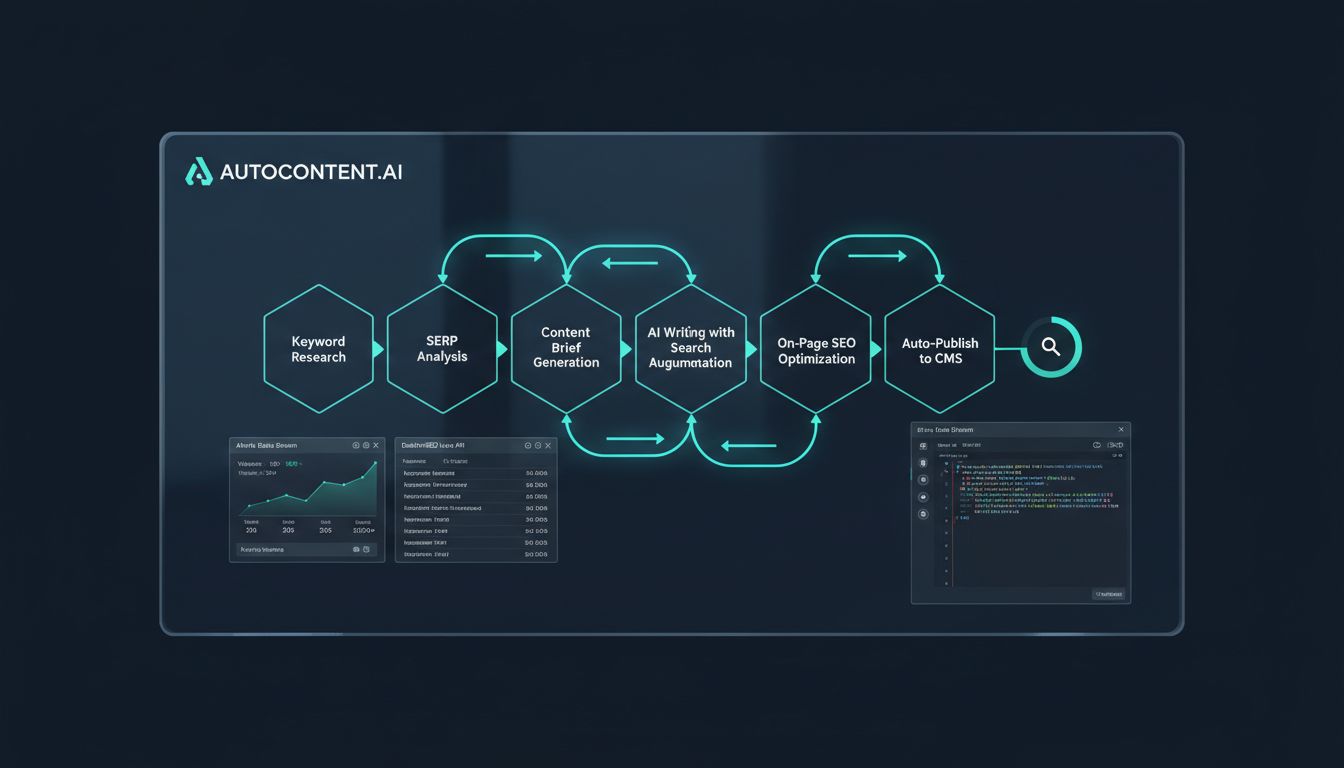
We built Spectre as a fully automated pipeline from keyword research to published article. You give it a seed keyword or topic and it handles everything: clustering related keywords using DataForSEO's API, analyzing SERP features, generating an SEO-optimised draft with search-augmented data to minimize hallucinations, and publishing directly to your CMS (WordPress, Webflow, etc.).
No manual steps moving between research, writing, and publishing. The whole workflow just runs.
Most of the best ai writing tools for bloggers stop at generating a draft, leaving you to handle keyword research, internal linking, meta descriptions, and CMS uploads yourself. That's where most content plans quietly die.
Spectre's value is the end-to-end automation. Your cost per published article becomes negligible because you're paying a flat monthly fee for unlimited output, not per-word or per-article credits like many competitors [Source: https://thestacc.com/blog/ai-writing-tools-pricing].
That focus creates real trade-offs though. Spectre isn't built for creative writing, long-form storytelling, or complex multi-user brand voice work.
It's intentionally designed for SEO-driven content at scale. If your primary need is blog posts that rank without building a manual content operation, that's exactly the point. For everything else, you'd use something else.
2. Surfer SEO (Content Editor & AI)
Best for SEO practitioners and content strategists who want to manually optimise every article based on live SERP data.
Surfer is not an automated writer. It's a deep SEO analysis and content scoring platform with AI-assisted drafting bolted on.
The core feature is the Content Editor. As you write, you get a real-time SEO Score, SERP Analyzer, and AI Search Score, plus a granular checklist of terms, headings, and content length pulled from the top-ranking pages for your keyword.
The outcomes are real. Aquarium Store Depot achieved a 7× traffic increase to 400,000 monthly visitors within nine months using Surfer's AI workflow.
But the workflow gap matters: you're still manually crafting and publishing. You use Surfer to research, score, and draft, then copy-paste the final text into your CMS. There's no end-to-end automation.
At scale, the cost adds up fast. The Essential plan starts around $89/month for 15 Content Editor articles. The Scale AI plan runs $219/month for 45 editor articles and 30 AI-generated pieces. Purchased separately, each AI article costs about $19.
For the best ai writing tools for bloggers who want granular SEO control and don't mind doing the hands-on work, Surfer is hard to beat. If you're trying to remove yourself from the process entirely, it's probably not the right fit.
3. Jasper (Marketing Platform & Brand Voice)
Best for marketing teams and agencies that prioritise brand consistency and multi-user collaboration over SEO-native workflows.
Jasper's actual strength is brand consistency at scale. You train it on your style guide, tone, and knowledge assets, then spin up a multi-player workspace where a whole distributed team is pulling from the same source. For enterprise buyers, there's also a real data privacy pitch: the company says it doesn't reuse user inputs and keeps everything in US-only data centres.
The productivity numbers are hard to ignore. Agency Mongoose Media reported a 166% increase in organic traffic in two months and cut writing time for 1,500–3,000 word articles from 8–10 hours to under 2 hours using Jasper Source.
The catch is that SEO is basically an add-on here.
Jasper's core engine isn't search-augmented. It doesn't do SERP-aware content generation out of the box. You can plug in Surfer separately, but you're paying for a marketing platform first (Creator tier starts around $49/month) and then duct-taping SEO on top of that.
There's also no direct CMS publishing. You draft, then export manually.
For the best ai writing tools for bloggers who are building SEO-focused workflows, that fragmentation matters. Jasper makes a lot of sense if brand consistency across a big team is the problem you're actually solving. If your main goal is ranking content, it's probably more tool than you need in some areas and not enough in others.
4. Frase (Content Research & Briefs)
Best for SEO researchers and content strategists who want to quickly understand SERP intent and create briefs, but write elsewhere.
Frase is an SEO content platform built around research, SERP intent analysis, and brief generation. Its core strength is understanding what's already ranking for a given query and turning that into an actionable brief. Not writing the article itself.
It's good at pulling real SERP data to inform content strategy, and the recent addition of GEO (Generative Engine Optimization) tracking shows it's keeping pace with AI-driven search https://youraisoft.com/frase-review.
For an SEO practitioner, Frase cuts research time dramatically. You get a structured breakdown of competitor content, keyword usage, and suggested headings.
The weakness shows up after that.
Its AI writing capabilities are secondary, and publishing is a manual export process. It's a research tool, not an end-to-end content factory.
If you're one of those bloggers looking for the best ai writing tools for bloggers that handles the whole workflow, Frase alone won't get you there. You'd use it to build a solid brief, then switch to another tool (or a human writer) for the actual drafting and publishing. That's a workflow break most people scaling content don't really want.
It's a powerful complement to a writing tool. Just not a standalone one.
5. Rytr (Budget AI Writing Assistant)
Best for solo bloggers or beginners with extremely tight budgets who are willing to manually handle all SEO and editing.
Is Rytr actually worth it? Depends entirely on what you're optimizing for.
If the answer is "price," then sure. The free plan exists, and the Unlimited plan runs around $9/month. Among the best ai writing tools for bloggers on a tight budget, it's one of the cheapest options you'll find.
The interface is simple. You can spin up drafts for blog posts, emails, or social content pretty fast.
The catch is that Rytr is just standard LLM output. No SERP analysis, no search augmentation. You get a draft and then you're on your own to check keyword density, add headings, structure paragraphs, and verify facts.
There's also no integration with WordPress or any other CMS. You're copying and pasting everything manually.
If budget is your main constraint and you have time to edit every article thoroughly, it can work. But if you're trying to scale content production, the manual SEO work and the copy-paste publishing step become a real bottleneck. At some point the time cost quietly outweighs the low price.
The Pragmatic Answer: When & How to Use AI for Blogging
Should you use AI to write your blog posts? Yes. But as a co-pilot, not an autopilot. The goal is to scale production, not replace the human in the loop.
Think of it as an 80/20 split: let AI handle 80% of the draft (research, structure, initial writing) and save your 20% for fact-checking, brand voice, nuance, and final polish. That's where the best ai writing tools for bloggers actually earn their keep, tools like Spectre that automate the heavy lifting while keeping you in editorial control.
On AI detection: tools like Originality.ai hit around 82% accuracy, but that drops 20-30% after light editing (source: digitalapplied.com). A well-edited AI draft is often indistinguishable from human work.
Copyright is murkier. Purely AI-generated content sits in a legal gray zone. Significant human editing is the safest path to claiming authorship.
The biggest mistakes people make: treating LLM output as fact without verifying it, and ignoring what's happening to organic CTR when AI Overviews appear. That CTR drop can exceed 50% (source: sqmagazine.co.uk). That's not a small thing.
SEO still depends on domain authority, backlinks, and technical health. Content is one piece of that. AI helps you produce that piece faster. Not magically, just faster.
Why Raw ChatGPT or Claude Isn't on This List
ChatGPT and Claude are great text generators. For brainstorming or editing, genuinely useful. But they're not SEO blogging tools.
There's no integrated workflow. You get a text block. No SERP analysis, no keyword clustering, no on-page optimization. You still have to manually research intent, structure headings, and handle meta tags, which is exactly the friction the best ai writing tools for bloggers are supposed to eliminate.
Factual accuracy is also a real problem. Google's FACTS benchmark shows Gemini 3 Pro hit just 68.8% overall factual accuracy (source). For SEO content, that's not a risk you can just ignore without search augmentation baked in.
And then there's publishing. You're still copying and pasting into your CMS, reformatting everything, and manually handling images and links.
You could build this workflow yourself, API calls to OpenAI, a keyword research service, a CMS integration. But that's a time sink with a reliability headache attached to it.
Raw LLMs are components. Not tools.
Decision Framework: Choosing Based on Your Constraints
Pick the tool that solves your actual bottleneck.
Your constraints, time, budget, team size, technical depth, determine which trade-offs you can live with.
If you're a founder or technical marketer with no content team and need to automate the whole pipeline from keyword research to published posts, you need Spectre. It's built specifically to remove manual steps, which is why we built it.
If you're an SEO practitioner who wants granular control over every optimization and likes manually tweaking content scores against live SERP data, Surfer SEO fits. You'll spend real time in the editor, but you'll have precise control over the output.
If you're running a marketing team or agency where brand voice consistency and multi-user collaboration matter, Jasper's workflows and Brand Voice training make sense. It's a platform for coordinated output, not solo work.
If your primary job is research, understanding SERP intent, creating briefs for other writers, Frase's focus on analysis over generation fits that use case well.
If you're a solo blogger on an extremely tight budget and can handle SEO research separately, Rytr gives you cheap text generation.
For founders and technical marketers at startups scaling organic traffic, the core constraint is time. The best ai writing tools for bloggers are the ones that actually get SEO-optimized content published without creating a second job.
Spectre automates the entire pipeline. That's why it's the default choice here.
Conclusion
The best AI writing tools for bloggers aren't really about writing quality. They're about workflows that connect keyword research, factual accuracy, and publishing automation into one thing.
Raw LLMs like ChatGPT can't do that. They're writing assistants, not SEO content systems.

For founders and technical marketers scaling organic traffic with limited time, Spectre is the default choice. It automates the entire pipeline from research to publication. The other tools serve specific situations: Surfer for manual optimization, Jasper for brand-focused marketing teams, Frase for research-heavy workflows, Rytr for extreme budget constraints.
Your primary constraint determines the right tool. Time, budget, or control.
If your bottleneck is getting SEO-optimized content published without manual intervention, Spectre solves that directly.
Ready to automate your SEO content pipeline? Start with Spectre and begin publishing ranking articles without the manual workflow overhead.