June 29th, 2026
The Complete Guide to SEO and Digital Marketing for AI-Driven Growth
 WD
WDWarren Day
If you're driving growth in 2026, you've probably already felt it. The old playbooks for SEO and digital marketing, manual keyword research, static content calendars, isolated PPC campaigns, they're just not holding up anymore.
And it's not because you're doing it wrong. It's because the search results themselves changed. AI-generated summaries now dominate over half of all Google results, and two-thirds of marketers are already using AI in their day-to-day work. This isn't a trend you can wait out.
So what actually is SEO in digital marketing right now? At its core, it's still about improving your visibility in organic, unpaid search. But in 2026 that means optimizing for AI-driven environments like Google's AI Overviews, not just the ten blue links.
The game shifted. Most people haven't caught up yet.
Winning at SEO and digital marketing today isn't about using more AI tools. It's about building hybrid human-AI systems that are actually designed for how search works now. Strategic oversight matters more than any single tactic. The workflows, the data architecture, the automation layer, that's where the real competitive advantage lives.
This guide is for founders and marketing leads who are tired of generic advice. You'll learn how to audit your current strategy through an AI lens, run high-impact pilots without blowing your budget, and measure results in an era where referral traffic and conversion paths look nothing like they used to. We'll also get into why your domain authority isn't just a vanity metric, it's what determines which keywords are even worth going after in the first place.
Whether you've taken a google digital marketing course or you're learning from a top digital marketing agency in usa or you're somewhere in the middle of figuring out your first seo and digital marketing course, the principles here are the same. Build systems. Don't just follow checklists.
The State of Play: SEO and AI in 2026
Is SEO dead? No. But what you're optimizing for has changed pretty dramatically.
It's not just about ranking blue links anymore. It's about showing up inside an entirely new search ecosystem, one where AI answers the question before the user ever clicks anything.
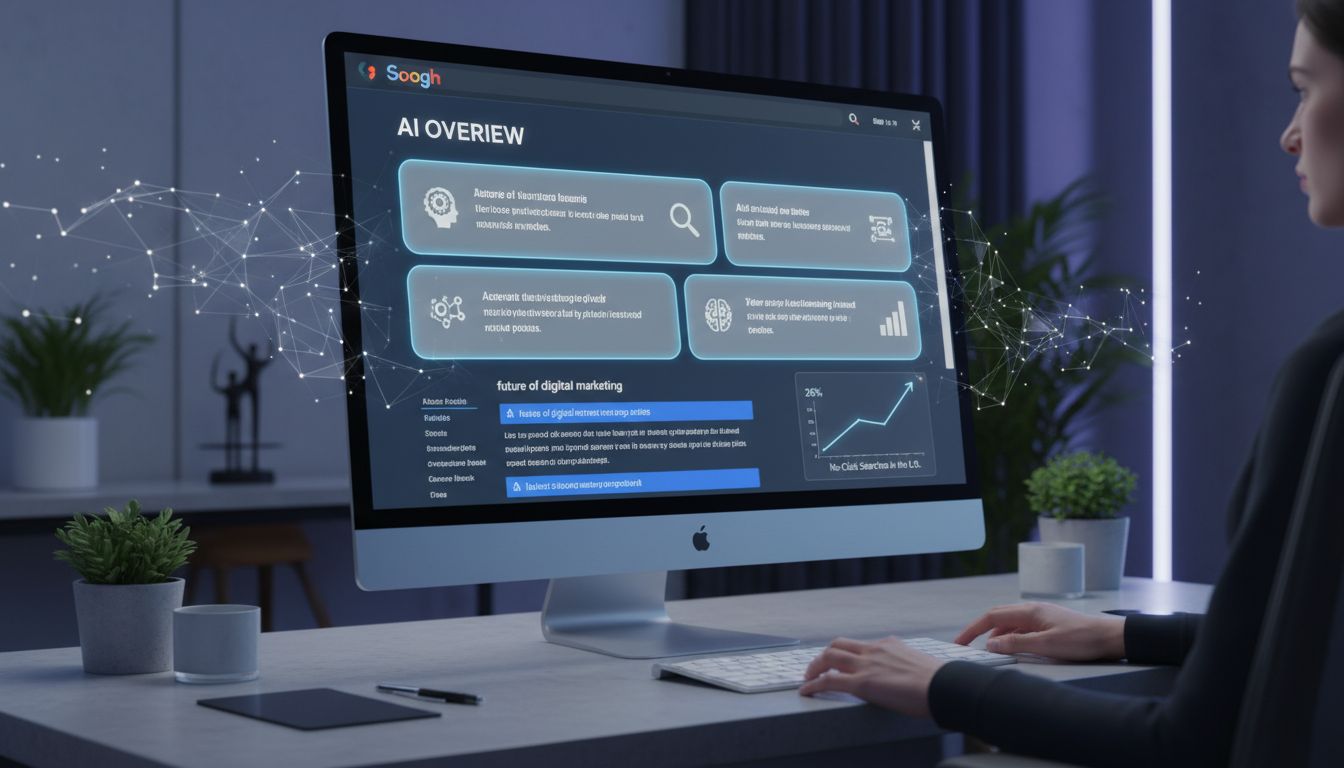
Here's the data that should change how you think about this. AI Overviews now appear in more than 50% of all search results, roughly double what they were in August 2024 [Source: LinkedIn]. And when those summaries appear, a lot of users just... stop there. In 2024, 60% of U.S. searches ended without a click, up from 26% in 2022 [Source: Spitfire Inbound].
So "position #1" doesn't mean what it used to. If your link sits below an AI answer that already satisfied the query, you're invisible in any way that matters.
The content side is shifting too. AI-generated content in Google's top results went from 2.27% in 2019 to 17.31% in 2025 [Source: Semrush]. By November 2024, AI-written articles outnumbered human-written ones globally [Source: Graphite]. Volume-based content strategies aren't going to cut through that.
The part most people miss: getting cited inside an AI Overview can actually be worth more than the #1 organic result. Research from Seer Interactive found that when a brand is cited in an AI Overview, its organic CTR jumps from 0.74% to 1.02% [Source: Seer Interactive].
That changes the goal entirely. You're not just trying to rank for a keyword anymore. You're trying to become a source the AI trusts enough to cite.
That means technical SEO now has to include machine readability, not just crawlability. Comprehensive schema markup so AI can parse and cite your content accurately. And content strategy moves away from keyword density toward demonstrating EEAT (Experience, Expertise, Authoritativeness, Trustworthiness) in a format that large language models can actually recognize.
It's also not just Google anymore. Perplexity hit 45 million active users and $148 million in annual recurring revenue by late 2025 [Source: GoodFirms]. These platforms have their own content preferences and referral patterns. The "Google-only" approach is already outdated.
The bottom line for anyone serious about SEO and digital marketing in 2026: your content needs to work as a high-quality data source for AI systems, not just a page that ranks. Whether you learned this from a google digital marketing course, a top digital marketing agency in usa, or an seo and digital marketing course, the shift is the same. Build for AI-driven discovery, or get answered around.
Foundations Re-examined: The 7 Pillars Through an AI Lens
You'll hear digital marketing described through seven core pillars. In 2026, these aren't separate channels you manage, they're interconnected workflows you architect. The difference between a tactical agency and a top digital marketing agency in the USA isn't their PPC or SEO skills anymore. It's whether they can engineer these pillars into a coherent AI-powered system.
Here's what each one actually looks like now.
1. SEO → AI-First SEO Traditional SEO was keyword density and backlinks. AI-First SEO is machine readability and structured data. Your content has to function as a high-quality data source for AI Overviews, which now appear in over 50% of searches.
The goal shifts from ranking #1 to being the most citable source. When a brand appears in AI Overviews, organic CTR rises from 0.74% to 1.02% [Source: Seer Interactive]. Your technical foundation, schema markup, entity clarity, semantic relationships, is your primary ranking asset now.
2. Content Marketing → AI-Augmented Content Pipelines This pillar goes from a creative department to a production line. AI assists at every stage: semantic keyword clustering, competitor gap analysis, first drafts, EEAT signal optimization.
The human role shifts from writer to editor. Brand voice and factual accuracy are yours. Scale is the system's problem.
3. PPC & Paid Media → Algorithmic Bidding & AI Ad Agents Manual bid management is obsolete. Smart Bidding in Google Ads adjusts bids in real-time across millions of auctions. Tools like Ryze AI can autonomously manage budget allocation and keyword strategy, reportedly delivering a 34% ROAS improvement.
Your job is setting constraints and reading outcomes. Not micromanaging campaigns.
4. Social Media Marketing → Predictive Audience Orchestration AI analyzes engagement patterns to predict which content resonates, with which segments, at what time. It automatically generates platform-specific variations of core assets.
The system learns what drives conversions and keeps refining. You're not targeting demographics anymore, you're doing behavioral prediction.
5. Email Marketing → Hyper-Personalised Automation Batch-and-blast is gone. AI segments your list based on real-time behavior, predicts churn risk, and generates personalized subject lines and content blocks.
Each email gets dynamically assembled from modular components matched to where that person actually is in their journey.
6. Affiliate Marketing → Performance-Based AI Optimization AI tracks millions of affiliate partnerships and separates publishers driving quality traffic from ones just driving volume. It automatically optimizes commission structures and creatives based on predicted lifetime value.
A sprawling, hard-to-manage network becomes a managed performance channel.
7. Marketing Automation → The Central Nervous System This is the connective tissue. Not just follow-up emails. Modern marketing automation is the workflow layer orchestrating data flow between all your AI tools, passing conversion signals from PPC to your CRM, triggering content refreshes when rankings drop, personalizing site experiences in real time.
None of this works if the pillars operate independently. Whether you picked this up from a google digital marketing course, a seo and digital marketing course, or time spent at a top digital marketing agency in USA, the architecture is the same: AI handles execution, humans provide direction. That's the shift that separates the ones winning from the ones wondering what happened.
The AI-Powered SEO Engine: Architecting a System, Not a Checklist
The difference between winners and everyone else in 2026 isn't the tools they use, it's how they connect them.
Traditional SEO was a checklist: keyword research, content creation, on-page optimisation, backlinks. Each task discrete. Each one creating a bottleneck. That approach misses the compounding effects you only get when the whole thing runs as a system.
Think of it as moving from manual assembly to building a production line. The goal isn't to write one better article. It's to engineer a scalable content pipeline where AI handles execution and humans provide strategic oversight, what I call the hybrid human-AI workflow.
This is the real answer to "can I do SEO by myself?" Yes. But only if you're willing to be a system architect, not a manual labourer.
Stage 1: AI-Driven Discovery
Forget scraping keyword volumes. Modern discovery uses AI for semantic clustering and predictive gap analysis.
Tools like Ahrefs or DataForSEO APIs feed into clustering algorithms that group keywords by user intent and underlying topic, not just lexical similarity. This surfaces content opportunities your competitors missed because they're looking at individual terms instead of thematic clusters. As coseom.com notes, "AI-powered keyword research moves from simple volume to topic modeling and intent mapping."
For a low-domain-authority site, this is your entry point. Target emerging, long-tail clusters before they get competitive.
Stage 2: Structured Creation with Guardrails
This is where most AI content initiatives fall apart at the last mile. You can't just prompt an LLM and publish.
You need a structured brief that enforces brand voice, EEAT signals, and factual accuracy. In my work with Spectre, we engineer this by using AI to generate a first draft within a strict template that includes:
- Expertise markers: Sections flagged for human SME input.
- Citation requirements: Placeholders for linking to primary sources.
- Competitor analysis: Direct references to top-ranking content's structure.
The AI writes the draft, but the system ensures it's a scaffold, not a finished product. Human oversight then injects real experience, the "why behind the why" that pure AI can't fabricate.
Stage 3: Machine-Readable Optimisation
On-page SEO is no longer about keyword density. It's about making your content consumable by both users and AI agents.
That means comprehensive schema markup, Article, FAQ, HowTo, BreadcrumbList, turning your content into structured data. Nav43.com puts it plainly: "AI SEO requires machine-readable structured data and semantic markup" (source). If you want to appear in AI Overviews, your content has to be the most easily parseable, well-sourced answer available.
This is a technical task. It usually means custom fields in your CMS or programmatic tagging at the publishing stage.
Stage 4: Automated Technical Governance
Technical SEO can't be an annual audit. It needs to be continuous.
AI-powered crawlers like Screaming Frog (now with integrated OpenAI and Gemini APIs) run scheduled crawls and classify issues by severity, crawl errors, slow render-blocking resources, duplicate meta tags. The useful part is impact prioritisation: the system estimates the potential traffic or conversion lift from fixing each issue, so you're not burning engineering time on things that don't matter. That aligns with what coseom.com describes as AI's ability to "prioritize fixes based on potential traffic and conversion impact."
Stage 5: Intelligent Measurement
Rankings aren't the metric anymore. With AI Overviews appearing in over 50% of searches and zero-click rates climbing, you need to track:
- Visibility in AI-generated answers: Are you being cited?
- SERP feature presence: Featured snippets, people also ask, local packs.
- Referral paths from AI platforms: Traffic from Perplexity, ChatGPT, or Gemini.
A brand appearing in AI Overviews sees organic CTR rise from 0.74% to 1.02% (Source: seerinteractive.com). If you're not measuring this, you're optimising for a reality that no longer exists.
The System in Practice: Tuning for Domain Authority
Here's the part most people skip: this system needs to be tuned differently depending on your domain rating.
A high-DR site (60+) can use this pipeline to go after competitive, high-volume terms. A low-DR site (20-40) has to use it to systematically target long-tail, question-based queries and niche clusters, places where comprehensiveness and clean technical execution matter more than authority.
Your domain rating determines your input strategy. Not your system's design.
Tools like Surfer SEO, Jasper, or BrightEdge slot into specific stages as components. BrightEdge has driven real traffic lifts in case studies by connecting AI across discovery and optimisation. But buying a tool isn't the solution. Engineering the hand-offs between tools and your human team is. You're replacing manual dashboards with automated workflows that move data from research to creation to optimisation without anyone transcribing anything.
Whether you learned this through a google digital marketing course, an seo and digital marketing course, or time at a top digital marketing agency in USA, the architecture is the same. And the output isn't just content, it's a measurable asset factory. That's what turns seo and digital marketing from a cost centre into something that actually compounds.
PPC and Paid Media: Navigating Algorithmic Bidding and AI Agents
The same AI shift reshaping organic search is rewiring paid media too.
Content teams are dealing with AI Overviews. PPC managers are now bidding against machine learning algorithms that adjust in real-time. Your success depends less on setting the right budget and more on understanding the system's prerequisites.
Start with Google Ads Smart Bidding. These are ML models (Target CPA, Target ROAS, Maximise Conversions) that analyse thousands of signals per auction, device, location, time of day, user behaviour, to predict conversion likelihood and bid accordingly.
The part most people gloss over: these models need data to function. Google's own documentation says Smart Bidding performs best with at least 30 conversions in the last 30 days. Launch it on a new campaign with sparse data and you're asking an algorithm to optimise towards a ghost.
That creates a fairly clear decision matrix. Under 30 monthly conversions, stay on manual or enhanced CPC to build baseline data. Once you hit that threshold with stable conversion tracking, Smart Bidding becomes viable. Then the choice between Target CPA and Target ROAS comes down to your margin structure, Target ROAS works better for e-commerce with consistent product margins, Target CPA tends to fit service businesses where lead values vary.
The next layer is AI ad agents, autonomous systems like Ryze AI that manage entire campaign structures. Not just bid adjustments. Keyword expansion, ad creative testing, budget pacing, audience management. Ryze reports an average 34% ROAS improvement across managed accounts, which sounds good until you read the fine print.
These agents work best as governors of already-performing campaigns with substantial historical data. They're not a fix for broken fundamentals.
Where it gets more complex is the overlap with organic. AI Overviews directly affect paid performance. When one appears, paid CTRs can drop 8–12 percentage points, a 20–40% decline in some verticals. But if your brand gets cited inside that Overview, both organic and paid CTRs go up. You can't treat organic and paid as separate buckets anymore. You have to track SERP feature presence and attribute value across the whole search journey.
The most common mistake I see is "set and forget." Teams implement Smart Bidding, disengage from campaign analysis, and assume the algorithm handles everything.
It doesn't.
Your role shifts from adjusting bids manually to managing what the algorithm sees: feeding it quality conversion data, structuring campaigns to give it clean signals, auditing its decisions against actual business outcomes. The algorithm runs the micro-auctions. You manage the algorithm's world.
The practical path is phased. Start manually, gather conversion data, graduate to Smart Bidding once you have the volume. Test an AI agent on a mature, well-instrumented campaign before handing over anything critical. And keep a unified dashboard tracking how AI Overviews are reshaping your cost-per-acquisition across both organic and paid. Whether you got here through a google digital marketing course, an seo and digital marketing course, or time at a top digital marketing agency in USA, the principle is the same, and it applies across all of seo and digital marketing now.
In 2026, paid media isn't about outbidding competitors. It's about collaborating with the algorithms that control the auction.
The Forgotten Factor: Data Governance and Organisational Readiness
Here's the uncomfortable truth most AI marketing guides skip: your biggest blocker won't be technical limitations. It'll be organisational chaos.
You can have the most sophisticated AI tools available. But if your data lives in disconnected spreadsheets, your brand voice is undocumented, and your processes are ad-hoc, you'll spend more time cleaning up messes than seeing results.

The foundation is a single source of truth for your marketing data. This isn't just good practice, it's a revenue multiplier. Companies that achieved this reported 44% revenue growth, compared to just 8% for those without [Source: GrowthLoop 2026 index].
AI-driven personalization can't function when customer data is fragmented across your CRM, email platform, ad accounts, and website analytics. A unified data layer lets your AI systems learn from complete customer journeys, not isolated touchpoints.
This is why tools like Spectre are built around centralisation from the start. Keyword research, content briefs, published articles, and performance metrics exist in one connected pipeline. When your AI content engine references that central repository, it's working with consistent brand guidelines, up-to-date product information, and accurate performance benchmarks. Without it, you get conflicting messaging and wasted effort.
Implementation costs are the other major hurdle, with 45% of businesses citing them as a primary obstacle [Source: IJRSI 2025]. These aren't just software subscriptions.
They include the time cost of training teams to think like workflow engineers rather than tactical executors, the integration work to connect new AI tools to legacy systems, and the ongoing governance overhead. Budget for at least six months of lower productivity as your team adapts.
Your governance framework needs clear human-in-the-loop checkpoints. Every piece of AI-generated content needs review for factual accuracy, brand voice alignment, and E-E-A-T signals before it goes live. Maintain a centralised style guide and entity database your AI tools can reference, definitions of key terms, product specifications, company values. This prevents the brand dilution that happens when different team members use different AI prompts.
Establish processes for acting on AI audit findings too. When your technical SEO tool flags structured data issues or crawl budget problems, there should be a clear workflow for developers to implement fixes. Create ethical guidelines covering transparency, data privacy compliance, and avoiding bias in automated decisions.
Governance isn't red tape. It's the structure that lets you scale AI without things breaking.
Whether you picked this up through an seo and digital marketing course, a google digital marketing course, time at a top digital marketing agency in USA, or just working through problems in the trenches, the lesson is the same. It applies across all of seo and digital marketing now.
Without governance, you're just automating chaos.
Your AI Adoption Roadmap: A Phased Implementation Plan
Governance gives you the structure. But you still need a path forward.
The two questions I hear most from founders: "Can I learn SEO on my own?" and "Can I do SEO by myself?"
Yes to both. But only if you treat it as a progression, not a switch you flip. Most people fail because they try to jump from zero to full automation without building anything in between.
Here's a four-level framework that maps to what's actually achievable:
Level 1: Assisted (Novice) – You're using ChatGPT for idea generation and basic audits. Maybe you take a Google digital marketing course or an SEO and digital marketing course to build some foundation. This is where most solo founders start, and that's fine. You're learning, manually implementing, figuring out what actually matters.
Level 2: Integrated (Practitioner) – You're running AI tools in one specific stream, like content refreshes or keyword clustering. AI handles research and drafting. You handle direction and voice. You've stopped learning and started doing.
Level 3: Automated (Strategist) – You're orchestrating multi-tool pipelines. A platform like Spectre runs your entire content operation, research, writing, optimisation, publishing, while separate agents manage paid campaigns. You're not using tools anymore. You're engineering systems.
Level 4: Autonomous (Engineer) – Custom models, fine-tuned on your own data, with automated reporting and anomaly response. Enterprise territory. AI isn't assisting your strategy at this point, it's become a competitive moat.
The jump from Level 2 to Level 3 is where most businesses stall. AI works in isolated pilots but won't scale across an organisation without creating chaos.
Phase 1: The 30-Day Content Refresh Pilot
Start with the lowest-risk, highest-impact project: refreshing existing content that's underperforming.
Pick 5-10 pages. Run the pilot. Get your proof of value before rolling anything out wider.
Here's the concrete plan:
Week 1: Selection & Analysis
- Use Google Analytics or Ahrefs to find pages with decent traffic but poor conversion or declining rankings.
- Run each through an AI-powered content gap analysis. Surfer SEO or MarketMuse will show you exactly what top-ranking pages cover that yours doesn't.
- Audit technical health: page speed, mobile responsiveness, and structured data implementation.
Week 2-3: AI-Assisted Rewrite
- Feed the gap analysis and your existing copy into an AI writing tool with strong optimisation capabilities.
- Don't just regenerate, restructure. Add missing sections, improve readability, and work in semantic variations of your target keywords.
- Manually review for brand voice. Add specific examples and proprietary data that AI couldn't know.
Week 4: Enhanced Implementation & Measurement
- Implement schema markup (Article, FAQ, HowTo) to improve machine readability for AI Overviews.
- Update internal links from high-authority pages to point at your refreshed content.
- Track a new KPI: visibility in AI Overviews. Not just traditional rankings.
This pilot gives you a measurable win, a documented workflow you can repeat, and clarity on which tools actually work for your team.
Tool Selection: Matching Solutions to Your Stage
Ignore feature checklists. Ask one question: "Will this move me to the next maturity level?"
For solopreneurs at Level 1, ChatGPT with SEO plugins is probably enough. For scaling teams at Level 2, something like Jasper or Surfer SEO gives you structured workflows. But Level 3, systematic, scalable content operations, needs an orchestration platform that connects research, creation, and publishing into a single pipeline.
That's where Spectre sits. Not as another point solution, but as the thing that moves you from one-off pilots to predictable output. It handles the whole workflow so you're focused on strategy, not manually stitching together a dozen different tools.
Whether you got here through an seo and digital marketing course, a google digital marketing course, time at a top digital marketing agency in USA, or just working through seo and digital marketing problems on your own, the roadmap is the same.
Start with the 30-day pilot. Document what works. Scale what delivers.
The Future, Careers, and Your Strategic Imperative
Is SEO a good career? Yes. But not the version you probably learned.
The role is turning into something closer to AI-Driven Growth Engineering. Technical SEO, data thinking, systems design, all of it converging into one job: building scalable pipelines instead of manually executing inside them. The tedious stuff (rank tracking, on-page tweaks, reporting) gets absorbed by the system. Your job moves up a level.
What's replacing the SEO specialist? Nothing, really. The siloed specialist just becomes a growth engineer. Someone who builds the system, not someone who operates inside it.
That's exactly what a top digital marketing agency in usa actually sells now. Less "we'll build you links," more "we'll design and run a hybrid AI-human content engine that compounds over time."
One genuinely interesting data point: as of 2026, the most Googled person globally is still a rotating cast of pop culture figures, often athletes like Cristiano Ronaldo or musicians like Taylor Swift [Source: Google Trends]. Human interest doesn't care about algorithm updates.
The goal for 2026 isn't to out-prompt a model on a single task. It's to build a system that out-executes your competitors consistently, month after month, whether you're watching it or not.
Whether you got here through an seo and digital marketing course, a google digital marketing course, or just grinding through seo and digital marketing problems yourself, the endgame is the same.
Stop doing SEO. Start engineering the system that does it for you.
Conclusion
SEO and digital marketing aren't being replaced by AI. They're turning into hybrid systems where how you build the workflow matters more than any single optimization.
That shift isn't optional. AI Overviews now appear in over 50% of search results, and 60% of searches end without a click. [Source: linkedin.com/top-content/artificial-intelligence/ai-in-seo/the-future-of-seo-in-an-ai-driven-landscape, blog.spitfireinbound.com/navigating-2024-seo-landscape-adapting-to-ai-zero-click-searches-declining-traffic]
So the target moves. You're not just chasing organic rankings anymore. You're structuring content for machine readability, pursuing citations inside AI-generated answers, and tracking performance on platforms like Perplexity.
That means clean data, centralized into a single source of truth, with humans staying in the loop on brand voice and EEAT signals. Companies that get this right report 44% revenue growth versus 8% for those that don't. [Source: prnewswire.com/news-releases/growthloop-unveils-2026-ai-and-marketing-performance-index-highlighting-that-data-issues-significantly-slow-marketing-cycles-experimentation-and-personalization-302770331.html]
The people who win here are practitioner-builders. People who design the system, not just run tasks inside it.
Start by auditing your current workflow. Find one bottleneck, whether that's content research, technical debt, or measurement, and run a pilot using the hybrid human-AI frameworks in this guide. If content production is the constraint, something like Spectre can handle research, writing, and publishing so your team can stay focused on strategy.
Whether you got here through an seo and digital marketing course, a google digital marketing course, or just years of doing seo and digital marketing work the hard way, the next move is the same.
Stop doing it manually. Build the thing that does it for you.