June 23rd, 2026
How to Write Website Content for SEO: A Step-by-Step Framework for Founders
 WD
WDWarren Day
You're a founder, not an SEO. Between product, fundraising, and hiring, you have maybe 2-3 hours a week for "marketing." The SEO advice out there is either too simple or written for full-time professionals with actual budgets.
Neither helps you.
Here's the math though: for every $1 invested in SEO, businesses see an average return of $22 [Source: SeoProfy/FirstPageSage]. That's hard to ignore. The problem is 96.55% of content gets zero Google traffic [Source: Ahrefs]. So the opportunity is real, but most people are doing it wrong.
Is SEO dead in 2026? No. It's just different. AI Overviews now correlate with a 58% reduction in clicks for top-ranking pages [Source: Ahrefs], and AI-generated content makes up roughly 17% of the web [Source: Exploding Topics via Semrush]. Generic AI content isn't going to save you. What actually works now is firsthand experience, deep domain knowledge, and content that matches real search intent, the exact things you already have as a founder.
This article is a phased, 90-day framework for website content writing for SEO, built around founder constraints specifically. Low domain authority, tight time, and the need to show results fast.
The first 30 days: lay a technical foundation. The next 30: build core content that actually ranks. The final 30: scale authority.
Not more work. Just the right work, in the right order.
Before You Write: The Founder's SEO Mindset & Toolkit
Let's clear something up first. Website content writing for SEO isn't blogging. It's the process of creating useful, intent-matching content structured for search engines to drive qualified traffic that actually converts. Your goal isn't to "write articles." It's to solve specific problems your ideal customers are typing into Google.
And remember that stat from above: 96.55% of all content gets zero traffic from Google. Ahrefs' research is pretty clear on this.
So the only question worth asking is: which pages are in the 4%?
That's the 80/20 rule for SEO in practice. Your entire focus should be on identifying and obsessively perfecting the small number of pages that will deliver most of your results. Your core service pages. A handful of pillar articles. Not a scattergun approach where you publish everything and hope something lands.
Your Lean Toolkit
You don't need every platform. You need three things.
- Google Search Console (GSC): Free, non-negotiable, and your source of truth. It shows you what Google actually sees about your site, crawl errors, indexing issues, and the queries you're already getting impressions for. Ignore this and you're flying blind.
- A Keyword Research Tool: This is your primary investment. For depth and backlink analysis, Ahrefs is industry-standard. For breadth and integrated reporting, Semrush is excellent. If budget is tight, start with a starter plan or use a free trial to map your initial keyword list. The cost is less than one hour of an agency's time per month.
- Your CMS: WordPress, Webflow, Shopify, whatever it is, you need to be able to update page titles, meta descriptions, and headings without calling a developer. If you can't publish and edit content yourself, you've already lost.
Commit to 2-3 hours a week of focused, uninterrupted work on this. The founder who spends 3 hours weekly on a real strategic framework will outpace the one who randomly publishes five AI-generated posts every quarter.
SEO compounds. But only with consistency.
Phase 1: Lay Your Foundation (Days 1-30)
Stop. Before you write a single word of website content writing for SEO, you need to fix the pipes.
96.55% of content gets zero traffic from Google Source: Ahrefs. And the most common reason isn't bad writing. It's technical failures that prevent Google from seeing or valuing your pages.
You're fixing leaks before you pour in expensive content.
Step 1: Run a 'Technical Audit Lite' (Week 1)
Don't hire an agency. Don't run a 200-point audit. Do this 30-minute checklist.
- Verify Indexing in Google Search Console (GSC). Go to GSC > Indexing > Pages. Check "Why pages aren't indexed." If your homepage or key product pages aren't indexed, nothing else matters. Request indexing for any critical missing pages.
- Check for Critical Crawl Errors. In GSC > Indexing > Pages, look for "Crawled - currently not indexed" or "Discovered - currently not indexed" statuses. These mean Google found your page but chose not to index it, usually because of quality or duplicate content issues.
- Test Core Web Vitals. Go to PageSpeed Insights, enter your homepage URL, look at the "Core Web Vitals" assessment. Poor Core Web Vitals act as a ranking ceiling. Google's own guidance states they can prevent a site from reaching full ranking potential even with great content (Source: Search Engine Journal). Fix anything labelled "Poor."
- Check robots.txt. Visit
yourdomain.com/robots.txt. Look for lines likeDisallow: /orDisallow: /wp-admin/that might accidentally block your entire site or key sections. This is a common WordPress misconfiguration.
Verification: After 24-48 hours, check GSC to see if crawl errors decrease and indexing increases. That confirms Google can actually access your site.
Step 2: Harvest Low-Hanging Fruit from Google Search Console (Week 2)
This is your first quick win. It proves SEO works and builds momentum.
Go to GSC > Performance > Search results > Pages tab. Set the date range to the last 3 months. Sort by "Impressions" (high to low).
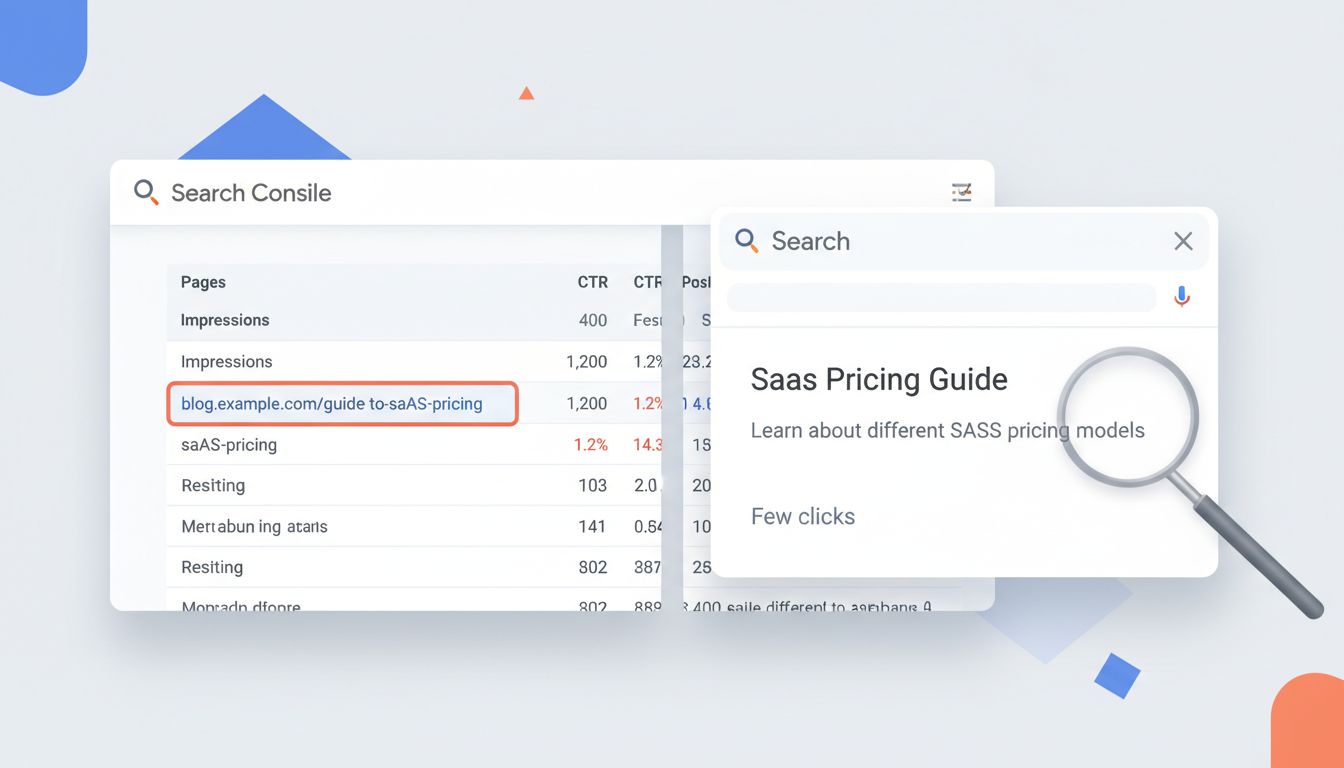
You're looking for pages with decent impressions but low Click-Through Rate (CTR) and average position below #10. Something like:
- Page:
/blog/guide-to-saas-pricing - Impressions: 1,200
- CTR: 1.2%
- Avg. Position: 14.3
This page is showing up in search results but nobody's clicking. The fix is almost always the title tag and meta description.
- Click on the page URL in GSC.
- Switch to the "Queries" tab. This shows the actual search terms driving impressions. Note the top 2-3.
- Craft a new, click-worthy title tag (under 60 characters) that includes the main query. Make it benefit-driven, not generic.
- Write a compelling meta description (around 150-155 characters) that clearly states what the user will learn or gain, and includes a primary keyword.
Example Rewrite:
- Old Title: Guide to SaaS Pricing
- New Title: SaaS Pricing Models: A 2024 Guide with Examples
- Old Meta: Learn about pricing your SaaS product.
- New Meta: Struggling to price your SaaS? We break down 7 models with real-world examples, formulas, and common mistakes to avoid. Get the guide.
Update these directly in your CMS. You'll often see CTR improvements within 1-2 weeks. Measurable wins, no new content required.
Step 3: Conduct Foundational Keyword & Intent Research (Weeks 3-4)
Now you can think about what to write. Most founders skip straight to "keywords with high volume." That's the wrong move.
You need to find keywords you can actually rank for, which requires an honest look at your Domain Rating (DR) versus the competition.
Here's the process:
- Gather Seed Keywords. Don't start with a tool. Pull 15-20 phrases from:
- Customer discovery calls ("What problem were you trying to solve when you found us?")
- Support ticket summaries
- Competitor homepage and blog title tags
- Cluster with a Tool. Input seeds into Ahrefs' Keywords Explorer and use the "Parent Topics" report, or use Semrush's Topic Research tool. This groups related terms and reveals core "pillar" topics alongside supporting "cluster" questions. Seeds like "SaaS pricing models," "how to price SaaS," and "SaaS pricing calculator" might all cluster under "SaaS Pricing."
- Classify Search Intent. For each cluster, manually Google the main phrase and look at the top 5 results. Are they:
- Informational (blog guides, "how-to" videos)?
- Commercial (comparison articles, "best X" lists)?
- Transactional (product pages, pricing pages)?
Your content has to match that intent. Writing a commercial "best tools" list when Google is showing transactional product pages is a guaranteed fail.
The Founder's Reality Check: Realistic Difficulty
Ignore the generic "Keyword Difficulty" score. You need to manually assess the SERP.
Say you find "SaaS pricing strategy" (Volume: 800, KD: 30) and you have a DR of 22. You click the SERP and the top 5 are HubSpot, Salesforce, and Close.com, all DR 70+. That "30 Difficulty" is a lie for you. That keyword is effectively impossible.
Your filter: For any keyword, check the Domain Rating (using Ahrefs' free Chrome extension) of the top 3-5 ranking pages. If they're all 30+ points above your DR, shelve it. Look for clusters where at least one or two ranking sites have a DR within 10-15 points of yours. Those are your realistic beachheads.
This moves you from generic keyword lists to a targeted, intent-mapped content blueprint based on what you can actually win.
Phase 2: Build Your Core Content Assets (Days 31-60)
You have a map now. This phase is where you build the actual landmarks that will attract your first real organic traffic.
Your goal isn't to publish 50 blog posts. It's to create 3-5 high-value, intent-matched pages that have a real shot at ranking and converting.
Step 4: Prioritize Using the 3-Factor Content Matrix
Forget the massive keyword spreadsheets. You need a ruthless prioritization filter. Plot every content idea on a simple mental grid with three axes:
- Search Intent Clarity: Can you definitively answer "What does the searcher want?" Is it informational ("how to"), commercial ("best X software"), or transactional ("buy X")? If the SERP is a confusing mix of blog posts, product pages, and videos, the intent is muddy, avoid it.
- Realistic Difficulty: Be brutally honest. Look at the Domain Rating (DR) of the sites ranking on page one in Ahrefs or Semrush. If they're all DR 70+ media giants and you're a DR 15 startup, you will not win that keyword in the next 90 days. Target SERPs where you see a mix of DRs, including sites you could realistically compete with.
- Business Value: Will traffic from this page actually matter? A post targeting "funny cat memes" might get traffic, but will those visitors ever become customers? Prioritize content that aligns with problem-aware or solution-aware stages of your customer's journey.
The sweet spot is the overlap of all three. These are your Phase 2 targets.
Step 5: Execute the Pillar & Cluster Model
Don't publish isolated articles. Build interconnected topic hubs.
- Pillar Page: Your cornerstone. A comprehensive, in-depth guide (aim for 2,000-3,000 words) targeting a broad, important topic for your business. For a project management SaaS, this might be "Agile Project Management."
- Cluster Content: Supporting articles that tackle specific, long-tail questions related to the pillar. They link to the pillar page. Examples: "Sprint Planning Template," "How to Run a Daily Standup," "Kanban vs. Scrum."
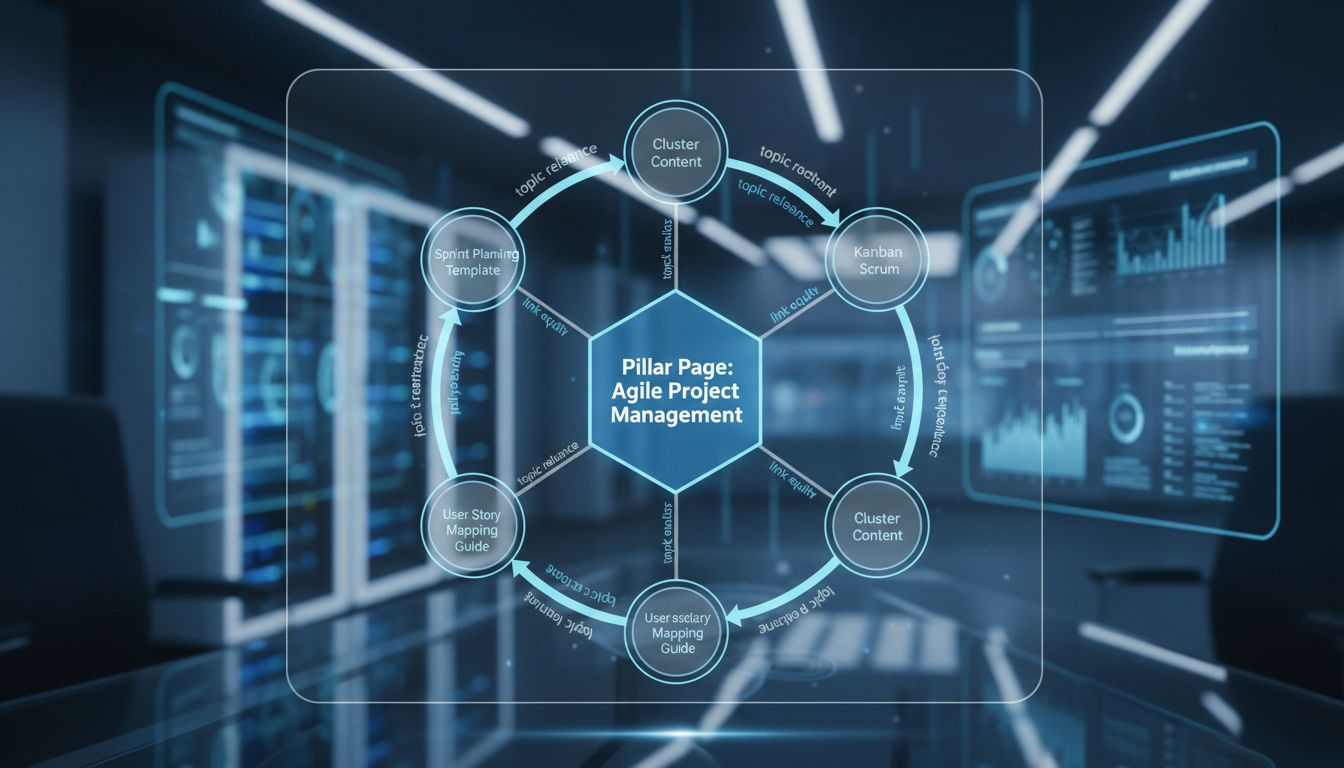
This structure tells search engines your pillar page is the definitive resource on the topic, funneling "link equity" (ranking power) from the cluster posts. Ahrefs found that a single high-ranking blog post can generate traffic for more than two years.
Start with one pillar and 3-5 cluster pieces. Use Ahrefs' "Parent Topics" or Semrush's "Topic Research" to find these natural topic groupings.
Step 6: Write with a Rigorous Content Brief
Never let a writer, or yourself, start with a blank page. A content brief is your spec sheet. It ensures every piece aligns with strategy before a single word is written.
Download our Founder's 1-Page Content Brief Template.
Your brief must include:
- Primary Keyword & Intent: The target phrase and a one-sentence description of the searcher's goal (e.g., "Learn the basic steps").
- Competitor URLs: 2-3 top-ranking pages to analyze. What are they doing well? What's missing?
- H1 & H2 Outline: The exact headline and subheading structure. This forces strategic thinking about content flow.
- Target CTA: What is the one action you want the reader to take? (e.g., "Sign up for a template," "Read related article X").
- Word Count Target: Based on competitor analysis and topic depth.
The most critical part?
The H1 and first 100 words must unmistakably signal the page's intent to both users and Google. Answer the query immediately.
Deep Dive: "Can ChatGPT Write SEO Content?"
The short answer is yes, but treating it as a final draft is a fast track to generic, low-EEAT content that blends into the ~17.31% of AI-generated content now on the web.
Your workflow should be hybrid:
- AI as Draft Engine: Feed your detailed content brief into ChatGPT, Claude, or a tool like Spectre. Use it to overcome the blank page, generate a structure, and produce a first-draft base. This saves hours.
- Human as Editor & Injector: This is non-negotiable. You must:
- Fact-Check: AI hallucinates. Verify every statistic, claim, and step.
- Inject EEAT: Add your first-hand experience. "In my last startup, we found that..." or "A common gotcha our clients face is..." This is what Google's E-E-A-T guidelines reward.
- Sharpen the Narrative: AI prose is often flat. Rewrite for voice, add contrarian points, and include concrete examples from your industry.
- Optimize On-Page: Add headers, meta descriptions, alt text, and internal links. AI won't do this strategically.
Google's Search Liaison has explicitly advised against publishing AI content without human oversight. Use AI for scale, but rely on human expertise for credibility and conversion.
The founder's unique insight is your unfair advantage, don't delegate it to a machine.
This is true for all website content writing for SEO, not just the pieces you're outsourcing or automating. The pages that rank long-term have a real person's fingerprints on them.
Your output this phase should be a small, powerful set of pages built on a clear strategy. Not 50 articles. Maybe five. Built right.
Phase 3: Activate Authority & Scale (Days 61-90)
You've built your core assets. Now you need to make them count.
This phase is about moving from creation to distribution. Turning those pages into authoritative hubs that search engines trust and users actually find.
The goal is to systematically distribute "link equity" across your site, earn your first meaningful external endorsements, and build a repeatable production system that doesn't eat your entire week.
Step 7: Implement Strategic Internal Linking
Open your site in a tool like Screaming Frog or run Ahrefs' Site Audit. Your first job is to find orphan pages, pages with no internal links pointing to them.
These pages are invisible to both users and crawlers. Complete waste of effort.
The principle is simple: internal links are votes. When you link from Page A to Page B, you're passing a small amount of authority and telling Google what Page B is about.
The most common mistake founders make is using generic anchor text like "click here" or "learn more." That's anchor text waste. You're spending a vote without telling Google anything useful.
Use keyword-rich, contextual anchor text within your body copy instead.
Here's your action plan:
- Map Your Hierarchy. For each pillar page, list all its supporting cluster posts.
- Link from Cluster to Pillar. In every cluster post, include 2-3 contextual links back to the main pillar page. Use anchor text that includes the pillar's primary keyword or a close variant (e.g., "our complete guide to B2B SEO").
- Link from Pillar to Clusters. Within your pillar page, link out to relevant cluster posts to help users go deeper and distribute authority.
- Fix Orphan Pages. For any important page with no inbound links, add at least one contextual link from a relevant, high-traffic page on your site.
This creates a "silo" where link equity flows to your most important commercial pages, boosting their relevance.
For an extra technical edge, consider implementing RelatedLink or SignificantLink schema markup, as recommended by SALT.agency, to programmatically signal these relationships to search engines.
Step 8: Earn Your First Meaningful Backlinks
Forget buying links or spammy directories. As a founder, your advantage is unique insight.
Backlinks are digital referrals. You earn them by creating something genuinely useful.
Focus on quality, not quantity. A single link from a reputable industry site is worth more than a hundred from low-quality directories. According to a Backlinko analysis, the top-ranking result has, on average, ~3.8x more backlinks than positions 2-10.
Execute these founder-friendly tactics:
- Build a Simple Tool. Create a free, useful tool related to your niche. A SaaS company for designers could build a font pairing generator. A marketing platform could create a content ROI calculator. Tools attract links naturally, as resources.
- Share Unique Data. Mine your own product data (anonymised and aggregated) for a surprising insight. "We analysed 10,000 marketing campaigns and found X." This is linkbait that only you can provide.
- Participate in Expert Roundups. Keep an eye on HARO or niche publications asking for expert commentary on your topic. A thoughtful, concise quote can get you a valuable link and real visibility.
The key is to create assets that answer a specific, common problem better than anything else out there.
Long-form content has a real edge here too, according to Backlinko's 2019 study, it receives ~77.2% more backlinks than short articles.
Step 9: Scale with a Hybrid AI-Human System
You have a proven framework now. You also have a company to run.
The research, briefing, drafting, and optimization for a single high-quality article can easily take 10+ hours. To scale beyond your 2-3 hours per week of strategic oversight, you need a system.
This is where a tool like Spectre becomes your execution engine. It automates the heavy lifting of Phases 1 and 2:
- Automated Research: It connects to data sources like DataForSEO to find and cluster keywords, identifying pillar opportunities and long-tail variations you'd miss manually.
- Intent-Aligned Briefs: It generates detailed content briefs for each piece, analysing the top SERPs to define structure, word count, and key questions to answer.
- First Draft Generation: It writes a comprehensive, SEO-optimised first draft based on the brief, complete with proper H2/H3 structure and keyword placement.
- On-Page Optimisation: It scores the draft against SEO best practices and suggests improvements for metadata, readability, and internal linking.
Your role shifts from writer to editor-in-chief. You apply the human judgment, real-world experience (EEAT), and final approval that AI lacks.
You're not removing yourself from the process. You're moving your focus up to strategy and quality control.
This matters for all website content writing for SEO, not just the stuff you're automating. The human layer is what separates content that builds trust from content that just exists.
While AI-generated content in Google Search grew from 2.27% in 2019 to 17.31% in 2025, and about two-thirds of it ranks within two months, trustworthy brands will win on the layer of human expertise on top. AI for scale and consistency. Founder insight for everything else.

By Day 90, you're not just publishing content, you're running a content engine. A small portfolio of powerful pages, a solid internal linking structure, the beginnings of a real backlink profile, and a system to produce more without it becoming your full-time job.
The Pre-Publish QA Checklist (Your Launch Protocol)
You've drafted the content. Before you hit publish, run through this. Missing one item can tank your page's performance before it ever ranks.
1. Readability Scan Open your page and skim it in 10 seconds. Do you see clear H2/H3 subheadings, short paragraphs, bulleted lists? If not, break it up. Google rewards scannable content.
2. Title Tag Check Your title tag needs to land around 55 characters. Put your primary keyword near the front. This is your single biggest click-through lever.
3. Meta Description Audit Write a 150-155 character meta description. Include your keyword and a clear reason to click, as in, "why this result and not the other nine?" Source: SalesHive.
4. Image SEO Pass
For every image: rename the file descriptively (e.g., website-content-seo-checklist.png), write alt text that describes what's actually in the image (no keyword stuffing), and compress it. Squoosh.app works fine, or use a WordPress plugin.
5. Internal Link Insertion Find at least one natural place to link to another relevant page on your site. Use descriptive anchor text like "our pillar page on keyword research." Not "click here."
6. On-Page Keyword Placement
Check that your primary keyword is in the H1, within the first 100 words, and shows up naturally a couple more times. Make sure your URL slug is clean too, /website-content-writing-seo, not /post-1234.
7. Mobile & Speed Preview Pull up the page on your phone. Does it load in under 3 seconds? If not, check Core Web Vitals. Poor scores can stop a page from ranking no matter how good the content is. Source: White Label Coders.
8. Final Human Read-Through Read the whole page out loud. Does it sound like a knowledgeable person wrote it? If any part feels like generic filler, rewrite it. This is your last EEAT gate before it goes live.
Measuring What Actually Matters: Founder-Centric KPIs
Most founders measure the wrong things and wonder why SEO feels like it's not working.
Early-stage SEO is about laying track, not arriving at the destination. Your KPIs should reflect that.
First, avoid the vanity metric trap. Don't obsess over Domain Authority or total keywords ranked in month one. Those are lagging indicators. They won't tell you what to do differently. Focus on these instead.
Early-Stage KPIs (Months 1-3):
- Pages Indexed (Google Search Console > Coverage). This is your first gate. Are your key pillar and service pages actually in Google's index? If not, nothing else matters.
- Keywords in Top 50 (GSC or your SEO tool). Moving from unranked to the top 50 is the first real win. Track your 5-10 priority keywords here.
- Organic Sessions (Google Analytics). Look for raw growth, even if it's 10 to 50 sessions. That's your content being found. That counts.
Growth KPIs (Months 4+):
- Impressions & CTR in Google Search Console. A rising impression count means Google is showing your page for more queries. CTR tells you whether your titles and meta descriptions are pulling their weight. Worth noting: Ahrefs found AI Overviews correlate with a ~58% CTR drop for top results, which makes position #1, or a featured snippet, more important than it used to be.
- Conversions or Marketing Qualified Leads (MQLs). Set up a simple goal in Google Analytics for demo requests, sign-ups, or contact form submissions from organic search. This is what website content writing for SEO is actually supposed to do.
For reporting, don't build custom dashboards from scratch. Use a pre-built template from Windsor.ai or Semrush.
Each month, answer three questions: What changed? Why did it change? What are we doing next? One page. That's it.
Your job isn't to report on SEO. It's to use data to grow the business.
Conclusion
SEO isn't about checking every box. It's about executing the right sequence for your resources.
The 90-day framework works because the order matters: foundation first, intent-aligned content second, authority building third. Reverse it and you'll spend months chasing keywords your site can't rank for yet.
Start with technical health and intent research. Build pillar assets that solve real problems. Then scale authority through backlinks and supporting content.
AI helps you draft faster, but your human expertise, your EEAT, is what actually makes website content writing for SEO rank and convert in 2026. [Source: Search Engine Land] There's no shortcut around that part.
Measure progress by realistic early-stage KPIs: pages indexed, keywords in the top 50, actual organic sessions. These prove ROI long before you crack page one for competitive terms.
Right now, pick one thing from Phase 1. Check your indexing in Google Search Console. Run a Core Web Vitals test. That's it.
If you look at Phase 3 and think "I can do the strategy, but I'll never have 10+ hours a week for research, drafting, and optimization", that's where Spectre comes in. It automates the heavy lifting of this framework: keyword research, AI-powered drafting, optimization. Your 2-3 hours of weekly strategy becomes a full-scale content engine. Your expertise guides it; the system executes it.
Frequently Asked Questions
What is content writing in SEO?
Website content writing for SEO is the process of creating useful, intent-matched content that search engines can understand and rank. It starts with keyword and competitor research, not typing. For founders, it's about building a scalable asset, not just filling a blog.
Can ChatGPT write SEO content?
Yes, but there's a real caveat. AI-generated content went from 2.27% of published content in 2019 to 17.31% in 2025 [Source: Semrush], and a lot of it does rank. But Google explicitly advises against publishing AI content without human review.
Treat ChatGPT like a draft engine. It's useful for ideation and structure. The human editing part, accuracy, EEAT signals, intent alignment, is not optional.
What is replacing SEO?
Nothing is replacing it. It's just changing shape. Traditional SERPs now compete with AI Overviews (which correlate with a 58% CTR drop for top results [Source: Ahrefs]) and chat-based answers.
Your content needs to be authoritative and well-structured enough to feed all of those interfaces. Matching user intent and providing real value matters more now, not less.
What is the golden rule of SEO?
Create for users first, search engines second. Keyword research, on-page optimization, link building, all of it exists to serve that one principle.
If your content doesn't solve a real problem for an actual person, no amount of technical optimization will make it stick long-term.
What is the 80/20 rule in SEO?
Roughly 80% of your organic traffic and conversions come from 20% of your content. That 20% is your intent-matched pillar pages and high-conversion service or product pages.
It's why depth and quality in those core assets matters more than publishing volume. Most content, 96.55% of it, per Ahrefs, gets zero Google traffic. More content isn't the answer.
What are the 4 pillars of SEO?
Technical SEO (crawlability, speed, indexation), On-Page SEO (metadata, headings, URL structure), Content SEO (keyword targeting, intent-matching, EEAT), and Off-Page SEO (backlinks, brand signals).
The 90-day framework maps to all four. Phase 1 is Technical and On-Page, Phase 2 is Content and On-Page, Phase 3 activates Off-Page authority.