May 30th, 2026
How to Write SEO Content: A Practical Step-by-Step Guide for Founders
 WD
WDWarren Day
What if all those blog posts you wrote did nothing?
Not "underperformed." Nothing. 96.55% of all pages get zero search traffic from Google. So statistically, most of what you've written is just... sitting there.
The problem isn't effort. It's that someone sold you a marketer's playbook when what you actually need is a founder's system.
You're probably the CEO or CTO of an early-stage B2B SaaS startup. Live product, paying customers, no marketing team. Someone told you to "do content marketing," you wrote a few articles, and the results were underwhelming at best.
Here's the thing: you don't need to become an SEO expert.
You need a process. One that uses competitor data and AI as force multipliers, not as substitutes for thinking. A high-quality SEO campaign can deliver an average ROI of 748% [Source: sagapixel.com], but only if you're executing systematically, not just publishing whenever you feel like it.
That's what this guide is for.
It's a founder-specific framework for learning how to write SEO content that actually ranks and converts. We'll start with diagnosing your domain's real starting point, move into targeting high-intent keywords, then get into a hybrid human/AI writing workflow that scales. The whole thing is built around business impact, not vanity traffic numbers.
Before You Start: The Founder's Prerequisites (Not a Deep Tech Stack)
First, strip away the intimidation. You don't need a marketing team or a six-figure budget.
You need three things:
- A live website you control, with admin access to your CMS (WordPress, Webflow, etc.). You must be able to publish and edit pages.
- Two to three hours of focused time per week. SEO is a compounding investment, not a one-off project.
- Basic business literacy, you understand your CAC, your LTV, and can explain what your product does.
Your technical skill ceiling is "can edit a webpage." No HTML. No JavaScript. No deep knowledge of Google's algorithm required.
For tools, start free. Get Google Search Console connected to your site. Run your URL through Google PageSpeed Insights, only 33% of sites pass Core Web Vitals, and pages that take more than 3 seconds to load see a 32% higher bounce rate. For keyword research, grab a free trial of Semrush or Ahrefs, or use a platform like Spectre that bundles this all together.
The goal here isn't becoming an SEO expert.
It's publishing one fully-optimised article that targets a real business opportunity and actually knowing how to write SEO content that does something. Pre-seed startups already get 20–40% of their traffic from organic search. You're not starting from zero, you're just making the process repeatable.
Step 1: Diagnose Your Domain's True Starting Point
Start by knowing where you actually stand.
Run a free backlink check on your domain using Ahrefs' Site Explorer or something similar. This gives you your Domain Rating (DR), basically a credit score for your site's authority. It goes from 0 to 100, and it's your main constraint when picking keywords to go after.
The rule isn't complicated: if your DR is below 30, don't target keywords with a Difficulty (KD) score above 30.
I've seen startups spend months writing content for KD 50+ keywords when their DR is sitting at 15. It's like showing up to a Formula 1 race in a family saloon. Targeting keywords beyond your current authority is the fastest way to waste time if you're learning how to write SEO content that actually ranks.
Next, run a quick technical health scan. Use something free like SEOptimer or your platform's built-in audit tool. It'll spit out 50+ warnings. Ignore most of them.
There are only three things worth fixing right now:
- Page load time over 3 seconds, pages above that threshold bounce 32% more than faster ones [Source: ClickRank.ai benchmarks], which hits conversions directly.
- Missing H1 or Title tags on your homepage and key product pages, 59.5% of sites have this problem, and it's basically telling search engines you have no main heading.
- Broken HTTPS/SSL configuration, redirect issues affect 95.2% of sites and can block proper indexing.
Missing alt attributes, minor redirect chains, schema markup, that's all fine to ignore for now.
For a new site with DR 20, chasing technical perfection has terrible ROI. Fix speed and basic structure first. Then go write something.
Step 2: Implement the ROI-First Keyword Research Method
Stop thinking about traffic. Start thinking about customers.
Search volume is the most dangerous vanity metric for founders. You'll pour time into a 10,000-volume keyword, rank for it, and get zero qualified leads.
The priority stack for early-stage B2B SaaS is simple: commercial intent first (bottom-of-funnel), then Keyword Difficulty below your domain rating plus 10, then your unique angle, can you actually give a better, more specific answer than what's already ranking?
First, find founder-gold keywords. Look where customers are nearly ready to buy. Think "alternative to [competitor]", "[your product category] for [your niche]", "[specific problem] solution". Don't just use keyword tools, mine competitor review pages, Reddit threads, LinkedIn groups. Real buying questions live there.
Open Ahrefs or Semrush. Filter for Keyword Difficulty below 30, long-tail keywords with KD under 30 drive 67% of total organic sessions for SaaS sites [Source: ClickRank.ai benchmarks].
Sort by "Keyword Difficulty", not "Volume". Scan for phrases with question words ("how", "what", "best") or commercial modifiers ("price", "alternative", "review").
Apply the 80/20 filter. For each keyword idea, ask: "If someone searches this, are they signaling they might need my product in the next 90 days?" If yes, it's in the 20% that will drive 80% of your early results.
Start there.
Here's the contrarian part: most tools' KD scores are inflated for low-DR sites. A reported KD 25 might be impossible if every page in the top 10 has DR 50+. Always cross-check by clicking "SERP Overview" to see the actual domain ratings of current ranking pages. If you're DR 20 and competing with DR 60 media sites, pick a different battle.
Example: "What is CRM?" has high volume but zero buying intent and brutal competition. "Best CRM for bootstrapped SaaS founders 2026" has lower volume, but the searcher is actively evaluating solutions. You can differentiate with pricing transparency, founder-specific workflows, or integration advice they won't find on generic review sites, which is exactly how to write SEO content that actually converts.
Your goal isn't to rank for everything. It's to rank for the few things that connect directly to your revenue.
Step 3: Reverse-Engineer Success with a Data-Driven Content Brief
Stop trying to write from scratch. Your goal isn't creativity, it's reverse-engineering what's already working.
Open the top five results for your target keyword and start taking notes.
First, document the basics. Note the average word count, informational pages ranking well tend to run 1,800–2,400 words, while transactional pages hit 800–1,200 words [Source: ClickRank.ai]. Match or exceed that by 10%. Copy their H2/H3 structure as your outline skeleton. Identify the primary keywords they're targeting and what format they're using: list, guide, comparison.
Check for structured data too. 67% of pages ranking in positions 1–3 now use FAQPage Schema [Source: ClickRank.ai]. If your competitors use it, you need it.
Here's a real example from analyzing "best project management software for startups":
Target Word Count: 2,100
Common H2s: "What Makes Good Startup PM Software?", "Key Features to Look For", "Top 5 Tools Compared", "Implementation Tips"
Schema: FAQ markup in 4 of top 5 results
Missing: Real pricing breakdowns, founder-specific workflow examples
That last line is your opening.
Find where the top pages go shallow, no real-world data, no founder perspective, no practical implementation. That's where you add something they can't match: a mini-case study from your own experience, unique usage data, or the technical "why" behind a recommendation.
Build your execution brief around these fields:
- Primary & Secondary Keywords
- Target Word Count (±10% of SERP average)
- Target H2 Structure (list them verbatim)
- Unique Angle/Contribution (what's missing that you'll add)
- Target URL (for internal linking)

Don't do this manually. Tools like Gumloop's SEO Content Brief Generator or Spectre's brief feature automate the SERP scraping and analysis. That's 30+ minutes saved per piece, and you're building from data instead of guessing.
The brief isn't a suggestion. It's the spec. And knowing how to write SEO content that actually competes starts here, before you write a single word.
Step 4: Execute the Hybrid Human/AI Writing Workflow
The brief is done. Now you write.
Think of AI as a co-pilot handling the grunt work, research, structure, first draft. You're still the pilot. You steer strategy, inject expertise, and make sure the final thing doesn't read like it was generated at 2am by a robot.
1. Input Your Brief, Generate the Draft
Open your AI tool, Spectre, ChatGPT with advanced prompting, or whatever you're using. Paste the complete brief from Step 3: target keywords, SERP analysis, competitor gaps, your unique angle. Run the generation.
2. Perform the 'Founder's Edit'
This is where actual value gets created. AI drafts are competent but generic. Your job is to inject what they lack:
- Temporal context: Add "now," "currently," or "in 2026." AI often writes like nothing has a timestamp.
- Specific expertise: Replace generic advice with a real workflow from your product. Name the tools you use, the friction you've actually seen, the "gotcha" that cost you two hours last Tuesday.
- Contrarian points: AI avoids strong opinions. Add one. If everyone says "do X," explain why you sometimes do Y and what the trade-off is.
- Customer pain points: Weave in verbatim quotes from support tickets or sales calls. Immediate relevance.
3. Sharpen the Intent-Driven CTA
AI-generated calls-to-action are weak. Rewrite it. If the keyword is "best CRM for startups," the CTA should be a direct, low-friction path to trying yours, not "learn more." Match the action to the search intent.
The data backs this up. AI content users reported a median year-over-year growth rate of 29.08% versus 24.21% for non-AI users, and 75.7% of marketers use AI for brainstorming. The ones winning use it for ideation and drafting, not for hitting publish on raw output.
Writer's Trust Caveat: For core product claims or YMYL topics, financial advice, health, legal, pure AI content is a brand and trust risk. Your expertise in the final edit isn't optional. This isn't about tricking Google. It's about using a force multiplier to scale your own insight, which is the whole point of knowing how to write SEO content that actually holds up.
Step 5: Run the 10-Minute Pre-Publish Optimization Checklist
Content's written. Before you hit publish, run through this. Ten minutes. It catches the on-page issues that kill ranking potential for most pages.
-
Craft your title tag for clicks, not just keywords. Include your primary keyword, keep it under 60 characters, and front-load the benefit. Google rewrites title tags 33.4% of the time, but a clear, compelling one gives it less reason to.
-
Write your meta description last. Aim for 150-160 characters. Include your keyword and a clear value proposition. Google rewrites these 62.78% of the time anyway, but a strong one at least sets the right expectation.
-
Verify your URL slug. Short, primary keyword included, hyphens only (e.g.,
/best-crm-bootstrapped-saas-founders). No underscores, no stop words. -
Check your headers. H1 must contain the primary keyword. Scan your H2s and H3s for semantically related terms. Confirm your keyword shows up naturally within the first 100 words and again in the conclusion.
-
Add descriptive ALT text to every image. Missing alt attributes are a problem on 80.4% of sites. Don't just leave "image123.jpg" sitting there. Describe what the image actually shows in context.
-
Implement FAQ Schema if applicable. If your article answers specific questions, use your CMS plugin (Yoast, Rank Math) to add FAQPage Schema. Takes two minutes. 67% of pages ranking in positions 1-3 now use it.
-
Insert 2-3 relevant internal links. Link to older, authoritative posts on related topics. Distributes page authority and keeps readers moving through your site.
-
Compress images for speed. Run them through Squoosh.app or ShortPixel. Pages that load above 3 seconds bounce 32% more. Check visual load time with Google PageSpeed Insights.
That's it. This is the difference between a page that ranks and one that joins the 96.55% getting zero traffic, and if you're serious about how to write SEO content that actually performs, this checklist is non-negotiable.
Step 6: Monitor, Refine, and Scale the System
Publishing isn't the finish line. It's the first checkpoint.
First, set your expectations. Mark your calendar three months out. Initial traffic will likely be zero, that's normal. New content typically takes 3-12 months to reach peak ranking, and only 5.7% of pages rank in the top 10 within a year. Check rankings monthly, not weekly. You'll burn out otherwise.
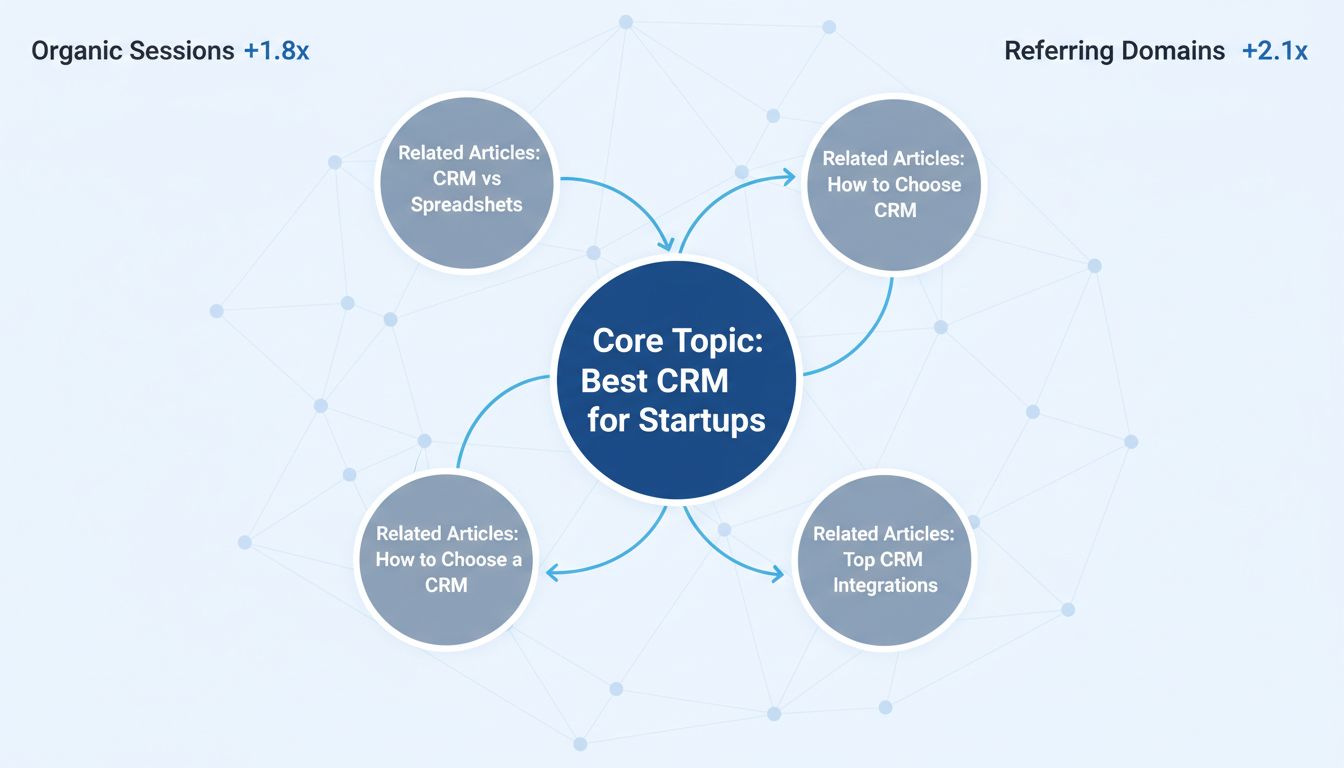
First scaling rule: build topic clusters, not random articles. Take your single best-performing topic from Step 2, the one with the clearest commercial intent and achievable difficulty. Write three or four more pieces that orbit that core topic and link them together in a hub-and-spoke structure. This signals topical authority to Google far more effectively than scattered posts. Publishing 4+ articles per month within a topical cluster yields 2.1× more referring domains and 1.8× more organic sessions.
Second rule: refresh, don't just create. Every six to twelve months, audit your content. Look for pages getting steady traffic but poor conversion, or ones slipping from position 4 to 7. Update them with new data, fresher examples, a stronger call-to-action. This maintenance often delivers more value than writing something new from scratch.
Watch one metric above all others: organic conversions. In Google Analytics 4, set up a conversion goal for trial signups, demo requests, or contact form submissions coming from organic search. Traffic is vanity. This is sanity.
Once you have five to ten articles consistently generating qualified leads, reinvest. Commission a unique data report to attract journalist links, or run technical audits to fix Core Web Vitals. Scale what's already working.
That's how to write SEO content that compounds, you build the system once, then you tend it.
Common SEO Content Mistakes That Kill Founder Results
Most of these mistakes are avoidable. That's what makes them so frustrating.
Chasing top-of-funnel traffic volume. You see a keyword with 10,000 monthly searches and think "that's the one." But if the intent is purely informational, you're attracting people with zero interest in buying anything. For an early-stage startup, that's vanity metrics, not customers. Focus on bottom-of-funnel, high-intent keywords first.
Publishing thin content. You cannot out-fluff an expert. For informational queries, the top-ranking pages are typically 1,800-2,400 words [Source: clickrank.ai/seo-benchmarks]. Publishing a 500-word "guide" because it's faster signals to Google that you have less to say than your competitors. Match the depth the SERP demands.
Ignoring page speed and Core Web Vitals. Pages loading above 3 seconds bounce 32% more than those under 2 seconds [Source: clickrank.ai/seo-benchmarks]. You're losing a third of your potential audience before they read a word. Run Google's PageSpeed Insights and fix the critical issues. It's technical debt that directly costs you traffic.
Setting and forgetting. Publishing a post and never looking at it again leaves a lot of value on the table. Only 5.7% of pages rank in the top 10 within a year of publication [Source: ahrefs.com/blog/seo-statistics]. Monitor performance, update old posts with new data, and build internal links over time.
Relying solely on raw AI output. AI is a useful force multiplier for research and drafting. But unedited, generic AI content lacks the Experience, Expertise, Authoritativeness, and Trustworthiness signals Google increasingly rewards. It loses to human-augmented content that has a real point of view.
Trying to do everything. You're a founder, not an SEO agency. The goal isn't to master every technical nuance, it's to execute the 20% of actions that drive 80% of the results. That's what knowing how to write SEO content actually means in practice: focus on what moves the needle, delegate or ignore the rest until you have proven traction.
Conclusion
So what does all of this actually add up to?
Knowing how to write SEO content as a founder isn't about becoming an expert. It's about building a system you can repeat. One that starts with an honest read of your domain's authority, targets keywords you can actually win, and works backward from the SERPs you're trying to beat.
The hybrid human/AI workflow keeps execution manageable. The ten-minute pre-publish checklist catches the technical stuff before it quietly kills your rankings.
Then you wait. New content typically takes 3–12 months to reach peak ranking [Source: cactusmarketing.io]. Staying consistent within topic clusters builds authority faster than publishing random posts and hoping something sticks.
Treat your next post as a system test. Don't aim for perfect. Run one full cycle: diagnose your domain, pick one keyword, brief from the SERPs, write with AI-assist, optimize, publish, monitor.
If it works, do it again.
To scale, tools like Spectre can handle the research, briefing, and writing pipeline so you're not doing everything manually. That frees you up to focus on your product and customers, which is where your time should be going anyway.
That's the sustainable SEO engine. Not a content sprint. A process.
Frequently Asked Questions
How to write good content for SEO?
Start with a data-driven brief from SERP analysis, not a guess about what feels right. You need the right length for the search intent, informational topics typically want 1,800–2,400 words, transactional pages perform better at 800–1,200 words [Source: clickrank.ai].
The final piece needs a clear structure with keyword-rich headers, EEAT signals like actual founder insights, and a direct conversion path. Generic information doesn't cut it anymore.
What is the 80/20 rule for SEO?
80% of your qualified leads will come from 20% of your content. Specifically: bottom-of-funnel, high-intent keywords.
Put most of your early effort into those. Things like "[your product] alternative" or "solution for [specific pain point]." Only 20% of your resources should go to top-of-funnel, brand-building content.
Business impact over raw traffic. That's the priority order.
Is SEO dead or evolving in 2026?
Evolving. The core principles, understanding searcher intent, building authority, haven't changed. But tactics have shifted toward multi-modal search (AI answers, video) and stronger EEAT signals.
Google now rewrites title tags 33.4% of the time and meta descriptions 62.78% of the time [Source: ahrefs.com]. So knowing how to write SEO content that holds up under that kind of interference matters more than it used to.
Generic content just doesn't work here.
Can ChatGPT write SEO articles?
Yes, but not on its own. LLMs like ChatGPT are good co-pilots for brainstorming and drafting from a detailed brief. Pure AI output almost always lacks the Experience and Expertise signals Google is looking for.
The workflow that actually works is hybrid: AI for ideation and first drafts, then a human editor, ideally the founder, adds unique insights, current context, and a call-to-action that AI can't authentically replicate.