June 22nd, 2026
Search Engine Optimization for Small Businesses: The Complete AI-Powered Guide
 WD
WDWarren Day
Here's the thing nobody tells you: both headlines are wrong.
"AI Overviews are Killing SEO!" versus "AI is the Ultimate SEO Savior!" are two flavors of the same overreaction. The actual situation is messier, and honestly, more workable than either camp wants to admit.
Yes, Google's AI Overviews reach 2 billion monthly users. That's not nothing. But search engine optimization for small businesses isn't dead, it's just different now. The answer-first nature of AI search means a smart hybrid approach matters more, not less.
What does hybrid mean here? You use AI tools to handle the tedious, repetitive execution work, while human judgment drives the strategy. Relevance, expertise, technical health, those don't get automated. The keyword research and content drafts? Those can be.
86.07% of SEO professionals are already using AI in their workflows. So the question isn't whether to adopt it. It's how to do it without blowing your budget or accidentally getting penalized.
If you've gotten a quote from an seo company for small business and nearly choked on the number (agencies often start at $1,000/month), this is for you. There are affordable seo tools and seo packages for small business that actually work, you just need to know where to look and what to do first.
This guide skips the hype. What you're getting is a clear 90-day action plan, a practical tool stack broken down by budget, an ethical framework for AI governance that keeps you out of spam territory, and a systematic method to automate research and content without gutting your credibility.
Affordable seo for small business is real. Search engine marketing doesn't have to cost a fortune. But it does require a plan, and that's what this is.
The ROI Reality: Is SEO Worth It for Small Businesses in 2026?
Is SEO actually worth it for small businesses, or is it just something agencies say to sell seo packages for small business? The numbers are pretty hard to ignore.
Nearly seven in 10 companies report better returns after integrating AI into SEO and content workflows [Source: https://semrush.com/blog/ai-seo-statistics]. That's not a marketing claim. That's from businesses that actually did the thing.
Coalition Technologies has case studies where a dentist's revenue grew fourfold, and a fashion ecommerce brand pulled in over $6 million in additional revenue [Source: https://coalitiontechnologies.com/blog/understanding-the-roi-of-seo-in-the-ai-era]. There's also an Australian meal-delivery company that hit a 91% increase in monthly organic revenue within eight months, 169 AI citations, zero spend on link building [Source: https://rankmax.com.au/case-studies/ecommerce-ai-seo-case-study].
These aren't vanity metrics. This is high-intent lead generation that compounds over time, unlike ad spend, which stops the second you stop paying.
So the question for search engine optimization for small businesses isn't really "does it work." It's "can I execute it without burning through my budget or the next six months of my life."
You're basically choosing between three approaches:
| Approach | Time Investment | Cost | Control |
|---|---|---|---|
| DIY SEO | High | Low | Full |
| Agency | Low | High | Limited |
| Hybrid | Medium | Medium | High |
The hybrid model makes sense for most small businesses. You use affordable seo tools like Spectre for execution, bring in a fractional consultant for strategy, and sidestep the $1,000+ monthly quotes you get when searching for an seo company for small business, without stumbling through months of trial and error on your own.
But here's the thing most people skip over: your Domain Rating (DR) dictates your entire strategy. If your site is at DR 32, going after keywords owned by DR 90+ publishers is pointless.
You need "winnable" keywords. Think service + city combinations where local intent matters more than domain authority. That's where affordable seo for small business actually starts working.
And manage your expectations. An early win in search engine marketing isn't ranking for "best plumber in London." It's ranking for "emergency plumbing repair in Croydon" and getting 2–5 extra qualified calls per month within four to six months.
That's the real ROI. Incremental, measurable, and it builds from there.
Core Components You Can't Ignore: The Foundational Pillars
AI can generate content and suggest keywords. It cannot fix a broken technical foundation.
Before you think about keyword strategy or AI workflows, you need to sort out the mechanical health of your site. This is the boring, non-negotiable work that separates businesses getting sustainable traffic from ones wasting time chasing trends.
For a small business, your crawl budget is precious. It's the finite amount of attention Google gives your site. Generate hundreds of thin AI pages without fixing core issues first, and Google burns through its crawl resources indexing rubbish instead of your actual service pages.
You're competing against yourself.
Here's the foundation checklist to complete within the first 30 days. The tools are either free or have free tiers, which matters, given the "affordable SEO tools" barrier most small businesses run into [Source: businessresearchinsights.com].
1. Set up Google Search Console (GSC) and GA4. This isn't optional. GSC tells you what Google sees: which pages are indexed, what queries bring impressions, what errors are blocking indexing. GA4 gives you the user side, traffic, conversions, behaviour. Without this baseline, you can't measure progress or diagnose problems. Benchmark your rankings, traffic, and lead sources immediately.
2. Run a free site audit. Use Ahrefs Webmaster Tools, Moz's free tools, or the limited free crawl of Screaming Frog. This flags crawl errors, broken links, and redirect chains. Fix them. A single broken link on your homepage can signal poor site health to search engines.
3. Submit an XML sitemap. It's a file listing all your important pages. Submit it in GSC. Direct map for search engines, tells them what to index. For a small site, this takes minutes.
4. Run Core Web Vitals on your top pages. Use Google's free PageSpeed Insights. Loading speed, interactivity, visual stability, these are direct ranking factors. For most small business sites the fixes aren't complicated: compress images (Squoosh or a WordPress plugin), add lazy loading for below-the-fold images, defer non-critical JavaScript. Slow sites lose rankings and conversions.
5. Add basic schema markup.
Put Organization and LocalBusiness structured data on your homepage and key service pages. It's not magic. But it helps search engines, and increasingly, AI models, understand your business type, location, and services clearly. Missing it means leaving contextual clues off the table.
One common mistake worth calling out: accidentally blocking search engines in your robots.txt file. Blocking Bingbot specifically can kill your visibility in Microsoft's ecosystem, which matters more now with AI search. Always check this file.
Writer's note: If you're technically inclined, you can automate these audits. Tools like Spectre connect to the Ahrefs and Google Search Console APIs via MCP (Model Context Protocol), running scheduled health checks and alerting you to new issues. Turns a monthly manual chore into a monitored system.
This foundation work isn't exciting. But it's what lets everything else, your content, your local listings, your search engine optimization for small businesses strategy, actually function.
A site with crawl errors and slow pages is building on sand.
Keyword Strategy and Content Creation in the AI Era
Here's the shift that changes everything: you're not just trying to rank on page one anymore. You're trying to be the source an AI cites.
Google's AI Overviews now appear in 18.76% of US search results [Source: genesysgrowth.com/blog/ai-overviews-trends-for-marketing-leads-for-marketing-leaders]. Getting cited inside one of those is often worth more than the #1 organic result.
So your keyword strategy has to be realistic about what you can actually win.
Forget chasing "best plumber in London." For search engine optimization for small businesses to actually work, you need terms you can compete for. Start by identifying 20–50 target terms, grouped by service, city, and intent. Like this:
| Service | City | Intent (Question/Problem) |
|---|---|---|
| Emergency boiler repair | Manchester | "boiler leaking water what to do" |
| Kitchen installation | Leeds | "cost to install a new kitchen" |
| Bathroom renovation | Sheffield | "how long does a bathroom remodel take" |
The filter is your Domain Rating (DR). If you're under 30, competing against DR 50+ sites on broad terms is a waste of time. Target specific, problem-oriented queries where you can show clear, useful expertise.
For content, the workflow that works is hybrid. Use an AI-powered tool like Spectre or Frase to analyze what's ranking, what People Also Ask questions are showing up, what structure the top results use. Then draft with AI, but do one specific thing: write your H2 headings to answer those PAA questions word for word. That's how you target featured snippets and AI citations directly.
The AI handles the draft. You inject the expertise.
Client stories, verified local regulations, photos of actual work, real FAQs from real customers. That human layer is what builds E-E-A-T. Without it, you're generating pages that add nothing, which risks running into Google's spam policy on scaled content abuse [Source: searchengineland.com/guide/ai-generated-content].
Once the draft is done, run it through an on-page optimizer like Surfer SEO to check keyword signals and content length against competitors.
Then do the internal linking. Every new piece should link to 3–5 existing pages using descriptive anchor text. Every existing page should link back to at least one new piece. That creates a topical mesh that builds authority across the whole site, not just individual pages.
One distinction worth keeping clear: search engine optimization tools handle the execution side of things, while search engine marketing (SEM) is the paid channel, buying ads for immediate traffic. They're not the same thing. SEO is the long-term asset you own. Affordable seo tools like Surfer or Frase make the process faster, but they don't do the thinking.
The thinking is what makes your content worth citing. No tool replaces that.
Whether you're working with an seo company for small business, buying seo packages for small business, or doing it yourself with affordable seo for small business options, the logic is the same: real expertise on the page, structured so AI can find and cite it.
The Local & Trust Flywheel: GBP, Citations, and Structured Data
For local businesses, your Google Business Profile isn't just a listing. It's how AI systems verify you exist.
Google AI Overviews and AI Mode pull business information directly from GBP listings [Source: https://brightlocal.com/learn/ai-and-local-search-tips]. That makes it your most important asset for search engine optimization for small businesses right now.
Your first month of work should start here. Claim your GBP if you haven't, then go through this checklist:
- Upload high-quality photos of your premises, team, and work
- Select every relevant service category (don't just pick "Plumber", add "Emergency Plumbing Service", "Water Heater Installation")
- Fill all attributes (Wheelchair accessible, Free estimates, Family-owned)
- Post regular updates (service offers, seasonal tips, completed projects)
- Enable messaging and booking if applicable
- Set up a simple review request workflow (email clients after service completion)
Next, audit your citations. NAP consistency, your Name, Address, and Phone number appearing identically across directories like Yelp, Yellow Pages, or industry-specific sites, is a basic trust signal.
An inconsistency tells search engines your business information might not be reliable. Use search engine optimization tools like BrightLocal's Citation Builder or Whitespark to check your top 20 citations and fix what's off [Source: https://whitespark.ca/listings-service].
Structured data is the other piece. LocalBusiness, GeoCoordinates, and FAQ schema give AI models a standardized way to read your hours, location, and services [Source: https://searchenginejournal.com/how-to-use-schema-for-local-seo-a-complete-guide/294973]. It doesn't replace your GBP listing. It supplements it. Implement it on your key service pages.
These elements work together. An optimized GBP, consistent citations, and a steady stream of real reviews builds local ranking. Higher ranking drives more visibility, more customer interactions, more reviews. The cycle compounds.
That's what makes your business more likely to show up in AI Overviews when someone searches "emergency plumber near me."
The common mistake is treating this as a one-time setup. It's not. New photos every quarter, regular posts, citation audits twice a year, structured data updates when your services change.
Whether you're working with an seo company for small business, using seo packages for small business, or handling it yourself with affordable seo for small business options and affordable seo tools, this maintenance loop is what separates businesses that appear in local search from ones that don't.
The flywheel only works if you keep it spinning. Search engine marketing can buy you short-term visibility, but this local trust infrastructure is the asset you own long-term.
AI-Powered SEO: A Practical Tool Stack and Workflow by Budget
Local trust flywheel running? Good. Next question is execution. How do you actually produce content at scale without it becoming a second full-time job? This is where AI-powered workflows stop being theoretical and start being the whole point.
Nearly 46% of SMEs say high subscription costs are their biggest barrier to AI SEO adoption, yet this market is projected to hit $2.43 billion in 2026. The gap isn't tool availability. It's picking the right combination for your budget.
Most small businesses make one of two mistakes. They either buy every tool that promises AI magic (tool sprawl), or they avoid all tools because the pricing feels paralyzing.
The fix is a systematic workflow built around 3-4 core tools that actually talk to each other. Think assembly line: keyword opportunity triggers research, AI drafts with constraints, humans edit for nuance, automated publishing handles the rest.
Budget tier matters here. You don't need Ahrefs' enterprise suite if you're targeting 50 local keywords, but Google Keyword Planner alone won't give you the competitive picture you need for search engine optimization for small businesses.
Tool Stack by Budget Tier
| Task | Free/Cheap Tier | Mid-Tier ($50-150/month) | Best-in-Class (If Budget Allows) |
|---|---|---|---|
| Keyword Research | Google Keyword Planner, AnswerThePublic | Ubersuggest, Semrush Guru (limited) | Ahrefs Lite, Semrush Pro |
| Content Creation/Optimization | ChatGPT, Claude | Spectre, Frase, Surfer SEO | MarketMuse, Clearscope |
| Technical Audit | Google Search Console, PageSpeed Insights | Screaming Frog (paid), Ahrefs Webmaster Tools | Sitebulb, DeepCrawl |
| Local SEO | Google Business Profile, Moz Local Check | BrightLocal Pro, Local Falcon | Whitespark, Yext |
Here's what most agencies won't say out loud: tool sprawl kills ROI faster than any algorithm update. I've watched businesses run six different "AI SEO" subscriptions that don't connect to each other, creating more manual work than they started with.
Your stack should integrate via Zapier or native APIs. Keyword research flows into content briefs, briefs trigger your AI writer, drafts land in your CMS for human review. That's it.
Take content creation as an example. The free tier (ChatGPT) means you're manually researching SERPs, structuring outlines, and prompt engineering every article yourself. Mid-tier affordable SEO tools like Spectre pull SERP data, analyze top-ranking content, generate optimized drafts, and handle publishing.
The human role shifts from writer to editor. You add the unique expertise, the client anecdotes, the brand voice that AI can't replicate.
For local businesses using seo packages for small business, the integration between your GBP dashboard and citation tools matters more than any single feature. BrightLocal Pro pushes business updates to directories automatically. Whitespark is better for manual citation cleanup when you need precision over speed. Pick based on whether you need automation or accuracy.
The gap I see most often? Measurement. Only 19% of organizations track KPIs for generative AI. If you're running affordable SEO for small business workflows with AI tools, track content production time (should drop), ranking velocity for new pages (should climb), and AI citation rate in tools like Bing's AI Performance dashboard.
The workflow looks like this in practice. Monday, your keyword tool flags "tankless water heater installation cost" as an opportunity. Tuesday, your AI content platform drafts it with H2s pulled from People Also Ask. Wednesday, you spend 30 minutes adding job photos and three client testimonials. Thursday it publishes with schema. Friday you check Search Console.
Whether you're working with an seo company for small business or running search engine optimization tools yourself, this is how the execution actually works. Machine efficiency doing everything repeatable. You doing everything a machine can't.
That's how small businesses compete in search engine marketing right now: you own the strategy, the workflow handles the volume.
AI Governance: Ethical Use, Risk Mitigation, and Authority Building
The workflow isn't about replacing humans. It's about automating everything except what only you can provide.
That's how search engine optimization for small businesses works in 2026: machine efficiency executing human strategy. But that strategy needs guardrails. Using AI without governance is like handing someone a power tool with no instructions. Eventually, something breaks.
Search engines have been pretty clear about where they stand. Google says it doesn't penalize content just because AI wrote it, but it explicitly flags bulk-generating pages without adding value as a spam policy violation. [Source: https://searchengineland.com/guide/ai-generated-content] Bing's updated Webmaster Guidelines focus on "grounding, citations, and whether content adds value." [Source: https://writtenlyhub.com/news/bing-geo-webmaster-guidelines-ai-search]
The common thread isn't about the tool. It's about the outcome. Does this page actually help someone?
The red flags are obvious once you see them: bulk-generating hundreds of near-identical service pages across different cities, hiding affiliate links inside AI-written reviews, creating "expert" author bios for people who don't exist. These aren't just bad SEO. They're business risks that can destroy your domain's trustworthiness.
The green flags define the hybrid sweet spot. Use AI for ideation, research, first drafts, meta descriptions, summarizing complex data. Reserve human effort for injecting real expertise, original analysis, fact-checking, and the final polish that makes content sound like it came from your business.
Google specifically recommends human editing of AI-written content for this reason. [Source: https://searchengineland.com/guide/ai-generated-content]
Here's a practical prompt template that positions AI as a research assistant, not a ghostwriter:
"Act as a research assistant. Analyze the top 5 SERP results for [keyword]. Identify the 3-5 most common H2 headings, key data points or statistics cited, and one angle missing from all of them. Output a structured outline with [number] sections, suggesting where original data, local case studies, or contradictory evidence could add unique value."
This gives you an outline you own and expand on. Not generic text you have to fact-check from scratch.
Monitor what's working. Bing Webmaster Tools has an AI Performance dashboard that tracks how often your pages get cited in AI-generated answers. [Source: https://writtenlyhub.com/news/bing-geo-webmaster-guidelines-ai-search] That's a direct signal of whether AI systems see your content as credible. It's a leading indicator for future visibility, which is worth paying attention to.
The most common mistake? Assuming AI output is publication-ready. It's not.
Treat every AI draft like a first draft that has to pass through a human gatekeeper who adds experience, catches inaccuracies (AI is notoriously bad with local specifics), and makes sure it lines up with your actual business goals.
From an agency perspective, the model that works for most small businesses is a fractional consultant at 5-10 hours per month handling strategy and quality control, paired with affordable SEO tools handling execution. Whether you're using search engine optimization tools yourself or working with an seo company for small business, this keeps costs manageable while making sure the output builds authority, not just page count.
Affordable SEO for small business only works if what you're producing is actually good. That's what separates seo packages for small business that compound in value from ones that just generate noise.
Authority in the AI era comes from being a consistently cited, accurate source. In search engine marketing terms, that's a reputation you can't automate. But you can build it systematically.
A Content Hub and Internal Linking Model for Small Sites
Most small business websites are flat and disconnected. A homepage, a few service pages, maybe a blog that hasn't been touched in two years.
That structure confuses search engines. It also doesn't signal to anyone that you know what you're talking about.
To compete with larger domains, you need an architecture that shows topical authority and moves link equity to the pages that actually matter. Think of it as a hub-and-spoke system. For a local plumber, it looks like this:
[Homepage] (H1 - Core Hub)
|
├── [Plumbing Services] (H2 - Pillar Page)
│    ├── [Emergency Leak Repair] (H3 - Cluster Page)
│    ├── [Bathroom Installation] (H3 - Cluster Page)
│    └── [Drain Unblocking] (H3 - Cluster Page)
│
└── [Blog / Resources] (H2 - Supporting Content)
     ├── [How to Fix a Dripping Tap] (H3 - Blog Post)
     └── [Winter Plumbing Checklist] (H3 - Blog Post)
Your homepage is the authority hub. Each major service category becomes a pillar page. Individual service pages are cluster pages that go deep on specifics. Blog posts answer related questions and prop up the commercial pages.
The linking rules are mechanical. Each cluster page links back to its parent pillar with descriptive anchor text like "our plumbing services." It also links to 2-3 other relevant cluster pages, an emergency repair page might link over to bathroom installation. Each new blog post should link to 3-5 existing service or pillar pages as recommended in the foundational research.
And when you publish something new, go update existing pages to link to it. That part most people skip.
This creates a closed loop. PageRank flows from your strongest pages down to your detailed commercial pages, while blog content feeds relevance signals back up. For search engine optimization for small businesses, this matters more than almost any other structural decision you'll make.
Google's AI Overviews need to understand entity relationships to surface your business. A clear hub-and-spoke model tells them: this business is the authority on plumbing. You're not just building pages. You're building something machines can actually read and make sense of.
That's the part affordable search engine optimization tools can help you audit and maintain, but the architecture itself has to be intentional from the start. No seo company for small business or seo packages for small business can fix a site that's built without this foundation. Search engine marketing only compounds when the structure underneath it is solid.
Your 90-Day AI-SEO Implementation Plan
Where do you actually start? That's the real question. Most small businesses have limited time, tight budgets, and no patience for plans that don't show results. So here's a week-by-week framework that builds the foundation first, then creates content, then measures what's working.
Month 1: Foundation & Audit
Weeks 1-2: Technical Setup
- Day 1-3: Set up Google Search Console and GA4. Benchmark current rankings, traffic, calls, and form submissions right away.
- Week 1: Run free audits with Ahrefs Webmaster Tools, Moz, or Screaming Frog's free tier. Fix critical crawl errors, broken links, and redirect chains. Submit your XML sitemap.
- Week 2: Claim and optimize your Google Business Profile. Audit your top 20 citations for NAP (Name, Address, Phone) consistency using BrightLocal or Whitespark's free tools.
Weeks 3-4: Core Optimization
- Week 3: Run Core Web Vitals on your top 3-5 pages via PageSpeed Insights. Address image compression, lazy loading, and deferred non-critical JavaScript. Add basic structured data:
LocalBusinessorOrganizationschema to your homepage. - Week 4: Identify 20-50 realistic keywords grouped by service, location, and intent. Use a simple spreadsheet or free rank tracker to establish your baseline.
Month 2: Initial Content & On-Page
Weeks 5-6: Cornerstone Content Create 2-3 cornerstone service pages using the AI-human workflow from Section 6. Each page should target one primary commercial keyword, include clear H2s that answer People Also Ask questions verbatim, and contain FAQ schema where appropriate.
Weeks 7-8: Blog Content Creation Produce 2-3 FAQ-focused blog posts targeting informational queries your customers actually ask. Use AI to research and draft, then inject specific local examples, case studies, or photos that show your expertise.
Week 9: Internal Linking Implementation Apply the hub model from Section 7. Link each new piece of content to 3-5 existing pages with descriptive anchor text. Make sure each existing service page links to at least one new blog post.
Month 3: Expand, Refine & Measure
Weeks 10-11: Content Expansion & Simple PR Create 1-2 additional cluster pages to fill content gaps. Then start simple public relations: submit a story about a recent project to local news outlets or industry blogs to earn quality citations. Don't buy links. Earn them through genuine local relevance.
Week 12: Analysis & Systematization Analyze 90 days of GSC and GA4 data. Refine your keyword list based on search impressions and CTR. Set up a review request workflow, email or SMS follow-up after service completion.
Managing Expectations & AI Volatility
SEO compounds like interest. You might see initial ranking movements or call increases in 4-6 months, but significant revenue impact typically takes 8+ months of consistent execution [Source: https://coalitiontechnologies.com/blog/understanding-the-roi-of-seo-in-the-ai-era].
This timeline also accounts for AI search being unpredictable. Different sources report wildly varying AI Overview visibility, from 18.76% to 55% of searches [Sources: https://genesysgrowth.com/blog/ai-overviews-trends-for-marketing-leaders, https://searchlogistics.com/learn/statistics/ai-seo-statistics]. You can't control which number proves accurate.
So you diversify. Build for traditional organic rankings, optimize for AI citations with clear Q&A structure, and dominate your Google Business Profile for local queries. That's what affordable search engine optimization for small businesses actually looks like in practice.
No seo company for small business or seo packages for small business can shortcut the fundamentals. Search engine marketing only compounds when the structure underneath is solid. The affordable seo tools help you audit and track, but the execution is on you.
This plan isn't about chasing every new feature. It's about running timeless fundamentals, technical health, relevant content, local trust, with consistency. Then measuring what actually moves the business forward.
That's it. Search engine optimization for small businesses doesn't have to be complicated. It has to be done.
Measuring Success: KPIs Beyond Rankings
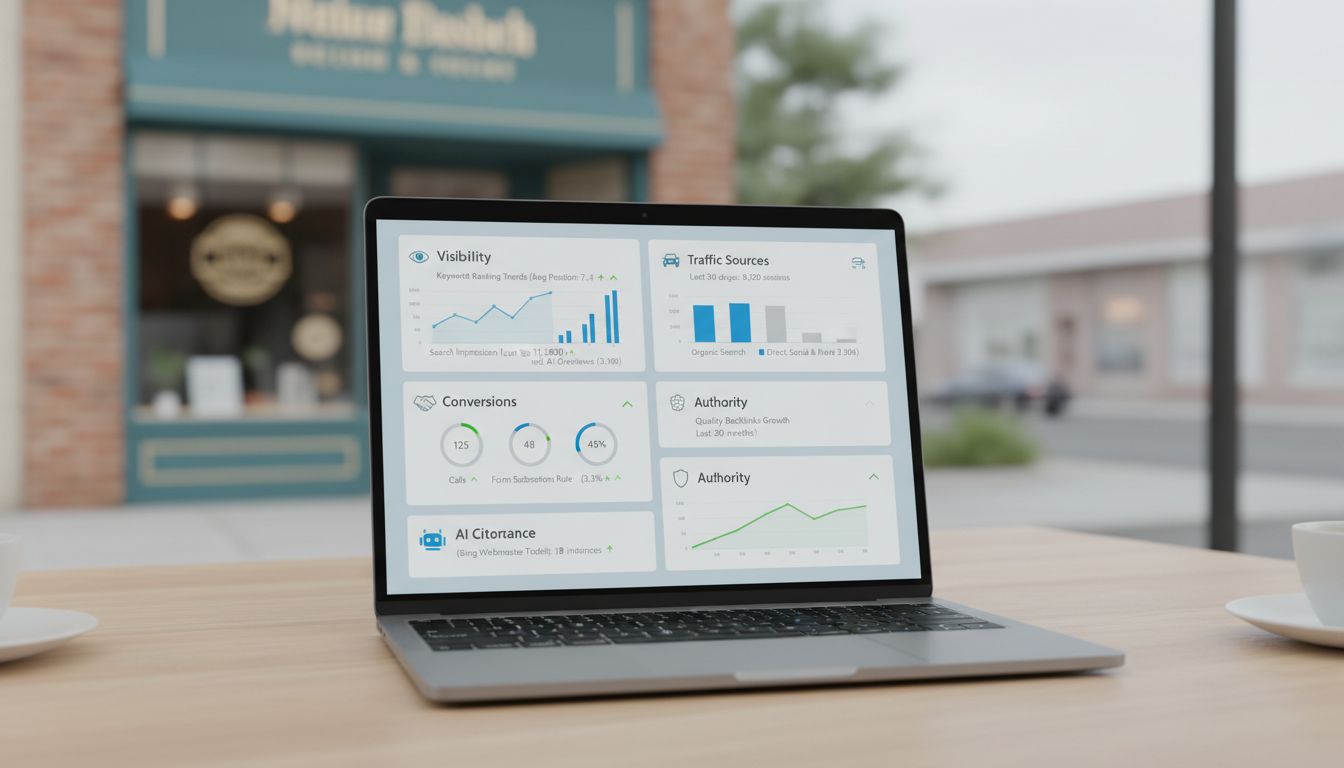
Your 90-day plan needs a scorecard. Rankings are just one number, for search engine optimization for small businesses, you need metrics that connect to actual revenue.
Start with a dashboard tracking five things: visibility, traffic, conversions, authority, and AI performance.
Visibility means keyword rankings month over month, but also Google Search Console impressions, specifically anything showing up under "AI Overviews" or "AI-generated answers." Traffic should separate organic visitors from everything else. Conversions are what actually matter: set up call tracking on your website number and watch "Calls from website" in Search Console alongside form submissions from organic traffic.
Authority grows slowly. Track new quality backlinks monthly using Ahrefs Webmaster Tools or something similar. For AI-specific performance, Bing Webmaster Tools has an AI Performance dashboard that shows how often your pages get cited in AI-generated answers, it's an early signal for whether your content has grounding value.
Only 19% of organizations track KPIs for generative AI. Setting this baseline now puts you ahead of most people using affordable seo tools who are only watching organic traffic.
Benchmark everything against Month 1. SEO compounds slowly, the Rankmax case study showed a 91% increase in monthly organic revenue, and it took eight months of consistent execution to get there. Don't expect linear weekly growth.
Review monthly. Adjust quarterly. The fundamentals work. They just take time.
Conclusion
Search engine optimization for small businesses in 2026 isn't a choice between human strategy and AI automation. You combine them.
The fundamentals don't move: technical health, Google Business Profile optimisation, clear keyword targeting. Those stay non-negotiable. What affordable SEO tools and AI do is execute that strategy faster, at a scale that doesn't require agency-level budgets.
The 90-day plan gives you structure. Budget-tiered search engine optimization tools make it feasible. Tracking real KPIs (not just rankings) keeps you focused on revenue, not vanity metrics.
Start with the 30-day foundation checklist. It's the highest-ROI place to begin, and everything else builds from it.
Ethical AI governance isn't a nice-to-have either, it's what protects the authority you're building, which is the whole point of affordable SEO for small business in the first place.
If you want the whole system running without babysitting every step, platforms like Spectre handle the keyword research, AI drafting, and programmatic publishing side of search engine marketing for you. You stay focused on strategy and expertise. The machine handles execution.
That's what it means to work with an seo company for small business that actually fits your budget, or to build your own stack with seo packages for small business that do the same thing. Either way, the system works. You just have to start.
Frequently Asked Questions
Is SEO worth it for small businesses?
Yes, but only if you're not just throwing money at it randomly. Nearly seven in 10 companies report better returns after integrating AI into SEO and content workflows [Source: semrush.com]. Done right, search engine optimization for small businesses delivers high-intent leads at a lower long-term cost than ad spend, there are case studies showing 91% monthly organic revenue growth within 8 months [Source: rankmax.com.au].
What is the 80/20 rule of SEO?
It's the Pareto Principle applied to search engine optimization: 20% of your efforts drive 80% of your results. For small businesses, that 20% is fixing your technical foundation, optimizing your Google Business Profile, and building out 3-5 cornerstone content pieces around keywords you can actually rank for. The 90-day plan in this guide is built around doing those things first.
Can I do SEO by myself?
Yes. Affordable SEO tools have made this genuinely possible without hiring an agency. The move is a hybrid approach, something like Ahrefs Webmaster Tools for audits, an AI content platform for execution, and maybe a fractional SEO consultant once a quarter for a strategy check. Affordable SEO for small business doesn't have to mean going it completely alone, but it also doesn't have to mean a big retainer.
What is replacing SEO?
Nothing is replacing it. It's just expanding. Search engine marketing now includes AI Overviews (which show up in anywhere from 18-55% of searches depending on who you ask [Sources: genesysgrowth.com, searchlogistics.com]), visual search, voice assistants, not just the traditional blue links. The core stuff hasn't changed though. Relevance, expertise, technical health. Those still matter, just across more places.
What is the golden rule of SEO?
Write for people, not search engines. That's always been true, and it's more true now that AI search actively rewards content that actually helps someone. Google doesn't penalize AI-generated content outright, but it does flag content that exists purely to manufacture pages without adding value, that runs into spam policy territory [Source: searchengineland.com].
How do I use search engine optimization for my small business?
Follow the 90-day plan. Set up Google Search Console, run a site audit, optimize your Google Business Profile, and find 20-50 realistic keywords grouped by service and intent. Then build an AI-assisted content workflow around actually helping people. Track calls and form submissions, not just rankings, those are the numbers that tell you if it's working.