June 10th, 2026
Best SEO Tools for Bloggers: Top Picks to Grow Organic Traffic
 WD
WDWarren Day
Three hours on keyword research. Another hour on a brief. Two more writing. Thirty minutes fighting your on-page plugin. All of that to publish one blog post.
That's the real cost of dashboard sprawl, and it's why most founders just... stop publishing consistently.
It's gotten worse too. Google's AI Overviews now answer around 16% of queries, and top-ranking pages are seeing CTRs drop by 58%. You're not just up against other bloggers anymore. You're up against Google itself.
Quality matters. Volume matters. And somehow you need both.
I've watched this problem from both sides. As a senior engineer who's built content systems for major media companies, and now running Spectre (an AI-powered SEO automation platform), the friction is real and it's fixable.
The best seo tools for bloggers right now aren't just feature lists. They're systems that handle your workflow from research to publishing, without you bouncing between six tabs.
This list cuts through that. Using the SPECTRE selection criteria (15 years of technical SEO experience baked in), we're going to look at the definitive top seo tools for founders and doers. Where the classic heavyweights still hold up, where the best ai seo tools actually fit, and how to build a lean stack that lets you scale without burning out.
The seo tools list covers top 10 seo tools, seo software tools free options, best seo tools for small businesses, best seo tools for beginners, top seo tools free, best blogging tools, and the best seo tools for bloggers worth your time in 2026.
The SPECTRE Criteria: Our Framework for Choosing the Best SEO Tools
Most SEO tool comparisons just list features and prices. That's useless when you're choosing what to actually use every day.
After building Spectre and working with these tools across startups and enterprise teams, I put together the SPECTRE framework. Seven criteria that separate time-wasters from actual leverage.
S - Saves Time (Automation/Workflow) Does it reduce manual steps or create a more efficient pipeline? For founders, time is your scarcest resource. A tool that makes you jump between five tabs to research, brief, write, and optimise isn't helping.
P - Provides Actionable Data Does it tell you what to do next, not just show you charts? I've seen tools that beautifully visualise keyword difficulty but give zero guidance on how to actually rank for those terms.
E - Effective for Low/Medium Authority Sites Does it work for realistic blogger domains (DR 20-50), not just enterprise giants? Most SEO advice assumes you have a DR 80 site. That's irrelevant for 99% of founders.
C - Content-Centric Is it built to help create and optimise content, not just audit or analyse? Technical audits matter, but they don't drive growth if you're not publishing regularly.
T - Transparent & Accurate Are its data sources and limitations clear? All SEO data is an estimate, different tools report wildly varying search volumes. Honest tools admit this.
R - Reasonable Cost (Value for Output) Does the price align with the output it enables for a solo founder or small team? Paying £250/month for features you'll use twice a year is a waste.
E - Easy Integration Can it fit into your existing CMS and workflow without engineering headaches? If you need a developer to connect it, it's not a blogger's tool.
This framework filters out tools that look impressive in a demo but don't actually help you publish more, better content.
That's what matters.
A Quick Reality Check on SEO Tools and Data in 2026
Is SEO dead? No. But it has changed.
Google's AI Overviews now answer roughly 16% of queries, with a 58% lower click-through rate for the top-ranking page. That doesn't kill SEO. It just means publishing high-quality content at scale matters more than it did before. The game has shifted from just ranking to satisfying both users and the AI models that summarize them.
Second question I keep hearing: can ChatGPT do SEO?
It can't. It's a writing copilot, not a strategist. It has no keyword research, no SERP analysis, no publishing logic, and no way to figure out what to write about in the first place. It generates text. It doesn't execute a content strategy.
Now, a data reality check worth knowing before you touch any tool on this list.
"Keyword difficulty" and "search volume" are proprietary estimates. Not facts. Ahrefs, SEMrush, and Moz all use different models, and they'll give you wildly different numbers for the exact same query. Pick one as your benchmark and stick with it. Switching between them just to get a better-looking number is how you end up making bad decisions.
Also worth knowing if you're pulling data via the Google Search Console API: you're capped at 50,000 rows per property per day. For larger sites, that's a meaningful blind spot. Most beginners never realize it exists.
Last thing, and this applies to every tool in this seo tools list: AI writing tools need human oversight. Fact-check the output. Add your brand voice. Make sure it actually fits your strategy. The tools are assistants.
The Top 8 SEO Tools for Bloggers in 2026
Here's how the leading contenders stack up against the SPECTRE framework. Each tool is evaluated on how well it consolidates your workflow, not just how many features it has.
If you want the quick version, this table covers the core fit:
| Tool | SPECTRE Score (/10) | Best For | Key Strength | Ideal User Profile |
|---|---|---|---|---|
| Spectre | 9.5 | Automated SEO content production | End-to‑post automation, from keyword to published article | Founders & solopreneurs who need to scale content without scaling time |
| Ahrefs | 9.0 | Deep‑dive competitor & backlink intelligence | Backlink index & competitor gap analysis | Marketers needing to reverse‑engineer competitor success |
| Surfer SEO | 8.5 | On‑page content optimisation | Data‑driven content structure & grading | Content teams focused on ranking specific pages |
| Rank Math | 8.0 | All‑in‑one WordPress SEO | Schema control & on‑page guidance inside WordPress | WordPress bloggers who want deep control without leaving the editor |
| Google Search Console | 7.5 | Free foundation & indexing data | Direct Google data on impressions & clicks | Every blogger, as a non‑negotiable free baseline |
| Screaming Frog | 7.5 | Technical SEO health checks | Crawling & identifying site‑wide technical issues | Technical founders or those auditing site structure |
| SE Ranking | 7.0 | Budget all‑in‑one alternative | Affordable rank tracking & local SEO features | Bootstrapped startups watching every pound |
| Frase & Jasper | 6.5 | AI writing copilots (when paired) | AI‑assisted drafting & brief generation | Writers who want an AI assistant, not full automation |
This is about as complete a seo tools list as you'll need if you're a blogger trying to not waste money. Whether you're looking for the best seo tools for beginners, the best seo tools for small businesses, or the best ai seo tools with actual automation built in, something on this list covers it.
The scores reflect one thing: how well does this tool get you from idea to published, optimised post with as little friction as possible.
That's the whole game. These are the top seo tools, the top 10 seo tools most practitioners actually use, and the best blogging tools that double as serious seo tools for bloggers. Some are top seo tools free or seo software tools free options. Others cost money but earn it back fast.
The best seo tools for bloggers aren't the ones with the longest feature list. They're the ones you actually finish a post with.
1. Spectre: The Best Overall for Automated SEO Content Production
The top pick for founders and solopreneurs who need to scale quality content production, not just manage another dashboard.
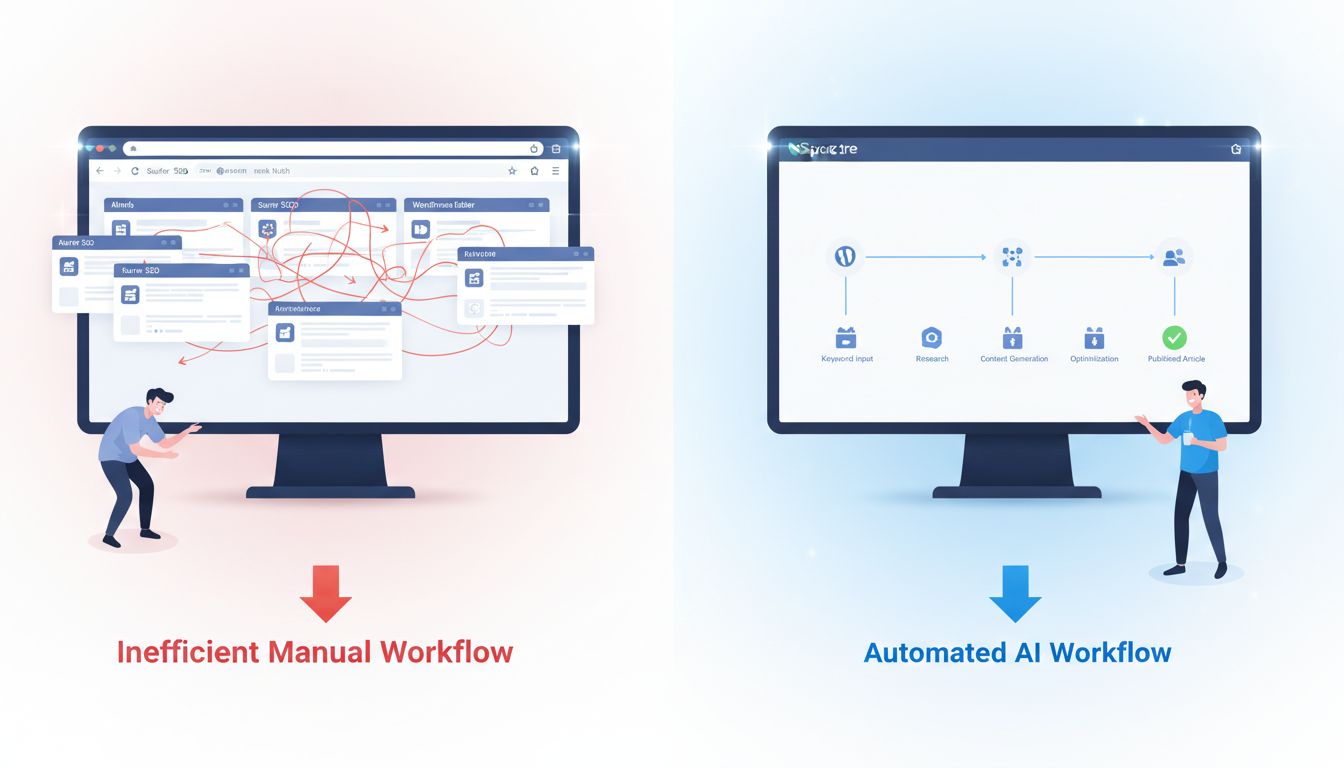
You know the five-tab workflow. Ahrefs for keywords, Surfer for optimisation, ChatGPT for drafting, WordPress for publishing, Rank Math for on-page tweaks. You're switching contexts constantly and somehow still not publishing enough.
Spectre consolidates that entire chain. It's the productised version of the internal content pipelines I've seen power large media houses, rebuilt specifically for early-stage teams where the constraint is time, not budget.
Here's how it maps to the SPECTRE criteria.
Saves Time: it's fully automated. Give it a seed topic or keyword and it handles the rest. Researching SERPs and competitors via DataForSEO, clustering related terms, generating a structured brief, writing the article with proper E-E-A-T framing, optimising for target keywords, publishing directly to your CMS via API. What normally takes 4-6 hours of manual work happens in under 30 minutes.
Provides Actionable Output: you don't get another report. You get a publish-ready article, complete with meta tags, headers, internal linking suggestions, and images.
Effective for Medium-Authority Sites: it's built for the reality that most startups and niche blogs sit in the 20-50 Domain Authority range. It focuses on content gaps and weak spots in SERPs you can actually win.
Inherently Content-Centric: the whole system is built around the article as the deliverable. Not metrics about the article. The article itself.
The trade-off is deliberate. Spectre isn't built for deep manual backlink analysis or crawling your site for technical issues. It assumes you'll use Google Search Console for core diagnostics and complements that with relentless production.
For the founder who needs to go from zero to a consistent content engine, that's the right trade. You're getting a system that executes the 80/20 of content SEO, so you can focus on strategy and promotion instead.
AI Overviews now answer roughly 16% of queries, with a 58% lower CTR for the top-ranking page as a result (source: imforza.com). Competing in that environment means publishing more targeted content, systematically, not occasionally.
That's the problem Spectre solves. Among all the seo tools for bloggers in this list, it's the only one where the output is a published post, not a longer to-do list. If you're looking at best ai seo tools that actually remove work rather than just assist with it, this is the one worth starting with. For anyone serious about finding the best seo tools for bloggers that double as a real content engine, Spectre is where the best blogging tools conversation starts and, for a lot of people, ends.
2. Ahrefs: The Best for Deep-Dive Competitor and Backlink Intelligence
The industry benchmark for backlink data and reverse-engineering competitor strategies.
Ahrefs is the power user's choice. If you need to understand why a competitor ranks, not just what they rank for, this is your tool.
Its core strength is a backlink index of 35 trillion links. For bloggers in competitive niches, that data is invaluable for strategic link-building and picking apart a rival's content moat.
Site Explorer shows you every link pointing to a domain. The Content Gap tool finds keywords your competitors rank for that you don't. I've used its API to programmatically analyse link-building campaigns, and the data freshness holds up. In one test, its traffic estimates were within 25 users of GA4 data over a five-day period. (Source: 321webmarketing.com)
The weakness is the learning curve. It's a complex suite that can become a data rabbit hole quickly.
For a new site with a Domain Rating under 20, a lot of this intelligence is academic. You simply can't compete for those high-authority backlinks yet. At over $100/month, it only pays off if you're ready to actually act on what it shows you.
Among the top seo tools and seo tools for bloggers in this list, Ahrefs sits firmly in the "established site" category. It's not where you start. It's where you go when you've outgrown the beginner tools and need to get serious about competitive positioning. If you're looking at the top 10 seo tools or building out a proper seo tools list, it belongs on there, just not at the top of your priority stack if you're still getting started.
Best for: Established bloggers in competitive verticals who are ready to invest in strategic link analysis and have the bandwidth to execute on complex data.
3. Surfer SEO: The Best for On-Page Content Optimisation
Best for content teams who need a rigorous, data-driven checklist to optimise existing drafts, not generate them.
Surfer SEO turns "write better content" from vague advice into a concrete to-do list. Feed it a keyword, and it analyses the top-ranking pages and spits out specific targets: word count, structure, which semantic terms to include and how many times.
It's a real-time editor that grades your draft against the competition. That's why it's rated 4.8/5 by nearly 500 users (Source: findstack.com). For bloggers writing manually or alongside an AI copilot like Jasper, Surfer fills the optimisation gap.
The value for content teams is the consistency. Everyone's working from the same benchmarks instead of someone's gut feeling about what "good" looks like.
The catch: it's purely an optimisation tool. You need a complete draft first. No help with research, no ideation.
There's also a real risk of over-optimising if you follow the score too religiously. You can end up with content that ticks every box but says nothing interesting.
At around $69/month, that's a real commitment for a solo blogger. If you're one person, an all-in-one tool probably makes more sense than a dedicated optimisation layer on top of everything else.
Among the best seo tools for bloggers and best blogging tools in general, Surfer sits in a specific lane. It belongs on any seo tools list for content teams, and it's one of the top seo tools for on-page work specifically. But as a standalone pick for the best seo tools for beginners or best seo tools for small businesses, it depends entirely on your workflow.
In short: If your process is "draft in Google Docs, then optimise," Surfer is the gold standard for that step. If you want optimisation baked in from the start, you're looking at a different category of tool entirely.
4. Rank Math (WordPress): The Best All-in-One WordPress SEO Plugin
Best for WordPress bloggers who want enterprise-grade on-page control without touching code.
If your blog runs on WordPress, your SEO plugin choice actually matters.
You can't outsource title tags or structured data to some other tool. Yoast is fine when you're starting out, but Rank Math is what you move to when you need actual depth. It turns WordPress from a publishing platform into a real SEO workstation.
The standout feature is the direct integration with Google Search Console and GA4. You're not looking at some generic "SEO score", you're seeing your actual click-through rates and impressions right inside the post editor. That changes how you optimize.
It also ships with over 20 predefined schema types and an advanced builder. HowTo markup, FAQ schema, complex structured data, none of it requires a developer.
The Content AI feature is genuinely useful too, basically a lightweight Surfer SEO baked into your dashboard. And the value is hard to argue with: features that rival expensive standalone tools, at a fraction of the price.
The catch is obvious though. It's WordPress only. It's your on-site layer, not a complete setup. You still need separate seo tools for bloggers to handle keyword research and competitor analysis.
But for controlling what actually happens on your own domain? As far as seo software tools free and paid options go for WordPress users, it belongs near the top of any seo tools list, and it's one of the best seo tools for small businesses and best blogging tools you can add without a big monthly bill. Among the top seo tools, top 10 seo tools, and best ai seo tools lists that get passed around, Rank Math consistently shows up for a reason. It's also one of the top seo tools free (in its base version), which makes it one of the best seo tools for beginners who don't want to spend anything upfront.
For WordPress users specifically, it's the most powerful thing you can install.
5. Google Search Console: The Non-Negotiable (and Free) Foundation
The mandatory free tool that shows you exactly how Google sees your site.
Every blogger needs this. Full stop.
Google Search Console (GSC) is your direct line to Google's data. Which queries are triggering impressions, which pages are getting clicks, whether your content is being indexed at all. It's the only real source of truth for organic performance. (Source: theclaymedia.com)
This is also where you figure out why a post isn't ranking. Coverage issues, crawl errors, hidden keyword opportunities buried in the "Queries" tab, it's all there. Unfiltered, straight from the search engine itself.
The real weakness isn't the sparse interface. It's the API cap. GSC limits data exports to 50,000 rows per property per day, which sounds like a lot until your site grows and you realize you're missing a significant chunk of long-tail keyword data. That's a blind spot that actually matters. (Source: similar.ai)
Think of it as the floor everything else sits on. The paid seo tools for bloggers, the ones on every top seo tools list, the best ai seo tools, the top 10 seo tools people argue about, they all add layers of competitor intelligence and keyword research on top of what GSC gives you. But none of that works without this base.
It's one of the best seo tools for beginners because there's nothing to figure out budget-wise. It's free. It belongs on any seo tools list, any roundup of top seo tools free options, any list of best seo tools for small businesses or best blogging tools. Among seo software tools free options, nothing comes close to what it actually tells you.
You can't skip it. There's no substitute.
6. Screaming Frog SEO Spider: The Best for Technical SEO Health Checks
Best for diagnosing unexplained traffic drops or preparing for a site migration.
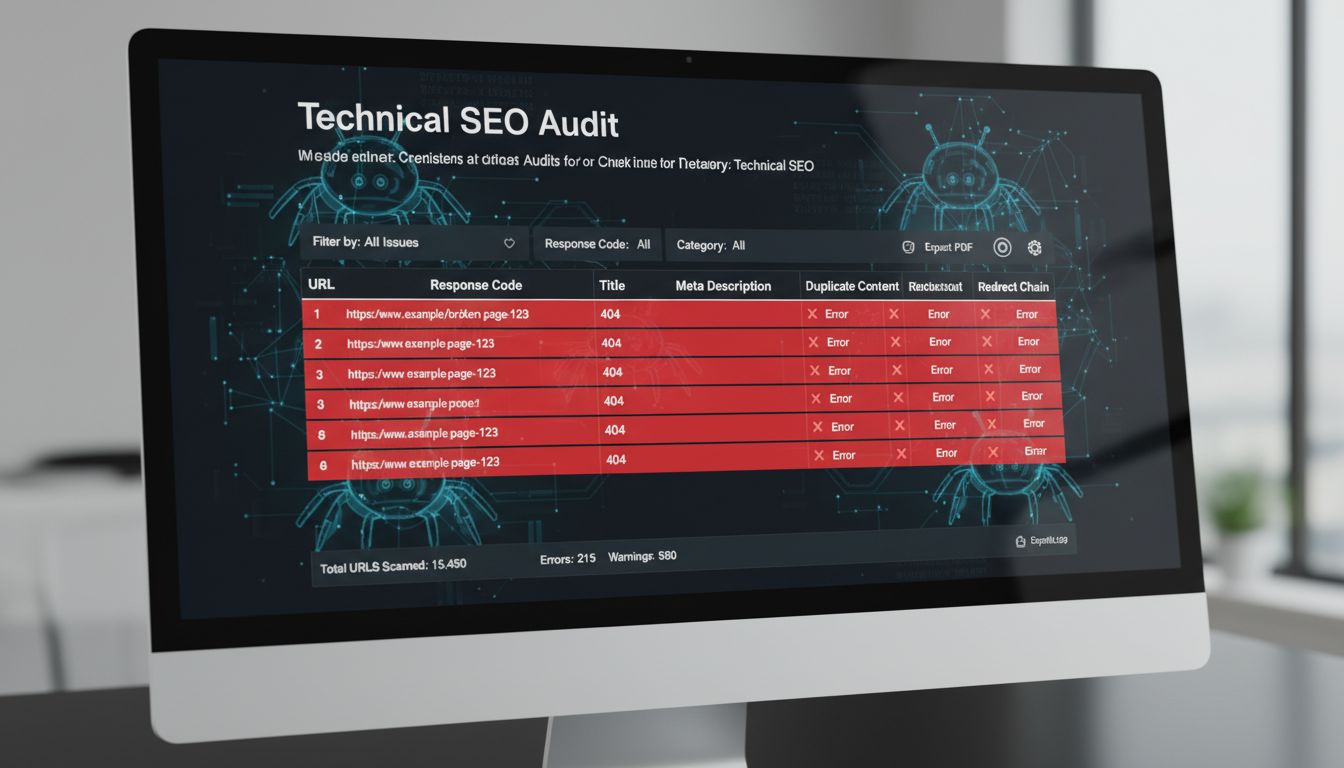
Think of it as an X-ray for your site. It crawls your entire technical structure the same way a search engine bot would, catching things content-focused tools never see. The free version handles up to 500 URLs, which is plenty for most early-stage blogs.
What it finds: broken links, duplicate content, missing meta tags, redirect chains that go nowhere useful, bloated page weight. I run it quarterly on every site I manage.
It's how you find the 404 that's been quietly leaking link equity for months. Or the canonical tag you forgot to set.
The catch is that it's purely diagnostic. You get a spreadsheet of problems, not fixes. Acting on it requires some technical baseline, you need to know what a 301 redirect is and how to implement one.
It won't touch keyword strategy or content. But if your traffic just dropped and you can't figure out why, this is the first place to look.
It's one of the more underrated seo tools for bloggers, and it belongs on any honest seo tools list alongside the top seo tools and best seo tools for small businesses, especially if you care about what's happening under the hood. Not the flashiest of the top 10 seo tools people talk about, but for technical audits, nothing else comes close. Even among seo software tools free options, the free tier holds up well for smaller sites.
7. SE Ranking: The Best Budget All-in-One Alternative
Best for small businesses and local bloggers who need broad functionality without the enterprise price tag.
SE Ranking gives you keyword research, rank tracking, site audits, and backlink monitoring starting around $44/month. That's roughly a quarter of what Ahrefs or SEMrush costs.
For bloggers running local service businesses or targeting geographic keywords, the Google Maps rank tracking is genuinely useful. The interface is clean and beginner-friendly, one of the more accessible all-in-one options on any seo tools list.
Data updates daily, and they offer a solid API with reasonable limits (10 requests/second for data calls) per SE Ranking's own API documentation. No frills, just works.
The trade-off is depth. Index size and historical data don't match the 35-trillion-link behemoths, so competitor analysis and keyword difficulty scores will be less nuanced.
It's a tool for execution, not deep market intelligence. If you're looking at the top seo tools free options and keep hitting feature walls, SE Ranking is worth considering as a paid step up, it's one of the better seo tools for bloggers on a tight budget, and shows up on most best seo tools for small businesses shortlists for good reason.
But if scaling content output is the goal, the gap between research and publishing doesn't close itself. That's still on you.
8. Frase & Jasper: The Best AI Writing Copilots (When Paired Correctly)
AI writing assistants that accelerate drafting when fed a solid SEO strategy.
These are for bloggers who already have a keyword and content brief from somewhere else, Surfer, Ahrefs, whatever, and just need to move faster through the writing phase. Jasper (built on GPT-4) produces surprisingly fluent first drafts. Frase is better at structuring research-backed briefs by pulling apart what's already ranking.
The speed is real. Drafting time goes from hours to maybe twenty minutes.
But here's the thing: alone, they are not SEO tools. No keyword research, no competitive analysis, no optimisation. You get fast, generic content that doesn't rank.
The pairing fixes that, Jasper plus Surfer is a common recommendation, but now you're paying for two subscriptions and manually moving data between a research platform, a writing tool, and your CMS. That's a workflow you're stitching together yourself.
It's faster than writing from scratch. It's not a consolidated system. For anyone trying to keep their seo tools list short, or looking for the best ai seo tools that handle more than one job, this combo will feel like it's always one tool short of being complete.
Worth knowing if you're building out your stack of seo tools for bloggers or shopping the best blogging tools generally: these two show up on almost every best seo tools for beginners list, which is accurate, they lower the skill floor for drafting. Just don't confuse "easier to write" with "easier to rank."
Building Your Lean SEO Stack: Two Workflows for 2026
The point of reviewing eight tools isn't to buy them all. It's to pick a system and actually use it.
Based on your real constraint, time or budget, here are two workflows worth considering for 2026.
Workflow A: The Automated System for Time-Poor Founders
This is what we built Spectre for. If your bottleneck is hours in the day, you need something that handles the whole pipeline, not just one piece of it. Use Spectre for keyword research, SERP analysis, AI-powered writing, and direct publishing. Pair it with Google Search Console for the free diagnostics on how Google actually sees your site.
That's the whole stack. Your CMS is just where the content lands.
No manual stitching between research, writing, and optimisation. You're focused on strategy and editing, not switching between tabs.
Workflow B: The Hands-On Power User Stack
If you have the time and appetite for deep analysis, this gives you more control. Start with Ahrefs (or SE Ranking if budget is tight) for keyword and competitor research. Feed those insights into Surfer SEO to build data-driven briefs and optimise drafts. Use Rank Math for on-page tweaks and schema in WordPress, and run Screaming Frog quarterly for technical health checks.
Powerful stack. But it demands consistent, manual effort to keep everything connected.
The mistake most people make is trying to use a bit of everything. Inconsistent use of five tools from your seo tools list gets you worse results than actually committing to two. That's true whether you're looking at top seo tools, seo software tools free, or the best seo tools for small businesses.
For most founders I work with, the automated system isn't just more convenient. It's the only reason the content actually gets published.
Pick the workflow that matches your real capacity. The best ai seo tools, the best seo tools for bloggers, the top 10 seo tools, none of it matters if you're not using them consistently. The top seo tools free options in Workflow A (Search Console, specifically) exist for a reason: they lower the barrier to just starting.
That's it. Commit to a workflow, and let consistency do the rest. The best seo tools for beginners aren't the ones with the most features, they're the ones you'll actually open tomorrow.
Conclusion
Your primary constraint, time, budget, or expertise, should dictate which tools you actually use. Not which ones look good in a comparison table.
Google Search Console is non-negotiable. It's free, it's direct from Google, and skipping it makes no sense. Paid tools should fill specific gaps from there, not replace the thinking.
The mistake most people make is trying to use a bit of everything. Systematic use of two tools beats inconsistent use of five. Every time.
For founders with limited time, start with the automated system. Test your personalised content strategy with Spectre's free trial, layer in GSC for free diagnostics, and that's honestly enough to start compounding. For the hands-on strategist, commit to one all-in-one platform like Ahrefs and one content optimizer like Surfer.
Whichever path you pick, look for best SEO tools for bloggers that get you out of dashboards and back to creating. The best blogging tools, the top seo tools, the best ai seo tools, the top 10 seo tools, seo software tools free, none of it matters if you're not actually using them.
The best seo tools for beginners aren't the ones with the most features. They're the ones you open tomorrow. The best seo tools for small businesses aren't the most powerful ones. Same logic. Pick from your seo tools list and commit. Top seo tools free options like Search Console exist specifically to lower the barrier to starting.
So just start.
Frequently Asked Questions
How to get organic traffic on Blogger/Blogspot?
Blogger/Blogspot has real technical limitations. Page speed, custom schema, URL structure, you don't fully control any of it, and that creates genuine SEO problems.
Google Search Console is your best friend here. Use it obsessively for keyword discovery and indexation monitoring, and compensate for the platform's constraints by making the content itself genuinely good.
For serious bloggers, migrating to self-hosted WordPress is often the first real SEO win. You just get full technical control, and that matters more than most people realize.
How to increase organic traffic in SEO?
Apply the 80/20 rule, and apply it ruthlessly. 20% of your existing posts are probably driving 80% of your traffic right now.
Find those posts through analytics. Then use something like Ahrefs for content gap analysis against whoever's ranking above you for similar terms.
Expanding and refreshing what's already working beats chasing brand new topics. That's where tools like Spectre return disproportionate results, by building on proven content pillars instead of starting from scratch every time.
Which SEO tool is best for blogging?
Depends entirely on where you're stuck.
If you need fully automated content scaling from research to publication, Spectre is about as consolidated as the workflow gets. For deep competitive intelligence and backlink analysis, Ahrefs is still the standard. For on-page optimization, Surfer SEO or Rank Math (if you're on WordPress) both do the job well.
SE Ranking is worth a look if budget is the constraint, it's the most capable all-in-one option at that price range.
What is the 80/20 rule for SEO?
Roughly 80% of your organic results come from 20% of your efforts. High-intent keywords, content pillars that actually convert, that's the 20%. Vanity metrics and low-value backlinks are not.
For bloggers, this means pulling up your analytics and figuring out which posts are driving real traffic and revenue. Then improving and expanding those, systematically.
The seo tools for bloggers that help you find that productive 20%, through content gap analysis and performance tracking, are worth far more than generic keyword research platforms. That's true whether you're looking at the top seo tools, seo software tools free options, or building out your broader seo tools list. Best seo tools for small businesses, best seo tools for beginners, top seo tools free, the category doesn't matter as much as whether it helps you find the stuff that's already working.