June 4th, 2026
SEO Tools for Competitive Analysis: A Practical Guide for Content Teams
 WD
WDWarren Day
You've been told to "outperform competitor content." So you log into an SEO tool, and immediately there are dashboards, thousands of keywords, backlink charts, contradictory difficulty scores. A week later you have a massive spreadsheet and zero new articles published.
That's the actual experience for most content managers using seo tools for competitive analysis.
The stakes aren't small either. Organic search drives 44.6% of all revenue attributed to digital channels, and a top-ranking position in Google pulls an average click-through rate of 25.84% [Source: seoprofy.com/blog/seo-roi-statistics]. The upside is real. The gap between "I have data" and "I published something that ranks" is also real.
Here's the premise this guide is built on: competitor analysis tools are only useful if they plug into a repeatable workflow that turns intelligence into published content. Without that, they're expensive dashboards that measure your problems without solving them.
You probably already know the basics, keywords, meta descriptions, maybe Google Search Console. What's missing isn't more data. It's a system. One that tells you who you're actually competing with for search visibility (usually not who you think), helps you build a tool stack that fits your budget and needs, and feeds your content calendar with briefs that have a real shot at ranking.
This isn't another generic seo tools list. The focus here is the content production workflow itself, how to match features from the best competitor analysis tools to specific intelligence needs, what pitfalls to skip, and where to be skeptical of vendor data and AI recommendations. Whether you're looking at seo software tools free options or paid platforms, the framework matters more than the software.
Defining Your True SEO Competitors (It's Not Who You Think)
This is where most teams waste their first week. You log into Ahrefs or Semrush, list your obvious business rivals, and start analyzing their backlink profiles. You're already wrong.
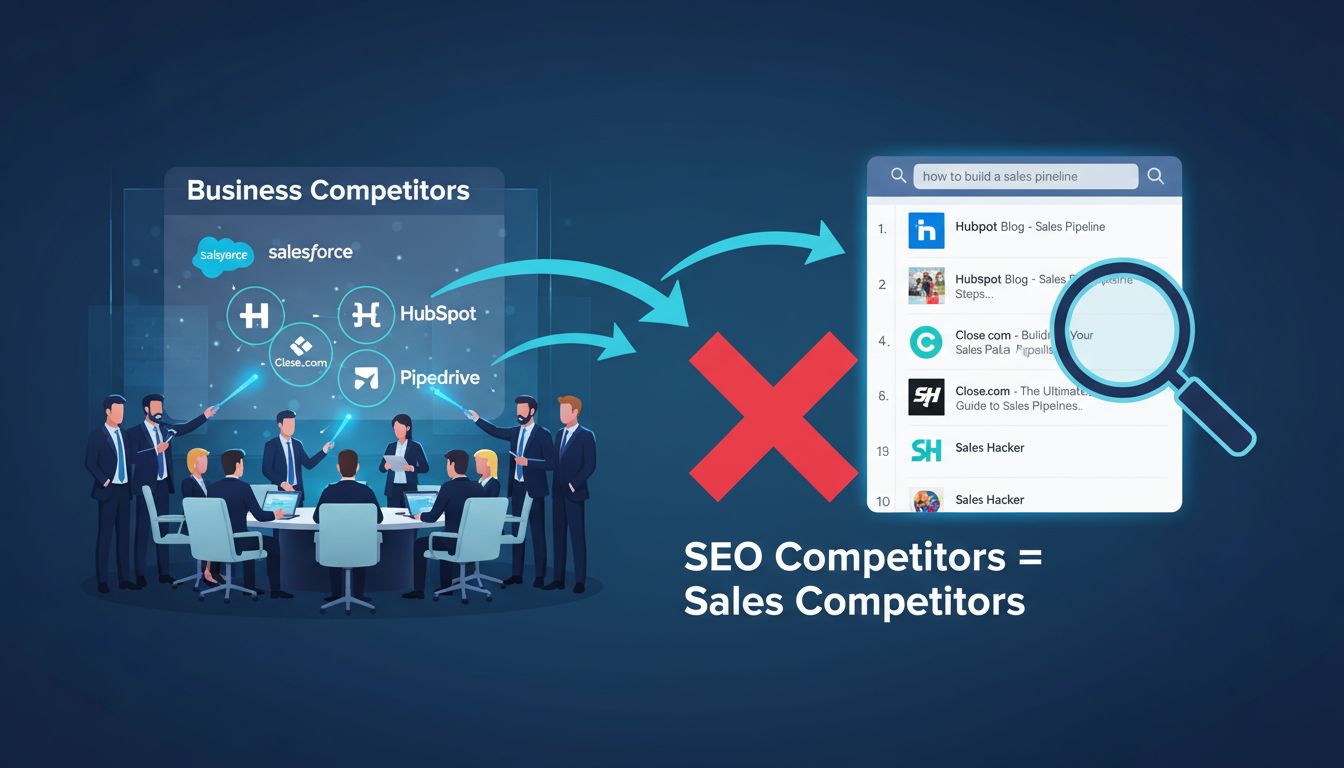
Your true SEO competitors aren't the companies you fight for customers in sales meetings. They're the websites Google ranks above you for the queries that actually drive your business. These are two different lists, and they rarely overlap.
Confusing them means you end up analyzing irrelevant content strategies and chasing keywords you can't realistically win.
Let the SERP decide. For your core 5-10 seed keywords, the ones that convert, look at which domains consistently show up in the top 10. Those are your real SEO rivals.
A SaaS CRM company's business rival might be Salesforce. But for "how to build a sales pipeline," their SEO competitors could be HubSpot's blog, Close.com's academy, and something like Sales Hacker. None of those are selling CRM software. They're capturing the audience before that audience is ready to buy.
This distinction matters a lot when you map intent. Your competitor for "best CRM software" is completely different from your competitor for "sales process template." SERP results should determine your SEO competitors, not business assumptions. The sites ranking for "integrate CRM with marketing automation" might be developer docs or niche tech blogs, not the enterprise vendors showing up on Gartner reports.
The practical output here is simple: build an "SEO Competitor Shortlist" of 3-5 domains. These are the sites you'll actually analyze, using your seo competitor analysis tools, your semrush competitor analysis data, whatever's in your stack, instead of trying to monitor every site in your industry.
That focus matters. You're not competing against everyone. You're competing against the handful of sites Google has already decided are the authorities on your target topics. Using the right seo tools for competitive analysis just helps you figure out which handful that is.
The Five Intelligence Needs of a Content Team
You've got your shortlist. Now the actual work starts.
Most teams jump straight to keyword gap analysis. That's fine, but it's only one piece. Content managers need five distinct types of intelligence to build content that actually wins.
1. Topic & Keyword Gaps: "What are they ranking for that we've missed?"
This is the foundational question. Tools like Semrush's Keyword Gap or Ahrefs' Content Gap show you the exact search terms where competitors show up in the SERP and you don't.
The value isn't just a list of keywords. It's understanding the intent clusters. Are they capturing commercial queries you've overlooked, or informational questions your audience is already asking? That's what feeds your editorial calendar.
2. Content Format & Quality Benchmarks: "What should my article actually look like?"
Keywords tell you what to write about. Content analysis tells you how. You need to know the word count, structure, and media types of the pages that rank.
Is the top result a 3,000-word guide with embedded calculators, or a concise 800-word answer with a video? Tools like Surfer's SERP Analyzer or MarketMuse break this down, heading structure, image counts, readability scores. The stuff you need to match or beat.
3. Backlink Profile & Opportunity: "Is this a content battle or a link-building battle?"
This is where reality checks happen. You can write the perfect article, but if the top-ranking page has a formidable backlink profile, you'll struggle. Position 1 in Google has an average of 168 referring domains.
Run the competitor's domain through Ahrefs' Site Explorer. The question isn't just "do they have more links?" It's "who's linking to them that might also link to us?" That answer tells you whether content creation alone is enough, or whether you need to pair it with a real outreach campaign.
4. Technical & UX Signals: "Is their foundation simply better than ours?"
Content sits on a technical platform. If their pages load twice as fast, have better mobile responsiveness, or use schema markup that pulls rich results, your better-written article might still lose.
Use Google PageSpeed Insights or a crawler like Screaming Frog to audit their technical setup. Sometimes the answer is that you need engineering resources before you even brief the writer.
5. SERP Feature Tactics: "How are they capturing extra real estate?"
Modern SERPs are more than ten blue links. Are your competitors winning Featured Snippets, dominating "People Also Ask" boxes, showing up in image packs?
Tools like Semrush's Position Tracking and other seo competitor analysis tools in your seo tools list show where they're gaining visibility beyond standard organic rankings. That tells you how to structure content so you're competing for those spots too.
Each of these maps to a different layer of what's actually happening in search. Skip one and your strategy has a blind spot, and those blind spots are usually why content doesn't rank even when it probably should.
This is the real case for investing in the best competitor analysis tools you can get your hands on, whether that's paid software like Semrush or one of the decent seo software tools free options. The top seo tools aren't interchangeable across all five needs either. Some are better for backlinks, some for SERP features, some for content benchmarks. Knowing which is which matters.
If you're just starting out, the best seo tools for beginners tend to bundle a few of these together, competitor analysis tools free like Ubersuggest or the free tiers of Semrush get you far enough to run this process. A free competitor analysis tool won't cover everything, but it's enough to run this process on your top two or three rivals and see where the gaps actually are.
Building Your Strategic Tool Stack: A Matrix, Not a List
Stop thinking about this as a ranked list. Think about it as a matrix.
Most guides give you a popularity contest of "best seo tools for competitive analysis." That's not useful. What you actually need is a set of tools chosen to answer the five intelligence needs we just defined, working together within your budget.
No single platform excels at everything, despite what their marketing says. The real value comes from connecting tools that fill specific gaps in your workflow.
Here's the framework I use and recommend to teams. It maps tool categories directly to the intelligence needs they serve.
| Category | Primary Purpose | Key Metrics It Delivers | Example Tools |
|---|---|---|---|
| Keyword & Market Gap Analysis | Identify search volume, difficulty, and competitor keyword overlap. | Search Volume, Keyword Difficulty, Share of Voice, Keyword Gaps. | Semrush, Ahrefs, SpyFu, Moz Keyword Gap. |
| Technical & UX Audit | Benchmark site health and page experience signals against competitors. | Core Web Vitals, Mobile-Friendliness, Indexability, Crawl Errors. | Moz Pro Site Crawl, Google PageSpeed Insights (free), Screaming Frog, Google Search Console. |
| Content & AI Analysis | Understand content depth, structure, and AI-assisted opportunities. | Content Score, Topic Coverage, Estimated Word Count, Social Shares. | MarketMuse, BuzzSumo, NeuronWriter, GrowthBar, Clearscope. |
| Monitoring & Alerting | Get notified of competitor changes and SERP movements in near real-time. | Rank Tracking, Page Change Detection, Alert Cadence. | Visualping, rank tracking modules in Semrush/Ahrefs, Google Alerts. |
This matrix forces you to think functionally. You might use Semrush competitor analysis for its Keyword Gap tool and broad marketing data, but pair it with Ahrefs when you need to go deeper on a competitor's backlink profile, something Semrush's data can be less granular on.
That's really the core of the Ahrefs vs. Semrush debate most beginners get stuck on. Ahrefs has traditionally invested more in the depth and freshness of its backlink index (they reported indexing 35 trillion external backlinks in 2025 Source: ElectroIQ). Semrush tends to win on feature breadth, pulling in more market intelligence and advertising data. Choose based on your primary intelligence need, not which one has the better landing page.
Your stack should also be tiered by budget. A starter stack for a lean team could be Ahrefs Lite ($129/month) for keyword and backlink gaps, paired with Visualping's free tier for change monitoring. A growth stack might upgrade to Semrush Guru and add a dedicated content tool like MarketMuse for topic authority analysis.
And always include the free seo software tools in your plan. Google Search Console and PageSpeed Insights give you the ground-truth technical and indexing data that paid tools can only estimate. They're the calibration layer for everything else.
The goal isn't to collect the most competitor analysis tools. It's to make sure each category in your matrix has at least one reliable source covering it.
That prevents the most common failure mode: amazing keyword data with no way to act on it, or fantastic content insights but no system to catch when a competitor quietly pivots. The best seo tools for beginners in your seo tools list won't matter much if they're all covering the same ground.
Tool Deep Dives: Mapping Features to Content Workflow
Having the matrix is one thing. Actually using it is another. The difference between data and action happens here, in knowing which button to click and what column to export.
Ahrefs for Content Teams: Finding Your Missing Content
Forget the overwhelming interface. Start in Site Explorer. Enter your domain and your validated competitors. The column you care about is "Referring Domains", it shows the backlink moat you're up against instantly. A competitor with 5,000 referring domains ranking for a commercial keyword has built authority over years. Your content needs a different angle.
Now click "Content Gap" under the "Organic search" section. Input your site as the target, add competitors as references, then filter by Keyword Difficulty (0-30 to start) and Volume (100+). The report shows keywords they rank for that you don't.
The actionable column isn't just the keyword. It's the "Parent Topic" and "Traffic Potential." A keyword like "best project management software" might have a parent topic of "agile methodology." That's your clue: the SERP wants broader, foundational content, not a product list.
Output: An exported CSV with 20-30 keyword gaps, each annotated with the inferred parent topic and a note on whether the opportunity is a new article or a section to add to existing content. This becomes your content team's priority backlog.
Semrush for Content Teams: Deconstructing Winning Structure
Semrush competitor analysis has two things going for it here: the Keyword Gap tool and its newer AI-assisted content features. Go to Keyword Gap, add your domain and up to four competitors. Filter for "Competitor's Unique Keywords", terms they rank for that you don't appear for at all. Export that list.
Most teams stop there. Don't.
Take the raw list into "Keyword Manager" and use the "Cluster by Topic" feature. Semrush's AI groups semantically related keywords. You'll see that "SaaS pricing models," "subscription billing," and "revenue recognition software" might cluster under "SaaS Finance Operations." That's your content pillar, identified by the tool, not your gut.
Then run the "Content Topic Analyzer" on a top-ranking competitor URL for your target cluster. It breaks down H2/H3 structure, keyword density, even sentiment. You see the exact narrative flow that Google rewarded.
Output: A content brief with: 1) a primary keyword cluster, 2) a proven heading structure from the top-ranking page, and 3) a list of 5-7 semantically related secondary keywords to naturally include. Your writer gets a blueprint, not just a keyword.
Moz Pro for Content Teams: The Reality Check
Moz gets underestimated a lot. But its "True Competitor" tool is genuinely useful for one thing: stopping you from wasting time on battles you can't win yet.
Enter your domain and let it analyze SERP overlap. You get a list sorted by "Overlap Score" and "Rivalry Score." High overlap, low rivalry, that's a vulnerable competitor. You're going after the same audience but aren't directly battling yet.
Then compare Domain Authority. If your DA is 35 and theirs is 78, ranking above them for a commercial term is a multi-year project, not a quarterly goal. Use this to tier your targets: "Now" (DA parity), "Next" (slightly higher DA), "Later" (needs link-building first).
Output: A segmented competitor list, "Primary Target" (similar DA, high overlap), "Monitor" (higher DA but content angles exist), "Aspirational" (authority players to learn from, not challenge directly). It keeps you from fighting the wrong battles.
AI-Powered Tools: Benchmarking Completeness
Tools like MarketMuse and NeuronWriter shift focus from keywords to topical coverage. In MarketMuse, you input a target keyword and run a "Competitive Content Analysis." The output is a visual heatmap showing how thoroughly each ranking page covers subtopics. A competitor might score 85/100 for "Coverage" but only 40/100 for "Authoritativeness." That gap is your opening.
NeuronWriter works similarly but inside a writing interface. Enter your keyword, it analyzes the top 10 ranking pages and generates "Questions to Answer," "Recommended Terms," and internal linking suggestions. The "Content Score" updates in real-time as you write, measuring your page against the competitive benchmark.
Output: For MarketMuse, a report highlighting specific content gaps, things like "none of the top 5 pages explain X, which 17% of related queries ask about." For NeuronWriter, a live document with a target score and a checklist of semantic terms, so writing becomes a targeted optimization task instead of a guessing game.
The common thread across all of these seo competitor analysis tools: you're moving from a passive report to a formatted output that slots directly into your content calendar or CMS. The tool gives you the intelligence. You design the workflow that turns it into a brief, a ticket, or a target.
Skip that translation step, and you've built a very interesting library that nobody uses.
From Data to Published Content: The Actionable Workflow
The common thread across all these workflows is moving from a passive report to an active, formatted output that slots directly into your content calendar or CMS. The tool provides the intelligence, but you design the workflow that turns it into a brief, a ticket, or a target.
Without that translation step, you're just building a library of interesting data no one will ever use.
Here's the five-step cyclical process that actually moves data to published content.
Step 1: Identify & Prioritise
End your tool analysis with a filtered, actionable list. Not a spreadsheet of 200 keywords.
Using Ahrefs' Content Gap or the Semrush competitor analysis Keyword Gap tool, apply three filters: search volume above your site's threshold (maybe 500+), keyword difficulty below your domain rating's realistic ceiling, and a clear content gap where you have zero coverage.
The output isn't a report. It's a prioritised queue in your project management tool. I use a simple formula: (Estimated Traffic Value × Feasibility Score) / Resource Required. Feasibility considers your domain authority relative to the SERP.
If the top results average 168 referring domains and your site has 40, that's a two-year project, not a next-quarter win. Source: searchlab.nl
Step 2: Analyse & Brief
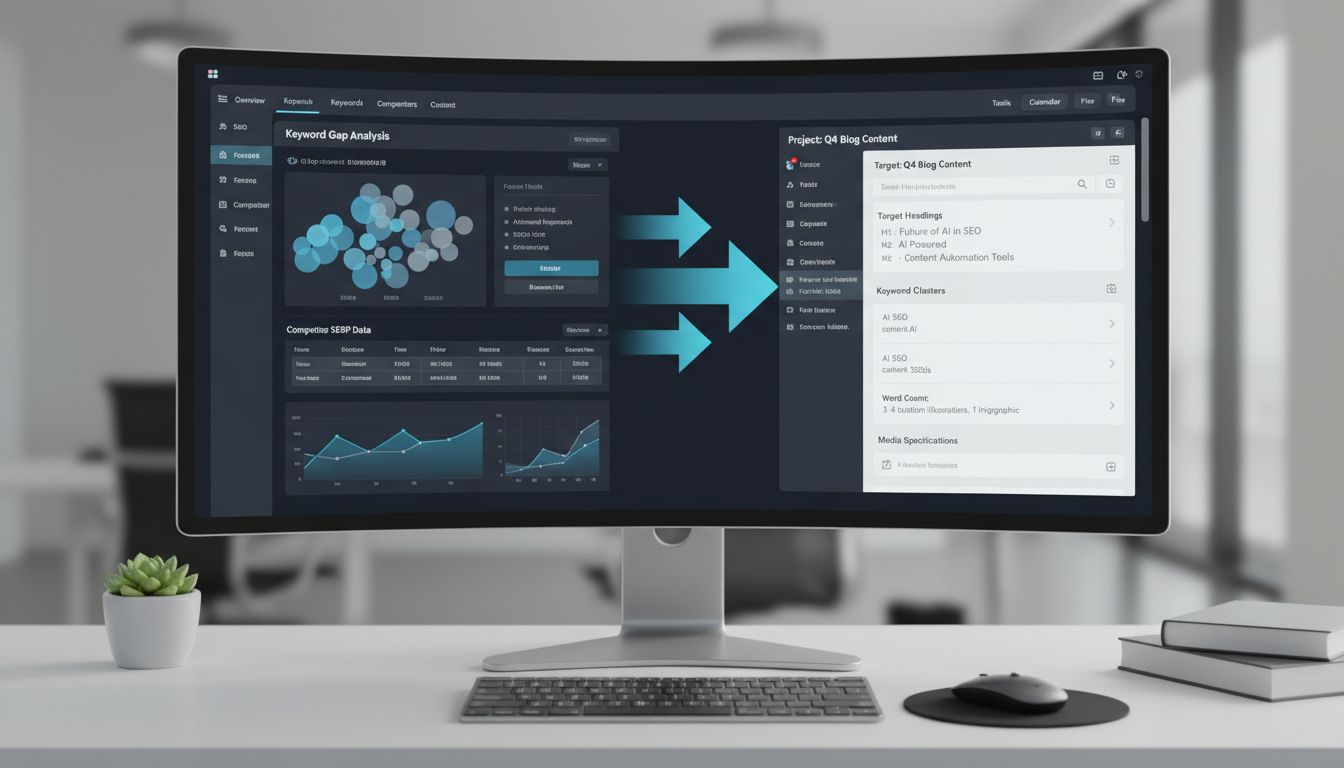
For each priority keyword, open the top ranking pages side-by-side. Use Semrush's Content Topic Analyzer or manually dissect structure. Document the target word count (average plus 15%), required H2/H3 headings that appear across competitors, internal linking opportunities, media types used, and any visible schema markup.
Most teams stop at surface metrics. The deeper question is: what's the search intent behind the keyword? Are all ranking pages listicles, or is there one definitive guide dominating? That tells you what format to create.
Step 3: Interpret & Assign
Transform the analysis into a structured brief for your writer or agency. It must include three things:
- The Strategic 'Why': "We're targeting this keyword because Competitor X ranks #3 with thin content, and we have deeper product expertise."
- The Tactical 'What': A concrete outline with target headings, word count, required media, and internal link targets.
- Success Metrics: Primary target keyword, 3-5 secondary LSI terms to include naturally, and target position (e.g., "Top 10 within 90 days").
This brief should live in your CMS or project tool, not a disconnected Google Doc. The hidden cost of "swivel-chair workflows", copying data from one of your competitor analysis tools into a brief template into Asana, wastes hours and introduces errors.
Step 4: Act & Publish
A well-structured brief is machine-readable. AI writing tools can consume these briefs to generate first drafts that already align with SEO requirements. This isn't about replacing writers. It's about eliminating the blank-page problem and making sure first drafts are strategically aligned from the start.
This is the problem we built Spectre to solve. It connects directly to DataForSEO (and similar APIs) to automate the research in Step 1, uses the analysis patterns from Step 2 to generate briefs, and then produces optimized first drafts that publish directly to your WordPress or Webflow CMS.
The entire workflow from keyword discovery to published draft runs without manual copying, pasting, or formatting.
Step 5: Monitor & Iterate
Publishing isn't the end. Set up a Visualping monitor on the competitor pages you just targeted. You'll get alerts when they update their content in response to yours, which is a clear signal you've struck a nerve. Track your own ranking weekly for the first 90 days.
Feed the results back into Step 1. Did a piece outperform expectations? Look for semantically related keywords it now ranks for and create supporting content. Did it stall? Figure out whether the difficulty score was miscalculated or if you missed a critical search intent signal.
The Action Translation Table
| Tool Input | Analysis Activity | Brief Output |
|---|---|---|
| Ahrefs Content Gap report | Filter by volume, difficulty, gap | Prioritised keyword queue in Asana |
| Top 3 SERP pages + Semrush Content Topic Analyzer | Reverse-engineer structure, intent, media | Outline with target headings, word count, media specs |
| Google Search Console performance data | Identify ranking improvements for related terms | Brief for follow-up "cluster" content |
| Visualping change alert | Analyse competitor content update | Decision: update our piece or create new angle |
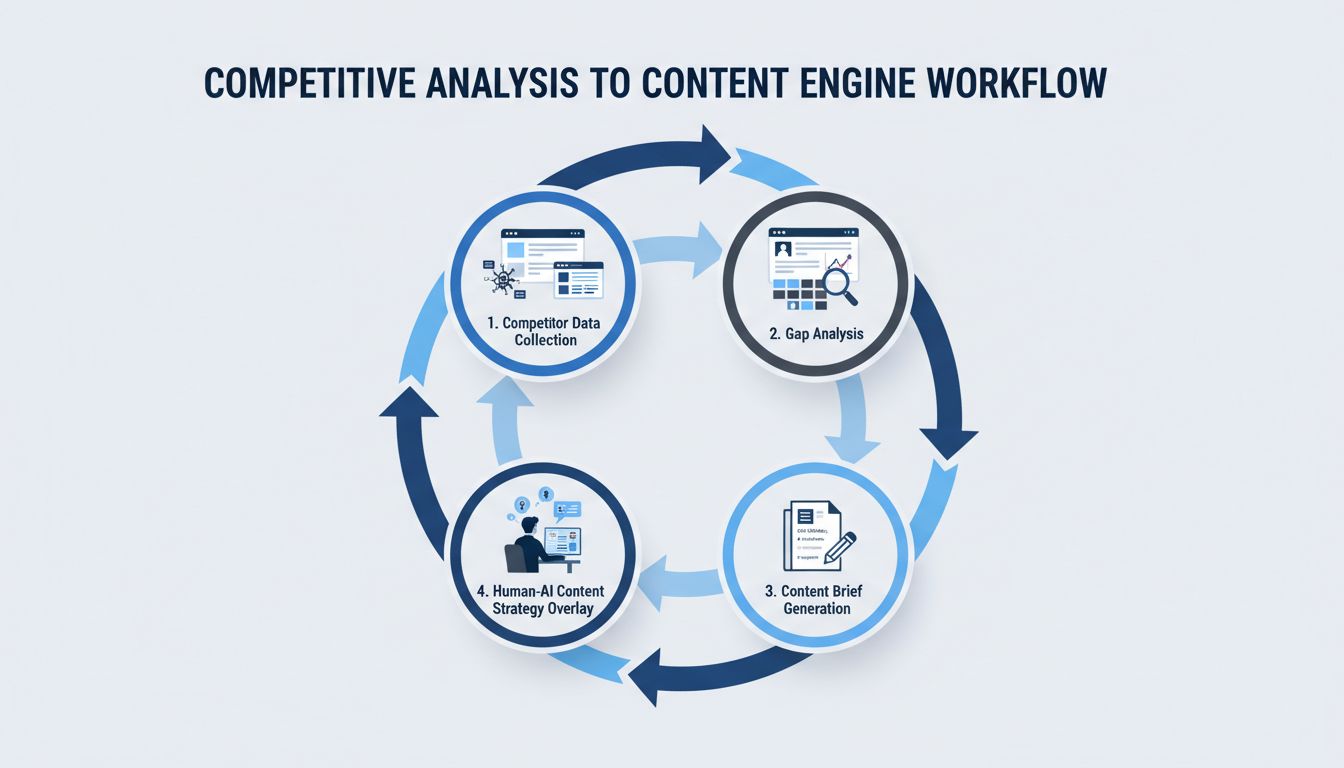
This workflow turns competitive analysis from a quarterly reporting exercise into a continuous content engine. Each piece of intelligence has a clear destination: a formatted brief that becomes a published article.
Without this process, even the best seo tools for competitive analysis, whether you're using top seo tools with paid plans, seo software tools free tiers, or a free competitor analysis tool to get started, become just another dashboard you glance at occasionally, wondering why your rankings haven't changed. The best competitor analysis tools, the best seo tools for beginners, the most complete seo tools list you can find... none of it matters if the data never becomes a brief.
Common Pitfalls: Wasting Time and Misreading Data
Here's the thing about these mistakes: they feel productive while you're making them.
You're running reports, collecting data, exporting to dashboards. Feels analytical. Then you look up and it's been a week and you haven't written a single brief.
The most seductive trap is analysis paralysis. Your seo competitor analysis tools show you can compare five competitors across 50 metrics. So you do. Then you run the same report for different keyword clusters. Two days later you have gorgeous visualisations showing exactly how far behind you are... with zero next steps.
Set a brutal rule: two hours of analysis must produce one content brief ready for a writer. If it doesn't, you're collecting data. That's not the same thing as competitive analysis.
Keyword difficulty metrics are particularly deceptive. Most tools calculate this as a proxy for domain authority, so a "Medium" 40 KD term might be mathematically out of reach if every top result has a Domain Rating above 80. I've seen teams target keywords where the average top position has 168 referring domains while their site has 12. Source: Searchlab
The heuristic is simple: compare your authority metric to the top ten's average. More than 20 points behind? You're not competing for that keyword. You're donating crawl budget.
Treat every estimate in these tools as directional, not absolute. Traffic numbers, keyword difficulty, "traffic value", these are proprietary algorithms, not Google Analytics exports. They're great for relative comparison (Competitor A gets roughly 10x more traffic than Competitor B) but terrible as KPI targets.
I once watched a marketing team present a tool's "$50,000 monthly traffic value" estimate to their CFO as projected revenue. The actual conversion value was about $3,000.
The one-and-done syndrome kills momentum too. Competitive analysis isn't a quarterly project you complete and check off. If you're not revisiting your competitors' new ranking pages at least monthly, you're already behind. Embed a recurring task: every four weeks, run the same gap analysis you did initially and look for what's changed. That's where the real opportunities are.
Then there's the AI overlay problem. With 74% of new web content now created with generative AI, every seo tool for competitive analysis is pushing AI recommendations for keywords and content angles. The problem is these suggestions identify patterns in what's already ranking, not what could rank with a unique angle.
They'll tell you to write "10 best CRM software" because five competitors rank for it. Not because there's an underserved angle about CRM implementation for remote teams.
Use AI outputs as brainstorming starters. The moment you're creating content identical to what the AI found in your competitors is the moment you've lost any edge. The best competitor analysis tools, the best seo tools for beginners, the most complete seo tools list you can find, none of the semrush competitor analysis reports or free competitor analysis tool tiers or top seo tools matter if you're just copying what everyone else already did.
Trust Caveats, Data Limitations, and the AI Overlay
Every seo tool for competitive analysis sells you a version of reality. Your job is figuring out where that version diverges from actual search engine data, and where it leads you somewhere you shouldn't go.
Start with what the tools actually measure versus what they imply. When Ahrefs reports 35 trillion indexed backlinks or Semrush claims 26 billion keywords in its database, those are vendor-reported numbers. [Source: https://electroiq.com/stats/ahrefs-statistics] They tell you about scale, not accuracy, and definitely not completeness for your specific niche. These platforms sample the web. Google crawls it exhaustively.
Transparency Box: Understanding Vendor Metrics
- Domain Metrics (DA, DR, AS): Moz's Domain Authority (DA), Ahrefs' Domain Rating (DR), and Semrush's Authority Score (AS) are proprietary, relative scores. They're engineered to correlate with rankings within their own data sets. A DR 50 from Ahrefs is not a DA 50 from Moz. Use them for internal comparison (Competitor A has a higher DR than us) but never as an absolute benchmark.
- Traffic Estimates: These are models, not measurements. Tools don't have access to Google Analytics log files. They use clickstream data partnerships, toolbar data (a tiny, skewed sample), and assumed click-through rate curves to estimate monthly visits. The business incentive is obvious: showing you a competitor gets "50,000 visits/month" makes the tool feel essential. Treat these as directional indicators of relative volume, not gospel.
- Keyword Difficulty: Another proprietary score. It typically factors in the Domain Ratings of pages that are already ranking, sometimes backlink counts too. It tells you how entrenched the competition is, not whether your specific angle can break through.
The reality is that all third-party SEO data is a sophisticated guess. These tools stitch together incomplete data sources and apply statistical models to fill the gaps. Useful for spotting trends and gaps, yes. Ground truth, no.
Now layer on the AI problem. Every major tool, whether you're looking at semrush competitor analysis, the best competitor analysis tools, or a free competitor analysis tool on a budget, now offers AI-generated content briefs, keyword suggestions, outline recommendations. This creates a strange loop: you're using AI to analyze competitors who may have used AI to generate their content in the first place.
With 74% of new web content now created with generative AI, you risk optimizing toward a homogenized middle. The AI finds patterns in what already ranks and tells you to replicate them.
It won't find the contrarian take. It won't surface the original research. It won't tell you the thing nobody has said yet.
That's the shift. The top seo tools, the best seo tools for beginners, the longest seo tools list you can find, the seo software tools free tier you're trialing, the competitor analysis tools free options you're stitching together, all of it just gives you a map. What you do with the map is still on you.
Your original analysis, practitioner experience, and actual point of view are what beat both human and AI-generated competitors. The workflow isn't done until you've asked: "What does this data miss, and what can we say that no one else is saying?"
Conclusion
Competitive analysis isn't about collecting data. It's about building a repeatable system that turns that data into published, ranking content.
The tools themselves, Ahrefs' Content Gap reports, Semrush's Keyword Gap analysis, whatever free competitor analysis tool you're stitching together on a budget, are just instruments. They only matter when you've wired them into a workflow with actual outputs.
A few things worth keeping in mind as you build that out.
Your real SEO competitors are whoever shows up on the SERP, not whoever you think of as a competitor in a strategy meeting. Build your tool stack around what you actually need to accomplish, not what has the longest seo tools list or the flashiest feature page.
The biggest failure point is the handoff from data to action. Run a semrush competitor analysis, pull a keyword gap report, identify an opportunity... and then nothing happens. That gap is where most teams lose. Clear outputs, content briefs, update tickets, assigned owners, are what close it.
And stay skeptical of vendor metrics. Domain Rating, traffic estimates, keyword difficulty scores, these are inputs, not answers. The best competitor analysis tools, the seo competitor analysis tools with the biggest databases, the seo software tools free tiers you're testing, all of them are giving you a model of reality, not reality itself.
So here's where to start: pick one true SEO competitor. Run one report in one of the top seo tools or competitor analysis tools free options you have access to. Find the single strongest gap and turn it into a content brief this week.
Not a perfect process. Not a complete stack. Just your first piece of competitor-informed content, published.
That's the goal. If you want to close the gap between brief and live page faster, that's what tools like Spectre are built for, connecting your research directly to published output, so the analysis actually lands somewhere.
Frequently Asked Questions
What is the best free competitor analysis tool?
Depends on what you're trying to do. Google Search Console is the obvious starting point, the 'Queries' and 'Links' reports show you who you're actually competing against in search. For analyzing other sites, Moz has a genuinely useful free competitor analysis tool for comparing Domain Authority and top pages.
For watching what competitors publish and how they move on SERPs, Visualping's free tier does the job. Just know that free tools get you started. For real depth and scale, you'll hit the ceiling fast.
How often should I run a competitive SEO analysis?
Quarterly for the deep dive. That aligns with content planning and gives you enough time for meaningful shifts to show up. But certain things shouldn't wait, set up alerts for when key competitors push major new content, and check your core keyword rankings weekly.
Think of it as a quarterly physical with weekly vitals checks.
What's the most important metric for content teams?
Keyword Opportunity. Not raw search volume, not keyword difficulty in isolation, a synthesized view that factors in volume, your realistic ability to rank based on Domain Authority comparison, and the content gap between what you have and what's actually ranking.
It's not a number any tool hands you directly. It's the conclusion you draw from comparing those inputs. But it's the thing that should be deciding what you write next and how much effort it gets.
Can I do competitive analysis without expensive tools?
Yes. Search your top target keywords and note the domains that keep showing up. Use site:competitor.com [topic] to see what they've covered. Run their pages through Google's free tools, PageSpeed Insights, Mobile-Friendly Test, for technical checks.
It's slow and doesn't scale. But it works well enough to prove the concept. Once you've done it manually a few times, the case for paying for seo competitor analysis tools basically makes itself.
Is Keyword Difficulty a reliable metric?
It's a trap if you treat it as a final answer. KD scores, whether that's Ahrefs' KD or Semrush's Keyword Difficulty, are heavily correlated with the Domain Authority of whatever's currently ranking. A KD 30 keyword might be completely out of reach if every top result is sitting at DR 80+.
The right move is to check the actual Domain Ratings of the top 10 results and see if your site is in the same ballpark. If it's not, that "medium difficulty" keyword is effectively hard for you. Use KD as a filter, not a verdict.
Should I use the AI writing features in these SEO tools?
Yes, but stay skeptical. AI-generated outlines and content briefs from tools like Semrush, MarketMuse, or GrowthBar are solid first drafts, they're good at mapping subtopic clusters and surfacing common questions, and they'll save you real research time.
The part they can't do is inject actual expertise, original data, or a point of view. Use the AI output to hit the baseline the SERP demands, then beat it with something human. Publishing it as-is without review is how you end up with content that looks like everyone else's.