May 29th, 2026
Semrush vs Ahrefs: Which SEO Tool Is Better for Content-Led Growth?
 WD
WDWarren Day
You're a founder or a small team tasked with scaling content. You know you need SEO tools, and you've landed on the classic debate: Semrush vs Ahrefs. But if your goal is content-led growth, you're asking the wrong question.
Most comparisons frame this as a binary choice between two powerful manual research platforms. They debate database sizes, backlink counts, keyword features. What they miss is that for founders and small teams, the real constraint in 2026 isn't finding data, it's having the bandwidth to turn that data into published, ranking articles.
You don't just need to know what to write.
You need the article written, optimized, and live on your site. That's a different problem entirely. And it's why the semrush vs ahrefs debate is incomplete, it compares two manual research engines when what most teams actually need is an automated execution system.
This article compares Semrush and Ahrefs on the things that actually matter for content-led growth: pricing for small teams, content workflow integration, AI capabilities, and automation potential. It also covers why, for most founders and marketers, a purpose-built AI content automation tool like Spectre delivers faster ROI than either traditional platform. You'll get a clear verdict on which to choose depending on whether you're building a manual research process or an automated content engine.
What is Semrush? The All-in-One Marketing Command Center
Semrush isn't really an SEO tool. It's closer to a marketing command center, SEO, PPC, social media, content, competitive research, all in one dashboard. For teams that need visibility across multiple channels without juggling five separate platforms, that's genuinely useful.
The Content Marketing Toolkit is where it gets interesting for content teams. It's bundled with Guru and higher plans, and it tries to connect keyword research directly to content creation workflows, planning, optimization, performance tracking in one place. The keyword database is massive too: 27.9 billion keywords, updated daily.
They've also moved into AI visibility tracking. The AI Visibility Toolkit (launched October 2025) monitors brand mentions across ChatGPT, Google AI Overviews, and similar platforms. That's a real sign of where search is heading.
All of this starts at $139.95/month for the Pro plan. You're paying for breadth, the idea being that everything lives in one place rather than being the deepest tool in any single area.
What is Ahrefs? The SEO & Backlink Specialist's Tool
Ahrefs is the SEO purist's tool. Built by practitioners for practitioners, it focuses relentlessly on the technical fundamentals of search, primarily backlink analysis and precise keyword research. While Semrush spreads wide, Ahrefs drills deep.
Its core strength is an unmatched backlink index, with live links updating every 15–30 minutes. As of March 2025, it tracked 27.2 trillion internal backlinks.
For SEOs who live and breathe link-building, that data freshness is non-negotiable.
The toolset, Site Explorer, Content Explorer, Site Audit, is built for meticulous competitor dissection and technical health checks. Not flashy. Just precise.
Ahrefs pricing starts at $129/month for the Lite plan, which positions it as a specialist instrument rather than a generalist platform. It's the default choice for consultants and in-house technical SEOs whose primary workflow is discovery, analysis, and manual execution. The SEO community's general read on semrush vs ahrefs reddit threads tends to land here: if backlinks and keyword accuracy are your whole job, Ahrefs wins on those fundamentals.
In the broader semrush vs ahrefs and ahrefs vs semrush debate, this is the tradeoff. Semrush gives you more channels. Ahrefs gives you more depth in the ones that matter most to a technical SEO.
Decision Axis 1: Pricing & Value for Content Teams
Here's what you actually pay, and what you get for it. For a small team trying to grow through content, this is where it gets real.
| Feature | Semrush (Guru) | Ahrefs (Lite) | Ahrefs (Standard) |
|---|---|---|---|
| Monthly Cost (Annual) | $249.95 ($208.33) | $129 ($108) | $249 ($208) |
| Key Content Feature | Content Toolkit Included | Basic AI Content Helper | More Historical Data & Credits |
| Projects/Keywords | 15 Projects | 5 Projects, 500 Credits | 25 Projects, 2,500 Credits |
| API Access | 5,000 units/month | Limited (V3 may be Enterprise-only) | 400,000 units/month (conflicting data) |
| Best For | Teams needing integrated content briefs | Solo practitioners focused on backlink research | Teams needing deeper historical analysis |
The headline numbers are clear: Ahrefs Lite at $129/month is a lower entry point than Semrush Pro at $139.95/month. Source: checkthat.ai. Most comparisons stop there. That's the wrong place to stop.
The first gotcha is feature gating. Semrush's Content Toolkit, the actual suite for planning and optimizing articles, is locked behind the Guru tier at $249.95/month. Without it, you're buying a research database, not a content workflow. Ahrefs has the same issue: comprehensive historical data and higher API limits require stepping up to Standard at $249/month.
Then there's add-on fatigue. Want to track how your brand appears in AI Overviews and ChatGPT? Semrush's AI Visibility Toolkit is an extra $99 per month. What starts as a single subscription becomes a stack of incremental charges pretty fast.
But here's the part most semrush vs ahrefs comparisons skip entirely: the subscription fee is the smallest line item.
The real cost is time. Both tools are built for manual, analyst-heavy workflows. You pay $250/month for insights, then pay someone $5,000/month to interpret those insights, write briefs, assign tasks, and actually publish. The value equation isn't "insights per dollar", it's "published, ranking articles per dollar."
For a founder or a lean team, that's the lens that matters. You're not buying data. You're buying a path to organic traffic. If the tool doesn't shorten the gap between keyword discovery and published post, you're paying for potential that never converts.
Decision Axis 2: Content Planning & Workflow Integration
Once you've found the keywords, the real work starts. Planning the calendar, briefing writers, managing production. That's where the difference between these tools stops being theoretical.
Semrush bundles its Content Toolkit on Guru and above. You get keyword clustering, a brief generator that pulls SERP data, and a writing assistant that scores drafts on readability and SEO. The workflow is integrated, but project limits are real, Pro gives you 5 projects, Guru 15, Business 40. You're still moving data between tools by hand.
Ahrefs is built around research first. Content Explorer is genuinely good at surfacing top-performing pages in your niche, and the AI Content Helper (higher tiers only) gives you optimization suggestions. But the whole system runs on credits, Lite includes 500 and caps you at 5 projects.
It's excellent for discovery. Turning those discoveries into an actual editorial calendar still means setting up Asana or Google Sheets yourself.

Both platforms flag content refresh opportunities. Updating existing content can increase organic traffic by 43%. Semrush's Content Audit and Ahrefs' Site Explorer both surface declining pages worth revisiting.
But identifying the page is step one. Rewriting it, optimizing it, and republishing it, that's entirely outside either tool.
That's the core bottleneck. Grizzle's partnership with Semrush contributed to a 64% increase in non-branded search traffic, but that came from an agency running a full content operation, research, planning, writing, publishing, with Semrush as the data source, not the execution engine.
For a founder or a team of one, this gap is what actually matters. Both semrush vs ahrefs as a debate and semrush vs ahrefs vs moz as a broader comparison tend to focus on features. But both Semrush and Ahrefs are planners and analysts. They give you a prioritized list of what to write.
The actual writing, optimization against EEAT signals, internal linking, hitting publish, all manual. You're paying for a map. You still have to build the car and drive every mile.
Decision Axis 3: AI & Content Automation Features
Both platforms bolted AI onto their existing architecture. Neither redesigned the workflow.
Semrush launched its AI Visibility Toolkit in October 2025 as a $99/month add-on. It tracks brand mentions across ChatGPT, Google AI Overviews, Perplexity, and Gemini.
That's monitoring, not creation. It tells you where you're appearing in AI answers. It doesn't help you create the content that gets you there. You're paying extra to watch the scoreboard.
Ahrefs has its AI Content Helper, which third-party reviews put at around $99/month. Brand kits, an "Ask AI" button, an AI citations widget. In practice, the scoring can be repetitive and disconnected from actual ranking factors. It's a writing aid, not an execution engine.
Here's the thing both tools have in common: they treat AI as a feature layer. An assistant for discrete tasks like generating meta descriptions or monitoring sentiment. Bolted onto fundamentally manual workflows.
A human still researches, writes, outlines, optimizes for EEAT, publishes, and builds internal links. That hasn't changed.
From an engineering standpoint, this is feature creep, not workflow redesign. You're getting AI sprinkles on a manual process. The core bottleneck, turning keyword research into published, optimized content, is still entirely untouched.
For a founder, that means you're still the bottleneck. The AI helps you write a better meta description, but you still need to write the 2,000-word article, optimize its structure against SERP features, add internal links, and hit publish.
Incremental efficiency. Not transformational automation.
Decision Axis 4: Automation & API Potential
This is where things get real for anyone trying to build an actual content engine. You can't run reports by hand forever. At some point you need the keyword research talking directly to your content pipeline.
So let's look at what's actually possible.
Semrush has a documented API with monthly unit allocations: 3,000 units/month on Pro, 5,000 on Guru, and 10,000 on Business [Source: stitchflow.com/user-management/semrush/api]. Sounds like a lot until you start using it. Fetching keyword data for a single term costs 10-50 units.
Build a system that monitors 100 keywords, pulls competitor SERPs, and tracks rankings daily... you're burning through your monthly allowance before a single piece of content gets made. Their newer MCP Server reportedly bumps this to 50,000 units for some subscribers, but eligibility is unclear.
Ahrefs is more confusing. Their API v3 documentation lists rate limits and per-tier allocations, but a help article explicitly states "API v3 is available only to Enterprise customers" [Source: help.ahrefs.com/en/articles/6559232-about-api-v3].
That's a real problem. You can't build a business-critical automation pipeline on a feature you might not even have access to.
From a systems architecture standpoint, building a true content pipeline on top of these APIs is a multi-month engineering project. Not a weekend project. You need to:
- Manage API rate limits and quotas with exponential backoff and graceful degradation.
- Parse complex, nested JSON responses to extract actionable insights.
- Store and correlate data across keywords, competitors, and historical rankings.
- Build a job queue to schedule research, content generation, and publishing.
- Integrate with an AI content generator (another API).
- Connect to your CMS (WordPress, Webflow, etc.) via its API to publish.
And here's what makes the semrush vs ahrefs debate somewhat moot at this layer: both provide data-fetching APIs, not workflow-execution APIs.
They tell you what keywords to target or what backlinks your competitor has. They don't give you a framework to take that data, turn it into a brief, generate a draft, optimize it, and publish it. You build all of that yourself.
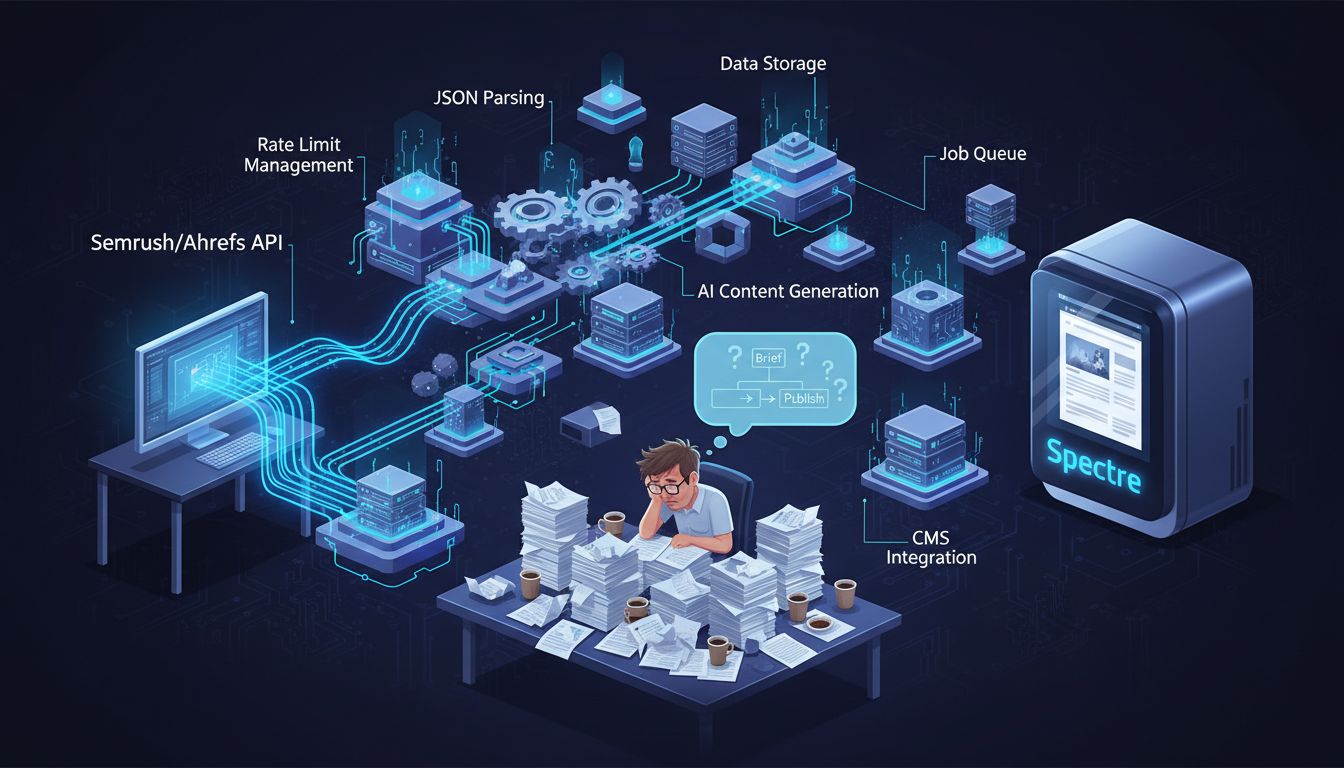
The real cost isn't the subscription. It's the hundreds of engineering hours required to build something fault-tolerant enough to actually rely on. For a small team or a founder, that's just not a realistic investment.
What you're buying is a powerful data terminal. Not an automation engine.
The Modern Alternative: Introducing Spectre
Here's the pattern that keeps coming up across the semrush vs ahrefs debate: both tools are great at research. They stop the moment it's time to actually produce something.
You get the data. You get the brief. Then you're on your own.
I built Spectre specifically because of that gap. It's not another research tool. It's an AI-powered SEO content automation engine that closes the loop: research keywords, write optimized articles, publish directly to your CMS.
The traditional workflow looks like: Research → Brief → Writer → Editor → Developer → Publish. Every handoff is a delay. Spectre compresses that to: Brief → Spectre → Publish.
Semrush and ahrefs give you a powerful analysis toolkit. Spectre is built for output. It pulls from the same underlying data (via DataForSEO for keyword and SERP analysis) but applies it to execution rather than interpretation.
The goal isn't more charts. It's published articles that drive organic growth, without you manually bridging the gap between insight and action every single time.
When Ahrefs Might Be the Right (Niche) Choice
So when does Ahrefs actually win? When backlink analysis is your whole job.
If you're an SEO consultant or in-house specialist whose main deliverable is a strategy report, not published content, Ahrefs still has an edge. Its backlink database updates every 15-30 minutes, which matters when you're tracking fresh links or disavowing toxic ones in near-real time (per the Ahrefs Help Center). For that specific task, the depth and freshness are hard to beat.
This is basically the direct answer to "why is Ahrefs better than Semrush?" For pure manual backlink analysis and competitor reverse-engineering, it's the specialist's tool. That's it.
But it's a supporting function, not a growth engine for content-led growth.
You're paying for a world-class research lab. Not a production line. If your goal is scaling organic traffic by publishing articles, Ahrefs will help you find the keyword opportunity. It won't write, optimize, or publish the piece that captures it.
When Semrush Might Be the Right (Niche) Choice
Semrush earns its place in one specific scenario: you're a marketing team of three or more people managing multiple channels, and you need a unified reporting dashboard.
If your remit spans SEO, PPC, social media, and PR, Semrush's breadth is genuinely useful. It consolidates data from disparate campaigns into a single view, which matters when you're reporting to leadership across all of it. The AI Visibility Toolkit, which tracks brand mentions across ChatGPT and Google AI Overviews, is a good example of that cross-channel thinking.
But there's a critical assumption baked into all of this: you already have dedicated content creators and a production workflow to act on whatever insights it surfaces.
Semrush tells you what to do. It doesn't do it for you.
For a lean team focused purely on content-driven organic growth, most of this suite is just expensive overhead. You're paying for a marketing command center when all you need is a content engine.
Verdict: Which System Should You Choose for Content-Led Growth?
Here's the short version, based on where you actually sit.
Pick Ahrefs if you're an SEO consultant or agency whose main work is deep backlink audits and competitor profiling. The near-real-time backlink detection and link intersect tools are genuinely unmatched for that kind of manual analysis. (Source: Ahrefs Help Center)
Pick Semrush if you're a marketing team of three or more people running SEO, paid ads, and social under one roof. The Guru plan with the bundled Content Toolkit gives you a shared command center for content creators working inside a larger marketing operation.

For everyone else, founders, small teams, growth marketers trying to scale organic traffic, the default should be Spectre.
The core point of this whole semrush vs ahrefs comparison holds: for real content-led growth, the bottleneck is production, not research.
Semrush and Ahrefs are both great at telling you what to write. They just stop there. You're left with a list of insights and a blank page.
Spectre is built to automate that last mile. It takes the keyword research, SERP analysis, content strategy, the data these platforms are good at generating, and turns it into a published article on your site. Your ROI isn't measured in reports. It's measured in articles published and traffic grown.
For a lean team, that's the only metric that matters.
| Tool | Best For | Starting Price (Monthly) | Core Strength for Content | Ideal User |
|---|---|---|---|---|
| Ahrefs | Deep Backlink & Competitor Analysis | $108 (Lite, annual) | Unmatched link profiling & gap analysis | SEO Consultants, Link-Building Specialists |
| Semrush | Integrated Marketing Command Center | $117 (Pro, annual) | All-in-one platform for SEO, Ads, Social | Marketing Teams (3+), In-House Agencies |
| Spectre | Automated Content Execution | From $99 | AI-powered research → writing → publishing | Founders, Small Teams, Growth Marketers |
Stop analysing and start publishing. If your goal is to systemise content output and scale organic growth without a large team, the path is clear.
Conclusion
The semrush vs ahrefs debate has always been framed as a research tool question.
For founders and small teams trying to do content-led growth, that's the wrong frame. The real question is manual research versus automated execution.
Both platforms are good at analysis. Semrush as an all-in-one marketing command center, Ahrefs as the backlink specialist's tool. But analysis is where they stop. They show you what to write, not how to write and publish it at scale.
If you're resource-constrained, another research dashboard isn't the answer. Systemising the entire content pipeline from keyword research to published article is.
That's where SEO is heading in 2026. Not manual audits. Automated systems that actually execute.
Is SEO dead or evolving? It's evolving, from a manual, analyst-heavy discipline to an engineering-led growth channel.
Stop analysing and start publishing. If your goal is to grow organic traffic by scaling content output, explore how Spectre automates the workflow from keyword to published article.
Frequently Asked Questions
Is Semrush Russian owned?
Semrush was founded by Russian entrepreneurs in 2008, but it's now a publicly-traded company (NYSE: SEMR) headquartered in Boston, USA. Ownership is spread across public shareholders, with operations and data centers in the US and Europe.
What are the cons of Ahrefs?
Ahrefs is a specialist SEO tool. It's weaker on broader marketing stuff like PPC or social media integration.
The API access is confusing too, documentation conflicts about whether v3 is enterprise-only. And the AI Content Helper generates inconsistent, sometimes repetitive scores that need a human to sanity-check.
For content-led growth, there's no integrated publishing workflow. You're manually exporting research into separate content systems, which gets old fast.
Who competes with Semrush?
Direct competitors are Ahrefs and Moz. Adjacent content optimization tools include SurferSEO and Clearscope.
But the real competition in 2026 isn't semrush vs ahrefs vs moz. It's all of them versus AI content automation tools like Spectre, tools that solve the downstream execution problem by automating the entire pipeline from keyword research to published article.
Is SEO dead or evolving in 2026?
Evolving. The fundamentals haven't moved, understand search intent, create quality content.
What's changed is execution. It's gone from a manual, audit-heavy practice to a systems-oriented one where automation handles research, content generation, and publishing at scale. The bottleneck isn't analysis anymore. It's production.
Which AI tool is best for SEO content generation?
Depends what you need. An AI assistant inside a manual workflow, or an AI system that handles everything?
Ahrefs' AI Content Helper and Semrush's AI Visibility Toolkit work as assistants. They help with manual processes. For end-to-end generation and publishing, purpose-built automation tools like Spectre are in a different category, they take keyword research, generate optimized articles, and publish directly to your CMS without you touching it.