February 21st, 2026
AI Content Creation Software for SaaS Marketing Teams: How to Choose
 WD
WDWarren Day
You've been tasked with scaling content output by 30% without adding headcount. Your patchwork of ChatGPT, SEO tools, and design apps is creating inconsistency and security headaches. You need a real solution, not another flashy demo.
The problem isn't that you lack content creation software. You're drowning in options. The real issue is that most SaaS marketing leaders choose tools based on feature checklists rather than strategic fit, which leads to wasted spend, brand drift, and workflows that fragment instead of scale.
Look, the AI-powered content creation market is exploding right now. Vendor consolidation is coming. Feature sets are diverging fast. The teams that lock in the right architecture now will compound their advantage while everyone else is still duct-taping tools together.
I've watched dozens of B2B SaaS teams make this evaluation. The ones that succeed stop treating AI content tools as "better writers" and start treating them as infrastructure. For your team, the optimal content creation software functions as a command hub. A central system that enforces brand governance, connects directly to your performance data (SEO rankings, CRM attribution, conversion metrics), and provides the security controls and workflow orchestration your legal and RevOps teams actually need.
This guide walks you through the 5-Pillar Command Hub Framework I use to evaluate platforms for teams like yours. You'll learn how to assess strategic fit, measure real ROI beyond "time saved," audit security and compliance requirements, and avoid the five implementation traps that derail most AI adoptions within 90 days.
The SaaS Marketer's Reality: Why Generic 'Best Of' Lists Set You Up for Failure

I've watched too many marketing leaders burn three months evaluating content creation software, only to realize six months later they bought an expensive writer when they needed a system orchestrator.
The typical "best AI content tools" listicle throws you a parade of capabilities. Blog generation, social copy, email templates. What it doesn't address is the operational reality you're actually living in. Your team isn't starting from scratch. You're already running ChatGPT for first drafts, Clearscope for SEO, Canva for visuals, and HubSpot for distribution. Stacking "the best AI writer" on top of this doesn't solve your problem. It compounds it.
Here's the part those lists skip: mature marketing teams run 2-5 AI tools in parallel once usage scales. Without something acting as central command, you end up with fragmented workflows, duplicated effort, and content that sounds noticeably different depending on which tool your writer grabbed that morning. Your brand voice fractures. Your SEO strategy becomes a patchwork quilt. Your CRM has zero visibility into what content is actually moving deals.
SaaS marketing has specific requirements that consumer-focused AI tools just ignore. You need product-led content that maps to a 90+ day consideration cycle. You need ABM integration so content connects to pipeline, not vanity traffic metrics. You need to protect proprietary product messaging and customer data when 75% of teams still don't have a formal AI roadmap in place.
Choosing content creation software without that roadmap is like hiring a senior writer without defining the role first.
You'll get output. But you won't get outcomes. The framework below gives you the structure to evaluate platforms as system infrastructure, not just fancy content generators.
Evaluating Content Creation Software: The 5-Pillar Command Hub Framework
I built this after watching three different SaaS teams pick platforms based on slick demos, then quietly shelve them six months later. The tools weren't bad. The teams just never had a structured way to match capabilities against what they actually needed to get done.
Think of this as a vendor-agnostic scorecard. Full template's at the end of the article, but here's how it breaks down:
The 5-Pillar Command Hub Framework:
- Strategic Fit & Core Workflow Coverage , Does it support the content types your team actually produces (landing pages, email sequences, product docs)?
- Content Quality, Brand Safety & E-E-A-T , Can it maintain your voice, enforce editorial standards, and pass Google's quality bar?
- Tech Stack Integration & Orchestration Capabilities , Will it connect to your CMS, CRM, and marketing automation without creating data silos?
- Security, Compliance & Organizational Governance , Does it meet SOC 2, GDPR, or your enterprise security requirements?
- Total Cost & Realistic ROI Modeling , What's the true cost beyond the subscription, and when will you actually see payback?
You're not looking for the platform that writes the prettiest first draft.
63% of B2B marketers are already using AI for promotional content like landing pages and email. The teams winning this transition are selecting content creation software that acts as the central nervous system for their entire content operation. Not just another word generator collecting dust in the stack.
Pillar 1: Strategic Fit & Core Workflow Coverage
Before you evaluate a single feature, map your actual content mix against what the platform was built to handle. I've seen teams spend $40K annually on tools optimized for blog SEO when 70% of their output is product documentation and email sequences.
Start with your four core SaaS content categories: top-of-funnel educational content (blogs, guides), product-led content (feature pages, comparison sheets), bottom-of-funnel conversion assets (case studies, demo scripts), and retention content (onboarding emails, help docs). Pull your last quarter's content calendar and calculate the percentage split. If landing pages and email sequences dominate your output, you need a platform with strong promotional content capabilities. Not one that excels at 3,000-word thought leadership pieces.
Here's what the generic "best of" lists won't tell you: a platform that crushes long-form SEO content often produces mediocre email copy, and vice versa. Jasper and Writesonic optimize differently than Copy.ai or Anyword. Your workflow mix should dictate the shortlist, not G2 ratings.
Now map the tool against your seven-step content workflow: strategy and ideation, brief creation, draft generation, internal collaboration, editorial approval, CMS publishing, and performance analysis. The platform shouldn't just accelerate step three (draft generation). It needs to integrate into steps two, four, and seven without creating new bottlenecks.
If your approval process lives in Google Docs and the AI tool exports only to proprietary formats, you've just added friction instead of removing it.
When evaluating demos, ask vendors to show you how their platform handles your second-most-common content type. Not the hero use case they've optimized the pitch around. Request a workflow walkthrough from brief to publish for a landing page, then a product comparison page, then a nurture email sequence. The gaps will surface fast.
What most SaaS teams actually need differs radically from what solo creators or agencies use. ChatGPT and Canva work for one-person operations. You need workflow orchestration, not just word generation.
Pillar 2: Content Quality, Brand Safety & E-E-A-T
The platform you choose will either enforce your brand standards or erode them at scale. I've seen teams publish 50 AI-generated blog posts before realizing they all sound like the same generic SaaS voice because the tool had no mechanism to encode their actual brand.
Your content creation software needs to function as a brand governance engine, not just a text generator.
Look for platforms that let you upload and enforce style guides, product glossaries, and tone parameters at the workspace level. Dynamic tone guides, where the AI references your approved language for product names, positioning, and even forbidden phrases, separate enterprise-grade tools from consumer apps. If you can't feed the system "never say 'cutting-edge' or 'game-changer'" and have it actually comply, you're stuck with manual QA on every draft.
The best platforms let you create custom knowledge bases: approved case studies, product specs, compliance language, and competitor positioning. When a writer (or the AI) generates a feature comparison, it should pull from your verified data, not hallucinate specs or accidentally plagiarize a competitor's messaging.
Apply editorial frameworks directly to your AI output.
The 4 pillars of content design (structure, clarity, consistency, and purposefulness) aren't abstract ideals. They're acceptance criteria. Your platform should support structured templates that guide AI toward these principles: section-level briefs, required H2/H3 structures, and output formats that match your CMS. If the tool spits out unstructured walls of text, you've just outsourced the hardest part of content creation back to your team.
The 5 C's of content creation (clear, concise, compelling, credible, and consistent) should inform your quality rubric. Platforms that offer scoring, readability checks, or brand voice deviation alerts make these frameworks operational instead of aspirational.
For SaaS SEO, E-E-A-T isn't optional. It's the filter Google uses to separate signal from spam.
Experience, Expertise, Authoritativeness, and Trustworthiness require human validation, but your platform should scaffold the process. Look for features like citation prompts, fact-checking workflows, and expert review stages. If the tool generates a claim about "AI content ROI," it should either link to a source or flag the statement for human verification.
Platforms like Anyword go further, layering predictive performance scoring (they claim 82% accuracy) on top of generation. You're not just asking "is this grammatically correct?" but "will this variant drive conversions based on historical data?" That's the shift from content production to performance prediction.
If your platform can't enforce brand voice, structure editorial workflows, or support E-E-A-T validation, you're not scaling quality. You're scaling risk.
Pillar 3: Tech Stack Integration & Orchestration Capabilities
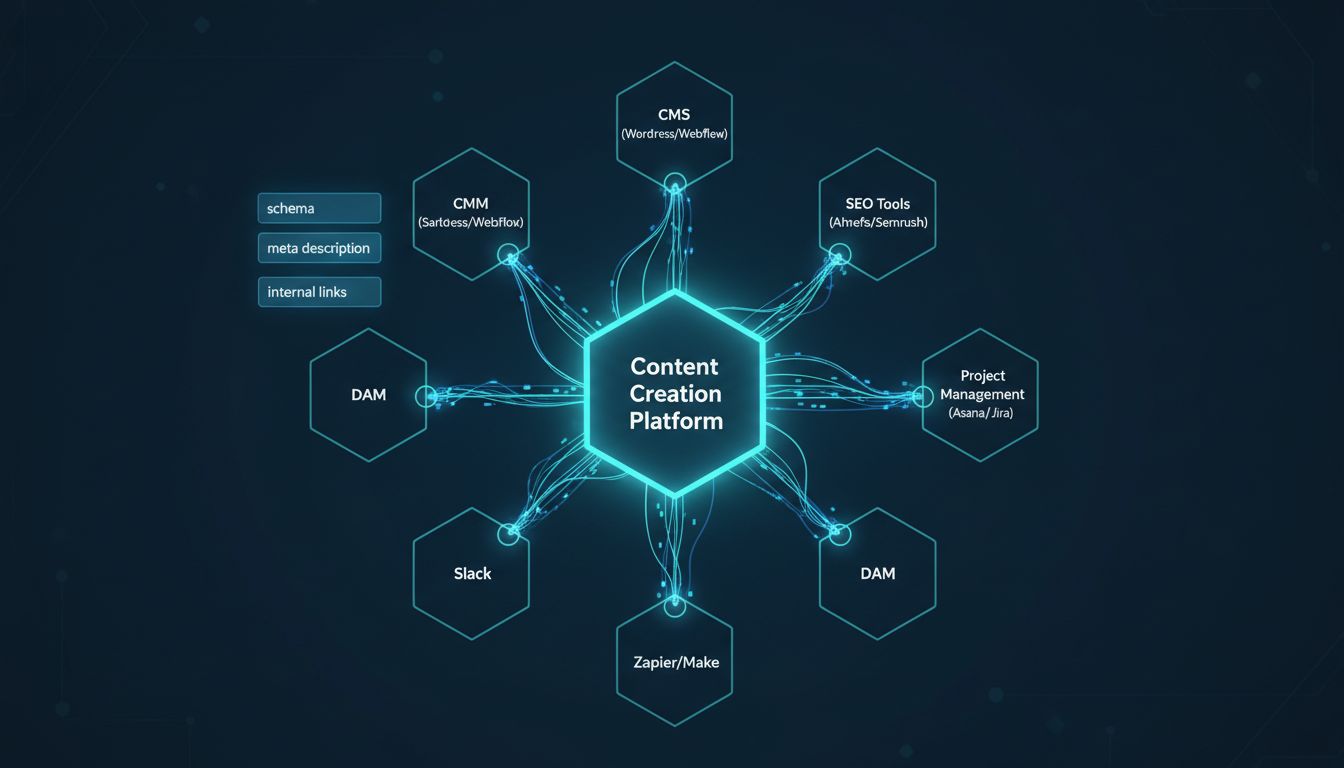
Your content creation software doesn't exist in isolation. It needs to plug into the ecosystem you've already built, or you'll spend more time copying, pasting, and reformatting than actually creating.
I learned this the hard way when a platform we selected had "integrations" that turned out to be glorified export buttons. We ended up with a team member spending six hours a week manually moving content between systems. That's not scaling. That's creating a new bottleneck.
Start with your non-negotiables. For SaaS teams, three integrations are table stakes: your CMS (WordPress, Webflow, HubSpot), your CRM (Salesforce, HubSpot), and your SEO data platform (Ahrefs, Semrush). These aren't nice-to-haves. They're the infrastructure for a closed-loop system where content performance feeds back into creation decisions.
Your CMS integration should support direct publishing with metadata intact, meta descriptions, schema, internal links. If you're manually copying drafts into WordPress and rebuilding formatting, the platform failed. CRM integration matters because 63% of B2B marketers use AI to create promotional content like landing pages and email sequences, content that needs to tie directly to lead data and campaign attribution.
The API and automation layer is where most platforms reveal their limitations. You need a robust, documented API for custom connections your team will inevitably need. But you also need native support for no-code automation tools like Zapier or Make, because your content ops person shouldn't require a developer to route a draft from creation to Slack to your project management tool.
Here's the contrarian take: while some platforms bundle free social media management tools and claim to be "all-in-one," SaaS teams should prioritize deep, reliable integrations over shallow feature breadth.
A platform that does content creation exceptionally well and connects cleanly to specialized tools will outperform a bloated suite that does everything poorly. Think CapCut for video editing, ElevenLabs for voice synthesis, your DAM for asset management. Clean handoffs beat feature sprawl every time.
This pillar is where the "command hub" thesis becomes operational. The platform you choose should be where briefs are created, drafts are generated, and work is routed from. Not where everything happens. The goal is orchestration, not consolidation.
Pillar 4: Security, Compliance & Organizational Governance
The first time a sales prospect asks "where is our data stored?" or your legal team flags an IP concern, you'll realize security isn't a checkbox. It's a veto point. I've seen vendor selections reversed three weeks before launch because someone finally read the data processing terms.
For SaaS companies, the risk profile is compounded. You're not just protecting your own IP, product roadmaps, unreleased features, competitive positioning. You're also handling customer data, PII from case studies, and proprietary research that, if leaked or used to train a vendor's model, could surface in a competitor's output.
Start every RFP with the vendor security checklist. Require explicit evidence of SOC 2 Type II or ISO 27001 certification. Not "in progress," but audited and current. Verify GDPR and CCPA readiness, and insist on a Data Processing Addendum (DPA) that clearly defines data ownership, retention, and deletion rights.
Data residency matters more than most teams assume. If your customer base includes EU or healthcare verticals, you need vendors that offer regional data residency options. OpenAI's expansion into multiple regions for enterprise customers is the benchmark here. The alternative is explaining to a customer why their support ticket data is being processed in a jurisdiction they didn't approve.
The most critical question is the vendor's data training policy. Copy.ai explicitly states they don't use customer prompts to train their models. That's the standard you're looking for. Anyword lists SOC 2, ISO 27001, GDPR, and HIPAA compliance, signaling they understand regulated environments. If a vendor is vague about whether your inputs become part of their training corpus, assume the worst and move on.
Vendor compliance is only half the equation. Your content creation software must support internal governance. Look for audit logs that track who generated what, access controls that limit which teams can publish externally, and version history that proves editorial oversight occurred. These aren't enterprise-only features. They're the evidence trail you'll need when leadership asks "how do we know this content is compliant?"
The reality most teams miss: 21% of companies still have no formal AI policy, and 75% lack an AI roadmap. Your platform should make policy enforcement easier, not optional. If it can't log, limit, or audit, you're building risk into your workflow by design.
Pillar 5: Total Cost & Realistic ROI Modeling
Most pricing pages show you what you'll pay per seat. What they don't show: the integration costs, API overages, training time, and change management overhead that make up your actual total cost of ownership.
I've seen teams budget $15K annually for a platform, then spend another $8K on API calls to OpenAI, $12K on a consultant to build workflows, and burn 40 hours of internal time on training. That's not a $15K decision. It's a $35K decision with a three-month ramp period.
Model your TCO honestly. Include subscription tiers, estimated API consumption (especially if the platform charges separately for model access), onboarding and training hours (multiply by loaded hourly cost), integration development time, and any required middleware or workflow automation tools. If you're replacing agency work, quantify those avoided costs. If you're scaling in-house output, calculate the marginal cost per additional piece.
Now for the uncomfortable part: vendor ROI claims versus reality. Jasper's Forrester TEI study reports 342% ROI over three years with payback under six months. That's a compelling headline. Industry analysts tell a different story. Typical generative AI payback often takes 2-4 years, and only a minority report payback under one year.
Use vendor case studies as a hypothesis, not a guarantee. Your content mix, team maturity, and measurement rigor will determine whether you hit those numbers or fall short.
Define KPIs before you sign. I track four:
- Time saved per content piece: Measure baseline production hours now, then track weekly after rollout.
- Agency cost avoided: If you're replacing outsourced work, this is straightforward. Dollars not spent.
- SEO traffic lift: Baseline your organic sessions and conversions by content type, then measure quarterly.
- Lead conversion lift: A/B test AI-generated landing pages or email sequences against your current control.
Look, 56% of marketers using AI have surpassed organizational goals, and 56% use it for SEO tasks. But "potential" and "realized ROI" are separated by measurement discipline. If you can't baseline your current performance, you won't be able to prove the platform's impact when your CFO asks six months in. And they will ask.
The Implementation Trap: 5 Common Pitfalls That Derail AI Adoption (And How to Avoid Them)
You've chosen your platform. The contract is signed. Now comes the part where most SaaS teams stumble.
I've watched well-researched vendor selections crash within 90 days because teams underestimated what it actually takes to change how they work. The numbers are brutal: 75% of teams lack an AI roadmap, and 58% cite skills gaps as their top challenge. Here's how to avoid joining them.
1. No Governance or Roadmap Before Purchase
Choosing a tool before establishing an AI use policy is like hiring writers before defining your editorial standards. You'll get output, sure. But it won't be strategic.
Draft your governance framework while you're evaluating vendors, not after. Define who approves AI-generated content, what requires human review, and how you'll audit for compliance. Make this a Pillar 4 prerequisite. Not an afterthought.
2. Ignoring the Skills Gap

The platform doesn't run itself.
Teams assume AI means "set it and forget it," then wonder why everything sounds generic. Budget for real training, not a single onboarding call. Designate power users per content type (blog, landing page, email) and give them actual time to develop effective prompt frameworks. Here's the reality: 70% of employers don't provide generative AI training, which explains why so many implementations plateau after the first month.
3. Expecting Overnight Payback
Some vendor case studies claim sub-six-month ROI. Industry data shows typical generative AI payback takes 2-4 years. The truth is somewhere in between, depending on your baseline and use case.
Set 6-month pilot KPIs tied to Pillar 5 metrics: time saved per asset, agency cost avoidance, conversion lift on AI-optimized pages. Measure monthly. Adjust workflows based on what actually moves numbers, not what the demo promised. If a tactic isn't delivering within 90 days, kill it and try something else.
4. Overlooking Data Privacy Policies
Your vendor's training policies determine whether your proprietary positioning ends up in a competitor's output.
Make the Pillar 4 checklist non-negotiable: verify opt-out from model training, confirm data residency, and require a signed DPA before launch. I've seen teams discover six months in that their vendor was training on customer inputs by default. By then, your differentiation is already in the training data.
5. Assuming a Single Tool Will Do Everything
Once usage matures, teams typically run 2-5 AI tools in parallel. Your content creation software is the hub, not the universe.
Choose your primary platform for its orchestration capabilities (Pillar 3), then plan how it connects to your SEO tool, CMS, and analytics stack. A hub-and-spoke model beats trying to force one tool into every workflow. Sometimes the best content creation software is the one that plays nicely with everything else you're already using.
Conclusion
Look, the AI content market is booming. But market size doesn't matter if you pick the wrong platform for your team.
Your job isn't finding the "best" content creation software according to some listicle. It's choosing the command center that actually connects your workflows, protects your brand voice, plugs into your existing tools, and pays for itself without creating a compliance headache down the line.
The five-pillar framework (strategic fit, quality controls, integrations, compliance, and realistic TCO) gives you a repeatable way to make this decision once and get it right. Because here's what most teams miss: 75% lack any AI roadmap at all, and typical payback takes 2-4 years. You need a scorecard, baseline metrics, and internal governance locked down before you sign anything.
Download our free, editable AI Content Platform Evaluation Scorecard Template to put this framework into action immediately. Your leadership wants 30% more content velocity. Give them a system that actually scales without breaking.
Frequently Asked Questions
Which software is best for content creation?
There isn't one. Best is whatever fits your workflow and actually moves your metrics.
For a SaaS marketing team, you need content creation software that acts as your system hub. That means integrating with your CMS and CRM, enforcing brand guidelines across everyone who touches content, protecting your IP with SOC 2 compliance, and connecting what you publish to funnel metrics like organic traffic and MQL velocity. If a platform can't prove it drives those outcomes in your specific stack, you're paying for an overpriced text generator.
What are the 5 C's of content creation?
The 5 C's break down as Clarity (easy to understand), Concise (no filler), Compelling (engages the reader), Credible (backed by data and expertise), and Call-to-Action (drives next steps).
The framework only works if you can actually enforce it at scale. That requires platform features: templates and content briefs that lock in Clarity and structure, brand voice profiles maintaining Credible consistency across different writers, and built-in CTA optimization so every piece drives conversion. Without your content creation software operationalizing these principles, they're just nice ideas in a deck somewhere.
What do most content creators use?
Solo creators lean on ChatGPT for drafts, Canva for visuals, CapCut for video. Tools optimized for speed and individual workflows.
SaaS marketing teams need completely different infrastructure. Multi-user collaboration with role-based permissions. Approval workflows enforcing brand and legal review. Version control. Direct integrations to publish into your CMS, marketing automation platform, and analytics stack [Source: gtm8020.com]. The gap between a solo creator's toolkit and enterprise content systems is massive, which explains why 75% of teams still don't have a formal AI roadmap [Source: gtm8020.com].
What are the 4 types of content creation?
The four types map to funnel stages.
Educational/TOFU covers thought leadership and SEO-driven guides. Product/Feature includes use case explainers and integration docs. Conversion/BOFU means case studies, ROI calculators, comparison pages. Retention handles onboarding sequences, feature announcements, customer success content.
Your content creation software should have distinct workflows for each. TOFU needs SEO brief templates and keyword clustering. BOFU requires personalized case study frameworks pulling CRM data. Retention content should trigger from product usage signals. A platform treating all four types identically will underperform on at least three of them.
What are the 7 steps of content creation?
Strategy (audience and goal definition), Briefing (research and structure), Creation (drafting and design), Collaboration (SME input and revisions), Approval (legal, brand, and leadership sign-off), Publishing (distribution to channels), and Analysis (performance tracking and iteration).
AI accelerates Briefing and Creation. Research time drops 40-60%, first-draft cycles shrink from days to hours. But only if your platform integrates with the tools handling the other five steps [Source: jasper.ai].
Look for content creation software with native CMS connectors, approval workflow automation, and bi-directional analytics integrations. Otherwise you just move the bottleneck from drafting to publishing, which solves nothing.
What is replacing CapCut?
CapCut still dominates short-form video editing, but AI-native tools are capturing enterprise budgets. Synthesia and HeyGen handle scalable avatar-based product demos and training videos. Descript and Runway offer AI-enhanced editing like automatic transcription, one-click filler removal, generative B-roll.
For SaaS teams, the shift isn't about replacing CapCut. It's choosing content creation software that can brief and orchestrate video projects: defining messaging, pulling brand assets from your DAM, tracking video performance in your attribution model. The actual editing can still happen in a specialized tool.