June 21st, 2026
AI Content Writer vs AI Content Generator: Which Is Right for Your SEO Stack?
 WD
WDWarren Day
You've been tasked with scaling content to hit growth metrics. You've tried piecing together ChatGPT, keyword tools, and WordPress, and now you're drowning in tabs, not traffic.
The real bottleneck isn't ideas. It's your time.
The confusion starts with terminology. Choosing an AI content writer versus a content generator isn't really a feature comparison. You're buying completely different outcomes. One sells you a faster draft. The other should sell you ranking articles.
Most tools ignore the brutal reality: your scarcest resource isn't computing power. It's skilled human hours for research, editing, and publishing.
This article cuts through the marketing noise. We'll compare these tools across four practical axes: workflow integration, output quality, true cost-per-ranking-article, and scalability.
And I'll show you why, for technical founders and growth marketers, the economically viable path isn't picking between a writer or a generator. It's a third category entirely, AI content automators like Spectre that handle research, writing, and publishing as a single system.
That matters if you're evaluating free ai writing tools like chatgpt against paid alternatives, or trying to figure out what's actually worth paying for in ai content writer jobs and workflows. The market is noisy. This should help.
What Is an AI Content Generator?
An AI content generator is a tool built to produce high volumes of text from a prompt. Text factory is actually a decent way to think about it, you put in a request, you get content at scale. There's no single agreed-upon definition, but these tools are categorised by their feature set.
Where they live: ideation, rapid drafting, high-throughput output where ranking isn't the immediate goal. Need 7,500 product descriptions in 24 hours? That's a generator job. Platforms like Jasper are built for that kind of volume. Base LLMs like ChatGPT, Gemini, and Claude are the engines underneath.
The limitation is what they don't do.
They don't understand SERP competition, SEO structure, or E-E-A-T signals, not without you doing a lot of the work yourself. They're fast at producing words. Those words just won't be positioned to rank unless you build that context in manually.
That's the gap most people miss when they're comparing a free ai writing tool like ChatGPT against something purpose-built for SEO. Fast output isn't the same as useful output.
What Is an AI Content Writer?
An AI content writer is a tool built specifically to create search-optimised content that ranks. Not just generate text, actually rank.
Unlike general generators, these platforms have SEO baked in from the start. They research keywords, analyse SERP competition, and build structured briefs before they write a single word.
Frase, for example, automatically pulls topics and questions from top-ranking pages to build your brief. Surfer AI drafts content based on NLP analysis of what competitors already have. The whole point is cutting down manual research time and giving you a data-informed starting point instead of a blank page.
That said, and this part matters, the draft is just a draft.
The research from digitalapplied.com puts it at 2–4 hours of fact-checking and human editing before an AI-generated article is actually rank-worthy. The sweet spot for editing is somewhere around 25–45% of the word count rewritten or reworked.
So if you're looking at ai content writer jobs, that's still a real job. The tools do the heavy lifting on structure and research. A human still has to make it good. And if you've been using free ai writing tools like ChatGPT to skip that editing step entirely... that's probably why the traffic isn't moving.
Decision Axis 1: Workflow & Hidden Labor
This axis measures the real, skilled work required to move a keyword idea to a published, optimized post. Not features. How many manual steps you're still doing.
AI Content Generators (like ChatGPT or Jasper) give you text. That's it. You're still manually researching the SERP, crafting a brief, writing the perfect prompt, copying the output, fact-checking every claim, applying on-page SEO, formatting for your CMS, and hitting publish.
The labor cost is real. Source: cited.so puts it at 2–4 hours of skilled editing per article. That adds up fast.
AI content writers (like Frase or Surfer AI) automate a chunk of this. They pull SERP data and generate a brief for you. But you still configure the tool, review the brief, guide the structure, copy the output into your editor, and publish.
Frase has a case study showing 180 hours saved per month (Source: frase.io). That's real. But the workflow is still manual and fragmented, just a slightly shorter version of the same thing.
AI Content Automators (like Spectre) handle the entire pipeline. You give it a seed topic or target keyword. It researches the SERP, builds a data-driven brief, writes the article, applies SEO best practices, and publishes directly to your site.
Your role shifts from doing the work to reviewing it and adding final expert insight. The constant context-switching between Ahrefs, free ai writing tools like ChatGPT, your CMS, and a checklist, that disappears.
For founders and growth teams trying to scale output without scaling headcount, that distinction matters a lot. AI content writers improve an inefficient process. Automators like Spectre redesign it. And if you're thinking about ai content writer jobs, that's worth understanding, because the role looks pretty different depending on which category of tool you're working with.
Decision Axis 2: Output Quality & SEO Viability
This axis measures whether a tool produces text that can actually rank, or just... text.
AI content generators are good at volume. SEO viability is another story. The data isn't subtle: purely AI-generated content hit the top search position 9% of the time, versus 80% for human-written content. A Google experiment found AI pages index fast (71% within 36 days) but only 3% were still in the top 100 results after about three months [Source: Search Engine Land].
For ranking intent, generators aren't a standalone solution. They're useful for ideation. Not for final drafts.
AI content writers like Frase or Surfer AI give you something more useful: SEO frameworks, outlines, keyword suggestions, content scores. Real edge over generators. But the raw draft usually lacks narrative depth and E-E-A-T signals without a lot of human work on top.
The optimal editing ratio for best traffic outcomes is 25–45% of the article's word count [Source: Digital Applied]. So you're still paying for substantial editing time before it's rank-worthy.
AI content automators like Spectre are built differently. The goal from the start is to match the topical authority and depth that Google actually rewards, not just drop in keywords and hope. So the editing work shifts from fixing fundamental problems to adding your expertise and brand voice.
Here's something most tools ignore: your domain rating sets a ceiling on what you can realistically rank for. A low-DR site publishing generic ai content writer output is burning resources. You need fewer articles, better targeted, going after keyword clusters you can actually win.
Spectre's strategy is built around that reality. It doesn't just write. It figures out what's worth writing given where your site stands right now.
Generators produce drafts you can't publish. Writers (whether human or an ai content writer tool) produce foundations you still need to edit. Automators are designed to get you to near-publishable from the jump, and if you're thinking about free ai writing tools like ChatGPT as a comparison point, the gap in ranking outcomes is pretty significant.
Decision Axis 3: True Cost & Time-to-ROI
This axis measures what most tools and most founders get wrong: the total loaded cost to produce one ranking-ready article. Not just the monthly subscription. Subscription plus the loaded cost of your skilled human time.
Model it properly and the economics flip.
AI Content Generators look cheap on paper. A ChatGPT Plus subscription is $20/month. But the hidden labor is enormous. You're spending 3–4 hours on research, structuring, editing, and SEO optimisation. At a reasonable freelance rate of $50/hour, that's $150–200 of skilled work per article before you've published anything.
Total cost per piece is high. Time-to-ROI stretches out over months.
AI content writers like Frase or Surfer AI cost more, typically $60–$150/month. They reduce the labor burden with SEO briefs and optimisation scores, but you're still looking at 2–3 hours of editing and fact-checking per piece. The optimal editing ratio for best traffic outcomes is 25–45% of word count [Source: Digital Applied]. That's still $100–$150 in human time.
Total cost-per-ranking-article: medium-high.
AI Content Automators like Spectre run a similar tool cost to premium writers. The difference is in labor. Keyword research, SERP analysis, drafting, on-page optimisation, it's one pipeline. Your review time drops to 0.5–1 hour. You're not editing from scratch; you're validating and adding unique insight.
At the same $50/hour rate, that's $25–$50 in human time per piece.
The thing most people miss: a founder's or marketer's time is the most expensive resource in a startup. When you factor that into the model, automation's payback period collapses. Full-stack automators often hit ROI in under 90 days because they immediately reclaim 10–15 hours of skilled work per week.
| Tool Type | Monthly Tool Cost (Est.) | Human Time per Article | Loaded Cost per Article (@$50/hr) | Total Cost per Ranking Article |
|---|---|---|---|---|
| Generator | $20–$50 | 3–4 hours | $150–$200 | $170–$250 |
| SEO Writer | $60–$150 | 2–3 hours | $100–$150 | $160–$300 |
| Automator (Spectre) | $60–$150 | 0.5–1 hour | $25–$50 | $85–$200 |
The verdict is arithmetic. For resource-constrained teams, a full-stack automator delivers the lowest blended cost-per-ranking-article and the fastest path to positive ROI. And if you're evaluating free ai writing tools like ChatGPT against this, the time cost alone changes the math pretty fast.
You're not buying a tool. You're buying back your own time.
Decision Axis 4: Scalability & Team Dependence
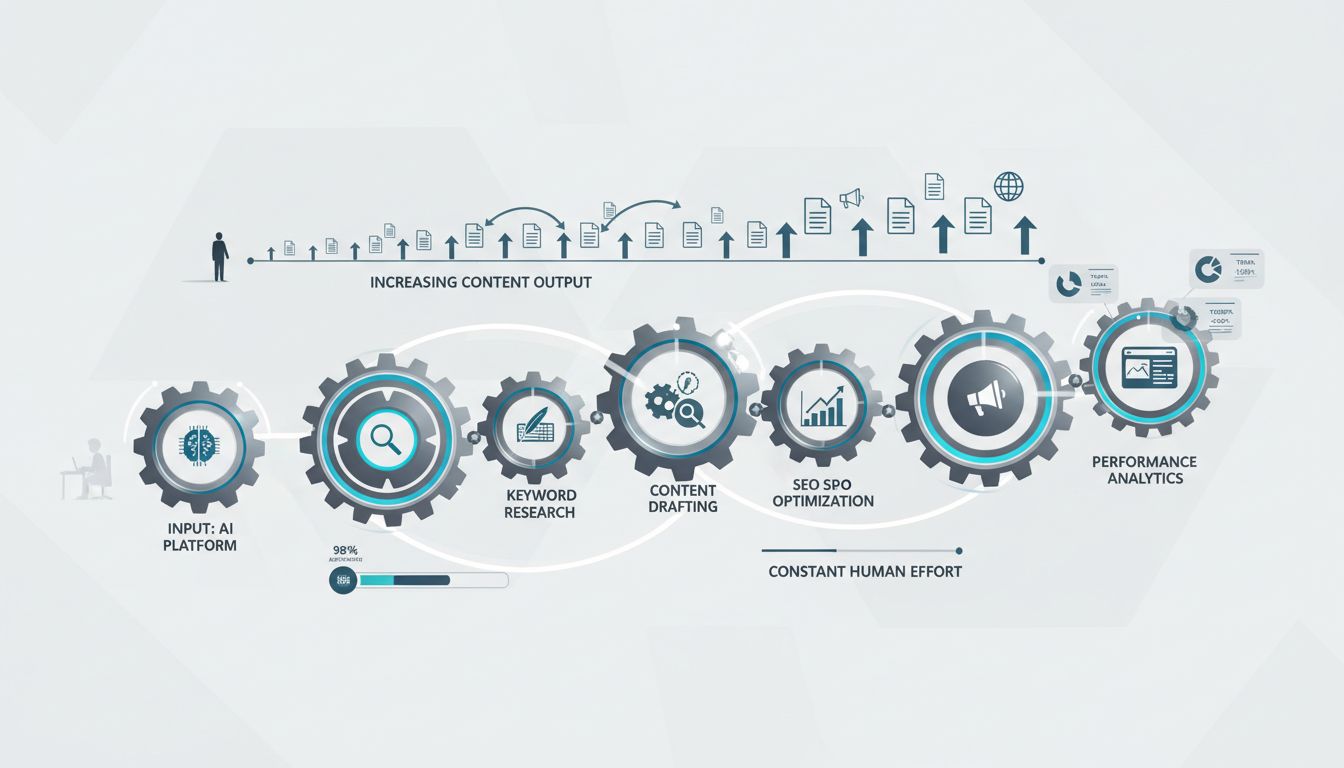
Can your content engine actually grow with your business, or does it hit a wall the moment you try to scale?
That's what this axis measures. Whether you can increase output without running into a hard ceiling on team capacity or your own bandwidth.
AI content generators fail this test completely. Scaling output means scaling manual effort. Need 10x more articles? You'll spend 10x more time prompting, editing, and publishing. Tools like Jasper can produce 7,500 product descriptions in 24 hours, but someone still needs to format, upload, and check every single one.
That's not scalability. It's just moving the bottleneck from writing to operations.
AI content writers offer something in between. You can produce more drafts, but each one needs the same editorial oversight. Agencies using these tools report hitting 80–100 articles monthly, but that throughput comes with proportional increases in editing hours and project management overhead.
You're trading writing time for coordination time. Not a great trade.
AI content automators like Spectre are built for true scalability. Once you define your content rules, keyword clusters, and publishing cadence, the system runs on its own. There's no linear relationship between output volume and human effort.
Spectre was designed specifically for founders who need to grow organic traffic without hiring an entire content team. You set the strategy. The platform handles everything from research through publishing.
The verdict: if you're a founder or growth lead using content as a primary acquisition channel, anything less than full automation creates an operational ceiling you'll hit within months. And if you're still weighing free ai writing tools like ChatGPT against purpose-built automators, this is the axis where that comparison breaks down the fastest.
Scalability isn't about producing more text. It's about creating ranking content without proportional increases in skilled human time. There's a difference, and it matters a lot once you're trying to grow.
The Edge Cases: When a Generator or Writer Makes Sense
The previous sections framed this as a growth decision. But there are specific scenarios where a simpler AI content generator or a manual AI writer is actually the right call.
Choose an AI content generator if your primary need is raw creative text for non-SEO purposes. This is where free AI writing tools like ChatGPT live, brainstorming, ad copy variations, social media posts. If you need 7,500 product descriptions in 24 hours (as one Jasper case study documented [Source: Jasper.ai customer stories]), a pure generator delivers volume no human can match. It also applies to established media sites with domain ratings above 70, where brand authority alone can carry basic topical coverage.
Choose an AI content writer like Frase or Surfer SEO if you're an SEO consultant doing bespoke work across diverse clients. These tools give you granular control over briefs and SERP analysis, which matters when every client has a different niche. They also make sense if you already have a skilled editorial team, the writer becomes a drafting assistant that amplifies what they do, not a replacement for it.
For founders and in-house marketers trying to scale organic growth, though, these are narrow edge cases. The generator path works for experimental or non-critical content. The manual AI content writer path works when specialised editorial labour is your core asset.
For everyone else, trying to build a scalable acquisition channel with either approach runs straight into the operational ceiling we've already mapped.
Which Should You Choose? Your Decision Flowchart
Forget feature lists and pricing pages. Three questions will get you there.
Start here: Is your primary goal to create content that ranks in search engines?
If No, you're drafting internal documents, brainstorming, or writing non-critical web copy, use an AI content generator like ChatGPT. Fast, cheap, good enough for ideation. Free AI writing tools like ChatGPT are built for exactly this.
If Yes, you need SEO traffic, keep going.
Question 2: Do you have a dedicated content editor or team to handle keyword research, SERP analysis, brief creation, and deep structural editing?
If No, you're a founder, solo marketer, or small team wearing multiple hats, your bottleneck is skilled editorial time, not writing speed. An AI content automator like Spectre is your only real path. It handles everything we mapped in Axis 1, from research to publishing, so you can put your hours into strategy and final polish.
If Yes, you have dedicated editorial capacity, one more question.
Question 3: Do you need to publish more than 20 ranking articles per month, consistently?
If No, and your domain rating is above 50, a traditional AI content writer like Surfer AI or Frase may be enough. You'll still manage the glue between tools, but a solid team can absorb that overhead.
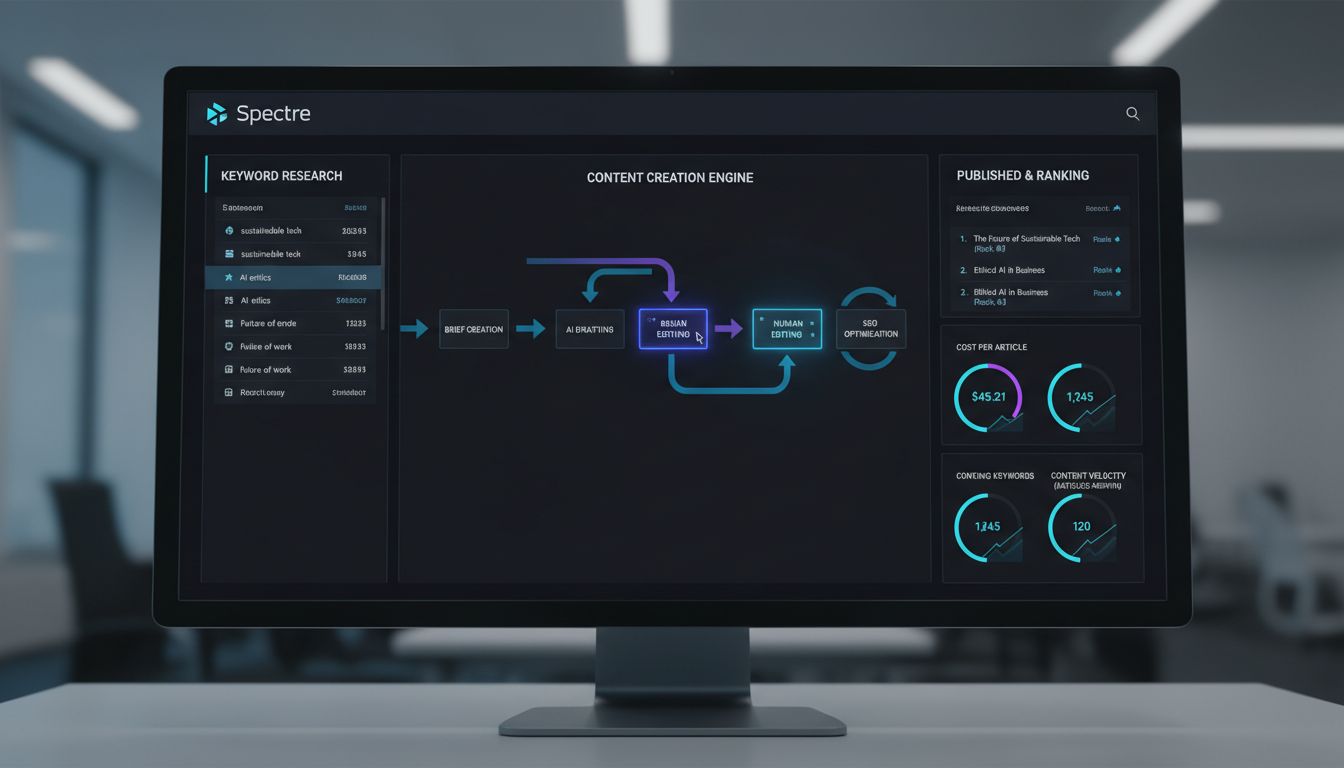
If Yes, you're scaling an acquisition channel, manual workflows break at volume. That's just the math. Spectre's automated pipeline keeps your true cost-per-article low and predictable.
Here's where most founders and growth leads land.
For teams who need ranking content at scale without a proportional increase in headcount, Spectre is the modern answer. It's not just another AI content writer, it's an automated SEO content pipeline that closes the "authority ceiling" gap by systematically targeting keywords your domain can actually win.
Hybrid AI-human workflows perform 127% better than raw AI output [Source: digitalapplied.com]. Spectre is built for that model, automating the 80% of rote work so your team can focus on the 20% of strategic editing that actually moves rankings.
Your time is your scarcest resource. Bet it on strategy.
Conclusion
Choosing between an AI content writer and a generator isn't really about features. It's about where your time goes.
Generators produce text. SEO writers create drafts. Full-stack automators actually remove the hidden labor tax and deliver ranking outcomes. That's a meaningful difference when you're measuring true cost-per-ranking-article.
For founders and marketers trying to scale organic growth, automation isn't a nice-to-have. It's the only thing that makes the math work.
Spectre handles the 80% of rote work, research, drafting, optimization, so your team can focus on the strategic editing that actually moves rankings. There are free ai writing tools like chatgpt for quick ideation, and there are ai content writer jobs that exist to manage the gap between those tools. Spectre closes that gap.
If you're ready to stop paying for labor-intensive workflows and start running an actual automated content pipeline, explore Spectre's features or start a free trial.
Frequently Asked Questions
What does an AI content writer do?
An AI content writer is a tool built to automate the creation of SEO-optimised content that actually ranks. Not just generate text, handle keyword research, SERP analysis, brief creation, and optimisation scoring.
You're not buying a text generator. You're buying a system built for one specific outcome: organic traffic growth. Spectre handles this entire pipeline, from research to publishing.
Is AI written content good for SEO?
Yes, but the qualifications matter. Pure, unedited AI content ranks in the top position only 9% of the time, versus 80% for human-written content [Source: semrush.com].
To actually work for SEO, AI content needs substantial human editing, somewhere around 25-45% of the word count, to inject the expertise and trustworthiness that search engines reward [Source: digitalapplied.com]. Spectre is built around this from the start, with human-in-the-loop elements baked in by design.
Which AI is best for SEO content?
The "best" tool is the one that produces ranking articles at the lowest total cost, and that includes your editing time, not just the subscription price.
For founders and SMBs without a dedicated content team, a full-stack automator like Spectre is usually the most economically viable path. For teams that already have skilled editors, something like Surfer AI or Frase can work, though they still require a lot of manual orchestration.
Can ChatGPT write SEO content?
ChatGPT can follow SEO instructions, but it's a general-purpose generator. There are free ai writing tools like ChatGPT that are genuinely useful for drafting, but they don't come with built-in SERP research, real-time optimisation scoring, or publishing automation.
Using it for serious SEO means you're manually handling research, briefing, optimisation, and deployment. That process quietly makes your true cost-per-article prohibitively high. It's a useful component, not a complete system.
Will AI replace SEO content writers?
It won't replace them. It'll change what the job looks like.
The shift is away from manual drafting and toward higher-value work: expert editing, fact-checking, and injecting the kind of unique perspective that makes content trustworthy. There are already ai content writer jobs built around exactly this, managing the gap between raw AI output and publishable, authoritative content. Spectre automates the rote parts so human talent can focus on that.
Is SEO dead or evolving in 2026?
Evolving, not dead. AI-driven search interfaces like AI Overviews change click-through dynamics, but they also raise the premium on expert-led, highly relevant content.
Winning in 2026 means building topical authority and demonstrating E-E-A-T at scale, consistently, not occasionally. That's where purpose-built AI content automators actually earn their place, producing trustworthy content at a volume a human-only team can't realistically sustain.