April 19th, 2026
How AI SEO Tools Are Shaping Careers in Freelance Writing
 WD
WDWarren Day
You're a freelance writer. You've seen the headlines, felt the anxiety, maybe watched a few low-paying gigs quietly disappear. The numbers back it up: writing jobs dropped 30.37% after AI hit the scene.
So yeah, the easy work is drying up.
But here's what most of those doom articles skip over. AI-written pages now show up in 17.31% of top Google results. That's not proof you're obsolete. That's actually a map for where careers in freelance writing are heading next.
The market isn't shrinking. It's splitting in two.
Freelancers offering AI-augmented services are already charging 30-40% more. Demand for specialists who can "humanize AI content" went up 641%. Those aren't small numbers.
The real shift isn't AI taking your job. It's AI handing you a different one, a better one. You stop being a pure content producer and start being the person who runs the system, shapes the strategy, and makes the output actually good.
That's what this piece is about. We'll get into the mixed economic data most articles gloss over, walk through how to integrate tools like Surfer SEO and Ahrefs into real workflows, and show you how to reposition your services so you're not competing on price anymore.
You'll also see why domain rating basically dictates your entire keyword strategy, how to build content pipelines that outperform manual work, and which hybrid skills like prompt engineering and automation setup are already pulling premium rates.
This applies whether you're looking at upwork freelance writing gigs, freelance creative writing jobs, or trying to break in through entry level writing jobs no experience remote. Even if you're hunting for writing sites that pay daily for beginners or freelance writing jobs remote no experience, the underlying shift is the same.
The writers who come out ahead won't just be good with words. They'll understand the systems those words live inside.
How AI SEO Tools Are Reshaping Content Production (and Your Workflow)
Start with the numbers. The Averi.ai 2026 Benchmarks show AI lets marketers publish a median of 17 articles per month versus 12 without it, a 42% jump in output, with production costs dropping by the same amount. That's not a projection. It's already happening in agencies right now.
When you see Surfer SEO claiming freelancers can produce a "high-quality article in under 20 minutes," be skeptical. I've built systems using Surfer's API. What they're actually selling is a compressed drafting phase, not a finished publishable piece. The 20-minute clock assumes the keyword research is already done, the brief is perfect, and you're editing an AI draft built on a proven template.
In practice, you're trading time writing for time engineering prompts, hunting down hallucinated facts, and restructuring content that missed the point.
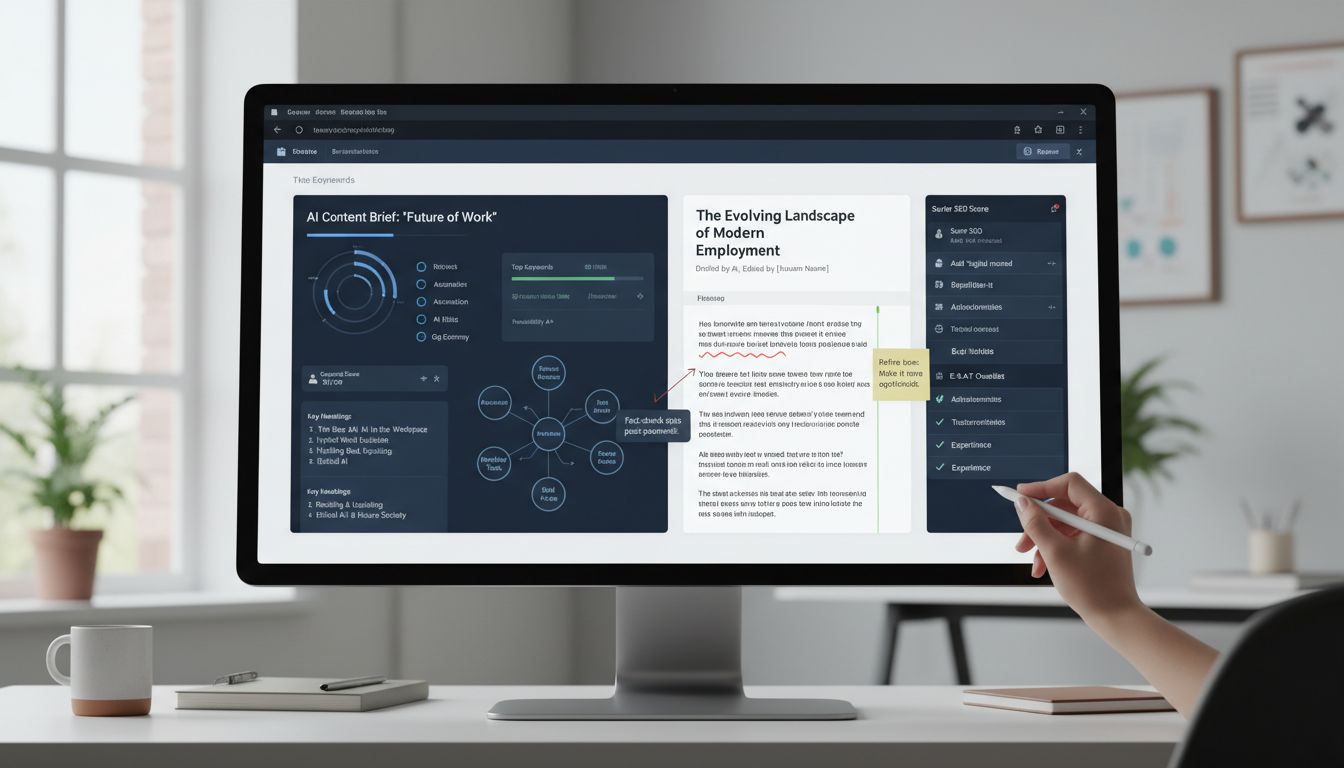
The modern AI workflow looks nothing like opening a blank doc and writing. It's a pipeline:
- Research & Briefing: Tools like Frase or Semrush's AI Writer take a keyword and produce a content brief in minutes, analyzing top-ranking pages, suggesting headings, estimating word count.
- Draft Generation: You feed that brief into ChatGPT, Claude, or a platform-specific AI like Jasper. This is where the 20-minute clock starts.
- Optimisation & Scoring: Drop the draft into Surfer SEO or Clearscope. They score it against NLP models and SERP winners and tell you what to adjust, keyword usage, paragraph length, readability.
- Humanisation & Final Edit: This is the slow part, and you can't skip it. Fact-check everything (AI hallucination is real), inject original insight, rewrite the robotic phrasing, and make sure the piece flows like something a real person would actually read.
The pipeline works. Semrush data shows AI-written pages now appear in 17.31% of top Google results, up from 2.27% in 2019. Traffic from conversational engines like ChatGPT and Perplexity jumped 1,200% between mid-2024 and early 2025. The tools are clearly moving the needle.
But efficiency comes with a set of mistakes I see constantly:
- Skipping foundational SEO. Writers get fixated on AI suggestions and forget the basics, meta descriptions, image alt text, internal linking.
- Skipping plagiarism checks. AI models regurgitate training data. Not running a draft through Copyscape is just professional negligence.
- Producing thin, keyword-stuffed content. Chasing a content score leads to unnatural keyword density and articles under 1,200 words that Google ignores.
- Burying the answer. Search Engine Land analysis cited by Seenos.ai found that placing key answers in the first 150 words increases the chance of an AI citation by 70%. Bury it deep and you're invisible.
The real trade-off isn't speed versus quality. It's manual effort versus systematic oversight.
Your job is shifting from creator to editor-in-chief of an AI content factory. The tools handle assembly. You bring strategy, accuracy, and the human signal that search engines, and readers, still actually need.
That's as true if you're grinding through upwork freelance writing gigs as it is for someone chasing freelance creative writing jobs or breaking in through entry level writing jobs no experience remote. The pipeline doesn't care where you're starting from. It just rewards the people who understand how to run it.
The Economic Reality: Job Trends, Rates, and New Opportunities
Here's what's actually happening. The freelance writing market is splitting in two.
On one side, writing job volume on platforms dropped over 30% after AI hit. Basic blog posts, templated copy, generic SEO filler, getting automated at scale. That part's real.
But so is this: freelancers offering AI-related work earned 44% more per hour on Upwork in 2024. Fiverr data shows AI-augmented services command 30-40% higher rates than traditional offerings. Low-skill work is contracting. High-value, technically complex work is expanding. That's not a contradiction, it's just how markets correct.
I've seen this in my own agency work. Clients who used to pay £0.08 per word for basic blog posts now allocate £2,000-£5,000 per month for strategic content automation setups. They're not buying articles anymore. They're buying systems.
What the Data Says About Earnings: From $1,000 to $2,000+ Per Week
"Can I make $1,000 a month freelance writing?" Wrong question. Way too low a bar. With AI-augmented workflows, £1,000 per week is the baseline for serious practitioners.
The arithmetic isn't complicated:
- Research automation: AI cuts briefing time from 2 hours to 20 minutes
- Draft generation: Turn outlines into 1,500-word drafts in 15 minutes instead of 3 hours
- Optimization at scale: Use Surfer or Clearscope to optimize 10 articles at once
Here's the shift that actually matters though: your income is no longer tied to word count. It's tied to outcomes. A complete content automation audit takes 3-4 hours and bills at £500-£1,500. A single 2,000-word article takes 6 hours and bills at £300. Do that math.
The highest paid freelance writing jobs right now look like this:
- AI Content Strategist: £3,000-£5,000/month retainers for designing hybrid human-AI workflows
- SEO Automation Specialist: £750-£1,500 per automation setup (Make.com, Zapier, custom agents)
- E-E-A-T Optimization Consultant: £400-£800 per article for adding expert signals AI can't replicate
And client demand is telling the whole story. Fiverr reports a 641% increase in searches for "humanize AI content" and an 18,347% surge in "AI agent" searches. Clients aren't looking for writers who ignore AI. They're desperately looking for writers who can bridge the gap between AI output and actual quality.
The Arvow case study, $0 to $10,000/month in 3 months using AI SEO strategies, shows exactly how. They didn't just write more content. They built a systematic approach to keyword clustering, AI-assisted drafting, and performance optimization that delivered measurable traffic growth.
Key economic shifts worth understanding:
- The 30% premium rule: AI-augmented services on upwork freelance writing and elsewhere command 30-40% higher rates than traditional writing
- Outcome-based pricing: Clients pay for traffic growth, rankings, and conversions, not content volume
- Technical differentiation: Basic writers compete on price; technical writers compete on value
- Platform evolution: Upwork's AI-related gross services volume grew 60% year-over-year while traditional writing jobs declined
This applies whether you're hunting freelance writing jobs remote no experience, grinding through freelance creative writing jobs, or already deep into careers in freelance writing and trying to figure out where the ceiling went.
The opportunity isn't competing with AI on price for low-value work. It's using AI to deliver outcomes that pure automation can't touch. There are even writing sites that pay daily for beginners where you can start building these skills before you've landed a single retainer, and entry level writing jobs no experience remote are still out there, they just reward people who show up already knowing how the pipeline works.
The market is telling you exactly what it wants.
A Practical Roadmap: Future-Proofing Your Freelance Writing Career
Stop reacting to market changes and start building your new position in it. Here's the four-step transition I've seen work for writers who go from being replaced by AI to being indispensable because of it.
1. Skill Stacking for the AI Era
Your new core competency isn't just writing. It's orchestrating content systems. Prioritize these skills in order.
First, learn prompt engineering specifically for SEO. Not "ask ChatGPT to write a blog post." Actual prompts that incorporate SERP analysis, target featured snippet formats, and embed E-E-A-T signals. The difference in output quality is staggering.
Second, develop basic data literacy. You need to read Google Search Console traffic patterns, understand what Ahrefs' Domain Rating actually means for keyword strategy, and interpret a simple API response. You don't need to be an engineer. But you need to speak the language of the tools driving decisions.
Third, grasp workflows and automation. Understand how a content brief moves from Ahrefs to Surfer to your CMS.
That systems-thinking is what separates a commodity writer from a strategic partner.
2. Tool Adoption and Budgeting
You don't need every subscription. Start with one core tool that solves your biggest bottleneck.
If research and brief creation slow you down, start with Frase (around $15/month). It's affordable and good for turning keyword data into structured outlines. If on-page optimization is the gap, Surfer's basic plan gives you actionable grading without the overwhelm.
View tool costs as an investment. The math is simple: a $45/month tool that saves you 5 hours of manual work, at $50/hour billing, nets you $205. Pick the tool that addresses an actual time-sink in your current process.
3. Service Diversification
Stop selling "blog posts." Start selling outcomes.
Offer "AI-Optimised Content Clusters", a package covering keyword research, pillar content, and supporting articles all built to establish topical authority. Pitch "SEO Performance Audits" where you analyze existing content, identify gaps AI can fill, and hand over a migration roadmap.
"Automated Brief Generation" works as a standalone service too. A lot of content managers are buried in the operational load of briefing. They'll pay for a system that delivers consistent, data-driven briefs at scale. This uses your new skills without requiring you to write every single word.
4. Client Pitching and Positioning
Change the conversation entirely.
Your opening line should never be "I'm a writer." Lead with something like: "I help B2B SaaS companies increase qualified organic traffic by building AI-augmented content systems." Now you're talking about their business outcome, not your deliverable.
Back it with data. Nearly 70% of businesses report higher ROI after integrating AI into SEO workflows. Position yourself as the person who helps them capture that value without the trial-and-error. Frame your fees around time saved and revenue gained, not per-word rates.
What About Entry-Level Opportunities?
Platforms advertising freelance writing jobs remote no experience or writing sites that pay daily for beginners still have a place, as portfolio builders, not career foundations.
Use those gigs to build 5-10 solid samples in a niche you want to own. Then stop competing on those platforms.
The goal is to use that portfolio to land clients directly, where you can actually implement AI-augmented services that command real rates. The lists of "top freelancing jobs" are shifting fast, the people winning are the ones who combine writing with tech-enabled strategy. That's true whether you're exploring entry level writing jobs no experience remote, grinding through freelance creative writing jobs, or already years into careers in freelance writing and wondering where the ceiling went.
Upwork freelance writing work is still out there. It just rewards people who show up knowing how the pipeline works.
The roadmap isn't about working harder. It's about working differently. Your value is no longer in keystrokes. It's in the judgment, strategy, and systems you apply to the whole content engine.
Technical Deep Dive: Integrating AI SEO Tools at Scale
Knowing how these tools connect is what separates users from architects. Most freelancers see the dashboards. The real advantage is knowing the plumbing.
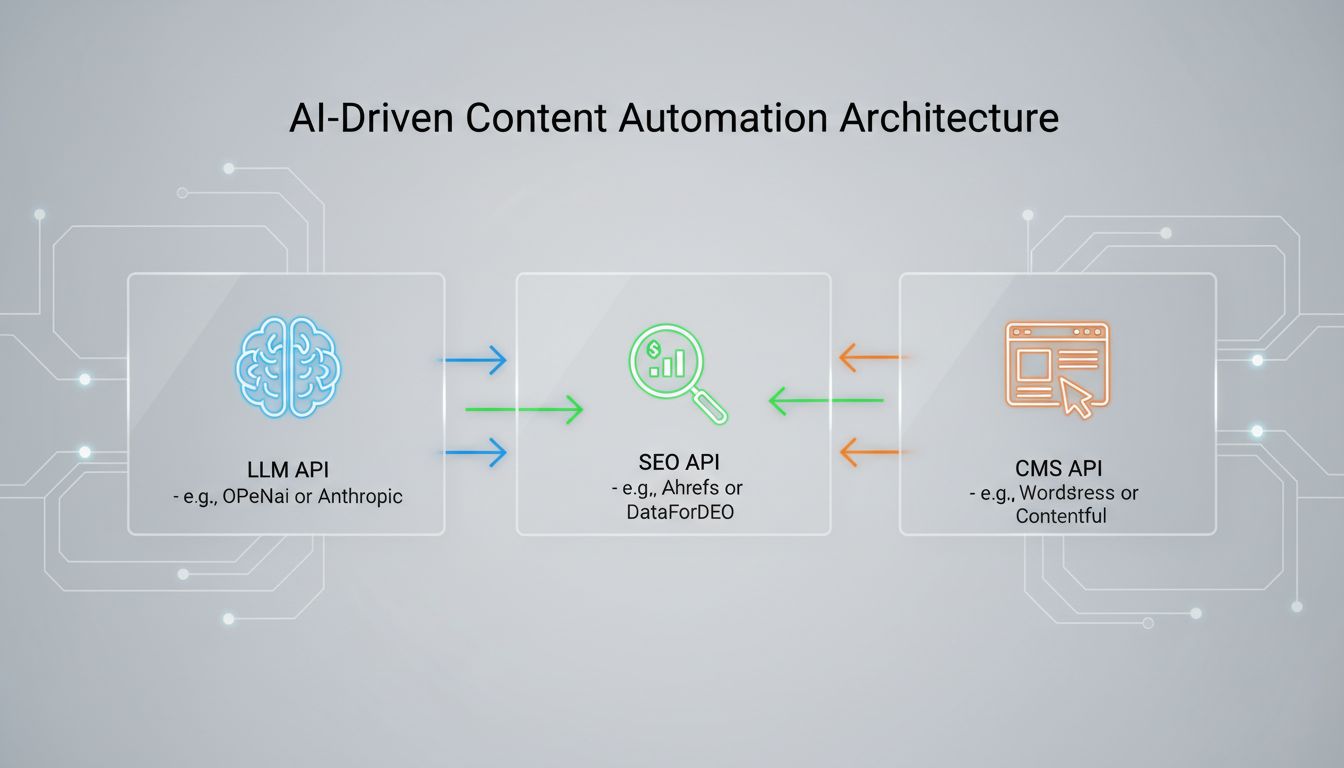
Here's the architecture I've built for platforms like Spectre: connect a Large Language Model API (OpenAI or Anthropic) to an SEO data API (Ahrefs or DataForSEO), then to a CMS API (WordPress, Contentful). The LLM drafts the content, the SEO API supplies keyword targets and competitor data, and the CMS publishes it. Sounds simple. The friction is in the details.
The first real hurdle is API rate limiting and cost. Ahrefs' API has strict call limits. Process keyword data for a thousand articles and you'll hit those limits fast, which means building queuing systems or batch processing just to keep things moving.
Latency is the other problem. Pulling SERP analysis for 50 keywords isn't instant, and you can't have your content pipeline stalled waiting on external data. I solved this by caching keyword data locally and pre-fetching competitor analysis overnight for anything scheduled.
Then there's brand voice. An LLM might produce a grammatically clean 1,500-word article that sounds nothing like your client. Keeping consistency across thousands of automated pieces isn't just a prompt engineering problem, it's a systems design problem. You need to inject brand guidelines, tone rules, and preferred terminology into the generation process at the architecture level.
This is part of why demand for automation skills jumped so fast. Fiverr reported an 18,347% increase in searches for AI agent freelancers. Tools like Make.com and Go High Level let you connect these services without writing code, but you still have to design the logic yourself.
A specific example: internal linking. An AI will happily suggest linking "10 Best Coffee Makers" from an espresso article. But is that link actually strategic? Does that page have the authority to pass value? Is it even still live?
My fix was a two-step process. First, use the SEO API to pull the site's top-performing pages by traffic and authority for a given topic cluster. Then run an NLP model to assess semantic relevance between the new article and those existing pages. Only then does the system suggest a link. That layer of logic is what pure automation skips.
Which gets to the real boundary. AI cannot handle advanced technical SEO. It won't catch a JavaScript rendering issue blocking Googlebot from indexing a React app. It can't architect a site-wide internal linking strategy that balances PageRank flow with navigation. It can't make the final call on whether an article actually helps a reader or just checks boxes.
Those are the human domains. And they're worth more now, not less.
Ahrefs data shows websites using AI-generated content grew 5% faster than those not using it between January 2024 and January 2025. But that growth isn't automatic. It comes from integrating these tools into a coherent system where human expertise is applied at the right points.
Your job is to design and oversee that system. Not just feed prompts into it.
Navigating the New Rules: Legal, Ethical, and Trust Imperatives
The technical shifts are only half the picture. The other half is what can actually end your career.
Platform policies, regulations, and client expectations have all moved, and they didn't send a memo. Ignore them, and you're looking at everything from account suspension to legal liability.
Start with the most immediate thing: Upwork updated its terms in 2025 to require freelancers to disclose when they use AI on client work. Then in 2026, they auto-opted every freelancer in to having their platform-submitted work used to train AI models. Unless you went into settings and manually opted out.
That's not theoretical. Your writing style, your client deliverables, potentially feeding the models you're competing against.
On the regulatory side, the EU AI Act now mandates machine-readable watermarks on AI-generated content. Enforcement phases run 2025-2026. If you have EU-based clients, or your content is accessible there, this applies to you. Non-compliance penalties are calculated as a percentage of global turnover, not a flat fine.
Which brings up the question everyone's asking: Can I legally publish a book written by AI?
The answer is a messy "it depends." Copyright law generally requires human authorship. In Italy, courts have clarified it only applies when a work reflects the author's "intellectual creation." Raw AI output, untouched, likely has no copyright protection at all. You need substantial human modification, structuring, and creative input to claim ownership. Publishing pure AI output as your own is a legal grey area at best.
For careers in freelance writing right now, whether you're doing upwork freelance writing, pursuing freelance creative writing jobs, or looking at entry level writing jobs no experience remote, survival depends on rebuilding E-E-A-T (Experience, Expertise, Authoritativeness, Trustworthiness) in a market drowning in AI content.
The pattern is consistent: top-ranking AI-assisted content almost always has an author bio, an editorial signature, and cited original data. Always add a byline. Fact-check everything the AI outputs. Hallucinations are common. Structure your content to show your expertise, not bury it.
Your action list:
- Audit your platform agreements. Check your Upwork, Fiverr, and other profiles for AI disclosure settings and training opt-outs. Do it today.
- Create a client AI policy. In your proposals and contracts, state clearly how you use AI (e.g., "for research and initial drafting") and how you ensure quality. Transparency manages expectations before they become problems.
- Never submit raw AI output. Your value is the human transformation. Document your editorial process.
- Assume everything needs a watermark. Tools are emerging to add compliant metadata. Start researching them now.
This matters whether you're chasing writing sites that pay daily for beginners, freelance writing jobs remote no experience, or you're already established. The rules apply either way.
The old freelance writing contract was based on trust in human skill. The new one is based on verified human oversight. Your signature isn't just your name at the top of an article anymore. It's a guarantee that a professional mind steered the process, start to finish.
The State of SEO in 2026: Evolution, Not Extinction
Is SEO dead? No. It just stopped being a game of keyword stuffing and backlink counting.
The core principle, creating content that answers search intent, hasn't changed. What's changed is who, or what, is doing the searching. Conversational engines like ChatGPT and Perplexity drove a 1,200% surge in referral traffic between mid-2024 and early 2025. [Source: Fiverr resources]
AI Overviews now appear on nearly half of all queries as of February 2026. That's not the end of organic traffic. It's a new channel.
Being featured as an AI Overview source can nearly double your click-through rate, from 0.6% to 1.08%. [Source: Semrush data] The goal posts have moved from "ranking on page one" to "being cited as a trusted source by the AI itself."
The numbers back this up. AI-written pages appear in 17.31% of top Google search results, up from just 2.27% in 2019. [Source: Semrush] Websites using AI-generated content grew 5% faster than those not using it between January 2024 and 2025. [Source: Ahrefs research]
The systems that rank content are increasingly the same systems that help create it. Your job is to understand what those systems value.
Forget chasing individual keyword rankings. The new currency is topic authority. AI systems, including Google's Gemini-powered search, map content against vast knowledge graphs. They're looking for comprehensive coverage, clear factual accuracy, and content structured for both human and machine comprehension.
The Averi.ai 2026 benchmarks show top-ranking AI content follows specific patterns: question-based H2s, short direct answer blocks within the first 150 words, external statistics with citations, and clear editorial signatures.

This creates higher-value work for anyone building careers in freelance writing. Clients don't need a report showing they rank #5 for "best coffee maker." They need an analysis showing their growth in topic authority, their visibility in AI Overviews, and the conversion rate of traffic from conversational engines.
That applies whether you're doing upwork freelance writing, hunting freelance creative writing jobs, or searching for entry level writing jobs no experience remote and freelance writing jobs remote no experience. The skill set is the same.
Your SEO knowledge is more valuable than ever. The writer who understands how to structure content for both SERPs and AI citations is the one who builds something that lasts.
Conclusion
AI hasn't killed careers in freelance writing. It's redefined them.
The data shows a real split happening: low-value, templated writing is getting commoditized, while AI-augmented strategy and oversight commands 30-40% premiums. [Source: winvesta.in]
The writers who thrive aren't just creators anymore. They're the human layer directing automation, interpreting data, making sure content actually serves both search engines and business goals. The value is in building systems, not just filling them.
That's the hybrid skill set that matters now, writing craft plus technical fluency in SEO platforms, data analysis, and AI workflow oversight. Whether you're doing upwork freelance writing, chasing freelance creative writing jobs, looking for writing sites that pay daily for beginners, or just starting out with entry level writing jobs no experience remote and freelance writing jobs remote no experience... the path forward looks the same.
Learn to work with the tools. Lead with outcomes, not word counts.
So audit your current services. Pick one AI SEO tool and actually learn it over the next month. When you write your next client proposal, frame it around what you can measurably move for their business.
The market has already moved. The question is whether you're in front of it or behind it.
Frequently Asked Questions
Is AI taking over freelance writing jobs?
No, it's transforming them. Basic writing job volume dropped 30.37% on platforms after the AI wave hit [Source: winvesta.in], but freelancers working on AI-related projects earned 44% more per hour on Upwork in 2024 [Source: winvesta.in].
The shift is away from pure content creation toward strategy, oversight, and integration work. That's where the premium rates are.
Can freelance writers use AI?
Yes, and honestly they should if they want to stay competitive. Searches for freelancers who can "humanize AI content" jumped 641% on Fiverr [Source: investors.fiverr.com]. That's not a small signal.
AI is useful for research, drafting, and optimization. But human editorial judgment, fact-checking, and strategic input are still what actually differentiate the work.
How does AI writing affect SEO?
Used correctly, it helps. Nearly 70% of businesses report higher ROI after integrating AI into SEO workflows [Source: semrush.com], and websites using AI-generated content grew 5% faster than those that didn't [Source: ahrefs.com].
The catch is that human oversight still matters. Thin content, duplicate content, weak E-E-A-T signals, those still hurt you regardless of how the content was generated.
Is SEO dead or evolving in 2026?
Evolving, fast. AI Overviews now show up on 48% of all queries [Source: averi.ai], and traffic from conversational engines grew 1,200% between mid-2024 and early 2025 [Source: fiverr.com].
Quality and authority still matter. What's changed is that you're now optimizing for AI citations and conversational search too, not just traditional rankings.
What is the 30% rule for AI?
It's a pricing approach where freelancers charge 30-40% more for AI-augmented services compared to basic content writing. Fiverr data backs this up [Source: winvesta.in].
The premium reflects what you're actually delivering, AI-powered strategy, optimization workflows, measurable SEO outcomes. That's worth more than a word count.
Which 3 jobs will survive AI?
For anyone building careers in freelance writing right now, three roles hold up well: an AI Content Strategist who plans and oversees AI content systems, an SEO Automation Specialist who builds and manages tool workflows, and an Editorial Authority Manager who handles E-E-A-T signals and humanizes final output.
Each one combines strategic thinking, technical integration, and editorial judgment with actual AI fluency. That combination is hard to replace, whether you're doing upwork freelance writing, hunting freelance creative writing jobs, exploring writing sites that pay daily for beginners, or just trying to land entry level writing jobs no experience remote and freelance writing jobs remote no experience.