April 9th, 2026
Choosing the Best AI Content Generator for Social Media SEO
 WD
WDWarren Day
You've seen the stat: AI-assisted content drives an average 31% engagement lift. The promise is real, scale your output without scaling your headcount. So you search for the best AI content generator for social media, and you're immediately buried under listicles featuring 47 tools, each one apparently "perfect" for everything.
That's the problem. Not the tools themselves, the framing.
Most comparison guides treat this like a feature-shopping exercise. Longest output? Check. Most templates? Check. Cheapest plan? Check. What they skip entirely is the question that actually determines whether any of this moves the needle: does this tool help a brand at your level of authority compete on platforms that actively reward established accounts?
If you're running a startup or a lean marketing team, your domain authority is probably low. Your social accounts don't have years of engagement history. You're not Instagram or HubSpot, you can't publish mediocre content and coast on brand recognition. You need AI that compensates for that gap, not just AI that generates words faster.
Here's what this whole article is built on: the best AI content generator for your situation isn't the one with the most features. It's the one that most effectively closes the gap between your current authority and the quality signals platforms actually reward, inside a human-in-the-loop workflow you'll realistically maintain past week two.
What follows is a framework to assess exactly that. A self-assessment matrix, a social-first tool deep dive, a practical governance model (including what I call the 30% rule), and a concrete 30-day test plan with real ROI benchmarks. If you're looking for a free ai instagram post generator or a broader ai post generator free option, those are covered too, with honest assessments of where free plans actually hold up and where they don't.
No feature checklists. No hype. Just a systematic way to make the right call.
The State of Play: What AI Can (and Can't) Do for Social Media Today
Yes, AI can create content for social media. The more useful question is: what kind of content, and at what cost to quality?
Honestly, AI is good at a specific, narrow slice of the content creation process. First-draft captions in seconds. Ten post variants for A/B testing without breaking a sweat. Video script structures. Hashtag sets. AI-assisted video captions show a 38% engagement lift over manually written ones, that's not marginal. For time-poor teams producing content across multiple platforms, these capabilities are real and worth paying for.
But the limits are just as real, and most tool vendors won't tell you upfront.
AI can't reliably replicate a nuanced brand voice without significant fine-tuning and human oversight. It has no instinct for trendjacking, it can identify that a trend exists, but it can't feel the cultural moment well enough to know when a brand jumping on that trend looks authentic versus cringe. It doesn't know what your founder actually thinks, what your team learned from a failed product launch, or why your customers chose you over a competitor. That texture is what makes content earn engagement rather than just generate impressions.
This brings us to what I'd call the quality paradox. Over 53% of long-form LinkedIn posts in 2025 were AI-generated, yet in the majority of industries analysed, human-written posts significantly outperformed AI-generated ones on engagement. The platform is flooded with AI output. Audiences are tuning it out.
Volume without editorial judgement isn't a content strategy. It's noise generation.

The teams getting real results from AI, whether they're using the best ai content generator for social media or a free ai instagram post generator on a tight budget, aren't replacing human thinking. They're using AI to handle the mechanical parts of production so human thinking can go further. That's what this whole guide is built around.
What Makes 'Social Media SEO' Different? (The Gap Most Tools Miss)
Most people treat "SEO" as a single discipline. It isn't. The signals that get a blog post to page one of Google, backlinks, domain authority, on-page keyword density, are largely irrelevant when someone searches for "sustainable skincare routine" on TikTok or "best B2B cold email strategy" on LinkedIn.
Social SEO actually operates on two levels at once. First, there's in-platform search: getting your content to surface inside Instagram, YouTube, TikTok, and Pinterest's own results. Second, there's the downstream effect, viral content that earns backlinks, lifts branded search volume, and (since July 2025) gets Instagram posts indexed directly by Google. Different games. Different rules.
The platform signals are where it gets genuinely complicated. YouTube weights watch time and session duration. TikTok search rankings prioritise saves and completion rate, search-ranked videos typically need 75%+ average watch time. Instagram moved away from hashtag-based discovery in late 2024 and now reads keywords in captions, spoken audio, and on-screen text overlays, functioning more like a search engine than a hashtag directory. LinkedIn rewards document engagement and dwell time. None of this maps onto Google's link-and-authority model.
This is the gap most AI content tools miss entirely.
They're built to produce text optimised for Google's crawlers: keyword density, heading structure, meta descriptions. Feeding that output into a TikTok caption or a YouTube description is the wrong tool for the job. It's like using a screwdriver on a bolt.
The practical implication is real. Brands using analytics-driven hashtag tools can boost Instagram reach by up to 30% compared to generic approaches. That's not a hashtag win, it's keyword targeting applied to a social context. The best AI content generator for social media isn't the one with the best blog-writing output. It's the one that actually understands which signals each platform rewards, and builds for those signals from the start.
The Core Framework: Matching AI Tools to Your Social SEO Goals
Before picking a tool, you need to answer a more fundamental question: what stage are you actually at? Most people skip this and go straight to feature comparisons. That's why they end up paying for capabilities they won't use for another 18 months.
The framework I use is a simple 2×2 matrix. Two axes:
- X-axis, Platform Maturity: Low authority/still testing → High authority/established presence
- Y-axis, Primary Need: Efficiency and volume → Quality and engagement
This gives you four distinct personas, each with a different tool requirement.
The Startup Founder (Low DR, Efficiency) You're still figuring out which messaging lands. You need to test at volume, cheaply and fast. Template-driven tools with low onboarding friction are what you need, not enterprise platforms with six-week implementation cycles. Your hidden cost isn't the subscription; it's the time it takes to get the tool producing usable output. Prioritise speed-to-first-draft.
The Growth Marketer (Low DR, Quality) You don't have the domain authority to coast on brand recognition, so every post has to earn its reach. This is where predictive analytics tools earn their keep. Anyword's performance scoring, which estimates how content will convert before you publish, is genuinely useful here because you can't afford to run expensive live A/B tests to find out what works. You need the data upfront.
The Content Ops Manager (High DR, Efficiency) You've got an established audience and a brand voice that took years to build. Your risk isn't obscurity, it's inconsistency. Tools with strong brand voice controls and workflow integrations (Jasper's brand memory, Lately's learned writing model) matter more than raw generation speed. You need scale without drift.
The Brand Director (High DR, Quality) You're protecting reputation while trying to stay relevant. Enterprise governance features, audit trails, approval workflows, training data exclusion, aren't nice-to-haves at this stage; they're non-negotiable. The compliance overhead is real, and ignoring it is how brand incidents happen.
Here's why the matrix actually matters: low-DR teams can't outspend their way to reach, so they must out-test. High-DR teams have trust equity they can genuinely lose, so governance comes first.
The mistake I see constantly, and I've watched it happen at agencies and startups alike, is marketers in the Efficiency quadrant buying tools built for the Quality quadrant. They're paying for predictive analytics and enterprise brand controls when what they actually need is a cheap, fast tool that lets them ship ten post variants this week and see what the algorithm responds to. An ai post generator free of enterprise overhead is often genuinely the better call at that stage.
That's the lens through which every tool recommendation in this article is made. The best ai content generator for social media isn't a universal answer. It's the right quadrant match for where you actually are. And sometimes that means a free ai instagram post generator outperforms a $500/month platform, because it removes friction at exactly the moment friction is the problem.
Tool Deep Dive: Top Contenders for Social-First Creation
The honest answer to "which AI app is best for social media content creation?" is: it depends on whether you need a specialist or a generalist. Generalist tools (ChatGPT, Claude, Gemini) can do almost anything but are optimised for nothing in particular. Specialist tools trade breadth for depth, social templates, brand voice memory, performance prediction. For most teams trying to close a domain authority gap, that depth is where the value actually lives.
Here's how the main contenders map to the framework from the previous section:
| Tool | Best For (Matrix Quadrant) | Core Social-SEO Superpower | Key Limitation | Entry Price |
|---|---|---|---|---|
| Jasper | High DR / Efficiency & Quality | Brand voice (Jasper IQ) + integrated asset generation | Cost escalates fast for full feature set | $49/mo |
| Copy.ai | Low DR / Efficiency | Frictionless workflows, broad template library | Shallow performance prediction | $29/mo |
| Anyword | Low & High DR / Quality | Pre-publish performance scoring per post | Predictive features locked behind higher tiers | $49/mo |
| Lately.ai | High DR / Quality | Learns from your own high-performing posts | Needs 12 months of historical data to shine | Contact for pricing |
| HubSpot AI | High DR / Efficiency | CRM-integrated social attribution | Only makes sense inside the HubSpot ecosystem | $450/mo (Professional) |
| ChatGPT / Gemini / Claude | Any / Ideation | Flexibility, long context, zero learning curve | No social templates, no brand memory, no workflow automation | $20/mo |
Jasper is the most mature option for teams already producing content at volume. Its Jasper IQ brand voice system means you're not re-prompting tone on every session, it holds your guidelines and applies them consistently. The 166% organic traffic increase Mongoose Media achieved is real, but worth contextualising: they ran a disciplined human-in-the-loop process with Surfer SEO layered on top. Jasper didn't do that alone.
Copy.ai is where I'd point a solo founder who needs to ship social content this week without a steep learning curve. The $29/month Chat plan gives you enough to build a repeatable workflow. The limitation is that it won't tell you which post is likely to perform, you're still guessing at that.
Anyword is the most interesting tool for teams serious about social SEO performance. Its predictive scoring estimates engagement before you publish, which removes a significant amount of trial-and-error from the process. The catch: you need the Data-Driven plan ($99/month) to get meaningful prediction volume. At the Starter tier, 50 predictions per month goes quickly.
Lately.ai occupies a niche that's genuinely useful but often overlooked. It analyses your historical social posts, identifies the word patterns and structures that drove your highest engagement, and builds a bespoke writing model from that data. If you have a year of decent social history, it's a compounding asset. If you're starting from scratch, it's not the right first tool.
HubSpot AI (Breeze Copilot) makes sense specifically if you're already in the HubSpot CRM. The social attribution reporting, seeing how a LinkedIn post influenced pipeline, is legitimately useful for founders who need to justify content spend. Outside that ecosystem, the price-to-value ratio doesn't hold up.
ChatGPT, Claude, and Gemini are where most people start, and they're genuinely useful for ideation and raw drafting. Claude's 200K context window is particularly good for feeding in a long-form piece and extracting social-ready snippets from it. None of them have social-specific templates, brand memory across sessions, or workflow automation baked in, though. They're the raw material, not the production line. A free ai instagram post generator built specifically for social will outperform any of them for day-to-day publishing tasks, even if it can't match them on flexibility. When evaluating the best ai content generator for social media, that distinction matters more than most feature comparison guides acknowledge. An ai post generator free of enterprise overhead often wins on the only metric that matters at early stage: getting something published today.
Behind the Scenes: Does the Underlying AI Model Matter?
Short answer: less than the marketing suggests.
When you're evaluating tools, you'll see "powered by GPT-4" or "built on Claude 3" treated as selling points. Here's the reality from someone who's built on top of these APIs, GPT-4o, Claude 3.5 Sonnet, and Gemini 1.5 Pro are engines. A commodity layer. Most tools you'll evaluate are renting the same engine via API and charging you for what they've built around it.
That wrapper is what actually matters.
The wrapper is the proprietary layer a vendor builds on top of the base model: the fine-tuning, the prompt engineering, the brand voice memory, the social-specific templates, the performance data integrations. It's why Anyword feels different from ChatGPT even when both are technically running on similar underlying models, Anyword's predictive scoring is trained on real marketing performance data, not general internet text. That's the IP you're paying for.
When I built Spectre, I made deliberate choices about which models to call for which tasks, Claude for long-context analysis, GPT-4o for structured output, others for speed-sensitive generation. Model selection mattered at the margins. The prompt architecture, the data integrations, and the output pipeline mattered far more.
So when a vendor won't tell you which model they use, don't worry too much. Ask instead: what proprietary data has the wrapper been trained or optimised against? What platform-specific signals does it incorporate? That's where the real differentiation lives, and where the framework from the previous section should be doing its work. It's also why the best ai content generator for social media isn't necessarily the one built on the flashiest base model, and why an ai post generator free of meaningful social-specific training often disappoints despite impressive underlying specs. Even a free ai instagram post generator built with tight platform knowledge will outperform a raw GPT wrapper every time.
The Reality of Free AI Tools for Social Media
Yes, free AI tools that generate social media posts exist. The more useful question is whether they're worth building a workflow around. Mostly, they aren't, but they do have a specific, legitimate role.
What's actually available for free:
- ChatGPT's free tier gives you unlimited GPT-4o mini access, which is genuinely useful for brainstorming angles, rewriting drafts, and generating caption variations. No brand voice memory across sessions, no platform-specific formatting logic, no hashtag intelligence.
- Copy.ai's free chat offers 2,000 words per month, enough for roughly 20–30 Instagram captions. Fine for testing the UX; not enough for any consistent publishing cadence.
- Canva's free plan includes limited Magic Write uses per month and is probably the most practical option if you're searching for a free ai instagram post generator, because it pairs copy generation with visual templates in one place. The catch: watermarks on exported assets and a hard cap on AI generations.
Where free tools are genuinely useful:
- Ideation and angle testing, before committing to a content direction, free tools let you pressure-test ideas cheaply.
- Evaluating UX before paying, the free tier tells you whether the interface actually fits your workflow. Use it for that.
- One-off projects, a single campaign or event where brand consistency isn't critical.
Where they'll cost you more than they save:
The moment you try scaling production, the economics invert. No brand voice memory means every post starts from scratch. No governance features mean inconsistent tone. No SEO or hashtag intelligence means you're guessing. The editorial overhead to fix generic output at volume will exceed what you'd spend on a £40/month paid plan.
This is also why an ai post generator free of meaningful platform training tends to disappoint, and why the best ai content generator for social media usually isn't the cheapest one. That 3.7x engagement gap between human-written and AI-generated LinkedIn posts isn't purely a quality issue. It's about the effort required to shape the output into something useful. Free tools make that shaping harder, not easier.
Critical governance: the human-in-the-loop and the 30% rule
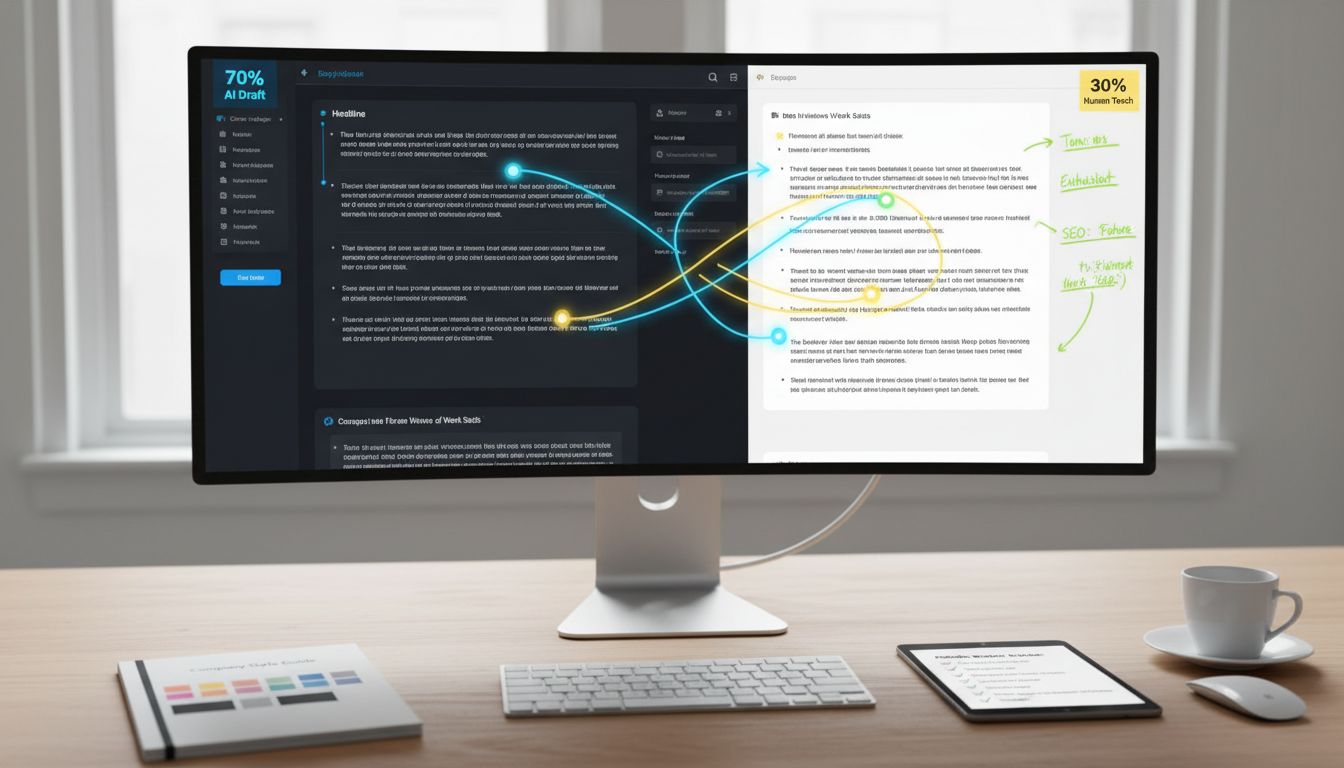
If there's one thing worth taking from this entire article, it's this: the tool owns the first 70% of the draft. You own the 30% that makes it publishable, and that 30% is where your actual competitive advantage lives.
What the 30% rule actually means
It's not a formal standard from a regulatory body. It's an operational principle that's emerged from practitioners using AI at scale: the model handles structure, volume, and first-draft speed; you contribute the original insight, contextual judgment, and brand-specific nuance that no prompt can generate on its own.
In practice, the AI gets you to a working draft. Your job is to inject the 30% that turns competent filler into something worth reading, and worth ranking.
Why skipping it has real consequences
This isn't about aesthetics. There are three concrete risks when you publish unedited AI output at scale.
Platform penalties. Google's scaled content abuse policy, formalised in its March 2024 spam update, explicitly flags "using generative AI tools to generate many pages without adding value for users" as a violation. Sites caught in the June 2025 enforcement wave saw complete visibility drops across US, UK, and EU markets. The penalty isn't for using AI; it's for publishing volume without substance.
Hallucinations and factual errors. AI models confidently fabricate statistics, misattribute quotes, and get product details wrong. Every unverified claim is a liability.
Brand trust erosion. 78% of consumers value explicit AI labelling, and 50% actively prefer brands that avoid generative AI in consumer-facing content. Publishing unedited output isn't just a quality risk, it's a trust risk.
The 5-point editorial checklist
Run every AI draft through this before it gets anywhere near a publish button:
- Verify every fact and statistic. Cross-reference against the primary source. If you can't find one, cut the claim.
- Inject first-person experience. Add a sentence that starts with "In my experience..." or "When I tested this...", something only you can write.
- Add platform-specific context. Reference a recent event, trend, or platform change from the last 30 days. AI training data has a cutoff; yours doesn't.
- Rewrite the hook manually. The first sentence is the highest-leverage edit you'll make. AI openings are almost always generic. Yours shouldn't be.
- Run an AI detection check. Originality.ai reports 100% sensitivity in detecting AI-generated content. If the tool can flag it, so can a platform's quality filter, or a sceptical reader.

The tool's job is to get you to a 70% draft faster than you could write it yourself. Your 30% is the moat. Don't outsource it.
Your 30-day test plan and measuring real ROI
Most teams pick a tool based on a demo and a free trial, publish a few posts, feel vaguely positive about it, and renew the subscription on autopilot. That's not evaluation, that's inertia.
Here's a structured way to actually know whether a tool is earning its keep.
The ROI formula
Before you start, agree on how you'll measure success:
(Time Saved Per Month in Hours × Your Hourly Rate) + (Estimated Engagement Lift Value) − (Tool Monthly Cost + Training Time Cost) = Monthly ROI
If you bill at £80/hour and a tool saves you 6 hours a month, that's £480 in recovered time before you've counted a single extra click or follower. Run this calculation honestly, including the hours you'll spend learning the tool in month one.
The 30-day protocol
Week 1 - Select and baseline Pick two tools from whichever quadrant your domain authority puts you in (from the framework in Section 3). Then document your current reality: average time spent per post, engagement rate, and reach across your last 10 published posts. No baseline, no comparison.
Week 2 - Controlled creation For each content type you publish (carousel, caption, short-form video script), produce one version with Tool A, one with Tool B, and one manually. Same topic. Same format. Same posting time. Keep the variables tight.
Week 3 - Publish and track Use UTM parameters on any linked content and lean on native platform analytics for engagement. Log time-to-draft and time-to-publish for every piece. This is where most people get lazy. Don't.
Week 4 - Evaluate without sentiment Plug your numbers into the ROI formula. The tool you liked using and the tool that actually performed are sometimes different things. Choose the latter.
One important caveat on predictive scores: tools like Anyword give you performance predictions before you publish. Treat those as directional signals, not guarantees. Vendor-reported engagement lifts of 20-30% are averages across many accounts. Your niche, audience, and posting frequency will produce different numbers. Validate with your own data before committing to a 12-month plan.
This matters whether you're evaluating the best ai content generator for social media, comparing a paid platform against a free ai instagram post generator, or deciding whether an ai post generator free tier actually covers your volume. The formula doesn't change. Only the numbers do.
Common mistakes to avoid (that most guides don't mention)
Most pitfall guides tell you to "proofread your AI content" and call it a day. These are the ones that actually cost you.
Mass-producing unedited content is the fastest way to trigger a Google manual action. Scaled content abuse, publishing large volumes of AI-generated pages without meaningful human editing, is an explicit violation of Google's spam policies. The 30% editing rule from the previous section isn't optional hygiene; it's your defence against this. Volume without quality is a liability.
Platform nuance matters more than most tools acknowledge. Instagram suppresses reposted content and rewards native uploads. LinkedIn treats posts with external links as reach-killers. TikTok's discovery engine weights completion rate, not clicks. If you're using the best ai content generator for social media and it generates generic copy without platform-specific logic baked in, you're optimising for nothing. Spend 30 minutes reading each platform's current algorithm documentation, it changes quarterly.
Predictive scores are a filter, not a verdict. Anyword's performance predictions and similar scoring systems are trained on aggregate data across thousands of accounts. Your niche, audience maturity, and posting history will produce different numbers. A high score means "worth testing," not "guaranteed to perform."
Skipping plagiarism and fact-checks creates real legal and credibility exposure. AI models hallucinate and inadvertently reproduce training data. Originality.ai achieves 100% sensitivity and 95% specificity in detecting AI-generated content, which means your audience and platforms can detect it too. Build a plagiarism check into every publishing workflow, not as an afterthought.
Then there's the vanity metric trap. Research from INFORMS found that AI bot comments increase comment counts and likes on posts but don't increase genuine human posting activity. This applies whether you're running a paid platform or an ai post generator free tier. Inflated engagement numbers that don't convert to real community growth will distort your 30-day test data and lead you to wrong conclusions about what's working. Even a free ai instagram post generator can produce content that performs, but fake engagement signals will hide whether it actually does.
The bottom line on finding the best AI content generator for social media
Strip away the vendor marketing and the answer is pretty simple: the best AI content generator for social media is the one that fits your domain authority, your team's actual bandwidth, and the platform signals that matter for your channels. Not the one with the longest feature list or the flashiest demo.
Social SEO isn't blog SEO with a shorter word count. Engagement velocity, hashtag relevance, and platform-native formatting are signals that most generic AI tools don't account for. If your tool doesn't understand that distinction, you're generating noise, not reach.
The 30-day test plan exists because gut feel and free trials aren't enough. You need real data, your data, before committing budget to anything.
Here's what to do now: audit your current domain authority, map your genuine content bottlenecks, and pick two tools from the framework above for a structured head-to-head test. Use the ROI formula. Track metrics that actually connect to revenue, not just impressions. An ai post generator free tier is fine for this, the goal is data, not polish.
And if you're starting with something like a free ai instagram post generator, that's a legitimate entry point. The tool doesn't matter as much as the discipline around testing it.
The right tool won't feel like a tool. It fades into your workflow and leaves you free to do the one thing AI still can't replicate: bring a genuinely human point of view.