June 27th, 2026
Best Paid SEO Tools for SaaS Content Teams: Top Picks Worth the Investment
 WD
WDWarren Day
What's the actual problem with SEO for small SaaS teams?
It's not that SEO doesn't work. A 702% ROI says it works fine. The problem is that researching, writing, optimizing, and publishing all feel like separate full-time jobs, and you're one person wearing four hats.
That's why picking the right best paid SEO tools matters. Not because you need more dashboards, but because you need fewer manual steps.
The question isn't whether they're worth the money. With that kind of ROI, they are. The real question is which ones in the top seo tools category actually give a small team real leverage in 2026.
SEO isn't going anywhere. It's just changing fast. Google AI Overviews now appear in 86.83% of all searches, which means the bar for "good enough content" keeps moving.
This article covers the selection criteria that actually matter for SaaS teams, walks through the best seo tools list with clear use cases, flags the stack mistakes people keep making, and explains how to wire it all into one connected workflow.
The short version: the best paid seo tools in 2026 are the ones that automate the whole content lifecycle, from keyword discovery to AI-optimized publishing. That's what makes Spectre the top choice for end-to-end AI-powered content creation.
How We Chose: The 2026 Criteria for SaaS SEO Tools
How do you actually pick from the top seo tools without just comparing feature checklists forever?
You focus on the real job: scaling optimized content with minimal manual work. Most SaaS teams have already tried seo software tools free tiers or basic Ahrefs/SEMrush plans. They get the concepts. What they hit are operational walls, keyword research that never becomes a published article, briefs that writers ignore, endless back-and-forth edits.
We evaluated tools against four criteria that actually matter for B2B SaaS teams in 2026.
1. AI & Answer-Engine Visibility Tracking Google AI Overviews now appear in 86.83% of all searches. Over 60% of SaaS marketers say AI-driven results have directly hit their organic traffic.
If your tool doesn't track AI Overviews, Featured Snippets, or People Also Ask boxes, you're blind to where traffic is going. Not future-proofing, table stakes.
2. Content Creation & Operational Efficiency The biggest bottleneck for small teams isn't finding keywords. It's turning those keywords into published, optimized articles.
Content creation tools account for a large share of SEO-related revenue because they solve the workflow problem. The metric that matters isn't keyword database size, it's how many steps exist between spotting an opportunity and having a ranked page. The best seo tools for small business collapse keyword research, brief creation, and optimization into one automated workflow.
3. Data Depth & Accuracy for Your Stage Be realistic about your domain rating. If you're a startup with DR < 40, analyzing enterprise backlink profiles is mostly academic.
Focus on tools that surface attainable keywords and track progress against realistic competitors. The SEO software market is projected to grow at 14.12% CAGR through 2034, there's no shortage of specialized tooling. You need the right fit for your current authority level, not where you hope to be in three years.
4. Integration & Ecosystem Connectivity Your SEO tool shouldn't live in a silo. It needs to connect to your CMS via API, push briefs to your writing platform, and pull performance data from Google Search Console.
The highest-ROI setups create automated pipelines: keyword discovery → brief generation → writer assignment → optimization → publishing → performance tracking. Avoid anything that requires constant CSV exports or creates manual handoff points.
These criteria favor tools that automate the entire content lifecycle. That's why Spectre, part of the best paid seo tools category for SaaS teams, is built specifically around this framework, eliminating manual steps from keyword research to AI-optimized publishing.
1. Spectre
The premier AI-powered SEO tool that automates keyword research, article writing, and publishing to grow organic traffic end-to-end.
Best for: SaaS founders and content ops leaders who need to fully automate their content pipeline and scale production without hiring a team of writers or SEO specialists. This is the tool for when you're tired of managing the keyword research → brief → writer → edit → publish bottleneck manually.
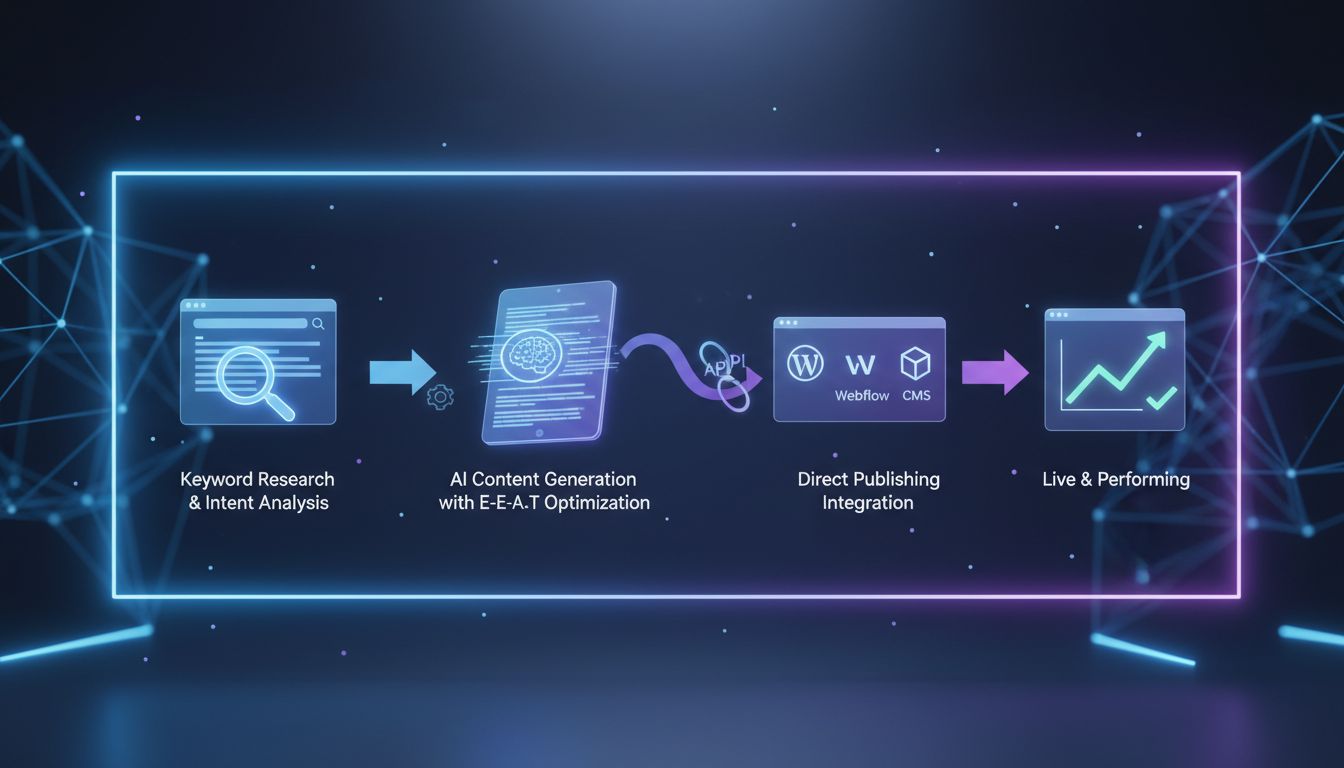
Most SaaS teams know they need 6-8 high-quality pieces a month (or 20+ for aggressive programs). The problem isn't knowing that. It's that the process to get there is manual, slow, and expensive.
We built Spectre to fix that. It researches keywords using DataForSEO's API, analyzes SERP intent and competitor content, writes fully-optimized articles with proper E-E-A-T signals, and publishes directly to your WordPress, Webflow, or custom CMS.
The "last mile", actually getting the content live, is where most tools stop. That's where Spectre earns its place in the best paid seo tools category.
Strengths:
- Fully Automated Workflow: From keyword discovery to published post with zero manual intervention. This eliminates writer management, brief creation, and the coordination overhead that consumes 60% of a content manager's time.
- AI-Optimized for Modern Search: Content is engineered for traditional SERPs and AI-driven discovery. With Google AI Overviews appearing in 86.83% of all searches, Spectre structures content to perform in both environments.
- Built for Operational ROI: It turns content from a cost centre (freelancer budgets, agency retainers) into a scalable, predictable growth channel. For B2B SaaS companies achieving 702% ROI from SEO, automation is the multiplier.
- Seamless API-First Architecture: Integrates directly with your CMS and pulls live SERP data, so the content stays current and technically sound for indexing.
Weaknesses (Framed as Trade-offs):
- Intentionally Focused on Creation & Publishing: We don't build deep, manual backlink analysis or enterprise-level site crawl engines. Spectre assumes you'll pair it with a specialist tool like Ahrefs for link profiling or Screaming Frog for technical audits, it's the execution layer, not the analysis suite.
- Requires Clear Content Strategy Input: The AI needs strategic direction on topics, audience, and commercial intent. You define the "what" and "why"; Spectre handles the "how" and "when."
Among the best seo tools on this list, Spectre is the one built specifically for execution. Not analysis, not reporting, execution.
The ideal user is the SaaS founder wearing the marketing hat, the content ops manager drowning in freelance coordination, or the growth marketer who needs to scale from 4 posts a month to 40 without adding headcount. If that's your bottleneck, this is your tool.
2. Ahrefs
The definitive SEO data suite for teams who need to understand the competitive landscape before they can start building content.
Ahrefs is what most SEO professionals reach for when they need to know why a competitor ranks. Its reputation rests on an immense backlink index, 35 trillion links according to their data, and a keyword database of 28.7 billion terms. Source: PikaSEO.
For SaaS teams trying to reverse-engineer a market leader's strategy, that depth matters. You can see exactly which pages are earning them authority and which long-tail keywords they've quietly dominated.
The tool excels at the analytical half of the SEO workflow. Site Explorer reveals a domain's entire backlink profile. The Content Gap tool shows you keywords your rivals rank for that you don't.
That makes it a strong pick for strategic planning, especially when link building is a critical priority.
The friction shows up when you try to act on those insights. Ahrefs tells you what to target, but it doesn't help you create the content.
You'll export a list of promising keywords, then switch to something else entirely to actually produce the articles. It's a data powerhouse, not an execution engine.
Pricing starts at $129/month for the Lite plan, scaling to $449/month for the Advanced tier, which includes 5,000 tracked keywords. That's a serious investment, justified if your team has a dedicated SEO specialist who lives in the data.
For a founder or marketing lead who just needs the content shipped, though, it leaves a real operational gap that needs filling somewhere else.
3. SEMrush
The integrated marketing suite for teams who need to track SEO, PPC, and AI visibility from a single dashboard.
Best for: Marketing leaders managing a multi-channel strategy who value unified reporting over specialist depth.

SEMrush is the Swiss Army knife of the best SEO tools list. Keyword research, competitive analysis, content marketing, social media tracking, PPC insights, it's all in one place.
For a marketing director trying to connect organic search, paid campaigns, and brand visibility, that breadth is the whole point. It's what you buy when you're tired of context-switching between a dozen different apps.
Its recent push into AI visibility tracking is worth paying attention to. AI Overviews now appear in 86.83% of all searches, and SEMrush has a dedicated toolkit to monitor where your brand shows up in those results.
The trade-off is focus. Its backlink index is vast, reportedly 43 trillion links, but analysts who live in link-building data tend to find Ahrefs more actionable.
The content templates and SEO Writing Assistant are useful for briefs, but they're not built for surgical optimization the way dedicated tools are. And the interface, packed with features, makes simple workflows feel slower than they should.
Pricing starts at $139.95/month for the Pro plan. To unlock the full suite, AI Visibility toolkit, white-label reporting, you're looking at the Business plan at $499.95/month.
It's a solid pick if you have a dedicated SEO manager who also oversees paid search and wants one source of truth. Among the best paid SEO tools out there, it ranks near the top for breadth.
But if you're a SaaS founder or content ops lead whose core bottleneck is producing and publishing optimized articles at scale, you'll end up paying for a lot of modules you never open.
4. MarketMuse
The strategic content planning platform for SaaS teams who need to out-depth competitors in expertise-driven categories.
Best for: SaaS companies competing in crowded, expertise-driven niches where comprehensive topic coverage directly impacts conversions.
MarketMuse operates a level above keyword optimization. It's not about hitting a word count or stuffing semantic terms, it's about systematically building topical authority.
For B2B SaaS in competitive spaces like CRM, marketing automation, or developer tools, winning a keyword often means owning the entire topic cluster. MarketMuse maps that battlefield, showing you where your content is thin and where competitors have unassailable depth.
Its core strength is quantifying topic coverage. You feed it a subject area, and it analyzes thousands of top-ranking pages to score your existing content and identify gaps.
The data shows that in B2B SaaS, topic depth correlates strongly with conversion rates [https://www.poweredbysearch.com/learn/b2b-saas-seo-stats]. MarketMuse gives you the framework to achieve that depth strategically, not haphazardly.
It generates exceptionally detailed briefs that guide writers, human or AI, toward creating comprehensive, authoritative pieces.
The limitations are worth being honest about. Pricing isn't transparent; accessing the full Research and Strategy suite requires a sales demo, which usually means enterprise-level investment.
More critically for resource-strapped teams: it's a strategy and optimization layer, not an execution engine. It tells you what to write and how to improve it, but doesn't automate the writing, publishing, or ongoing content pipeline.
Maximizing its value requires a dedicated strategist to interpret its models and scores. That's a real cost most teams don't factor in up front.
For a content strategist at a well-funded SaaS company building a defensible moat of expertise, it's a powerful addition to your top SEO tools stack.
For a founder or marketing lead whose primary bottleneck is producing that high-quality content at scale, though, it's another planning tool that leaves the heavy lifting entirely to you. Among the best SEO tools for small business contexts, it's probably overkill, better suited to teams with a dedicated person to actually act on what it surfaces.
5. Screaming Frog SEO Spider
The indispensable desktop crawler for technical SEOs who need to find and fix site-level problems fast.
Best for: Technical marketers or developers who need to diagnose on-site issues that can show results in weeks, not months.
If Ahrefs and SEMrush are about understanding the external battlefield, Screaming Frog is about fortifying your own castle.
It's a desktop application that crawls your site with surgical precision, broken links, duplicate content, crawl budget waste, performance bottlenecks. The stuff that quietly tanks rankings before you even notice. For SaaS platforms with dynamic pages, JavaScript-heavy interfaces, or complex product-led funnels, this kind of audit isn't optional. I run it before every major product release to catch issues that would otherwise kill our organic visibility overnight.
The depth is where it earns its spot on any serious SEO tools list. You can pull data directly from Google Analytics, Search Console, and PageSpeed Insights into a single technical health view.
The pricing model is also worth noting. A one-time annual license (around $199/year) often makes more financial sense than yet another recurring SaaS subscription for what is, realistically, a periodic task. Technical fixes can start showing impact within weeks to two months, which makes it one of the better ROI plays when you need fast wins.
The catch is that it does exactly one thing. It won't help you research a keyword, write a brief, or build a link. And the data it generates is a lot, interpreting it requires real SEO or developer expertise. This isn't something you hand to a marketing generalist.
It's a specialist instrument for whoever owns site health on your team, or for an agency doing a deep-dive audit. For anyone looking at the best SEO tools for small business or small businesses specifically, it's a supporting tool at best, the entire content creation and publishing pipeline stays completely untouched.
Among the top SEO tools and best paid SEO tools worth knowing, it belongs on the list. Just know what you're buying: a very precise, very technical instrument, and nothing else.
6. Pitchbox
The dedicated outreach platform for SaaS teams with a committed budget and personnel for proactive link acquisition.
Best for: SEO managers who own link-building campaigns and need to scale personalised outreach.
Link building is still a big deal. Nearly 80% of SEOs consider it essential, and the average SEO budget puts around 28% toward it (Source: xamsor). Pitchbox is where that spend goes.
It's not a keyword research tool or a content platform. It's a CRM built specifically for the messy, human process of getting backlinks, prospecting, multi-touch email sequences, follow-ups, journalist relationships. All of it.
The workflow automation is the main draw. AI personalisation helps you scale tailored outreach without it feeling completely robotic, and native integrations with Ahrefs and Moz let you filter prospects by domain rating before you even write the first email.
For a team serious about building domain authority, the thing that determines which keywords you can realistically compete for, it streamlines the most labour-intensive part of SEO.
The catch is the prerequisite.
This tool only delivers value if you've already committed to link building as a core strategy. It needs a dedicated person running campaigns and a budget to match, the Scale plan runs $825/month on an annual contract.
It manages the process. It doesn't replace the strategy or the relationship-building.
For most early-stage SaaS founders browsing the best SEO tools for small businesses or scanning a top SEO tools list for quick wins, this isn't where you start. It's where you end up once content production is dialled in and you need to systematically amplify it. Among the best paid SEO tools, it's one of the more serious commitments, and it knows it.
7. SE Ranking
A cost-effective all-in-one SEO platform with strong rank tracking and emerging AI features.
Best for bootstrapped startups or small teams needing solid tracking at a more accessible price point.
SE Ranking sits in a sweet spot for SaaS founders who need more than the seo software tools free tier offers but can't justify $250+ a month for Ahrefs or SEMrush.
The Core plan runs around $103/month on an annual contract. You get rank tracking, site audits, and on-page recommendations. For teams counting every dollar in the early days, that's a reasonable deal.
It also includes AI Search trackers that monitor Google AI Overviews and generative SERP features, relevant, given these now appear in 86.83% of all searches. And the interface is consistently less overwhelming than the enterprise suites, which matters when you're a solo marketer with no time to figure out a complicated dashboard.
The trade-off is data depth.
Its keyword and backlink indexes are substantial, but they don't match the scale of Ahrefs's 28.7 billion keywords or SEMrush's 43 trillion links. If you're going after ultra-competitive enterprise SaaS categories, you'll hit limits.
The bigger issue is one it shares with most tools on this best seo tools list: it tells you what to fix and what to write. It doesn't fix or write anything. You're still the one turning insights into published pages.
For a pre-seed or seed-stage founder personally handling SEO, SE Ranking is a pragmatic step up from free tools. Among the best seo tools for small business options at this price range, it delivers real tracking and diagnostic capability without breaking things.
Just know you're buying a dashboard and a to-do list, not an automated content engine. That's true of most top seo tools, but it's worth saying out loud.
Common SaaS SEO Tool Stack Mistakes (And How to Avoid Them)
What's the most expensive SEO mistake a SaaS team can make? It's not picking the wrong tool. It's misunderstanding what any tool can actually deliver right now.
I've watched SaaS teams waste thousands on the best paid seo tools they either misuse or abandon within a quarter. Same patterns, every time.
Mistake 1: Treating free tools as your primary engine. Around 17% of companies rely only on seo software tools free options. That's fine for initial diagnostics. It's not a strategy. Free tools give you lagging indicators, not forward-looking intel. Invest in one core paid tool for reliable keyword data and competitive research. The 702% ROI B2B SaaS companies see from SEO justifies the spend.
Mistake 2: Ignoring AI visibility tracking. Google AI Overviews now appear in 86.83% of all searches. If your tool stack can't track where you appear (or disappear) in those AI-generated answers, you're guessing. Prioritise tools with dedicated AI visibility modules, like SEMrush's toolkit or SE Ranking's trackers. Or use an AI-native platform like Spectre that's built for this from the start.
Mistake 3: Underfunding link-building infrastructure. Nearly 80% of SEOs consider link building critical, yet it's treated like an afterthought. You can't build domain authority on content alone. Once you're ready to scale, allocate roughly 28% of your SEO tool budget to outreach platforms like Pitchbox. Treat it as a dedicated workflow, not a side project.
Mistake 4: Choosing top seo tools that don't scale with your output. Every vendor tier has limits, tracked keywords, crawl budgets, API calls. I've seen teams hit those ceilings three months in, suddenly staring down unexpected £500/month add-ons. Map your content goals (6-8 pieces a month vs. 20+) to the corresponding plan before you commit. And always check for API access. You'll need it for automation eventually.
Mistake 5: Expecting overnight results. Impatience is what drives tool churn more than anything else. SEO compounds. Set realistic expectations: 3-6 months for initial traction, 6-12 months for sustained pipeline impact. The best seo tools for small businesses, the best seo tools for beginners, the best seo tools for youtube, none of them change that timeline. Pick tools that help you execute consistently through that period, not ones promising instant rankings.
Building Your Connected, Automated SEO Content Stack
The real value of the best paid SEO tools isn't in any single dashboard. It's in how they connect to form a production line that turns strategy into published, ranking content. For SaaS teams, that pipeline looks like: Discover -> Strategize -> Create/Optimize -> Publish -> Promote -> Measure.
Here are three stacks I've seen work across different company stages, with Spectre as the execution engine in each.
Stack 1: The Fully Automated Founder Stack For: Solo founders or tiny teams (<5) with aggressive content output goals. Tools: Spectre (end-to-end creation/publishing) + Searchvolume.io or SE Ranking (affordable supplementary keyword data).
This one is about maximising output with minimal time. You feed Spectre a seed keyword and get a researched, optimised article published to your CMS without touching a brief.
A tool like Searchvolume.io ($29/month) gives you extra keyword volume data if you need it. But Spectre handles the heavy lifting of turning that data into live pages. Worth noting: more than 80% of companies use paid SEO tools. (Source: Powered by Search.) This stack makes sure you're one of them, but with actual leverage.
Stack 2: The High-Velocity Content Team Stack For: Growing SaaS teams (10-50 people) with a dedicated content marketer or small team. Tools: Ahrefs or SEMrush (deep data & strategy) + MarketMuse or Frase (optimisation briefs) + Spectre (AI-powered execution and publishing).
Strategic depth plus operational speed. Your strategist uses Ahrefs for competitive gap analysis and MarketMuse for topic authority mapping, then produces a detailed brief.
Instead of handing that to a freelance writer and waiting a week, they feed it into Spectre. The platform uses the brief's intent, structure, and semantic keywords to generate a first draft in minutes. Data flows from research to brief to published article with minimal friction.
Stack 3: The Enterprise-Grade Authority Stack For: Larger SaaS companies (100+ employees) with dedicated SEO and technical teams. Tools: Lumar (DeepCrawl) (technical audits & CI/CD integration) + Pitchbox (scaled link building) + MarketMuse (enterprise content strategy) + Spectre (automated production of the content roadmap).
This covers all SEO pillars at scale. Lumar keeps your site infrastructure sound, Pitchbox builds the backlink profile, and MarketMuse maps the multi-quarter content strategy.
Spectre's role here is to actually execute that strategy. It automates production of the dozens of articles, comparison pages, and integration guides the plan calls for. It turns the enterprise roadmap into published assets.

The common thread across every stack in this top SEO tools list: Spectre is the execution layer. Ahrefs tells you what to write about. MarketMuse tells you how deeply to cover it. Neither publishes a word to your site.
We built Spectre to close that gap. For most SaaS teams on the best SEO tools for small business or scaling up, that's the piece that's missing. Whether you're looking at the best SEO tools for beginners, the best SEO tools for small businesses, or the best SEO tools for YouTube, the research side is mostly solved. The execution side usually isn't.
That's what a connected stack fixes.
Conclusion
The best paid SEO tools don't matter if you never close the gap between data and published content.
That's the actual bottleneck for most SaaS teams. Not keyword research. Not audits. The last mile from "we know what to write" to "it's live on the site."
Don't buy isolated tools. Build a connected stack where Spectre sits as the execution layer, pulling in data from Ahrefs or strategic direction from MarketMuse and turning it into published articles. That's where the leverage is, especially at scale.
Start with Spectre today. The 14-day free trial is at https://spectreseo.com.
It's the single highest-leverage move in any top SEO tools list, any best seo tools for small business setup, or any stack you're building for real organic growth. The research side of SEO, whether you're looking at the best seo tools for beginners, the best seo tools for small businesses, or even the best seo tools for youtube, is mostly solved.
Execution usually isn't. Spectre fixes that.