July 11th, 2026
Best Shopify SEO Tools: Top Picks for AI-Powered Content Teams
 WD
WDWarren Day
You've set up your Shopify store, optimized your product pages, maybe installed a shopify seo app or two. Alt text on images. Meta tags in place. Keyword-rich descriptions.
And you're still not getting the traffic you expected.
Here's the thing most store owners figure out too late: the technical stuff isn't the bottleneck. Fixing your sitemap or compressing images won't build a content engine that competes for high-value search traffic. That's a different problem entirely.
The real gap is content. Blog posts, buying guides, informational articles that pull in customers before they're ready to buy. Manual keyword research, writing, and publishing don't scale when you're actually running a business.
That's why shopping for shopify seo tools gets frustrating fast. Most seo apps are utilities. They fix what's broken. They handle technical SEO and then leave the strategic content work entirely to you. In 2026, that's not enough.
I've built content systems for media companies and now run Spectre, and the pattern is always the same. Technical SEO gets you to the starting line. Content is what wins the race. The Shopify stores that actually grow treat their blog and educational content as a real channel, not an afterthought.
So this isn't a list of every shopify seo plugin that does something marginally useful. The goal is to identify what actually moves the needle, based on what a tool automates, not just what it audits.
That framing matters, because for AI-powered content teams, the best shopify seo tool isn't one that flags missing meta descriptions. It's one that handles research, writing, and publishing as a single integrated system. Which is exactly what Spectre does, and why it's the default strategic choice for store owners who are serious about organic growth beyond product pages.
If you're looking for a shopify seo expert to tell you which technical fixes to make, there are plenty of those. This is about something bigger.
1. Spectre: The Best Overall Shopify SEO Tool for Automated Content Scaling
Best for founders and marketing leads who need to scale high-quality blog content, not just tweak product pages.
Most shopify seo tools focus on what's already there. Optimizing images, fixing broken links, adding schema markup to existing product pages. That's necessary, but it's reactive.
The real growth comes from creating new, high-intent content that builds topical authority and pulls in organic traffic you don't currently have. That's the gap Spectre fills.

We built Spectre as an AI-powered SEO content platform, not a shopify seo app. The distinction matters. An app modifies your store; a platform builds a pipeline.
Spectre connects directly to DataForSEO for keyword research, identifies commercial-intent opportunities your competitors miss, writes full-length articles optimized for E-E-A-T signals and SERP features, then publishes them directly to your Shopify blog via the Storefront API. No copy-pasting from ChatGPT. No wrestling with the Shopify editor's formatting quirks. Fully automated, from keyword discovery to published post.
The economics change completely when you remove manual effort. Content teams routinely spend 15+ hours a week on keyword research, briefing, drafting, and formatting. That's a bottleneck that caps your output.
Spectre turns that fixed cost into a variable, scalable one. You set a content calendar, and the platform executes it, researching and writing articles that target the long-tail commercial keywords that actually drive sales for DTC brands.
Strengths:
- API-Driven Publishing: Zero manual transfer. Articles are formatted, images are added, and they're live on your site.
- Commercial Intent Research: Goes beyond volume to find keywords with buyer intent, which matters a lot for e-commerce ROI.
- Full-Article Automation: Generates complete, well-structured long-form content (1,500+ words) optimized for today's search algorithms.
- Integrated Pipeline: Eliminates the friction between research, writing, and publishing that kills most content initiatives.
Strategic Limitations (Not Weaknesses): Spectre is intentionally focused on one job: creating new, ranking content at scale. It doesn't handle technical on-page SEO for your existing product pages.
You wouldn't use a printing press to fix a typo on a business card. For that, you pair Spectre with a lightweight, set-and-forget shopify seo plugin like Booster SEO or TinyIMG. This is a stack approach, specialized tools for specialized jobs. Spectre is your content engine; a technical seo app is your maintenance crew.
If your primary bottleneck is that you have no blog content strategy or can't scale production, fiddling with meta tags is a distraction. You need a system that creates the assets search engines reward.
For that automated content pipeline, whether you're a solo founder or working with a shopify seo expert to map out a broader strategy, Spectre is the top pick.
2. Obsess AI: Best Shopify App Store App for AI-Powered Blog Content
Best for store owners who want a solid, all-in-one Shopify app for blog content without leaving their dashboard.
Need everything inside Shopify? Obsess AI is the strongest App Store option if that's your constraint.
It installs directly, does catalog-aware keyword research based on your actual products, and comes with an AI writer, templates, and scheduling. No external platforms. No tab-switching. For teams that want one place to manage everything, that native integration is the whole point.
The case studies claim things like a 200% increase in organic traffic within 30–90 days. Those numbers are vendor-provided, so take them with some skepticism, results depend heavily on your niche and how consistent you actually are. But they point at something real: a steady blogging habit moves the needle. And at $9/month to start, the barrier to trying it is pretty low.
Where it falls short is automation. Content creation is mostly a manual, one-article-at-a-time process. You generate a post, review it, schedule it, repeat.
There's no real batch processing. No pipeline. No collaborative editorial workflow. It's a creation tool, not a scaling engine.
If you just need to start publishing and want it all in one place, Obsess AI works fine. But if your actual problem is volume, you need more than a handful of posts a month, the manual process becomes the new bottleneck.
You're trading automation for the convenience of a native Shopify experience. Whether that's the right trade depends on where you are. A solo founder just getting started? Probably fine. A store trying to scale content production with a shopify seo expert guiding the strategy? You'll outgrow it fast.
3. Booster SEO & TinyIMG: Best Set-and-Forget Technical SEO Utilities
Best for store owners who need to automate technical SEO chores without becoming experts.
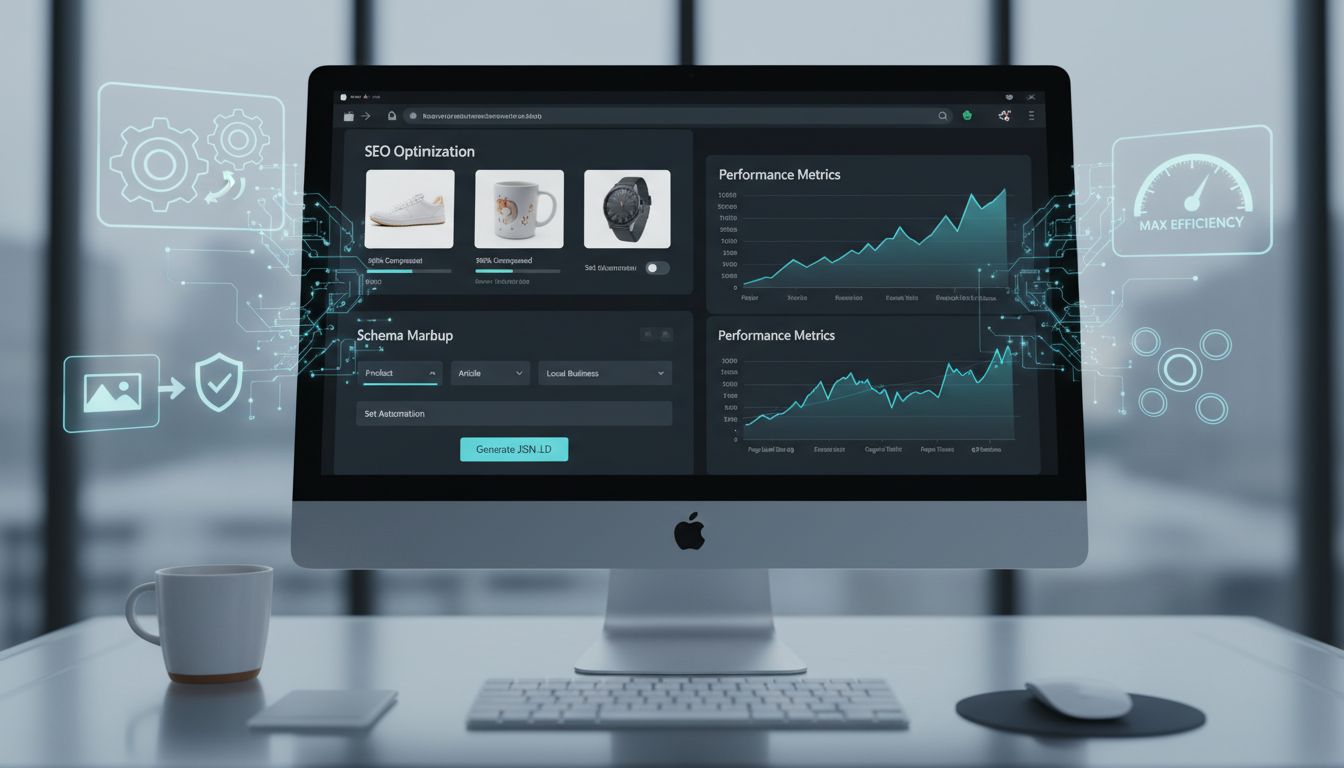
These are the workhorse shopify seo tools that dominate the App Store for a reason. Image compression, JSON-LD schema, meta tag optimization, speed fixes, the unglamorous stuff that still matters. You install them, configure once, and they run in the background.
Booster SEO powers over 350,000 Shopify stores and has 4,258 reviews with a 4.8 average rating. Its AutoPilot features automatically optimize image alt text, generate product schema, and can shave 1-2 seconds off load times through compression.
TinyIMG covers similar ground, bulk metadata editing, broken link fixing, lazy loading. Both have free tiers if you want to test before committing.
Their strength is focus. As a shopify seo app, each one does the technical pillar well. Slow site, unoptimized images, missing structured data? These seo apps will handle it. Reliable, low-maintenance, minimal ongoing management.
There are two real trade-offs worth knowing before you install.
First: these apps fix what you already have. They don't research or write the blog posts and buying guides that pull in new organic traffic. That's a different problem entirely.
Second, and this matters for technical founders, many of the changes these shopify seo plugin tools make are app-managed, not baked into your theme's Liquid code. The Booster app listing itself warns that some modifications may be removed if you uninstall. The changes often live as a proxy layer. That's something to think about before you go all-in.
Also watch for ambiguous free plan limits. TinyIMG's free tier shows conflicting data depending on where you look, one source says 50 monthly optimizations, another says 900. Verify directly with the vendor before committing.
For a complete SEO strategy, I pair these technical utilities with a content platform like Spectre. Let Booster or TinyIMG handle the on-page optimization of your existing catalog, while Spectre automates the research and creation of net-new, ranking-worthy content, the kind a shopify seo expert would prioritize. One covers the technical side. The other fills the content gap.
4. Tapita AI SEO Optimizer: Best Balanced App for Technical + Light Content
Best for stores that want a single, well-reviewed Shopify app to handle both technical SEO basics and light blog content creation.
Tapita is the App Store all-rounder. Speed optimization, image compression, SEO audits, JSON-LD schema markup, and a built-in AI blog builder, all from one dashboard. One install, multiple boxes ticked. The social proof backs it up: 2,526 reviews and a perfect 5-star average across 15,785+ installs.
The breadth is real. You can fix image alt text, submit your sitemap via IndexNow, run a basic site audit, and generate a blog post draft without switching tools. At $9.99/month, it's a low-risk way to test AI-assisted workflows as shopify seo tools go.
The trade-off is depth, especially on content. The AI blog builder runs on a credit system, so output is capped. The publishing workflow stays inside the app's interface. No keyword clustering, no pipeline orchestration, none of the direct CMS integrations you'd get from a dedicated platform. Among seo apps, it's competent across the board but doesn't go deep anywhere.
If you need a few blog posts a month to support your catalog, Tapita works fine. It's a reputable shopify seo app and a reasonable first step beyond basic product page optimization.
But if content is central to your growth strategy, you'll outgrow it. The kind of volume and keyword targeting a shopify seo expert would push for, that's not what this shopify seo plugin is built for. At that point you need something more specialized.
5. SearchPie & Plug in SEO: Best for Hands-On SEO Experts and Audits
Best for SEO specialists and agency professionals who want to manually diagnose and fix every technical issue.
If the previous tools are automated content factories, SearchPie and Plug in SEO are the surgical diagnostic suites. These are for the practitioner who wants raw data, a full-site audit, and full control over every fix. Not scale. Control.
SearchPie has over 70,000 reported installs and a 4.9 rating [Source: searchpie.io]. It runs daily SEO reports with guided fixes, 24/7 real-time support, and deep on-page editing. You get the full audit, broken links, duplicate content, schema issues, and then you go fix it yourself.
Plug in SEO takes a similar approach, pulling in Google Search Console and Google Analytics data directly inside your Shopify admin. As shopify seo tools go, both are built around diagnosis first.
The depth is real. They'll tell you exactly which product page has a missing H1 tag, which collection has thin content, or which image is tanking your mobile load time.
The weakness is that they hand you a detailed report and expect you to know what to do with it. There's minimal automation. You're the surgeon, and this is your scalpel.
For a shopify seo expert who enjoys the process, or an agency billing hours for technical audits, these are powerful shopify seo apps. For a founder trying to build a content engine, they're a distraction.
You'll spend hours diagnosing problems instead of publishing solutions. They're optimization tools. Not creation tools. No shopify seo plugin in this category is going to write your next blog post.
What to Look For: Choosing the Right Tool for Your Bottleneck
Before you install another Shopify app, ask yourself: what's your actual bottleneck?
Most store owners think they need better meta tags when what they actually need is a system that turns keyword opportunities into published articles without them touching anything.
From building Spectre and working with dozens of e-commerce brands, I've found four things that separate time-wasters from genuine accelerators.
1. Publishing Workflow Automation Does the tool publish content directly via Shopify's Admin API, or does it dump text into a box for you to copy-paste? Manual publishing is the hidden tax that kills content scaling. A real automation platform handles the whole pipeline: research → draft → optimize → publish → track.
If you're still copying and pasting, you're not scaling.
2. AI-Driven Strategic Input Does it just generate generic text, or does it research keywords with commercial intent and prioritize them based on your domain authority? Most shopify seo apps are reactive, they optimize what you already have. The real leverage is proactive keyword discovery that finds gaps your competitors haven't filled yet.
3. ROI (Return on Time) Calculate the actual cost. If you spend 5 hours per blog post on research, writing, and formatting, that's £500+ at a conservative hourly rate. A tool costing £100/month needs to save you just 1 hour to pay for itself.
The justification isn't the subscription fee. It's the hours you get back.
4. Ecosystem Fit Do you need a shopify seo plugin for on-page tweaks, or an external platform for content at scale? App Store shopify seo tools are great at technical fixes, image compression, schema markup, but they hit a wall when you need to publish 20+ articles monthly. External platforms like Spectre integrate via API to get around those limits.
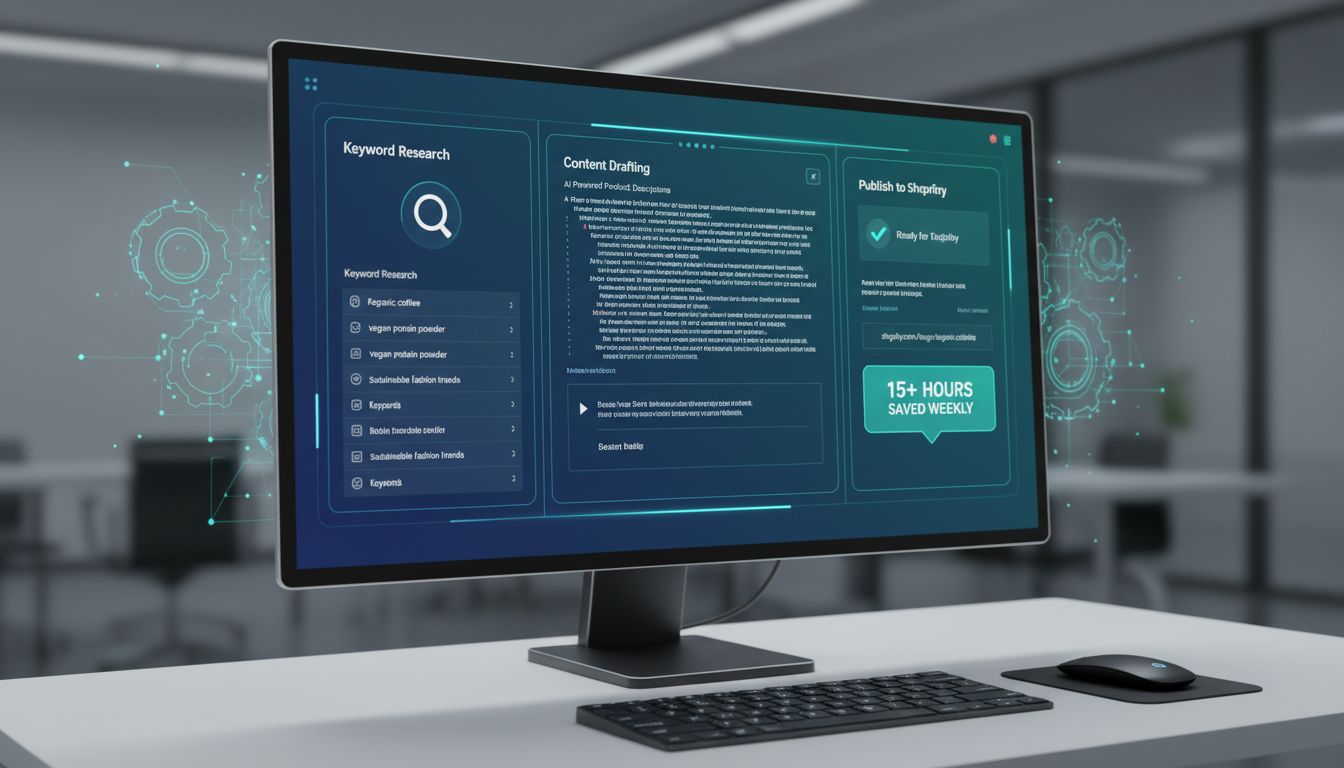
Our top pick, Spectre, covers the first three because we built it specifically to solve the publishing bottleneck. It doesn't just generate text, it automates the entire content lifecycle from keyword research through to publication. That's why store owners using it report reclaiming 15+ hours a week they were previously burning on manual workflows.
The gap between tools isn't really about features. It's about workflow philosophy.
Most shopify seo tools help you optimize existing pages. The ones that win in 2026 help you create new ranking pages at scale. A shopify seo expert will tell you the same thing: pick based on which bottleneck is actually slowing you down, not which tool has the longest feature list.
Conclusion
Shopify SEO is really two separate jobs: technical maintenance and content scaling. Apps like Booster SEO and Tapita handle the technical foundation well. But sustainable traffic growth comes from publishing keyword-targeted content consistently.
For most store owners, the real bottleneck isn't meta tags.
It's not having enough ranking pages to compete. That's why we built Spectre, it automates the entire content pipeline, turning keyword opportunities into published articles without you touching anything.
Your tool stack should reflect your actual constraint. If you're serious about moving beyond product pages, you need a platform that scales content production, not just one that optimizes what you already have.
Start with Spectre for content scaling, then layer on Shopify App Store utilities for technical polish. A good shopify seo expert will tell you the same thing, and the right shopify seo app or shopify seo plugin can handle the rest.
Ready to set your blog to autopilot? Sign up for Spectre today and start scaling your organic traffic.